You know what they say, “March comes in like a lion, and goes out like a lamb”. And this lion is eating me alive. Snow I can live with, but the frozen layers of sleet, snow and graupel that greeted me on the driveway made me question my choices in life. New Englanders everywhere are asking themselves the classic question of March, “should I just wait for it to melt?”
The alternative to waiting for it to melt with such a mix is to get to work. Snowblowers don’t work on such stuff. One must test the ticker scraping this crap off the pavement with a sturdy shovel inch by inch. Slow and steady wins the race. Happily the ticker is still ticking.
The thing is, we choose this lifestyle. What is it about me that believes that a clean driveway is all that important this time of year? It’s going to melt in a few days anyway. Right. Alas, I live by the philosophy of a tidy ship. And I wasn’t in the Navy.
It comes down to mindful work. I cannot control what is happening in the world, I cannot control the rapid physical or mental decline of people in my life, I cannot control much of anything in the universe, but sometimes I can control how clean my driveway is. And generally it looks pretty darn good for a driveway this far north in a legit tough winter. And then Mother Nature reminded us once again who the boss really is.
These are days when it helps to have perspective. We are gaining twenty minutes of daylight every week. Things are literally getting brighter. Focus on the beauty in the world, not the maddening setbacks to all that was right and good. For this too shall pass, and soon enough the daffodils will rise to greet us once again. Yes, it’s going to melt. Sooner or later… right?
Beauty is twice beautiful and goodness is doubly good when it concerns two wools socks in winter. — Pablo Neruda, Ode To A Pair Of Socks
There are two kinds of people in this world. Those who complain about the weather and those who dress for the weather we’ve been blessed to experience this day. The former tend to shelter in place. The latter tend to step out into it. I don’t judge either camp, but I’m clearly in the latter.
While snowshoeing Saturday morning, I came to a split in the trail. I went to the left that morning, breaking trail and returning with the thrill of having been out in it, doing the work of being fully-alive on a bright clear morning. But all that evening I thought about the path not taken. It remained unbroken and unexplored, and with that, I felt incomplete. Those paths not taken have a way of haunting us, don’t they?
The only thing to do was to go out again Sunday morning to see what was left for me. I silently hoped it would be unbroken still, that I might finish what I started. I saw footprints in the snowshoe tracks I’d laid and thought to myself that the opportunity was lost. But the footprints crossed the bridge and then turned back, indicating someone inclined towards common sense. Why continue on trails without the proper gear?
The thing is, I had the proper gear. And so I kept on walking to that fork in the path and turned right onto a gloriously unbroken trail, blazing a path for any who might follow. There is sheer delight to be found in the cold stillness of a pristine snowy forest, so long as you’re prepared to be out in it and have the tools to make your way back out again no matter what.
Having completed that walk, I doubled down with another, bringing the pup to the beach for a second winter walk. That proved far colder with wind chill cutting through our gear. Cold is one thing, cold wind is something else entirely. Even proper winter gear will let you know when it just isn’t enough. We simply have to listen to what nature is telling us.
The pup loves the beach and could have stayed all day but for the wind. Even clad in a winter coat of her own, she knew when we were having too much of a good thing. Sometimes the best thing to do is to step out into it. And sometimes it’s best to simply turn back with stories to tell. Two stories in fact. Twice beautiful, simply for having ventured out to meet them.
Two paths diverged. Hampstead Conservation Land.Snow on dunes. Hampton Beach State Park.
“I wonder if the snow loves the trees and fields, that it kisses them so gently? And then it covers them up snug, you know, with a white quilt; and perhaps it says, “Go to sleep, darlings, till the summer comes again.” ― Lewis Carroll, Alice’s Adventures in Wonderland
We are having a proper winter in New Hampshire this season. The cold is unrelenting and the snow consistent. It isn’t inclined to melt away when the days are frigid. Instead we have sublimation of the snowpack, and a sting on the skin. As we step into February, I write of the last day of January 2026, and a walk in the woods I’ll remember as particularly remarkable (so much so that I’m remarking on it).
Almost a week after the region’s big snow, I finally had some time available to head to the local conservation area for a walk in the woods on my snowshoes. I went with trepidation, for I know the damage that can happen to a trail after a week of people and their pets post-holing through deep snow. But the parking lot was surprisingly empty for a Saturday morning, and the trails themselves were relatively clean. Post-holed for sure, but it’s been so cold and the snow so fluffy that it wasn’t the icy hellscape I thought it might be.
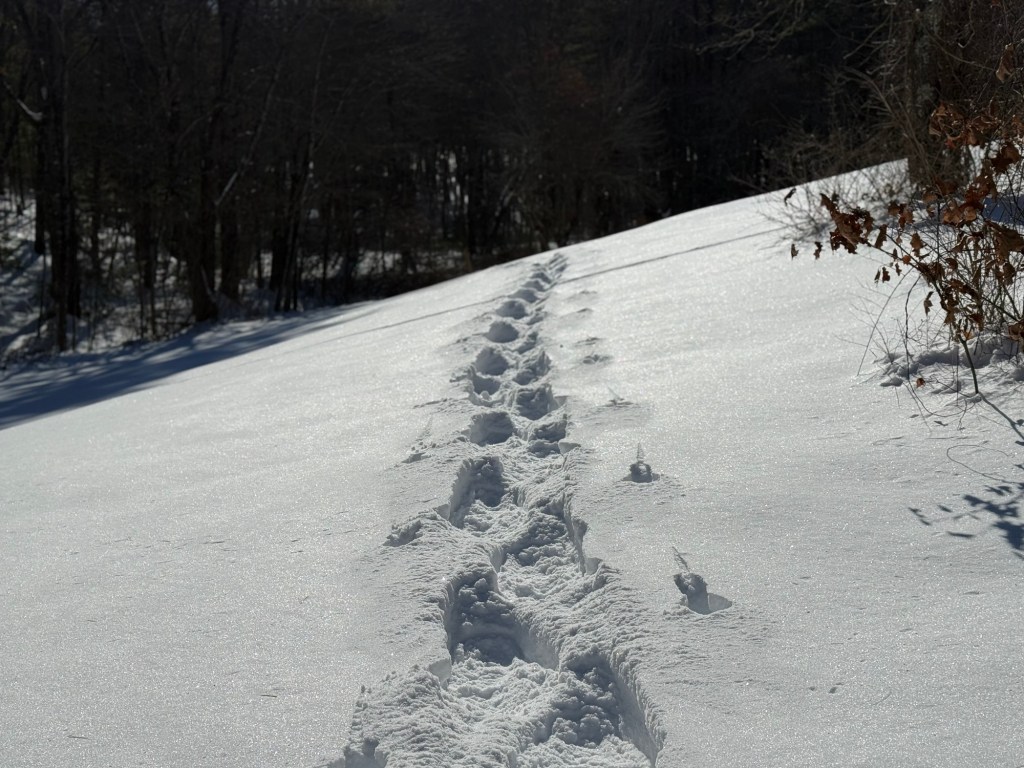
I still chose to break trail on pristine snow whenever the opportunity presented itself. Making a bee-line across steep terrain from one broken trail towards another. Some of the drifts were pretty deep, almost 4 feet of powder, but my snowshoes were up to the task. Thankfully, so was I!
Large portions of the conservation land’s trail network were completely unbroken. I smiled to myself at the lucky break and braced myself for the work ahead. Breaking trail on snowshoes is a great workout, and I’d gone out by myself with nobody to share the load. This is where being well-acquainted with working out comes in handy. I’m no Olympian, but I can break a trail for a few miles without passing out from the effort.
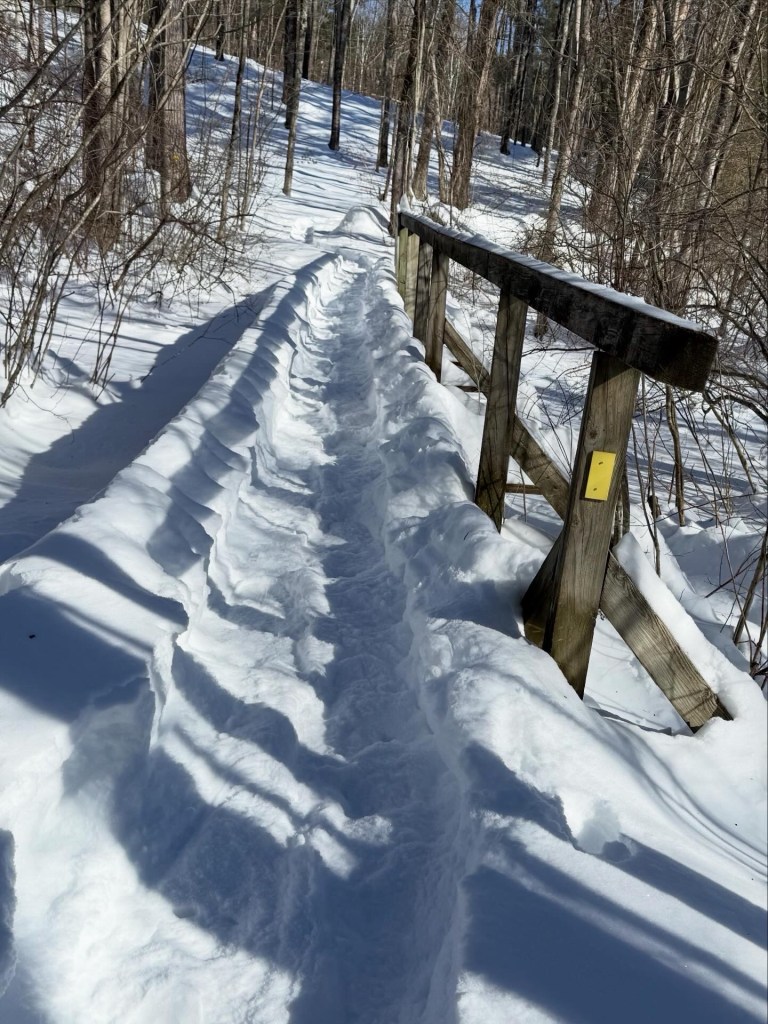
The larger trail network required an out and back over a bridge spanning wetland. On the way to it the bridge was untouched by anything but snow. On the return, I captured a picture of the trail I’d made on the out and back. It will be interesting to see what it looks like today, with a broken trail that others may have since walked.
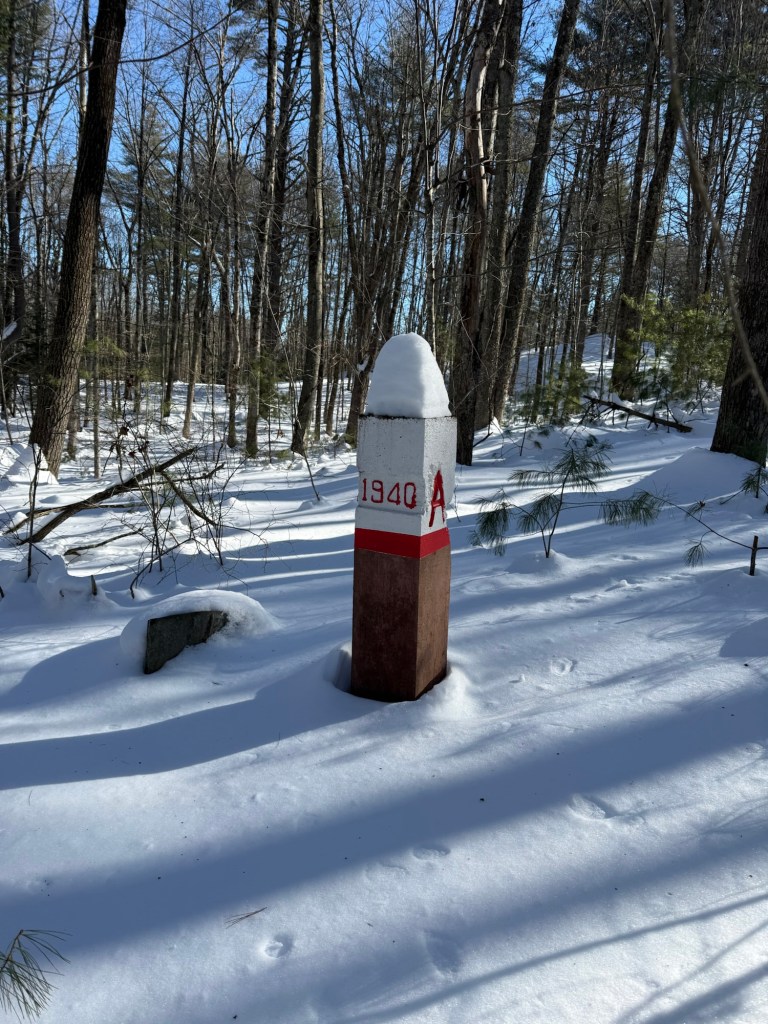
In one section, I revisited a town border marker that someone has since painted white with red lettering to make it more obvious to visitors. A is for Atkinson. There’s an H on the other side for Hampstead. Most of the trail network covers the latter town.
For all my time in nature on this snowshoe walk, I didn’t see much in the way of wildlife (It’s not like I’m sneaking up on anybody marching across the snow). Ironically, when I drove home afterwards, a neighbor excitedly told me he’d had three bald eagles in a tree in his yard not more than 30 minutes before. Now we’ve had a lot of wildlife moving through the neighborhood over the years, but none of us had ever seen a bald eagle, let alone three of them together. I’m sure that they’re hungry, and with the rivers frozen over they are scoping out the local valleys to expand their menu.
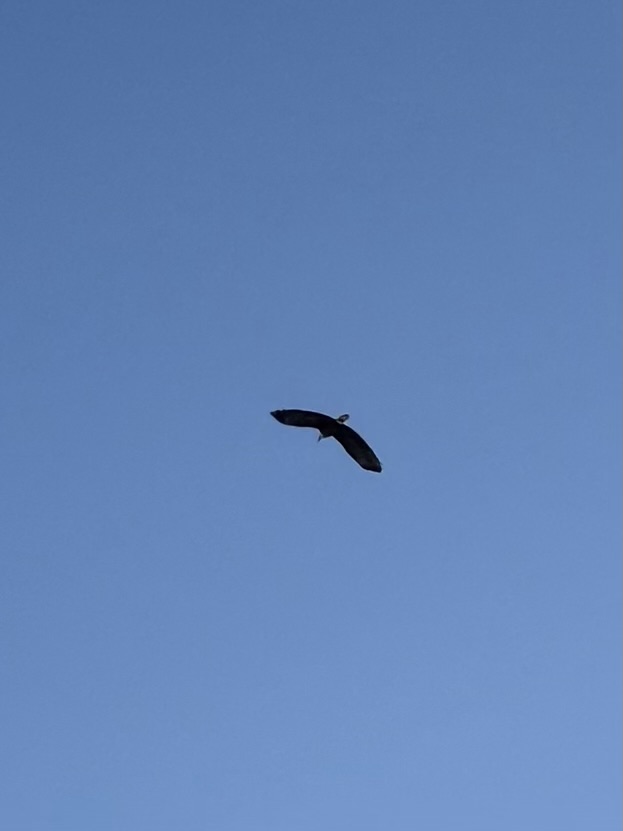
The odds were against seeing them still in the area, but I recruited the dog for a walk of the neighborhood to see if one would return. Sure enough, I was blessed with a fly-over by one of them. There’s no mistaking an eagle soaring over the landscape, and it was a thrill to see it. By the time I had my phone out to snap a picture it was already past me gliding towards open fields beyond the woods. It was a great way to cap a Saturday morning in snowy New Hampshire.
“Joy is not made to be a crumb.” — Mary Oliver, Don’t Hesitate
It hasn’t been lost on me that I’ve largely ignored the joy in the abundance of snow we’re having this winter while focusing on the chores that come with that abundance of snow. There ought to be more snowshoeing. There ought to be more walks in frozen woods. There ought to be more snowy play dates with the pup, who’s got enough joy to fill a barn. We can learn a lot from joyful souls, whether they’re human or otherwise.
Winter is far from over in this frigid land, and at the risk of making plans, I will find my way back to play. All work and no play makes Jack a dull boy. All play and no work makes Jack a poor boy. But money in and of itself is the pursuit of fools and empty suits. Get out and live before the buffet closes for that long night. Before all that’s left are crumbs and thoughts of what might have been.
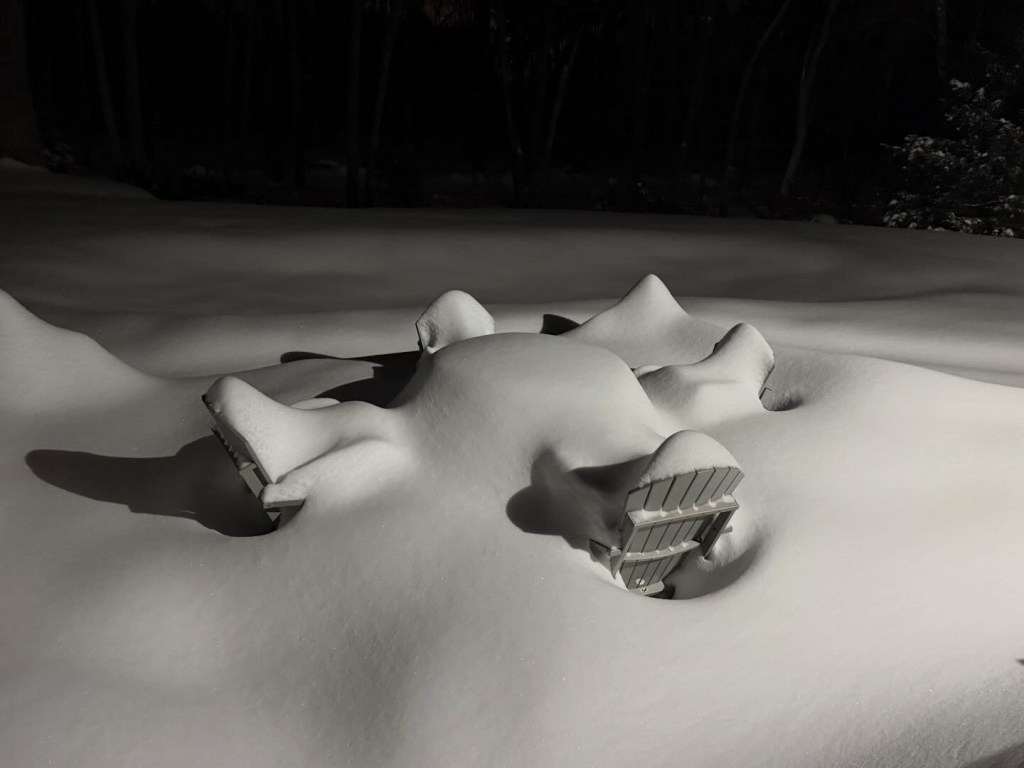
We see it most vividly when a fresh blanket of snow covers the landscape. Like children in bedsheets pretending to be ghosts, the hardscape rises up in whispers, haunting us with what once was in warmer days. Of what may be again in whispers of the future.
But not now. Now there is only silence and a cold tickle on the back of the neck. Ghosts? Or merely snowflakes finding skin? The imagination brings us to our version of the truth. The only truth here is the quiet embrace of winter.
“Every single thing you do today is something that your 90-year-old self will wish they could go back and do. The good old days are happening right now.” — Sahil Bloom
Overnight snow is the best kind of snow. It’s like Christmas morning with its big reveal at first light. With it, we may think in terms of chores or play. Either way, it won’t be here forever. We must always remember that neither will we.
Snow removal completed on the home front, sun offering a brilliant day that felt warmer than it really was, I read the timely Thread above from Sahil Bloom and it reinforced what I knew I had to do. Really, I’d been thinking it all morning. Get out there in it! Find some virgin snow and glide across it with all the vigor one can muster. For we may never cross this way again.
Snowshoeing on local trails can be thrilling or discouraging, depending on the condition of the trail and the snowshoer. It didn’t start off well, with a dog walker arriving just ahead of me post-holing the trail where the snowshoers before me had been. Adding insult to injury, the dog walker didn’t clean up her dog’s poop, dropped right next to the trail. That’s no way to go through life, I thought to myself. But walkers in deep snow are quickly overtaken; I nodded hello, said hi to the pup and kept my feelings to myself. I was here for something more essential than policing other people’s behavior. I was here to fly.
The main trail had already seen visitors, and I did my part to compress the trail further—a gift for those who would follow without snowshoes. Eventually I reached an intersection where the snowshoer before me had gone left, while the side trail to the right was virgin snow extending on through the trees for as far as my eyes could see. The choice was clear.
Two roads diverged in a wood, and I— I took the one less traveled by, And that has made all the difference. — Robert Frost, The Road Not Taken
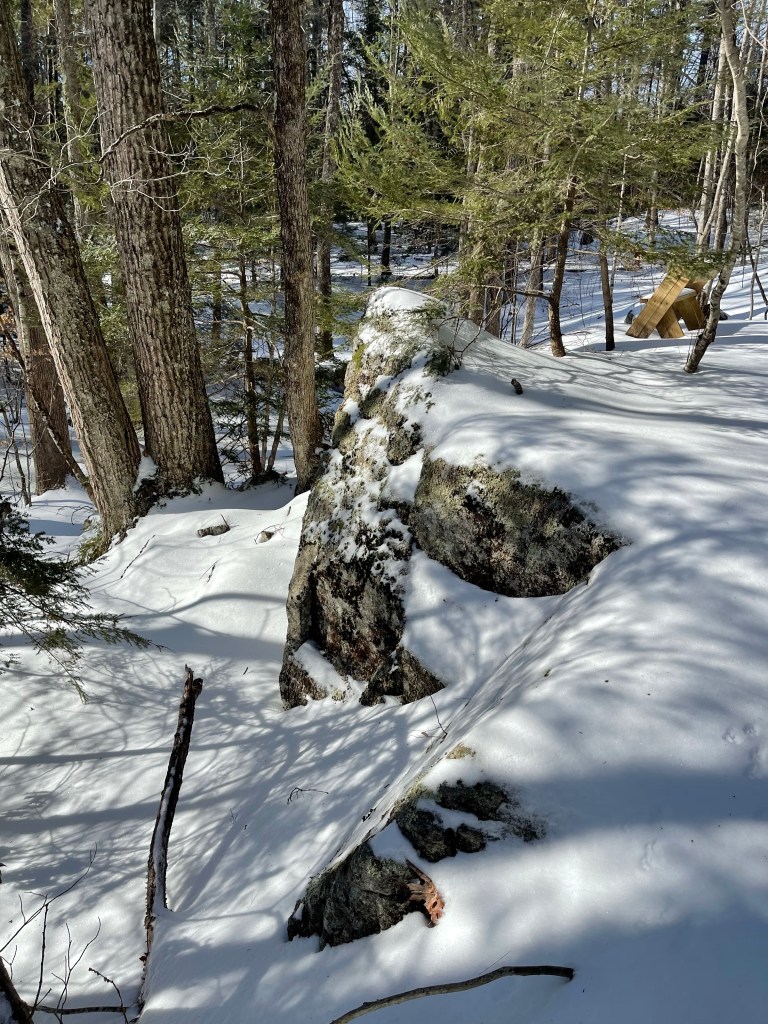
I know these woods well. I know where the waterfalls lie smothered under ice and snow, where granite outcroppings and hemlocks form a cathedral as beautiful as anything made by man. Snow transforms the landscape and forces one to learn it anew. If the trail had been broken I might have strayed further afield, but I felt an obligation to guide those who would follow my tracks. Stay on trail to show the way, and I may stray another day.
I tend to think in time buckets now. What might I do now that I won’t be able to do later in life, when I’m old and frail? Do that thing now and celebrate the gift of health and vigor. Maybe one day we will regret not watching others live their best lives while we sat on the sidelines, but I think not. This is our time too. What are we to do but make the most of this day?
Virgin snow with a worn, familiar trail revealed underneathOut and back trail compression
“If we winter this one out, we can summer anywhere,” — Seamus Heaney
“On the other side of endurance, joy waits.” — Joanna Nylund, Sisu: The Finnish Art of Courage
I have friends currently afloat in pristine, turquoise waters. I have other friends unsatisfied with the snowpack in their own backyards who hike seemingly every waking moment above tree line to find paradise in fickle and extreme weather conditions. I could be doing either of those things myself right now, but instead I’m holding the center that we may all meet in the middle again one day.
We do have agency with such things as winter. We may choose to stoke the fire and watch the storms pass by from the comfort of our favorite chair, book in hand and a hot beverage to warm us from the inside out. Or we can dress the part and venture out into the swirling snows and bitter wind, to taste for ourselves the bite of January. If we have the currency of health and the accessories of winter, there’s every reason to fully experience everything winter has to offer.
The world feels colder and darker than it’s felt in some time. These shifts are seasonal, we tell ourselves. The pendulum will swing back one day to warmer and brighter. Our mission is to toe the line between chaos and order and make the most of our days, whatever the climate. This is stoicism. This is grit. This is Sisu. Whatever we wish to call it, it’s a mindset and quiet resolve to face the day and whatever it brings to us. To hold the line and winter out the worst that we may summer it up again one day.
Winter is different this year. The ground, frozen for weeks leading up to the New Year, thawed in a warming trend that hit New England in the first few weeks of the year. We sometimes say we’re grateful when it rains instead of snows here, knowing the general equation of one inch of rain equalling one foot of snow, but some of us actually prefer the snow. And when it finally came after the thaw and heavy rains, it made for muddy cleanup when you dared stray off the pavement. Yes, winter is finally here, sort of, and fashionably late, so enjoy it while you can. Just don’t go straying out on pond ice or try to steer a snowblower across the lawn to the shed. Each of these reckless acts will end in regret.
Plenty of friends and acquaintances celebrate a mild winter. Perennially overextended, they’d rather deal with snow on their terms, with a quick ride up I-93 to the ski resorts. “Let them have the snow;” they say, “we’d rather not deal with it here”. As if we aren’t meant to have it here. Here isn’t all that far from there, I think, and winter has retreated enough already.
I’m more sympathetic with the aged and the frail amongst us. Shoveling and navigating the world is a lot more complicated for them when you add heavy snow. This is where a sense of community is essential, to help those who might not be physically able to help themselves. Like snow, we accumulate awareness and empathy over time, and learn to check in on people more than we might have when we were younger and more carefree.
We witness the changes in those we know moving from vibrant wrestlers of winter conditions to a more fragile condition. On days of particularly heavy and wet snow, we learn to face our own move to a more fragile condition. They call it “heart attack snow” for a reason, and something as mundane as shoveling snow can be a reckless act if our heart isn’t up for the task. We ought to celebrate the things we can do now, like walking in snow through the woods to visit a pond or simply shoveling the deck, for one day it will be beyond our reach.
After cleaning up the remnants of the latest storm, I took a walk through the woods to see how winter was treating a local pond. During the drought of summer it had dropped to sad levels. With the rains of autumn and winter the water levels were back to normal and now coated with a slushy ice coating that wasn’t to be trusted. Still, it made for a pretty winter scene on a quiet winter morning. Moments like this are what we remember about winter, even as we forget that winter isn’t what it once was.
Facing the changes this winter, it’s easy to see that everything is connected. Everything has its time, maybe even normal winters. With things like climate and physical fitness, we ought to do what we can while we can. Regret is no way to cap a window of time when it closes.
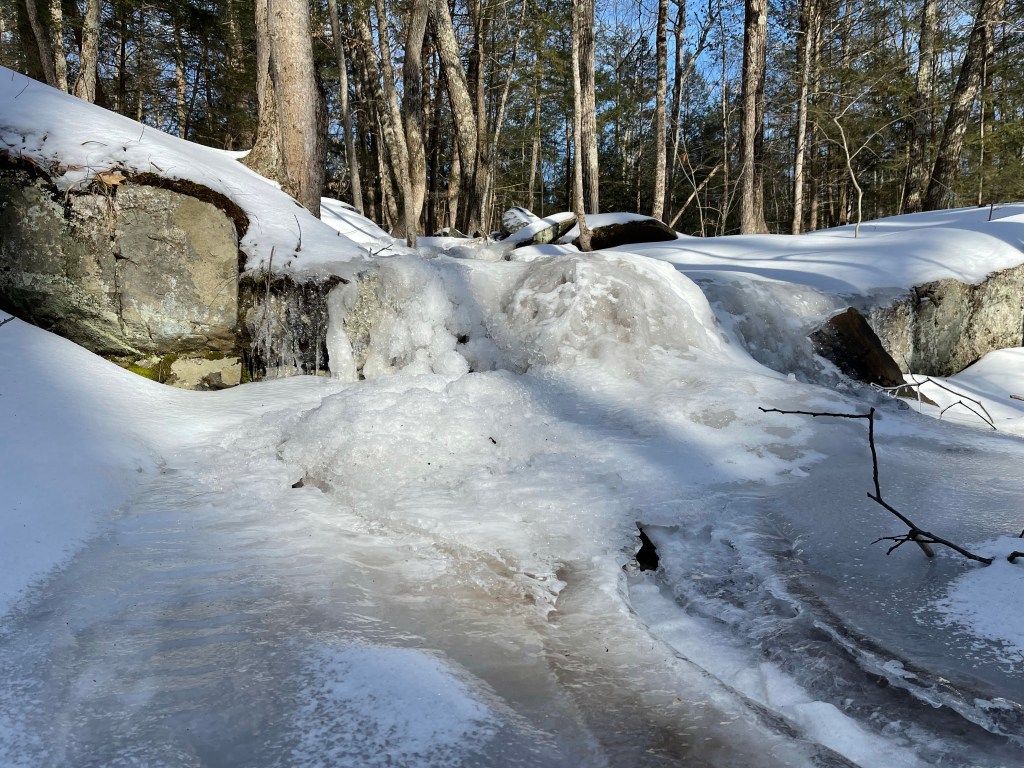
Friday offered heavy rain that turned to sleet and finally snow. With temperatures plummeting, this quickly turned into a frozen mess on the roads. And temperatures stayed well below freezing, guaranteeing that anything frozen was likely to stay that way for a few days. The snow was transformed to rock-hard ice, with a light frosting of granular snow atop it. It was perfect for slipping on boots and micro spikes and heading for the trails.
The same conditions that make roads miserable transform trails into magic carpet rides. Most of the sins of the trail are locked below the frozen hard pack, and with the right gear the trail is a joyful peregrinate through the wonders of the forest. Streams and waterfalls become sculpture. Granite recedes from primary feature to delightful accent locked in the ice blanket. The trail itself offers an entirely different experience than it did just days before when snowshoes were the kit of choice. In winter every day brings something new, should you go out to find it.
Much like the landscape around you, walking alone through the woods on a frozen but brilliant sunny day you become intensely embedded in the moment. You don’t walk with purpose to a destination, the walk is your destination. Every step becomes the point of your being here. With micro spikes announcing their grip on the ice, every step becomes a cry of Now! Here! Now!
I visit a frozen waterfall. I only seem to visit it in winter, when it’s locked away in ice, and each visit I tell myself I ought to stop by in spring when the water is running angry. We all feel locked away ourselves in winter, I suppose the waterfall and I are kindred spirits in this way. My visit becomes a vote of solidarity with the falls behind the ice. I promise once again that I’ll be back, and believe I mean it this time. The frozen waterfall is indifferent to my promises. All that matters is the present for a waterfall. The future lies upstream, waiting for its moment. Whether I’m here for it doesn’t matter to the waterfall.
I come across a few people along the way, couples and dog walkers and snowshoers gamely giving it a go on the ice. Read the room, folks. The trail betrays all who have come before me: fat tire tracks, boots, paw prints and snowshoe tracks. We believe we’re the only people on earth when we’re alone in the frozen woods, yet here was proof of all who came before, with all that you chance upon. You aren’t really alone in the woods, you’re alone in the moment. And there’s a measure of delight that washes over you as you make your way towards your own future.
“I wonder how long it would take you to notice the regular recurrence of the seasons if you were the first man on earth. What would it be like to live in open-ended time broken only by days and nights? You could say, “it’s cold again; it was cold before,” but you couldn’t make the key connection and say, “it was cold this time last year,” because the notion of “year” is precisely the one you lack. Assuming that you hadn’t yet noticed any orderly progression of heavenly bodies, how long would you have to live on earth before you could feel with any assurance that any one particular long period of cold would, in fact, end?” — Annie Dillard, Pilgrim at Tinker Creek
Lately I’ve been watching some Lonewolf 902 YouTube videos of winter camping with a hot tent. I’ve done a bit of winter camping in my time, with an old sleeping bag sprinkled with ember burns to prove it, but not recently. I don’t see myself hauling a titanium stove through the woods of New Hampshire and cutting up dead standing timber for firewood anytime soon. But his adventures northeast of me in Nova Scotia and Cape Breton Island are stirring the imagination once again. It’s time to get back out there.
You might feel the cold, and might even experience the snow when you stay put in your nest. But you just don’t become a part of the season without being immersed in it. January, by all rites, offers cold, short days. I’ve noticed that I don’t notice as much when I don’t get out in it. Without a dog to walk in the cold night, I don’t watch the celestial dance across the sky. Without gathering my hiking gear and heading north, I don’t feel the sting of winter or the snow blindness of brilliant sun on frigid snow. What fun is January if you aren’t out in it?
“Sunshine is delicious, rain is refreshing, wind braces us up, snow is exhilarating; there is really no such thing as bad weather, only different kinds of good weather. ” — John Ruskin
January is the month when you begin to go stir crazy if you aren’t active enough. The best remedy is right in front of us—bundle up and get your ass out there. The magic of snow and ice and crisp air won’t last for long. You must go to it, prepared, if you want to experience the exhilaration of winter. Melancholy is for those who would shelter indefinitely. Nothing breaks the hold of the winter blues faster than embracing winter. So get out and experience all winter offers! How many more do you expect to have? Appreciate the gift that this season represents.