Tag: winter

  • What Is

    “What is left
    is what is.”
    – Wendell Berry, The Broken Ground

    Lingering soreness from a long winter hike and tackling a foot of snow with a snowblower that quite halfway through the task, leaving only shovels to overcome mechanical obstinance. Fatigue, not all of it in muscles, wished me a good morning with a smirk.

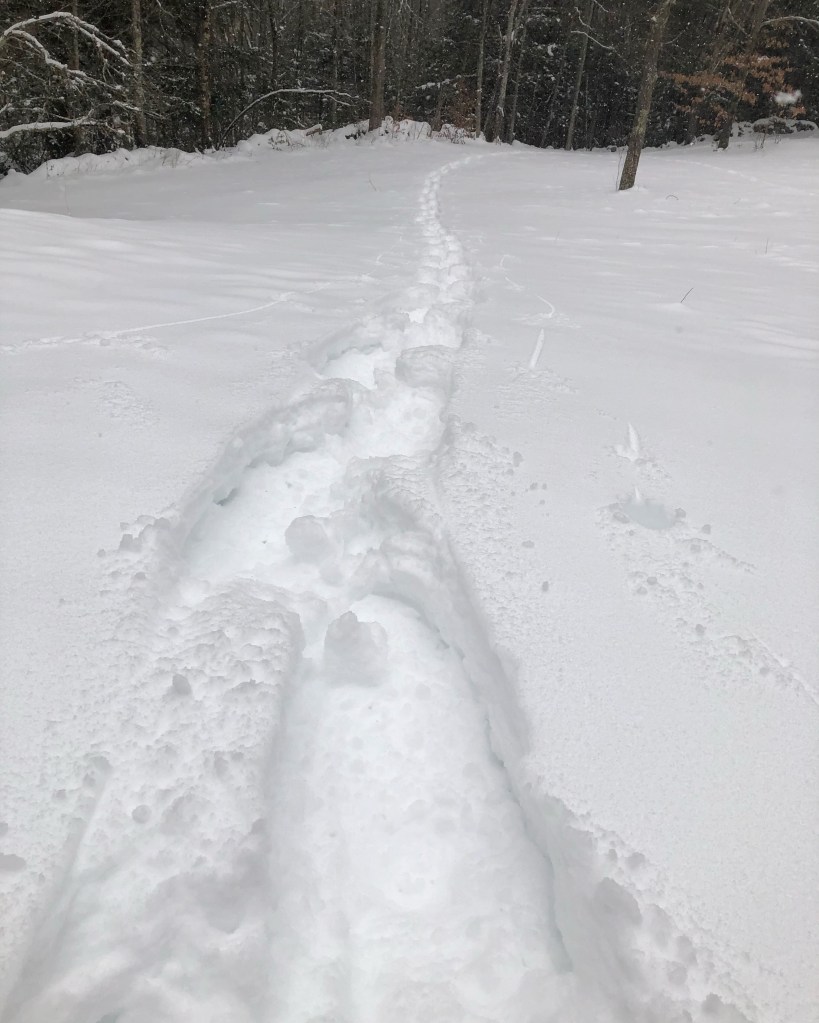
    Looking out the window, I saw the tip of a snow drift dropping down from the roof, as if a wave frozen in the middle of its break. This naturally lured me outside for a look, which led to a walkabout, which led to slipping on snowshoes for a walk in the deep snow out to the bird feeders at the edge of the woods. Silently carving my two foot path across the yard, nothing but the rubbing clumpy sound that cold snow makes when compressed. One foot in front of the other, out and back, feeders filled. Were the yard only longer, for I wasn’t quite ready to finish.

    The feeders were wiped out by Starlings. Greedy, sloppy eaters who cast away seed by the shovelful to get at the dried fruit and other choice treats they favor. What’s left is an empty feeder and a mess on the snowy ground that is gobbled up by squirrels and Mourning Doves and other such ground feeders. The food is there for this purpose, so do I have a right to complain? Only at the waste and frenzied emptying. I can either pause feeding until they find somewhere else to ransack or tolerate the intrusion. But once you commit to feeding the birds you can’t very well stop after a heavy snowstorm.

    For all the dry sameness of the inside of the house, outdoors offers something new at every turn. The second morning after a big snowfall lacks the drama of tackling the job at hand, but it makes up for it with time to have a look around. To see what’s changed. To assess the landscape and yourself. To see what’s left. What is.

  • Traction and Comfort in Winter Hiking

    The last day of January felt like it should throw up challenging hiking in New Hampshire. In fact the temperature read a solid -4 degrees at the start. But the truth is that if you aren’t breaking the trail it’s comparatively easy. The snow pack on popular trails covers up a lot of the erosion and exposed granite ankle biters that are a normal part of hiking in the White Mountains. You simply trade the pounding on your lower extremities for a different pair of challenges: traction and hours of walking with your toes pointing up.

    Think about a groomed ski slope, all corduroy and pristine. Perfect for skiing down, but imagine walking to the summit straight up that slope. How do your feet grip? How does that angle feel on your ankles and calves after about an hour? That’s the dilemma of the hiker on a snow packed trail. Snowshoes and descending butt sliders press the snow down into a version of that groomed slope, albeit it two feet wide. Step six inches off trail and your foot plunges down two feet into the abyss.

    Overcoming such challenges requires mechanical assistance. On the one hand you have micro spikes; one of the best inventions ever for handling winter traction issues. I’ve gushed about micro spikes before and generally they’re perfect for frozen packed snow. They become more challenging when the snow softens and begins to ball up under your feet. Walking on snowballs is just as enjoyable as it sounds. Another consideration is ice. I feel comfortable walking on ice with micro spikes on, but not walking up a slide with them. Trusting rubber bands with your general well being has limits. And this is where an upgrade is in order.

    A step above micro spikes are crampons, which offer more traction with a deeper spike designed to linger in your nightmares. I see crampons and think about those times I accidentally kicked myself in the back of the leg hiking in tight terrain and shudder. But then I recall a story I read about a guy who stepped out of his tent to take a leak hiking Everest or some such place. He made the unfortunate decision to not put on his crampons and promptly slid down the mountain screaming to his death. Crampons are made for comfortable late night relief in such conditions. Truthfully, I tend to avoid most “icy slide nightmare” hiking, but sometimes you run into spots where it would be the better choice. On Mount Liberty a couple of days ago I wished I’d had them a few times as I kicked my micro spikes into frozen snow hoping for footing.

    And then there are snowshoes, used by generations of people trying to get from point A to point B without post-holing every step along the way. Snowshoes have come a long way, and the best of them have crampon-like steel spikes protruding from them and a wonder for the sloped uphill hiking conditions: the heel lift. A heel lift is a metal hinge that flips up to offer welcome support for your heel. It effectively levels your foot on a slope, creating a more comfortable hiking angle. Snowshoes come in different sizes based on your weight and the type of snow you’re hiking it. I have a great set of Tubbs snowshoes that are perfect for fluffy powder walks in open terrain. Being a tall clydesdale my shoes are 36″ long, which makes them a challenge on tight trail hiking. And with the trail compacted it’s simply easier to stick with the micro spikes or crampons. Using shorter snowshoes for compacted snow would offer the best of both worlds.

    There are times when you might put all three on in the same hike. I didn’t bring crampons on my last hike but wore the snowshoes for an hour during a steep ascent in packed powder. My hiking partner that day chose to stick with micro spikes on the ascent and flew up the hill with me gasping to keep up with the extra burn of snowshoes. When I conceded and switched back to micro spikes our hiking speed equalized again. He wore his crampons on the descent while I wore micro spikes. In softening snow broken down by many hikers at that time of the day it was a toss-up. Had it been frozen and compacted as it had been in the morning the crampons would have been better.

    Ultimately accessories are successful when you start with a great pair of boots, pick the right accessory for the terrain, and are willing to switch on the fly when things change. Another truth is that if you don’t get out there in it, none of this matters. Winter is meant to be lived in fully. Being shut up in the warm house might be comforting, but don’t we spend way too much time in our houses now? Step out there. Just wear the appropriate gear.

  • The Art of Packing for a Winter Hike

    Contingencies. I pack for contingencies. Most of it stays in the bag, bulging against the sides, weighing the pack down directly onto the hip belt, as designed, and a bit on the shoulders, as is the way. First aid kit, extra warm clothing, extra food, and, it turns out, just enough water for this eleven mile trip. Snow demands micro spikes, but also snowshoes. Mine spent most of the day strapped to my backpack, but I gave them a try for about an hour of hiking before strapping them back on the pack. The compressed snow and narrow trail made wearing them more hassle than salvation. Sometimes you try out your contingencies and realize that you were better off with the original plan. But I do love those heal lifts on steep inclines.

    It was -4 degrees Fahrenheit at the start of my hike this morning. Most layers packed as contingencies went right on the body for the start of the hike. Snow has a way of being crispy and slippery when you dip below zero. And the trail we started hiking wasn’t the same trail we descended when the sun rose and warmed temperatures into the twenties. Having the right footwear and accessories is essential when you see swings in temperatures like that.

    Still, for all the contingencies planned for, most everything stayed in the pack. Sleeping pad, extra layers, way too much food, all of it mocking me on the steepest parts of the incline and for most of the descent. But as soon as you don’t pack it you know what’s going to happen. Yeah, contingencies, especially in winter, must be a part of your kit. You’ve got to have a winter pack that can handle all the extra stuff, provide tie downs for the snowshoes, and remain an afterthought for the duration of the hike. For day hikes I’ve settled on an ULA Photon pack, which offers everything I need and the space for those extras.

    Winter hiking in New Hampshire offers plenty of beautiful moments. Moments that serve as exclamation points on the trip and in your life. But winter can offer up stunning beauty and calamity quite rapidly in the White Mountains. Mother Nature doesn’t care about your feelings. You must be prepared for whatever she throws at you. And that’s what contingency packing is for. Sure it mocks you when it never gets used, but it also assures you that it will be there for you if you need it.

    The next blog post will cover the actual hike. Memorable, incredibly clear, and two more 4000 footers checked off. Stay tuned, there’s a lot to cover.

  • Ice and Snow

    New England in winter is a land of ice and snow.  Sure, there’s all that other stuff here, but when you live here you’re always aware of these two things that encroach on your daily routine more than anything else.  Want to double or triple the time it takes you to get to the office?  Add ice and snow.  It’s the one thing New Englanders never get tired of talking about.  Well, that and sports.

    This morning we got a dusting of snow.  Maybe half an inch of fluffy white snow.  Nothing for us, especially on February 1st.  Now on April 1 we might think half an inch of snow was psychological warfare, but we wouldn’t even bother shoveling it.  You do the math when you live in New England.  Snow in April will go away quickly.  Even the crocuses would laugh at half an inch of snow in April.  Back in February this barely registers.  Just brush of the car and move on, right?

    The wild card with this snow was the ice underneath it.  Snow is a headache but we know it well.  Ice is our other headache, and we deal with it.  Put ice on top of snow and you get a nice crusty treat that my dog Bodhi loves to snack on during our walks.  Crunch & munch the entire walk.  He’s never met a crusty snow bank that he didn’t love.  Add a little road salt and he’s in heaven.  Ice on snow can be beautiful as it glimmers in the sun.  You aren’t making snowballs out of this stuff, but at least it’s nice to look at.

    Ice and snow in reverse is a different story.  Put a half an inch of snow on a patch of ice and now you’ve got a minefield of comic, sometimes tragic proportions.  Add a slight decline and the magic happens.  Slip-sliding, arms waving, eyes-widening magic.  Caught unprepared, snow on ice let’s you know quickly who’s boss.

    I feed birds.  I don’t feed them in summer, when they have plenty of food.  Mostly because I don’t feed bears.  Do we have bears here?  Maybe.  I’ve seen or heard almost every other kind of wildlife native to this area.  So bears are a possibility.  But in February they stay indoors bing watching Netflix, so I feed birds.  Birds bring motion, color and life to the frozen landscape.

    The bird feeders are on a pole out back where the lawn meets the woods.  I realize having bird feeders close to the house would allow me to see birds close up.  That’s nice.  Mine are farther away.  Out beyond the snow covered ice.  Filling bird feeders back there is like going north of the wall.  You need to be prepared.  Dress for success.  I was dressed.  I felt prepared.  I neglected to wear my micro spikes over my boots.  Turns out I wasn’t prepared.  I wasn’t dressed for success.  And so I brought my own motion, color and life to the frozen landscape.

  • Sand, Snow, Sea and Shells

    Winter brings seclusion to the beach.  After all, who’s really lingering on a beach in January anyway?  Well, I am when the opportunity presents itself.  I’m not a beach person in that I don’t see any point in lying on the sand while the sun cooks your skin.  And yet I’m a beach person in that I love to walk on the beach, especially near the surf, and especially when I may find solitude.  Since I’m not wealthy enough to own a private beach, my options for solitude are early in the morning and in the off-season.  A beach in the Northeast doesn’t get much more off-season than January.

    January beach time brings together seclusion, sand, snow, sea and shells.  If that’s not an attractive alliteration I’m not sure what is.  I seek out solitude because I like to think, and I like to re-charge my batteries through nature and walking.  I welcome the occasional sniff from a dog running free with it’s human.  I take a picture that strikes my fancy.  Sometimes I pick up a shell or driftwood or sea glass.  I try to get my steps in for the day.  And I think.  Being alone with your thoughts seems to be less of a thing nowadays.  People escape into their devices, their TV shows, politics, celebrity gossip or sports.  Some escape into a bottle or religion or drugs or exercise programs.  I’m not interested in escape.  I’m interested in enjoying the ride while I’m on this earth.  Now.  Not deferred to some retirement or vacation in the future.

    Tim Ferriss calls this living the lifestyle of the New Rich.  Time and mobility.  I’ve tried over the last decade to build my career around this NR lifestyle.  While I haven’t pulled off the rich part, I’ve generally lived in such a way that I’ve had the freedom to do what I want to do most of the time.  Generally that means being able to see my kids play sports or attending other milestones in their lives, but sometimes it means taking a walk along a cliff in Portugal, or seeing a sunrise from the easternmost point in Newfoundland, or taking a walk on the beach on Plum Island on a random Tuesday.

    Through Ferriss and Ryan Holiday I’ve found myself reading more stoicism lately.  There are three phrases in Latin that I’m trying to embrace.  Amor fati, or “a love of fate”, Memento mori, or “remember that you have to die” and of course the old standby Carpe Diem, or “seize the day”.  Each day I’m trying to live a complete life.  Some days I accomplish more than in others, and I’m always seeking improvement.  Life, like the sand, shells and snow on a beach, is fleeting and ever-changing.  All we’re guaranteed is now.  So if now is all I’ve got, I might as well walk on a beach in January.