Month: August 2019

  • The Hold of Stuff

    I gave a friend a chain saw that another friend had given me. It was a great saw, and a joy to use. All around me are trees that need trimming or encroach into the yard. There’s no logical reason for me to have given it away, but I felt better about having released it immediately. The saw was never mine to begin with, but I’ve had a couple of moments of regret for having given it up. Such is the hold of stuff in our lives.

    Looking at the garden, it’s clear that I’ve over-planted. What appears to be empty space in May is chock full of healthy plants muscling each other out for space. It’s a common gardening mistake and I’ve made it many times. I’ve got to thin out the garden and relocate some plants that I eagerly purchased just a few months ago.

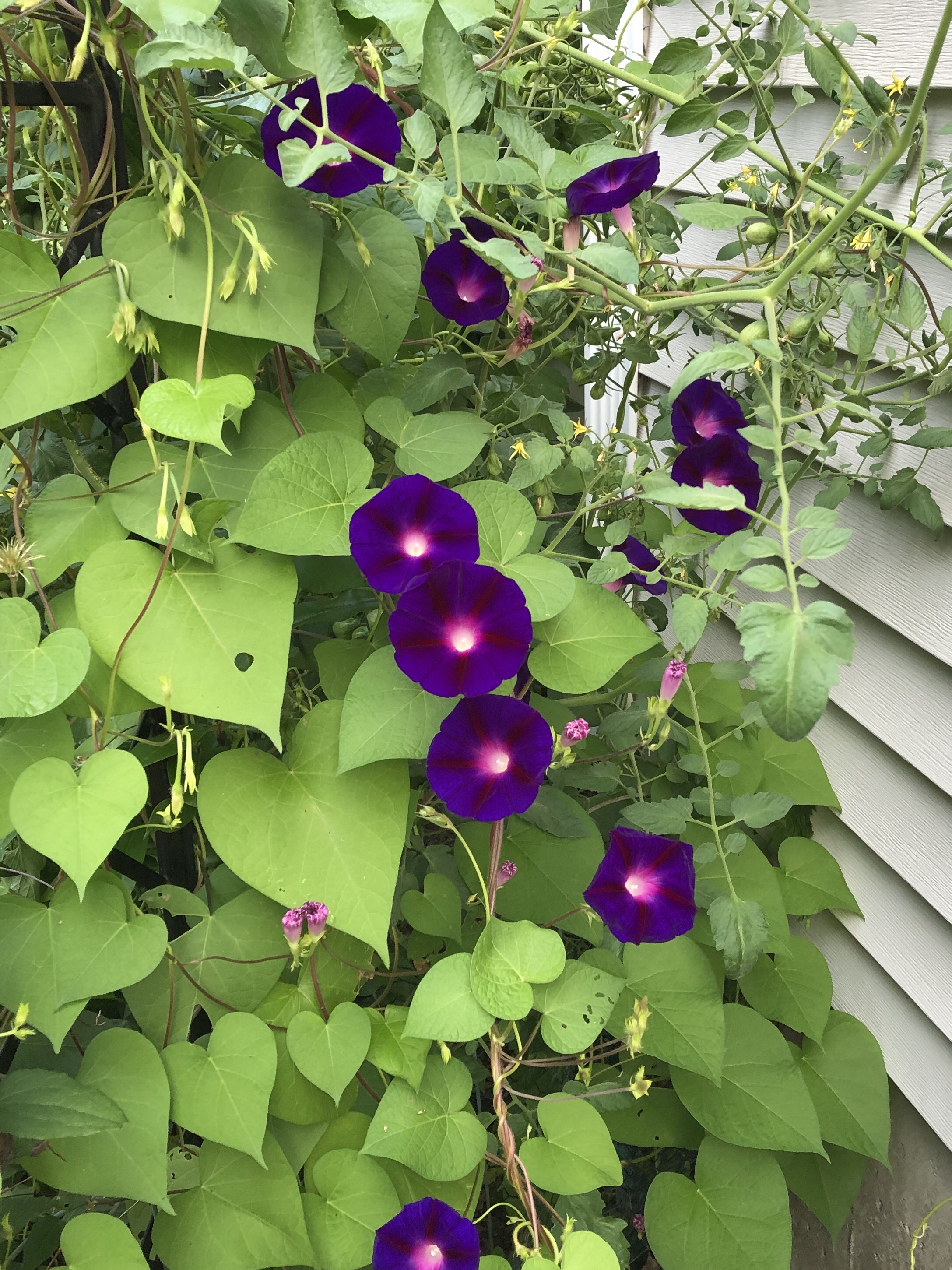
    I spent the first two months of gardening season pulling morning glory seedlings out of the garden. Like Sisyphus pushing the rock up the hill it’s an impossible task. Once they’re in your garden they’re a part of your life. And sure enough I went away on a business trip and came back to a thriving morning glory population laughing and singing in the sun along with those unruly cherry tomatoes. They’re mocking me, I know it.
    As I was writing this I glanced up and saw a rabbit on the lawn. By the second paragraph there was a second one. I refilled my coffee cup and walked out to see a third. The rabbits were offering emphasis literally right before my eyes. Stuff accumulates in our lives and sometimes an aggressive pruning is required. But you can’t stop with one pruning, because things can get out of hand quickly (The rabbits returned when our dog passed. I can’t say I prefer the trade-off but we’ve learned to coexist).

    So I gave up the chain saw that could help thin out trees encroaching on the yard like those morning glories encroach in the garden. Not the best choice for eliminating stuff, yet I feel better for having done so. I can borrow it back if I need to, and don’t have the burden of ownership that comes with accumulation. It’s a small beacon of hope in a house full of twenty years of this and that and the other thing.

    The friends who gave me the chain saw could teach a master class in simplification. They stepped down from a house full of stuff to an apartment full of less stuff to a sailboat with just the essentials. Nothing forces aggressive pruning like downsizing (It’s not like they can tow a shed around with them). We aren’t downsizing at this time, but the siren of simplification is calling, and it’s time to listen.

  • Progress Whispers

    Scales don’t lie, and this week I added a couple of travel pounds. Sales meetings involve unnatural portion sizes repeated often, with snacks in between. And so the pants were a bit more snug than when I arrived. That seemed to be the consensus as all 90% of us immediately agreed to lose 10 pounds by a trade show in September. Peer pressure multiplied by $20 each generally does the trick.

    “Progress…. is quiet. It whispers. Perfectionism screams failures and hides progress.” – Jon Acuff

    Some words jolt you awake and help you see things a bit more clearly. Progress whispers resonated for me this morning. Progress towards our objectives is often painfully slow, and we find ourselves growing frustrated by the level of progress we might be making. Acuff makes another point in highlighting perfectionism as the antagonist to progress, undermining it with its relentless chirping.

    Steve Pressfield describes this as “The Resistance“, Seth Godin calls it our “Lizard Brain“. It’s the inner voice that tells you it’s not good enough and not yet. Godin’s advice is to start pulling the thread anyway, to learn to dance with The Resistance. To ship your work, even if it’s not perfect. The concept of shipping a Minimum Viable Product (MVP) is common in nimble businesses today, but harder to dance with when it comes to writing your first novel or starting a business.

    Sales is a numbers game, and so is losing weight, writing a novel (or blog) or accomplishing any worthwhile objective. Progress whispers, and you need to break it down into the smallest increments to track it just to see any meaningful forward momentum. The 12 burpees I do every morning aren’t all that much, but they add up to 4380 in a year. I’ve noticed the change in my body even from this small amount, done repeatedly and consistently over time. So it is with sales calls, writing daily, and other accretive activity.

    Losing weight is tougher as you get older. You may say it’s because our metabolism slows down. I’d certainly say that too. But then I look at the guy I went to college with who rides his bike every day and hikes the rest of the time. His high activity level has bought him washboard abs, without sacrificing career or family. Another friend who embraced CrossFit shortly before turning 50 is now in better shape than when he was 25. No, “metabolism” is “Lizard Brain” in disguise.

    Activity over time equals identity. Athletic, writer, Rainmaker, parent, spouse and trusted friend are all identities I try to embrace. I’m a little better at a few than others but hope to make progress with each. My progress may be a faint whisper but it’s progress nonetheless. Best for me to listen for it more. Throwing $20 dollars and the threat of peer ridicule to the mix amplifies the goal a bit too.

  • The Thing About Chess

    When I was in college I’d play chess for hours with roommates during the winter break.  We’d all come back from our respective part-time jobs and rotate in to play whomever the winner was.  Chess was the only thing I had in common with a couple of those guys and we drifted apart as rowing (for me) and other distractions (for them) took over.  During a college trip to Finland and what was the Glasnost-era USSR I picked up a magnetic chess set and we played the whole flight back.  But chess drifted away when the convenience of time that college offers drifted away.

    Fast forward years later and my grandfather moved up to Massachusetts from Florida when my grandmother passed away.  I’d schedule nights with him every week or two, I’d order some sandwiches and we’d play chess once or twice before calling it a night.  Chess with my grandfather was story time, and he’d tell me stories of working at Eastern Airlines in Miami where he’d play chess with some older black men who also worked there.  In the 1960’s that wasn’t the norm in Florida, but he told me he didn’t much care.  Just two guys playing chess during a work break.

    I tried to steer my kids towards chess, but no luck.  Too many other activities in their lives and it was a game that required some learning.  Checkers for awhile, and then it was on to sports and video games.  So I’d hit a dead end where there wasn’t an opponent to play against, and so the game drifted away again.  Playing the game in the newspaper or on a handheld device never appealed to me.

    Eventually I rediscovered chess on my Mac.  There are settings that allow you to make the virtual opponent devastatingly difficult or ridiculously easy.  Eventually I got a place where I’d win sometimes, the computer would win sometimes and the pace of play was satisfying enough to make it interesting.  Computer chess doesn’t offer the nuance of playing against a real person or the tactile experience of picking up and moving pieces, but it’s better than nothing.  Like other computer activity it becomes a time suck if you let it, so I’ve established rules for myself where I’ll only play in the evening on the home computer for a max of 3 games at a time.  None when I travel or during the work day.

    While there are chess clubs everywhere, when you live in the suburbs it’s not as convenient to find an opponent.  I think if I lived in the city I’d be drawn to the places that offer chess boards for anyone to sit down and play.  Harvard Square has a spot where I could play a chess master in one game and a homeless person in the next game.  I’d surely never leave if I lived or worked in Harvard Square.  Chess welcomes all players, and offers an opportunity to deeply focus on the complexity of the game with someone you might be on the opposite end of the spectrum politically, socioeconomically, in age or in countless other ways.  The world could use more chess players.