Month: October 2019

  • More in Less

    Recently I’ve begun limiting myself to one cup of robust coffee when I brew it with the AeroPress, where I’d previously indulge in a second and often a third. It seems one does the trick, and one more would be too much. The net benefit is less money spent on coffee, fewer trips to the bathroom, and ironically, sharper focus.

    There’s merit in avoiding the things that dull the senses, and embracing the things that electrify the senses. You’ll be the better for having done so. Take for example, a glass of single malt scotch.  It offers so much more in less. Savor it, reflect, take another sip. A little sip of Scotland to brighten your day. And an example of more in less. So I’m trying to take a similar approach to coffee.

    Today feels like a good opportunity to practice brevity.  I’m averaging a little over 400 words per post.  Today’s contribution will lower that average a bit.  So be it. I chip away at it nonetheless. Sometimes less is more?


  • On Foliage and the Passing of Time

    “Who made the world?
    Who made the swan, and the black bear?
    Who made the grasshopper?
    This grasshopper, I mean-
    the one who has flung herself out of the grass,
    the one who is eating sugar out of my hand,
    who is moving her jaws back and forth instead of up and down-
    who is gazing around with her enormous and complicated eyes.
    Now she lifts her pale forearms and thoroughly washes her face.
    Now she snaps her wings open, and floats away.
    I don’t know exactly what a prayer is.
    I do know how to pay attention, how to fall down
    into the grass, how to kneel down in the grass,
    how to be idle and blessed, how to stroll through the fields,
    which is what I have been doing all day.
    Tell me, what else should I have done?
    Doesn’t everything die at last, and too soon?
    Tell me, what is it you plan to do
    with your one wild and precious life?”
    —Mary Oliver, ‘The Summer Day’

    Mary Oliver passed away in January this year, at the age of 83.  If I may say it, too soon.  With her passing, her question commands even more urgency than before:

    Tell me, what else should I have done?
    Doesn’t everything die at last, and too soon?
    Tell me, what is it you plan to do
    with your one wild and precious life?”

    This afternoon I drove back from meetings in Boston, flipped open my laptop and diligently followed up on the list of items that demanded my time.  All save one, which required closing the laptop, stepping outside and finding foliage.  New Hampshire glows in orange, yellow and red in October, and I’ve spent entirely too much of the first eleven days of the month indoors or behind the wheel of my car.  So a walk down to a local pond on a gusty day felt more like living than crafting another email for somebody’s spam filter.

    Foliage stirs up memories of autumns past, and I try to push those aside.  Not because the memories aren’t mostly pleasant, but because there’s more than enough living now to occupy my limited brain cells.  And there’s only today; words we all know but seem to push aside for the distraction of the moment.  “What else should I have done?”  Indeed.  Take “what is it you plan to do with your one wild and precious life?” and replace “life” with “day”.  For really, that’s all we have, isn’t it?  The foliage illuminates the cold black water of a small pond nearby, and soon those leaves will float down onto the water, drift along the surface for awhile and then slowly slip quietly under the surface to return to the earth.  The briefness of this life exemplified in a single leaf.  Had I not gone to witness the foliage would the opportunity have been there tomorrow?  Surely that’s a trick question.

  • Solving the Wren Riddle

    I was clearly wrong. My educated guess was off the mark. My attempts at online research failed. Apps I trusted to point me in the right direction flopped. So it goes.

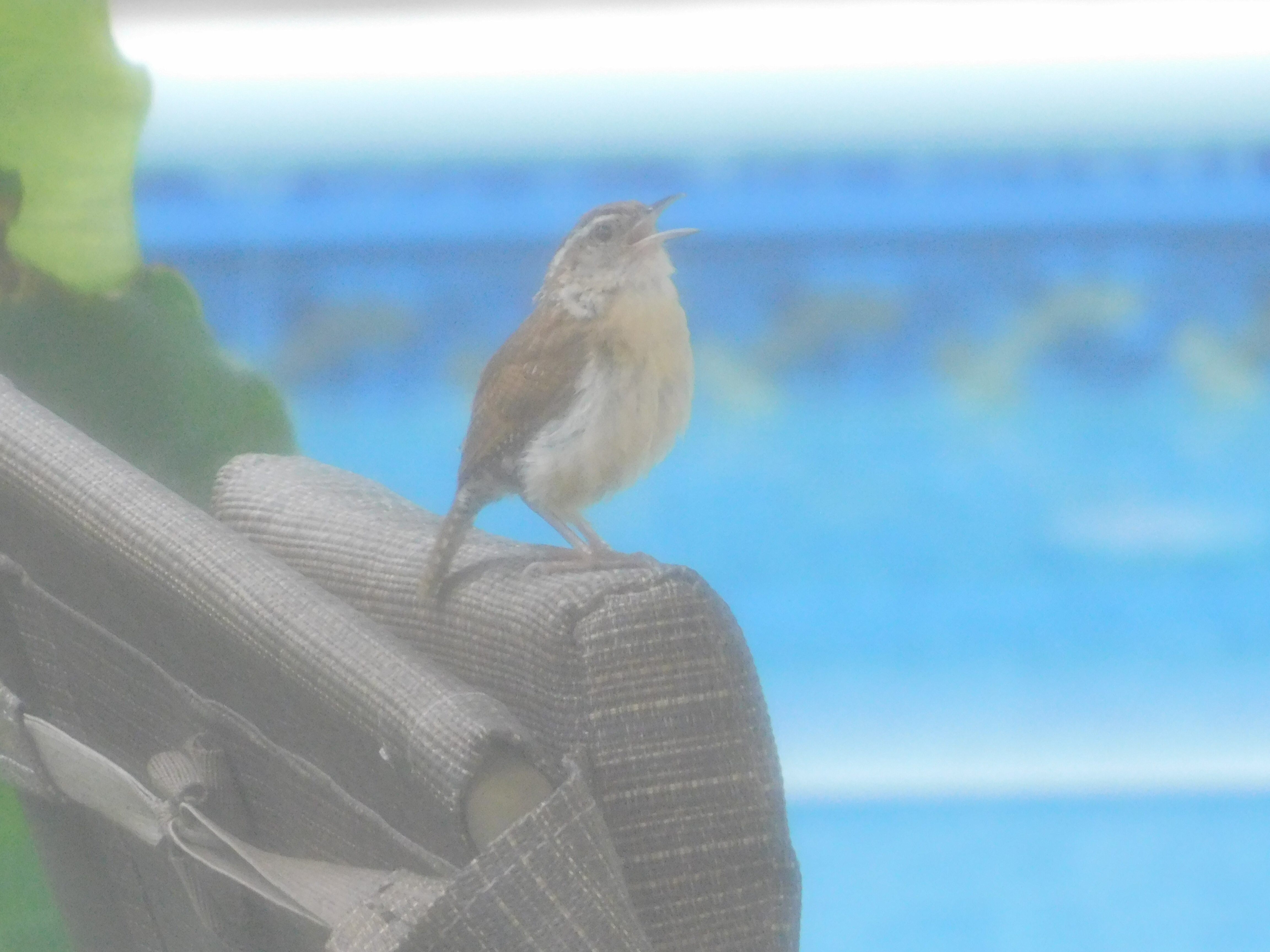
    I’ve written about my attempts to identify a bird I wasn’t familiar with that has moved into the neighborhood. And not just this neighborhood but I’ve heard a similar song on Cape Cod, as if it was following me across the Bourne Bridge, taunting me all along.  After many fruitless searches I’d finally settled on the Brown Thrasher as the most likely candidate, and have referred to the Brown Thrasher ever since.  But it wasn’t a Brown Thrasher at all.  It was a Carolina Wren.

    The Carolina Wren, as the name indicates, is typically seen (and heard) further south of here.  I’ve seen another “southern bird”‘, the Baltimore Oriole, in Massachusetts and New Hamphire, but this was a new song; a song I couldn’t get out of my head until I solved the riddle.  An app that records birds singing and analyzes it like Shazam continually got the wrong answers.  So I tried a different app, and still continually got the wrong answers.  Frustrated, I emailed the .m4a voice file to Chirp, the second app I tried, and they responded within 24 hours with the elusive answer; Carolina Wren.  A quick search online confirmed this was indeed the singer I’d been searching for all season.  It seems the bird song apps use a strong location filter to eliminate matches that wouldn’t normally be found in your area.  And Carolina Wren’s weren’t thought to settle in New Hampshire so Chirp was eliminating it as a choice.  Well, welcome to the Granite State, my southern friend.

    The New York Times recently published an article detailing the decline of North American birds, and followed that with an article detailing birds moving away from natural territory as the climate changes.  New Hampshire’s Purple Finch is apparently considering a move to other climates.  Thankfully the one’s who visit my backyard haven’t felt so inclined as of yet.  But then again, I have this new visitor to my backyard whom I’ve never had before who might be singing that there’s something to this story after all.

    Carolina Wren teasing me with her song, July 2019
  • Theodicy of Trumpists

    I was just contemplating the fact that some people I have a high regard for really like this person in the White House. Nothing ever seems to change their mind about him. And really, …there’s been a lot of things. But then again nothing good that he’s done (?) has changed my low opinion of him either. We believe what we believe and look for any evidence to validate that belief.

    “In theology, the term ‘theodicy’ refers to the effort to maintain belief in a benevolent god, despite the prevalence of evil in the world; the phrase is occasionally used to describe the effort to maintain any belief in the face of contradictory evidence.” – Oliver Burkeman, The Antidote: Happiness for People Who Can’t Stand Positive Thinking

    So maybe theodicy explains this tendency to believe this person in the White House is doing great things. Or maybe some people watch Fox News while I don’t. It tends to shape and validate beliefs for some true wing nuts, including that person in the White House. I do know I’ve come across some hardcore right wing zealots out there, and some equally hardcore left wing extremists. I have no use for either extreme, for there’s no progress to be made with either. Where are the voices in the middle, the advocates for diplomacy and fairness? Where’s the common sense approach to the environment and other critical issues of our time? There’s no room for reason in media, where ratings, subscribers and clicks per minute rule. Sadly, it’s not in the White House either.

    The response from extremists to that last paragraph would be to condemn me for not having strong convictions. For lacking courage to fight for what is reprehensible on the other extreme. I call bullshit. It takes tremendous courage and conviction to meet people in the middle, to recognize you might not be right about something, and to compromise when it makes sense to do so. Where shall the world go next?

  • A Walk in Time

    Too much indulgence at dinner drove a desire to move, and I went out in the dark night to walk the street.  I’ve walked this street many times over the last twenty years, thinking  too much at times.  For fifteen of those years I had a loyal companion, Bodhi, who was patient with me even as I wasn’t always patient with him.  Labradors want to explore the world on their own terms, and when he was younger I wrestled with his instincts and my selfish desire to keep moving.  As we got older together I learned to slow down, and regret not giving him enough time to linger on the neighborhood dog message boards he inevitably sniffed and marked along the way.  Perhaps he was complaining about the short leash I’d give him, but he wasn’t one to complain much.

    The neighborhood has changed in twenty years.  People come and go, usually from the same houses, while the rest of us anchor the cul du sac with memories of block parties, eventful storms, swarms of kids trick-or-treating on Halloween, and the occasional scandal.  Some quirky people, some gossiping and manipulative hens, some hard chargers, and at least one oddball who walked in the dark at 10 PM every night with his dog.  But we all tended to look out for one another in some fashion.

    Of the hundred or so people who have lived on this street these twenty years, we’ve seen our share of drama.  Three couples divorced, two people went to prison, two women had breast cancer and one man chopped his fingers off trying to clear his snowblower.  They stitched them back on, but it dominated conversation for a few weeks.  But there’s plenty of good on the street too.  Kids who grew up, went to college and became contributing members of society.  Successful careers, at least one book published on the street and one aspiring author working to add another, a locally famous weatherman, and a few recent retirees checking the box on a career.  The American dream, and some of the drawbacks to pursuing it, all on one street.

    The biggest, most expensive home on the street is directly behind my own house.  The cul du sac loops around like a “j” with a long driveway leading back to the big house, creating a “u”.  It’s twice the size of my own home, with a five car garage, movie theater, fitness room and a stunning view of rolling fields of a horse farm.  The long driveway is lined with light poles on either side, which we derisively call the runway when lit up.  The house has changed hands three times in twenty years.  The first owner was a crooked chiropractor who went to prison for a large scale insurance scam he orchestrated.  He built a flashy house, drove both a Hummer and a Dodge Viper and trolled for young women on the streets of Lawrence, Massachusetts while his wife was home raising children.  His house of cards came crashing down and his wife and children had to move out of the neighborhood to a condo in another town while his accommodations were more sparse.  That house has turned twice since then but we still refer to it as the original owners house.

    Walking the street alone at 10 PM doesn’t feel quite right anymore.  The street is the same yet everything is different.  Late evening walks are best done with a companion.  Bodhi is gone, the kids are in different corners of the world, and my bride has surrendered to prime time television.  But I walked anyway, if only to digest a bit, to think, and in the futile hope of seeing a few shooting stars.  Streaky overcast skies offered a glimpse of a few stars and a hazy moon, but wasn’t going to pull the covers off for a proper show.  Just me and the acorns falling.  And memories of twenty years on a single street in New Hampshire.

  • Oh, That Magic Feeling: Abbey Road

    Abbey Road turned 50 years old last week. It’s always been my favorite Beatles album, particularly side two with its magical medley. It grabbed me the year that Lennon was shot and hasn’t let me go since. To be coming into my own as a young Beatles fan and then lose one of them was a gut punch at a time when I hadn’t taken a lot of gut punches yet.

    Abbey Road ages well. From the first notes of Come Together to the surprise bonus track Her Majesty, the album is still an astonishing journey after countless listening. It’s The Beatles throwing it all out there to see what happens, as they’d done for each of their milestone albums since Rubber Soul. It would all end with Abbey Road, their last studio album, and the last song they’d ever collaborate on was Come Together. Surely they had a sense of irony?

    George Harrison, the quiet Beatle, was at his creative peak with two of the best Beatles songs ever, his masterpieces Here Comes The Sun and Something. As a kid I latched onto Harrison as my favorite Beatle. Lennon and McCartney were just too big for me then. Harrison wasn’t flashy, he just got things done. And he surely was doing, er, Something. “Something in the way she moves” would be a line James Taylor would borrow from George for his own song of the same name, a tribute to the giants around him when he was recording at Abbey Road Studios around the same time.

    If the album had great individual songs on side one, side two would become famous for that medley. How many radio DJ’s put the needle down on that medley and ran to the bathroom because they had time? All of them. Because, You Never Give Me Your Money, Sun King, Mean Mr. Mustard, Polythene Pam, She Came In Through The Bathroom Window, Golden Slumbers, The End…. Her Majesty. Boom. Rapid fire, half finished songs blended together into one unified medley. Brilliant percussion from Ringo and Paul’s underrated bass guitar, John and George on guitar… and all of them harmonizing like they’d sing together forever. But this truly was the end.

    One verse in that medley stands out for me the same back as a teenager as it does today, if the meaning has changed over the span of time;

    “Any jobber got the sack

    Monday morning, turning back

    Yellow lorry slow, nowhere to go

    But oh, that magic feeling, nowhere to go

    Oh, that magic feeling

    Nowhere to go, nowhere to go”

    – The Beatles, “You Never Give Me Your Money”

    Surely the idea of nowhere to go meant something to The Beatles, having ground themselves to dust touring and then prolifically cranking out brilliant album after brilliant album. They were exhausted, sick of each other, burdened by business transactions gone wrong, wrestling with creative tensions, and incredibly, still in their twenties. Solo careers were just ahead for all of them, but they came together for this incredible album to give us one last gift. Let It Be would come later, but was recorded prior to Abbey Road. This would be it, but what a way to end.

  • Writing Illuminates

    October 7th and there’s no escaping it now. The morning concedes more and more of herself to the greedy darkness. Darkness, not satiated, comes back for more sooner and sooner each afternoon. The days are more beautiful than ever this time of year in New Hampshire, there’s just less time in the day to enjoy it all.

    The available light changes routine. No going outside to read in the still morning light now. Instead I find myself huddled inside during the magic hour. This won’t do at all. Perhaps a brisk morning walk outside would serve me better, with reading later? But thoughts of work encroach the later in the morning it gets, and by 7 AM there’s no escaping the feeling that the jig is up. Daylight brings responsibility, there’s no more buffer when the earth turns a cold shoulder to the sun.

    Still, there’s beauty in darkness. That old huntsman Orion greeted me in all his glory over the weekend. He’s tired of playing hide and seek with the Northern Hemisphere. And I delighted in greeting him once again. True, the Autumnal Equinox makes stargazing more accessible. There’s that. Take what the day brings you, that’s the answer isn’t it?

    Darkness grudgingly concedes the day, and I must be moving on. Writing calls, but so does the day job. The endless wrestling match between creative output and economic responsibilities. One voice tends to dominate the conversation. So what’s a writer to do? The answer, it seems, is to get up even earlier tomorrow. More time alone in the darkness, though not in the dark. Writing… illuminates.

  • A Handshake with Norman Rockwell

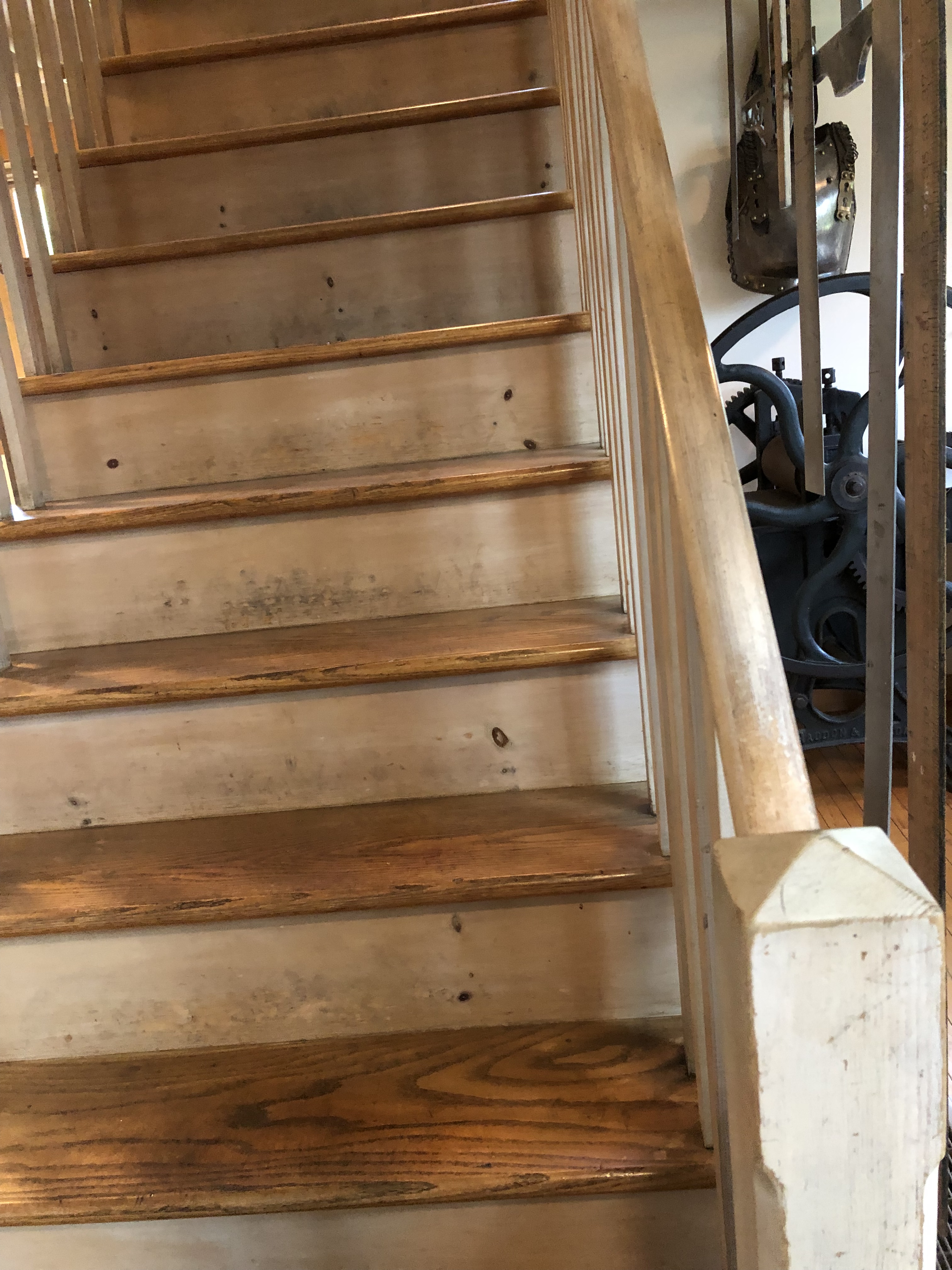
    I always make a point of grabbing the newel post and sliding up my hand on the stair railing when visiting the homes of artists, writers and historical figures.  I’ve written about doing this at Ernest Hemingway’s Key West house, at Mark Twain’s Hartford, Connecticut house, and at Robert Frost’s farmhouse in Derry, New Hampshire.  I had the opportunity to do it again when visiting the Norman Rockwell Studio in Sturbridge, Massachusetts recently.  This to me is a handshake with those who came before, and I feel it most profoundly when I visit the places like these where the giants of the past did their greatest work.

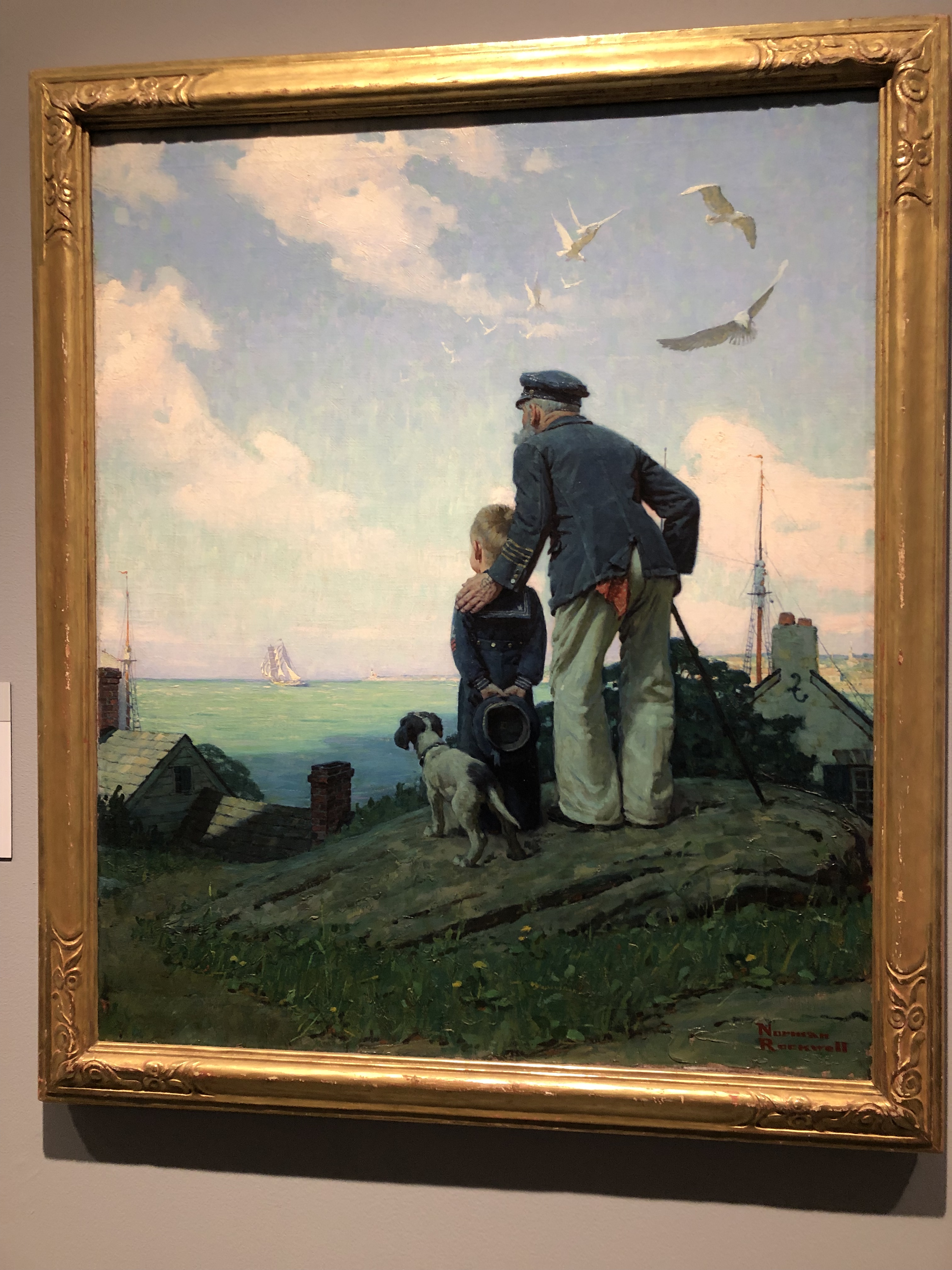
    If you live in America you know Norman Rockwell.  His paintings and sketches are more widely known than any other artist in the 20th century, thanks in large part to his work with The Saturday Evening Post during some of the most significant milestones of that century.  Rockwell was capturing the very human moments everyone felt during the Great Depression, World War’s I and II, the Kennedy Assassination, etc.  The museum carries you through his work and is worth a visit.  I’ve driven by it for decades before finally stopping by for an hour while driving home from New York.  Seeing his paintings doesn’t give me the same feeling as seeing Aivazovsky’s The Ninth Wave did, but that’s largely because there’s a humbleness to Rockwell’s work that doesn’t inspire awe as much as appreciation for the incredible detail he put into his work.

    There’s a story of the painting Country Doctor, which when published on the cover of the Saturday Evening Post inspired letters from people asking about the woman in the photograph on the doctor’s desk.  It seemed she looked like a nurse that had treated patients in England during World War II, and a soldier wrote to ask if she was in fact the same woman….  and was.  Such was the detail in Rockwell’s paintings that a random detail in a larger work, shrunk down for the cover of a magazine, sparked recognition. Rockwell apparently made his subjects, mostly his neighbor’s in the Berkshires, laugh while painting, and there’s joy in most of his work.

    I appreciate art, and linger in the museum longer than I should have on my trip home, but for me standing in the space where Rockwell created that art was more impactful. That space is his studio, moved four miles from downtown Stockbridge to a hill overlooking the Housatonic River and the Berkshires in 1976. Rockwell gifted the studio to the Norman Rockwell Museum, and the studio is set up as it would have been in 1961 when Rockwell was painting Golden Rule, which seems appropriate for an artist who’s work reflected that rule. The space is largely the same, if transported from its original foundation in the heart of Stockbridge. The staircase to the loft is roped off, but the newel post and railing are in reach, like a handshake with Norman. And that sums up his art; within reach of everyone. Simple but complex, and beloved, like the artist himself.

  • Let the Clamor Be

    Wednesday afternoon I found myself in a customer’s Audi driving to lunch. His customer in turn was also in the car (my role being “vendor”). The 15 minutes spent in the car was spent listening to the driver’s pro-Trump diatribe on the impeachment investigation and his firm belief that anything he said would result in strong nods of agreement from the two passengers in his car. He didn’t notice that neither of us said anything. I don’t know the political views of the end user, but I do know mine. More importantly, neither of them know my political views. I happen to have strong views on this topic, but those views had no place in a business meeting. Aside from lack of professionalism, it’s unnecessary noise that distracts from purpose. Me jumping in on this topic would have created more rather than relieved tension.

    “Learn to stop trying to fix things, to stop being so preoccupied with trying to control one’s experience of the world, to give up trying to replace unpleasant thoughts and emotions with more pleasant ones, and to see that, through dropping the ‘pursuit of happiness’ a more profound peace will result.” – Oliver Burkeman, The Antidote: Happiness for People Who Can’t Stand Positive Thinking

    I’m not seeking “happiness” (that’s akin to playing Whac-A-Mole) but I do have a fair amount of restlessness I work through. So it’s interesting if only to me when two books arrive at the top of my stack of real and virtual books at the same time. Burkeman’s and Ryan Holiday’s latest, Stillness is the Key. Both tackle similar ground – with focus on the value of Stoicism in particular, but common themes in Buddhism and (in Holiday’s book), other world religions and philosophies.

    Burkeman throws out a nugget in his book that struck me as profound: “Let the Clamour be.”  In American English we’d spell that ‘clamor’.  But no matter, the point is made.  I’ve worked on that for years, sometimes successfully, sometimes not so.  What I don’t do is actively meditate.  I take my meditation in turning off the noise and doing yardwork, or gardening, washing dishes or simply taking a quiet walk.  Am I missing out on something significant by not meditating?  Probably, but I feel better about myself for getting something done while I’m in my mind.

    Which brings me to the acorns.  I’ve got 10’s of thousands of them sitting on my front lawn right now, just waiting for me to rake them up.  Just me, a rake, shovel and barrel, and endless acorns.  I can feel the stillness already.

  • Thin Walls

    Contemplating the snoring of the person in the room next to mine, I appreciate the consistently good hotels I usually stay in. Not expensive, mind you, but clean, friendly and generally built with thicker walls and floors. This one is old school independent, built economically – I’m guessing – in the 1980’s. The comforter I peeled off looked to be an original. The television, which shall remain dark, doesn’t owe them anything. Yeah, this place was new when Huey Lewis was cranking out hits.

    I’ve stayed in some dive hotels and motels before; from the run down to the truly gross. This isn’t one of those. The owners keep it clean, it just shows it’s age a bit. In this era of Airbnb and chain hotels it’s a throwback to another time. Yelp and other such online review sites has made it less of a mystery what you’re walking into, but I’ve found most people who write negative reviews need to be filtered out. Find the average and go with it. For me, if a room is clean, I received a warm welcome when checking in and the environment is safe you’re already at 3 1/2 stars.

    Ultimately we’re spoiled by the relative luxury we live in. Who am I to complain about the choice of bread in a free continental breakfast? I’m trying to cut down on carbs anyway. I’m well aware of how lucky I am to live here, at this time, with a great job and good health. Most of us have more than enough. I will eat today; that’s more than many can say. Thin walls just remind you that there’s other traveling souls out there, and I learned many years ago to always bring ear plugs.

    “Choose not to be harmed — and you won’t feel harmed. Don’t feel harmed — and you haven’t been.” – Marcus Aurelius