Month: April 2021

  • A Meaningful Walk

    If you’re counting walking as a workout, at what point does it really count? When you reach 10,000 steps? By how many flights of stairs it equates to? Or is simply getting out and walking enough to count? It depends, doesn’t it? It depends on fitness level, on injuries or disabilities you’re working with, and on state of mind. Every walk counts for something. Every walk can be meaningful.

    Any walk of substance, whether hiking a mountain or a long walk on a bike path, could be called a workout. And a walk with the stars or a dog curious about the world can be especially meaningful. A walk filled with an abundance of steps and curiosity can be both. I think the point is to get out there and do something. To experience the world on her terms.

    This month I’m in a challenge to do 25 workouts in the month of April. Given my fitness level, which is decent but not Olympian, I count a walk as a workout when I hit 10,000 steps (5 miles), and the walk itself is brisk. Sometimes I don’t have the time to do 5 miles in one walk and I’ll walk again at night to finish the steps. It’s my workout, these are the rules I put in place.

    Walking as a workout isn’t the most efficient use of your time. I can row 5000 meters in half the time that I can walk 10,000 steps. If I broke that 10K into meters I could have a killer workout of 5x2K or 10x1K. And I can quickly raise my heart rate swinging a kettle bell, and mix in those workouts too for the pure intensity they offer. But sometimes you don’t care about efficiency. Sometimes you just want to walk.

    I’m doing the math on those 25 workouts in the month challenge and figure I need to do a few double sessions this coming week to make the total. I’m having my second vaccine on the 27th and would like to be done by then just in case I have side effects. I haven’t done double sessions in some time, but I’m drawn to the idea. A mix of rowing, kettle bell swinging but especially those brisk walks. A micro burst of meaningful workouts to get across the finish line. And a burst into spring.
  • Living That Last Word

    See with every turning day,
    how each season wants to make a child
    of you again, wants you to become
    a seeker after rainfall and birdsong,
    watch now, how it weathers you to a

    testing
    in the tried and true, tells you
    with each falling leaf, to leave and slip

    away,
    even from that branch that held you,
    to go when you need to, to be courageous,
    to be like that last word you’d want to say
    before you leave the world.

    – David Whyte, Coleman’s Bed

    We all move through the world at our pace, seeing things as our mind opens our eyes to them. I could never have read this poem ten years ago and seen it the way I do today. I wonder at who I might be in another ten years, should I be so bold as to expect the time.

    We all transform over time and place, in each conversation and with every realization. We get consumed with thoughts of whether we do enough or become enough, we reach a point where we gently push such self-talk away or let it eat us alive. But the question isn’t whether we’ve done enough at all. It’s simply, have we lived enough?

    When you’re lying on your death bed someday 50 years from now or maybe tonight, what will your last word in this earth be? What are the last thoughts racing through your fading mind? Will you smile in your last breath or will a tear form in your eye? That person in that last moment wants you to be courageous today.

  • Moving through Liminal Space

    If 2020 was a year of transformation forced upon all of us by a pandemic and political and social unrest, then what is 2021? A continuation of the same or something different entirely? We see the light at the end of the tunnel, but we’re still very much in the tunnel. Are we in limbo, or is it something else?

    I don’t know what life will show me
    But I know what I’ve seen
    I can’t see where life will lead me
    But I know where I’ve been
    – Jimmy Cliff, Sitting Here in Limbo

    “Limbo” originally was the region on the border between Heaven and Hell, now commonly thought of as being stalled in a period of transition. Plenty of us felt like 2020 was Limbo. But you can make a case for it to be something more.

    This place of transformation between one place or phase and the other is also known as “liminal space”. I’d first heard the phrase from Richard Rohr, who points to Victor Turner’s The Ritual Process as the origin. Rituals seem straightforward: sweet sixteen parties, bar mitzvahs, commencement ceremonies and funerals are all rites of passage signaling a change. But what of the passage itself? Passage is motion, not stalling. And that’s where liminality comes in.

    “Liminality (from the Latin word līmen, meaning “a threshold” is the quality of ambiguity or disorientation that occurs in the middle stage of a rite of passage, when participants no longer hold their pre-ritual status but have not yet begun the transition to the status they will hold when the rite is complete. During a rite’s liminal stage, participants “stand at the threshold” between their previous way of structuring their identity, time, or community, and a new way, which completing the rite establishes.” – Wikipedia

    The passage through “liminal space” infers movement between phases of life. This seems a more focused use of the time, don’t you think? Passage is high agency, decide what to be and go be it liminality. Stalled is low agency, waiting for things to happen to us limbo. You see this in how people use their time during the pandemic. Some bought and used bicycles and hiking boots, others hoarded toilet paper and literally waited for shit to happen.

    Life is about transformation and passage. If we’re all in this transition between one place and another, are we using this liminal space to proactively move into a better place or are we simply waiting for things to open up again? The thing about passages is you have some measure of control over the direction you’re going in. We ought to have something to say about which threshold we cross on the other side, don’t you think?

  • Friends with the Sky

    “One of the many ways we have made ourselves lonely without gaining the deeper nourishment and intimacies of true aloneness, is the way we have lost the greater supporting circle of friendship available to us in the created, natural world: to be friends with the sky, the rain, the changing light of a given day and the horizon always leading us beyond the circle we have drawn too readily for ourselves.” – David Whyte, from the forward of Essentials

    I’ve often wondered at loneliness. I’m rarely lonely, but I’m often alone. I think the root of it lies in Whyte’s observation about the greater supporting circle – a connection to the world around you and with your own inner voice. Nothing awakens your relationship with the world like lingering with it on its terms.

    One of the things I miss about having a dog is that forced connection with the outside, no matter the weather. It’s easy to just stay inside when it’s raining sideways or bitter cold. But having a dog forces your hand – they’ve gotta go, and you must connect them with the place they go. Letting them out is a cop-out. You must walk as a true offering to the pet gods.

    This connection to the outdoors doesn’t require a dog, I’ve had similar connection with hiking, rowing and sailing where you’re forced to deal with nature as it comes to you. When you’re a small part of the natural world you tend to see it differently than you might looking at a screen from the comfort of a favorite chair. Nature demands that we meet it with respect and reverence, and in return we awaken something deeper in us.

    I suppose a circle drawn around us feels like a hug or the blankets you pull over yourself on the coldest nights. The problem with a tight circle is that it’s inherently limiting. Getting out under the open sky and feeling the elements, you recognize that you’re alone, yet a part of something bigger than yourself. When you see the world outside that old circle, you’re never quite the same.

    Loneliness is a state of isolation derived from looking inward. Connection is looking outward, and beyond yourself. Stepping outside the circle is a courageous act if you haven’t spent much time there, but it leads to a world that is alive with wonder. A sensory world of conversations in many dimensions. A world where we can become more than whatever it was you were when contained in that circle. That’s where you’ll find larger possibility. You’ll never be lonely outside your comfort zone.

  • What Shape Waits in the Seed of You?

    Now, looking through the slanting light of the morning window
    toward the mountain presence of everything that can be
    what urgency calls you to your one love?
    What shape waits in the seed of you
    to grow and spread its branches
    against a future sky?
    Is it waiting in the fertile sea?
    In the trees beyond the house?
    In the life you can imagine for yourself?
    In the open and lovely white page on the writing desk?
    – David Whyte
    ,What to Remember When Waking

    We get lost in the person we told ourselves we’d be today when we were someone else yesterday. To-do lists and created obligations conspire to hold you to what your scheduled to be. There’s a future you being created in that schedule that should make you burst out of bed with excitement. But waiting a beat or two to listen to the calling informs.

    I’ve mentioned before that I do a one line per day entry at the end of the day. I sometimes wake up thinking about it, contemplating how I might make the line worthy of the ink. Worthy of the day crossed off the short list of days we have on this earth.

    Morning writing forces the hand, you might say. It forces you to reconcile the whispers before getting to those other things. I highly recommend it for anyone looking to figure out what that voice is actually saying in your ear. And when you hear it, what then? Does it chafe against that which you’ve planned for yourself?

    The beginning of the day sets our course based on the conditions and circumstances we find ourselves in. We know where we’d like to go, but must reconcile it with our current reality. With our previous expectations for ourselves, set on the calendar. The question is whether we’ve left ourselves the room to grow into that future sky. The answer, like the question, lingers in that quiet, solitary moment.

  • A Hole in the Ground

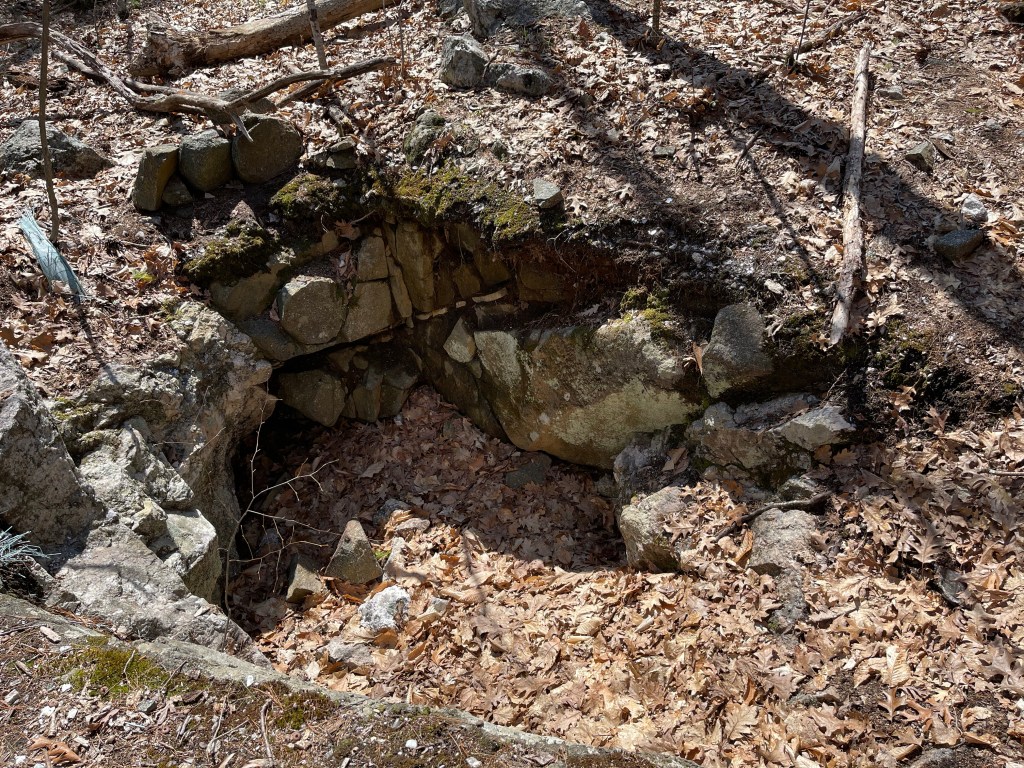
    Walking through the woods of Hampstead, New Hampshire we found an old mine quietly marking time. A modest hole in the ground, really, with scattered bits of Mica all around. To call it a mine seems a bit of a stretch when compared to the big mining operations elsewhere in the world. But it called to me, knowing I’d been looking for it, and seemed to sparkle in the sun for the attention.

    Mica is also known as Isinglass. From a resource perspective, Mica is sheet silicates used in everything from glass making to fashion to a key ingredient in gypsum. It has some heat-resistant qualities and is non-conductive, which makes it useful. But it’s very expensive to mine and labor intensive, so most of the mining now is done in India. For anyone complaining about their work, I’d point to Mica mining as one of many professions that might be a bit tougher.

    In New Hampshire you see flakes of Mica everywhere but the meaningful sheets (or “books”) were harder to find. When they did find it, they’d root it out by blasting and drilling carefully around the sheets. Keeping the sheets intact was the labor-intensive trick.

    There’s a semi-famous mine in Grafton called the Ruggle’s Mine, now closed, that used to be a tourist attraction. Visitors could carry out whatever rock that met their fancy. The mountain where it was mined was called Isinglass Mountain. You can find it on a topographical map but good luck finding that on the list of New Hampshire’s 1,786 mountains. Does a mountain lose prominence when people dig holes in it?

    Back in the woods, I wondered about this old hole in the ground, once a Mica mine, now a landing place for leaves and pine cones. There’s little history around it, probably because it really isn’t any bigger than a cellar hole. But it’s in my nature to wonder about such things. Not so much for the hole but the people who labored in it. I imagine they’re buried somewhere in town, filling their own holes in the ground. What was their story?

    Holes in the ground aren’t nearly as flashy as waterfalls and mountaintops. I can’t blame anyone who skimmed the first paragraph of this post and thought, “not for me”. But there’s a story there in the ground, marking time like the rest of us. And I wonder, what would it take to dig it out? For without a story it’s just another hole in the ground.

    Mica Mine hole in Hampstead, NH
  • A Visit to Fall of Song

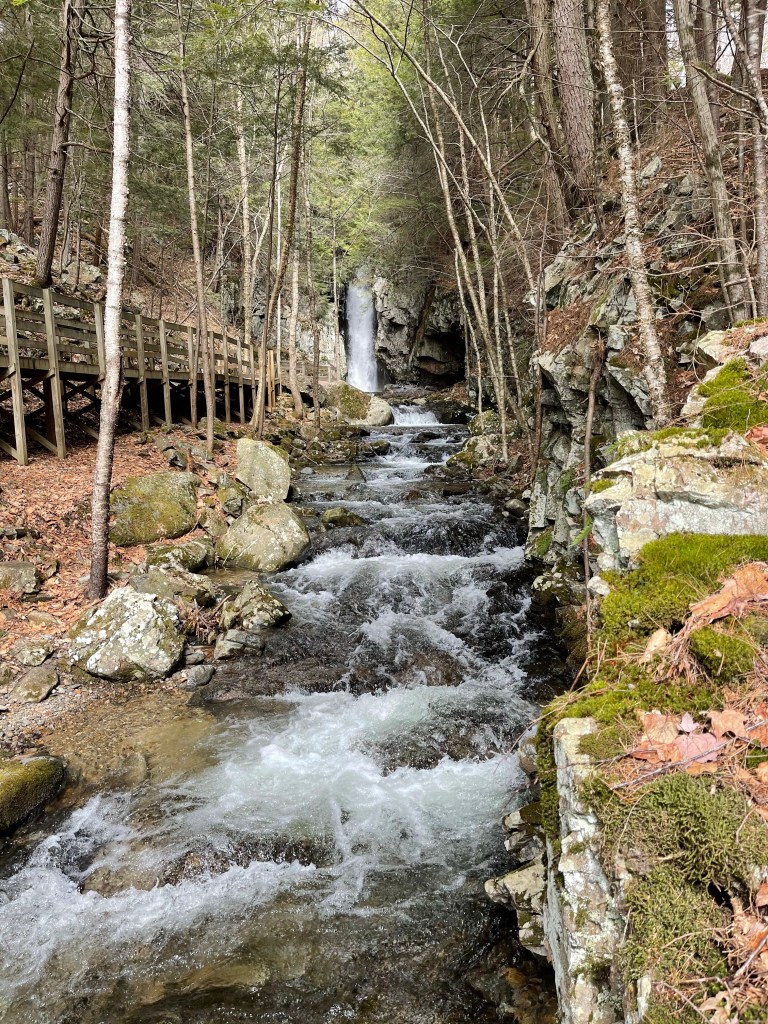
    The Fall of Song is a popular place located on the grounds of Castle in the Clouds in Moultonborough, New Hampshire. The is a waterfall with infrastructure to support the masses, with a large parking lot a short walk from the walls and a boardwalk that runs right up to the waterfalls. These make it far more accessible than most of the waterfalls I visit, and likely ensures a lot of company when you visit at peak times. As is my nature, I visited off-peak and had the place to myself for a short time.

    The Fall of Song was once called Ossipee Falls, so named for the mountain range they’re in. I’m not sure exactly when the name changed to the medieval, lyrical Fall of Song. It may have been in the mid-19th century when the area was known for its mineral springs, or maybe later when BF Shaw came up from Lowell to build Ossipee Park mountain resort here. Or maybe it was when the property was sold to Tom Plant who built his Castle in the Clouds. Any of the characters from that time could have named it Fall of Song. It really doesn’t matter, I suppose. The falls have drawn visitors for generations because they’re simply beautiful.

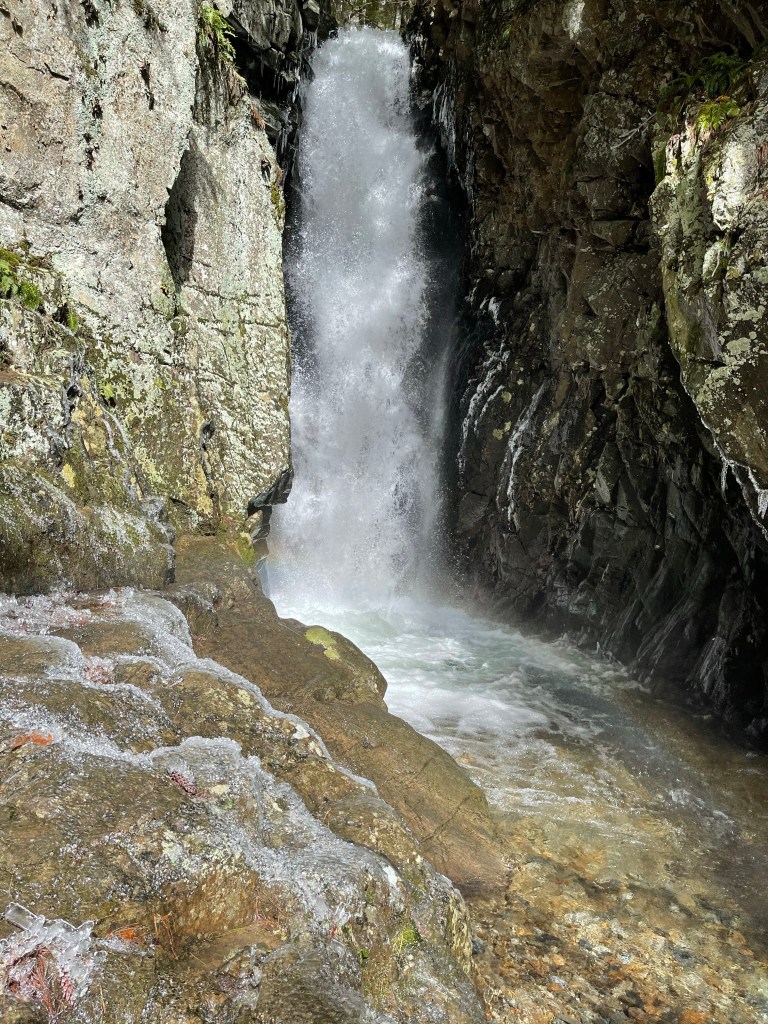
    Fall of Song

    In the winter and early Spring the gates are closed but pedestrians are welcome. A quick half mile walk up the road offers beautiful views of Shannon Brook tumbling down to greet you. You soon reach The Pebble, a giant glacial erratic that stands watch between the brook and the road. I see a lot of glacial erratics in my walks through the woods, and this one is pretty impressive.

    The Fall of Song is an impressive 40 foot plunge through narrow granite walls. With recent rain they were singing with gusto, with an icy mist swirling into a rainbow in the afternoon sun. I appreciated the boardwalk for what it offers in accessibility for people who might not otherwise see Fall of Song, while thinking about how great the photo might have been without the boardwalk in the picture. So it goes.

    Fall of Song and Shannon Brook

    Not being one to settle for the easily accessible, I hiked up the trail above the falls to see them plunge from above, and then made my way up to Bridal Veil Falls just above Fall of Song. This second fall is one you have to earn, but in doing so you feel you’re in on a little secret that those who only visit Fall of Song never know. I tried several approaches to get to the best vantage point without being completely satisfied with any of them and have promised myself another visit to see them again.

    Shannon Brook, above Fall of Song with a glimpse of Bridal Veil Falls above

    There are several other falls above Fall of Song worth a look, with Bridal Veil being the prettiest. And you can spend a lot more time hiking this area beyond the waterfalls. For all my wandering further north in the White Mountains, the old volcano ring of the Ossipee Mountain range offers stunning vistas. This is a place worth returning to.

  • Bridging the Tragic Gap

    I spoke with a friend who is experiencing some PTSD after all the extremist action and rhetoric of the last few years. I don’t have anything to offer but support and faith in progress. Words, really, backed by optimism. But I know I don’t see the world the same way that someone targeted by bigotry and hate does, nor do I feel the gut punch of lost hope and lack of opportunity that the marginalized and enraged feel. I tend to reside in the middle, seeing the possibility of a future where the gaps between us disappear. But the cold reality is that won’t happen in my lifetime. And there lies the tragic gap.

    “By the tragic gap I mean the gap between the hard realities around us and what we know is possible — not because we wish it were so, but because we’ve seen it with our own eyes…
    I call it “tragic” because it’s a gap that will never close, an inevitable flaw in the human condition. No one who has stood for high values — love, truth, justice — has died being able to declare victory, once and for all. If we embrace values like those, we need to find ways to stand in the gap for the long haul, and be prepared to die without having achieved our goals…
    That means we need to change our calculus about what makes an action worth taking and get past our obsession with results. – Parker Palmer, The Sun interview, If Only We Would Listen

    There is a lot to chew on in this 2012 interview, but it’s Parker’s concept of the tragic gap that took hold. For those of us who fancy ourselves bridge-builders, it resonates. For we fill the gap with love and possibility, only to see the divide grow as more people embrace the extremes on either side. Knowing what’s possible and how far we seem to be from it are frustrating at best, tragic at worst.

    So what are we to do? Change our calculus and not obsess with results? Modify expectations and chase the small victories that get us incrementally closer? You see the friction in the world as the two sides of the gap pull away from each other and wonder if bridge-building is even possible. Seen from the lens of history progress is clear, but we never quite get all the way there before the gaps seems to grow again. But is this a trick of the mind at work, just so much amplified noise? The optimism in me believes we’re closer than we sound like we are. With much work still to do.

    “I refuse to accept the view that mankind is so tragically bound to the starless midnight of racism and war that the bright daybreak of peace and brotherhood can never become a reality. I believe that unarmed truth and unconditional love will have the final word.” – Martin Luther King, Jr.

    It’s a tough blow to realize we will never be bridge the tragic gap in our lifetimes, but that doesn’t mean we shouldn’t try. Seeing our own unarmed truth for what it is and doing our small part offers tangible, incremental progress. Each of us, small links in the chain, reaching across the chasm to find a link to a better future. Beyond us, but out there waiting.

  • Freeze and Thaw

    In the dark time of the year.
    Between melting and freezing
    The soul’s sap quivers.
    – T.S. Eliot, Little Gidding

    There are more famous lines from this poem, but this is the time of sap buckets and lines run between maple trees in New England, so forgive me for straying from the popular. For these are the days of freezing and thawing – a confused mix of awakening and nature turning a cold shoulder on us. A reminder that warmer days are coming but we aren’t there just yet.

    And so it is with the vaccine and a pandemic that hasn’t quite finished its business with us, despite casual disregard and letting up of guards. We aren’t quite there, but surely we’re closer. So persevere; for we’ll get through the darkness, together in our isolation.

    Eliot wrote Little Gidding during the darkest days of the Blitz, set it aside in dissatisfaction and returned to it again to publish it during slightly brighter days in 1942. Who would ever think of 1942 as brighter days? Someone who lived through the Blitz of 1940-41 I suppose.

    So who are we to complain about a turn to colder days just as the sun began to warm us once again? Who are we to complain about wearing a mask for just a bit longer? Are we that precious and self-absorbed? Focus on the brighter days ahead, but stay the course in the meantime.

    As the snow and ice retreats for another season, the mud rises to meet our favorite footwear in a cold, gooey grip. The warmest days bring swirls of bugs celebrating their brief dance with life. And we, the comfortable masses, find reasons to complain about the mud and bugs and even the miraculously fast release of vaccines to the world that just seem a bit too slow. For all the joy of thaw, we seem to prefer the angst of freeze.

    Spring is upon us, despite it all. The sap flows with each freeze and thaw, and drips slowly into buckets. Drop by drop, the buckets fill. It’s the only way, really. You can’t very well cut the tree in half to pour out the sap. Not if you hope to have another season anyway. No, progress is slow that way. And offers lessons in patience and perseverance. Of going with the flow and staying the course.

  • Something More

    “The world always seems brighter when you’ve just made something that wasn’t there before.” Neil Gaiman

    This rather cheery quote by Gaiman prompts a challenge of sorts from me. For making something isn’t what makes the world brighter, making something you care about making is what brightens the world. For in the making of something in such a way you honor the world with your contribution.

    As Gaiman rightly points out, we’re lovingly placing something that wasn’t there before out in the world for it to embrace. Will it fly or get lost in the noise? It’s not up to us to decide. It’s up to us to create it and set it free. And then to get back to the business of building another beacon.

    The best of our work becomes accretive rather than reductive. Look around, there’s plenty of people creating hateful, mean-spirited work that divides and diminishes the world. But not us, no: we offer something more. Something that resonates across the table and across time. For the very best work becomes timeless.

    So what makes something timeless? I believe it’s the deep connection between two people that your work represents. Paint placed just so on canvas. Architecture that stirs the heart generations after the last stones were laid. Words that transcend the author or poet and connect one soul to another. This is what brightens the world. This is the shining soul beacon of the artist that keeps hope alive, like a Fresnel lens lights the distance in a turbulent dark sea:

    “If you have built castles in the air, your work need not be lost; that is where they should be. Now put the foundations under them.” – Henry David Thoreau, Walden

    “Dwell on the beauty of life. Watch the stars, and see yourself running with them.”
    – Marcus Aurelius, Meditations

    “Tell me, what is it you plan to do
    with your one wild and precious life?”
    – Mary Oliver, The Summer Day

    “If you dare nothing, then when the day is over, nothing is all you will have gained.”
    – Neil Gaiman, The Graveyard Book

    “This above all: to thine own self be true,
    And it must follow, as the night the day,
    Thou canst not then be false to any man.”
    – William Shakespeare, Hamlet

    All words across time, offering a path through the darkness in the world. Offering hope and direction and illumination. This is something more. And this is our opportunity too. Great artists are ambassadors to the world, bridge builders to the future, and infinite soul connectors. That’s something to aspire to.