“Imagine if you will being on your death bed – And standing around your bed – the ghosts of the ideas, the dreams, the abilities, the talents given to you by life.
And that you for whatever reason, you never acted on those ideas, you never pursued that dream, you never used those talents, we never saw your leadership, you never used your voice, you never wrote that book.
And there they are standing around your bed looking at you with large angry eyes saying we came to you, and only you could have given us life! Now we must die with you forever.
The question is – if you die today what ideas, what dreams, what abilities, what talents, what gifts, would die with you? ” – Les Brown
You may have heard a version of this in a Denzel Washington commencement speech with something like 40 million views, but the framework for this story is older than that, and as far as I can tell, Les Brown was the first to tell it. And honestly, his version flows better than Denzel’s, and thus quotes better.
I’ve been thinking about this lately myself. Whether to keep blogging or focus on the bigger writing I want to do. Whether to travel and explore to the level I want to or defer until some undefined, unlikely time in the future. Asking myself, what do you finish when you don’t have an infinite lifetime?
Questions demand answers. Most of us distract ourselves from thinking about these things. Our lives are filled with white noise and busywork, but eventually we need to reckon with our ghosts.
What dreams, abilities, talents and gifts will die with you? We can’t do everything in life, but surely we can do more. So what will you bring to life before you go?
You ask me: Why do I live On this green mountain? I smile No answer My heart serene On flowing water Peachblow Quietly going Far away Another earth This is Another sky No likeness To that human world below ~Li Po, On The Mountain: Question And Answer (translated by C.H. Kwôck & Vincent McHugh)
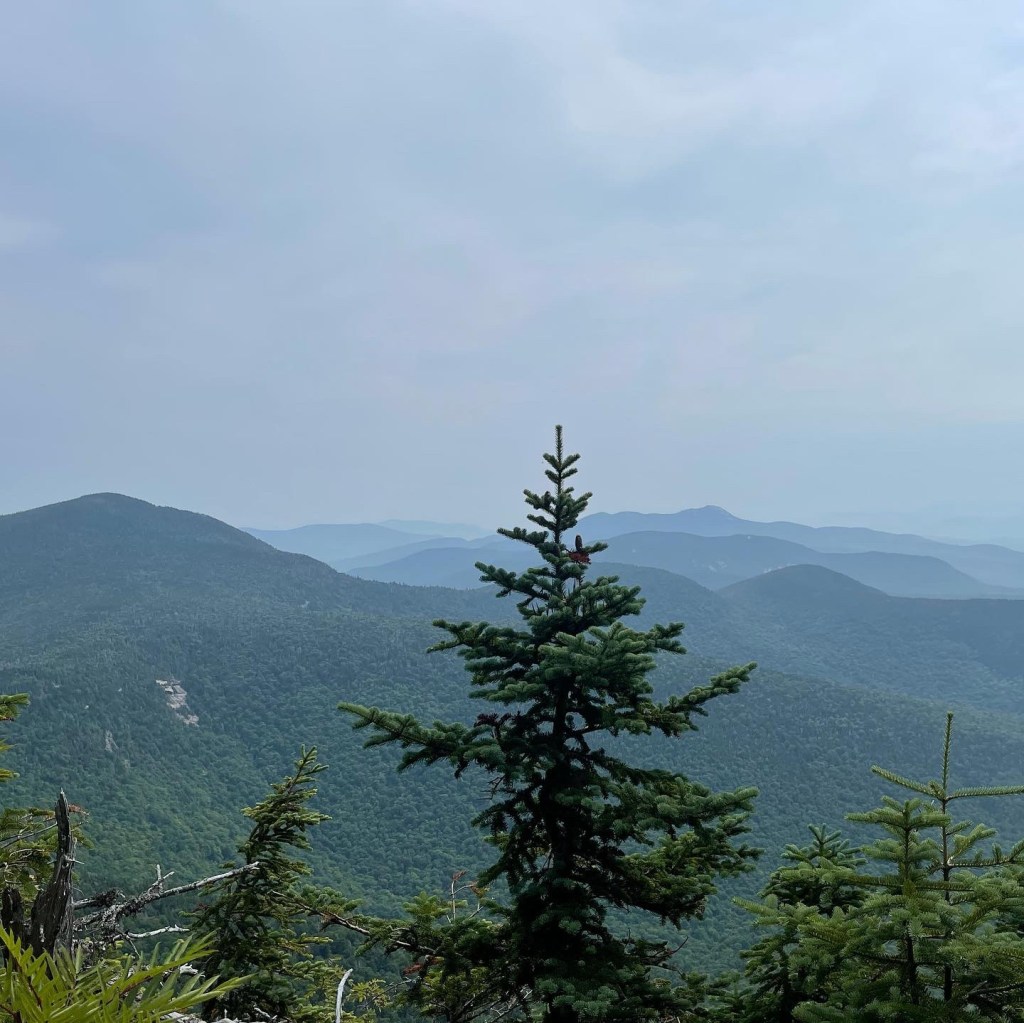
Three days later and I’m still on a mountaintop. The aches and pains fade but the glow of walking the ridge line between peaks stays with me. And I wonder at this world I’ve created for myself, pressed in close to a desk, laptop at the ready, always asking for more. The mountains don’t ask for anything of you, but it’s understood that they demand respect.
Solo hiking, for all the social abuse I receive for it, offers meditation and a connection to the mountains that you don’t get with even the quietest, most reverent hiking buddy. So occasionally I like to indulge in time alone on trails, walking until my own voice finally stops talking to me and I begin at last to listen to the song of the infinite.
Yet you’re never quite alone in the mountains. There’s always a fellow hiker on a pilgrimage of their own, with a knowing look and a brief exchange before turning their attention back to the trail. The mountains aren’t entirely about solitude, for there are more people than ever on the trails. And every one of us with a reason for being up there.
There’s an energy that you draw on when hiking with others. A momentum of common purpose, shared struggle, and shared beliefs. I do like hiking with others, quite a lot, and look forward to sharing the mountains with them again soon. Just give me a moment alone with this sky before I reluctantly descend to that human world below. Where I’ll plot my return.
How do you judge a weekend? By the afterglow? Or the fog? By the accumulated soreness? Or the spring in your step? If a weekend is celebrated upon arrival, how do we view it in the rearview mirror on Monday morning?
What you do with your downtime is your business. I don’t judge someone that lies on the beach all day, I just don’t want to do it myself. You’ll find me in the water swimming laps or testing my mettle against the waves. That staying still business is all fine and good, but for a restless spirit it’s torture. Yes, I have people in my life that shake their head when I won’t just sit still for awhile.
I tend to view weekends by what was accomplished over the two days. What projects were completed? What summits summited? Who did we see and what places have we visited? This is scorecard living. Tally the moments, judge the days. But judging your days isn’t the same as judging someone else’s days. We all use our time in our own way. How we spend our days is how we spend our lifetimes.
When you see someone on Monday morning, one of the first things you might say to them is “How was your weekend?” which on the surface is closely related to “How are you doing?” in that most people expect a response of “Fine” or even “Great”. And honestly, most people just leave it at that. But when you ask about someone’s weekend you’re inviting a response bigger than one word. How you answer it generally reflects how you’ve judged it.
Hot, muggy August days create hazy, sweaty conditions for hiking, with a dash of risk for thunderstorms. But it’s been six long months since I’d last hiked a 4000 footer, and I was way overdue to notch one or two more. The question then is, who do you hike with? For me, the answer for this day was to hike solo. I needed to work out the rust of hiking on granite again without feeling the obligation of keeping pace. And more importantly, I needed the mental space that hiking offers after another half a year of working during a pandemic.
My thoughts on hiking alone aside, I didn’t want to drive an extra hour to find the less crowded peaks of the northern White Mountains. So my focus turned to Mounts Passaconaway and Whiteface, each part of the Sandwich range and relatively close with relatively good elbow room. And planned my hike the way most people seem to do it, to hike Mount Whiteface first and then loop around to Mount Passaconaway afterwards. Plans are lovely things, aren’t they?
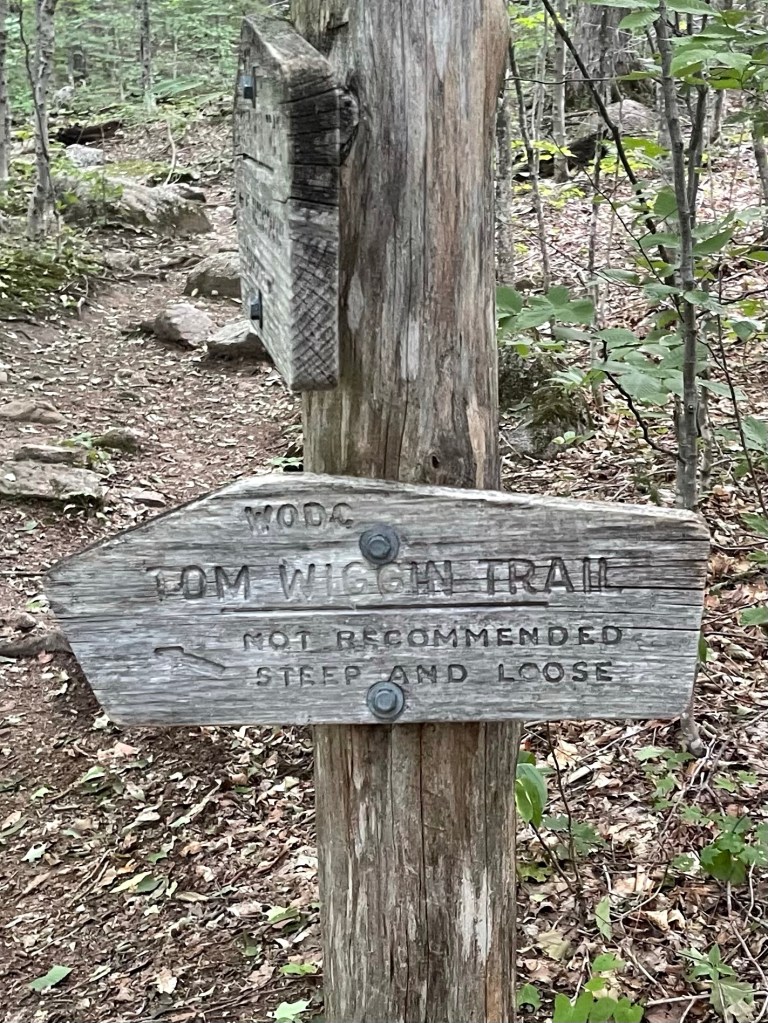
When you’re hiking on a trail and come across a spot where you can either haul yourself over a boulder or bypass it entirely by taking the worn path around it, which do you choose? The answer is subjective, isn’t it? It depends on the size of the boulder. It depends on the condition of the worn path around it. And it depends on your mood at the time. My mood at the time I reached the Tom Wiggins trail was such that when I read the sign warning that the trail was not recommended because it was “steep and loose” I paused for a couple of minutes to consult my trail map, contemplate the implications to the overall mileage I’d do that day, and opt for the out and back option instead of the loop. This decision added almost five miles to my hike, and I’d second-guess it the rest of the day, but sometimes you have to trust your gut.
Decision Time
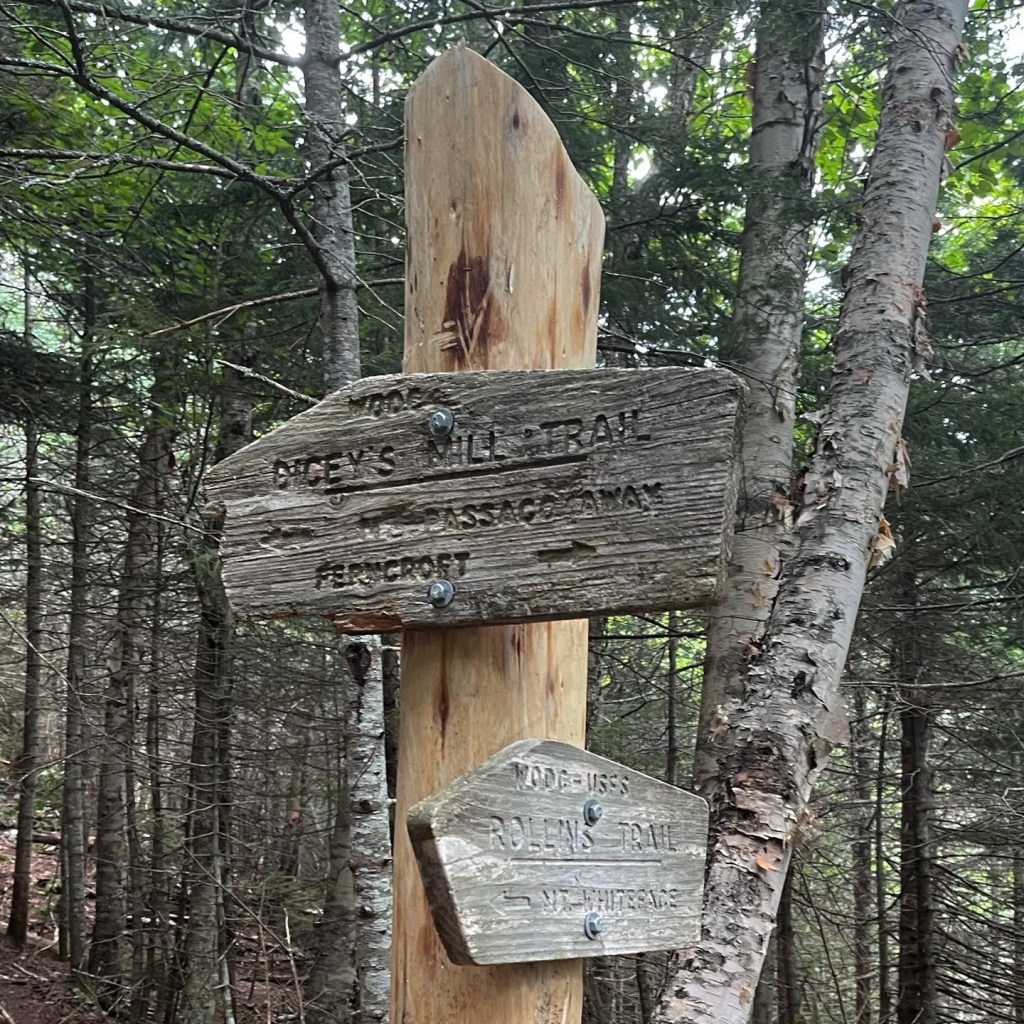
Decision made, I hiked the Dicey Mill Trail to the junction of the Rollins Trail, where I had another choice to make: knock off summitting Mount Passaconaway first, or hike over to Mount Whiteface via the Rollins Trail and save Passaconaway for last? And here I made another choice that I’d second guess the rest of the day. I chose Whiteface, and hiked the 2.3 miles over to the cairn that marked the summit, went past it to the next trail junction and then turned around and hiked all the way back to where I’d begun. Far simpler to have just knocked off Passaconaway while the legs were fresh. It would have given me the option of descending the Tom Wiggins Trail (which was admittedly advertised as steep and loose). I may still have doubled back, but at least I’d have the option. Anyway, these are the hindsight options you think about as you’re sweating through your hiking shirt and feeling your knees and ankles remind you of your choices in life.
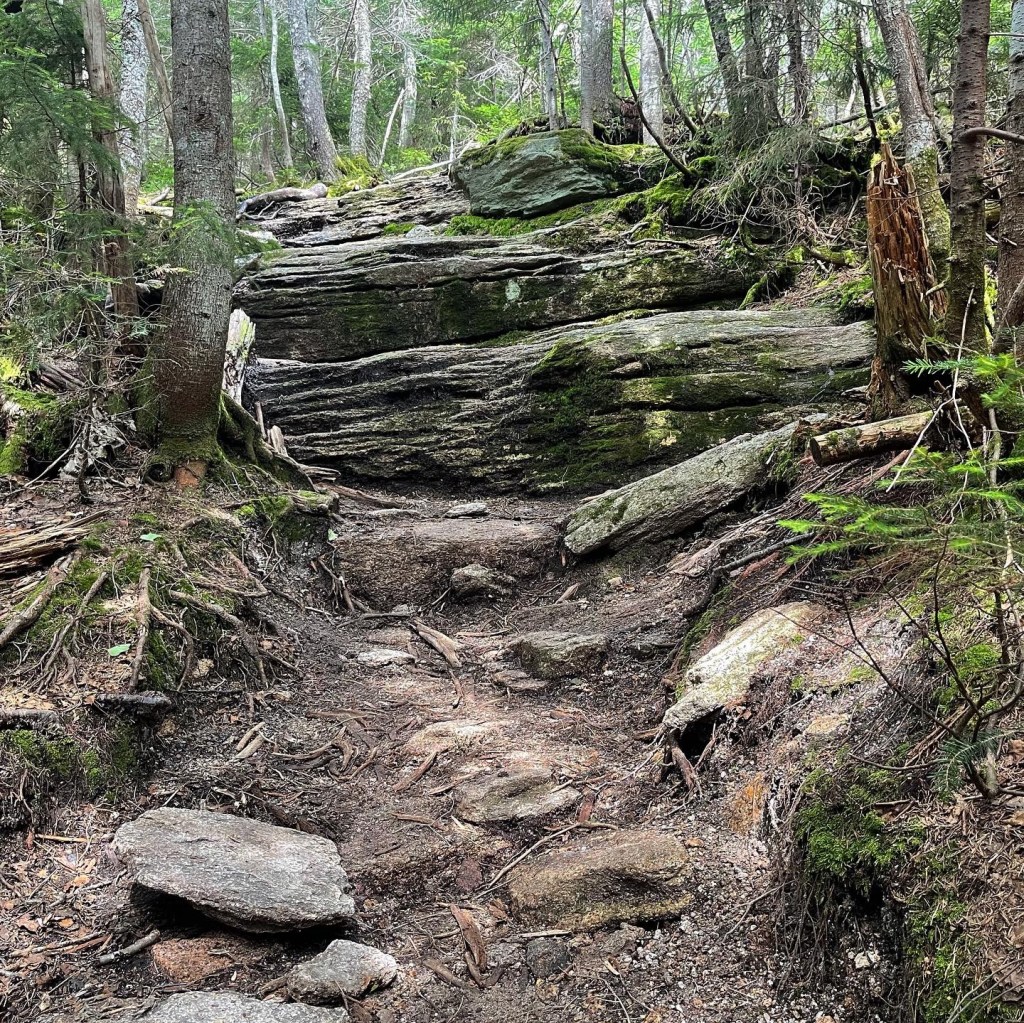
This out and back hike wasn’t all that challenging, it was just long. And that’s exactly what I’d signed up for back at that sign. Sometimes you have to make peace with your decisions in life, and I’m okay with this one. Seeing comparable hikers who started right in front of me finishing the loop I’d contemplated after me, I recognized that either option was fine. I’ll hike the steep and loose section another day, probably in winter when the only part that matters is steep.
This was my non-traditional hike of two more 4000 footers. I know if I’d hiked with friends I’d have just done the loop I’d planned all along, but sometimes you’ve got to just go it alone. And live with your choices along the way.
On the fence about whether to hike a pair of 4000 footers, I decided to just start getting my pack ready, just in case. When the backpack was ready, the boots and hiking clothes laid out, it became a foregone conclusion that I’d actually get up and go at 4:30 AM. But it all started with packing that backpack.
There’s nothing revolutionary about putting your workout clothes out, or getting your bag packed for an early flight. The work you put in the night before sets the tone for the morning. You don’t forget important things, you aren’t scrambling to find things that you swore were right where you left them the last time you hiked. But mostly, you do what you said you were going to do. Waking up to the alarm with everything laid out eliminates excuses, and pokes you with some positive pressure: I got everything ready, the least I could do is get my ass out of bed and get to it.
So when you’re on the fence, or when it really matters that you follow through, prep the night before. It’ll make all the difference the next morning. Just remember to set the alarm!
When you hear someone say they had a perfect day, what does that mean to you? We have this stack of days, one to the next, before it ends someday. What makes a few of them perfect, while the rest fall slightly short?
Let’s start with the obvious: Waking up this morning, the day is already off to a great start. If you celebrate that moment the rest of your day may ebb and flow, but starting from a better place you set the tone for what follows. Carpe diem begins with celebrating the gift of life. If you’re bored with life or indifferent to the potential of each moment you’ll never have a perfect day. Each will fall short in some way because your mind isn’t open to the joy of living.
Perfect requires stacking the moments in a day with just enough beauty and sparkle to reflect back at you, leaving an afterglow in your last moments awake as your cheek feels the cool softness of your favorite pillow. Perfect ought to include certain elements mixed in an elixir: A dash of wonder, moments of connection, the realization of experience, breathless celebration and sensory perception. You drink up this elixir, feel it soak through your pores and course through your veins, and feel high on life.
We all have moments of perfection in our lives, but to ask for a full day of it seems almost too much. More likely, we forget the down moments in a day. Pushing moments of discomfort or awkwardness or frustration down in our minds for the glow of the rest of the day. And sure, maybe there’s really no such thing as a perfect day at all, but we can surely reach for it.
As I began my day, I wondered, how can I make this one perfect? I may not reach it, but knowing the recipe you can get pretty close. Does seeking perfection make it artificial, or deliberate? You only find what you look for. There is no perfection, but there is magic in each moment. Often hiding in plain sight.
And so I seek connection with each of my fellow life passengers that I stumble across, and keep my eye out for new experiences as big as a new summit and as small as watching leaves stir from a hummingbird’s wings, and tickle my senses with a new song on the radio or the scent of garden tomatoes growing on a summer day. These moments of aliveness, stacked together, are where perfection lies. It’s not the day at all, but the moments stacked together. For what is life but that?
“Stuart Cornfeld once told me that in a good screenplay, every structural unit needs to do two things: (1) be entertaining in its own right and (2) advance the story in a non-trivial way. We will henceforth refer to this as ‘the Cornfeld Principle.” – George Saunders, A Swim in a Pond in the Rain
I don’t recall who recommended Saunder’s book to me. It was most certainly a podcast or blog somewhere along the way. On the face of it the book seems a bit academic, but it’s a delightful class in writing well using Russian short stories as the vehicle for instruction. If that sounds boring, I understand, but Saunders makes the stories come alive while informing us on the craft of building a story.
Which brings me to this observation on writing a screenplay by Stuart Cornfeld. Who can argue each point when it comes to building a story? Yet so many fall flat in one or both element. And what of building a life? Shouldn’t a life be built around joy and purpose? There’s a balance there between fully enjoying this short life and making something of our short time here, isn’t there? What do we keep in our stories and what do we eliminate? This Cornfeld Principle offers a simple template, even if the application isn’t always so simple in practice.
Stuart Cornfeld passed away last year. He’s best known for collaborations with Ben Stiller, including a joy nugget, The Secret Life of Walter Mitty. I don’t know much about him other than his work, but it’s clear he brought a bit of happiness to the world in his brief go at life.
Shouldn’t we all aspire to a similar contribution? As we write our oh-so-brief life stories day-to-day, don’t we owe it to ourselves to make it both interesting and non-trivial? Whether our story becomes a page-turner of a life or a satisfying epic is up to us. Edit well.
First he chipped fire Out of the veins of flint where it was hidden; Then rivers felt his skiffs of the light alder; Then sailors counted up the stars and named them: Pleiades, Hyades, and the Pole Star; Then were discovered ways to take wild things. In snares, or hunt them with the circling pack; And how to whip a stream with casting nets, Or draw the deep-sea fisherman’s cordage up; And then the use of steel and the shrieking saw; Then various crafts. All things were overcome By labor and by force of bitter need. – Passages from Virgil’s First Georgic, translation by Robert Fitzgerald
When you read something like this, what does it do to you? Most of us won’t ever experience the life or death struggles that our ancestors faced. Yet the force of bitter need echoes in how we live our lives today. As a student of history, it’s easy to treat the migration of humans across the globe as an academic exercise. To treat wars and conflict and the enslavement and genocide of large swaths of people as horrible footnotes in history. But the stories we tell ourselves that keep the world in order is all so very fragile.
This translation of Virgil is breathtaking to me, because it reveals our shared history, our overcoming of things, to survive another day and maybe build off that to create a generation after us to keep things going. Our human story is one of deep struggle, pain and labor. Of surviving despite the deck stacked against us. May we never forget how all that we’ve overcome as humans has shaped us. And shapes us still.
“Whoever is not in his coffin and the dark grave, let him know he has enough.” – Walt Whitman
The nagging begins in weak moments of fatigue or boredom or frustration: “More“, the voice says. “I want more” it persists. And the voice bleeds over to the blog now and then, with complaints about not being out there in the world, not finishing that book, not reaching that fitness goal…. whatever.
The moment you woke up this morning you had enough. More than old Walt has, more than every person you can even think of born before 1900 and most of those born before 1921. A hundred short years and most everyone you can ever think of as being alive vanishes to the other side of life. So who are we, complaining about enough?
Feel life wash over you, in each breath and heartbeat and blink of an eye. For it is enough. That life is outrageously unfair is well-documented. That we might make a difference if we worked just a bit harder is indeed possible. But never forget in those moments of fatigue and boredom and frustration that this business of being alive today is just audacious enough in itself to celebrate the moment.
The gobs of wet leaves and pine straw pulled with bare hands from the gutter weren’t posted on YouTube for the world to see. Nor were the pulled fence posts as they were chipped free of old concrete footings. The world will never wonder at the labor put into such things by these hands. My labor remains undocumented.
The same fingers that write these jumbles of words once laid brick on a curving walkway only to pull it up two decades later to reset a stubborn gate heaved by frost and refusing to close. This is the price of time in one place, you find yourself undoing what you’ve done before over and over again. It’s the labor of living, and like generations before mine the work goes largely unnoticed by most. Like an Offensive Lineman, you understand that if your work is noticed it wasn’t done correctly. But you know when it’s done well and when it isn’t.
Labor is done for profit, and it reveals itself in moments. Each time I open the gate without having to kick the bottom corner, I’ll celebrate the sweat and strain of a Sunday in August when the work was done. Each time it rains I’ll celebrate the sound of water running through the downspout and not up and over the top of the gutter. These observations aren’t celebrated in the same way as seeing the Grand Canyon or St. Basil’s Cathedral or the Tower of London for the first time, because they’re mundane. But when you’ve fixed something that needed fixing and see it work, none of those other places matter a lick in that particular moment.
I know plenty of people who hire others to do their labor for them. I understand this particular inclination, for paying others buys you time for yourself. Time spent on yard work is time not spent on a mountain summit or a beach on these briefest of days we call summer. But I know deep down that the work done by these hands reveals something in myself that I’d never find if I left the work to others.
There are lessons in the labor, residing deep inside of me, that others may not see. Lessons that open up for you like a swinging gate free of obstruction. Flow through you like water through a downspout. When you do the work, even when it might all be undone once again someday, you understand that our brief, fleeting lives only have meaning in these mundane contributions we make. Even if it’s never seen on YouTube.