Month: July 2023

  • There is a Season

    “You’re alive only once, as far as we know, and what could be worse than getting to the end of your life and realizing you hadn’t lived it?” — Edward Albee

    “To every thing there is a season, and a time to every purpose under the heaven” — Ecclesiastes 3:1-8

    Sometimes we find ourselves stressed out and distracted when we’re pushing through activity for which the season is wrong. Sometimes this is out of our control, and often it’s just us doing more than we ought to be doing in the moment. It would be helpful to remind ourselves that everything has its time. Even when we don’t want to hear it.

    The idea of distinct time buckets isn’t new, it’s just another way of describing seasons of our lives. They were talking about this thousands of years ago too. We live in a world where we want it all now, and surely technology enables us to achieve far more than we might have in the past. But there’s still truth in the words.

    So how do we reconcile the urgency in Albee’s words with the reality of not being able to do everything at once? Find the season for the activities that matter, and forget the things we’ll never get to. Easier said than done, perhaps, but the only way to savor the season we’re in.

    We must be present in this place and season in which we find ourselves, do the work to make the most of this time, and position ourselves for the brightest possible future. We can’t take it with us, but we can plan for the best time to dance with life. The saddest people on earth are those who realize that they didn’t seize the moment in a season that has passed them by. We must prioritize for regret minimization as much as future security. Embrace moments with the people, places and purpose that align best with the season we’re in, and position ourselves to optimize experiences in their best season in our life to come.

  • Adding a Piece Back In

    “My heart is moved by all I cannot save:
    so much has been destroyed
    I have to cast my lot with those
    who age after age, perversely,
    with no extraordinary power,
    reconstitute the world.”
    ~ Adrienne Rich
    from “Natural Resources”

    Day two of life with a rescue puppy is a reminder that life will be different. This is a sweet puppy, but a puppy nonetheless, one who loves to put her nose into house plants and see how tippy the gates really are. She’s learning her new home, but also learning what her limits will be. This is to be expected, and in some strange way, welcomed. Strange because I didn’t know what was missing until the gap was filled in again. You reach a point in life where it sometimes feels like the essence of your identity is being removed, one piece at a time. I talk to seniors and feel the void I’m helping to fill just by being present. It feels good to be adding something back in again.

    We rise up to meet what the universe asks of us, or we don’t. Life goes on either way. And in this give and take with the universe, we learn what our own destiny is. Most of us will never be famous or change the course of human history, but we will each make a ripple, or as Whitman put it, we will each have a verse. And this matters a great deal too. Simply rise up to meet the moment, to follow through on what is being asked of us. We find that the piece that was missing was us all along.

  • The Thing About Adopting Puppies

    They don’t tell you this when you first see the picture of a puppy looking for a forever home, but maybe they ought to: You’ll quickly forget you were ever puppy-less at all. And your new puppy will quickly forget that once they didn’t have a forever home. It will seem like it’s always been this way right from the first day.

    The process of picking up our new rescue puppy began with an alarm jolting us awake from a deep slumber at 0430. I’m not generally an alarm person but then I’m not usually waking up at 4:30. We did this to meet the saints who save puppies when the van arrived at 0730. We had it relatively easy: others picked up their puppies at midnight, 0330 and 0545. The van was jammed with empty Red Bull cans and snack bags. Whatever gets it done. It seems nighttime is the right time to find your canine soulmate. Really it was about minimizing time in a hot van for furry friends. Being the last stop was like hitting the sleep lottery. And they arrived right on time.

    Most dogs being adopted seem to come from the south, where attitudes about spaying seem lax. Less birth control means more puppies needing rescue before they run out of time. How many dogs are put down before they find a home? Too many. That’s no way to begin a life. Birth control for pets and people shouldn’t ever be controversial. Without it things become a bit more complicated than some people are willing to step up to meet head-on. In the absence of personal responsibility bad things happen in the world. But hey: thoughts and prayers while we pick up the slack.

    So once again I have a dog in my life. Am I ready? Are we ever ready? Each chapter is an epic adventure in this lifetime. We turn pages at our pace, skimming over some chapters and lingering with others. Sometimes we like a chapter so much we read it again and again. Finding joyful nuggets balances out the dark and tragic bits. If we’re lucky anyway. And of course, we rise to meet the moment.

  • To Be Open

    “Few people know how to take a walk. The qualifications are endurance, plain clothes, old shoes, an eye for nature, good humor, vast curiosity, good speech, good silence and nothing too much.” ― Ralph Waldo Emerson

    I set out on an early morning walk fully prepared to listen to a podcast through noise-cancelling headphones for the bulk of the five miles I’d planned to traverse. Walking down the driveway, I heard the distinct song of a cardinal greeting the morning. Listening more carefully, I heard almost nothing else beyond the cardinal. With such clear guidance, I stuffed the earbuds in my pocket and opted to take in the world instead of block it out.

    A proper walk ought to be simplified. Without earbuds I could hear the approach of cars, industrious squirrels harvesting acorns high above, and feel the world around me in a way not possible when you’re focused on a podcast or your favorite playlist. There’s a place for multi-tasking with earbuds, but there are times when bringing your ears to the walk offers a greater overall experience.

    All of this seems obvious on a hike or a walk through a place we’re visiting for the first time. Could you imagine walking through Edinburgh or Amsterdam or across a stunning ridgeline for the very first time wearing earbuds? Neither can I. We tend to save the addition of media for the mundane. But what if we sought out something new in each step? This is only possible when we’re fully present.

    The thing is, it’s not just walking, is it? Within each moment we have the choice to block out the world or let it in. What we do in that moment influences our now and our accumulation of experiences. We don’t just learn how to live, we learn how to live optimally. To be open to the world allows us to receive more than we otherwise might have.

  • Push and Pull

    “Pull the string and it will follow wherever you wish. Push it, and it will go nowhere at all.” — Dwight D. Eisenhower

    Motivation is a pull. It is something that is internal that fuels you, that drives you.” — Julie Gurner, Dr. Julie Gurner (Part 1): Caring Deeply, Challenging Directly [The Knowledge Project Ep. #169]

    Lately I’ve been pushing myself to finish a few projects that have been mocking me for not completing them. Mountains to hike, work projects to finish, customers to meet with. I find in each case that the self talk isn’t supportive encouragement but sternly disciplinarian: “Do it already!” instead of “Isn’t this a great time to finish?” And shockingly, I find the mountains aren’t being hiked, the projects are stalled, and certain customers aren’t getting the face time they need. The push isn’t working all that well.

    I used to go to the dentist anticipating the lecture about flossing more. One day I decided to add it to my habit tracker as a box to fill in each day of every month, and thus forever. I’ve found that I haven’t missed a day since then, and my dentist is a lot happier with me as a result. Is this a push, not missing a day, or a pull? I think the latter. I’m drawn to streaks, and make it a point to mark as many days as possible before missing one. Flossing is an easy habit, writing is more time-consuming, yet I write this blog every day no matter what. Some days it may be a small post, and on some particularly challenging days it may likely be a post not fully fleshed out yet, but damn it there’s a blog post sitting here every day. When I miss the morning it calls to me every moment until I finish it. That’s a pull.

    Eisenhower was a great leader because he believed in leading from the front. You pull your team up and over obstacles and challenges, you don’t get great long term results when you push them. Lead by example. The old adage “do as I say, not as I do” rings true because we all quickly see the fallacy of trying to follow someone pushing from behind. It’s the same with bosses and coaches as it is with generals. Show you’re invested and we’ll follow you anywhere.

    Another old adage, “follow your passion”, is often dismissed as unrealistic in a world where the bills need to be paid and there are only so many passion jobs to go around. Yet it rings true. We do our best work when we’re drawn to it. We go through the motions when we feel it a chore. Flossing was a chore until it became a game of never breaking the streak. Writing was an unfulfilled dream until it became a daily mission. You probably have a few things that pull you equally hard, saying, “This is the way.”

    It’s not in our best interest to be frivolous with all that attracts us—there are habits and behaviors that clearly shouldn’t be followed at all. But the underlying draw ought to be examined. Why are we drawn this way? What is the root positive within this pull that will help in my development? Put another way, is this a good habit worth following, or a bad habit that feels good in the moment? Choose wisely and check the right boxes. Forget the push; seek the pull.

  • Upsetting the Apple Cart

    They say that habits are made to be broken. But who wants to break positive habits? Still, every now and then our routines are disrupted by forces out of our control. Sometimes people or events occur that upset the apple cart. Sometimes [gasp] even the very things that define our identity are disrupted.

    This summer has been a stack of disruptions that are taking their toll on my systems and routines. A home remodeling project, great and much-needed time with family and friends, and soon, a new puppy in the family all conspire to disrupt the very routines established to improve my health, fitness and intelligence. These are all worthwhile disruptions, so the trick isn’t to eliminate pattern disruptors, but to modify my habits to account for them. We can’t do everything, but we must continue to do the really important things.

    Our systems and routines help structure our days, allowing us to think about other things while the things we ought to be doing get done on autopilot. When that autopilot fails us, we must revert back to deliberate action. Doing things out of order is confusing, missing a day entirely is frustrating, but giving up on a positive habit should be out of the question. Start anew, with renewed vigor and focus. Most importantly, check the box and stabilize that apple cart again. For we still have much work to do in our days.

  • Here We Are

    “Welcome Aboard, Mr. Pilgrim,” said the loudspeaker. “Any questions?”
    Billy licked his lips, thought a while, inquired at last: “Why me?”
    “That is a very Earthling question to ask, Mr. Pilgrim. Why you? Why us for that matter? Why anything? Because this moment simply is. Have you ever seen bugs trapped in amber?
    “Yes” Billy in fact, had a paperweight in his office which was a blob of polished amber with three ladybugs embedded in it.
    “Well, here we are, Mr. Pilgrim, trapped in the amber of this moment. There is no why.”

    — Kurt Vonnegut, Slaughterhouse Five

    Every book is different the second or third time you read it, and when you add a few decades of life experience to the lens they tend to transform into something entirely new. More accurately, we do, even as the book remains the same. Re-reading Slaughterhouse Five as an adult makes the changes in me readily apparent. Perspective is a beautiful thing indeed.

    Lately I’ve been saying time flies more than I can ever recall saying it. This whole life is a time warp of emotion and transformation and growth and the occasional sideways slide off the cliff. We do with these things what we will, for we each handle the changes we go through in our own way.

    Not everything will make sense, all we have is control over is how we react. Life is complicated in that way. No wonder they needed to write a serenity prayer. It speaks to the common challenge we each face of dealing with our moment in the amber:

    God, grant me the serenity to accept the things I cannot change, the courage to change the things I can, and the wisdom to know the difference.

    The thing is, all these changes move us along the path. Heck, change is the path. That which does not kill us makes us stronger, makes us better equipped to handle the next thing that comes our way, and the one after that. Resilience is a superpower honed through adversity. We ought to remember that some have it much worse than us, and sure, some have it better too. But we’re all going through something.

    So here we are, in the amber of this moment, trying to figure out that evasive why. Maybe Vonnegut had it right all along and there is no why at all. Does that mean we shouldn’t look for purpose? Or simply to stop trying so damned hard and live the best life in the amber that we can muster? We know how it ends, we ought to focus on how it plays out instead.

  • The Right Time

    I spent a lifetime
    Waiting for the right time
    Now that you’re near
    The time is here, at last
    It’s now or never
    Come hold me tight
    Kiss me my darling
    Be mine tonight
    — Elvis Presley, It’s Now or Never

    What is your five year plan? Do you have one? Or should we simply live in the moment? Is there purpose in the moment or only intent? Intent can cause all kinds of problems if it conflicts with purpose. Some say that five years is too long a period of time, entire cultures (looking at you, Japan) may think it too limited a scope. A long view is seeing the forest for the trees and setting the compass heading, while a short view is the immediacy of successfully executing this next step. It’s equally fair to say that we must know our general direction or we’ll walk in circles as it is to say it doesn’t matter where we were heading if we stumble and fall off the cliff.

    The lens of a lifetime is simply too broad a focus because there are only so many things we can focus on at any given time. Given this, it’s better to set auto-pilot whenever possible so we can get back to the business of now. 401(k) plans are helpful because you set it and forget it. We can say the same about healthy lifetime habits like exercise and flossing. Such tasks are best left to auto-pilot, but we can’t very well live our life on auto-pilot, for one day we’ll look around and find we’ve missed everything that mattered.

    Using the lens of time buckets becomes a way of understanding what our priorities ought to be in this particular phase of our lives. We only have so many years to do physical things, only so many years to be a parent, only so many primary earning years… it all adds up to a lifetime of only so many years. Within that lens of time buckets, our reason for being, raison d’etre, becomes more focused. Asking big questions about the entirety of our lives is impossible to answer, because we change so much over our lifetime. My raison d’etre at 20 was entirely different from my raison d’etre at 40. Looking ahead to someday 60 or 80 (if we’re so bold as to believe we’ll reach it), you see the reason changing dramatically over and over again. Sure, family and friendships will matter at any age, but a purposeful hike of the Appalachian Trail is rapidly shrinking down in relevance. It’s fair to say it’s now or never for such a life goal.

    Waiting for the right time seems counterintuitive when we become hyper aware of our own mortality. Memento mori naturally leads to carpe diem, doesn’t it? It turns out it mostly doesn’t. Most people just live their lives as best they can. We can’t do everything, but we can surely try to do the most important things within the context of the time bucket we’re currently residing in. The time is always here for something. Prioritizing the really essential things for this time lends focus and urgency to the moment, enabling us to seize the day.

  • A Walk Around the Timeless Kenoza Lake

    Kenoza! O’er no sweeter lake
    Shall morning break, or moon-cloud sail,
    No lighter wave than thine shall take
    The sunset’s golden veil.
    — John Greenleaf Whittier, Kenoza

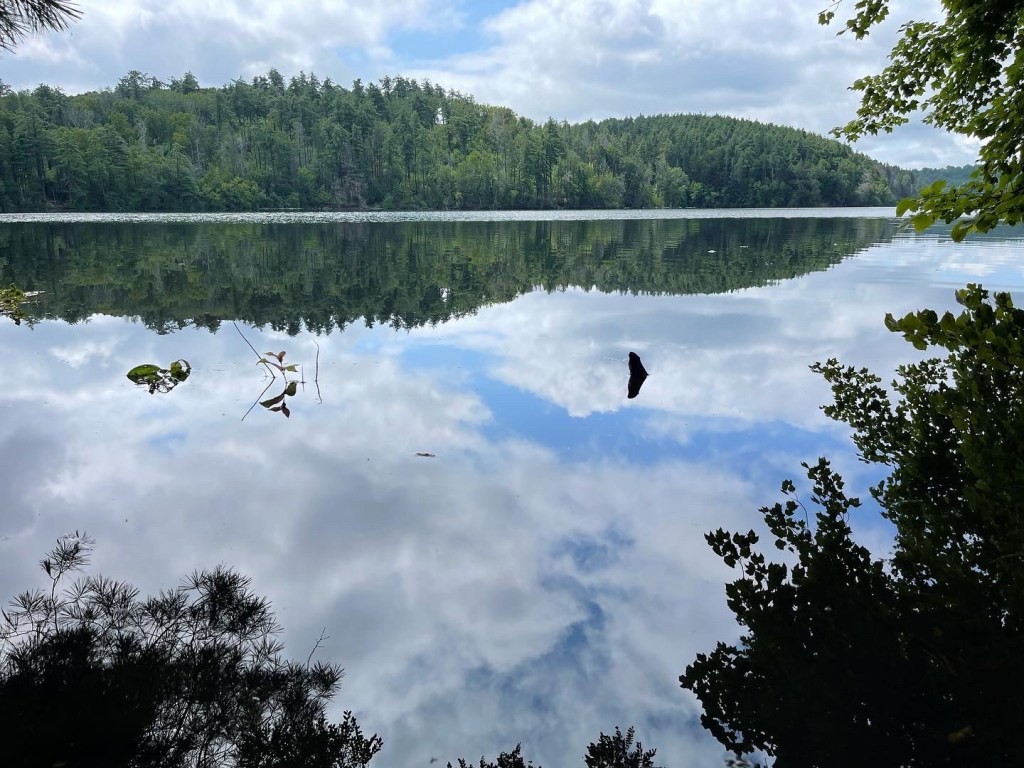
    Whittier wrote this poem for the dedication for a beautiful lake in Haverhill, Massachusetts that was to be named Kenoza Lake. Kenoza means “lake of the pickerel” in the native Algonquian language, and in 1859 the locals formalized the name. There is irony in Native American place names living on when the people who’s language was being used for those names were swept away, but that’s everywhere in the world. The names always betray the past if you dig deeply enough.

    Whittier was an abolitionist, and likely saw the plight of the Native Americans who once lived here with a sympathetic eye. He once lived just a couple of miles away from Kenoza Lake in a quiet farmhouse. His farm looks very much the same today as it did then. Importantly, Kenoza itself also remains pristine, today a protected reservoir that supplies drinking water to the City of Haverhill. That lends a timelessness to the lake and surrounding land that’s impossible not to feel as you walk the grounds.

    The land has transformed over time. It was once deep forest, became farmland (like so much of America in colonial times) and eventually returned to forest again. That the land wasn’t developed required some luck. Dr. James R. Nichols, a wealthy scientist who made his fortune developing chemical fertilizers, acquired the farmland and set about building a castle for himself on top of a hill with views of three states. He called the place “Winnekenni”, which means “very beautiful” in Algonquian. Walking the property, today maintained by the City of Haverhill as parkland and a natural buffer for the reservoir, feels like you’ve been transported back to another time.

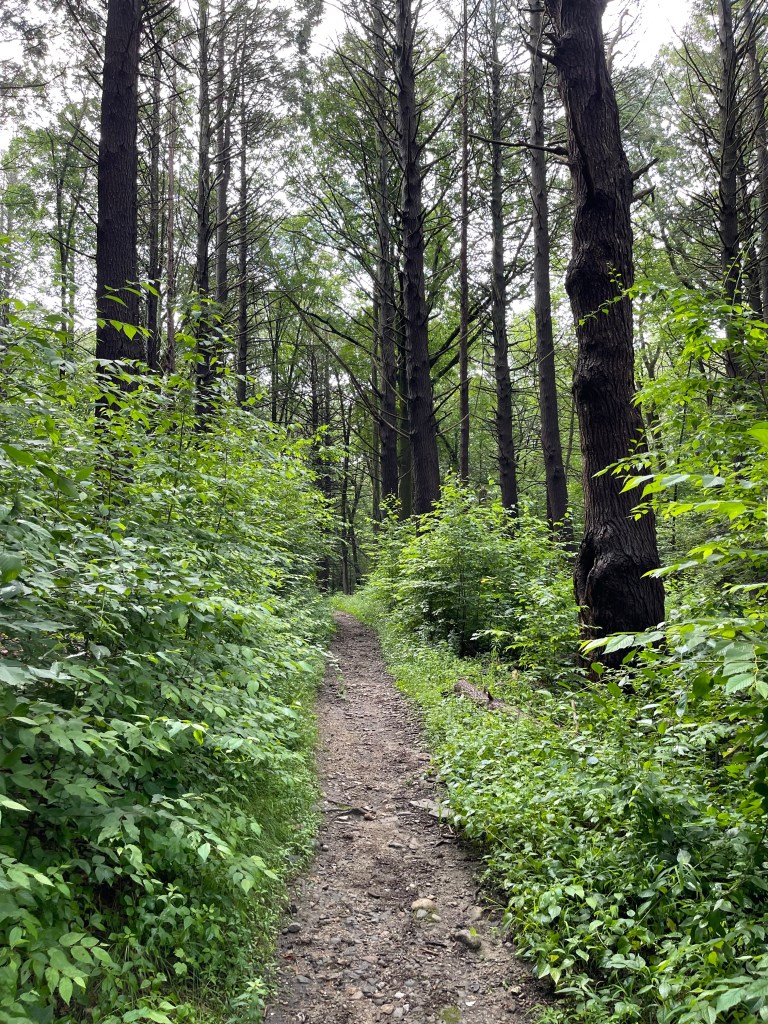
    There is a network of trails throughout the the park, and you can manage a great step count by doing the entire loop around the lake. They range from gravel roads to single track paths squeezed on both sides by abundant undergrowth(including, alas, poison ivy). The trails are well-marked and it’s very difficult to get lost, as you always have the lake to show you your progress. We encountered plenty of walkers, horseback riders and mountain bikers on the trek around the lake, but never felt it was overcrowded. Indeed, on the single track we saw only one other person, a trail runner who quickly distanced himself from us.

    Reservoirs, like graveyards, are time machines back to the days they were established. The lay of the land remains largely as it was then, and offers an opportunity to hear the whispers of history. It’s relatively easy to imagine how this place looked for Dr. Nichols or John Greenleaf Whittier because it’s largely that same place today: timeless, and beautiful.

    Kenoza Lake
    Winnekenni Castle
    The lake is almost always in view
    Local resident
    Very large Bondarzewiaceae fungi enjoying the wet summer
    Single track trail
    One of several memorials in the park
  • Venture, and Be Bold

    “Don’t underestimate the risk of inaction. Staying the course instead of making bold moves feels safe, but consider what you stand to lose: the life you could have lived if you had mustered the courage to be bolder. You’re gaining a certain kind of security, but you are also losing experience points.” — Bill Perkins, Die With Zero

    The question came up just before I began writing this blog—So what are you doing today? It was asked by a friend dashing off to go scuba diving. I mumbled something about the number of miles I needed to walk to maintain my commitment to a charity I’m walking for. There are of course many ways to cover the miles, the trick is to make the way worthy of the things we’re opting out of.

    So what are we doing today? Is it something epic and memorable, or is it satisfying some commitment made? There’s surely value in commitment, for it grounds us in profoundly meaningful ways. We just can’t let it grind us to dust. We must choose our commitments wisely, and default to enriching our life with experiences that lend exponentially profound meaning to a lifetime. If the game of life is score by how well we live it, then we all ought to double down on enriching our days with fulfilling and memorable experiences. Whatever we decide to do with our days, we ought to make it bolder than we might have defaulted to otherwise.

    “Begin, be bold, and venture to be wise.” ― Horace

    It’s essential for us to ask ourselves, what makes a great life? We all keep score in our own way, for we all value some things more than others. Some value security, while some value spontaneity, others simply try to find balance. Life shouldn’t be about regret minimization on our deathbed, but a purposeful quest to reach for a higher plane. Each experience is accumulated and cherished for what it makes of us. Each day may yet be savored. So go on, venture wisely, but with a dash of boldness in this day.