“There will never be a perfect time to do something that stretches you. If you were ready for it, it wouldn’t be growth.”― James Clear
Each day we start over, usually carrying the weight of yesterday on our shoulders. There is something in this that is comforting, but also self-limiting. We ought to pack lighter at the beginning of each journey. We might ask ourselves, what are we carrying that is better off released?
This is the nature of habits and routine, but also of baggage. Baggage wants to be carried from one place to the next. Let it all go and see how light our steps can be. Imagine how far we might leap!
How far might one swim carrying such an anchor? We’re more likely to sink and drown. Let it all go and feel the buoyancy.
Today is as good a day as any to try something new. Small, incremental and worthy of the investment we’re making in our future. The baggage will always be there if we want to return to pick it up. We might treasure burying it instead.
“There will be no one like us when we are gone, but then there is no one like anyone else, ever. When people die, they cannot be replaced. They leave holes that cannot be filled, for it is the fate—the genetic and neural fate—of every human being to be a unique individual, to find his own path, to live his own life, to die his own death. I cannot pretend I am without fear. But my predominant feeling is one of gratitude. I have loved and been loved; I have been given much and I have given something in return; I have read and traveled and thought and written. I have had an intercourse with the world, the special intercourse of writers and readers. Above all, I have been a sentient being, a thinking animal, on this beautiful planet, and that in itself has been an enormous privilege and adventure.” ― Oliver Sacks, Gratitude
Thinking about the progress I’ve made in some areas, I’m pleased with the progression but still frustrated with the gap between who I am and who I want to be. This is a natural state, and leads to either positive change through action or the despair of the powerless. I don’t dabble much in despair, but we’ve all been down the well now and then in the course of a lifetime. Climbing back out is easier for some of us than others. We simply accumulate enough evidence of the light to dwell in the darkness for long.
I work to treat every living creature with the respect due a fellow traveller in this place and time. My work is on myself and making my contribution bigger than it’s been to this point. If we each aspired for greater contribution and a deeper engagement with the world, it follows that the world would be a far more exhilarating place to be. For now, we’ve identified gaps that must be filled. It’s a good thing we’re here to do the work. Awareness and the boldness to take initiative are the beginning of all great progress.
I’m simply a sentient being working to understand the place I fill in this world, and the gap that would otherwise exist were I not a part of it. Developing an awareness of what our unique value is, and creating more of that value for more people, is one way to mark an extraordinary life. The gap between a really great life and extraordinary is what I’ll spend the balance of my life trying to fill. Measured as contribution and value, it feels a worthy use of my remaining time. How about you? Where will you spend yours?
The forest is dead quiet in the early morning hours when you walk out into it. At least until the creatures assess you and, seeing no imminent threat, go back about their business. It’s akin to going to a cocktail party and either working the room as the life of the party or receding back a bit and seeing what’s actually happening in the room. You might believe you’re the life of the party in the one case, but you won’t know what’s actually going on around you. It pays to shut up and read the room now and then.
Sitting quietly in my trusty Adirondack chair, the woods soon erupted into chatter, as various couples expressed distain or encouraged more urgent attention to the nest. A young squirrel chewed through maple branches and hauled them back to the nest, where another squirrel seemed to be dissatisfied with the progress. Nearby, a house wren destroyed the silence with loud chattering birdsong. It’s always the smallest birds that make the most noise. Some might say the same about people. Two ears, one mouth is the ratio I taught my children. Sometimes I even take my own advice.
There have been precious few mornings like this, just sitting outside listening to the world wake up around me. We’ve arrived at the month of July, and in New Hampshire it doesn’t really feel that’s possible. Blame it on the rain, relentlessly taking control of the month of June in the region. We’d all like to gift the precipitation to places that desperately need it now. Canada, on your big day, please have as much as you’d like. Feast or famine: that’s the climate now. The lawns thrive, the tomatoes and basil are horrified.
I use that Adirondack chair for more than just listening to wildlife. It’s the place to listen to what’s happening between the ears as well. Assessing where we are, what we’ve done, what was left undone. Sometimes you have to sit still long enough to recognize it wasn’t ever about listening to the squirrels and house wrens or the weather. Assessing moments with people, places seen for the first time or the thousandth time, projects completed, projects put aside for another day. Where did it all get me? How about you?
We’ve rounded the mark on the year: six months down, six to go. When we look back on the first half of the year, now ended, how do we feel about it? Do we like the view? A good life is represented by stacking our days with memories and small wins, all measured as progress. Sometimes we aren’t progressing at all, but receding and trying to hold it all together as best we can. Sometimes everything slips away and we feel we’re left with nothing. That’s life too. We all know how this ends, but it doesn’t mean we have to let today slip away without a small win. Maybe tomorrow too. String enough wins together and half a year later maybe we actually have something to celebrate. I hope so. But either way, there’s this other half of the year to reckon with, beginning today.
There is a pleasure in the pathless woods, There is a rapture on the lonely shore, There is society, where none intrudes, By the deep Sea, and music in its roar: I love not Man the less, but Nature more, From these our interviews, in which I steal From all I may be, or have been before, To mingle with the Universe, and feel What I can ne’er express, yet cannot all conceal. — Lord Byron, Childe Harold’s Pilgrimage
Do you ever look at the surface of a pond or pool and wonder at the gumption of those who would breach the surface and enter another world? Dolphins and whales leap from the deep and experience our world for a brief moment. Humans dive into water and recall deep within the connection. There’s a calling in water that draws us there. Those who live there apparently seek time in our world as well. This is as it should be, for we are all of the water.
Do you ever feel the presence of the trees when you walk deep in the woods? The ancients, not the brash young things fighting for a place in this world. Old growth trees know things we’ll never know in our brief lifetime. Rooted deeply into the past, reaching into the future, grounded by a sense of place, trees are the life force of the forest. When we cut down forests we rob ourselves and generations to follow of all of these things.
Do you ever spend time above treeline, looking at clouds mingling with the lower peaks below you. Are we meant to be in such places where even the wild things steer clear? Walking in such places brings us closer to the universe, and to the heights we may aspire to in our quiet moments of bold reflection.
We all want a sense of timelessness and a place with the infinite. We forget sometimes that we’re already a part of it. We can’t see the forest for the trees. We must break the surface of self-absorption and see what we’ve been missing deep within ourselves. Doing more of the “do you ever” things is a step in the right direction.
Duxbury, Massachusetts doesn’t have the same notoriety as its neighbor Plymouth, but the roots of history run nearly as deep here. To be fair, if people think of Duxbury at all, it’s usually as an upper class suburb of Boston. There’s plenty of wealth on display in this town. But step away from the massive homes with their perfectly manicured gardens and you’ll find a legacy that reaches back to the Mayflower. The most famous character on the Mayflower, Myles Standish, lived and died in Duxbury, and is buried in what is now known as the Myles Standish Burying Ground.
The burying ground was once adjacent to a meeting house, long gone, but marked with granite stones to indicate where it once stood. It is the oldest continuously maintained graveyard in the United States. The lay of the land is largely the same within the enclosure. The thing about graveyards is you’re walking on ground largely unchanged since the days when the people buried there were laid to rest. The entire area around a graveyard becomes housing developments and strip malls and paved roads, but these small graveyards are a time machine back to another time.
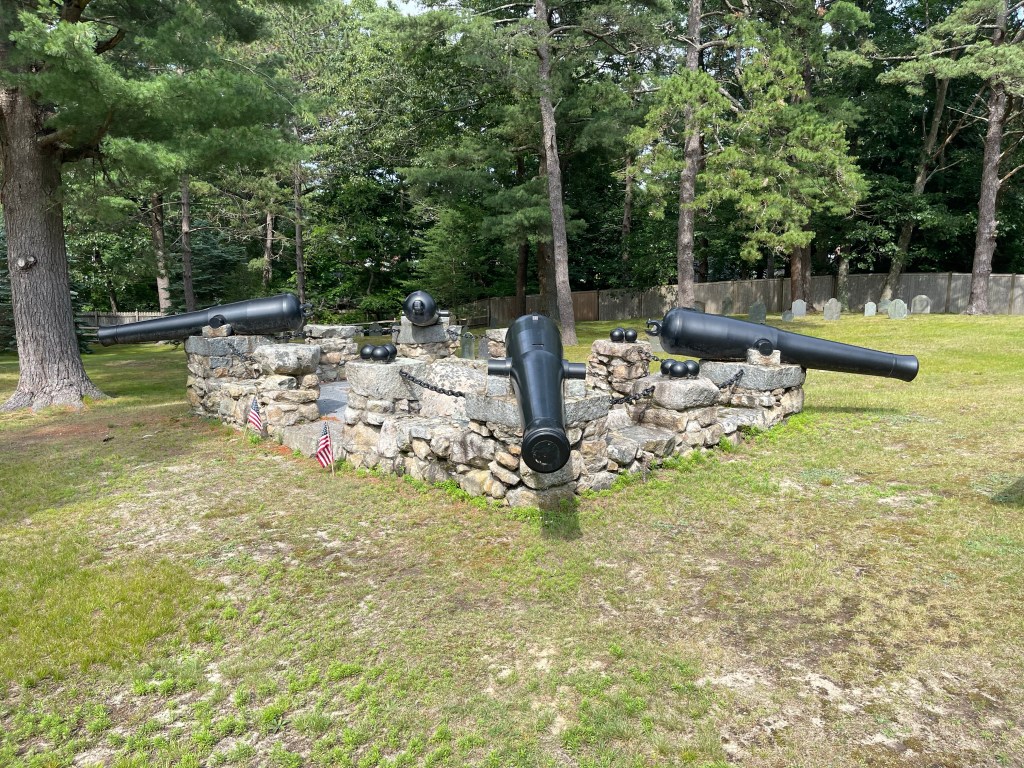
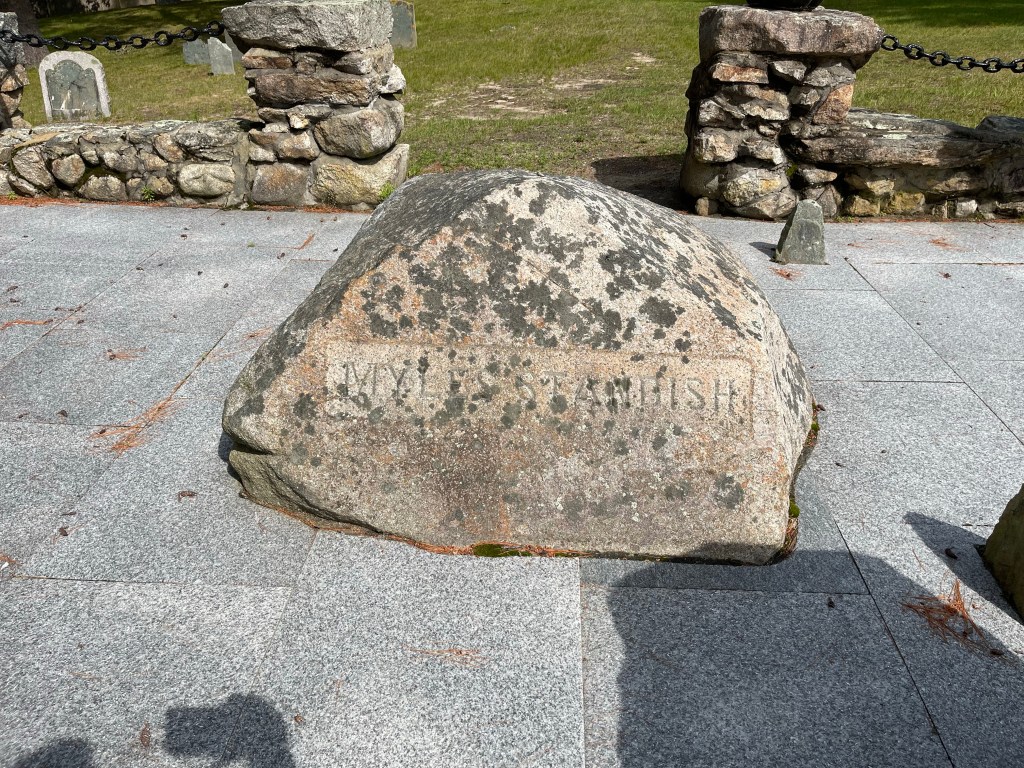
Captain Jonathan Alden, son of Mayflower passengers John and Priscilla Alden, is also buried in this graveyard, and his is the oldest gravestone in the burying ground. Standish, who died well before Alden, likely had small pyramid-shaped stones marking his interment initially, and the monument built around the spot in 1893 (you can see one of these stones behind the boulder engraved with Myles Standish’s name in the picture below). That engraved boulder, like Plymouth Rock, is something for the tourists. The monument itself, with a fieldstone wall surrounding it and four cannon mounted on each corner, projects the violent boldness of the man interred beneath.
Myles Standish was a military advisor to the Pilgrims. By all accounts he was brutal and decisive in his actions. He would preemptively attack when he heard trouble was brewing, and famously stuck the head of one rival, Wituwamat, on a pike as a deterrent to others. There seems to be no doubt that Wituwamat was lured into a room and murdered. Was this act of brutality something to be celebrated or scorned? Was there a legitimate threat to the Pilgrims, and could it have been resolved in a more diplomatic way? What’s clear is Standish believed he was fighting for the lives of the colonists, and used any method he could to intimidate those who he believed were threats to their safety. As with all history, we judge it from the comfort of distance.
At another spot in town, on a point of land jutting out into Kingston Harbor, there are four more granite stones laid out in a park amongst multi-million dollar homes overlooking the harbor. It was here that Myles Standish actually lived. I found this interesting, as a military man like Standish would normally seek the high ground. A review of a Google map later revealed a small pond nearby that would have been his source of fresh water. Perhaps Myles dined regularly on Duxbury oysters, which have become almost as famous as the town’s most notable resident.
“The business of life is the acquisition of memories. In the end that’s all there is.” — Mr. Carson of Downton Abbey
“You retire on your memories. When you’re too frail to do much of anything else, you can still look back on the life you’ve lived and experience immense pride, joy, and the bittersweet feeling of nostalgia…. Making deliberate choices about how to spend your money and your time is the essence of making the most of your life energy.” — Bill Perkins, Die With Zero
We all talk of how the time flies by, but perhaps we ought to focus on how many great memories we accumulate in that span. If we’re living well, experiences are acquired and flipped into memories with the turn of the calendar. We may not become financially wealthy, but surely we might accumulate a lifetime of memories worthy of our time. As the quote above points out, in the end, isn’t that all there is?
What are memories but the realization of deliberate action? As much as I love a good spreadsheet, I know deep down that working in them isn’t creating memories that will last a week, let alone a lifetime. But I may just remember the conversation I have with someone important in my world a lot longer. I may recall the thrill of peering over a cliff at an angry ocean in Portugal and smile someday when I’m too old for such things. I expect I’ll still smile at the recollection of my kids realizing the amusement park ride they insisted on going on was going to be a lot scarier than they’d bargained on when they begged to go on it. This is the accumulated wealth of memories.
Perkins’ book challenges us to stop accumulating savings and start spending our money while we’re healthy and fit enough to actually do the things we promise ourselves we’ll eventually do, someday, when we retire. As if we can do at 65 what we might do at 25 or 35. Do it now. There is no tomorrow, and if there is, we won’t be able to pull off some of the things we believe our bodies and minds will be capable of someday when.
I’ve watched too many people in my life hear the news that they won’t make it to retirement. Cancer seems to be the most common thief of dreams, but maybe an accident or a heart attack steals everything you’ve ever planned for “someday when” away from you. Your life is now: accumulate the memories that will make you richer then. It’s the best return on investment we can have with today.
“Men are inclined to laziness. Some will feel that he might have said with greater justice: they are all timorous. They hide behind customs and opinions. At bottom, every human being knows very well that he is in this world just once, as something unique, and that no accident, however strange, will throw together a second time into a unity such a curious and diffuse plurality: he knows it, but hides it like a bad conscience.” — Friedrich Nietzsche, The Will to Power
To borrow the Kenny Loggins phrase: This is it. Make no mistake where you are. You’re going no further. We know this intuitively, yet we still wrap ourselves in lazy routines and escapism. We’ve got nothing more than now to work with, yet we treat our days as frivolously as disposable napkins. ’tis now or never friend. Break the lazy—be bolder.
Easier said than done. We all have our bank of bad habits. I know I ought to work out more and put in more time with the things I’m leaning into becoming. But life gets busy, people we care about need our attention, work demands are never quite satiated. The fact of the matter is, after a long day of filling other people’s buckets our own feels pretty empty. Good enough seems okay in such moments. This is where we must break free of ourselves.
“How does one become stronger? By deciding slowly; and by holding firmly to the decision once it is made. Everything else follows of itself.” ― Friedrich Nietzsche, The Will to Power
Decide what to be and go be it. And then establish habits that affirm the identity we wish to have in this brief lifetime. Simple, right? We know better. Creating the person we wish to become is never simple, but it is possible. This is the less lazy way, and everything else follows.
You have been forced to enter empty time. The desire that drove you has relinquished. There is nothing else to do now but rest And patiently learn to receive the self You have forsaken for the race of days.
At first your thinking will darken And sadness take over like listless weather. The flow of unwept tears will frighten you. You have traveled too fast over false ground; Now your soul has come to take you back. Take refuge in your senses, open up To all the small miracles you rushed through.
I might go weeks without reading poetry. I may feel victorious in my efficiency and productive use of time. I can sometimes grind through my days in hopeful work, forgetting to walk outside to greet the day. These are days of emptying the bucket while filling the ledger with checked tasks. Empty buckets make a hollow sound. They demand to be filled.
It’s not lost on me that I’m posting about taking time to rest at the beginning of another work week. When we go, go go! for weeks at a time, sometimes things like weekends disappear in a flash. We forget to see the small miracles we rush through in our mad pursuit of getting things done.
Slow down. Step away. Find that which is calling you from outside yourself. The work will always be there, awaiting your return. Or maybe it was never your work at all. How can you know if you never take the time to listen?
The days and the seasons roll on by, like waves to the beach. We only have so many days. Only so many seasons. We must learn to slow down and celebrate the one we’re in.
When the goal is to seize the day—Carpe diem— then being busy is the natural state. To do everything we wish to do in a lifetime requires our full attention. But the thing about attention is it is quickly stolen away by all of life’s distractions. Focus is thus essential to prioritizing the most important things. We know when we’re being pulled away from the meaningful and important, and when we’re deeply immersed in it. What we lean into makes all the difference in how we feel about those grains of sand moving through the hourglass.
There’s no doubt that one kind of “being busy” can be viewed as a distraction from other things we ought to be tackling. But there’s also a kind of “being busy” that is living an active, meaningful life. One key indicator is the phrase itself: When we say we’re very busy, it’s usually the distracted kind of busy. When we’re deeply engaged in meaningful activity, we don’t think of ourselves as being busy so much as making the most of our time.
Taking stock of the year as we close in on the halfway point, we might be amazed by all we’ve done with the time. I hope so, for isn’t that the point? To augment our days with joyful activity at the expense of all of the trivial pursuits that the universe throws at us has always been our underlying mission.
It’s one thing to be aware, it’s another to be absorbed by the trivial. How many grains of sand would we trade for things that don’t matter in the end? We must be frugal, even as we must be active. Our lives depend on it.
“And I asked myself about the present: how wide it was, how deep it was, how much was mine to keep.” — Kurt Vonnegut, Slaughterhouse-Five
“It occurred to him that there must be some state institute, a kind of time bank, where he would be able to change at least some part of his shabby seconds.” — Rainer Maria Rilke, The Notes of Malte Laurids Brigge,
Time is not ours to keep—more a wave we surf to the beach. We dabble in time, thinking about improving our productivity and efficiency and doing more with less, but really, we’re trying to avoid wasting the time we have. Making the most of the present is the only worthy goal as we surf this wave.
Lately conversations about time have come up a lot in the circles I run amuck in. Talk of people taking more time off, people who feel they’re time hasn’t been used wisely, people quickly running out of time (I’ve had more conversations about hospice recently than at any time in my life). Everybody is going through something in their lives. The surfing isn’t always great in this complex world.
This writing habit is one of the best things I’ve invested my time in. Writing isn’t passing the time, and it isn’t a celebration of one’s greatest exploits. It’s putting a spotlight on the hourglass and seeing each grain of sand and savoring the seconds. This is living in the present: good, bad and all that lies in between. The secret is to add depth and breadth to each moment of it. And maybe write the chapter in such a way that it lives on beyond the present.