“Do you think that I count the days? There is only one day left, always starting over: it is given to us at dawn and taken away from us at dusk.” — Jean-Paul Sartre
“You are — your life, and nothing else.”— Jean-Paul Sartre
There are days that feel bigger than others—weddings and epic vacations quickly come to mind, but really every day is epic for the gift it represents. And being here as we blessedly are to dance with this magnificent day, we ought to celebrate and honor it, as one does with any cherished gift. For this is our moment.
Sartre is pragmatic and concise in his observation that we are this: Right here, in this moment and in what we’re doing with this gift. We are surely the sum of our days, for they carried us here, but yesterday was taken away from us like empty wine bottles on recycling day. Appreciate them, but focus on uncorking this moment and all it offers.
“Dale Hollow Dam and Lake was authorized by the Flood Control Act of 1938 and the River and Harbor Act of 1946. The project was completed for flood control in 1943. Power generating units were added in 1948, 1949 and 1953. The project was designed by the U.S. Army Corps of Engineers and built by private contractors under the supervision of the Corps…. The dam impounds a length of 61 miles of the Obey River creating Dale Hollow Lake with 620 miles of shoreline, 27,700 acres of water, and 24,842 acres of land for recreational opportunities. ” — US Army Corps of Engineers, Nashville District
Dale Hollow Lake is named after William Dale, a government surveyor who came to the region to survey the border between Tennessee and Kentucky. He settled in the region and later drowned in a boating accident while taking part in the War of 1812. That drowning would prove prescient. The land was originally the region of the Cherokee tribe, and retains its natural beauty, though the Cherokee and William Dale would hardly recognize the place now, hundreds of feet underwater in places they once walked.
The shoreline is controlled by the Army Corps of Engineers and protected from development, largely preserving the area as a pristine natural environment. Beyond the shoreline, development is grabbing hold of the region, but the lake remains a beautiful statement for preservation, even as it conceals what it stole away. There’s a town named Willow Creek under this lake, built before the Revolutionary War, a ghost lingering below the water hinting at times past. We forget sometimes, living in our moment of now, that there was so much we don’t know about what was here before us. The region whispers its Cherokee and early settler history when you stop and listen.
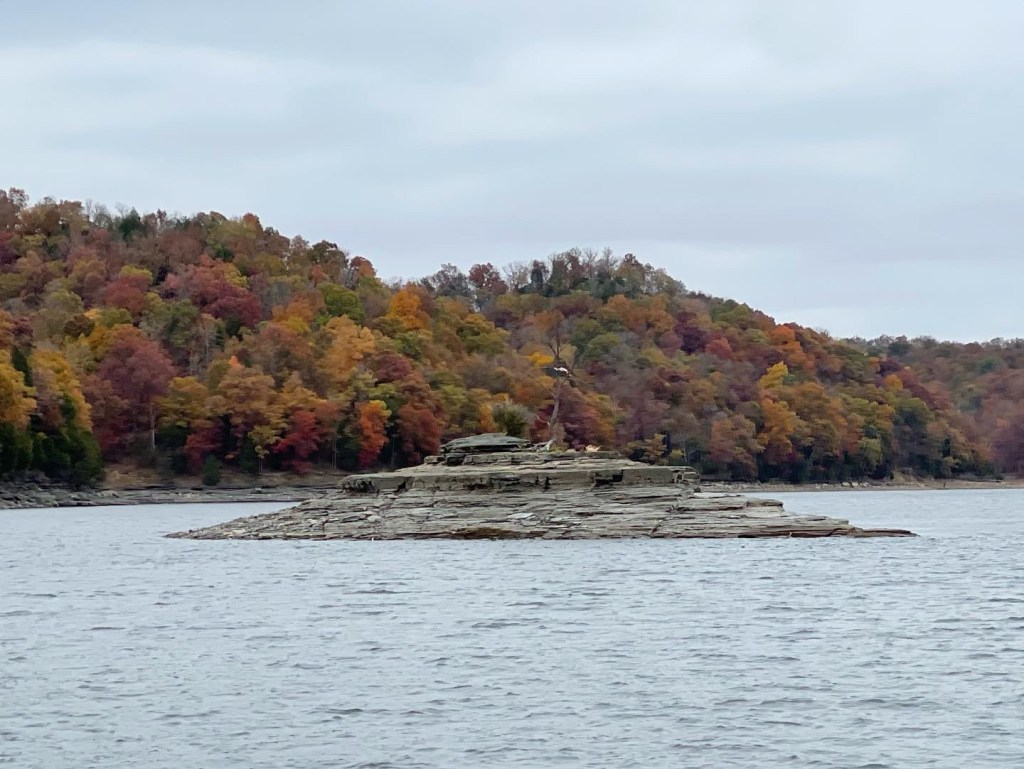
Being out on a boat on a raw Late October day, it was easy to listen. The hundreds of houseboats, pontoon boats and fishing boats were largely dormant at marinas. I imagine in summer the area is a bit “Ozark” crazy, but we couldn’t have seen more than a half dozen other boats out on the water with us, all of them fishermen. Off-season has it’s perks.
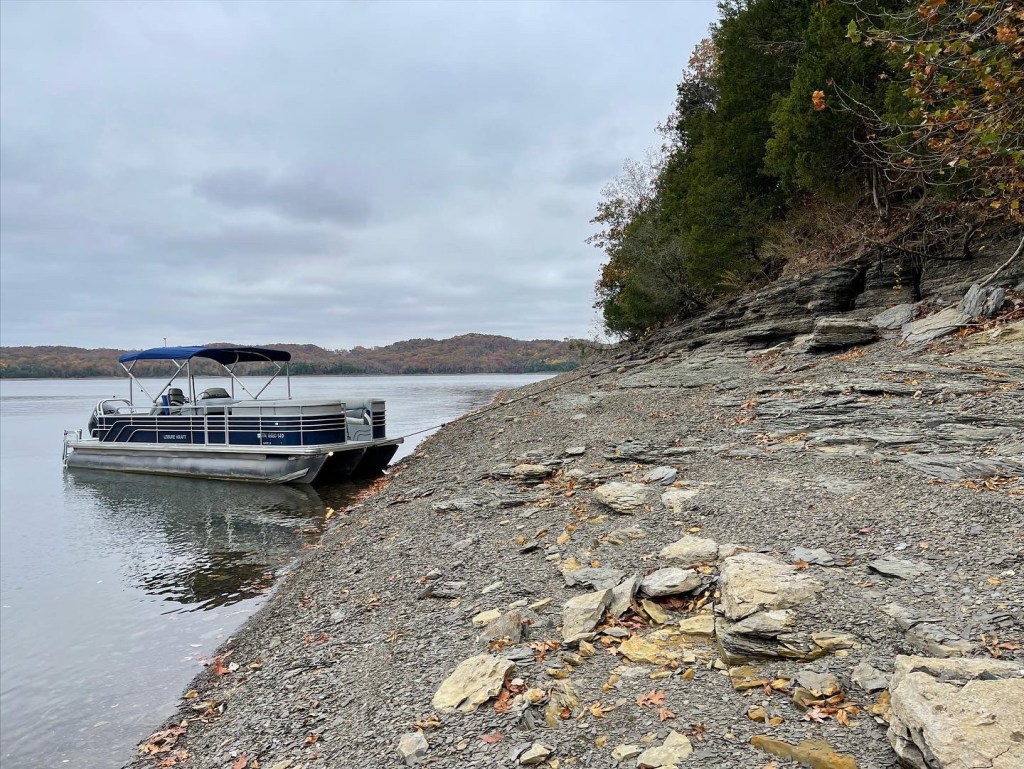
Turning off the engine, you quickly drift past slate and limestone beaches created when they lower the lake for the winter. The shoreline is composed of countless bits of broken slate, brittle and pliable underfoot. This doesn’t seem a great place for walking barefoot, but as with anywhere, when you dress for the environment it makes all the difference. Walking on those broken sleet beaches was fascinating and wonderful.
And I do wonder at this place. The region is going through an identity crisis of sorts. On the one hand, you have the people who have always been here: farmers and hunters and people scraping together a living in an area desolately beautiful. On the other hand you have land speculators scooping up property at ridiculously low prices (for a New Englander) and building vacation and retirement communities. Just as the lake swallowed up Willow Creek, there’s an entire community here that is slowly drowning in change, and reacting to it as you might expect. Trump and “Let’s Go Brandon” signs are everywhere, crime is rising as some misfit locals break into vacant houses packed with luxury goods. There’s friction in change, and the changes here are accelerating. Like the lake, some will drown in it, and others will find opportunity to flourish.
Hilltop turned islandPillars of slate exposed when lake is lowered in winterDale Hollow Lake is split between Kentucky and TennesseeWhen the lake is lowered it exposes a slate and limestone “beach” worth exploring
“A thousand Dreams within me softly burn: From time to time my heart is like some oak Whose blood runs golden where a branch is torn.” — Arthur Rimbaud, Complete Works
We all dream of things beyond the scope of our present situation. It’s human nature to dream, and we tend to collect dreams like books waiting to be read. How many books can we read in a lifetime? When you think of your average, it’s a surprisingly short number. So it is with dreams: we may dream an unlimited number, but accomplish but a few. We ought to make them our favorites.
Dreams are evasive distractions until we start working towards them. Dreaming is unproductive on its own, for we must scheme as well. Without a plan, we risk walking in circles. Or maybe we dance in circles, happy in our own little world, content to linger with our dream. But we humans like to scheme too, and soon we’re dreaming of the next mountain to climb.
Schemes and dreams pair well together in this way. But we’ve all experienced moments where we’re forever planning our next big move, but never actually beginning the climb. Excessive planning is procrastination. Dreams and schemes are just a dance without action.
We tend to think we’ll be productive and get things done in good time. But great ideas don’t transform themselves into completed work, the muse just chooses a different author willing to dance long enough to make it real. That trip of a lifetime likewise doesn’t happen on it’s own. We must do the work to realize our dreams, or they’ll simply dance with someone else.
“Homer’s epic poems brought into focus a notion of arete, or excellence in life, that was at the center of the Greek understanding of human being…. Excellence in the Greek sense involves neither the Christian notion of humility and love nor the Roman ideal of stoic adherence to one’s duty. Instead, excellence in the Homeric world depends crucially on one’s sense of gratitude and wonder. …. the Greek word arete is etymologically related to the Greek verb “to pray” (araomai). It follows that Homer’s basic account of human excellence involves the necessity of being in an appropriate relationship to whatever is understood to be sacred in the culture.” — Hubert Drefus, All Things Shining
My first memory of hearing the word arete was when a history professor I was quite fond of suggested we use it as the name of a new rowing shell our crew had acquired. The Greek word for excellence seemed as worthy a name as any to aspire to, and so I proposed it. The rowing coach, never one to embrace such things, chose a different name. And it turned out that we never did quite achieve excellence, settling somewhere into better than average. I wonder if we’d chosen it we might have been inclined to be so? One can’t very well name a rowing shell Arete and finish in the middle of the pack.
What’s become clear to me over the years since that first encounter with arete is that it’s been my objective ever since. We reach, fall short, move a step closer and reach again. That’s how we move forward towards something greater than our previous self. Living with a sense of gratitude and wonder, embracing that which is sacred, and working towards excellence is a blueprint for a lifetime.
We can’t control everything in life. Surely things happen along the way that may be chocked up to luck, timing or serendipity. But certainly, what we aspire to makes all the difference in how full our lives turn out to be.
Call me old-fashioned if you will. Call me privileged in a first world sort of privileged way. But I prefer an assigned seat when I travel. The budget airlines like Southwest built an empire on first come, first served, which merged into assigned groups. My particular group is C21, which isn’t good folks. There are 140 people boarding before me, making it likely I’ll be checking a bag and sitting in a midfle seat. Poor me, right?
The thing is, I don’t mind any of this except for the lack of an assigned seat. Middle seat? Not ideal but will make it work. No room for my bag in overhead ? Don’t lose it please. But the mystery of musical chairs? I can do without it, thanks. Give me predictability in business travel.
We all have our crosses to bear—this is one of mine. Wanna get away? Check in early. But on the plus side, I finished this blog post during the wait for my middle seat.
In the deep fall don’t you imagine the leaves think how comfortable it will be to touch the earth instead of the nothingness of air and the endless freshets of wind? And don’t you think the trees themselves, especially those with mossy, warm caves, begin to think of the birds that will come – six, a dozen – to sleep inside their bodies? And don’t you hear the goldenrod whispering goodbye, the everlasting being crowned with the first tuffets of snow? The pond vanishes, and the white field over which the fox runs so quickly brings out its blue shadows. And the wind pumps its bellows. And at evening especially, the piled firewood shifts a little, longing to be on its way. — Mary Oliver, Song for Autumn
Autumn whispers to us through trees. For trees, naturally rooted to place, learn a thing or two in their seasons. Whole communities once thrived in places where only trees stand today. Old stone walls and cellar holes, old road beds and grooves in stone that once served as a simple mill. These things become more apparent when we act like trees and linger awhile.
Humans aren’t rooted to a place, not really, we’re too prone to wandering. In this way, we’re more like the leaves, sailing off to find our place in the wind, eventually landing and becoming a part of the place we settle into in our time. If leaves become loam and feed the forest, don’t we too feed the future in our service to others?
But there’s a restlessness in many of us. Perhaps remembering our time as leaves and longing to fly once again, a fire burns inside. Our fire, when fully expressed, may transform and carry us to places we couldn’t imagine before we fed the spark. Feed the fire, autumn whispers.
Surely, ash returns to earth just as leaves do. But how far might it soar before it turns back towards the earth? We live in days, but ought to think in seasons. Everything has its time. The earth awaits.
“I cannot endure to waste anything so precious as autumnal sunshine by staying in the house.” ― Nathaniel Hawthorne,The American Notebooks
I write this knowing what awaits me. Today is the day of reckoning for a lover of trees. For in late October we turn our eyes from the skies to the work at hand, and sweat and toil to relocate those countless, blessed fallen leaves from the yard and place them with their kin in the woods. This process will repeat itself several times before it’s done, and this writer will bow to the trees in the order of their fall; the maple and elm, hickory and oak, even the pine sheds itself of old needles. Autumn is called fall for a reason, after all, so fall they must.
My secret is a fondness for such labor. It’s a workout to be sure, but work that fills the soul, as weeding or washing dishes fills the soul when meditated upon in the moment. Our singular focus on any one thing is preciously rare in this world of sound bites and notifications. Leave the phone behind and get back to the work—and find yourself in the process.
There will be no rider mower efficiency in this work. I made the choice to walk my lawn when mowing a few years ago, and don’t regret it. There is a soreness that offers solace on a crisp October day, earned through such moments wrestling fallen leaves. If this seems wonderful to you, come celebrate with me. For there are more than enough leaves to share, and only so much autumnal sunshine to work with.
“He who is not courageous enough to take risks will accomplish nothing in life.” – Muhammad Ali
“He who has a why to live for can bear almost any how.” ― Friedrich Nietzsche
Is courage the leap into the unknown or the perseverance and grit to see it through? I think Muhammad Ali would add that courage requires more of us than simply stepping into the ring, it’s taking the punches and standing up again round-after-round. We all have our own ring to step into, filled with work, family, relationships, fitness goals, writing goals, getting-through-the-day goals.
What are we prioritizing and what do we let slip away? Isn’t it just as courageous to say no as it is to say yes to something? Perhaps more so? Which does beg the question: What are we really trying to accomplish in our brief time here?
A long and rewarding career? Wrestling a career from the ground up is a grind, filled with moments of sacrifice and tactics, honor and betrayal, tedium and tenure. How we play it determines just how long and rewarding it turns out to be. Maybe we also prioritize building a strong nest and raising a family. It takes courage simply to have children, especially for the mother, but also courage to stay in the game for the long haul—raising them to be strong advocates for decency and hope.
Just what do we lean into for the long haul? Comfort? Adventure? Can you be comfortable when you seek adventure? Perhaps, but isn’t it a different kind of comfort than the comfort the person who seeks comfort seeks? Every climb requires discomfort. Every leaper must bear the impact of the landing before leaping again. Discomfort is what we pay now for comfort later. Conversely, comfort now tends to make later more discomfortable. We each must pay our dues in life to get to the place we want to be. Life takes time and courage to see it through.
The neighbors through the woods had a large shed built last year during the summer months. My bride and I debated just what they were building as it seemingly took all summer to complete the work. She said that whatever it was, we’d have the big reveal when the leaves dropped in the fall and everything would become obvious. Sure enough, that’s exactly what happened.
It’s worth asking ourselves every time we stand up in our own ring, why am I doing this? For there’s no long-term courage without a compelling purpose. Sometimes the answers are obvious, and sometimes we have to wait for our own big reveal, when the seasons change and the things that were most important all along become apparent. Often, courage is staying the course long enough to find out.
So through the night rode Paul Revere; And so through the night went his cry of alarm To every Middlesex village and farm,— A cry of defiance, and not of fear, A voice in the darkness, a knock at the door, And a word that shall echo forevermore! For, borne on the night-wind of the Past, Through all our history, to the last, In the hour of darkness and peril and need, The people will waken and listen to hear The hurrying hoof-beats of that steed, And the midnight message of Paul Revere. — Henry Wadsworth Longfellow, Paul Revere’s Ride
Most every schoolchild in America learns the story of Paul Revere, who rode out to warn of the British march on Lexington and Concord on the eve of the American Revolutionary War. What you never hear about is that Revere was captured by the British on his ride between Lexington and Concord, never warning the latter town, but that one of his counterparts on that night escaped capture and completed the job.
Paul Revere and William Dawes both set out to warn colonists about the British march to Lexington and Concord, taking different routes to Lexington. They reunited in Lexington and set off together to warn the residents of Concord of the British Regulars’ imminent march. During their ride, they came across Dr. Samuel Prescott, who’d been out courting a woman named Lydia Mulliken. That chance encounter would prove fortuitous for the colonists.
Prescott decided to join Revere and Dawes to help warn the residents of Concord. During their ride, they were stopped by a British patrol, who attempted to take them prisoner. Revere was captured, Dawes was able to flee back towards Boston, and Prescott, who knew the area well, evaded capture and was thus able to complete the ride to Concord, where he warned his fellow colonists.
“We set off for Concord, and were overtaken by a young gentleman named Prescot, who belonged to Concord, and was going home. When we had got about half way from Lexington to Concord, the other two stopped at a house to awake the men, I kept along. When I had got about 200 yards ahead of them, I saw two officers as before. I called to my company to come up, saying here was two of them, (for I had told them what Mr. Devens told me, and of my being stopped). In an instant I saw four of them, who rode up to me with their pistols in their bands, said ”G—d d—n you, stop. If you go an inch further, you are a dead man.” Immediately Mr. Prescot came up. We attempted to get through them, but they kept before us, and swore if we did not turn in to that pasture, they would blow our brains out, (they had placed themselves opposite to a pair of bars, and had taken the bars down). They forced us in. When we had got in, Mr. Prescot said ”Put on!” He took to the left, I to the right towards a wood at the bottom of the pasture, intending, when I gained that, to jump my horse and run afoot. Just as I reached it, out started six officers, seized my bridle, put their pistols to my breast, ordered me to dismount, which I did. One of them, who appeared to have the command there, and much of a gentleman, asked me where I came from; I told him. He asked what time I left. I told him, he seemed surprised, said ”Sir, may I crave your name?” I answered ”My name is Revere. ”What” said he, ”Paul Revere”? I answered ”Yes.” The others abused much; but he told me not to be afraid, no one should hurt me.” — Letter from Paul Revere to Jeremy Belknap, circa 1798
Longfellow’s poem made Paul Revere rightfully famous, but he did a disservice to Dawes and Prescott. Early on the morning of 19 April 1775, it would take all of them to finish the job. It’s funny that Paul Revere’s own accounting of the night receives less attention than Longfellow’s romanticized tale. But that’s history for you, we remember it as it is told, not always as it was.
Site of Revere’s capture with the modern road beyondAutumn foliage along the route
When we come across young people who exhibit a level of maturity beyond their years, we often describe them as having old souls. Many of us believe that the job of parents is to raise children to be old souls from as young an age as possible. Teaching life skills that will carry them a long way in life is the obvious primary mission, but also critical is to avoid leaving as much of our own personal baggage on their shoulders as possible. The best parents are both instructive and inclusive with children. When they feel a part of the conversation, they feel enabled and drawn into the world. When they’re constantly berated and corrected by parents, they feel inadequate and diminished. Thus old souls are formed by inclusive parenting.
Young hearts think in possibility, take leaps of faith, seek adventure and break rules. Certainly many young people have a young heart, but many don’t. Just so, there are many old people with young hearts too. It’s an exclusive club, revealed with a secret handshake and a twinkle in the eye—you know the young at heart when you encounter them in the wild. And if you’re inclined to do things that others feel aren’t appropriate for your age and status, well, you might have a young heart too.
To get anything done in this world, we must have a healthy combination of old soul and young heart: Maturity and insight mixed with the Moxie to just do it already. Old souls with young hearts make the world go round. Inventors and pioneers, musicians and poets, fighter pilots and social leaders who dare shake up the status quo, all have the right stuff. Bold, but not reckless, they seek expression in their chosen craft.
We forget, sometimes, that older people with young hearts get a lot of things done too. We can accomplish so much more as we get some momentum behind us if we choose to pursue our own passions. Age is simply a number—it’s fitness, health and vibrancy that fuel the fire, whether you’re 23 or 103 or somewhere in between. If we’re lucky and blessed with enough runway, forward propulsion and lift, we just might soar. Life is best lived with an old soul and a young heart.