Blog

  • Add a Question Mark

    Don’t accept the false stories people tell.
    Things are neither good nor bad — they’re as neutral as a rock.
    When people give opinions, add a question mark.
    If they say, “Immigration is bad,” change it to, “Immigration is bad?”
    Let the questions drift away, unanswered.
    – Derek Sivers, How To Live

    There’s a hidden message in this Sivers book that comes to you as you read it. Don’t take it all at face value. Question everything. Especially the very things you’re reading in his book. The advice feels both right on point and at other times the completely opposite of what you believe in your core. And that’s the point of it all. There’s no set way to live your life, question all advice and find what works for you.

    I wish more people would add a question mark instead of just blindly believing what they hear from people with accumulated connections, titles and degrees. They may be absolutely correct about a position they take, but it’s just a story until we validate it ourselves. The old expression, “Trust, but verify” comes to mind. Add the question mark to those statements and watch them transform:

    Vaccinations are meant to control people?

    Government serves people?

    There is only one true god?

    You must stick with one company to grow your career?

    You aren’t “qualified”?

    Tom Brady is the greatest quarterback of all time?

    See? Most people throw their beliefs at us to try to make it stick in our own mind. Adding the question mark is like spraying teflon on our skull, making us immune to questionable stories, and making us assess the validity of the feasible. Every statement above could be true, or complete bullshit, but we don’t really know which at face value. We must add the question mark, and in doing so, pause and assess the original statement. Or, for the truly outlandish, let it drift away.

    But Brady is definitely the GOAT. Right?

  • Returning to November Stillness

    Walking along the edge of the woods through a thick blanket of fallen leaves, I noted the changes in the landscape since I was last home. New Hampshire is well past peak now, and recent wind and heavy rain coaxed some holdouts down in my absence. The hardscape is glaringly obvious now. November in New Hampshire offers a cold stillness that can be jarring for the uninitiated. But I love it for all that it offers.

    No doubt the pandemic made everything different for all of us. Collectively we might never be the same, but this is the natural state of the world, isn’t it? The one thing the pandemic did, aside from all the horrific stuff, was alter our perception of the world. For if there’s one benefit to what we’ve collectively gone through, it’s acquiring a heightened sense of change. We were forced to slow down and look around at the circle we placed ourselves in. And reflect on whether that was where we wanted to be.

    Bouncing across the country these last two months, I’ve savored some incredible regional food that’s as much a part of the uniqueness of a place as the language and landmarks. I’ve had sourdough bread in San Francisco, popovers in Vermont and biscuits in the Carolinas. Breaking bread offers lessons. The food tastes amazing whether you lean to the right or the left. We’re all human, we just forget that sometimes in our race to categorize others. There’s nothing like a face-to-face conversation to define the common ground between us. And this is one of the primary benefits of travel — getting out of your circle of influence into something wholly new. And seeing that we’re not all that much different from each other after all.

    When my son was two months old I went away for ten days on a white water rafting trip through the Grand Canyon I’d had booked for well over a year. As funny as it seems, I felt in that time away that I’d missed a lot of him growing up. But in going away, I learned to pay more attention to the moment-to-moment changes when I was back home. Sometimes you don’t know what you’ve got until you’re gone. Returning to the stark woods of New Hampshire this November, I’m aware of the changes I’ve missed here. And the changes that have taken place within me while I’ve been away. In the stillness of November, I celebrate both.

  • Carolina On My Mind

    Dark and silent, late last night
    I think I might have heard the highway call my name
    Geese in flight and dogs that bite
    Other signs that might be omens say, “I’m goin’, I’m goin’”
    I’m gone to Carolina in my mind
    – James Taylor, Carolina in My Mind

    There’s a sense of place that feels right when you’re in the Carolinas. Something about the land that feels like home. Something about the people that makes you feel welcome. I can feel it when I’m in the region, it’s a place I could live in. Judging from the list of best places to live in the USA put out by a couple of publications, I’m not the only one to feel this way.

    North and South Carolina are increasingly thought of as home for transplants from the north. Those looking to retire somewhere that feels like home without the extreme weather, those who are young and aspire to build a great life for themselves in an up and coming place. Those who just want to be where the air is clean and the people are friendly.

    There’s no doubt that Raleigh, North Carolina is a trendy city. It often hits the top five on those best places to live lists, and why not? Great job market, great college scene, easy access to the outdoors and city life alike. Raleigh is one of those places you step into and feel like you could live in forever, should you ever want to move away from all that you’ve built around yourself in the place you call home already.

    The Warehouse District is a distinctly cool place with great restaurants, art galleries, breweries and coffee shops in old brick buildings. If you love sushi try O-Ku for delicious nigiri and sashimi, if you love tapas get yourself to the restaurant Barcelona (of course, the city in Spain is great too!) for a great selection of small plates. These are just two restaurants jammed full of people celebrating life for awhile in a place built for it. Raleigh is just one great city in the Carolinas with great vibes reverberating with people in the know. Charlotte, Greenville, Charleston, Winston-Salem, Asheville also get a lot of attention.

    On the opposite end of the food spectrum, go to Biscuitville for a uniquely tasty biscuit with a Carolina twist. Don’t worry, there’s plenty of opportunities to burn off those epic biscuits with great hiking and mountain biking in the area. The Carolinas deserve the attention they’re getting as a wonderful place to move to. But let’s keep that to ourselves, we don’t want to ruin a good thing.

  • The Hidden Giant

    “A fox looked at his shadow at sunrise and said, “I will have a camel for lunch today.” And all morning he went about looking for camels. But at noon he saw his shadow again—and he said, “A mouse will do.” – Kahlil Gibran, The Fox

    Walking on a beach at sunset earlier this week, shadow revealing the giant hidden within me, reminded me of this fable by Gibran. The beginning of the day is an opportunity to dream big dreams, with the freshness of the morning suggesting we might just be capable of anything. The long day might temper this enthusiasm, full as it is with ebbs and flows, accomplishments and setbacks, but the end of the day offers a chance once again to look at ourselves differently. To see what we’ve achieved and what we might yet do.

    There’s something about seeing yourself from a new perspective that reminds you that you’re not done just yet. You’ve still got that potential for bigger and better things; for greatness. The world is bigger than this day, and that long shadow is a reminder that you can be too.

  • Through Fields of Cotton

    Driving through the Carolinas on back country roads in harvest season, you’re struck by the endless miles of ripe cotton greeting you. With many crops, you look at it and wonder what it might be when you’re flying by at 50 MPH. Not so cotton. You know immediately what this crop is. You’ve been wearing it all your life. Ripe cotton waves back at you like a stadium full of home run hankies or laundry lines strung with tighty whities.

    Cotton fields echo. Deep down you know the labor history of this crop, know the historical advancement in picking the stuff from slavery to machinery and all it meant in between. Cotton and tobacco share similar echoes, but cotton reverberates a bit louder. As I understand it the crop was more labor intensive to pick, but also grew exponentially in demand. Cotton was one of the first commercial crops grown by European settlers in America. They grew it in both Florida and at Jamestown, Virginia in the first wave of settlements. The value of cotton in human lives demanded attention, and fueled generations of economic prosperity and more than a little oppression too.

    Driving through field-after-field of cotton you begin to feel the weight of it all, this essential crop for so much of what we wear and use in our daily lives. I wanted to shout to stop the car so I could walk through the fields, feeling the cotton plants (Gossypium) in my own hands. But we kept rolling through, and those endless fields soon felt like clouds rolling by your plane window. And I began to feel like we were flying through history.

    Cotton Firld
  • Into My Arms

    And I don’t believe in the existence of angels
    But looking at you I wonder if that’s true
    But if I did I would summon them together
    And ask them to watch over you
    To each burn a candle for you
    To make bright and clear your path
    And to walk, like Christ, in grace and love
    And guide you into my arms

    – Nick Cave & The Bad Seeds, Into My Arms

    Some songs you hear take time to enter your rotation as “favorites”, but others grab you the first time you hear them. Nick Cave’s Into My Arms is the latter kind of song for me. And it’s one of those songs you don’t exactly play at parties, so I have no idea how other people feel about it, but for me it’s on that playlist I play for myself. I know I’m not the only one, you just need to look at the number of views on YouTube for this song in the many performances he’s put out there over the years to see it hits a cord for a lot of people.

    I heard an interview with Bono recently where he mentioned that Nick Cave played this song at the memorial service for Michael Hutchence in a darkened room. Bono was so deeply moved by this that the song stays close to his heart to this day. Listen to the song and imagine that moment, and you might never think of it the same way again either. It’s changed how I think of it now, hearing Bono’s story. Elevating it to a new place than before. Maybe my sharing it will change how you think of it too.

    This is a love song, first and foremost, but you know it’s more than that. This is a song about questioning it all, these stories that we all tell ourselves. And maybe acknowledging that there’s something special in the universe to have put a kindred spirit in this world and pointed us towards each other at just the right moment. Serendipity? Or something more? To say you know the answer to that only means you’ve embraced one story over another. The only story I trust in the story of today, just you and me and this crazy world we live in for now.

    Just another song on my Memento Mori playlist, as I march through this one brief life. You might think that’s a morbid thing, remembering that we all must die. I think of it as a reminder to live with grace and love in these days of light. And to celebrate our time together while it’s here. To remember, really, that we all must love.

  • Pier, 2 Piers

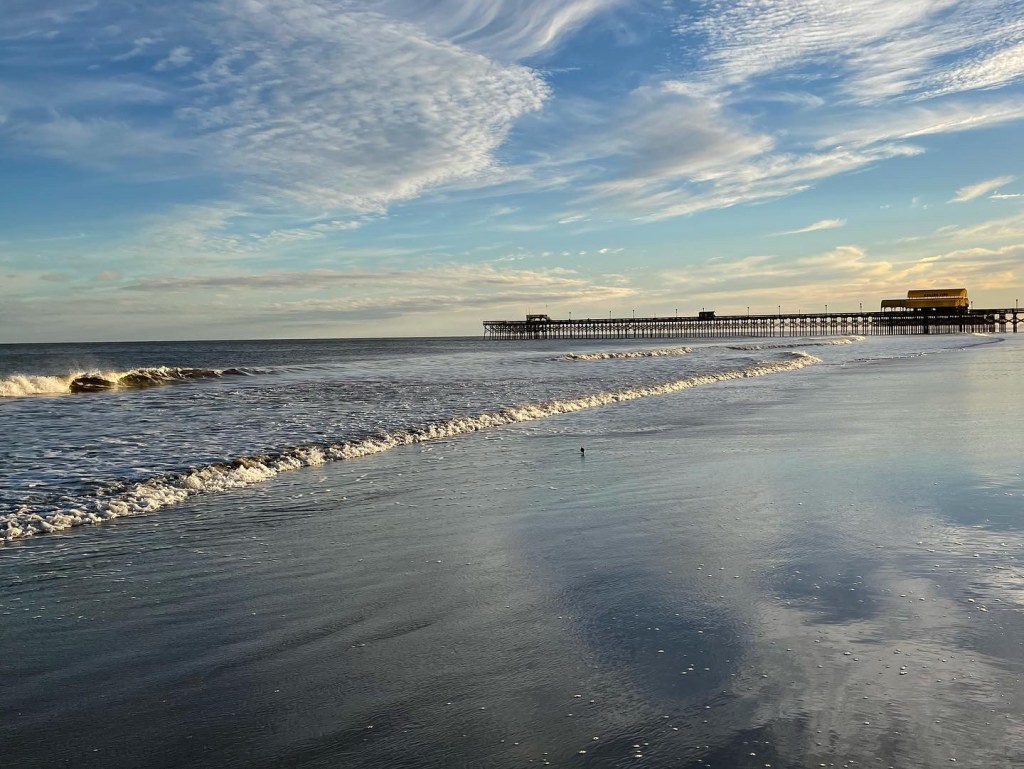
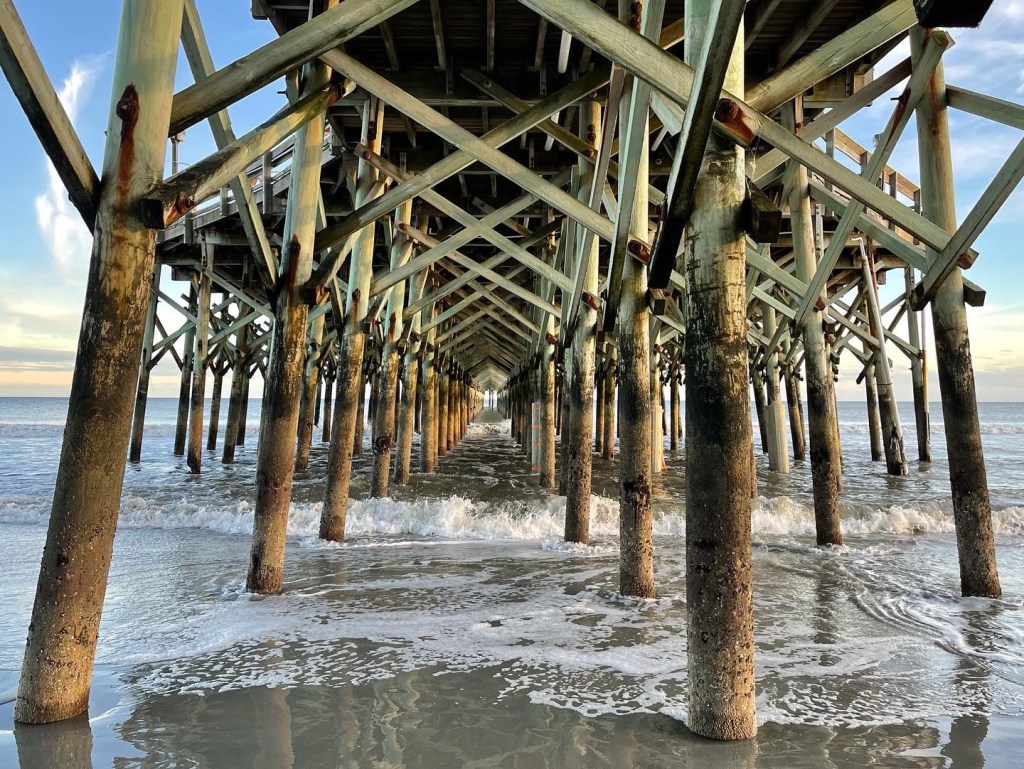
    The Apache Pier in Myrtle Beach, South Carolina and the Oceanside Pier in Oceanside, California share two things in common. They’re the longest piers on the eastern and western coasts of the United States, respectively. And secondly, this writer managed to unwittingly stumble upon both of them with no prior knowledge of their standing in the world of wooden fishing piers.

    The Apache Pier in Myrtle Beach was build in 1994, making it a relative toddler in the world of wooden piers. By comparison, the Oceanside pier was first built in 1888 and subsequently rebuilt several times. Apache reaches out 1,206 feet into the Atlantic Ocean, while Oceanside juts 1,954 into the Pacific Ocean. If you’re wondering, Apache Pier is named for the beachside campground that owns it.

    I’ve written a bit about Oceanside recently. Myrtle Beach is new for me, and it seems like paradise for year-round golfers, with over 100 courses nearby. I’m not much of a golfer, but I appreciate a long, walkable beach in the offseason, and they surely have that in Myrtle Beach. The piers connect two places for me, if only as common ground. Latitude isn’t that far off, Myrtle Beach is at 33.6891° N, while Oceanside is at 33.1959° N. The gulf currents are of course opposite between the coasts, with warmer water reaching up to greet Apache Pier, while Oceanside Pier has cooler waters coming down from Alaska.

    I confess I rarely think about fishing piers. I live in New Hampshire, and we have piers too, but not piers that stick a thousand feet out into the open ocean. So it’s interesting to spend a bit of time with a couple of the big boys in lumber allocation. I may never write about fishing piers again, but I never thoughts I’d have two posts about them already. You just never know where travel and blogging will take you, do you?

    Myrtle Beach and Apache Pier
    Apache Pier
    Apache Pier
    Oceanside Pier
  • The Random Gift of Injury

    Stoicism is accepting whatever the world throws at you. Not to be bullied by the universe, but to accept fate and manage the moment. This, of course, is an oversimplification, but for our purposes we’ll run with this definition. There are bookshelves full of stoic philosophy at the ready should you wish to dive deeper.

    With this in mind, what were the odds that I’d bruise my right heel stepping on a small log tossed underfoot by a rogue wave I was running to avoid on a beach in Marin, California on the one morning I happened to be walking in that place in my lifetime? Not quite as random as hitting the birth lottery, but pretty damned remote. One step of thousands of steps, landing on the exact spot to create a bruise that’s irritated me for a couple of weeks now.

    Maybe irritate is the wrong word. Maybe fascinate is better, because of the randomness of that bruise. Semantics aside, it’s a classic test of stoicism, one I ought to embrace for the gift it is. A bit of pain in the heel is a small tradeoff for the celebration of random events that brought us together. And sure, it could have been a lot worse. Rogue waves aren’t to be trifled with.

    Accepting whatever is thrown at you doesn’t mean you don’t deal with the problem at hand. You don’t have to like getting hurt. To do so would be a clear signal of another problem in your life. A bit of motrin, some heel inserts, and other efforts to heal the heel are ongoing. Some long walks I’d planned have been postponed. To press on would aggravate the injury, extending it, and from a stoic point of view, it would mean not accepting this fate.

    Who am I to ignore this random gift?

  • Getting Outside

    “Go out, go out I beg of you, And taste the beauty of the wild. Behold the miracle of the earth with all the wonder of a child.” – Edna Jaques

    Getting outside to nature cures all things. Stress, fogginess, illness—all are tempered or eliminated by getting deep into nature. When I’m not feeling well, the first thing I try to do is get out into the cold, crisp New Hampshire air and breathe deeply. Inevitably this is the beginning of recovery.

    Driving around California tor 11 days, I was most at home in the wildest places. The rugged coastlines, the redwood forests and the dunes of Marin all served to restore whatever was lost in city traffic. Even in Los Angeles, there are mountains around you that make you believe nature isn’t far away… if only that smog wasn’t pressing down on you so relentlessly. New England is the same in many ways (though thankfully without the smog). The ocean rules the coastline, the mountains and the forests rule the interior. Cities are full of modern wonder but also a fair share of ugliness. Step away when you can, for it’s only in nature that we find balance.

    If there’s irony in writing this post, it’s that I came inside from a walk to do it. But that’s the tradeoff we all make, isn’t it? Work, family time and the constant draw of screens keep us indoors more than we ought to be. There’s a place for the indoor life, but it shouldn’t dominate your life. Shouldn’t tasting the wild dominate our time? It seems to me that getting outside is the only way to find your center. And the more time you’re away from the outdoors, the more unbalanced we become.

    Get outside.

  • Sick Days

    Remember celebrating sick days when you were younger? I remember them well. Stay home from school! Freedom! Sort of…. But somewhere along the way I became frustrated by the loss of momentum a sick day represents. If we only have so much tome in life, why waste it sick?

    This is the place where adulthood kicks in. Responsibility and reliability are key metrics on the career path. Doing what must be done seems honorable and right. But sometimes your body has other plans for you. We must listen.

    We didn’t get things like stomach bugs and colds during lockdown. When these things happen now it seems an unpleasant novelty. Not so much to be experienced but managed. Sick days are different now. There’s more at stake. So use them wisely.

    It seems today is a sick day.