“However much I may be impressed by the difference between a star and the dark space around it, I must not forget that I can see the two only in relation to each other, and that this relation is inseparable.”– Alan Watts
In the United States, we have this peaceful transfer of power every four to eight years, depending on whether someone was re-elected or not. It seemed a rather ordinary thing until some folks spun up some other folks to attempt a violent overthrow. Most Americans recoiled when they saw that, knowing it isn’t who we are. A few celebrated it for the anarchy and division it created. Such are our differences.
Amplifying our differences became a nagging pursuit over the last five years of Trump. Biden is built differently. Built on empathy and unity and a healthy dose of humility. Strong leaders draw people of strong character to their circle. Weak leaders do the opposite. When you pull back the covers there’s really not much of substance there.
Four years ago I’d hoped the guy I didn’t vote for would rise to the job. I hope for the same for the guy I voted for this time around. It turned out to be a particularly bad time to have a weak, divisive President in this country. But now we move on, with a guy that hopefully doesn’t pose in front of the heads on Mount Rushmore, but instead works to emulate their best attributes.
We all have the best and worst attributes encoded within us, don’t we? With some only the venom reaches the surface. But some are better at drawing out the very best in themselves and others. And that’s where I hope we are now and for many years to come. We’ve seen the relation between our brightest tendencies and our darkest, and it was jolting. Now that we’ve finally all seen how fragile Democracy is, what will we do next?
Ultimately, in the United States we give the new President a shot at leading to the best of their ability. And hope that they might reach beyond expectations. Every four years, usually on January 20th (unless a Sunday), they take the oath, not to lead, but to serve:
“I do solemnly swear (or affirm) that I will faithfully execute the Office of President of the United States, and will to the best of my ability, preserve, protect and defend the Constitution of the United States.” – Presidential Oath of Office, in accordance with Article II, Section I of the U.S. Constitution
Many will note there’s nothing in that oath about being an ethical, decent human being. But it’s implied one ought to rise up to the responsibilities granted in the role. Some are satisfied with reaching the title and not doing the work necessary to unite and lead the country. But the thing is, something fills the void when character isn’t present. When you look at the stars, take a look at the dark space around them. And note the relationship between the two.
“I have learned, as a rule of thumb, never to ask whether you can do something. Say, instead, that you are doing it. Then fasten your seat belt. The most remarkable things follow.” – Julia Cameron, The Artist’s Way
The hard part about writing every day wasn’t starting, it was mentioning to people that I was writing every day. Writing has always been part of my identity, it was just expressed in other ways for a couple of decades while I busied myself with other things. People tend to assume those other things are who you are. But we know better don’t we? The quiet conspiracy of expressing your identity stays with you always. One day I just started writing again, and remarkable things have followed. And really, I’ve only just dipped a toe in the waters. There’s so much farther yet to go.
“I have seldom conceived a delicious plan without being given the means to accomplish it. Understand that the what must come before the how. First choose what you would do. The how usually falls into place of itself.”– Julia Cameron, The Artist’s Way
We all have bold plans. Some are fully realized, some fall aside in the grind of commitments and pandemics and other things. The world is fascinated with the characters who follow through on their boldness. Elon Musk, Richard Branson, Steve Jobs and Oprah Winfrey followed through on the schemes and dreams and truly audacious whimsies that most of us would gently set aside. First they chose what they would do, and the how fell into place.
I’m watching the kids I watched grow up wade deeper into adulthood. Their own identities are emerging, different from what we might have assumed; thinking them a basketball or soccer player, or perhaps the noisy kids giggling in the basement over a Disney movie they’ve watched a hundred times. If I’ve learned anything on my own wading into the waters, it would be to offer encouragement and support the audacious without being an overprotective “adult”. Maybe offer some ideas about the “how“. Or who they might talk to about the “how“. And then get out of the way.
So the question is, do we do that with ourselves? Do we fully support our own boldness or brush it aside as just so much nonsense? Do we focus on the “how” or the “why we shouldn’t“?
Say, instead, that you are doing it. Then fasten your seat belt... The how usually falls into place of itself.
Don’t just dip a toe or gently wade in the shallow waters. Figure out the hows: how deep is the water? How well can I swim in this? What do I need to know to stay afloat? (all of these questions limit your downside) And then quickly leap. And see how big a splash you can make.
“We have somehow conned ourselves into the notion that this moment is ordinary. This now moment, in which I’m talking and you’re listening, is eternity.”– Alan Watts
Well, we’ve reached it again. Now. Did you expect it to be more?
Now. Such that it is. Our time; our only time. Make it shine.
I thought about Sal and Dean and those other characters moving from coast-to-coast and back again chasing the next thing in Jack Kerouac’s On the Road. In some ways, that’s all of us, isn’t it? Chasing the next thing, always going somewhere else in the future.
I’ve tried to turn that into making exceptional nows out of otherwise mundane nows. Visiting waterfalls is one way, but so is getting up early and watching the sky gradually brighten as the world wakes up anew. And so is walking out in the woods just to see what a winter with no snow smells and feels like out there. Eternity is watching a squirrel sort out how to get into a squirrel-proof feeder. And it’s the next wave swelling to meet the retreating salty foam undermining your feet in the surf. A poem stacked together just so.
This is our little bit of eternity, living this now moment. We either spin it up with wonder and magic or we ignore it at our peril. For it won’t come this way again.
The day started with heavy, gusty rain. The kind of rain that would be a nor’easter had it been snow. The kind of rain that makes you glad you’re indoors looking out a window at it. And paradoxically, the kind of rain I wanted to be outside fully alive in. There’s an edge to any storm, and this one was abating just enough to prompt me to pursue a micro adventure or two. I packed up my rain gear and a water bottle and headed out to visit waterfalls.
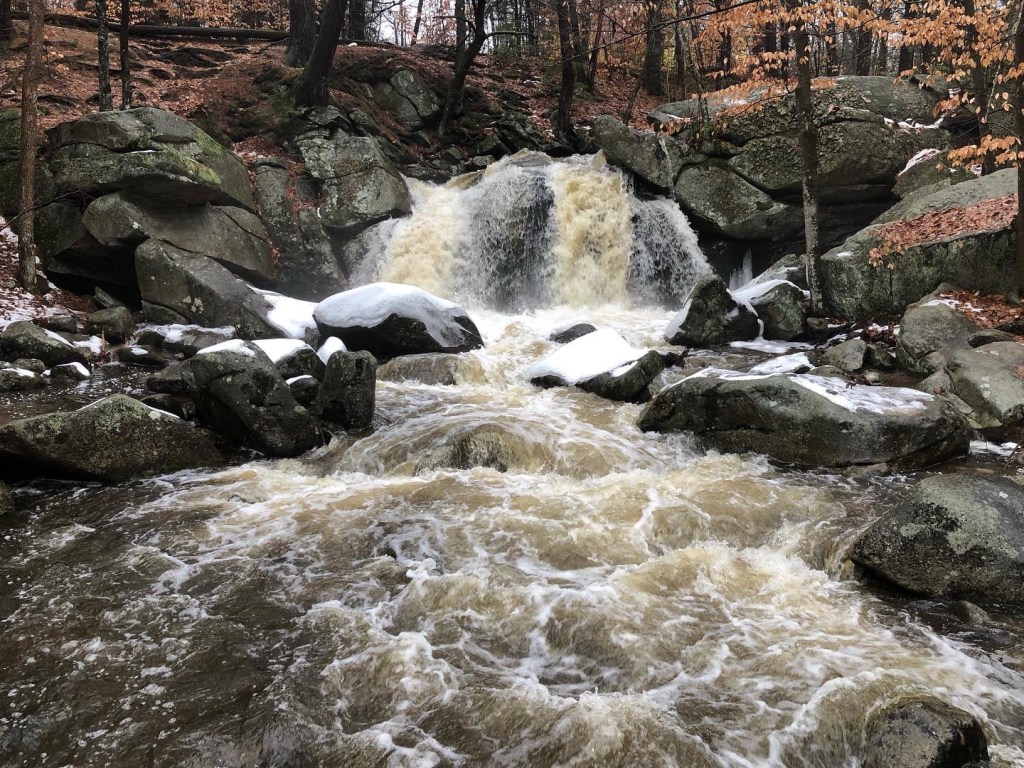
First stop was an hour from home, at Willard Brook State Park in Ashby, Massachusetts where the beautiful Trap Falls pour forever over granite ledge. This is a popular spot in the warmer months, but on a rainy Saturday in January I was the only one there. The falls were roaring from the rain, and easily heard from the small parking lot. A brief, shuffling walk on a few slippery spots and I was quickly at the falls, and thought it might be a trick. How could I have this all to myself on this day when the falls were screaming for attention? The answer lies in that moment when I looked out the window and decided I ought to go out in this weather, while the rest of the world thought that would be a crazy idea. Score one for the crazy folk.
Trap Falls
A few pictures and rock scrambles later, I headed back to the car and consulted the maps in Greg Parson’s excellent resource New England Waterfalls, which I’d picked up as a gift to myself while purchasing a gift for kindred spirits. Parson’s recommended a cluster of waterfalls just over the border in New Hampshire. I looked at two in particular as promising and plugged in their coordinates in my Waze app and headed off for more adventure.
Driving towards Milford, New Hampshire, I decided to focus on Lower Purgatory Falls as my first choice, and sought out the trailhead on Wilton Road. The trailhead displayed some icy conditions and I brought my micro spikes with me for this hike. I would soon be grateful for having them.
The walk from the road to the falls is roughly half a mile. Nothing too crazy, really, just an old logging road that carries you to a yellow-blazed trail. And like Trap Falls, you could hear Lower Purgatory Falls well before you got to them. The falls are named for Purgatory Brook, a beautiful stretch of water that was white water after all the rain. Cresting a small rise, I saw the falls ahead and worked my way down to see them.
And this is where the micro spikes were absolutely required. I was hiking solo in isolated conservation land on a day when nobody else thought it logical to be out there. A slip and fall would have been bad news. Micro spikes remain one of the best hiking investments I’ve ever made, and they offered a clear return on investment as I made my way down an ice covered hill with wet roots and rocks making up the better footing.
Lower Purgatory Falls is a triangle-shaped wonder set deep in the woods of the aptly named Purgatory Falls Conservation Area. After the heavy rains and melt-off the falls had a lot to say, and I lingered by them for a bit to tap into their energy. Again I wondered why I was the only fool out there on this day, but I’m grateful I never came to my senses and stayed home.
Lower Purgatory Falls
As I was leaving the car I took a picture of the trail map supplied in Parson’s book. It indicated I could hike upstream to see Middle and Upper Purgatory Falls. The trail seemed clearly blazed in yellow and tightly followed the brook. And so I made my way upstream seeking more adventure. I found it.
Hiking along the swollen brook, there were a couple of spots where it flooded over the trail, making for sketchy crossings. Not plummet into a frozen brook sketchy, for I’m not that crazy to attempt such things, more water deeper than your boot is tall sketchy. I made a few calculated crossings, trail blazed in a couple of spots, but always stayed safe and kept the yellow blazes in sight.
Mossy ErraticsPurgatory Brook, swollen with rainwater and melt-off
Eventually the trail dead-ended at a development with a port-o-potty announcing “progress”. I silently cursed the abrupt ending to the trail, looked around to see if I’d missed it diverting elsewhere, and doubled back towards Lower Purgatory Falls, crossing anew the sketchy water crossings I’d already attempted.
And here’s where it got interesting. I returned to the spot where I’d first seen the falls, looked left and right and saw yellow blazes going off in different directions. WTF.
“Make sure to return on the trail you came in on as there are several official and unofficial paths in the area. Look for the yellow blazes and the junctions you passed through on the way to the falls originally.” – Greg Parsons and Kate Watson, New England Waterfalls
Well, this is where I went wrong. I took the wrong yellow-blazed trail towards what I thought was a return to my car. After a few minutes of walking I was aware that I didn’t recognize any part of this trail. I doubled back and saw a logging road I’d ignored before and started following it until it dead-ended. Damn. And this is where you make choices deep in the woods. I could blaze my own trail through the woods with the compass on my cell phone, a picture from a book and Google maps as my guide, or I could double back once again and find the right trail. I’ve learned to trust my instincts in such situations, and not trust a phone battery. I doubled back.
Finding a junction in the trail, I saw the yellow blazes once again splitting off in two directions. Who the hell blazed this land?? I stuck with the more worn trail and followed it to a place where (surprise!) I’d been before. It seems I’d followed the yellow blazed loop back around onto itself. And this is why bringing a compass and a reliable waterproof map is essential. Having neither, I relied on my experience in similar situations and kept my head about me. Since I was back on a trail I recognized, I simply followed it back to the Lower Purgatory Falls. Once there I saw immediately where I’d gone wrong and followed the correct yellow-blazed trail back to the logging road and eventually to the trailhead. Phew!
This adventure started off as seeking a few waterfalls on a wet day. It became a small test in orienteering in unfamiliar woods on a wet, disorienting day without the proper equipment. And it ended with me deciding that two waterfalls were enough for one day. I thanked my wits and good fortune and headed home. The other waterfalls will have to wait… for now.
“For unless one is able to live fully in the present, the future is a hoax. There is no point whatever in making plans for a future which you will never be able to enjoy. When your plans mature, you will still be living for some other future beyond. You will never, never be able to sit back with full contentment and say, “Now, I’ve arrived!” Your entire education has deprived you of this capacity because it was preparing you for the future, instead of showing you how to be alive now.”– Alan Watts
I was thinking about flowers. Specifically, Bee Balm (Monarda). The blooms of next summer are currently scheming in the frozen turf of the garden, awaiting the heat of late June and July to burst onto the scene. In that respect, I share more in common with the flower than the hummingbird, which ignores border restrictions altogether and zips down to Mexico and Central America for the winter. You think that snowbird expression invented itself? The hummingbird is one of many birds that bolts the limited prospects of survival in the north for the tropics.
Still, I don’t mind winter, when we have it. This year is a confusion of rain and frigid temperatures, but no significant snow to speak of just yet. But that’s the world we live in now, with seasons shifted slightly askew, and some uninformed loud people thinking climate change is a hoax, like COVID and election results and any science that doesn’t jibe with their worldview.
I imagine the hummingbirds I got to know last summer are doing the Macarina with friends from around North America in some tropical paradise right about now. And why shouldn’t they? They flew 3000 miles and straight across the Gulf of Mexico to arrive in the tropics. So go on: guzzle that nectar and dance to your heart’s content!
Back here in the frozen north, we wonder when the snow might return again, and then the flowers, and finally the hummingbirds. But, as Watts points out, we can’t live in the future, we can only embrace what we have now. We keep things going here, the dormant flowers and their gardener, making the most of what we’ve got until warmer days and open borders.
As a gardener, I know there’s merit in planning for the future that Watts doesn’t account for in the quote above. Amending the soil, sowing, weeding and generally seeing your crop through to harvest are inherently forward-looking activities that happen in the present. There’s nothing wrong with knowing where you’re going while living fully in the present. Watts knew this too of course, but you can’t wedge everything into one clever quote.
Here in New Hampshire, I’m packing as much alive time as possible into each day as it presents itself. In six months time, should we be fortunate to arrive there together, I’ll get reacquainted with the hummingbirds, who like to hover at eye level and check out the character who tends the garden for them. They’ll have squeaky tales of perilous travel over open water and jungle reunions with cousins. What shall my own tales be for them? Don’t we owe it to them to make it interesting?
“My house stands in low land, with limited outlook, and on the skirt of the village. But I go with my friend to the shore of our little river, and with one stroke of the paddle I leave the village politics and personalities, yes, and the world of villages and personalities behind, and pass into a delicate realm of sunset and moonlight, too bright almost for spotted man to enter without novitiate and probation. We penetrate bodily this incredible beauty; we dip our hands in this painted element; our eyes are bathed in these lights and forms.” – Ralph Waldo Emerson, Nature
I’m returning Emerson once again, partly to counter the din of political tweets and headlines that dominated over the last week, and partly because I’d like to read or re-read all of his work in 2021. Which brings me back to his essay Nature, for (I believe) a third reading. And I couldn’t help but linger on the sentence above, which resonates in this time, and for this place I myself reside, in a house in low land, with limited outlook, on the skirt of the village. Emerson had the Concord River to paddle to truth. I have the New Hampshire woods and the wildlife it sustains to show me the way.
Days like these, a quiet bit of immersion in the forest seems in order. We live in strange times, distracting times, and I’ve seen the impact on my writing lately. Thankfully, I know where to find the remedy: in nature, in tapping into the Great Conversation, and in solitude.
“Accept what comes from silence. Make the best you can of it. Of the little words that come out of the silence, like prayers prayed back to the one who prays, make a poem that does not disturb the silence from which it came” – Wendell Berry, How To Be a Poet (to remind myself)
A special thanks to Maria Popova and Brain Pickings for pointing out this particular poem in a recent tweet. This poem immediately served as a catalyst on two fronts: to search for more Wendell Berry and seek the silent contemplation I’ve stolen from myself absorbing the madness of the world. Silence, as they say, is golden.
So outside of paddling off on my own or building a small cabin in the woods, how to bring together the natural world and the silence necessary for contemplation? The answer, for me, lies in early mornings. The conspirator against a quiet mind is the whirl of madness in the world and a desire to keep up and understand it. In these times, finding a way to paddle or walk away from it all, if only for a little while, seems imperative.
from this moment looking at the clock, I start over
So much time has passed, and is equaled by whatever split-second is present
from this moment this moment is the first” – Wendell Berry, Be Still In Haste
Two weeks into the New Year. About as distracting a beginning to a New Year as I can ever recall. We know where we’ve been, where we’ve come from. But what comes next? We change from moment to moment with the ticking of the clock, but what do we do with that change?
Start over. Again.
“Time does not exist. There is only a small and infinite present, and it is only in this present that our life occurs. Therefore, a person should concentrate all his spiritual force only on this present.” – Leo Tolstoy
Sometimes it feels like we’re marching on a treadmill, especially during a lockdown, but you look back and see progress despite the illusion. A pile of actions that didn’t work. A few, sifted through the remains, that did. What do we make of it? All that has passed, has passed. This moment is the one that counts. This moment is the first.
“In times when we thought ourselves indolent, we have afterwards discovered that much was accomplished, and much was begun in us.“– Ralph Waldo Emerson, Essays: Second Series, “Experience“ (and all subsequent quotes in this post)
I got lost in the headlines for a bit before writing today. Getting spun up in politics and pandemics and the bad behavior of others. It’s important to be aware, to have an informed opinion to fight the good fight. I suppose… but indignation doesn’t spark the creativity I aspire to. And so a return to Emerson was in order.
These are dark, wasted days if you choose to believe it. Alternatively, they’re the best, most productive days of our lifetimes. What do you prefer?
“Every ship is a romantic object, except that we sail in. Embark, and the romance quits our vessel and hangs on every other sail in the horizon. Our life looks trivial, and we shun to record it.”
Comparison is a bear. How we’ve spent the last year compared to someone else does us little good. I think of wasted opportunities and stop myself, for there’s no use going down that path. For all the madness of the last eleven months much was accomplished. Much is being accomplished. We might not see it just yet.
“Life itself is a mixture of power and form, and will not bear the least excess of either. To finish the moment, to find the journey’s end in every step of the road, to live the greatest number of good hours, is wisdom. It is not the part of men, but of fanatics, or of mathematicians if you will, to say that the shortness of life considered, it is not worth caring whether for so short a duration we were sprawling in want or sitting high. Since our office is with moments, let us husband them. Five minutes of today are worth as much to me as five minutes in the next millennium. Let us be poised, and wise, and our own, today.”
I’ve used the quote above before in this blog. It’s a favorite and I’ll likely use it again. Emerson whispers persistently, for all who might listen. I return to it now and then to remind myself of the worth of this day. Of this hour. Of these next five minutes. What shall we do with them, that we might record as remarkable in these times?
“Men live in their fancy, like drunkards whose hands are too soft and tremulous for successful labor. It is a tempest of fancies, and the only ballast I know is a respect to the present hour.”
I began the day with headlines… a tempest of fancies designed to distract and provoke and draw us out of our own heads. But we all have our own ships to sail. There’s urgency in the moment, generational urgency, and we should support those who rise up to meet it. But focus on moving down your own path too. Respect the present hour. Emerson insists.
“You boys going to get somewhere, or just going?” We didn’t understand his question, and it was a damned good question.– Jack Kerouac, On the Road
I first visited Jack Kerouac’s grave in Lowell, Massachusetts when I was 20 years old. Once I knew where it was I’d stop in now and then to visit in my younger days. Usually there would be some scattered bottles of whiskey or some other tribute piled about. I’ve seen similar tributes with Thoreau and Twain’s graves, but Kerouac’s was first. It was there that I learned the sticky bond between a great writer and his readers.
It was always mañana. For the next week that was all I heard—mañana,a lovely word and one that probably means heaven.
Funny thing, I was wrapped up in the history of Kerouac, but I kept putting off reading his classic On the Road for years. Maybe I didn’t want to be disappointed if I didn’t like it. Maybe I had an image of what it was but wasn’t willing to see for myself what it was all about. But it was always mañana with this book. Until a friend posted a picture of his grave on social media that triggered me and I immediately downloaded it and started reading.
“What is he aching to do? What are we all aching to do? What do we want?” She didn’t know. She yawned. She was sleepy. It was too much. Nobody could tell. Nobody would ever tell. It was all over. She was eighteen and most lovely, and lost.
I think if I’d read On the Road at 20 I might have hopped in my Ford F-150 and crossed the country right then. Because at 20 you understand how Sal and Dean feel. The lost souls bouncing coast-to-coast searching for answers. When you live a bit you realize you’re searching in the wrong place most of the time. Most of the answers you need are right where you started. What are you aching to do? What do you want?
“The days of wrath are yet to come. The balloon won’t sustain you much longer. And not only that, but it’s an abstract balloon. You’ll all go flying to the West Coast and come staggering back in search of your stone.”
Wandering about in life sounds romantic, but Kerouac paints the grim reality of the quest. The abject poverty, the desperation and rootlessness. The descent into drugs and sex and casual regard for anything meaningful. The pursuit of what’s next. If Sal and Dean had iPhones they might never have left New York. They may have scrolled blankly through their Twitter feed. The search continues one generation to the next, the characters just use a different mode of transportation.
He made one last signal. I waved back. Suddenly he bent to his life and walked quickly out of sight. I gaped into the bleakness of my own days. I had an awful long way to go too.
It took a few decades but I finally finished On the Road. And really, I don’t have an urge to immediately drive across the country chasing dreams. Well, maybe a little bit. But mostly I understand. I see how it influenced the Baby Boomer generation when it was published in 1957. I hear it echo in Bob Dylon and Simon & Garfunkel songs (Listen to America and you’re On the Road with Jack Kerouac). I understand now how it influenced me even without reading it. What took me so long? I don’t know. But I’m happy I’ve finally crossed that bridge.
“The world as we have created it is a process of our thinking. It cannot be changed without changing our thinking.” – Albert Einstein
Change happens slowly, one habit reinforced at a time. Some reach 10,000 views in one post, but most of us chip away for a few years of daily writing to get that first 10,000. Tolstoy filled War and Peace with 587,287 words. By that standard I’ve got a ways to go. I’ve only published 401K.
Diet, for all intents and purposes, is one morsel shoved in your mouth to the next. You want to eat better? Don’t make an exception for that tasty treat you’re eying. Want to get fit? Move more, and more consistently. Simple, right?
We all have reasons for the habits and beliefs we linger in. Life is a grind, after all. Sometimes the best you can do is walk to the refrigerator to see what inspires you that day. The world, as we’ve created it, can eat you up.
Yesterday was a great day to be outside in New Hampshire, and I took full advantage of that with a hike up Mount Jackson. A hike like that, with friends and on a beautiful winter day, leaves a mark inside. It reinforces who you are in some ways, but alters your thinking as well. Standing on the summit of Jackson and looking up at Mount Washington, I thought it well within reach. I’ve climbed Washington before, but not lately. Looking up at Washington yesterday, cold breeze chilling my sweaty clothes, I thought it possible to do more.