Category: Art

  • Edgy in Satire: Edith Lunt Small

    There’s a painting in the long hallway at Richardson’s Canal House that you can get lost in for hours. The artist was Edith Lunt Small, who passed away in 2017, 38 years after creating this fanciful world on canvas. Edith lives on in the painting, portraying herself as a skinny-dipping artist swimming in the Erie Canal in 1825. As the self-portrait indicates, there’s a lot of whimsy in her work, and I enjoyed spending a few minutes with this one.

    Art is meant to be enjoyed, and I found myself smiling at the little details she dropped into this painting, commissioned for Richardson’s Canal House. 1825 Bushnell’s Basin in Small’s world was raucous fun, and I imagine the artist was too. Her son called her work edgy in satire in his eulogy, and based on this one, I see what he means. I was happy to get a glimpse into the spirit that was Edith Lunt Small. These close-ups offer a small glimpse for you as well. This was an artist who clearly loved life!

  • A Handshake with Norman Rockwell

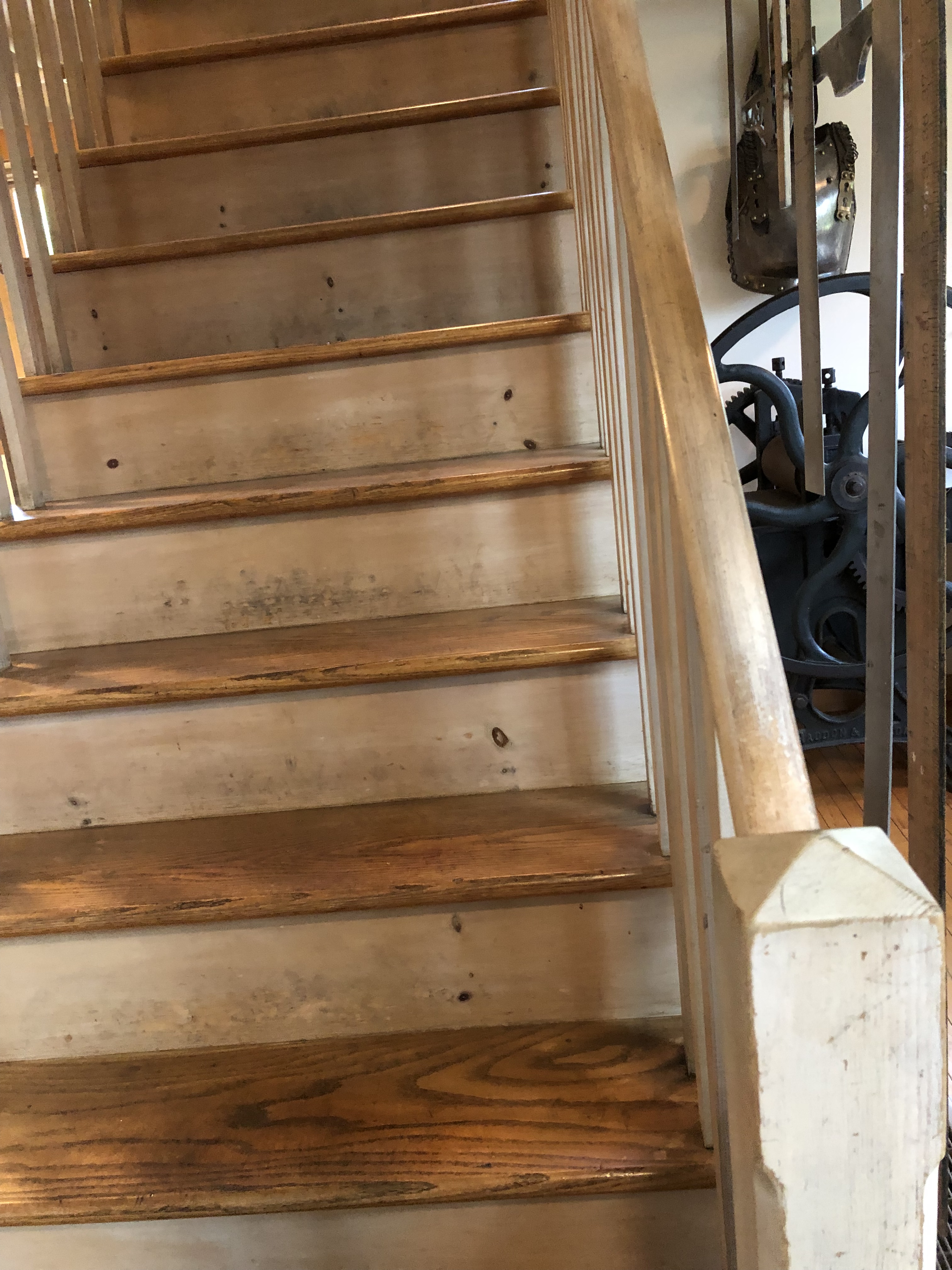
    I always make a point of grabbing the newel post and sliding up my hand on the stair railing when visiting the homes of artists, writers and historical figures.  I’ve written about doing this at Ernest Hemingway’s Key West house, at Mark Twain’s Hartford, Connecticut house, and at Robert Frost’s farmhouse in Derry, New Hampshire.  I had the opportunity to do it again when visiting the Norman Rockwell Studio in Sturbridge, Massachusetts recently.  This to me is a handshake with those who came before, and I feel it most profoundly when I visit the places like these where the giants of the past did their greatest work.

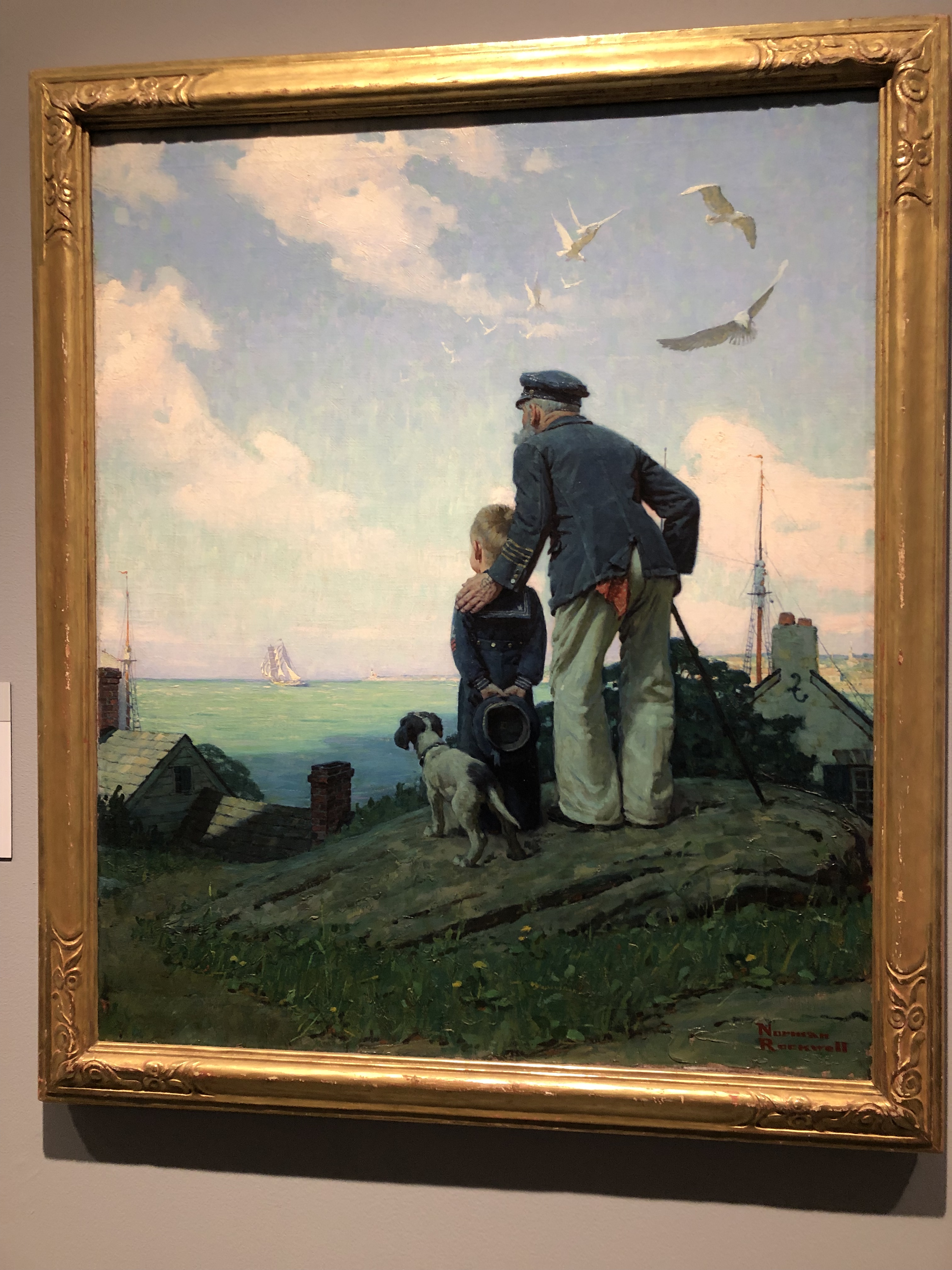
    If you live in America you know Norman Rockwell.  His paintings and sketches are more widely known than any other artist in the 20th century, thanks in large part to his work with The Saturday Evening Post during some of the most significant milestones of that century.  Rockwell was capturing the very human moments everyone felt during the Great Depression, World War’s I and II, the Kennedy Assassination, etc.  The museum carries you through his work and is worth a visit.  I’ve driven by it for decades before finally stopping by for an hour while driving home from New York.  Seeing his paintings doesn’t give me the same feeling as seeing Aivazovsky’s The Ninth Wave did, but that’s largely because there’s a humbleness to Rockwell’s work that doesn’t inspire awe as much as appreciation for the incredible detail he put into his work.

    There’s a story of the painting Country Doctor, which when published on the cover of the Saturday Evening Post inspired letters from people asking about the woman in the photograph on the doctor’s desk.  It seemed she looked like a nurse that had treated patients in England during World War II, and a soldier wrote to ask if she was in fact the same woman….  and was.  Such was the detail in Rockwell’s paintings that a random detail in a larger work, shrunk down for the cover of a magazine, sparked recognition. Rockwell apparently made his subjects, mostly his neighbor’s in the Berkshires, laugh while painting, and there’s joy in most of his work.

    I appreciate art, and linger in the museum longer than I should have on my trip home, but for me standing in the space where Rockwell created that art was more impactful. That space is his studio, moved four miles from downtown Stockbridge to a hill overlooking the Housatonic River and the Berkshires in 1976. Rockwell gifted the studio to the Norman Rockwell Museum, and the studio is set up as it would have been in 1961 when Rockwell was painting Golden Rule, which seems appropriate for an artist who’s work reflected that rule. The space is largely the same, if transported from its original foundation in the heart of Stockbridge. The staircase to the loft is roped off, but the newel post and railing are in reach, like a handshake with Norman. And that sums up his art; within reach of everyone. Simple but complex, and beloved, like the artist himself.

  • Dancing after the Dragons

    “How could we be capable of forgetting the old myths that stand at the threshold of all mankind, myths of dragons transforming themselves at the last moment into princesses?  Perhaps all dragons in our lives are really princesses just waiting to see us just once being beautiful and courageous.  Perhaps everything fearful is basically helplessness that seeks our help.” – Rainer Maria Rilke, Letters to a Young Poet

    The Ninth Wave is a painting by Ivan Aivazovsky on display at the Hermitage in St. Petersburg, Russia.  I stood in front of it 30 years ago and it stays with me still.  There are two paintings from that visit that keep coming back to mind, the other being Henri Matisse’s The Dance.  Both are stunning when you stand in front of them and immerse yourself in them.  Google both and look at the images that come up, and you’ll see a wide range of colors, from vibrant primary to muted mixed colors.  There’s nothing like seeing each in person, where it literally washes right over you and you swim and dance with the subjects in the paintings.

    I’ve got a bucket list of art and architecture that I hope to see in my lifetime.  I only have to reconcile the images I see in a book or online to know that there’s nothing like seeing the real thing.  Travel gives you that gift.  And more than seeing The Ninth Wave or The Dance in my mind, I see the entire picture of that time.  Babushkas sternly looking at college kids to make sure we weren’t taking flash photography or crossing past the ropes.  Black market traders trying to swap blue jeans for assorted USSR military stuff.  Seeing Cuban soldiers for the first time when we visited the Aurora (As a Cold War kid being in the Soviet Union and seeing Cuban soldiers was heady stuff).  Such is the richness of world travel; Seeing the world as it is and not some portrayal on a screen.

    I may never get back to St. Petersburg, but I would surely go to the Hermitage again and re-visit these two masterpieces.  I’ve changed quite a lot in 30 years, and so has St. Petersburg and Russia.  When I visited I was a college kid visiting a city with a different name in a country with a different name at the height of Glasnost, which would inevitably wipe Leningrad and the USSR names off the maps in favor of what once was and is again.  The enormity of the changes we’ve seen in the last 30 years cannot be understated.  And we’re in the middle of massive change still.  What will the next 30 years bring?  I hope I’m around to report on it.

    The image of that dragon in Rilke’s quote above brought to my mind The Ninth Wave.  This is the moment when the subjects in the painting are either driven to their deaths under the sea or they find salvation. Aivazovsky leaves it for us to interpret how it ends.  The optimist in me sees the brightening sky shining light through the wave.    Have the courage to hold on just a bit longer and things will get better.  Rise to the challenges of the moment and turn that dragon into a princess.  30 years ago it was Glasnost and Tiananmen Square.  Today it’s Climate Change, the rise of political extremism and the Hong Kong protests.  Is this the Ninth Wave?

    The optimist in me sees a positive future, and eventually the scarcity mentality that leads to extremism and greed giving way to a better world.  The report that showed the dramatic decrease in child mortality is a good example of how the world is getting better.  I’m well aware of the dragons in this world, and a little light shining through the storm clouds doesn’t mean the wave isn’t going to crash down on you.  But I see the joyful dancers of Mattise waiting for us if we can only have the courage to find the princess and join in.  What will we do to get us there?