Category: Art

  • Like Stone Nestles on Stone

    “Poetry is language against which we have no defenses.” – David Whyte

    I’ve been spending a bit of time with David Whyte lately, catching up on words I ought to have read long ago but wasn’t ready to hear. I was a different person then, more closed to the world despite the outward bravado. You learn who you are through the windy path of words flowing from you onto the page. And then you set them free to find an audience ready for that particular jumble of words to add to their own foundation.

    Let the words join
    one to another
    the way stone nestles on stone,
    the way water just leaves
    and goes to the sea,
    the way your promise
    breathes and belongs
    with every other promise
    the world has ever made.

    Now, leave them to go on,
    let your words
    carry their own life,
    without you, let the promise
    go with the river.
    Have faith. Walk away.
    – David Whyte, To Break a Promise (Cúnga Fheichin)

    For me releasing the words into the wild is a form of building my own foundation. Each place visited, each poem immersed in, and each mountain climbed is like stone nestled on stone joined together just so as a work very much in progress. Building a life out of adventurous conspiracies and schemes, written down and sent on their way out into the world for you to see.

    “The act of writing anything worthwhile always takes place at that strange and sometimes disturbing crossroads where aloneness and intimacy meet… This break of the boundary between what we think is a self and what we think is other than our self is where the rich vein of beauty and insight become a reward in and of itself, and where the words suddenly seem to belong to everyone.” – David Whyte, from the forward of Essentials

    Experience and words create that thing that is other than our selves. It’s the building of that puzzle that is our self one piece at a time. What seems a chaotic pile on the table slowly forms into a picture of who we are. The funny thing about a puzzle is you finish and throw it all back in the box and build another picture. You can’t build another part of your identity until you clear the table of the old one.

    So which is it? Are words and experience stacked together like a stone wall or foundation, laid to be resilient, or like a puzzle built very much the same way but temporary in nature? That’s one of those forest for the trees questions, isn’t it? The universe views the stacked stones and the stack of words the way it views those jigsaw puzzles on the table. Everything is temporal. Words are like carbon, momentarily ours and one day something else entirely.

    I believe we ought to keep stacking words and building new puzzles, but to do it for the joy of the process. To set those words free to fly on their own. Scattered throughout the world to land where they may. To that meeting place between aloneness and intimacy.

  • Something More

    “The world always seems brighter when you’ve just made something that wasn’t there before.” Neil Gaiman

    This rather cheery quote by Gaiman prompts a challenge of sorts from me. For making something isn’t what makes the world brighter, making something you care about making is what brightens the world. For in the making of something in such a way you honor the world with your contribution.

    As Gaiman rightly points out, we’re lovingly placing something that wasn’t there before out in the world for it to embrace. Will it fly or get lost in the noise? It’s not up to us to decide. It’s up to us to create it and set it free. And then to get back to the business of building another beacon.

    The best of our work becomes accretive rather than reductive. Look around, there’s plenty of people creating hateful, mean-spirited work that divides and diminishes the world. But not us, no: we offer something more. Something that resonates across the table and across time. For the very best work becomes timeless.

    So what makes something timeless? I believe it’s the deep connection between two people that your work represents. Paint placed just so on canvas. Architecture that stirs the heart generations after the last stones were laid. Words that transcend the author or poet and connect one soul to another. This is what brightens the world. This is the shining soul beacon of the artist that keeps hope alive, like a Fresnel lens lights the distance in a turbulent dark sea:

    “If you have built castles in the air, your work need not be lost; that is where they should be. Now put the foundations under them.” – Henry David Thoreau, Walden

    “Dwell on the beauty of life. Watch the stars, and see yourself running with them.”
    – Marcus Aurelius, Meditations

    “Tell me, what is it you plan to do
    with your one wild and precious life?”
    – Mary Oliver, The Summer Day

    “If you dare nothing, then when the day is over, nothing is all you will have gained.”
    – Neil Gaiman, The Graveyard Book

    “This above all: to thine own self be true,
    And it must follow, as the night the day,
    Thou canst not then be false to any man.”
    – William Shakespeare, Hamlet

    All words across time, offering a path through the darkness in the world. Offering hope and direction and illumination. This is something more. And this is our opportunity too. Great artists are ambassadors to the world, bridge builders to the future, and infinite soul connectors. That’s something to aspire to.

  • Trust Our Heaviness

    How surely gravity’s law,
    strong as an ocean current,
    takes hold of the smallest thing
    and pulls it toward the heart of the world.


    Each thing—
    each stone, blossom, child —
    is held in place.
    Only we, in our arrogance,
    push out beyond what we each belong to
    for some empty freedom.


    If we surrendered
    to earth’s intelligence
    we could rise up rooted, like trees.


    Instead we entangle ourselves
    in knots of our own making
    and struggle, lonely and confused.


    So like children, we begin again
    to learn from the things,
    because they are in God’s heart;
    they have never left him.


    This is what the things can teach us:
    to fall,
    patiently to trust our heaviness.
    Even a bird has to do that
    before he can fly.

    by Rainer Maria Rilke, How Surely Gravity’s Law

    It’s been a long time since I posted an entire poem, but Rilke’s demands a full reading. And if I were bolder I might just leave it there by itself, instead of injecting my own commentary on the world. But a blog (to me) necessarily demands contribution not simply reposting. And so my own words dare to follow Rilke’s, reaching for a place at the table.

    The key word in the poem is surrendered: to earth’s intelligence, to God’s heart if you will, to our own heaviness. You realize your imperfection and embrace it. In doing so you recognize the entanglements and struggles in others. You accept them for what they are as well. And learn to trust others and most of all your own voice.

    You reach a point in life where you let go of it all and to stop worrying about place and whether you’ve earned it. You stop worrying about everything, really. The work remains, but the will is stronger. You’ve rooted yourself to things tangible and true and begin to rise up.

    To push out beyond. Grounded. And anchored so, we begin to fly.

  • The Eternal Makes You Urgent

    “Once the soul awakens, the search begins and you can never go back. From then on, you are inflamed with a special longing that will never again let you linger in the lowlands of complacency and partial fulfillment. The eternal makes you urgent.” – John O’Donohue, Anam Cara: A Book of Celtic Wisdom

    O’Donohue picked the name of his book with purpose. “Anam cara”, or “soul mate”, suggests that the timeless wisdom buried within might offer the kind of guidance you would get from a cherished friend or spouse. Google it and you’ll find coffee mugs and spiritual retreats and other such things. It would also be a great boat name. And it stirs something in you whether you have one or long for one.

    This idea of the soul awakening isn’t new to us. If this awakening happens at all, it might not be thought of as soul, but as passion or purpose or calling. Some of us steer clear of words like soul. It almost feels intrusive for me to be writing about such things. Not skating my lane, you might say. But I understand eternity, and urgency, and this idea that the things that matter most to us require immediate attention. For our time in eternity isn’t the moments on this side of the turf.

    My own urgency started burning inside of me when I started writing again. It served as a catalyst for exploration and deeper thinking. And when you have it yourself you quickly see the urgency in others. Hikers hiking every available moment, landlocked sailors scrambling to be ready for the warmer days ahead, small business owners pouring every bit of available energy into standing up something special, artists creating brilliant mirrors that reflect back on the rest of us. Urgency senses its kind out in the wild.

    The trick is finding and awakening that soul. And you only find it by trying and doing, tossing aside and finding something else to do. If you’re lucky you find it quickly and embrace it. Or you see it and follow a different path, only to have it pull at you until you finally listen or die embittered at the path you took instead. That’s no way to begin eternity. Is it?

  • The Rhode Island Red Monument

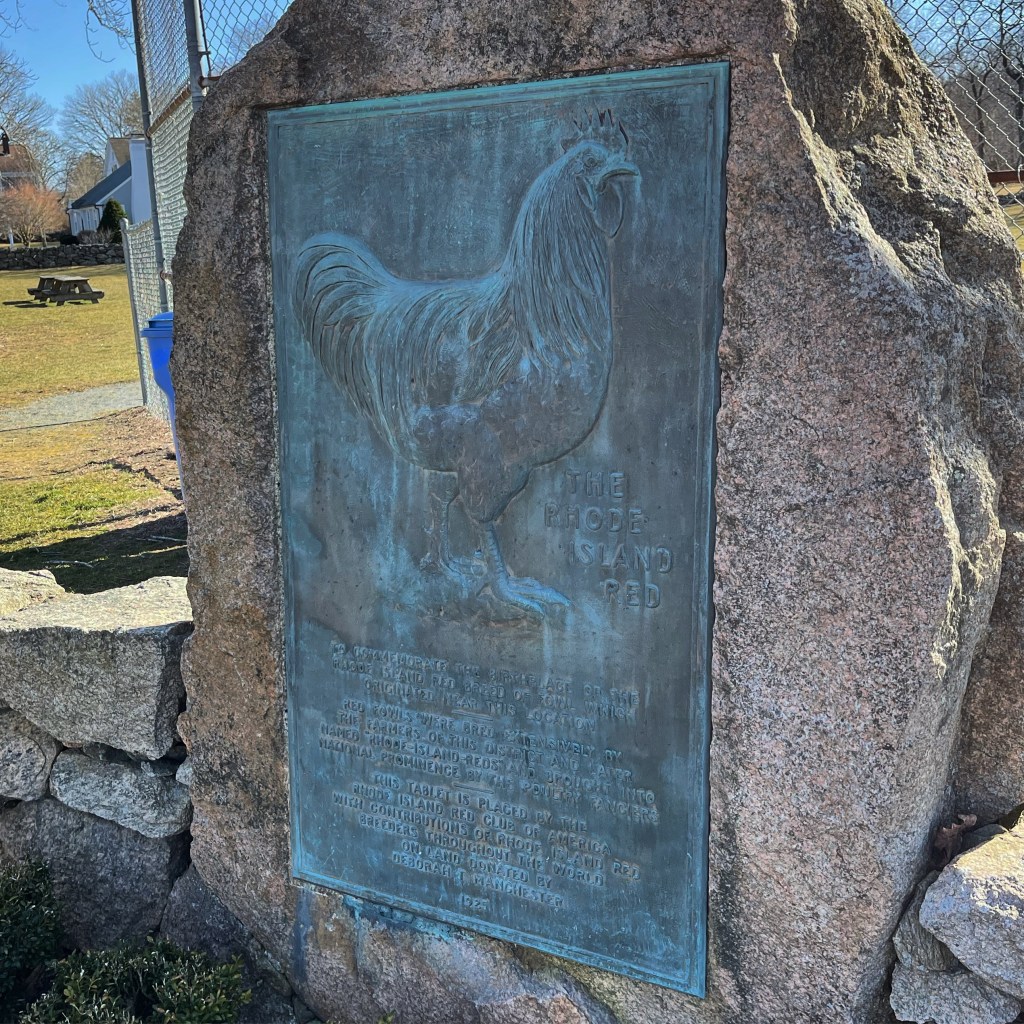
    One of the joys of travel is stumbling upon roadside curiosities. On my pilgrimage to visit a favorite hero of King Philip’s War I came across a monument to the Rhode Island Red that drew my attention. The Rhode Island Red is a hen, of course, that famously and productively laid eggs particularly well, which led to breeding of this particular character to make eggs a common and reliable staple of our diet. It seems the Rhode Island Red was first bred on a farm in Little Compton, Rhode Island.

    In 1925 a group of Rhode Island Red enthusiasts erected this monument to the hen, commissioning an artist named Henry Norton to make it. But here’s where the story gets interesting. One group wanted the monument to be erected at the actual farm where the hens were first bred. Another group wanted it in a more prominent location in town (where I came across it, validating their choice I suppose). For a small town, this was pretty heated, with both sides trying to establish a pecking order. At the unveiling of the first monument the opposing group didn’t show up, apparently feeling the location was pretty… fowl. A year later they erected their own monument at their preferred site. The 1925 monument features a rooster, the 1926 monument features a hen. But a well-placed hen. They really showed ’em.

    The 1925 Rhode Island Red Monument

    The inscription on the 1925 monument reads:
    “To commemorate the birthplace of the
    Rhode Island Red breed of fowl which
    originated near this location
    ___
    red fowls bred extensively by
    the farmers of this district and later
    named “Rhode Island Reds” and brought into
    national prominence by the poultry fanciers
    ___
    this tablet placed by the
    Rhode Island Red Club of America
    with contributions of Rhode Island Red
    breeders throughout the world
    on land donated by
    Deborah Manchester
    1925″

    This entire incident is described in the monument’s Wikipedia page in delightful detail. Not having the back story when I came across the monument, I wasn’t aware of the other monument. Now I feel compelled to return to Little Compton again sometime to find it. In the meantime, Norton’s 1925 monument quietly marks time, closing in on its 100th birthday. Placed on the National Register of Historic Places in 2001, this monument to a chicken has secured its own place in history.

  • A Blessed Unrest: Martha Graham in 7 Quotes

    “The only sin is mediocrity.” – Martha Graham

    I only know of Martha Graham, and associate her appropriately with modern dance, which admittedly I wrestle with. I’ve witnessed way too many angst-ridden dance competitions on the journey of my daughter dancing from kindergarten to High School Senior. But I respect the beauty of formal dance (while struggling with the abundance of teen angst), and wanted to understand the genius of Graham through her words. As with other geniuses, her brilliance transcends her art and her life. Speaking of the sin of mediocrity speaks to her passionate pursuit of the exceptional.

    “There is a vitality, a life force, an energy, a quickening that is translated through you into action, and because there is only one of you in all of time, this expression is unique. And if you block it, it will never exist through any other medium and it will be lost. The world will not have it. It is not your business to determine how good it is nor how valuable nor how it compares with other expressions. It is your business to keep it yours clearly and directly, to keep the channel open. You do not even have to believe in yourself or your work. You have to keep yourself open and aware to the urges that motivate you. Keep the channel open. … No artist is pleased. [There is] no satisfaction whatever at any time. There is only a queer divine dissatisfaction, a blessed unrest that keeps us marching and makes us more alive than the others.”

    Do you feel the urgency in those words? I do. I read a quote like that and understand. What is your quickening? Are you translating your vitality through action or wasting it in the trivial pursuits? Graham lived to 97 and packed those years with transformative action. What of our life force?

    “‘Age’ is the acceptance of a term of years. But maturity is the glory of years.”

    Growing older but not up is a state of mind; to remain young at heart. But it can also be an excuse for not getting to where you want to go. The glory of years is an accumulation of life and accomplishments and the ripples that resonate well beyond our time. It’s something to aspire to, not “getting older”, but accumulating maturity.

    “Practice is the means of inviting the perfection desired.”

    There’s no secret in how people reach mastery. We know it intuitively even if we don’t see the hours upon hours of work that go into muscle memory. These are the layers of competence that stack up to brilliance. Put in the time, do the work, make the mistakes, and reach for the next level. It’s the only way.

    “Some men have thousands of reasons why they cannot do what they want to, when all they need is one reason why they can”

    What is your why? Why are you doing all this in the first place? What whispers in your ear and prods you along? Without your why you’re just going through the motions. And what a waste that is.

    “Movement never lies. It is a barometer telling the state of the soul’s weather to all who can read it.”

    For all our words, our thoughts are betrayed by our bodies. You see it in how someone greets you, how someone answers a pointed question, and in how they dance with the world around them. We frequently won’t listen to what our gut is telling us, instead only believing what the mind is telling us to believe. Not wanting to be ignored, the gut tells the world what we won’t hear in ourselves.

    “Think of the magic of the foot, comparatively small, upon which your whole weight rests. It’s a miracle and the dance is a celebration of that miracle.”

    I’m not much of a dancer, not like those well-choreographed, practiced dancers people naturally circle on the dance floor in reverence, but I like to dance my own clydesdale celebratory dance anyway. Someday when the pandemic is over and weddings and other such gatherings seem appropriate again, we’ll find ourselves on a dance floor somewhere and we will rise up to celebrate life in all its glory. The celebration of that miracle – our being, our aliveness, the magic of it all, was the why in Graham’s life, and shouldn’t it be in our own lives as well? For we dance with life in all its complexity, pain and joy. There’s magic in being alive, and that’s reason enough to dance. And to rise up to more.

  • Sharing Meaningful

    “Sometimes the best writing gets no recognition in its time or gets censored. This is the price of art.” – Neil Strauss

    I’ve written a few blog posts over the years that keep popping back up. Someone will like a post I’d written a year or two ago about some place I went or thing I did, click the like button and remind me of that moment when I see the notification. It feels like those moments when you’re having a conversation with an old friend who brings up some shared experience or character from your past and instantly you’re flooded with warm memories of it.

    You never know what will resonate with others. That would be a horrible way to write anyway; trying to write something just for the clicks and follows. Writing then becomes a rather cynical job, doesn’t it? I’ve been playing the WordPress game long enough to know immediately what someone is trying to accomplish with their own blogs. Generally I’ll follow people who are trying to capture something meaningful – for themselves first, and shared with the world second.

    This entire experience of writing a blog has been about paying the price of art. Some people paint pictures and stack them up in their garage to gather dust, gradually marking the progress of an artist as the pile grows. Writing a daily blog is taking that stack and displaying it for the neighbors. Some art garners attention, some grows dusty and brittle by neglect. But all of it marks the journey, like breadcrumbs on the forest path or footprints on the beach. And like each, art is fragile in nature. Here but for a moment. Mine currently resides in some data center somewhere in the world.

    Whatever direction this blog goes in, it always starts with sharing something meaningful, if only to me. Whether that’s grilling a pizza or visiting a battle site from 350 years ago or just a pile of words that resonated with me in a particular way, it’s all just sharing meaningful, and locking it in my own mind for another day. Released by a random like at the most unexpected moments.

    Thanks for the like.

  • The What and How of Boldly Leaping

    “I have learned, as a rule of thumb, never to ask whether you can do something. Say, instead, that you are doing it. Then fasten your seat belt. The most remarkable things follow.” – Julia Cameron, The Artist’s Way

    The hard part about writing every day wasn’t starting, it was mentioning to people that I was writing every day. Writing has always been part of my identity, it was just expressed in other ways for a couple of decades while I busied myself with other things. People tend to assume those other things are who you are. But we know better don’t we? The quiet conspiracy of expressing your identity stays with you always. One day I just started writing again, and remarkable things have followed. And really, I’ve only just dipped a toe in the waters. There’s so much farther yet to go.

    “I have seldom conceived a delicious plan without being given the means to accomplish it. Understand that the what must come before the how. First choose what you would do. The how usually falls into place of itself.” – Julia Cameron, The Artist’s Way

    We all have bold plans. Some are fully realized, some fall aside in the grind of commitments and pandemics and other things. The world is fascinated with the characters who follow through on their boldness. Elon Musk, Richard Branson, Steve Jobs and Oprah Winfrey followed through on the schemes and dreams and truly audacious whimsies that most of us would gently set aside. First they chose what they would do, and the how fell into place.

    I’m watching the kids I watched grow up wade deeper into adulthood. Their own identities are emerging, different from what we might have assumed; thinking them a basketball or soccer player, or perhaps the noisy kids giggling in the basement over a Disney movie they’ve watched a hundred times. If I’ve learned anything on my own wading into the waters, it would be to offer encouragement and support the audacious without being an overprotective “adult”. Maybe offer some ideas about the “how“. Or who they might talk to about the “how“. And then get out of the way.

    So the question is, do we do that with ourselves? Do we fully support our own boldness or brush it aside as just so much nonsense? Do we focus on the “how” or the “why we shouldn’t“?

    Say, instead, that you are doing it. Then fasten your seat belt... The how usually falls into place of itself.

    Don’t just dip a toe or gently wade in the shallow waters. Figure out the hows: how deep is the water? How well can I swim in this? What do I need to know to stay afloat? (all of these questions limit your downside) And then quickly leap. And see how big a splash you can make.

    Ready?

  • November and the Ninth Wave

    “November retained its name (from the Latin novem meaning “nine”) when January and February were added to the Roman calendar.” – Wikipedia

    And there it is: November. I’ve wondered about October before. I mean, “octo” is eight yet October was the tenth month. I hadn’t thought much about the origin of November until I stared at the November 1 on my calendar a beat longer than normal. And so here we are, with “novem” forever associated with nine for me. (novem ≠ 11, novem = 9, but November is the 11th month so deal with it. Don’t even get me started on December). We learn through association. Those Romans forever shaped the minutia of our world…

    November has always had a special place in my heart, for in the Northern Hemisphere its the month of quiet walks on crunchy fallen leaves, when the world opens up to reveal all that was hidden previously by foliage. In the United States November is associated with Thanksgiving, the very best of holidays (at least in my family) because it’s only about giving thanks together with family and friends. There are November birthdays of note in the family, and personally, one very notable anniversary coming up in a few days to punctuate the importance of the month in this household.

    And then there’s the election. Every four years in the United States we have the national election to choose our President. The “first Tuesday after the first Monday” of November was chosen and made into law in 1845 “to establish a uniform time for holding elections for electors of President and Vice President in all the States of the Union.” So Election Day can never be held on November 1, since it must follow the first Monday (unless the law is changed of course).

    This year has been relentlessly charging along, both rapid in the spinning of days and painfully slow in getting it all over with. Nobody who loves life wishes away time, but we all wish away the current situation we find ourselves in. November marks the moment when we vote and either validate the current administration or reject it wholeheartedly and install new leadership. I know where my vote goes. Choose wisely with your own vote, fellow citizens.

    In sailing the ninth wave in succession is the largest. It’s the one that might sink the ship and drown the crew. I reflect back on the stunning masterpiece Ninth Wave by Ivan Aivazovsky that I was blessed to see once in my lifetime. The Ninth Wave offers a glimmer of hope for those clinging to the mast in a raging sea. The sun is rising through the storm, marking a turning point of sorts. Danger remains all around and there’s no guarantee of survival, but again, there’s hope. And that’s what I think about on this first day of November. November (novem), marks the turning of the seasons towards winter. Change is coming. We all know it, and now we all face it. With hope.

  • A Virtual Visit to Kópakonan

    There’s a statue standing on the rocks at the edge of the tidal range in the remote and sparsely populated town of Mikladalur in the Faroe Islands. It depicts a Kópakonan, or a “seal woman”, who would shed her seal skin to walk amongst the humans on land. When she wanted to return to the sea she would don her seal skin and transform back into a seal once again. A selkie is a shape shifter, which appears over and over again in mythology (Wolfman comes to mind). There’s a mythical ability to transform from animal to human and back again know as therianthropy that runs across cultures, and selkies or Kópakonan are a particularly fascinating form for those of us who feel most alive in the sea (there is a story of Kópakonan that you can find recorded in multiple languages here).

    Mikladalur is on the island of Kalsoy (which features another stunning destination, the Kallur Lighthouse). The Faroe Islands are explorer’s dream, and for those of us who explore wild places near the ocean, this is just about everything you could want in one place. Want to visit Mikladalur but find yourself locked down in a pandemic? This video gives you a lovely 4K view of what you might see. I must admit, watching the video I was ready to book a flight to the Faroe Islands today before I recalled that we aren’t going anywhere for awhile. It does serve to remind me that I’m a creature of the north, and while the tropics are lovely, there is so much to see above 30 degrees latitude.

    The statue was erected in 2014, but already has the green patina of an older statue. Living next to the sea has that effect I suppose. I can feel a patina developing on my own skin when I spend enough time near the sea (and there’s never enough time by the sea). Kópakonan also has the desired effect of being a siren call for those of us who follows whispers in the wind. Sure, Boston is a short drive away and is jammed full of statues, but the Faroe Islands are a destination for other reasons, and Kópakonan is just an attractive object framed by the stunning backdrop of the rugged island Kunoy and the frigid North Atlantic that calls for Kópakonan’s to come home once again. Why be drawn to such an isolated place to see a statue when you can just watch a video? As George Mallory would say, “Because it’s there.”