Category: Art

  • To Love Many Things

    “But I cannot help thinking that the best way of knowing God is to love many things. Love this friend, this person, this thing, whatever you like, and you will be on the right road to understanding Him better, that is what I keep telling myself. But you must love with a sublime, genuine, profound sympathy, with devotion, with intelligence, and you must try all the time to understand Him more, better and yet more. That will lead to God, that will lead to an unshakeable faith.” — Vincent van Gogh, Letter from Vincent van Gogh to Theo van Gogh

    There are miracles dancing just outside the door in the morning drizzle. I know this to be true because I encountered them when I walked outside to reassure the pup that it was indeed okay to go out for relief wherever she saw fit, surely burning some spot in the once-immaculate lawn. While you’re at it (I suggested), scratch a new hole somewhere, just to see what’s under the surface. She knows I’ll fill it in behind her. Miracles aren’t simply the Aurora Borealis dancing above my head just last week, miracles are in the everyday act of living. We must love it all, for our time with it is short. And we too are miracles—one day dancing with the sky like the northern lights, the next a memory. So do dance friend.

    I often shake my head at the desperate resolve to know such things as God. The answer isn’t in the ritual, the answer is felt within when we connect ourselves with the universe around us. It’s the crab apple laying a carpet of blossoms at her feet in the rain. It’s the bee’s frenzied roll in the flowers that it may carry its load back to the hive. And yes, it’s in an adolescent pup expressing her boundless energy with muddy paws. We must love many things to know the eternal.

    I’m beginning to understand eternity. It’s folly to believe we’ll ever truly know in our brief dance, but the clues are all around us, hiding in plain sight. The very word universe is derived from the Latin, universus: “combined into one”. Eternity is found in this fragile moment: as a carpet of blossoms or in the mind of a rambling writer figuring things out day-by-day. We may write a verse, as Walt Whitman once suggested. Yes, it’s been right there all along, waiting for us to make the most of the time.

  • Beauty in Focus

    You’re feeling that ice-cold
    Forgetting the good things
    Caught up in the problems
    Please stop complaining
    Tell me something beautiful
    Lovelier than usual
    Hope is the closest
    Haven’t you noticed
    There’s beauty in focus
    It’s dwelling in the depths of you
    A desperate longing to break through
    — half•alive, Ice Cold

    Over the last month I was focused on an upcoming trip. That proved a distraction from other things (for that’s how it goes), but now that the trip is behind me, focus is developing once again on other essential things. In a world full of distractions, a little focus goes a long way. What we focus on determines the quality of our production, in whatever form that takes—art, writing, work, attention to the needs of others. Focus is beautiful.

    Knowing this, we get to choose what to focus on. We may scroll through our social media feed, or on the ugly political climate, or on how the referees are calling the games, but to what end? None of it matters more than our most important things. We can’t go frittering away our opportunity to do great things, here and now.

    We become what we focus on. For that is the direction in which we inevitably move. We ought to choose something beautiful to move towards. Something calling from within, eager to be released. Feel the urgency of that for a beat. Imagine what we might do next when our heart, mind and eye are locked in on the same thing.

  • To Go Beyond

    “Firstly you need to aim beyond what you are capable of. You must develop a complete disregard for where your abilities end. Try to do things you’re incapable of.” — Paul Arden

    “The human spirit lives on creativity and dies in conformity and routine.” ― Vilayat Inayat Khan

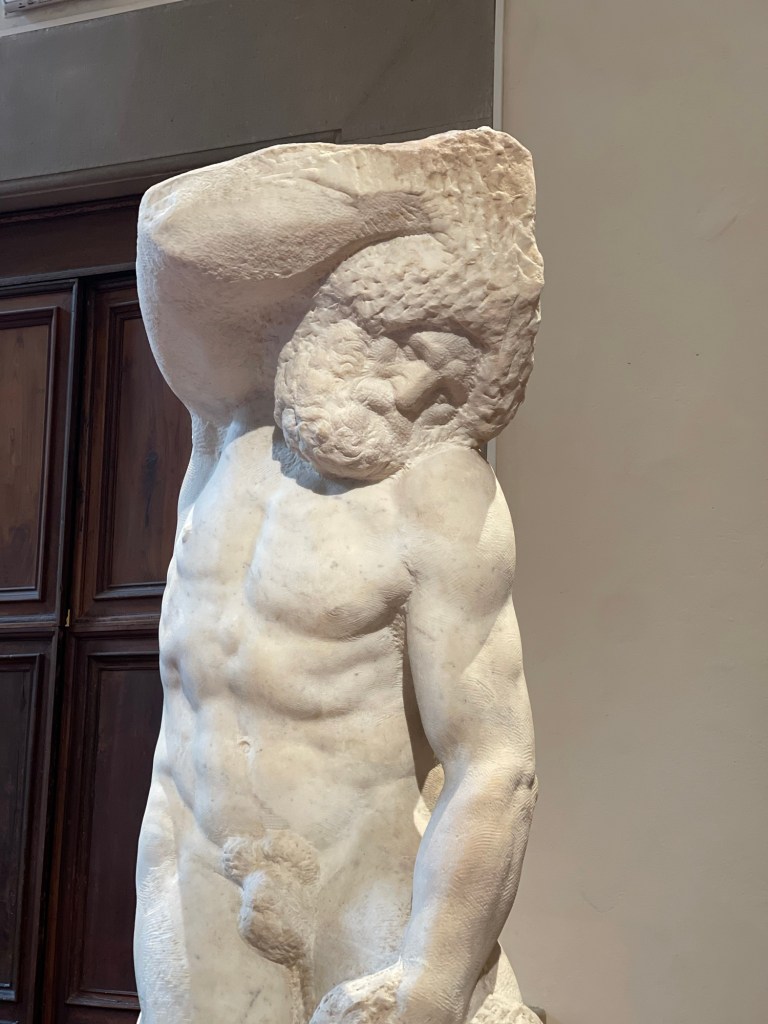
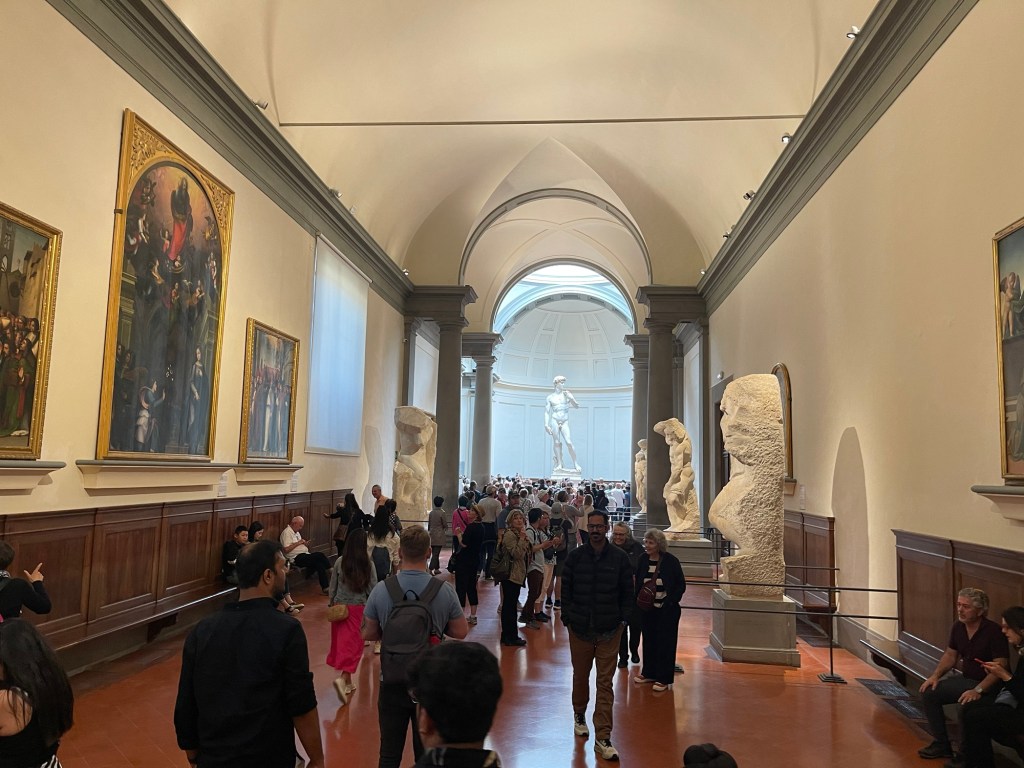
    When you walk up to Michelangelo’s David at the Accademia Gallery in Florence, some of his other sculptures in an unfinished state line the aisle on either side of you. Spending some time with each instead of just rushing past to see David is the best way to see how he released the masterpiece from the marble, as he described it. You can almost see them fighting to break free from the block, just awaiting the help of Michelangelo’s chisel. And so it is when you arrive at David, you understand where he came from—released perfection from a famously imperfect block of marble.

    The interesting thing about that block of marble was that two other artists had begun work on it, gave up on it and it sat partially chiseled and ignored by other artists who couldn’t see the masterpiece within. It wasn’t until Michelangelo saw David within that it became his project. And we are left with the brilliant result, forgetting sometimes the imperfect marble it started as.

    Lately I’ve been wrestling with the imperfect block myself, deciding whether there’s a masterpiece in there or not. To commit and begin chiseling away at something beyond what we are capable of in the moment is the only way to release something exceptional from the average. But why wait? There are no perfect blocks, only something trying to break free from what we have now. So begin with whatever it is we’ve been given and find what calls from within. In those unfinished sculptures is the pain of a masterpiece that never broke free for want of more time.

    The journey to David takes you past unfinished would-be masterpieces
    Michelangelo’s unfinished self-portrait forever trying to break free from the block
  • A Sequence of Everything Wanted

    “Rivers know this: there is no hurry. We shall get there some day.” ― A.A. Milne, Winnie-the-Pooh

    Slow down you’re doing fine
    You can’t be everything you want to be before your time
    — Billy Joel, Vienna

    In a dizzying turn of events, last night capped a sequence of things wanted for some time delightfully happening one after the other, from Rome to Athens to Sicily to Florence to… New Hampshire. Life is sometimes simply great timing, realized. To visit the Colosseum and the Sistine Chapel and the Acropolis and Mount Etna, to see Michelangelo’s La Pietà and David to bookend an epic trip and then return home to find the elusive Aurora Borealis dancing in my own backyard hours later is a sequence I’ll be processing for some time, thank you. This isn’t meant to be a brag about how lucky the last couple of weeks have been, rather a realization that patiently working towards something combined with a bit of good luck goes a long way in a lifetime. Amor fati.

    The thing is, I wear my impatience on my sleeve (and blog about it more often than I ought to). Some of us simply want to get right to everything as quickly as possible, knowing that time flies and we aren’t getting any younger. Sure, tempus fugit, but slow down—you’re doing fine… Vienna waits for you. Simply plot the steps, do the work, follow through and hope fortune smiles on you.

    Hope is a tricky word, and that’s where impatience comes in. Perhaps the better word is trust. We must trust the process when we build our systems. Work, marriage, fitness level, artistic contribution, social interactions, and yes, bucket list items are all lifestyle choices built on faith that doing this will lead to that. When it doesn’t arrive promptly we restless types get a bit impatient, so a reminder of all that’s come to pass helps now and then. Gratitude goes a long way.

    Life lessons are all around us, if we simply stop rushing about so much and focus on the journey. The biggest lesson is that the journey continues, and each milestone is simply a marker for where we’ve been and what we’ve seen and who we were at the time. What’s next matters too, doesn’t it? Our past is our foundation for the growth to come. We shall get there some day. For haven’t we thus far?

    Aurora Borealis, New Hampshire 10 May 2024
    Aurora Borealis, New Hampshire 10 May 2024
    Aurora Borealis, New Hampshire 10 May 2024
    Michelangelo’s La Madonna della Pietà
    Michelangelo’s David
  • Onward, Lisbon

    “Perfection is the fulfillment implicit in art, and [James Joyce] achieved it. Imperfection is life. All forms in life are imperfect, but the function of art is to see the radiance through the imperfection.” — Joseph Campbell

    I returned to the scene of the crime today. For it was in Lisbon that I spent the last days working for a company I didn’t love, with some characters I didn’t like all that much, simply to prove to myself that I hadn’t made a mistake joining that company two years prior. The crime, as you may have guessed, was selling one’s soul for financial gain. Immediately after Lisbon we parted ways, I began blogging in earnest and choosing culture over money in my work. The rest is history (mine anyway). Lesson learned, and passions pursued.

    This time I’m not lingering in Lisbon, but I’m using the opportunity to assess where I am versus where I was. On the whole I’m better, and still a work in progress. We must never rest on our laurels or settle for something that isn’t us. I’m surprised by the blog in many ways, for it hasn’t been the journey I thought it would be, but I’m still at it, even as I’m no longer that person who departed Lisbon six years ago.

    I’ve learned to accept imperfection in my writing, But work towards improvement. Perfection is an audacious act reserved for the very best, but who says we can’t strive to get closer to it? Today, the journey continues, literally and figuratively. Onward, Lisbon. A lot has changed since we’ve been together.

  • Conducive to Brilliance

    “Don’t rush your most important work. Allow it instead to unfold along a sustainable timeline, with variations in intensity, in settings conducive to brilliance.” — Cal Newport, Slow Productivity: The Lost Art of Accomplishment Without Burnout

    There’s something brilliant hiding in there somewhere. We believe it because we feel it, even if it takes its sweet time meeting us halfway. Or more likely, brilliant is waiting for us to meet it halfway. The truth is, all things have their time and when the work is done we’ll all be delighted for having completed it. Yet we live in a world, and with a mind, that demands results today.

    Newport’s book isn’t revelatory, but it is an important reminder that our most important work takes time—and a little time off—to reach a higher pinnacle. Sure, we want results now, but we’re talking about the work of our lifetime, not some simple project we could push out in a week. The trick is to know the difference, and settle into the journey that takes us there.

    We reach a place in our lives where accomplishment isn’t the primary goal anymore, but contribution is. We want to do work that matters, not just check boxes on a meaningless career path. In moments of clarity, we might see the forest for the trees, but the grind of important work means there’s a whole lot of trees to navigate. It’s natural to wonder: does it matter in the end? Sometimes it’s only a means to an end. Which leads to other questions. And so it is that life is one riddle after another in this way.

    The answer is to set up a routine that is conducive to brilliance. This blog may be all over the place at times, but it’s about the process of writing and publishing something every day that matters most. There are days I curse myself for having begun the journey, but I’ll get that one random like on a post from six months ago or a text message of support from someone that inspires me to keep going. We can always quit tomorrow, right? Just not today.

    The question is whether we’ll run out of runway before that brilliant work can take off. Plenty of great ideas crash and burn in this way. Still, we can’t worry about the length of the runway, only that we’re gaining momentum and lift. So we set a sustainable timeline (runway) and work daily towards achieving liftoff. That we might one day soar.

  • The Question of Questions

    Over the weekend I had the opportunity to visit both the Getty Center with its impressive collection and the Getty Villa, with its focus on the ancient arts. I could write a year’s worth of blog posts about the combined collected works we viewed there. Alas, we know how these things go. I’ve got hundreds of pictures and notes from similar encounters that have yet to be realized in creative output by this humble blogger. Every day something new may grab hold of us and demand our focus, leaving old ideas and stories to drift away, to be grabbed by someone else someday.

    We dance with the muse when we are blessed with its attention, whatever the topic may be. At the Getty Villa I came face-to-face with the muse, in the form of a Roman fresco from between 1 and 79 A.D. It’s been whispering to me ever since we met. I’m sharing a picture of the fresco here, that you may decide for yourself whether its power transcends plaster and pigment through bits and bytes.

    The thing is, I know only that I still have work to do beyond the blog. If we don’t listen to the muse it finds someone else. We must be deserving of its attention. My encounter with the muse was a reminder that there’s still work to be done. To answer the question of questions: Tempus fugit (time flies). So what have you done with it?

    Fresco with a Muse, displayed at the Getty Villa Museum
  • A Visit to the Getty Center’s Gardens

    “Always changing, never twice the same,” — Robert Irwin

    A day at the Getty must include a visit to the extensive collections exhibited in the museum buildings. Included in the collection are famous works like Vincent van Gogh’s “Irises” and Rembrandt’s self-portrait “Rembrandt Laughing“, along with significant works by Cézanne, Monet, Claudel and many more. One needs a full day at the Getty to see everything, and even then you feel compelled to return again as soon as possible.

    The gardens at the Getty Center are equally impressive and a must-see destination of their own. Robert Irwin’s Central Garden is a marvel in any season, and as with any magnificent garden, he practically demands that you see it in every season. In all honesty, I’d been wanting to see the museum for some time, but it was the gardens that really called to me. They don’t disappoint.

    Robert Irwin’s Central Garden is the star, with a stunning water feature, iron rod tree sculptures with bougainvillea rising through them, and an ever-changing flower-lined meandering path that leads you down to a central pond. It’s simply a must-see. Not to be undone, the Cactus Garden reaches out towards Los Angeles and the Pacific Ocean in a dramatic balcony seen from different levels. Other gardens fill the Getty as well: sculpture gardens, fountains and large rock gardens make wandering outside the museum as desirable as your time spent indoors.

    For me personally, it was time with my daughter in a magical place. She shares my love of art and the artistic process, and is pursuing her own dream to have a creative, expressive career. To share the Getty experience with her made the moment. For we too are always changing and never the same twice. And isn’t that also quite beautiful?

  • To Follow the Call

    “When one thinks of some reason for not going or has fear and remains in society because it’s safe, the results are radically different from what happens when one follows the call. If you refuse to go, then you are someone else’s servant. When this refusal of the call happens, there is a kind of drying up, a sense of life lost. Everything in you knows that a required adventure has been refused. Anxieties build up. What you have refused to experience in a positive way, you will experience in a negative way…
    Your adventure has to be coming right out of your own interior. If you are ready for it, then doors will open where there were no doors before, and where there would not be doors for anyone else. And you must have courage. It’s the call to adventure, which means there is no security, no rules.” ― Joseph Campbell, A Joseph Campbell Companion: Reflections on the Art of Living

    We have people in our lives who would read that passage from Joseph Campbell and shudder at the very idea of answering the call. They’ll throw all kinds of logic at you about why this is not a good idea at all, not nearly as good an idea as staying the course and following through on the path chosen for us. It’s an attractive rut to stay in place, doing what is expected of us, with a promise of retirement and a few healthy years before we die. It’s a Siren’s song that has lured many a soul to the rocks.

    Thoreau said something unnervingly similar, didn’t he, when he observed that “the mass of men lead lives of quiet desperation”? We may either look inward and refute the observation or find it rings true, but we may never be fully the same having seen the truth within us. Still, every day is a new opportunity to step into who we really are. Every day we may follow the call or go on killing the dream. We must choose wisely which voice we follow, remembering that the rocks are closer than we might believe.

    Alone on a midnight passage
    I can count the falling stars
    While the Southern Cross and the satellites
    They remind me of where we are
    Spinning around in circles
    Living it day to day
    And still 24 hours may be 60 good years
    It’s really not that long a stay
    Jimmy Buffett, Cowboy in the Jungle

    Joseph Campbell is very much in the “follow your bliss” camp. He’s largely the originator of the term. There are many who mock this following your bliss strategy as impractical at best and self-deceptive folly at worst. The question is, if we may have our 60 good years doing something we absolutely love—that calls to us—or if we will forever shelve that for what the world wants of us. What will it be, for you and me?

    Perhaps the answer is to follow our call, instead of bliss. Sure, it’s the same thing, but the optics are better for the person who knows what they want and seizes the moment attempting to achieve it. What is the difference between a start-up entrepreneur in the garage and a poet writing in a cabin in the woods? The former have better marketing budgets. We glamorize the chase for a personal fortune but mock the chase for personal enlightenment.

    Whatever our path is, whatever our call, we ought to feel the urgency to follow it immediately. For the rocks are getting closer and there’s no time to waste. Decide what to be and go be it.

  • To Give Light

    “What are we here for if not to enjoy life eternal, solve what problems we can, give light, peace and joy to our fellow-man, and leave this dear fucked-up planet a little healthier than when we were born.
    Who knows what other planets we will be visiting and what new wonders there will unfold? We certainly live more than once. Do we ever die—that is the question. In any case, thank God we are alive and of the stars—into all eternity. Amen!” — Henry Miller

    The thing about stars that may interest only me is that they give light to the eternal darkness of the universe for however long they exist. They aren’t relying on other stars for their energy—perhaps a little gravitation pull now and then, perhaps a bit of orbital spin, but their energy is all their own. Stars shine light into the vacuum of space with no expectation that anyone will receive it someday. That’s of no concern to the star—all their energy is put into giving light while they dance in their orbit to infinity and beyond.

    And here we are, stardust ourselves, receiving that light and mixing it with our own. We too are here to shine; we mustn’t ever worry where our own light goes, just that we give it freely to the universe in our time. The question is never whether to give light, but what our light should be. Perhaps, as Miller suggests, the answer is simply to enjoy this life eternal in our time and solve more problems than we create. Maybe it’s enough for us to put positive energy into the universe that illuminates others in their darkness, that they too might shine.

    Sometimes I wonder if I’m spinning in the right orbit or perhaps even burning out. There are days when I don’t want to do much of anything but find when I stop focusing on the void and begin the process something worthwhile eventually arrives to greet me. Something like the little note to himself Miller wrote in 1918 find their way to me and now to you, to serve as a reminder: Who are we to keep the light to ourselves?