Category: Culture

  • Perfectly Imperfect (That Tower in Pisa)

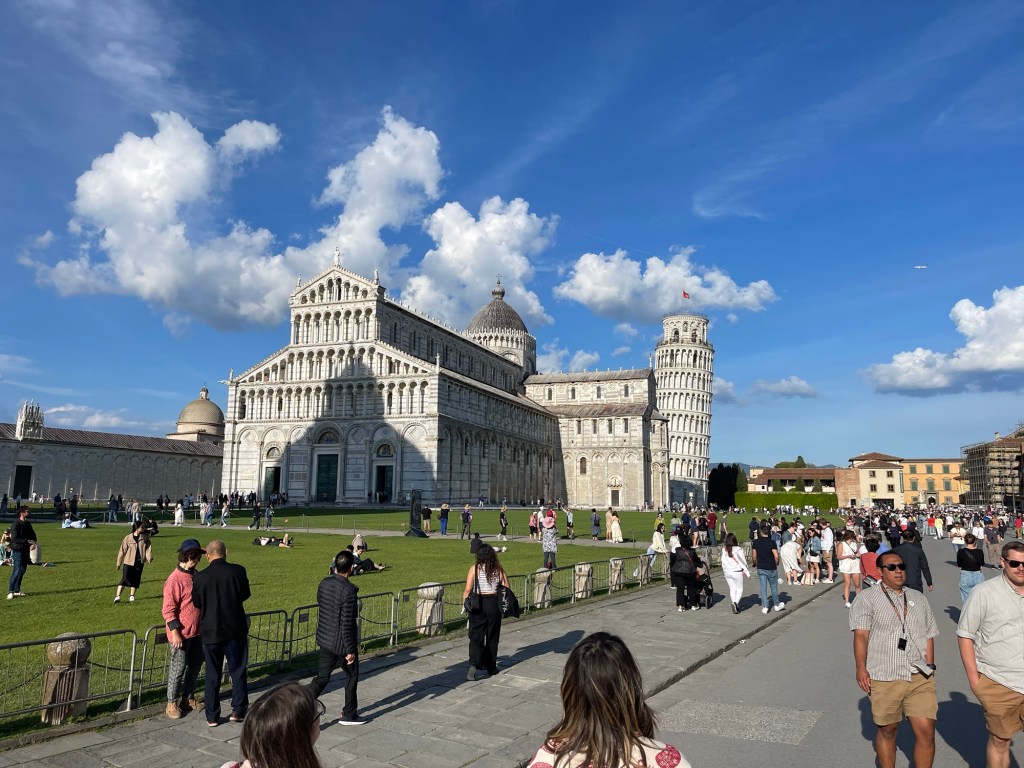
    The thing about the leaning tower of Pisa that we know intuitively is that the whole thing was a big mistake. Weak foundations mean buildings fail over time. But this one has been a massive success for the very fact that it’s still standing, if off-kilter, despite the fatal design flaw. It’s perfectly imperfect and thus appealing—for who among us is perfect?

    Pisa is a one hit wonder on the tourist circuit. Most people swarm in, head straight to the tower and leave shortly afterward. Plenty of kitschy trinkets for sale on the gauntlet between parking and the tower. This is the modern hazard of international travel to popular destinations: aggressive tchotchke vendors.

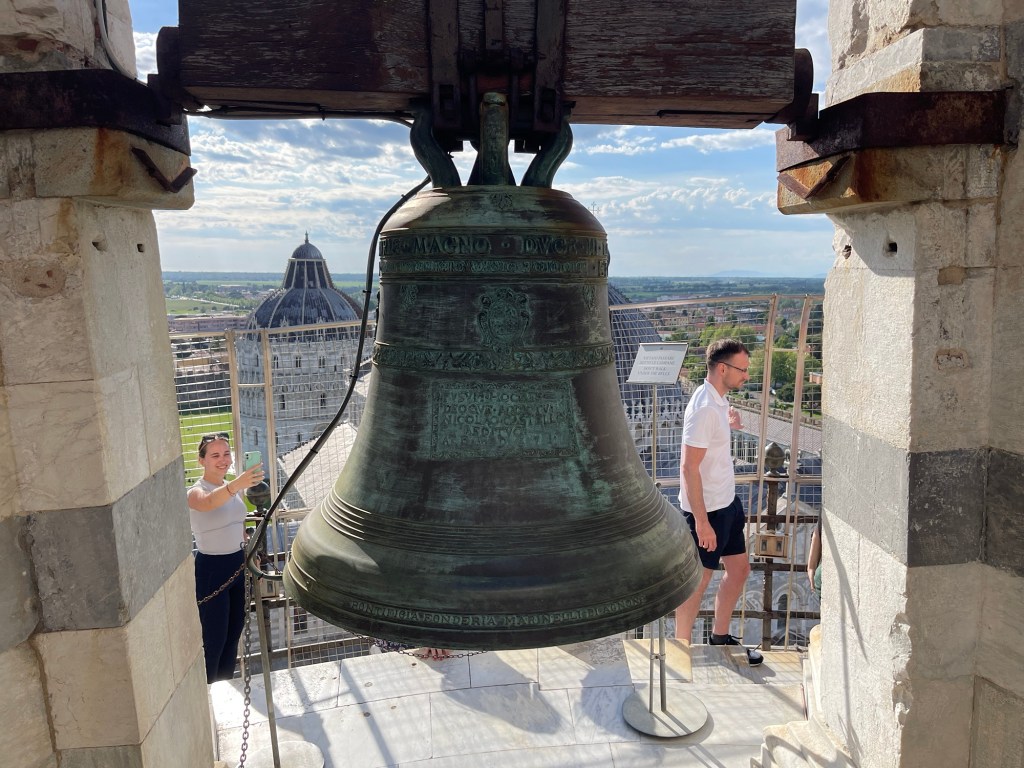
    The tower itself is the destination, and it shocks the senses when you actually see it up close and personal. To climb it, feeling that distinct lean in every step to the top, is quite unusual and a bit thrilling. We’ve climbed stairs before, but never an off-kilter spiral like this one. You know immediately why people come here to see and climb it. Perfection is in the eye of the beholder.

  • Greek Character

    “Character is a Greek word, but it did not mean to the Greeks what it means to us. To them it stood first for the mark stamped upon the coin, and then for the impress of this or that quality upon a man, as Euripides speaks of the stamp—character—of valor upon Hercules, man the coin, valor the mark imprinted on him. To us a man’s character is that which is peculiarly his own; it distinguishes each one from the rest. To the Greeks it was a man’s share in qualities all men partake of; it united each one to the rest. We are interested in people’s special characteristics, the things in this or that person which are different from the general. The Greeks, on the contrary, thought what was important in a man were precisely the qualities he shared with all mankind. The distinction is a vital one. Our way is to consider each separate thing alone by itself; the Greeks always saw things as parts of a whole, and this habit of mind is stamped upon everything they did.” — Edith Hamilton, The Greek Way

    Greece is a place of rugged beauty, to be sure, but also of rugged character shaped by a sense of timelessness that we simply don’t have in my own country. To walk around a structure built in 444 B.C. is to taste eternity. We are humans of course, and eternity isn’t ours to embrace just yet. But we may reach for the eternal in the form of development of our character.

    Poseidon was one of the Olympians for the Greeks, presiding over such volatile things as the weather. For a Greek sailing off to fish or fight, Poseidon was a big deal, and someone to cater favor with. He also influenced the temperament of horses, and was known as the “earth shaker” for his power to control earthquakes. So building a temple devoted to Poseidon made a lot of sense, and where better for it than on a prominent cliff overlooking the Aegean Sea on Cape Sounion?

    It’s one thing to read history, quite another to stand on the edge of a cliff between the Aegean Sea and a temple erected 2500 years ago as a tribute to the god who controlled both that sea and the ground we stood on. Best to embrace the spirit of the ancients in such moments, rather than incurring the wrath of Poseidon. And that’s the thing about Greece: you feel that you’re trying to measure up instead of trying to stand out. It’s a subtle difference, but it matters a great deal. It’s not that we aren’t special (our mother’s would insist that we are), it’s that we may be integral to something far beyond our time and place. That’s the Greek character.

    The Temple of Poseidon, 444 BC

  • Historical Memory

    “History is written by the victors and framed according to the prejudices and bias existing on their side.” — George Graham Vest

    History writes itself as humans progress generation-to-generation, but that’s no guarantee of it being remembered. For, as Vest, a Confederate Senator who managed to retain power after the American Civil War pointed out, our written history is only remembered when subsequent generations choose to remember it. How many billions of souls are nothing more than a footprint? How many heroic figures would have been portrayed as villains had the other side won?

    The point was hammered home for me on a visit to the Colosseum in Rome. The Colosseum affirms history—for who doesn’t know of the Colosseum?—while also emphasizing that remembering or saving anything from one generation is at the mercy of those who follow in the next. Whole sections of the Colosseum were removed and recycled into other things, which themselves may have been removed and recycled again and again. Were it not deemed sacred the Colosseum likely would have disappeared like the statue Colossus, from which it got its name, did.

    Most Emperors, Presidents and Popes fall away into history, let alone you and me. The lesson is to enjoy the ride while we’re here, but also to be so valued by those we leave behind that we’re remembered for all the right reasons. Ultimately, our lives are fragile enough as it is without the burden of being remembered beyond a generation or two after we’re gone, so we ought to simply pursue excellence for its own sake. Our time is not some dusty monument, we write our memories now. The rest is up to those who follow.

    Rome’s Colosseum
  • Breaking Up with Temporality

    “You give yourself to life by leaving temporality behind. Desire for mortal gains and fear of loss hold you back from giving yourself to life.” — Joseph Campbell

    Admittedly, I’ve had a complicated relationship with time. I spent too much of it rushing from one commitment to another, always striving to be early so as not to waste someone else’s time should the universe align itself to create delays. I write this very blog post in a coffee shop having arrived early for a meeting just down the street. Temporality is deeply engrained within me. It’s a hard relationship to break with.

    That doesn’t make it a healthy or enabling relationship. In fact, much of the stress I’ve felt in my lifetime is related to my relationship with time. Productivity calculations in a quarter, splits on a screen as I try to beat some preconceived expectation of how quickly I can complete some workout, or the pressure I put on myself to read or write a certain amount in the time I have available for such things. Time isn’t a great measure of our worth, unless you’re an Olympic athlete or attempting to solve a Rubik’s Cube or some such thing. Tempus fugit, indeed.

    So I’ve promised myself I’d break up with temporality, once and for all. Maybe not today, mind you (for I do have these commitments lined up), surely not tomorrow (I have a flight to catch, after all), but very—very— soon. How soon? Well, maybe time wIll tell? But know this: I’m serious this, uh, time.

  • A Hike to the Hollywood Sign

    If there’s anything iconic in Los Angeles, it’s the Hollywood sign. It’s so deeply engrained in our cultural awareness that when you actually see if for the first time it doesn’t seem real. But there it is, atop Mount Lee, surrounded by chain link fencing, surveillance cameras and warning signs about trespassing. One should heed the warnings, if only to avoid the rattlesnakes and Mountain Lions said to roam the area.

    And that’s the irony of the Hollywood sign: for something so famously welcoming, it’s surrounded by signs telling you to stay the heck away from it. The neighbors don’t want you anywhere near it. The people who protect the sign from vandals take great measures to remind you to stay away from it too. What’s a hiker to do but press on in the face of all the dire warning signs? There are public trails leading to it, after all. The aim isn’t to get within arm’s length of the letters—it’s to be close enough to say you got there.

    We hiked up there early on a raw, wet Sunday morning. There were plenty of other hikers making the same trek, including a busload of tourists with umbrellas and a couple of small groups led by tour guides. The hike is roughly 5 miles round trip from the closest parking area, on terrain (access road) that is forgiving for the sneaker-wearers. Total elevation for our hike was 856 feet. So really, anyone healthy enough to walk it can make it to the summit of Mount Lee, just behind the sign. There are surely longer hikes, but in a land of mudslides those aren’t so fun in the rain.

    So why do it at all? Because it’s there, partly, but also because it’s got amazing views of Los Angeles on a clear day. And really, because it’s kind of cool to say that you’ve done it at least once. Hiking snobs may sniff at the elevation or the bands of tourists swarming around them, but who cares? Sometimes simply hiking for fun is more than enough of a reason to go.

    Los Angeles rising through the mist

    Access road signage designed to jolt the casual tourist to awareness

  • A Visit to the Getty Center’s Gardens

    “Always changing, never twice the same,” — Robert Irwin

    A day at the Getty must include a visit to the extensive collections exhibited in the museum buildings. Included in the collection are famous works like Vincent van Gogh’s “Irises” and Rembrandt’s self-portrait “Rembrandt Laughing“, along with significant works by Cézanne, Monet, Claudel and many more. One needs a full day at the Getty to see everything, and even then you feel compelled to return again as soon as possible.

    The gardens at the Getty Center are equally impressive and a must-see destination of their own. Robert Irwin’s Central Garden is a marvel in any season, and as with any magnificent garden, he practically demands that you see it in every season. In all honesty, I’d been wanting to see the museum for some time, but it was the gardens that really called to me. They don’t disappoint.

    Robert Irwin’s Central Garden is the star, with a stunning water feature, iron rod tree sculptures with bougainvillea rising through them, and an ever-changing flower-lined meandering path that leads you down to a central pond. It’s simply a must-see. Not to be undone, the Cactus Garden reaches out towards Los Angeles and the Pacific Ocean in a dramatic balcony seen from different levels. Other gardens fill the Getty as well: sculpture gardens, fountains and large rock gardens make wandering outside the museum as desirable as your time spent indoors.

    For me personally, it was time with my daughter in a magical place. She shares my love of art and the artistic process, and is pursuing her own dream to have a creative, expressive career. To share the Getty experience with her made the moment. For we too are always changing and never the same twice. And isn’t that also quite beautiful?

  • Songs of Freedom

    Old pirates, yes, they rob I
    Sold I to the merchant ships
    Minutes after they took I
    From the bottomless pit
    But my hand was made strong
    By the hand of the Almighty
    We forward in this generation
    Triumphantly
    Won’t you help to sing
    These songs of freedom?
    — Bob Marley, Redemption Song

    We forget, sometimes, the progress we’ve made generation-to-generation through the years. In my own lifetime I’ve seen the pivot towards acceptance and inclusion, and of course the strong, often violent reaction of those who don’t want to change. It’s always been this way. Still, we progress.

    Call me an optimist, but I take the long view on social change. There is a growing awareness of the stakes, even as there’s been growing momentum on the side of autocracy. Populism swings to and fro like a pendulum, fueled by whatever information or disinformation is consumed. The old ways die, but so do memories, and we often repeat the same mistakes over and over again. It can be frustratingly obvious how manipulated we all are at times.

    Once someone is free it’s pretty difficult to ask them to put the chains back on. That requires force. And there are plenty of examples of that in the world too. Places where democracy never took hold, or extremists grabbed power. It can happen here too, should we let the pendulum swing too far.

    Sure, I’m an optimist, but I can’t even convince some of my closest friends that the guy they want to be king is a conman. These are dangerous times for freedom. Never trust someone who tells you they know what’s best for you. They’re almost certainly talking about what’s best for them. But enough have bought in that half the country thinks we’d be just fine slipping backwards. American authoritarianism has legs and some powerful financial backing.

    Really, I can’t even believe I’m writing this blog. It seems so obvious to so many of us what the logical path is that it’s hard to see that we’re just consuming a completely different information diet than the other half of the country. Half. The. Country… Good God. If there’s one thing true about humans, it’s that we don’t always do what’s logical. And so it’s clear that we have to look to the next generation for help. I think that they’re paying attention. Aren’t they? Aren’t we?

    Logic only takes us just so far. Emotion is what always brings voters out on election day. Won’t you help to sing these songs of freedom?

  • Easter Eggs

    “No one knows the future, but the present offers clues and hints on its direction.” — Innocent Mwatsikesimbe

    “An Easter egg is a message, image, or feature hidden in software, a video game, a film, or another — usually electronic — medium. The term used in this manner was coined around 1979 by Steve Wright, the then-Director of Software Development in the Atari Consumer Division, to describe a hidden message in the Atari video game Adventure, in reference to an Easter egg hunt.” — Wikipedia

    I’ve never been so hip in my life, or maybe excelled enough at video games, to have been fully aware of the existence of Easter Eggs in games and software. Like most people, it was a growing cultural awareness of such things. The thing is, you’ve got to be invested in that particular form in which the Easter egg is hidden to ever be aware of it, let alone understand what it might mean. In this way, Easter eggs are gifts to the loyal fans from the creators.

    When Game of Thrones was peaking 6 or 7 years ago, many people went back and watched it from the beginning, just to get caught up on all the things that were referenced in later episodes. It’s here that the term really took off for those of us not quite invested in video games or coding. A well-written show will hint at the future. These hints will be obvious, “ah ha!” moments for the invested audience. To get the joke, as it were, is part of the mass appeal of such shows.

    The term “Easter egg” is a bit trendy, but great writers have been dropping hints into their work for as long as there’s been works of fiction. Agatha Christie was masterful in setting the scene just so, that what is hidden in plain sight might reveal itself as perfectly obvious later in the story. The delight in her novels was trying to figure things out as you went through the story, knowing full well that she would place as many dead ends into the story (pun intended) as the hints that brought the culprit to justice in the end.

    “The impossible could not have happened, therefore the impossible must be possible in spite of appearances.” — Agatha Christie, Murder on the Orient Express

    All artists offers something of themselves in their work. Some artists literally create something of themselves within their art. Plenty of artists through the years have hidden their own face in their greatest works, that those in the know may delight in finding them. At St. Stephen’s Cathedral in Vienna, you can smile at the face of sculptor Anton Pilgram smiling back at you. Knowing that these Easter eggs exist, we may delight in seeing them again as if for the first time.

    Life is full of Easter eggs for us too. We have our symptoms, habits and associates that lead us into trouble or salvation. Sometimes the future is hiding right in plain sight, just like one of those Agatha Christie novels. We ought to be better at seeing the signs, that we may steer towards a safer course. Life isn’t a game, after all. But you saw that conclusion coming from the start, didn’t you?

  • Rumble Strips

    Rumble strips are designed to jolt a driver back to alertness. Drift a bit to the side and the tires make a loud rumble, preventing countless accidents. In this era of distracted driving it’s been a godsend. Surely it seems we need the roads to protect us from ourselves.

    Life offers virtual rumble strips as well. The scale or the waistline on our favorite pair of pants may jolt us out of our dietary habits. A terse letter from an angry customer may raise the customer service standards for an entire organization. A stern look has corrected plenty of bad behavior for generations. And in theory the United States has a system of checks and balances and regular free elections that act as rumble strips for bad actor surfing a wave of popularism for advantage. In life, when we drift off course we correct ourselves over time.

    The thing is, the world is full of examples where the rumble strips didn’t work. Accidents, bad habits and behavior and yes, rogue actors in politics still happen anyway. That doesn’t mean we shouldn’t have rumble strips in place. How else would we mitigate the impact of drift?

  • Our Expanding Universe

    “A book, too, can be a star, “explosive material, capable of stirring up fresh life endlessly,” a living fire to lighten the darkness, leading out into the expanding universe.” — Madeleine L’Engle, A Wrinkle in Time

    This week I finished another book, set it gently on the shelf to remind me of our time together, and set out on a journey with another book that’s been calling me for months. Just like that, I’d leaped from Provence to ancient Greece. This is a blog about experiences as much as processing the act of becoming that these experiences offer. Reading books is a borrowed experience, taking us to places we might never go otherwise.

    Earlier this month, The Atlantic published a list of The Great American Novels, which included 136 books deemed the best of the best in American fiction (including A Wrinkle in Time quoted above). I was chagrined to discover that I’ve only read 10% of the books on the list. For all the reading I do, apparently the classic American novel hasn’t been a focus. It seems I have work to do in this area.

    The thing is, to grow we must consume a healthy diet of diverse experiences. The more we learn, the more we understand the universe and our place in it. It’s the challenge of a lifetime, isn’t it? We are only given so much time, and there’s just so much to see and do… and read. The great tragedy in life is having never ventured beyond oneself at all. So many never quite leave their comfort zone, and crush themselves under the weight of superstition and fear of the unknown. That’s not us, friend.

    When we think about overachieving in a lifetime, the opportunity to read the greatest books ever written is as good a starting point as any. If I just maintain my current pace of reading, I may read at most another thousand or so books in an average lifetime. If my work and travel aspirations slow down and I focus more on reading, perhaps I can surpass my own expectations. We ought to factor in reading when we look at bucket lists. Assuming we will have the mental acuity to press on, the universe may yet expand far beyond current expectations.