Category: Culture

  • A Visit with Myles Standish

    Duxbury, Massachusetts doesn’t have the same notoriety as its neighbor Plymouth, but the roots of history run nearly as deep here. To be fair, if people think of Duxbury at all, it’s usually as an upper class suburb of Boston. There’s plenty of wealth on display in this town. But step away from the massive homes with their perfectly manicured gardens and you’ll find a legacy that reaches back to the Mayflower. The most famous character on the Mayflower, Myles Standish, lived and died in Duxbury, and is buried in what is now known as the Myles Standish Burying Ground.

    The burying ground was once adjacent to a meeting house, long gone, but marked with granite stones to indicate where it once stood. It is the oldest continuously maintained graveyard in the United States. The lay of the land is largely the same within the enclosure. The thing about graveyards is you’re walking on ground largely unchanged since the days when the people buried there were laid to rest. The entire area around a graveyard becomes housing developments and strip malls and paved roads, but these small graveyards are a time machine back to another time.

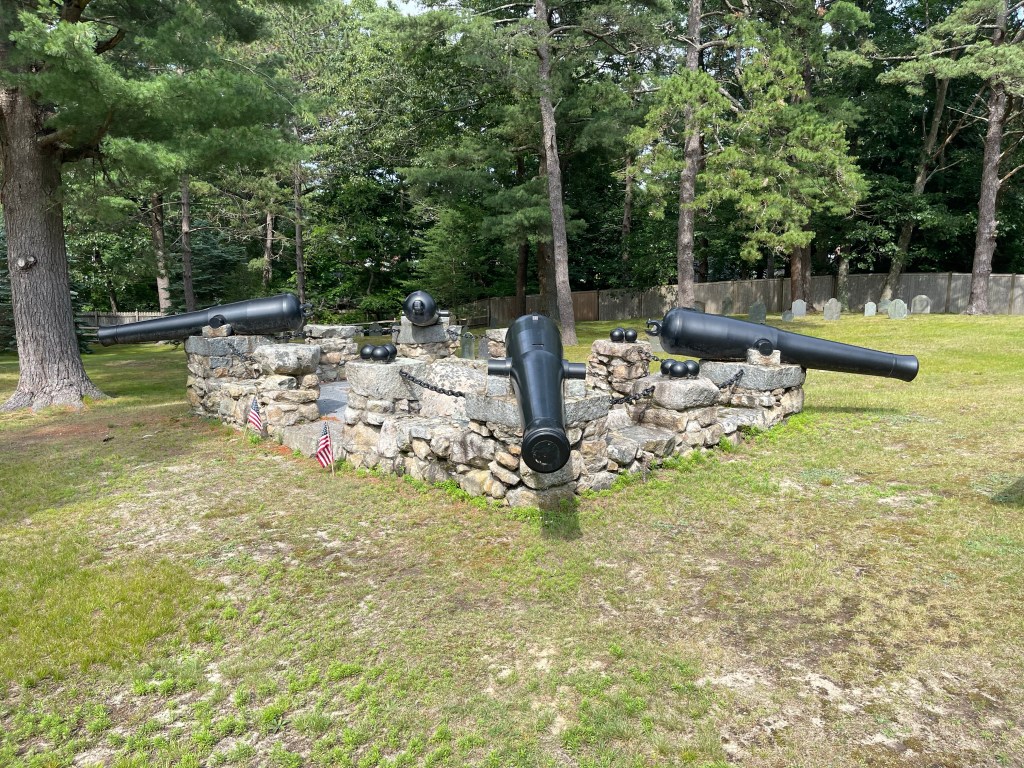
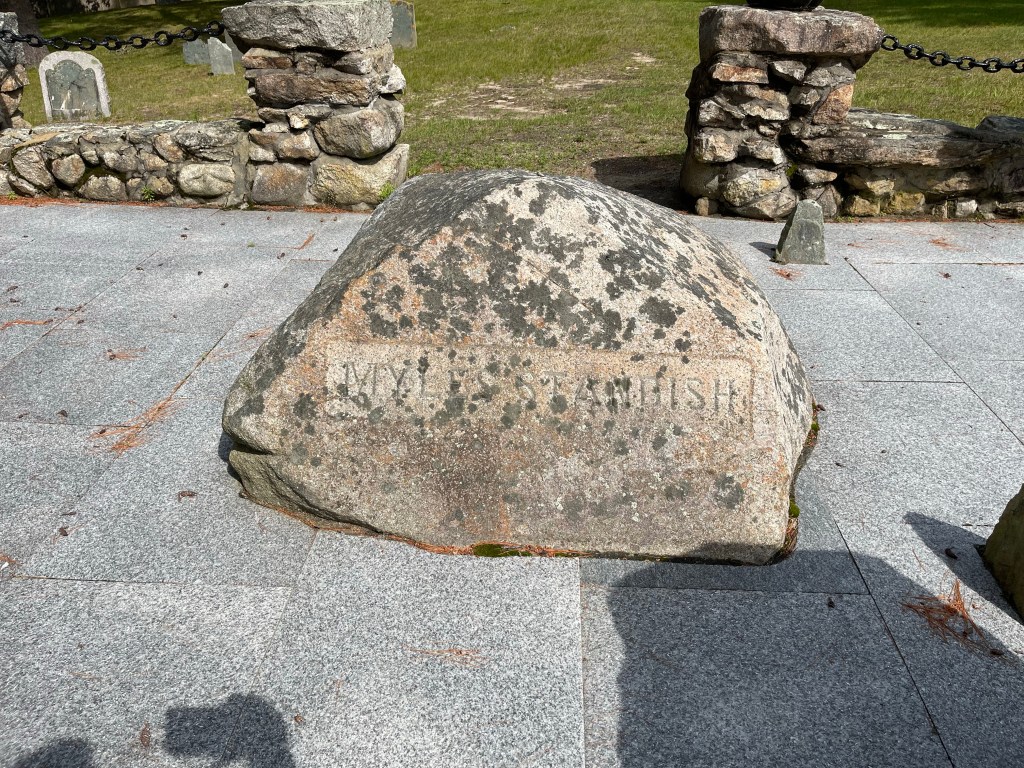
    Captain Jonathan Alden, son of Mayflower passengers John and Priscilla Alden, is also buried in this graveyard, and his is the oldest gravestone in the burying ground. Standish, who died well before Alden, likely had small pyramid-shaped stones marking his interment initially, and the monument built around the spot in 1893 (you can see one of these stones behind the boulder engraved with Myles Standish’s name in the picture below). That engraved boulder, like Plymouth Rock, is something for the tourists. The monument itself, with a fieldstone wall surrounding it and four cannon mounted on each corner, projects the violent boldness of the man interred beneath.

    Myles Standish was a military advisor to the Pilgrims. By all accounts he was brutal and decisive in his actions. He would preemptively attack when he heard trouble was brewing, and famously stuck the head of one rival, Wituwamat, on a pike as a deterrent to others. There seems to be no doubt that Wituwamat was lured into a room and murdered. Was this act of brutality something to be celebrated or scorned? Was there a legitimate threat to the Pilgrims, and could it have been resolved in a more diplomatic way? What’s clear is Standish believed he was fighting for the lives of the colonists, and used any method he could to intimidate those who he believed were threats to their safety. As with all history, we judge it from the comfort of distance.

    At another spot in town, on a point of land jutting out into Kingston Harbor, there are four more granite stones laid out in a park amongst multi-million dollar homes overlooking the harbor. It was here that Myles Standish actually lived. I found this interesting, as a military man like Standish would normally seek the high ground. A review of a Google map later revealed a small pond nearby that would have been his source of fresh water. Perhaps Myles dined regularly on Duxbury oysters, which have become almost as famous as the town’s most notable resident.

  • Becoming Rich With Memories

    “The business of life is the acquisition of memories. In the end that’s all there is.” — Mr. Carson of Downton Abbey

    “You retire on your memories. When you’re too frail to do much of anything else, you can still look back on the life you’ve lived and experience immense pride, joy, and the bittersweet feeling of nostalgia…. Making deliberate choices about how to spend your money and your time is the essence of making the most of your life energy.” — Bill Perkins, Die With Zero

    We all talk of how the time flies by, but perhaps we ought to focus on how many great memories we accumulate in that span. If we’re living well, experiences are acquired and flipped into memories with the turn of the calendar. We may not become financially wealthy, but surely we might accumulate a lifetime of memories worthy of our time. As the quote above points out, in the end, isn’t that all there is?

    What are memories but the realization of deliberate action? As much as I love a good spreadsheet, I know deep down that working in them isn’t creating memories that will last a week, let alone a lifetime. But I may just remember the conversation I have with someone important in my world a lot longer. I may recall the thrill of peering over a cliff at an angry ocean in Portugal and smile someday when I’m too old for such things. I expect I’ll still smile at the recollection of my kids realizing the amusement park ride they insisted on going on was going to be a lot scarier than they’d bargained on when they begged to go on it. This is the accumulated wealth of memories.

    Perkins’ book challenges us to stop accumulating savings and start spending our money while we’re healthy and fit enough to actually do the things we promise ourselves we’ll eventually do, someday, when we retire. As if we can do at 65 what we might do at 25 or 35. Do it now. There is no tomorrow, and if there is, we won’t be able to pull off some of the things we believe our bodies and minds will be capable of someday when.

    I’ve watched too many people in my life hear the news that they won’t make it to retirement. Cancer seems to be the most common thief of dreams, but maybe an accident or a heart attack steals everything you’ve ever planned for “someday when” away from you. Your life is now: accumulate the memories that will make you richer then. It’s the best return on investment we can have with today.

  • The Less Lazy Way

    “Men are inclined to laziness. Some will feel that he might have said with greater justice: they are all timorous. They hide behind customs and opinions. At bottom, every human being knows very well that he is in this world just once, as something unique, and that no accident, however strange, will throw together a second time into a unity such a curious and diffuse plurality: he knows it, but hides it like a bad conscience.” — Friedrich Nietzsche, The Will to Power

    To borrow the Kenny Loggins phrase: This is it. Make no mistake where you are. You’re going no further. We know this intuitively, yet we still wrap ourselves in lazy routines and escapism. We’ve got nothing more than now to work with, yet we treat our days as frivolously as disposable napkins. ’tis now or never friend. Break the lazy—be bolder.

    Easier said than done. We all have our bank of bad habits. I know I ought to work out more and put in more time with the things I’m leaning into becoming. But life gets busy, people we care about need our attention, work demands are never quite satiated. The fact of the matter is, after a long day of filling other people’s buckets our own feels pretty empty. Good enough seems okay in such moments. This is where we must break free of ourselves.

    “How does one become stronger? By deciding slowly; and by holding firmly to the decision once it is made. Everything else follows of itself.” ― Friedrich Nietzsche, The Will to Power

    Decide what to be and go be it. And then establish habits that affirm the identity we wish to have in this brief lifetime. Simple, right? We know better. Creating the person we wish to become is never simple, but it is possible. This is the less lazy way, and everything else follows.

  • The Present

    “And I asked myself about the present: how wide it was, how deep it was, how much was mine to keep.” — Kurt Vonnegut, Slaughterhouse-Five

    “It occurred to him that there must be some state institute, a kind of time bank, where he would be able to change at least some part of his shabby seconds.” — Rainer Maria Rilke, The Notes of Malte Laurids Brigge,

    Time is not ours to keep—more a wave we surf to the beach. We dabble in time, thinking about improving our productivity and efficiency and doing more with less, but really, we’re trying to avoid wasting the time we have. Making the most of the present is the only worthy goal as we surf this wave.

    Lately conversations about time have come up a lot in the circles I run amuck in. Talk of people taking more time off, people who feel they’re time hasn’t been used wisely, people quickly running out of time (I’ve had more conversations about hospice recently than at any time in my life). Everybody is going through something in their lives. The surfing isn’t always great in this complex world.

    This writing habit is one of the best things I’ve invested my time in. Writing isn’t passing the time, and it isn’t a celebration of one’s greatest exploits. It’s putting a spotlight on the hourglass and seeing each grain of sand and savoring the seconds. This is living in the present: good, bad and all that lies in between. The secret is to add depth and breadth to each moment of it. And maybe write the chapter in such a way that it lives on beyond the present.

  • Life is Sweet

    They told you life is long
    Be thankful when it’s done
    Don’t ask for more
    You should be grateful
    But I tell you life is short
    Be thankful because before you know
    It will be over
    ‘Cause life is sweet
    And life is also very short
    Your life is sweet

    — Natalie Merchant, Life Is Sweet

    The very first time I saw the VH1 Storytellers video for this song I was getting dressed in a hotel room in California preparing for a busy day on a business trip. By all accounts it was a day of hopefulness and adventure. With the lyrics running in my head, it became the soundtrack forever associated with a tragic event in American history for me. That was the day that Columbine happened. I’ve been wrestling the song back from that event ever since.

    There are people who will go to great lengths to apply their own brand of miserable to the world. But life can be beautiful if we offer a different perspective. We may not have as many days, or as many good days, as we’d want out of life. But the gift is there for us to celebrate should we take the time to unwrap it.

    Returning from a business trip last night through Washington DC, flight again delayed and overbooked, as they all seem to be nowadays, I glanced at the television monitors showing rolling footage of another tragedy, this one the Titan submarine that imploded on a Titanic dive. We all know that life is short, and the untimely deaths of people making the most of their lives can be shocking. Perhaps that’s why everyone slows down when passing an accident scene, or tunes in when breaking news occurs. Each day offers the opportunity to affirm our beliefs in the darkest nature of humanity or the very best within us. What do we focus on in the moment?

    Memento mori. Carpe diem. We know the soundtrack. Dance with life while the music is playing.

  • The Magic of Applied Attention

    “We’re all going to die, all of us, what a circus! That alone should make us love each other but it doesn’t. We are terrorized and flattened by trivialities, we are eaten up by nothing.” — Charles Bukowski

    There is a Persian lime tree growing in a large pot on the sunny deck behind my house. This spring there were more than a hundred blossoms on this tree, each developing into tiny fruit that promised a bumper crop of limes. But after a particularly angry thunder storm and torrential downpour dozens of those tiny fruits scattered the deck, their tart potential over before they really began. While mourning the loss of so may limes, I took solace in the dozens of fruit still developing on the tree. It seems the tree had culled itself that it might focus on the ripe potential of the fruit that remained.

    We each bear so much in our lifetime, holding on to things we ought to shed to focus on the essential few. It’s okay to let go of the trivial, that we might nurture the truly important things in our lives. Letting go is painful, but not as painful as diminishing our best work by carrying more than we should.

    Little by little,
    as you left their voice behind,
    the stars began to burn
    through the sheets of clouds,
    and there was a new voice
    which you slowly
    recognized as your own,
    that kept you company
    as you strode deeper and deeper
    into the world,
    determined to do
    the only thing you could do —
    determined to save
    the only life that you could save.

    — Mary Oliver, The Journey

    The night after the thunderstorm, I spent an evening with friends, throwing axes at a target drawn on a wooden wall and building fragile wooden castles in the air (Jenga). There is a unique strategy for each, naturally, being so very different from each other in practice. But there are also similarities. Besides each pursuit using wood, it was the act of applied attention that is common to both. To be good at either you must simply get out of your own head and focus on successfully completing the task at hand. One might utilize this in every pursuit, from writing to navigating any of the essential tasks that fill one’s day.

    We ought to cherish our time together, forgetting the trivial affronts that life throws at us. We ought to find our own voice in a world full of people waiting for us to shut up that they may say something clever. We ought to direct our attention inward, to the ripe potential of our own ideas, calling us to truth and clarity. We know, deep down, that we won’t survive this, but if we give ourselves the time to focus, we may just yet produce something substantial anyway.

  • On Father’s Day

    Father’s Day means something different when you’re a father. You learn to view your own father(s) through a different lens. After all, parenthood and marriage change us, and how we react to such changes has a profound impact on everyone within the nuclear family. Most would agree that to sire children is the easy part, but it doesn’t make one a father. You have to earn that part through presence and perseverance.

    My bride points out that Mother’s Day is not for the person who is the mother, but for that person’s mother. It surely applies to fathers as well. When you’re a parent, it never should be about you, only those you care for and protect. Nobody said it would be easy, let alone about us. It’s never really been about us anyway. Parenthood teaches this more than anything. Living for others makes us good humans, not just good parents, don’t you think?

    My own fathers, and I count two as fathers, weren’t fully ready for the role but did the best they could with the opportunity. I try to honor the best in both of them in my interactions with others, especially my own children. You become aware that many don’t rise to meet the role, and appreciate those who do. The ego truly is the enemy when it comes to being a great father. You know one when you meet one, and do what you can to be one.

    Father’s Day means something entirely different when your father slips away from you. Dementia, death, obligation or indifference are all forms of slipping away. Eventually something pulls our fathers away from us. Once you’ve experienced this, being fully present with our fathers while we have the opportunity seems the only way to truly honor and thank them for being a part of our lives.

    Happy Father’s Day.

  • The World Lies Waiting

    “Between the wish and the thing the world lies waiting.“ — Cormac McCarthy, All the Pretty Horses

    “The world is quite ruthless in selecting between the dream and the reality, even where we will not.” — Cormac McCarthy, All the Pretty Horses

    When those who have achieved mastery in their craft leave this world, what are we to do but reflect on their work? But something else stirs in their passing: Memento mori. A whispered reminder that we too will slip away one day, work and dreams of what might be be damned. It’s now or never, friend. Carpe diem.

    This is the urgency of living. This is the call to produce that which must be finished in our time. Between the wish and the thing the world lies waiting. But the world deals in reality, not dreams. We must realize the best in us through our actions.

    We must make the most of our days.

  • Observations From a 20K Day

    Sunday is supposed to be a day of rest, and I’d planned to do just that. There shall be no hiking or waterfall chasing for you, I told myself. But when you believe that we aren’t built to be sedentary beings, eventually those rigid thoughts of who we ought to be evolve into action. I wrapped my mind around 20,000 steps as a goal for the day, no matter what. What is the first rule with any goal? Putting ourselves in the best position to achieve that goal.

    The path to a 20K day really began a few years back, when I decided I was going to buy a push mower and walk the lawn instead of driving around on it. Would it be nice to sit on a cushy seat with a cup holder? Of course! But my work has me sitting entirely too much already. Mowing, trimming and leaf blowing the yard easily knocks off 4000 steps in roughly an hour. Is that the equivalent of hiking a 4000 foot mountain? Of course not, but it’s a starting point for an active lifestyle, and a head-start towards my activity goal for the day.

    I’ve hit 20K just doing yard work, but a change of scenery was in order. On a beautiful Sunday afternoon there were many choices available, but I opted for the local rail trail. As with beaches, I favor the rail trail when few people venture onto it, during snow or light rain, in the early morning or dead of winter. The rail trail in the middle of the day during peak season is an entirely different experience.

    A rail trail is popular because you’re safely removed from automobile traffic, but there are other hazards to consider. As on a highway, one must skate one’s lane and be predictable to avoid collisions. Hoards of cyclists, joggers and walkers descend on the trail, making it near impossible to be on a spot where there isn’t someone in your line of sight. e-bike Andretti’s zip past at breakneck speed, and clumps of independent teenagers on bicycles ride towards you shoulder-to-shoulder leaving you the choice of standing your ground or stepping aside (there’s magic in the moment they realize that you’ve—responsibly—put the choice back on them).

    In the off-season on this rail trail, I would immerse myself in the nature around me. There’s surely a lot more to witness when sharing the path with hundreds of people on a long walk. Inevitably, you begin to people watch. Humans are quirky. Fashion on the path runs from traditional breathable fabrics to bold statements of individuality. Of all the travelers, the e-bikers seemed to be the most outlandish, fully kitted with fishing poles or picnic baskets, small dogs poking out of backpacks, and fat tires announcing they’re about to pass you from 100 meters away. It was an impressive display, and reminded me of the parade of custom golf carts seen at 55 plus developments and campgrounds around the country. But I was here for walking, not powered transportation. There’s relative simplicity on a rail trail: you walk one direction for as long as you want, then you turn around and walk back.

    The thing about goal-setting is that we know the obstacles before we begin, but we don’t always account for them in our bold declaration that we’re going to do this thing. The only things that get in the way of completing a good goal are available time, resources (like health) and willpower. Hitting fitness goals usually comes down to simply beginning and not stopping until we’ve met our objective. On a day of rest I decided to hit 20K, not exactly a bold number but high enough that it required my time and attention. It also served as a reminder that I’m not ready to retire to an e-bike and backpack dog just yet. There’s still so much to do.

  • Where Would You Linger?

    A question came up over dinner with close friends and active world travelers: “Where do you want to go?” for which there are naturally a full evening’s worth of answers. I think that we had the question wrong all along. Perhaps “Where would you linger?” might have been more enlightening. The value isn’t in seeing a place, it’s immersing yourself there long enough to get to know it. And, just maybe, for the place to get to know you too.

    Would you choose to stay in a place long enough to learn its ways and figure out the language and tendencies of the locals? How else would you get to know it? An Instagram photo taken at the same spot everyone else takes there’s is nothing more than evidence that we were ever there ourselves. Is that enough? It says nothing of the experience of being there, let alone how we interacted with that place. Seeing hoards of people charge in to take the same selfie before heading off to the next photo op informs. It’s okay to be the tourist, but isn’t it better to stick around to enjoy the quiet with the locals when the last bus or cruise ship departs?

    The frenetic, “sampler pack” travel, favored by many, and realized through a bus tour or a cruise, is a good example. Being part of a group that drops in for a few hours, sees a few things, buys a souvenir and ships off to the next place, allows you to see many things you otherwise might not see on a tight vacation schedule. And this has some merit. That sampler pack is designed to check boxes and quickly give you a very general lay of the land. When you only have a few days, isn’t it (sometimes) better to fill it with as much as possible? The underlying message is that if you love a place you can always go back to it. How many do?

    Is modern travel inherently designed to allow people to keep up with others at a cocktail party? That may be too narrow and cynical a view. Shared experience bonds us in some ways, if only on a surface level. It’s a starting point from which we can go deeper if we wish to. Travel means something different to each of us, but the underlying fear of missing out (FOMO) seems to drive much of the industry. After all, bucket lists are real, and life is short, and available PTO is even shorter. So by all means, we should go see the Eiffel Tower, the Grand Canyon and the Colosseum while we can. Checking boxes in such a way fills bucket lists… but is it fulfilling?

    When I think back on the places I’ve been in this world, I think about the things I missed the first time around and feel a longing to return. With every trip, there’s a lingering feeling of a place not fully realized on the first go-around. It’s natural to want to return again. Do we wonder how we’d feel if we’d simply stuck around longer?

    Great questions prompt great conversation, but also reflection. As with travel, a great question can open us up to all sorts of possibility only partially answered over a few drinks. Great questions linger even after the evening is over. Instead of always wondering “what’s next?”, we might try “what of now?”, and see where it leads us next.

    After dinner and all the talk of places nearly (but never fully) exhausted, the question shifted to, “So, what are you doing this weekend?”, which prompted my response of not very much at all. Isn’t it funny that all the wanderlust revealed in a few hours together ended with such a statement? I think it points to quietly favoring savoring: A designed lifestyle choice, not general apathy towards getting out there in the world. A sense of belonging derived from being present and realizing the full potential of ourselves in that place and time. That’s what filling a bucket really means.