Category: Exercise

  • A Walk on Cahoon Hollow Beach

    “The sea-shore is a sort of neutral ground, a most advantageous point from which to contemplate this world. It is even a trivial place. The waves forever rolling to the land are too far-travelled and untamable to be familiar. Creeping along the endless beach amid the sun-squall and the foam, it occurs to us that we, too, are the product of sea-slime.” – Henry David Thoreau, Cape Cod

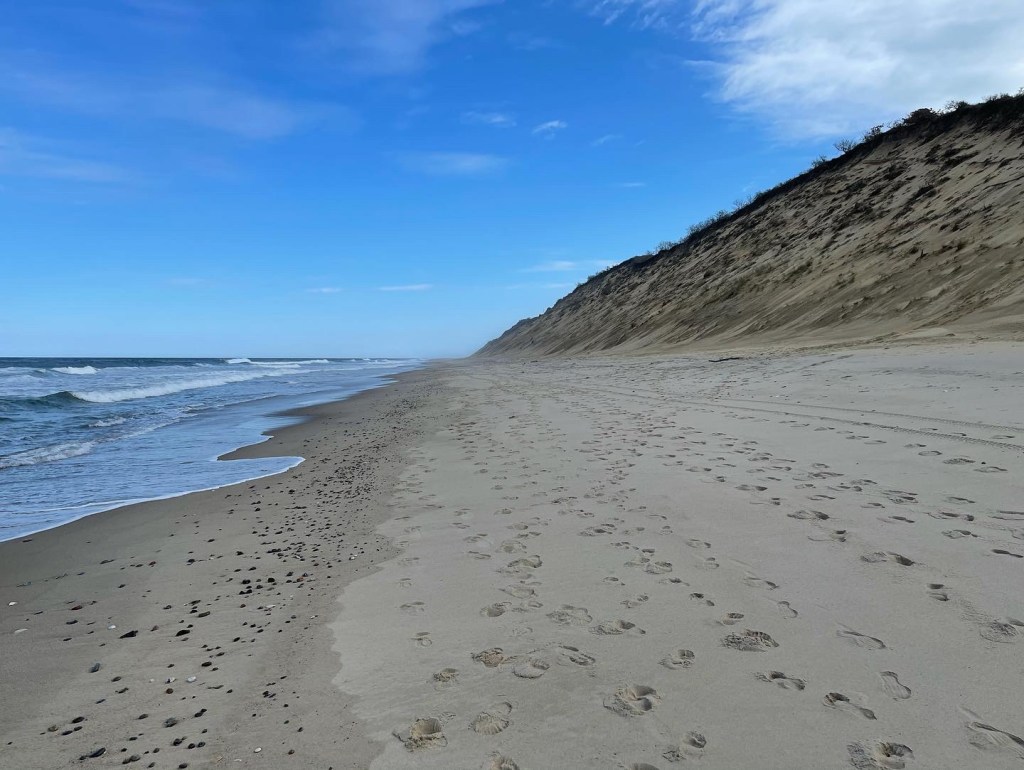
    Between the massive dunes and the crashing Atlantic Ocean in Wellfleet is a strip of sandy beach bearing the brunt of the relentless assault from wind and sea. The surf in warmer months is a feeding ground for Great White Sharks, who have modified their hunting style to chase grey seals right into the churning shallows that swimming humans like to frolic in during the warmer months. Great Whites don’t hunt humans, but sometimes they mistake humans for seals.

    In April you don’t see many seals bobbing in the surf on Cape Cod. So the sharks move on to other hunting grounds and leave this stretch of wild ocean to the occasional surfer and the beach walkers. A walk on the Cape Cod National Seashore can happen just about anywhere with an access path down the 100-foot dunes. Sand is dangerous stuff that can bury a reckless trespasser in no time at all. Sticking to the access paths preserves the dunes and just might preserve you too. The access paths themselves inform in their soft give. This is not a place for the meek. If you can’t handle the access path don’t walk this beach.

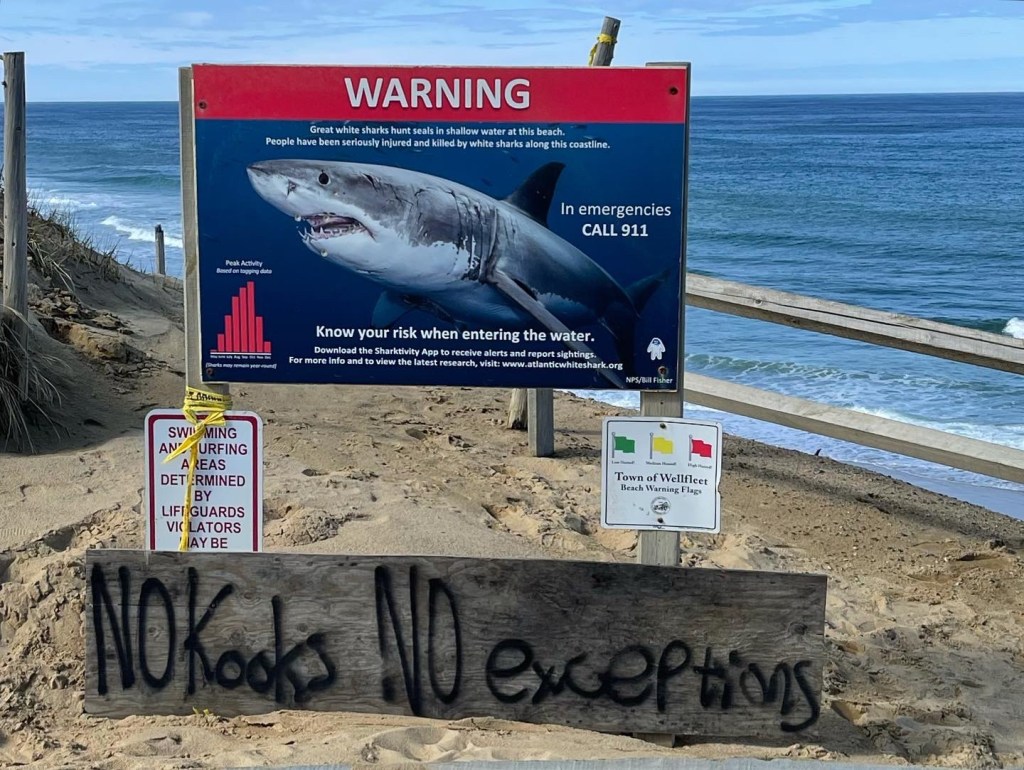
    For an off-season walk, we chose to park at the Beachcomber in Wellfleet and walk a stretch of soft sand known as Cahoon Hollow Beach. The Beachcomber is a trendy cool place at the height of summer. In mid-April it’s a convenient parking spot for easy access to the beach. A sign of the times is a shark warning with a handmade sign added to the bottom sharply suggesting “No kooks, no exceptions”. Wellfleet has had just about enough of the worst representatives of shark tourism.

    The National Seashore has a 40 mile stretch of beach that would test the strongest of walkers. When you say you’ll walk just to the bend you soon realize that bend keeps disappearing ahead of you. We walked about a mile, following the curve of the dunes around the forearm of Cape Cod. Walkers tend to gravitate towards the surf line where shells and smooth rocks offer themselves up for consideration. Soon your pockets are full and you recognize the folly of treasure hunting when every receding wave reveals another treasure.

    Thoreau walked the entire length from Chatham to Provincetown in the mid-1850’s and wrote about it for lectures that would end too soon in his abbreviated life. It would be published after his death in 1865 – the same year the Civil War ended. I think often about Thoreau, dying at 45 with so much left to do and see and write about. And here I was following him again, walking the beach between dune and sea, thinking it might just go on forever. Knowing it won’t.

  • Moving through Liminal Space

    If 2020 was a year of transformation forced upon all of us by a pandemic and political and social unrest, then what is 2021? A continuation of the same or something different entirely? We see the light at the end of the tunnel, but we’re still very much in the tunnel. Are we in limbo, or is it something else?

    I don’t know what life will show me
    But I know what I’ve seen
    I can’t see where life will lead me
    But I know where I’ve been
    – Jimmy Cliff, Sitting Here in Limbo

    “Limbo” originally was the region on the border between Heaven and Hell, now commonly thought of as being stalled in a period of transition. Plenty of us felt like 2020 was Limbo. But you can make a case for it to be something more.

    This place of transformation between one place or phase and the other is also known as “liminal space”. I’d first heard the phrase from Richard Rohr, who points to Victor Turner’s The Ritual Process as the origin. Rituals seem straightforward: sweet sixteen parties, bar mitzvahs, commencement ceremonies and funerals are all rites of passage signaling a change. But what of the passage itself? Passage is motion, not stalling. And that’s where liminality comes in.

    “Liminality (from the Latin word līmen, meaning “a threshold” is the quality of ambiguity or disorientation that occurs in the middle stage of a rite of passage, when participants no longer hold their pre-ritual status but have not yet begun the transition to the status they will hold when the rite is complete. During a rite’s liminal stage, participants “stand at the threshold” between their previous way of structuring their identity, time, or community, and a new way, which completing the rite establishes.” – Wikipedia

    The passage through “liminal space” infers movement between phases of life. This seems a more focused use of the time, don’t you think? Passage is high agency, decide what to be and go be it liminality. Stalled is low agency, waiting for things to happen to us limbo. You see this in how people use their time during the pandemic. Some bought and used bicycles and hiking boots, others hoarded toilet paper and literally waited for shit to happen.

    Life is about transformation and passage. If we’re all in this transition between one place and another, are we using this liminal space to proactively move into a better place or are we simply waiting for things to open up again? The thing about passages is you have some measure of control over the direction you’re going in. We ought to have something to say about which threshold we cross on the other side, don’t you think?

  • Incrementally Better

    “A mistake repeated more than once is a decision” – Paulo Coelho

    “The best criticism of the bad is the practice of the better.” – Richard Rohr

    When you live long enough you start to lose some of the hard edge that once defined you. That sarcasm you voice to others was nothing like the self-talk you once gave yourself. Quite simply, you stop worrying about the chase for perfection and start living with who you are.

    The Coelho quote above once tortured me for the patterns of decisions I’d made over time that didn’t help me. Eating the wrong food, opting out of exercise, not making the call you know you needed to make, not following through when you should have, and then not following through the next time either. Decisions made, not mistakes. This quote can eat you alive if you let it.

    And then I stumbled upon the Rohr quote, and recognized the incremental improvement in myself over time. When things aren’t going well in some area that self-talk amplifies the worst traits, making it more of who you are. Once you’ve recognized and completely own past decisions, what do you do with them now?

    You work to reduce their impact in your life. You get better each day at the things you once avoided. Slowly, surely, you incrementally grow better and the bad shrinks to memories of the way you once were. Still a part of you, always, but not who you are.

    Freud would rightly point to the Id, Ego and Superego at this point in the game. As you get a couple of years older you recognize each for what they are inside you. When you’re young and wild you run with one voice (Id) and just eat the chips with abandon. A bit later another voice (Ego) will start pointing towards the weight loss goals on your list and tell you to stop eating those chips. The Superego makes you feel guilty for eating the chips or proud for not eating them and working out. (This moment of pop-psychology brought to you by Pringles).

    Today, I’m just trying to be a bit better than I was yesterday so that tomorrow I’m proud of the progress made. It’s not that the Superego cuts me more slack, more that I choose not to wallow in self-criticism. The best way to diminish that critical voice is to show it progress towards the person you’re trying to become. Because that identity you’re aiming for is impressive. And even if you don’t reach it, “close enough” is still pretty good.

  • Good Soreness and Paying Dues

    This morning I stepped to the floor awash in good soreness after re-introducing kettle bell swings into my workouts. The workout started with a 5000 meter row, three sets of alternating two and one arm kettle bell swings, dead lifts and some dynamic stretching. Then a long, brisk walk on soft beach sand to really emphasize the legs workout.

    You know when your body needs a break, or at least you should know if you’re listening to it. Living with pain is a good indicator, signaling a need for adjustment to either your body or your routine. Pain is generally bad. But what do we make of sore? Exercise-induced soreness is the good kind of sore. It signals your body is adapting to change, flushing out lactic acid and repairing muscle fibers. And it signals dues paid towards a more vibrant tomorrow.

    Changing up exercise is a great way to keep the body guessing. Adding good stress to your body flushes out the bad stress, keeping that stack of organs and muscle you walk around with healthy. We intuitively know this, but most of us sit around too much anyway. If we know that sitting around too much is bad for the brain and the body, then we ought to get up and get moving more often, right? I tell this to myself all the time, but don’t always listen enough. I’ll present a convincing (if misguided) argument that I’ll get to it later. But later is just deferring our well-being. The body doesn’t care about your next meeting, it needs to move more often.

    “The more you move yourself by your own muscle power, no matter what form that movement takes, the surer you will be of the result.” – John Jerome, The Elements of Effort

    Jerome points towards the confidence that builds up inside of us when we do the work to build our better selves. Sports and nutrition guru Chris Carmichael calls people who are fit and vibrant as they age the defiant minority. We all know where we’re heading, but why not be fully alive when we get there? Adding a rigorous program of weight lifting or kettle bell swings to surprise the body offers day-after soreness but for-a-lifetime benefits. So embrace the soreness.

    “People who lead a physically active life have a lower risk of cognitive decline, and research is now emerging to show that greater fitness is correlated with maintaining better processing skills in aging brains.” – Sanjay Gupta, MD, Keep Sharp

    As I was finishing my workout yesterday I thought about the similarity between the kettle bell swing and a rock scramble in the White Mountains. The strength, endurance and mental toughness built through a workout like kettle bell swings translates well to other activities like hiking, offering yet another reason to add them to your routine. That soreness you feel the morning after a workout will translate well towards doing more, with less soreness, in those other activities you’ll do later. Pay me now or pay me later.

    And that pay me now or pay me later rule is really the point, isn’t it? If we continually defer our health and fitness through undisciplined exercise and nutrition choices now, we’ll pay for it with a shorter window of cognitive and physical well-being later. We’ll accomplish less in the time we have than we would if we’d simply invested in ourselves with exercise and disciplined consumption today.

    That soreness is yesterday’s glow of accomplishment. But today is a new day, requiring its own payment of dues. Keep the streak alive, pay today’s dues. Tomorrow will thank you.

  • Gratuitous Exercise

    “Keep the faculty of effort alive in you by a little gratuitous exercise every day.” – William James

    “All weakness is a weakness of will.” – Friedrich Nietzsche

    There’s no getting around it, I’ve been getting weaker – lacking the willpower to get on the erg or pick up the weights. This correlates exactly with work getting busier: more responsibility, more follow-up, and more sitting in front of a computer. That, friends, is no way to live a long and vibrant life. The science supports us: we must move to have a healthy mind and body.

    Don’t get me wrong, I’m hiking and snowshoeing and generally trying to be active on the edges of the day. But you know when you’re working hard and when you’re hardly working. A walk in the woods does the mind and body good, but you’ve got to supplement it with threshold-testing workouts. Through focused effort and honoring commitments to ourselves through exercise.

    I’ve been here before, of course. Burpees were kicking my ass until I started having serious shoulder pain. Rowing on an erg kicked my ass so much in college and CRASH-B’s that I have PTSD and have a hard time doing anything but steady-state on the thing. So what do you do when your worst enemy is yourself? You simplify and establish lifetime habits that brush aside the resistance with routine. It simply must be so.

    And so I’m returning to a workout program that doesn’t require spotters and doesn’t tolerate excuses. I’m returning to the kettle bell and dynamic stretching, and rowing on the erg to round out the challenge. You can take a kettle bell with you when you travel, you can break away from your computer for a simple workout that kicks your ass in minutes. And you can eliminate the excuse of time: Those optimistic long steady-state workouts written on the calendar that fall aside in the crush of work days. Habits build on themselves over time. Simply showing up starts the ball rolling.

    “No matter how strong you are, there will always be someone stronger than you. Using only a number as the litmus test of whether you are strong or not is self-defeating. You will get older. You will not be able to continue to set personal all-time bests forever. But you can continue to get stronger mentally. You can adjust to whatever the environment is and challenge yourself to push past wherever you are at the moment, in any way you can, and feel good knowing you just made yourself a better man or woman.” – Pavel Tsatsouline, Kettlebell Simple & Sinister

    Fitness is the ultimate objective, of course, but the why is to get stronger mentally. To build up your brain and push through excuses. To thrive on the faculty of effort and make yourself a better person. And this translates into everything else you do. If you’re making excuses on something as essential as your fitness, what else are you making excuses about? Mastery doesn’t happen overnight. But it begins with showing up and doing the work.

    “To master your mind is to master your life. There is no more worthwhile pursuit.” – Sir John Hargrave, Mind Hacking

    Gratuitous exercise implies frivolous or unnecessary. But there’s another definition for gratuitous, and that’s doing something free of charge. To exercise free from the burden of feeling like you have to do something and instead to exercise simply because it’s a part of who you are. Something you want to do. To simply do for the love of where it takes you.

  • Twice the Fun: Mount Israel & Beede Falls

    Not every amazing hike is over 4000 feet. In New Hampshire there are other lists besides the 4K list, lists like 52 with a view, which offers some beautiful views with a bit less effort than the 4000 footers. For a warm Sunday with snow melting into snowball-making consistency, a couple of friends invited me to join them on a hike of Mount Israel and for a bonus, a visit to Beede Falls, one of the waterfalls on my personal checklist to see in 2021.

    A bit of history is in order. Mount Israel is named for a settler named Israel Gilman, who lived near the trailhead for this mountain. There’s still an active farm near that trailhead, and it’s easy to imagine the land in the 1760’s when Gilman was walking around this place. Mount Israel is located in Sandwich, New Hampshire, which also has a bit of history in its name. The town of Sandwich is named for the 4th Earl of Sandwich, John Montagu, supposedly the inventor of the sandwich. Given that, I made a point of packing a sandwich for the hike, in honor of the Earl (or whomever it was, lost to history, who made sandwiches for him).

    The hike began at Mead Base in Sandwich, with a straightforward two mile hike up the Wentworth Trail. For those wondering about the name of the trail, a bit more history for you: Sandwich was founded in 1767 from a grant by Governor Benning Wentworth. Another name you’ll come to know is Daniel Beede, who was chosen to lead the settlement of Sandwich and granted 100 acres. Place names usually betray the history of that place, and if you look hard enough you’ll find Easter eggs like these on maps and street signs.

    I quickly fell in love with the Wentworth Trail. It winds through old growth oak and pine trees, with some tree trunks four feet in diameter – exceedingly rare around here. The snow cover acted as a spotlight on the biggest trees in the forest. I was smitten with one oak tree that had to be a witness to the transition from Native American land to English settlement. Further up, the trail wound around granite ledge and hemlocks, offering glimpses out to Squam Lake and the surrounding ridge line.

    The summit of Mount Israel is 2620 feet with 1900 feet of elevation. Despite its modest height relative to some of the other mountains in New Hampshire, it didn’t disappoint in views or the stunning beauty of the trail itself. Steep enough for a workout, short enough to give you time for other adventures. We made short work of the trail and before we knew it we were back at the trailhead at Mead Base and Act II.

    A half mile from the trailhead is another wonder worth visiting, Beede Falls, which is named after our friend Daniel Beede. The walk itself is wonderful, with granite ledge and scattered glacial erratics lining the edge of the trail. A large cave named Cow Cave offered a quick distraction. It was so named by some cows that decided to shelter inside the cave one day deep in the past. The cave was interesting, to be sure, but the real show was Beede Falls.

    In late February the falls were largely frozen, and we walked out on the ice that must be a lovely swimming hole on a hot summer day. The amazing part of Beede Falls in looking at them from behind. The falls froze solid in front, but you can access the back from the left and right side, and crawling behind them offered a magical trip into an icy palace. Water cascaded from the granite ledge, plunging between the icy wall you see on the outside and the cave formed behind. There’s just enough room to go all the way through it if you’re adventurous and don’t mind getting a little wet.

    In all our days on this earth, how often can you say that you got to see the world from the summit of a small mountain and from the crawlspace behind a waterfall in the space of a couple of hours? If you’re blessed with good health and mobility, then surely life is to be lived fully. Adventures like this one are within reach of most of us. All you’ve got to do is get out there.

    Frozen Beede Falls
    Ice wall in cave behind the falls
    Summit of Mount Israel
  • What Are You Waiting For?

    “Dare to be wise; begin! He who postpones the hour of living rightly is like the rustic who waits for the river to run out before he crosses.” – Horace

    When you really think about it, what are we waiting for? The right time? That river keeps on flowing by and never runs out. We run out.

    Of time… opportunities lost watching it all run by. So then what of this hour? What shall it launch?

    Begin. Do you feel the urgency of time? Do what must be done.

    Start where you are, use what you have, do what you can” – Arthur Ashe

    Easy for me to say, right? Who am I to challenge you? Make no mistake, I’m dipping a toe in that water myself. For I have my own chasms to cross. The only way across is by putting action where words are and getting to it.

    I like a good challenge. Do you? What can you accomplish, see, or become in ten days? Focus on living rightly in each moment, getting across whatever your river is. From today to March 4th and written about right here on March 5th. Comment on that post if you’ve taken the challenge yourself. What are we waiting for? Hurry! For it’s already slipping away.

  • The Business of Choosing

    I’m not a surfer, but I imagine them bobbing about in the swells, deciding which wave feels like the best for an epic ride to the beach. On some mornings writing feels a bit like that, with a series of false starts and bits of poetry and verse toyed with then put aside for another day. Each is wonderful and you eagerly want to share them, but they just don’t feel right for this proverbial ride to the beach.

    Writing is a way to sort it all out, of course. Deciding which swell of bubbling thought energy to surf. Once committed, you either ride it to glory or watching it sputter out into nothing much to speak of. But there’s glory in being in the swell too.

    “Your job is to collect good ideas. The more good ideas you collect, the more you can choose from to be influenced by.” – Austin Kleon

    This business of choosing applies to everything we do. Picking the right mate, the right career, the right friends and business associates, the right place to live, the right strategy, the right fitness and nutrition plan for your lifestyle, or the comparatively simple right ideas to explore in a blog. Sometimes the well runs dry, and sometimes the ideas stack up so high you can’t see the forest for the trees. When you’ve reached the bottom of the barrel or conversely when you can’t see the horizon anymore because you’re buried in ideas, a quick change of perspective does wonders for the mind.

    I’ve managed to get out on the snowshoes three times this work week for a quick lap around one of the trails. Twice at lunch and once at the end of the day with the sun setting and a headlamp at the ready should I need it. The cold air and crunchy snow quickly do a number on whatever was scrambling my brain. A rising heart rate always seems to clear a mind that’s turning on itself. In each case I returned home renewed and ready for the next wrestling match with work or words.

    Choosing is the tricky part, but I agree with Kleon, the more good ideas you collect, the more you can choose from. Get out and experience life. Read more material that stretches you in new directions. Get your heart rate up to push it all to the side so you can see where you need to go. And then do it. Even if the wave sputters out on you, you’ll still gain something from the ride.

  • Hiking Cannon Mountain

    A flurry of texts over the work week from two directions with questions about hiking led to a decision to join forces for a hike of Cannon Mountain. On the one hand were the Perry’s, increasingly famous in the White Mountains for years of summiting mountains and red-lining trails. I don’t recall a hike in the last couple of years where they didn’t know at least one person on the trails. And a text from my niece Kellyn offered a nice treat, with her deciding to hike with us as well.

    Cannon Mountain is an old granite mound that’s famous for a sheer rock face that once held the Old Man of the Mountain until it collapsed in 2003, and for the tram built to promote tourism and skiing on the mountain in 1938, making it the first passenger tramway in the United States. The Old Man of the Mountain gave this granite mound its first name, Profile Mountain, but eventually its resemblance to a cannon from some vantage points let to what we’re familiar with now.

    So the stage was set for four hikers to set out on a cold February 13th morning for a hike from Lafayette Campground. We chose the Lonesome Lake Trail, with three of us starting in micro spikes on the snow-packed trail. Our fourth hiker stuck with snowshoes the entire time. The conditions on the popular trail made either option fine. As with other hikes, you quickly know when it’s time to put on the snowshoes. For us that was when we took the largely unbroken Dodge Cutoff Trail over to Hi-Cannon for the hike up to the summit.

    Lonesome Lake is a beautiful lake sitting in the bowl of Cannon and the neighboring mountains of the Kinsman Range. It’s a destination of its own, and plenty of people hike up to see it, walk on the frozen lake for the beautiful views it offers, and then hike back down. But you don’t summit mountains when you turn around halfway. We powered on, snowshoeing through a wonder of marshmallow trees up the steep trail. There’s one ice-caked ladder on Hi-Cannon that I’ll always remember for the limited footing options presented to us, but we all got past it with a little help and a dose of courage.

    The thing about summits is they tend to be much colder when you’re exposed to the wind and you stop moving. Sweaty gloves quickly freeze up, making a change a requirement to keep your fingers working. We considered the observation tower for a few minutes and opted to just hike down to the ski resort’s Mountain Station, where I’m told you can buy a beer at 4080 feet. I opted for hot chili and hot chocolate, with extra hot, thank you. It’s a rare day when you can summit a mountain and have hot chili waiting for you. We quickly warmed up and reached a point where if we didn’t get going we might choose to close out the place. Onward.

    Crossing a ski trail is akin to crossing a highway. You judge the oncoming traffic, decide whether your speed can overcome the approaching traffic’s speed and go. We quickly crossed over to the trail back to the summit observation deck, crowned the summit and began our descent using the Kinsman Ridge Snow Chute, er, Trail. On the map, 4/10’s of a mile of hiking, but a lot of squiggly elevation lines stacked up in a small space. We butt-slid down large sections, my snowshoes were more telemarking skis on other sections, and we all collected snowy memories that will make great tall tales someday.

    On one of the butt-sliding sections I lost a water bottle. It wasn’t until we’d snowshoed across Lonesome Lake and I changed to micro spikes that I realized it. My disappointment at losing it turned to delight when we got to the trailhead and someone who’d found it and beaten us down the trail while we lingered at the lake had left it sitting on a post waiting for me. Good hiking karma right there. It was hard to come away with anything but positive vibes after hiking Cannon Mountain on a pristine winter day. A solar halo signaled goodwill to all. A very good day indeed.

    Cannon Mountain from Lonesome Lake
    Solar halo through the frosty trees
    Lonesome Lake with Franconia Ridge beyond
  • A Measure of Health

    “Nature says thou shalt keep the air, skate, swim, walk, ride, run. When you have worn out your shoes, the strength of the sole leather has passed into the fibre of your body. I measure your health by the number of shoes and hats and clothes you have worn out. He is the richest man who pays the largest debt to his shoemaker.” – Ralph Waldo Emerson

    Those Concord folks were walkers, weren’t they? Ralph and Henry wandered about, wearing out shoes and building big thoughts. There are a couple of versions of that Emerson quote above, but some online research makes me believe these were his words. I like the alternate quotes just fine, but when I start quoting people I’d like to have it right. I love the idea of transferring the strength of the shoes into the fiber of your body. It applies just as well with shoes as it does time and sweat equity invested in other worthwhile things.

    I’m wearing out shoes more quickly lately. My feet took a beating last year, ankles and knees too, but they merely paid it forward to my heart and soul. Over time the body adjusts and stops complaining about taking another step and just goes. It’s a bit like writing and washing dishes and making the calls, you just teach yourself that there’s joyful bits in every moment of doing.

    I’m a collector of joyful bits. On my deathbed I won’t regret not finishing Breaking Bad, but I’ll surely regret not seeing the Northern Lights or the Southern Cross should I not see each. The last year is a reminder to not take mobility for granted. Wearing out more shoes seems a great goal for our next normal. The correlation seems apparent. Wearing out your gear is an easy measure of your physical and mental health. So lace up; we have places to go.