Category: Exercise

  • Return to the Rail Trail

    For the first time since early in the pandemic I decided to take a walk on the Windham Rail Trail after work. I figured at dusk most people would be wrapping up their time on the trail and heading home. I figured wrong. I nodded a greeting to those who made eye contact, ignored those who didn’t, and held my breath many times for the unmasked swarm of humanity that passed by in close proximity unmasked and unconcerned. I’m not a germaphobe, but at this point in the pandemic I’m informed enough to limit such risks whenever possible.

    You notice a lot of things when you walk a trail often: The change of seasons and how that impacts the trail, the increase in traffic, encroaching development, the casual disregard for others by the relative few who dispose of bagged pet waste on the side of the trail, and the ebb and flow of wildlife. My six mile walk was informative. Comparing it to the fall of 2019 at a similar time of day it was much busier, with many more bicyclists than you’d see a year ago. More walkers too, but not exponentially more. No, it was the swarms of bicycles that were noticeable… and notable. Headlines like “Bicycle sales skyrocket during COVID” come to mind. Here is the proof, relentlessly zipping past me one after the other. While I prefer quiet walks, I can’t complain about the benefits of a healthier society overall. Still, I make a mental note to walk the trail in the rain next time.

    Exactly two months ago I did some damage to my right ankle on the descent of the Old Bridle Path from Mount Lafayette. I’ve largely pretended it wasn’t injured and would cinch up my hiking boots tighter during hikes, but I have tried to nurse it back to health. During this walk I was generally pleased with the progress of the ankle and pushed on past Mitchell Pond in hopes of getting a photo or two of the foliage reflecting on water in the late day sun. But with the drought the water has receded far from the rail trail, with muddy pockets and rotting logs replacing the shimmer of water that used to greet me on this stretch of trail. The heavy rain earlier in the week was a welcome relief for the wildlife that relies on this water. A lot more would be welcome. Like many of us, I expect they’re longing for a return to normal.

    My walk was six miles out and back. I was running out of daylight and didn’t want to deal with bicycles speeding along on dark trails. It was nice to get reacquainted with the trail, but it felt a bit less special than at other times. Instead of an intimate conversation with the trail and the wild spaces that it dissects it was more of a shouted exchange in a busy venue:
    “Hey, good to see you again!”
    “Good to see you too!”
    “Can you believe all this?”
    “I know! What a crazy year!”
    “How have you been?”
    “What?!”
    “How have you been?!”
    “What?!”

    Anyway, stay well, we’ll catch up again when its a little less busy.”

    And so I left the trail thinking about how parched it looked and how many people were using it. But I was grateful for having it there for them and for me when we needed it most. We all need to get outside and get more exercise, and rail trails serve as an entry into a safer world away from automobile traffic. Even if I like the trails more when they’re quiet, I still value having a place to go close to home. More utilization means there will be more investment in similar trails in the future. And that’s a win for all of us.

  • Past Peak

    Normally this weekend in New Hampshire is peak foliage season. But a sustained drought has stressed the trees just enough to pull peak ahead by two weeks. So the thousands of people plugging up the roadways of the Mount Washington National Forest were seeing the forest muted in dynamic impact. And yet they came. And they saw enough. For the mountains offer their own ruggedly stunning backdrop. I considered the tourists on my afternoon commute home from a day of hiking. Clusters taking a photo next to the roadside sign announcing you were in the MWNF, picture-taking all around you. Cars parked in odd assortments along the sides of the road, as if clung together by magnets the way the metal dust would clump together in the old Wooly Willy toy would clump into beards and eyebrows with a magnetic stick. Funny what you think about when you observe tourists in the wild.

    To be amongst the mountains is relatively easy when you live in New Hampshire. Less so, I suppose, if one were to live in Florida. But they have that tropical water hugging them on three sides, and I suppose the amusement parks and fresh oranges to consider too. But you can’t swim in a pond in Florida without risk of being dragged down by an alligator. There are no alligators in the mountains of New Hampshire. Maybe the occasional bear or mountain lion, but they mostly want the food in your pack, not you as food. The bigger threat to your well-being are the damned rocks. New Hampshire is the granite state, and as if to hammer that point home every trail is worn down to ankle-bending, knee-twisting rock. And in October those land mines are covered over in a bed of beautiful leaves. So a descent becomes a shuffle of sorts, as you work to avoid catastrophic injury on remote yet well-traveled trails.

    I have a friend who points out my tendency to pick overindulgent goals for myself. Really though; all my friends point this out. Like rowing a million meters on an erg in three months, or taking my family on a hike up the toughest mile of the Appalachian Trail, or peak-bagging three out-and-back peaks in one day, as I did yesterday with Mounts Willey, Field and Tom. I might have taken a hint from my hiking pro friend who refers to these three as the WTF hike. I chose to experience it on my own, with an extra helping of previous injuries I was nursing. WTF indeed.

    The morning after a hike like the WTF hike, the first step is to get out of bed without incident. Plant your feet and gradually put weight on the ankles and knees that you abused so ruthlessly the day before. Assess how much they resent you, and then shuffle to the bathroom for relief and some Motrin. This isn’t a walk of shame as much as a recognition of all you’d done, in the form of some tender moving parts and sore muscles. And I wonder in those moments of truth, am I past peak myself? Or simply overindulgent? I’d like to think the latter. All I can do is keep moving. Perhaps with a bit of moderation next time. I suppose that’s a perfectly reasonable request.

    Past Peak
  • Hiking Mount Willey, Mount Field and Mount Tom (and Back)

    I didn’t think this one through enough. An out and back using the same trail to hike three 4000 footers necessarily means you’re actually hiking five 4000 footers in a day. Ambitious. A bit reckless. A bit exhausting.

    10 miles round trip, with 4400 feet of elevation gain seems easy on paper. In practice the rock scrambles and ladders bridging impossibly steep sections made it a test of willpower. Some of those rock scrambles were borderline ladder territory as well. As wake-up calls go climbing the Willey Range Trail served as a good one. My heart was racing and my layers were shedding in no time. My mood bounced between exhilaration, despair and frustration with myself for not planning this hike a little better. But it was a quickly drafted plan B, and in hindsight, a good hike. Even if I wasn’t mentally ready for it.

    Mount Willey is 4255 feet tall and named after Samuel Willey and his family, who were killed in a landslide in 1926. Mount Field is 4327 feet and named after Darby Field, who made the first known ascent of Mount Washington in 1642. Mount Tom is 4052 feet tall and named after Thomas Crawford of Crawford Notch fame. The three peaks are relatively tame, other than the hike up the Willey Range Trail to the summit of Mount Willey. Approaching from the south, Willey is a tough ascent. It also makes a challenging descent. Starting and ending my hike with this trail set me up for a tough day. But I finished relatively healthy. And healthy with three more 4K’s checked off is enough for me.

    If you go, consider an approach from Crawford Notch or Mount Hale. The people who I ran into didn’t seem to have the same endurance test of ascending the Willey Range trail. For views, Willey and Field have some good observation spots, Tom not so much. But views are only part of the story. Finishing this hike and summiting these three 4000 footers was its own reward.

  • Hiking the Carters

    A bit removed from the crowded trails of the Presidentials in the White Mountains, there are four summits in the Carter-Moriah Range with the name Carter. There’s a story that says the Carters were named for a man who used to hunt in these mountains, and that nearby Mount Hight is named after his hunting partner. Whether that’s actually true seems to be lost to history, but its as good a story as any and it sticks harder to fact with every retelling. Hight is where the views are, but not on this day. With the summit of Hight socked in we stuck with the Carters on a Sunday morning hike that lasted well into the afternoon. Our hike was a 14 mile endurance test for a sore ankle, and generally I was pleased with the results.

    Carter Dome is the southernmost summit and the tallest of the four. Running northeasterly from Carter Dome are South Carter, Middle Carter and North Carter Mountains. Each was deep in cloud cover and gusty wind on our hike, but Carter Dome seemed to be spared from the winds blasting the rest of the range. There are remnants of an old fire tower on Carter Dome, with scattered window glass on the ground right around the base. That glass, the concrete footings and a few rusted steel bolts are all that remain of a steel tower built in 1924. The tower lookout had a hut a mile away that became the AMC hut. The tower itself was replaced by spotter planes after World War II.

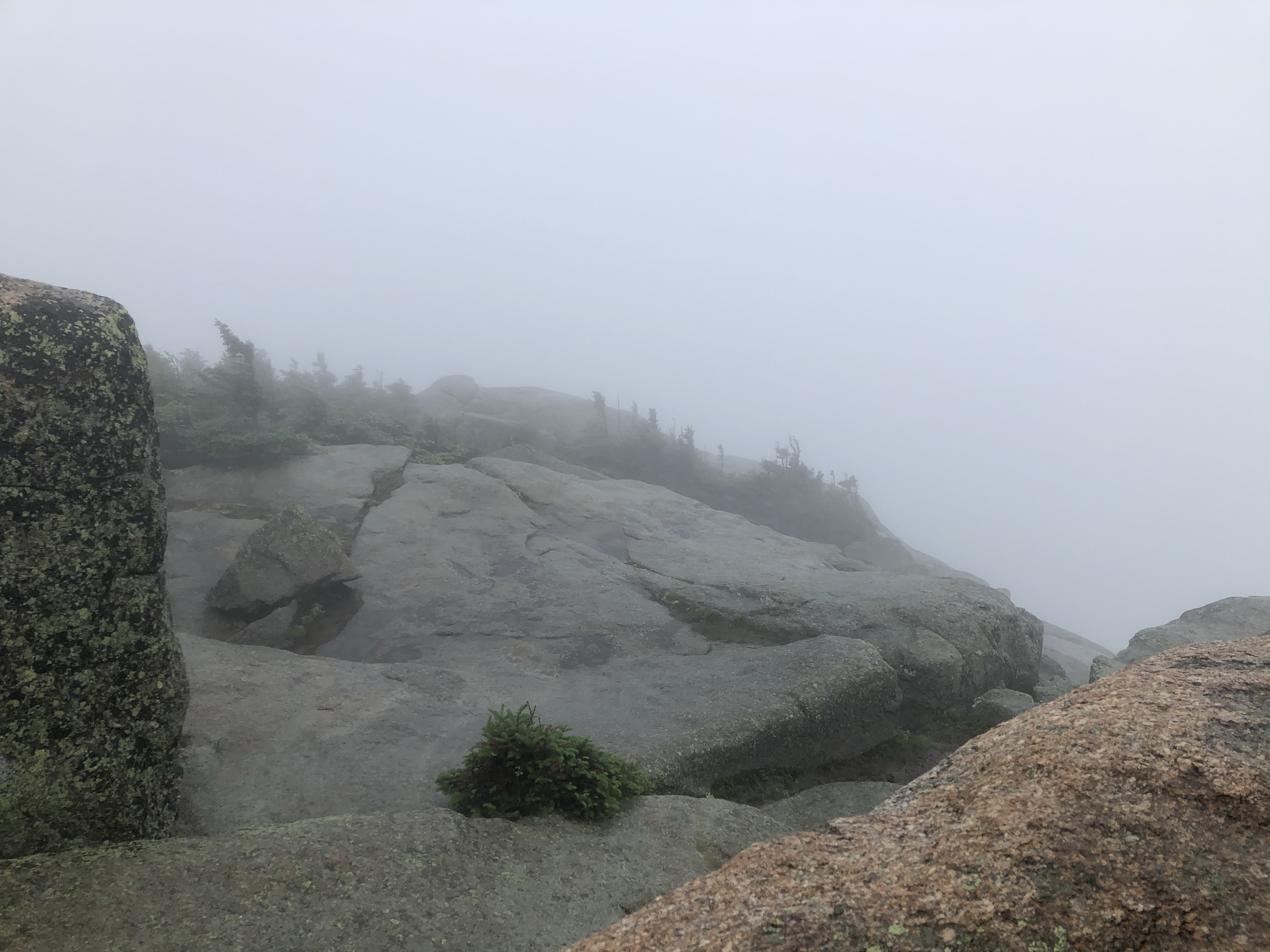
    The Carters feature several bald faces along the ridge line that offer beautiful views. But not on this day. Still, there’s something stunningly beautiful about being amongst the wind-whipped firs deep in the clouds. We felt a bit of ice mixed into the mist swirling about us, a clear sign that summer is drawing to a close. This was the first hike of the summer that I used every layer I brought, and it had me thinking about using a bigger pack as we shift towards autumn. The sun eventually came out in the valley below the range on our descent, warming and drying us off.

    One of my hiking partners informed me after the hike that we had over 4300 feet of elevation gain on the 14 mile hike. I believe it, but the challenge for me was the descent down the Imp Trail, which had me thinking about Game of Thrones while I navigated a nasty stretch of boulders, rocks and roots on the descent. Classic New Hampshire trail, this Imp Trail, and it tested the ankle and my new hiking boots synched up tight to support it. Not wanting to be left out, my knees both started complaining about halfway down the descent. This was about 12 miles into the 14 mile day, and they’d had just about enough of my aspirations. But we made it down to Route 16, walked the shoulder back to the cars, and headed to Gorham for some much needed pizza and beer.

    I love a good solo hike as much as anyone, but I was grateful for the company on this day. In fact, were it not for the invitation from my power-hiking friends I probably would have skipped the weekend altogether to give my ankle another week of rest. But sometimes we get a little too soft on ourselves, and the morning after the hike I believe I’m not the worse for wear. Good boots and hiking poles made all the difference for the ankle, and persistent friends made all the difference in my getting back on the trails. Another good lesson on living, with a nod to the couple who prompted me to shelve the excuses and get back out there.

  • Putting Yourself In It

    A question mark lingered over the last few days as the weekend grew closer. To hike or not to hike? The right ankle has been gimpy since the descent down Bridle Path a couple of weeks ago, when I apparently damaged it enough that hiking wasn’t a guarantee. But then my new hiking boots arrived, offering much better ankle support than the previous boots. A mix of ibuprofen and assorted balms would take care of the rest. And so I chose to hike with two jackrabbits who fly up mountains every weekend. This served to challenge both the ankle and the rest of me.

    Waking up at 3 AM for an early start to a hike a 2 1/2 hour drive away was the next challenge, one that I managed with my usual stoic acceptance. The first moment of wonder for me came 45 minutes before arriving at the trailhead, driving through Jefferson, New Hampshire as the brightening sky illuminated distant clouds and mountain tops as I drove east. In that moment I accepted the day at hand, sucky parts as much as the amazing parts. And so it was that I found myself, new boot wrapped tightly around a gimpy ankle and hiking four peaks and 14 miles on my Sunday “rest day”. But I put myself into it willingly.

    Ultimately, life is this short little blip. Highlighting the blip with wonder and a bit of hard work makes that blip seem a bit more relevant. If you don’t put yourself in it, you don’t reap the rewards. Today, despite some reservations, I put myself in it, and sure enough the moments of wonder appeared. In a year filled with challenges, a bit of wonder goes a long way.

  • Hiking the Franconia Ridge Trail: Little Haystack, Lincoln and Lafayette

    Today’s epic hike began with a 4 AM wake-up call (late by some hiker’s standards) and a drive two hours north to Lincoln, New Hampshire accompanied by Venus flirting with the crescent moon and old friend Orion pivoting in the sky.  A lot has happened since I last saw Orion, and we have a lot to catch up on.  But I focused on the road and the surprising number of cars driving north with me.  Who are all these people driving at 4:30 on a Saturday morning?  Are they up early or wrapping up a late Friday?  At least one car drifting out of their lane multiple times indicated the latter.

    The reason for the early morning was to beat the swarm of hikers that inevitably descend on the Falling Waters Trail.  This is one of the easiest  trailheads to get to, and one of the prettiest returns on your hiking investment with multiple waterfalls along the trail (even in a dry August) and a beautiful ridge line hike across Little Haystack Mountain to Mount Lincoln to Mount Lafayette along the Franconia Ridge Trail, which is a section of the Appalachian Trail (surely one of the AT’s most beautiful sections).  A short detour takes you down to Shining Rock, which lives up to its name with water flowing down a large granite face.  That detour doesn’t feel short when you turn around to hike the tenth of a mile back to the trail junction, but its worth the time.

    So knowing the trail would be crowded, I had my cloth mask at the ready and utilized it many times on the hike.  The majority of hikers brought masks with them and used them in tight quarters as you were passing each other.  I found myself wishing I’d brought a balaclava instead of a mask just for the ease of quickly pulling it up and down as you came across other hikers, and I came across a lot of hikers on this one, particularly on my descent of Lafayette to the Greenleaf Hut, which is open for business once again but requires a mask when you walk inside.  I was very ready for a cup of coffee when I visited, and a visit to the restrooms before beginning the descent down the Old Bridle Path.

    One thing that annoys me about crowded trails is trail etiquette.  In particular the people who leave their toilet paper after peeing next to or on the trail.  Pack it out with you, or if that grosses you out dig a cathole.  But don’t leave it clumped there for all to see.  A friend tells me that there are three times the normal number of people hiking this year because of COVID-19.   After my experience on Pierce/Eisenhower and now Little Haystack/Lincoln/Lafayette, I believe it.  But that doesn’t mean you shouldn’t respect the mountains.  Leave no trace people!

    Mount Lincoln is of course named after Abraham Lincoln.  As peaks go its pretty easy, sitting between Little Haystack and Lafayette.  Little Haystack is 760 feet above the 4000 foot mark but doesn’t qualify because its less than 200 feet to Lincoln, which is 5089 feet. As the taller of the two mountains, Lincoln gets the nod for the official 4000 footer list, but I can’t help but feel hiking Little Haystack and not getting credit for it makes up for hiking Tecumseh (3′ short of 4000) and getting credit.  The 48 giveth, the 48 taketh away…

    Mount Lafayette is named after Gilbert du Motier, Marquis de Lafayette, the French hero of the Revolutionary War and a heck of a singer in the Hamilton musical.  The mountain is 5249 feet and the most prominent of the three.  I lucked out with the weather, which offered beautiful views and a refreshing light breeze.  On my descent it started raining a bit, which didn’t amount to much.  But I bet it made some of the granite and basalt slippery.  Thankfully I was well past that by the time those few drops started falling.

    The loop up Falling Waters to Franconia Ridge Trail/AT to Old Bridle Path back to the parking lot is nine miles.  I’d like to say I did it solo, but I had a lot of company on the trail from my start at 6:15 to the return to the car at 1 PM.  I took a few photos of waterfalls, detoured to Shining Rock overlook, lingered for “brunch” on the summit of Lincoln, for some trail mix on the summit of Lafayette, and for coffee at the Greenleaf Hut and still completed the loop in under seven hours.  Not bad.  I didn’t set any speed records on the trail, and I’m just fine with that.  But I did lose five pounds in a day, even with rehydration and grazing on trail mix the entire drive back.  All-in-all a wonderful day in the White Mountains.

    img_8554

  • Breathe

    I admit I didn’t think much about breathing until recently when my son strongly recommended a book for the family.  After some due diligence in listening to the author interviewed on a Joe Rogan podcast I was convinced I needed to read the book myself and quietly slid the stack of real and virtual books aside to read Breath: The New Science of a Lost Art before anything else. I’m well into it now, and can tell its one of those transformative books that influences the way you think about many things. And so it was that I hiked two 4000 footers yesterday with these thoughts in my head:

    “In a single breath, more molecules of air will pass through your nose than all the grains of sand on all the world’s beaches—trillions and trillions of them.”

    “Nasal breathing alone can boost nitric oxide sixfold, which is one of the reasons we can absorb about 18 percent more oxygen than by just breathing through the mouth.”

    “The greatest indicator of life span wasn’t genetics, diet, or the amount of daily exercise, as many had suspected. It was lung capacity.”

    “Moderate exercise like walking or cycling has been shown to boost lung size by up to 15 percent.”

    “The most important aspect of breathing wasn’t just to take in air through the nose. Inhaling was the easy part. The key to breathing, lung expansion, and the long life that came with it was on the other end of respiration. It was in the transformative power of a full exhalation.”

    With apologies to author James Nestor, I wasn’t going to fully commit to nasal breathing hiking up Crawford Path yesterday. I gave it a try a few times but didn’t feel like I was getting enough air. Something to work on for sure, but I opted for the more familiar mouth breathing for the steepest stretches of the path and reserved the nasal breathing for the descent from Mount Eisenhower. I can tell I’ve got my work cut out for me, but anything worthwhile deserves putting the work in. What’s more worthwhile than breathing?

  • Hiking Mount Garfield

    As U.S. Presidents go, James Garfield is barely remembered, but he seemed like a decent guy.  He fought for the Union primarily to eradicate slavery, and is the only President to be elected from a seat on the House of Representatives.  So he should be viewed favorably and as an American success story.  Unfortunately, his tenure as President lasted a mere six months, as he fell victim to an assassination attempt, dying a few months after being shot from complications.  That you and I don’t remember much about Garfield has as much to do with his short and tragic life more than any flaw in his character  His mother Eliza was born in New Hampshire, so it seems fitting that there’s a mountain named after him.  This morning I climbed that mountain.

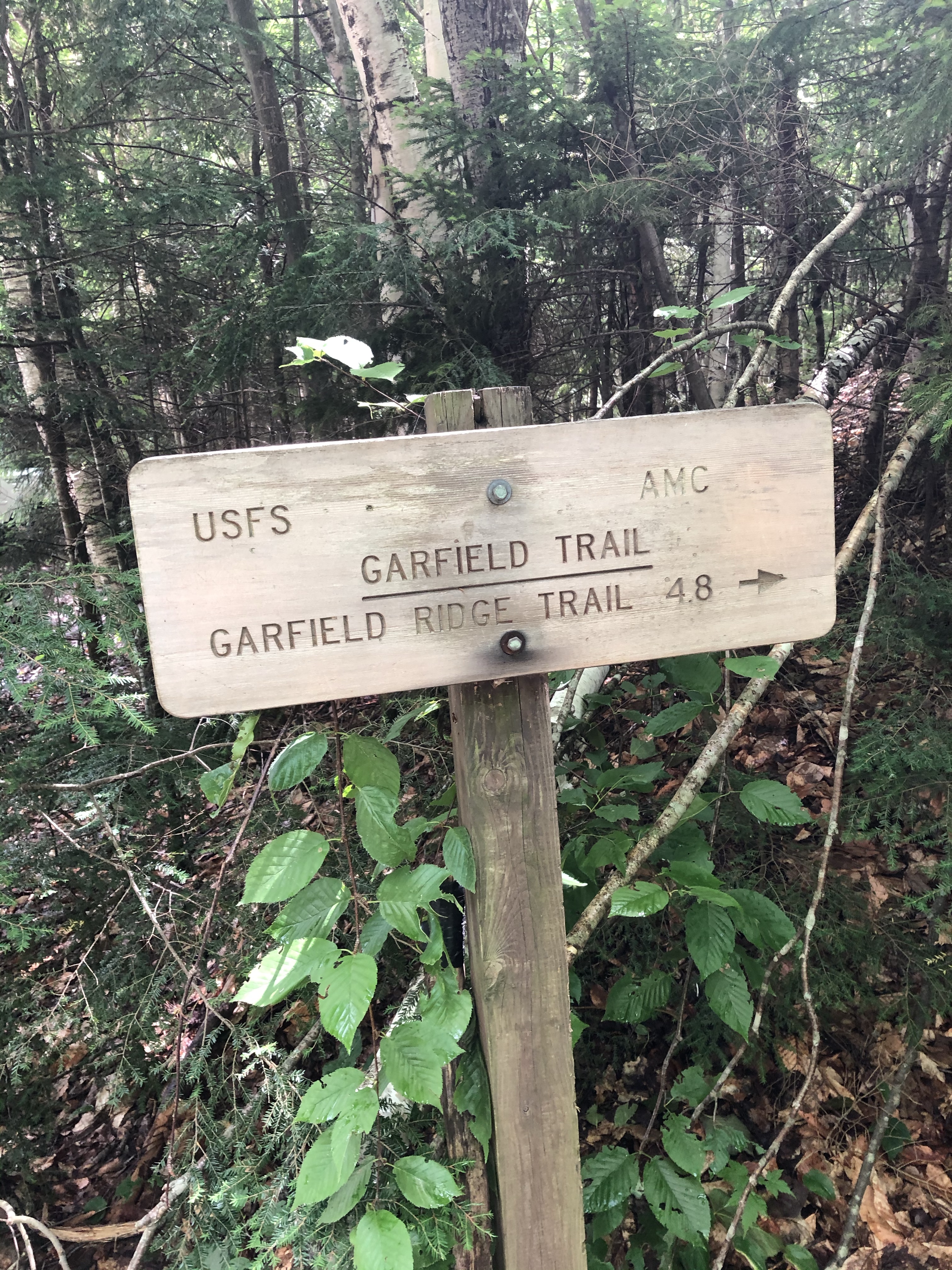
    Mount Garfield is known for the view from the summit.  There would be no view this morning, as rain and low cloud cover announced from the start that this wouldn’t be one of those days when you could see for miles.  I decided to hike it anyway, and to do it solo. The Garfield Trail is a relatively easy hike, and I was able to get to the summit in 2 1/2 hours.  As a wet hike, the Garfield Trail leaves a lot to be desired.  You feel like you’re hiking in a stream in stretches, and on the verge of getting bogged down in mud in some others.  But it’s a classic New Hampshire hike, with a cathedral of mature trees lining the ridge in the first third of the hike, and rocks for much of the rest of the way.  This is the type of hiking I’ve grown up with, and I quickly settled into my rhythm for the climb up.  For all its wetness, there were no bugs for the duration.

    Beginning at 7:30, I found little company on the trails.  I passed one father and daughter pair early on, and was in turn passed by a woman who flew past me after the first hour of hiking.  I’ve long checked my ego at the door when it comes to my pacing on hikes, and when I go solo I’m very deliberate with footing.  I’d see her again as she flew down the mountain at almost the same pace.  And that was it for company on the ascent.  It seemed most people were saving Garfield for a sunny day.  But the descent proved me wrong, with a steady parade of hikers streaming past me, most wondering about the view at the summit.  Not much of one, I’d tell them, but even as I spoke those words the day was beginning to change, with sunlight burning through the cloud cover and warming up the forest.  I was grateful for having done the ascent in the cool rain, even if the view didn’t cooperate.

    Mount Garfield is considered one of the easier climbs of the 48 4000 footers, but with that big payoff of a magnificent view waiting for you on a clear day.  If I wasn’t pursuing the 48, I might have saved this hike for better day, but I don’t view it as a waste at all.  20,000 steps later, I’d finished another 4000 footer and began my drive back home.  Garfield is a mountain I’ll do again a few times, certainly in autumn but also in winter when it becomes a longer hike as they close the gate on the access road.  Maybe my timing wasn’t good for a view, but it was an excellent 4 1/2 hour round trip anyway.  I’ve got my second notch on the 48 (I started over again from the beginning this year, since I rarely logged hikes previous to pursuing this goal) 4000 footers, and I got a decent workout in before lunchtime.  I’d call that a great success.

    A side benefit of hiking the 48 is learning more about the people the mountains are named for.  Other than knowing he was President and that he’d been assassinated, I didn’t know much about James Garfield until I chose this hike.  I’m glad I took the time to look back on his life a bit.  He only lived to aged 49, but managed to accomplish quite a bit in that time.  He was a classic rags to riches story with a life cut short too soon.  The White Mountains are dotted with more famous Presidents, but that doesn’t make Garfield a bit player.  Just a guy who ran out of time before he could do more.  I think he’s had a lot of company in that club.  A good reminder to get busy already, time waits for no one. And with that in mind I’m considering a peak bag for my next hike, which involves summiting multiple peaks in one day’s hike. I have another couple of former Presidents in mind for that one.


  • Beginning With Waumbek

    “Climb the mountains and get their good tidings.” – John Muir

    The workout today was pretty straightforward: hike a total of 7 miles round trip up one of New Hampshire’s forty-eight 4000 footers. I’ve hiked at least a dozen of them before , some multiple times, but I didn’t track it officially. So I’m simply starting over again. I’m not imposing a deadline on myself and I’m not in a race. I don’t go to the mountains to set distance records. I go to the mountains because I love the mountains. And I love who I become when I spend more time in the mountains. And so today was, officially, one. And some good tidings.

    I chose Mount Waumbek in Jefferson, considered a good beginner 4000 footer. I’m not a beginner, but I’m beginning again. Waumbek was as good a place to start as any. At 4006 feet, its one of the shorter 48, but it counts just the same as Mount Washington on the list. And so I announced to the family that I was going and got one taker; my daughter committed to getting up at 4:30 and joining me. You know someone is serious when they commit to 4:30 AM, and sure enough she was ready to go by 5 AM.

    Mount Waumbek is an interesting name. The White Mountains themselves were once called Waumbekket Methna, which either means “mountains with snowy foreheads” or “white rocks” in the dialect of the Abenaki. Or maybe some settler came up with that story after enough time passed. What I’m fairly certain of is that Mount Waumbek was once slated to be yet another ski area, but thankfully it fell through and was preserved. I imagine it would’ve still counted as a 4000 footer, as Cannon Mountain does, but it wouldn’t feel much like hiking then. I’ll take the New Hampshire rock and root tour, thank you.

    I like to start hikes early, especially in hot weather. It’s generally less crowded, making simple things like parking a car less of a process. And early makes a big difference on hot, muggy days. Get it done before the crowds, before the heat, and before the inevitable thunderstorms that roll through the mountains on such days. We began our first steps at 7:45, a bit later than desired, and with a bit more company, but thankfully no raindrops. Instead we ran into swarms of ravenous gnats, flies and a few odd mosquitos. None of them cared much for social distancing. None of them got the memo that we wore generous applications of bug juice, or that according to the small printed label, they’re supposed to hate this stuff. No, they actually seemed to view it the way I view olive oil.

    The only solution was to keep moving. Summit Starr King Mountain (now THAT is a name for a mountain), glance at the view, snap a picture, move. Summit Waumbek, sip some water and nibble on a snack (carefully brushing off the carnivores who made a reservation to dine on you), re-apply bug juice and get moving again. There was no getting around it, I chose the height of bug season to begin again. But a day of hiking, even with the swarm, is better than most workouts I can think of. 19,000 steps today, and I’ll surely feel it tomorrow.

    And so it was, we checked off the first of the 4000 footers, I’ll carefully note it on the tracking sheet, and I’ll move on to the next on the list. Maybe it’ll be a we? After all, I’m not the only one who checked a box today.

  • Home Workout

    The Saturday workout was supposed to be a 10,000 meter row. Sometime around 1:30 I realized that wasn’t happening, but I got a six hour workout in anyway: I painted the ceilings downstairs. Now before you roll your eyes dismissively at me, consider the logistics for a moment. In that time I climbed the equivalent of 31 flights of stairs, walked 8000 steps and performed countless overhead presses from taking a wet roller on a pole and rolling in awkward positions for hours. In the process of performing the latter I reacquainted myself with the shoulder pain I had from too many burpees in 2019.

    If there’s anything positive about this pandemic, its that I’ve finally stopped procrastinating on home improvement projects that have nagged me for years. This isolation and my sweat equity have brought a new kids bathroom, freshly painted laundry room and kids bedrooms, new door hardware on all the upstairs doors, new ceiling fans in each of the bathrooms, new shower in the master bathroom, new ceiling with crown molding in the guest bathroom, removal of the massively overgrown junipers that greeted visitors along the driveway and now, finally, freshly painted ceilings in the downstairs rooms. The house is like new, if you will, and today I walked around feeling both a sense of accomplishment and soreness in places I wasn’t aware you could feel soreness.

    So yesterday, as it snowed outside in that “it’s 2020 why not throw squalls in May at them to complete the mind f**k” kind of way, I ignored the outside world and checked boxes that were way down the list when we started this year. If the world was normal I’d be getting ready for my son’s graduation, planning a trip to New York to move our daughter back from college, and complaining about the pollen count while tactfully ignoring my to-do list of home improvement projects. But it’s not normal, and I’m pressing ahead on that list, making the most of found time at home. I’ll still need to get that 10,000 meter row in before the weekend ends, but I’m not complaining. My alternative workout yesterday turned out to be pretty productive after all. Now what else is on that list?