Category: Fitness

  • A Walk Around the Timeless Kenoza Lake

    Kenoza! O’er no sweeter lake
    Shall morning break, or moon-cloud sail,
    No lighter wave than thine shall take
    The sunset’s golden veil.
    — John Greenleaf Whittier, Kenoza

    Whittier wrote this poem for the dedication for a beautiful lake in Haverhill, Massachusetts that was to be named Kenoza Lake. Kenoza means “lake of the pickerel” in the native Algonquian language, and in 1859 the locals formalized the name. There is irony in Native American place names living on when the people who’s language was being used for those names were swept away, but that’s everywhere in the world. The names always betray the past if you dig deeply enough.

    Whittier was an abolitionist, and likely saw the plight of the Native Americans who once lived here with a sympathetic eye. He once lived just a couple of miles away from Kenoza Lake in a quiet farmhouse. His farm looks very much the same today as it did then. Importantly, Kenoza itself also remains pristine, today a protected reservoir that supplies drinking water to the City of Haverhill. That lends a timelessness to the lake and surrounding land that’s impossible not to feel as you walk the grounds.

    The land has transformed over time. It was once deep forest, became farmland (like so much of America in colonial times) and eventually returned to forest again. That the land wasn’t developed required some luck. Dr. James R. Nichols, a wealthy scientist who made his fortune developing chemical fertilizers, acquired the farmland and set about building a castle for himself on top of a hill with views of three states. He called the place “Winnekenni”, which means “very beautiful” in Algonquian. Walking the property, today maintained by the City of Haverhill as parkland and a natural buffer for the reservoir, feels like you’ve been transported back to another time.

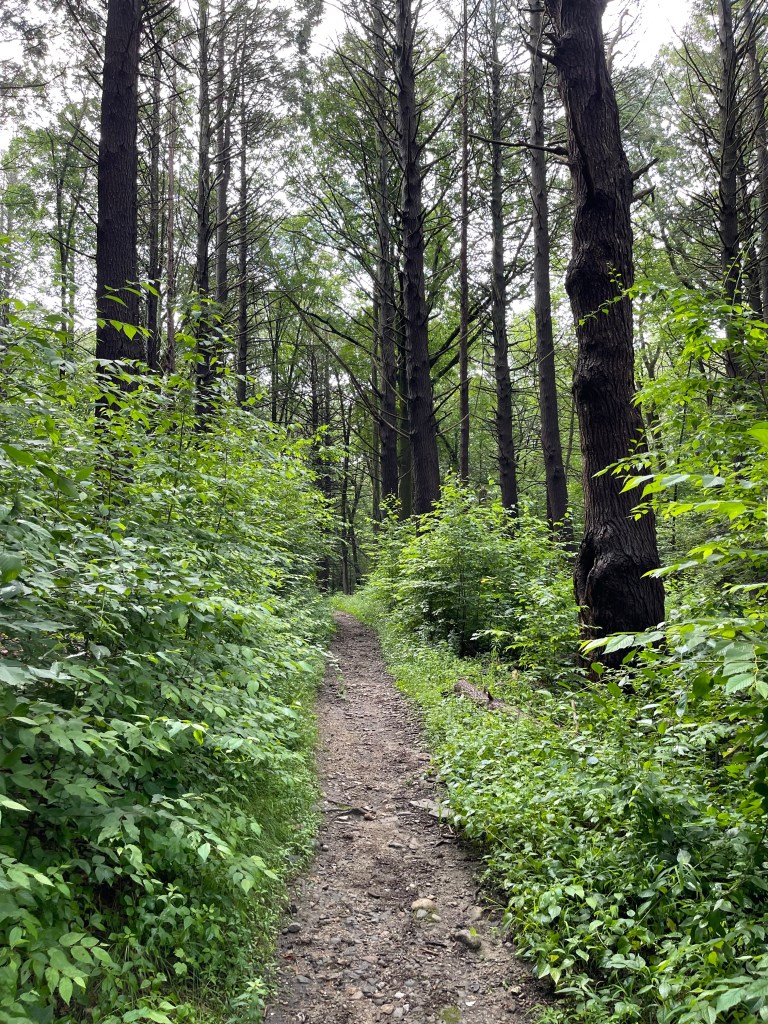
    There is a network of trails throughout the the park, and you can manage a great step count by doing the entire loop around the lake. They range from gravel roads to single track paths squeezed on both sides by abundant undergrowth(including, alas, poison ivy). The trails are well-marked and it’s very difficult to get lost, as you always have the lake to show you your progress. We encountered plenty of walkers, horseback riders and mountain bikers on the trek around the lake, but never felt it was overcrowded. Indeed, on the single track we saw only one other person, a trail runner who quickly distanced himself from us.

    Reservoirs, like graveyards, are time machines back to the days they were established. The lay of the land remains largely as it was then, and offers an opportunity to hear the whispers of history. It’s relatively easy to imagine how this place looked for Dr. Nichols or John Greenleaf Whittier because it’s largely that same place today: timeless, and beautiful.
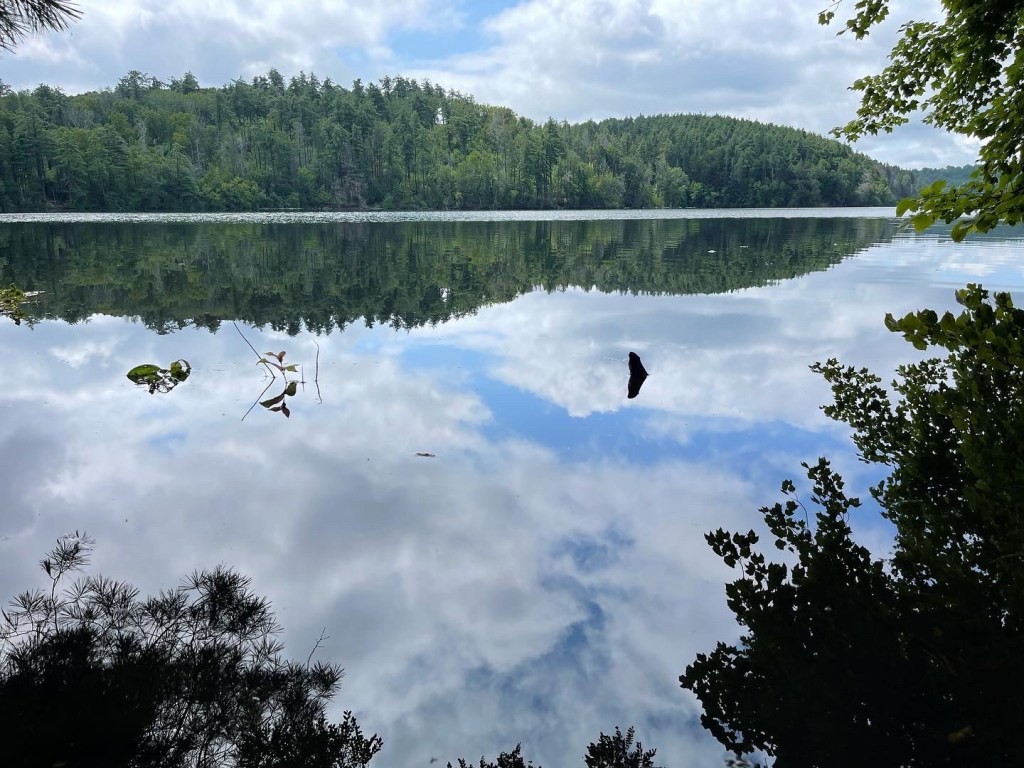
    Kenoza Lake
    Winnekenni Castle
    The lake is almost always in view
    Local resident
    Very large Bondarzewiaceae fungi enjoying the wet summer
    Single track trail
    One of several memorials in the park
  • This is Bliss

    “I believe that happiness is, it’s really a default state. It’s what’s there when you remove the sense that something is missing in your life. We are highly judgmental, survival, and replication machines. We are constantly walking around thinking I need this, I need that, trapped in the web of desires. Happiness is that state when nothing is missing. When nothing is missing, your mind shuts down and your mind stops running into the future or running into the past to regret something or to plan something. In that absence for a moment, you have internal silence. When you have internal silence, then you are content and you are happy.” — Naval Ravikant, Naval Ravikant: The Angel Philosopher (2017) [The Knowledge Project Ep. #171]

    I have people in my life who believe that I’m not happy deep down inside because I’m not out there chasing my professed dreams in the world. I contend that I’m just as happy taking a walk around the block as I am visiting some faraway place I’ve had on some bucket list. Happiness is a state we are either in or not in, based entirely on how we view the moment. My default, thankfully, is a state of happiness. That doesn’t mean I don’t stray into the desire for more—we all do that on occasion (and some of us dare to write about it). That desire for more disrupts our current state, upsetting the apple cart of happiness. Sometimes that’s necessary for growth, and sometimes it’s nothing but a distraction from the moment. Either way it’s a state change.

    I’ve been chasing a state change all of my life. Maybe you have as well. But nowadays I’m less into chasing and more into embracing the current state. Writing and creative output bring me to the moment very quickly. I walk and row more, which each lend themselves to being present for the next step or stroke, respectively. I’m equally present in the garden: when I’m dead-heading the geraniums or pulling weeds I’m very much in the moment. This is a state of presence the arrival in the internal silence Naval speaks of. This is bliss.

    The thing is, when we’re declaring our desire to travel or experience something outside of the moment we’re in, we’ve noticed something missing. In doing so, we’re missing the moment. If comparison is the thief of joy, then comparing our current state against some future or past state where we are somewhere else is a happiness remover. Sometimes we might need that kick in the ass: I’m moving more because I was unhappy being lazy and inactive. By being active again I’ve rediscovered a level of happiness that wasn’t there before. But if I start comparing my active body of today against that active body of peak fitness at 22, I may find my happiness knocked down a notch. All that really matters is the next step, the next stroke, and knowing this is the path for us now.

    Direction matters a great deal in reaching bliss, but it doesn’t infer we’ve reached our destination, only that we’re progressing there. We must remember that “there” is just a compass heading. Here is where living happens.

  • Facing the Storm

    There’s a metaphor that’s easy to find on the Internet if you Google it about the difference between cows and bison. When a storm is approaching, cows huddle together and run away from the storm. The problem with this is they end up running with the storm, thus prolonging their discomfort. A bison, on the other hand, runs into the storm, facing the discomfort of it head-on, and in doing so, the storm soon passes over them and shortens the duration of their discomfort. The lesson, of course, is to face the storm.

    One of the leaders of the company I work for told this story to a couple of us, and it fit his personality perfectly. When it comes to the tumultuous change needed to grow our company, not only is he facing it head-on and charging, he’s asking everyone around him to be a bison instead of a cow. In our moments of discomfort we must choose whether to face it or try to retreat from it.

    It’s likely most people don’t change because they don’t like the feeling of discomfort associated with beginning—of facing the storm. I’m currently walking around with an abundance of lactic acid and a reawakened creaky ankle, all from the combination of beginning to walk longer distances again and rowing much more than I had been. This state change has created discomfort that will eventually fade as my body adapts. We’ve all felt this, and we know where it leads if we stay on track. Most people retreat from discomfort instead of pushing through. Be the bison instead.

    It’s fair to ask ourselves just what it is that we’re charging into. Is this a storm we want to face? But we know deep down that change is coming either way. Pay me now or pay me later: this is true with everything we do in our lives, whether getting in shape, getting ahead in our career or managing our relationships. You can’t just hide from storms, you’ve got to face them head-on and get through them. To do otherwise is to prolong the discomfort. So get to it already.

  • Time Buckets

    “Draw a timeline of your life from now to the grave, then divide it into intervals of five or ten years. Each of those intervals—say, from age 30 to 40, or from 70 to 75—is a time bucket, which is just a random grouping of years. Then think about what key experiences—activities or events—you definitely want to have during your lifetime. We all have dreams in life, but I have found that it’s extremely helpful to actually write them all down in a list… Your list will be your own unique expression of who you are, because your life experiences are what make you who you are…
    Then, once you have your list of items, start to drop each of your hoped-for pursuits into the specific buckets, based on when you’d ideally have each experience…
    by dividing goals into time buckets, you are taking a much more proactive approach to your life. In effect, you’re looking ahead over several coming decades of your life and trying to plan out all the various activities, events, and experiences you’d like to have. Time buckets are proactive and let you plan your life; a bucket list, on the other hand, is a much more reactive effort in a sudden race against time.” — Bill Perkins, Die With Zero

    When I was helping to raise two very active children, I could barely keep up, let alone plan a sabbatical for three months to explore the fiords of Norway. If you learn anything as a parent, it’s that to be a good parent your own desires should take a back seat to the needs of your family’s. But that phase of life is a different time bucket that you’ll have before and after it. Everything has its season. The trick is to identify when those seasons are and feel the urgency to fill it with experiences that fit it best. I wouldn’t trade the time with my children when they were growing up for anything. Now that they’ve grown up, I might just look towards those fiords again.

    “If not now, when?” ought to be the our mantra, for there’s truth in it when we face it. Time buckets put it all in black and white. We see immediately what is possible and what will be a forever dream. If we don’t book the experiences we want in life, we’re likely to miss them altogether. History is full of people with regrets in those final moments.

    Many people go through life believing that they’ll do those big life experiences when they retire, but forget that our bodies may have other plans. We’re more fragile than we want to believe we are. And there’s no currency more valuable than health and fitness. Some things simply can’t be done when we lose this currency. If you want to hike the Appalachian Trail or follow the Tour de France course on your own bike, it’s unlikely you’ll be able or inclined to do these things when you’re 70 or 80. Even if you are, you’re body is better equipped for the experience when you’re 25 or 35. Time buckets force us to look at such things and determine where in our lives certain experiences best fit in, while reconciling what we’ll never do if we defer any longer.

    Putting life experiences into buckets has merit, but there has to be room for serendipity in our lives too, for life should never be fully lived based on a Day-Timer or spreadsheet. The point isn’t to schedule every aspect of our lives, but to identify the buckets of time when we’re most likely to have the time and resources to do the things we most want to do in this lifetime: Build it and they will come. Life is what what we plan for and make of our time. We’ll have misses along the way, but we ought to put ourselves in the best position to play the hits too.

  • The Net Benefit of Intervals

    I’ve always favored steady state work. Slow and easy may not win the race, but it keeps you in it for the long haul. The drawback is that your body and mind get used to this pace, creating a sense of apathy and inertia. Sometimes you simply don’t feel like you’re getting anywhere very quickly.

    Intervals are a great way to change things up. In rowing, this might mean doing ten 500 meter pieces with a minute off in between, rather than rowing 5000 meters in a steady state set. You end up doing more overall with the same distance as your mind and body commit to working harder for a shorter distance, knowing it will be over soon enough and you’ll have a bit of rest. I can shave two full minutes off the same distance in this way, while getting my heart rate up to places I couldn’t sustain for a longer distance. I’ve begun to mix in more and more interval training to see how my body (and mind) react. I’m far from the peak fitness days of college rowing, but workouts like this bring me a lot closer to those glory days. More importantly, they set me up for greater success with my fitness goals looking forward.

    The principle of intervals works equally well in our work. Rather than slog through a steady state of distracted work, I’ll put on my noise cancelling headphones, play the same Mark Knopfler instrumental song on repeat and power through a specific task until it’s done. This works equally well for writing as it does for finishing an expense report or developing a pivot table for trend analysis. It’s just you and the work, with a defined end point that’s close enough that you know you can get there without checking the phone ten times to see what’s happening in the world. As with the rowing, when you finish a day full of these intervals of focused work, you find that you’ve done far more than the norm.

    Our lives may feel like steady state as we plod along, one day to the next, doing the best we can in a distracting world. Breaking things down to intervals—this day, this hour, these next five minutes, creates the focus and urgency to get things done. Even if we aren’t enjoying this particular interval, we know it will be over soon enough. And just look what we might accomplish when we add it all together.

  • Leading Indicators

    I was bragging about a blister yesterday. This wasn’t just any blister, this was a rowing-induced, thousands-of-meters-sweating-and-working blister. I haven’t had one of those in a long time. Partly, this is breaking in a new rowing ergometer with a handle that doesn’t offer the cushioning of the previous rowing ergometer’s handle. But the handle is also angled slightly, putting a subtle pressure change in a new place on my fingers. And so I celebrated the emergence of a blister. Before you click unfollow, bear with me just a bit longer.

    As you surely have guessed, the point was never the blister, but the accumulation of sweat equity that it indicates. A blister is a leading indicator of change. I’m making progress on some fitness goals, one day and one workout at a time. You may hear more about that sometime in the future. For now, there’s incremental progress and the desire to keep it going. A great habit, replacing a bad habit, does a body good.

    Positive habits means checking boxes and building streaks. You check off a mission accomplished that day, then the next, and soon you want to keep that streak alive for as long as possible. When you achieve some momentum with this and then you do miss a day or two, beginning again is all you think about. The trick is to find the things you want to do to establish that positive momentum. The rest is checking boxes.

    Except that it isn’t that simple. Life gets in the way, we get busy, or other things take priority, like that cold beer your closest friends want to have with you. Finding the time anyway is the trick, and when you do that beer tastes a lot better than it might have otherwise. In moderation anyway, for we’ve got more work to do tomorrow.

    This is what momentum does to us. This is what progression towards a goal feels like. Incremental, positive change one workout at a time. That spot where the blister is will become callused eventually, telegraphing something even more significant: long term commitment towards a healthier life.

  • Rounding the Mark on 2023

    The forest is dead quiet in the early morning hours when you walk out into it. At least until the creatures assess you and, seeing no imminent threat, go back about their business. It’s akin to going to a cocktail party and either working the room as the life of the party or receding back a bit and seeing what’s actually happening in the room. You might believe you’re the life of the party in the one case, but you won’t know what’s actually going on around you. It pays to shut up and read the room now and then.

    Sitting quietly in my trusty Adirondack chair, the woods soon erupted into chatter, as various couples expressed distain or encouraged more urgent attention to the nest. A young squirrel chewed through maple branches and hauled them back to the nest, where another squirrel seemed to be dissatisfied with the progress. Nearby, a house wren destroyed the silence with loud chattering birdsong. It’s always the smallest birds that make the most noise. Some might say the same about people. Two ears, one mouth is the ratio I taught my children. Sometimes I even take my own advice.

    There have been precious few mornings like this, just sitting outside listening to the world wake up around me. We’ve arrived at the month of July, and in New Hampshire it doesn’t really feel that’s possible. Blame it on the rain, relentlessly taking control of the month of June in the region. We’d all like to gift the precipitation to places that desperately need it now. Canada, on your big day, please have as much as you’d like. Feast or famine: that’s the climate now. The lawns thrive, the tomatoes and basil are horrified.

    I use that Adirondack chair for more than just listening to wildlife. It’s the place to listen to what’s happening between the ears as well. Assessing where we are, what we’ve done, what was left undone. Sometimes you have to sit still long enough to recognize it wasn’t ever about listening to the squirrels and house wrens or the weather. Assessing moments with people, places seen for the first time or the thousandth time, projects completed, projects put aside for another day. Where did it all get me? How about you?

    We’ve rounded the mark on the year: six months down, six to go. When we look back on the first half of the year, now ended, how do we feel about it? Do we like the view? A good life is represented by stacking our days with memories and small wins, all measured as progress. Sometimes we aren’t progressing at all, but receding and trying to hold it all together as best we can. Sometimes everything slips away and we feel we’re left with nothing. That’s life too. We all know how this ends, but it doesn’t mean we have to let today slip away without a small win. Maybe tomorrow too. String enough wins together and half a year later maybe we actually have something to celebrate. I hope so. But either way, there’s this other half of the year to reckon with, beginning today.

  • Becoming Rich With Memories

    “The business of life is the acquisition of memories. In the end that’s all there is.” — Mr. Carson of Downton Abbey

    “You retire on your memories. When you’re too frail to do much of anything else, you can still look back on the life you’ve lived and experience immense pride, joy, and the bittersweet feeling of nostalgia…. Making deliberate choices about how to spend your money and your time is the essence of making the most of your life energy.” — Bill Perkins, Die With Zero

    We all talk of how the time flies by, but perhaps we ought to focus on how many great memories we accumulate in that span. If we’re living well, experiences are acquired and flipped into memories with the turn of the calendar. We may not become financially wealthy, but surely we might accumulate a lifetime of memories worthy of our time. As the quote above points out, in the end, isn’t that all there is?

    What are memories but the realization of deliberate action? As much as I love a good spreadsheet, I know deep down that working in them isn’t creating memories that will last a week, let alone a lifetime. But I may just remember the conversation I have with someone important in my world a lot longer. I may recall the thrill of peering over a cliff at an angry ocean in Portugal and smile someday when I’m too old for such things. I expect I’ll still smile at the recollection of my kids realizing the amusement park ride they insisted on going on was going to be a lot scarier than they’d bargained on when they begged to go on it. This is the accumulated wealth of memories.

    Perkins’ book challenges us to stop accumulating savings and start spending our money while we’re healthy and fit enough to actually do the things we promise ourselves we’ll eventually do, someday, when we retire. As if we can do at 65 what we might do at 25 or 35. Do it now. There is no tomorrow, and if there is, we won’t be able to pull off some of the things we believe our bodies and minds will be capable of someday when.

    I’ve watched too many people in my life hear the news that they won’t make it to retirement. Cancer seems to be the most common thief of dreams, but maybe an accident or a heart attack steals everything you’ve ever planned for “someday when” away from you. Your life is now: accumulate the memories that will make you richer then. It’s the best return on investment we can have with today.

  • The Way of Rain

    You have been forced to enter empty time.
    The desire that drove you has relinquished.
    There is nothing else to do now but rest
    And patiently learn to receive the self
    You have forsaken for the race of days.

    At first your thinking will darken
    And sadness take over like listless weather.
    The flow of unwept tears will frighten you.


    You have traveled too fast over false ground;
    Now your soul has come to take you back.


    Take refuge in your senses, open up
    To all the small miracles you rushed through.

    Become inclined to watch the way of rain
    When it falls slow and free.
    — John O’Donohue, For One Who is Exhausted, A Blessing

    I might go weeks without reading poetry. I may feel victorious in my efficiency and productive use of time. I can sometimes grind through my days in hopeful work, forgetting to walk outside to greet the day. These are days of emptying the bucket while filling the ledger with checked tasks. Empty buckets make a hollow sound. They demand to be filled.

    It’s not lost on me that I’m posting about taking time to rest at the beginning of another work week. When we go, go go! for weeks at a time, sometimes things like weekends disappear in a flash. We forget to see the small miracles we rush through in our mad pursuit of getting things done.

    Slow down. Step away. Find that which is calling you from outside yourself. The work will always be there, awaiting your return. Or maybe it was never your work at all. How can you know if you never take the time to listen?

    The days and the seasons roll on by, like waves to the beach. We only have so many days. Only so many seasons. We must learn to slow down and celebrate the one we’re in.

  • Only Action Satiates

    “Nothing comes merely by thinking about it.” — John Wanamaker

    When I was just starting out in my career I began collecting books that purported to show the way. We’re all trying to figure out the way, aren’t we? Bold titles like Unlimited Power, Maximum Achievement, The Magic of Thinking Big and Swim With the Sharks Without Being Eaten Alive all promised the secrets to a bigger life. I still keep these books on a shelf as a reminder to myself that words in a book don’t carry you to your dreams, actually doing the work does.

    We live in a world that rewards decisive action. Fortune favors the bold, as the saying goes. But what we boldly act upon matters a great deal. Choose wisely. Plan the work and then work the plan… so much advice thrown at us in this lifetime.

    We know that purpose and productivity go hand-in-hand. Figuring out the former is essential to being effectively engaged in the latter. But all this thinking about it is detrimental to getting things done at all. We must begin. We must produce something and ship it, learn from that experience and begin again. Rinse and repeat. Having a bias towards action isn’t a call to run around in circles, it’s a call to stop planning to have a great life and get to it already. For there is no tomorrow.

    All this italicized word soup points to the script that runs in one’s head when you spend a career reading about how to be successful. There’s nothing wrong with a clever sound bite if it runs in your head as you do the work that leads to where you want to be. Most self-help books are formulaic, written by people trying to capture financial success for themselves by showing you the secrets only they seem to know. If you’ve read one you’ve read them all.

    Stop searching for the formula for success and develop and reinforce positive habits. Read great literature instead of formula books. Find a fitness routine that you can use for a lifetime. Be the person who brings people together instead of the person climbing over the dreams of others in a reach for the big prize. Write things down and track your progress, and learn to pivot when you see the course is wrong. And yes, take action every day towards the attainment of meaningful objectives at the expense of the trivial pursuits life dangles in front of you.

    Success isn’t a formula, it’s a meandering path of figuring things out one day at a time. We aren’t here to merely think about where we ought to go, we’re here to do something with our time. Success word soup isn’t very filling at all—only action satiates.