“It is no harder to build something great than to build something good. It might be statistically more rare to reach greatness, but it does not require more suffering than perpetuating mediocrity.” – Jim Collins, Good to Great
Good to Great came out twenty years ago this year. It’s interesting to see how the companies Collins writes about transformed over twenty years, but lately I’m thinking more about how I’ve transformed over those twenty years since reading it. Reading through it with fresh eyes, I linger on the personal challenges now, less the diagnostics of what makes a company or its leader “great”. The real question in this book is, do we perpetuate greatness in our own lives, or do we perpetuate mediocrity?
In answering that question, the next question might naturally be, how do we perpetuate greatness in our own lives? What is our standard for ourselves? And how do we take meaningful steps towards greatness and shake the mediocrity out of our routines and mindset? The answer, of course, lies in action.
“Yes, turning good into great takes energy, but the building of momentum adds more energy back into the pool than it takes out.”
There’s the tricky part: turning good into great. Doing the work. Aligning yourself with the key “why” of what you do, the why that inspires you to slog through the tedious, to shake loose the mediocre and reach for something more. It’s easy to read a book on moving a company or ourselves from good to great. What comes after is hard. How many thousands of people read Collin’s book over the last twenty years? How many reached greatness? After twenty years it warrants self-examination and maybe reassessment.
Everyone has their own definition of success, or greatness for that matter. For some it means a great relationship or family life or washboard abs. For others it’s a C-level title and a house in an exclusive neighborhood. We all have our why. And it defines what we do to reach for greatness. What is your goal? Family, grades, professional or athletic career, relationship… what are you really reaching for, what’s your why?
We must push our personal flywheels for seemingly forever to build some measure of momentum. And when you stop pushing you lose it. It’s a tricky thing, that momentum: It works for you when you keep going, and even for a short time after you stop. But when you get too comfortable and stop pushing for too long the momentum is gone. Without it, what have you got? If you wallow too long, you have mediocrity. Personally, I haven’t had washboard abs in years. But they’re hiding in there waiting for me to push harder.
Collins has a phrase that lingers for these twenty years: “Good is the enemy of great.” The battle between good enough and reaching a profound place of mastery and excellence comes down to that question: what do we perpetuate in our own lives? How hard are we pushing for more? For our most compelling whys (the right flywheel for us), pushing harder seems the only answer.
“Nature says thou shalt keep the air, skate, swim, walk, ride, run. When you have worn out your shoes, the strength of the sole leather has passed into the fibre of your body. I measure your health by the number of shoes and hats and clothes you have worn out. He is the richest man who pays the largest debt to his shoemaker.” – Ralph Waldo Emerson
Those Concord folks were walkers, weren’t they? Ralph and Henry wandered about, wearing out shoes and building big thoughts. There are a couple of versions of that Emerson quote above, but some online research makes me believe these were his words. I like the alternate quotes just fine, but when I start quoting people I’d like to have it right. I love the idea of transferring the strength of the shoes into the fiber of your body. It applies just as well with shoes as it does time and sweat equity invested in other worthwhile things.
I’m wearing out shoes more quickly lately. My feet took a beating last year, ankles and knees too, but they merely paid it forward to my heart and soul. Over time the body adjusts and stops complaining about taking another step and just goes. It’s a bit like writing and washing dishes and making the calls, you just teach yourself that there’s joyful bits in every moment of doing.
I’m a collector of joyful bits. On my deathbed I won’t regret not finishing Breaking Bad, but I’ll surely regret not seeing the Northern Lights or the Southern Cross should I not see each. The last year is a reminder to not take mobility for granted. Wearing out more shoes seems a great goal for our next normal. The correlation seems apparent. Wearing out your gear is an easy measure of your physical and mental health. So lace up; we have places to go.
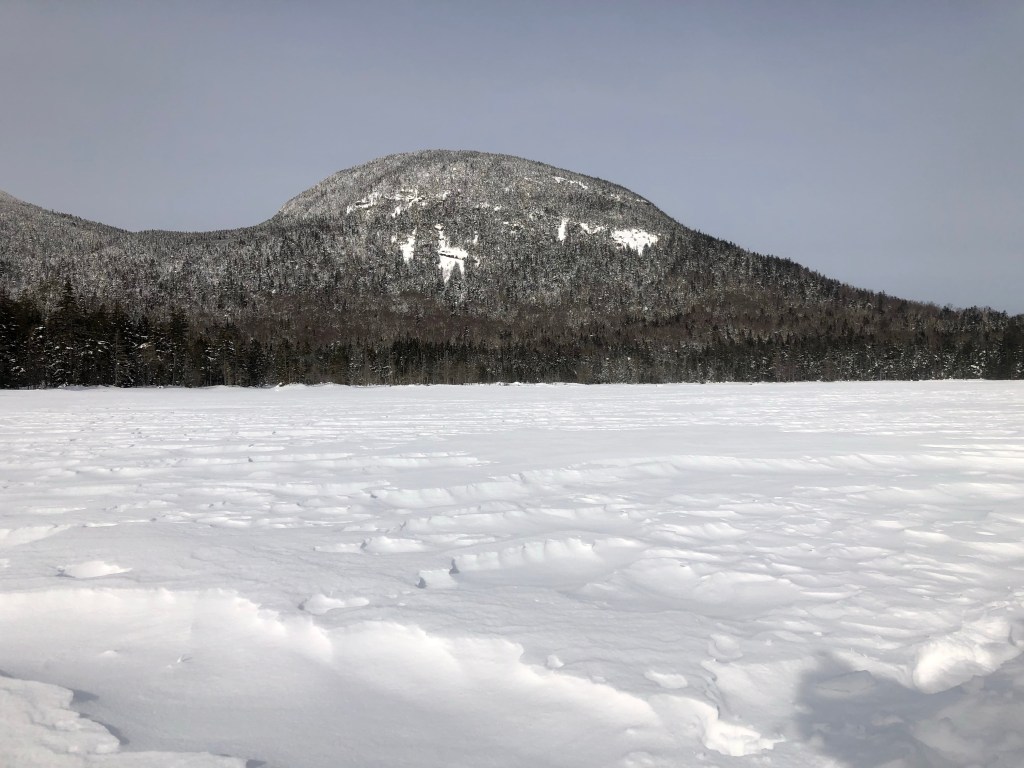
I promised myself a snowshoe walk in the woods for lunch, and dammit if I wasn’t going to honor that promise. There was more snow drifting down, quietly adding to the base layer in fluffy contentment. Day-old snow welcoming the new to the accumulation. We’re in the weather pattern now, folks. Snow-upon-snow: February in New Hampshire.
I’d walked these woods on Sunday, but felt a return was in order. Conservation land, with trails popular with dog walkers and tree whisperers. At lunchtime on a random Tuesday in winter you don’t expect a crowd but you expect somebody. In this case one car running, its driver staring down at a phone screen, oblivious to me strapping on snowshoes and beginning my walk.
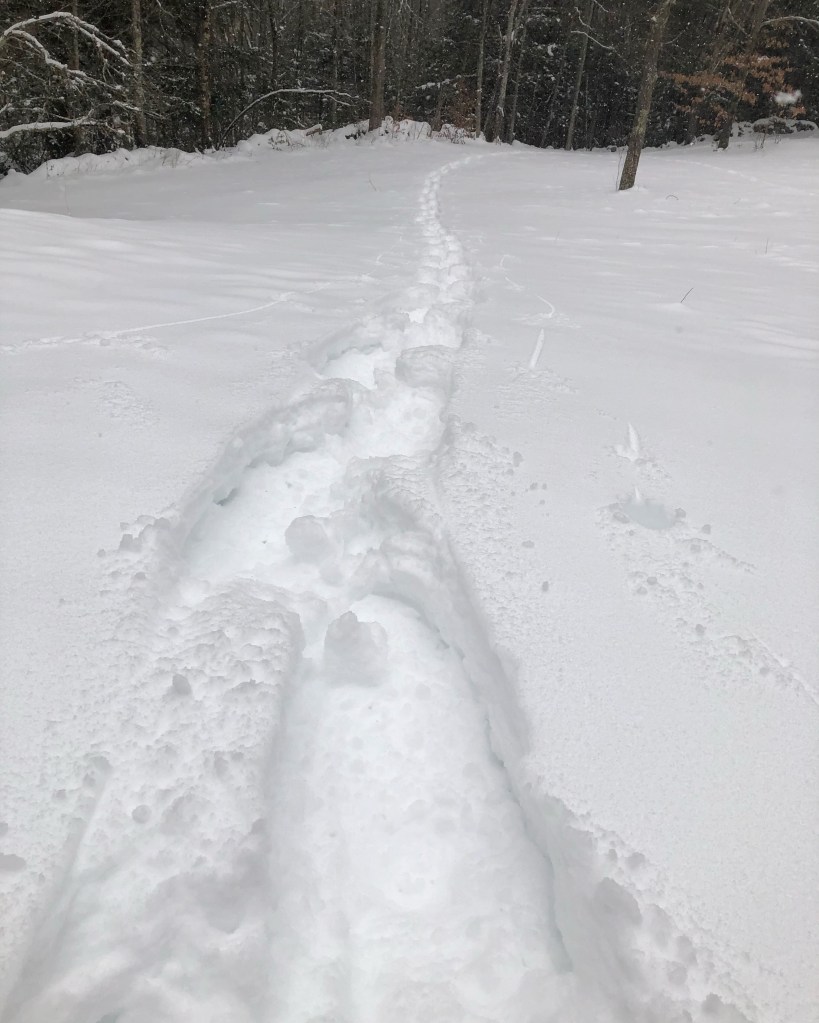
The trail is compacted again, a day after six inches of snow and with more in the air, speaking to the popularity of the trail. I help compact it for twenty steps and then move off trail into deeper snow. This is what I came for after all: the highly addictive, calorie-burning bliss of clumping about in deep snow. I followed an old stone wall that spends its lifetime keeping the woods and fields apart, and wonder at the farmers who built it a few hundred years ago, and the generations that mended it until the woods finally wrested back control of the land. Now it’s my turn on the land, and I quietly honor those who came before me; their hard life on display.
I rejoin the trail and the pace picks up, crossing a bridge over a stream I see a stand of old pines and step off trail to walk amongst them. Just me and the snowshoes, walking an endless blanket of white that covers the features of the land. Fallen trees, dormant vines and brambles, rocks and frozen wetland all lay together under Mother’s white blanket. And one soul clumping about above like a kid at recess. For that is how I feel, being out like this on a snowy workday.
I think about the time. How long have I been out here? 45 minutes? An hour? Hard to say, really, and I don’t want to look at the watch or phone to find out. But I know it’s time to head back towards the car. Clumping along, I join a familiar path, newly blazed but strangely not compacted as much as other trails. I help with that task while walking under hemlock trees – old friends who I speak with now and then across the years. They’d like me to linger awhile, I smile and hint I’ll be back another day. And cross a stone wall and step out on another field of white.
The car isn’t all that far away now. I could be in it and back in my home office in minutes. But the snowshoes want to fly some more, and so do I. Not just yet, world. I step off the path and walk back into the deep snow, a wandering soul in a quiet, timeless field. I spot a tall stone wall on a rise across an unbroken plane, set my course, and fly.
If you watch a commercial on television, or a reporter out on a city street, or even the cast intro on Saturday Night Live in February 2021, everyone is wearing masks. A year ago you’d have wondered at it, even as the pandemic rapidly descended on the world. Today it’s commonplace, and I’m more often surprised at the outliers walking into a store without one. I stood in a line for snowblower parts and a mechanic walked briskly through the store unmasked. In a crowded grocery store I saw an elderly woman(!) without a mask on. In both cases I had the same reaction I might have had two years ago to someone wearing a mask. Isn’t it funny how the world has changed our perceptions in such a brief turn of the calendar?
I chafe at restrictions, favoring wandering, crossing borders, friendly conversations with strangers and simply getting out there. But we all sense a light at the end of the tunnel, and we’ll reach a tipping point with vaccinations as we did with mask wearing. With more and more people I know joining the ranks of the vaccinated, a sense of optimism grows. Travel will soon be a reality again, even if a bit different from the travel of a few years ago. There’s plenty of travel available today, without worrying about the complexity of borders, just outside.
“My vicinity affords many good walks; and though for so many years I have walked almost every day, and sometimes for several days together, I have not yet exhausted them. An absolutely new prospect is a great happiness, and I can still get this any afternoon. Two or three hours’ walking will carry me to as strange a country as I expect ever to see. A single farmhouse which I had not seen before is sometimes as good as the dominions of the King of Dahomey. There is in fact a sort of harmony discoverable between the capabilities of the landscape within a circle of ten miles’ radius, or the limits of an afternoon walk, and the threescore years and ten of human life. It will never become quite familiar to you.” – Henry David Thoreau, Walking
Many times during the past year I’ve thought of Thoreau walking the landscape I know today. There’s plenty that’s changed since his time, but there’s also plenty that remains just as it was then. Much of it remains undisturbed, as if in a time warp, awaiting a visitor. I doubt he ever got up to the corner of New Hampshire where I walk, but I’ve walked in his woods near Walden and note the similarities.
“Walk until your day becomes interesting — even if this means wandering out of town and strolling the countryside. Eventually you’ll see a scene or meet a person that makes your walk worthwhile.” – Rolf Potts, Vagabonding
With a hint of the coming snow in the air, I took my snowshoes out to find new prospects. I quickly moved off the packed trail into virgin snow, crunching along on the snowdrifts through woods and fields. Cold hands soon warmed as I worked up a good pace past old stone walls and silent trees. Snowshoeing offers a slow burn, steady state workout similar to cross-country skiing. There’s a small thrill in hovering over the frozen land while blazing a new trail on snowshoes, and I felt a bit like I was flying as I crunched along.
Reconnecting with the blazed trail at a frozen stream crossing, I noted the collection of prints of those who had come before me. Snowshoes and fat tire mountain bikes, micro spikes and dog prints spiraling in circles from the trail in patterns of joyful exuberance and the freedom of the winter woods. It occurred to me that my own tracks were more similar to the dog prints than those of the trail walkers. Wandering spirits are rarely contains for very long on defined paths.
A simple walk in the woods, off trail, can change a person. In winter what was familiar ground becomes a voyage of discovery. Perception is how we frame the world around us, and I find it best to turn my perceptions upside down now and then. Every walk suggests something profoundly new, and winter transforms both the landscape and the visitor alike. Pausing a moment, I listened to the sound of silence. My snowshoes and I had walked our way to interesting, embracing the cold indifference of the woods to pandemics and masks and turns of the calendar.
Walking along on familiar trails transformed into strange country, I stopped worrying about the neglected collection of stamps in my passport. Feeling a million miles from anywhere I’d every been before, I came across a border marker deep in the woods indicating I’d crossed over from the town forest of my neighboring town into the undeveloped forest of my own town. I smiled and noted that not all borders are closed. And the unfamiliar isn’t very far at all from home.
Into the snowy woodsSnow blanket on an old stone fence
“Mens sana in corpore sano” – The Latin phrase for “a strong mind in a strong body”, has been in my thoughts lately. Let’s face it, we aren’t getting any younger, and we’ve only got this one body, and this one mind, for this one life. If we don’t take care of them eventually each breaks down. My favorite Navy pilot used to say that he saw the future, and he didn’t like it. Well, I’ve seen it too, and I don’t like what it might be without focused, consistent effort. We can’t stop the inevitable, but dammit we can delay it a bit.
The care of Mens, or “the mind”, is demonstrated in a lifetime of learning. Stretching your mind in new directions with unique experiences, travel and challenging reading that informs, proper nutrition, hydration, and above all, sleep. A fatigued, dehydrated mind is a sad spectacle indeed. Keeping our minds sharp should be a primary goal, acted upon daily. It offers the side benefit of richer conversations with a broader circle, a richer and fuller life, and doing well watching Jeopardy!
Corpore sano, “a healthy body”, shouldn’t be neglected in pursuit of a career, a vibrant mind, or because we’re busy with other things. The clear answer is that a healthy body is the foundation for all that we do in our lives. And as the Latin phrase infers, there’s an obvious connection between the health of the body and the health of the mind. Fitness and consistent exercise should be a primary focus in our daily lives, and should be scheduled and selfishly guarded against all who might infringe on our pursuit of a healthy body.
Think about the last time you had the flu, your body shut down to fight it. You had chills and aches. All you wanted to do was find some measure of comfort in your bed and try to sleep it off. Or think about the morning after some particularly hearty celebration, with a strong hangover and head pounding. Walking in a fog and feeling like death. We’ve all experienced the former, and most of us have experienced the latter. That’s no way to live, friends. But these moments inform, should we take notice.
So how about flipping that around to feeling our best most of our lives? Extending our vibrant lives to fill our days, and to extend our functional lifetimes? What is functional anyway? I’m looking for a bounce in my step and sharpness in my wit well into my senior years, and that starts with a strong foundation now. Why can’t we be hiking up mountains in our 90’s? Taking long, unassisted walks along cobblestone streets in faraway, ancient cities? Why can’t we be tackling new languages and reading Yuval Noah Harari and Nassim Nicholas Taleb books as we round 100? And shouldn’t we be doing that now as stepping stones for deeper thinking then?
Speaking of Taleb, the goal is resiliency. To become as antifragile as we possibly can so we can give our bodies and minds a fighting chance in this crazy world. To bend but not break when the going gets rough, as it surely is now for so many people.
“If something is fragile, its risk of breaking makes anything you do to improve it or make it ‘efficient’ inconsequential unless you first reduce that risk of breaking.” – Nassim Nicholas Taleb, Antifragile
The moments that test us, the toughest workouts and the most challenging concepts we wrestle with in our minds, these make us stronger, more resilient, and more vibrant. So waking up to this gift of another day, think Mens sana in corpore sano. What will we do to strengthen our minds and bodies today? Act now, without hesitation. A vibrant and fulfilling life begins with this. Our health and vigor define everything that we do in this, our one wild and precious life.
The last day of January felt like it should throw up challenging hiking in New Hampshire. In fact the temperature read a solid -4 degrees at the start. But the truth is that if you aren’t breaking the trail it’s comparatively easy. The snow pack on popular trails covers up a lot of the erosion and exposed granite ankle biters that are a normal part of hiking in the White Mountains. You simply trade the pounding on your lower extremities for a different pair of challenges: traction and hours of walking with your toes pointing up.
Think about a groomed ski slope, all corduroy and pristine. Perfect for skiing down, but imagine walking to the summit straight up that slope. How do your feet grip? How does that angle feel on your ankles and calves after about an hour? That’s the dilemma of the hiker on a snow packed trail. Snowshoes and descending butt sliders press the snow down into a version of that groomed slope, albeit it two feet wide. Step six inches off trail and your foot plunges down two feet into the abyss.
Overcoming such challenges requires mechanical assistance. On the one hand you have micro spikes; one of the best inventions ever for handling winter traction issues. I’ve gushed about micro spikes before and generally they’re perfect for frozen packed snow. They become more challenging when the snow softens and begins to ball up under your feet. Walking on snowballs is just as enjoyable as it sounds. Another consideration is ice. I feel comfortable walking on ice with micro spikes on, but not walking up a slide with them. Trusting rubber bands with your general well being has limits. And this is where an upgrade is in order.
A step above micro spikes are crampons, which offer more traction with a deeper spike designed to linger in your nightmares. I see crampons and think about those times I accidentally kicked myself in the back of the leg hiking in tight terrain and shudder. But then I recall a story I read about a guy who stepped out of his tent to take a leak hiking Everest or some such place. He made the unfortunate decision to not put on his crampons and promptly slid down the mountain screaming to his death. Crampons are made for comfortable late night relief in such conditions. Truthfully, I tend to avoid most “icy slide nightmare” hiking, but sometimes you run into spots where it would be the better choice. On Mount Liberty a couple of days ago I wished I’d had them a few times as I kicked my micro spikes into frozen snow hoping for footing.
And then there are snowshoes, used by generations of people trying to get from point A to point B without post-holing every step along the way. Snowshoes have come a long way, and the best of them have crampon-like steel spikes protruding from them and a wonder for the sloped uphill hiking conditions: the heel lift. A heel lift is a metal hinge that flips up to offer welcome support for your heel. It effectively levels your foot on a slope, creating a more comfortable hiking angle. Snowshoes come in different sizes based on your weight and the type of snow you’re hiking it. I have a great set of Tubbs snowshoes that are perfect for fluffy powder walks in open terrain. Being a tall clydesdale my shoes are 36″ long, which makes them a challenge on tight trail hiking. And with the trail compacted it’s simply easier to stick with the micro spikes or crampons. Using shorter snowshoes for compacted snow would offer the best of both worlds.
There are times when you might put all three on in the same hike. I didn’t bring crampons on my last hike but wore the snowshoes for an hour during a steep ascent in packed powder. My hiking partner that day chose to stick with micro spikes on the ascent and flew up the hill with me gasping to keep up with the extra burn of snowshoes. When I conceded and switched back to micro spikes our hiking speed equalized again. He wore his crampons on the descent while I wore micro spikes. In softening snow broken down by many hikers at that time of the day it was a toss-up. Had it been frozen and compacted as it had been in the morning the crampons would have been better.
Ultimately accessories are successful when you start with a great pair of boots, pick the right accessory for the terrain, and are willing to switch on the fly when things change. Another truth is that if you don’t get out there in it, none of this matters. Winter is meant to be lived in fully. Being shut up in the warm house might be comforting, but don’t we spend way too much time in our houses now? Step out there. Just wear the appropriate gear.
Let the record show that on the last day of January, 2021 this author fell in love with a pile of granite atop a ridge in New Hampshire. Mount Liberty rises 4,459 feet with a prominence of 379 feet, making it one of the state’s 4000 footers. I’ve flirted with Liberty for years, but when I wiped the slate clean and re-started my pursuit of the 48 4K’s last year in the middle of a pandemic I decided to leave this very popular hike for a quieter day. How about first light on the last day of January?
Mount Liberty was named for George Washington, but since there was already a Mount Washington Liberty seemed appropriate. It seems when you look at the mountain from a certain angle it looks like George lying in state. And sure enough, from a certain angle you can see that.
While Liberty was the goal all along, the proximity of Mount Flume, itself a 4000 footer with the rather intriguing measurements of 4,327’/407′ prominence made it a no-brainer for a peak bagging day. Since we were hiking an out-and-back, we ended up summiting Liberty twice, making for a three summit, eleven mile hike. There’s a loop option that includes the Flume Slide Trail, but we just weren’t that ambitious (and a friend talked me out of it). Talking to a hiker with crampons who’d done it, he described it as “gnarly”. And not in a good gnarly way. Better to stick with the safer route, thank you. Mount Flume is the source of Flume Brook, which carved the spectacular gorge named, you guessed it, The Flume. It’s worth a visit on a quiet day in late spring, but best done mid-week and early to beat the crowds.
You know right away that most people turn around after some time on Mount Liberty by the condition of the trail. The Liberty Springs Trail was compacted snow the entire hike, and the summit was completely compacted. The trail between Liberty and Flume was defined but definitely not as well-travelled. Since we started early, we were contributing to the trail break, but it was just compacted enough to keep the snowshoes strapped to the pack (more on snowshoes in tomorrow’s post).
For this hike, I’d texted a college friend I’ve hiked with before. The two of us met at the Liberty Springs trailhead at 6:45, making us some of the first hikers to climb that morning. We saw a few people on the summit of Liberty and were soon joined by a few more. The crowd was even thinner on the summit of Flume, with just a few diehards when we arrived there. But the day was spectacular and the traffic was picking up. Our return hike to Liberty required a lot of passing maneuvers, which generally meant whoever was coming downhill to posthole into virgin snow off trail to allow someone to pass. In summer you don’t think anything of it. In deep snow you think about it every time.
Back on a now-crowded Liberty, we had a quick snack, drank some water and began our two-hour descent. Plenty of people passed us on this leg, suggesting the return hike can be much faster for those who like to jog or butt slide down the trail. We took our time, a concession of age or wisdom or experience. I’m just not going to jog down a mountain with a full pack with snowshoes strapped on the outside. With all the traffic and the sun warming the snow the trail was breaking down a bit. Our timing was just right.
Mount Liberty, seen from Mount Flume summitTrail between the summits was a winter wonderland USGS marker on Mount Liberty with Cannon Mountain in the background
Contingencies. I pack for contingencies. Most of it stays in the bag, bulging against the sides, weighing the pack down directly onto the hip belt, as designed, and a bit on the shoulders, as is the way. First aid kit, extra warm clothing, extra food, and, it turns out, just enough water for this eleven mile trip. Snow demands micro spikes, but also snowshoes. Mine spent most of the day strapped to my backpack, but I gave them a try for about an hour of hiking before strapping them back on the pack. The compressed snow and narrow trail made wearing them more hassle than salvation. Sometimes you try out your contingencies and realize that you were better off with the original plan. But I do love those heal lifts on steep inclines.
It was -4 degrees Fahrenheit at the start of my hike this morning. Most layers packed as contingencies went right on the body for the start of the hike. Snow has a way of being crispy and slippery when you dip below zero. And the trail we started hiking wasn’t the same trail we descended when the sun rose and warmed temperatures into the twenties. Having the right footwear and accessories is essential when you see swings in temperatures like that.
Still, for all the contingencies planned for, most everything stayed in the pack. Sleeping pad, extra layers, way too much food, all of it mocking me on the steepest parts of the incline and for most of the descent. But as soon as you don’t pack it you know what’s going to happen. Yeah, contingencies, especially in winter, must be a part of your kit. You’ve got to have a winter pack that can handle all the extra stuff, provide tie downs for the snowshoes, and remain an afterthought for the duration of the hike. For day hikes I’ve settled on an ULA Photon pack, which offers everything I need and the space for those extras.
Winter hiking in New Hampshire offers plenty of beautiful moments. Moments that serve as exclamation points on the trip and in your life. But winter can offer up stunning beauty and calamity quite rapidly in the White Mountains. Mother Nature doesn’t care about your feelings. You must be prepared for whatever she throws at you. And that’s what contingency packing is for. Sure it mocks you when it never gets used, but it also assures you that it will be there for you if you need it.
The next blog post will cover the actual hike. Memorable, incredibly clear, and two more 4000 footers checked off. Stay tuned, there’s a lot to cover.
“It takes time for an acorn to turn into an oak, but the oak is already implied in the acorn.” – Alan Watts
January is a funny month. Plans for the year generally completed, we look at the climb ahead and take our first steps into the unknown. Where will it take us? What will we accomplish? How will the world change these grand plans we’ve wrestled with in our minds and on spreadsheets? How exactly are things going to play out?
The future is implied by our actions today. We turn plans into action one step at a time, one toe in the water, one conversation after another, one moment to the next. And in each step, we discover the truth about the world.
I look back a year and laugh at the plans dashed against the rocks in the COVID storm. We all had to bushwhack when the path washed away last year. Extreme, to be sure, but it demonstrated the nature of plans. They do change.
Words we used too much in 2020 included adapt and pivot and new normal. What words will we use in 2021? 2022? What is implied by the trends we see in the world? What is implied by our daily habits? We might not see everything in the future but we can surely see the path we’ve set ourselves upon.
I wonder sometimes at the future, but it isn’t mine to ponder. Plans are made and revised, such that they can be. Focus on the first step, small as it might seem in the moment. And go.
The day started with heavy, gusty rain. The kind of rain that would be a nor’easter had it been snow. The kind of rain that makes you glad you’re indoors looking out a window at it. And paradoxically, the kind of rain I wanted to be outside fully alive in. There’s an edge to any storm, and this one was abating just enough to prompt me to pursue a micro adventure or two. I packed up my rain gear and a water bottle and headed out to visit waterfalls.
First stop was an hour from home, at Willard Brook State Park in Ashby, Massachusetts where the beautiful Trap Falls pour forever over granite ledge. This is a popular spot in the warmer months, but on a rainy Saturday in January I was the only one there. The falls were roaring from the rain, and easily heard from the small parking lot. A brief, shuffling walk on a few slippery spots and I was quickly at the falls, and thought it might be a trick. How could I have this all to myself on this day when the falls were screaming for attention? The answer lies in that moment when I looked out the window and decided I ought to go out in this weather, while the rest of the world thought that would be a crazy idea. Score one for the crazy folk.
Trap Falls
A few pictures and rock scrambles later, I headed back to the car and consulted the maps in Greg Parson’s excellent resource New England Waterfalls, which I’d picked up as a gift to myself while purchasing a gift for kindred spirits. Parson’s recommended a cluster of waterfalls just over the border in New Hampshire. I looked at two in particular as promising and plugged in their coordinates in my Waze app and headed off for more adventure.
Driving towards Milford, New Hampshire, I decided to focus on Lower Purgatory Falls as my first choice, and sought out the trailhead on Wilton Road. The trailhead displayed some icy conditions and I brought my micro spikes with me for this hike. I would soon be grateful for having them.
The walk from the road to the falls is roughly half a mile. Nothing too crazy, really, just an old logging road that carries you to a yellow-blazed trail. And like Trap Falls, you could hear Lower Purgatory Falls well before you got to them. The falls are named for Purgatory Brook, a beautiful stretch of water that was white water after all the rain. Cresting a small rise, I saw the falls ahead and worked my way down to see them.
And this is where the micro spikes were absolutely required. I was hiking solo in isolated conservation land on a day when nobody else thought it logical to be out there. A slip and fall would have been bad news. Micro spikes remain one of the best hiking investments I’ve ever made, and they offered a clear return on investment as I made my way down an ice covered hill with wet roots and rocks making up the better footing.
Lower Purgatory Falls is a triangle-shaped wonder set deep in the woods of the aptly named Purgatory Falls Conservation Area. After the heavy rains and melt-off the falls had a lot to say, and I lingered by them for a bit to tap into their energy. Again I wondered why I was the only fool out there on this day, but I’m grateful I never came to my senses and stayed home.
Lower Purgatory Falls
As I was leaving the car I took a picture of the trail map supplied in Parson’s book. It indicated I could hike upstream to see Middle and Upper Purgatory Falls. The trail seemed clearly blazed in yellow and tightly followed the brook. And so I made my way upstream seeking more adventure. I found it.
Hiking along the swollen brook, there were a couple of spots where it flooded over the trail, making for sketchy crossings. Not plummet into a frozen brook sketchy, for I’m not that crazy to attempt such things, more water deeper than your boot is tall sketchy. I made a few calculated crossings, trail blazed in a couple of spots, but always stayed safe and kept the yellow blazes in sight.
Mossy ErraticsPurgatory Brook, swollen with rainwater and melt-off
Eventually the trail dead-ended at a development with a port-o-potty announcing “progress”. I silently cursed the abrupt ending to the trail, looked around to see if I’d missed it diverting elsewhere, and doubled back towards Lower Purgatory Falls, crossing anew the sketchy water crossings I’d already attempted.
And here’s where it got interesting. I returned to the spot where I’d first seen the falls, looked left and right and saw yellow blazes going off in different directions. WTF.
“Make sure to return on the trail you came in on as there are several official and unofficial paths in the area. Look for the yellow blazes and the junctions you passed through on the way to the falls originally.” – Greg Parsons and Kate Watson, New England Waterfalls
Well, this is where I went wrong. I took the wrong yellow-blazed trail towards what I thought was a return to my car. After a few minutes of walking I was aware that I didn’t recognize any part of this trail. I doubled back and saw a logging road I’d ignored before and started following it until it dead-ended. Damn. And this is where you make choices deep in the woods. I could blaze my own trail through the woods with the compass on my cell phone, a picture from a book and Google maps as my guide, or I could double back once again and find the right trail. I’ve learned to trust my instincts in such situations, and not trust a phone battery. I doubled back.
Finding a junction in the trail, I saw the yellow blazes once again splitting off in two directions. Who the hell blazed this land?? I stuck with the more worn trail and followed it to a place where (surprise!) I’d been before. It seems I’d followed the yellow blazed loop back around onto itself. And this is why bringing a compass and a reliable waterproof map is essential. Having neither, I relied on my experience in similar situations and kept my head about me. Since I was back on a trail I recognized, I simply followed it back to the Lower Purgatory Falls. Once there I saw immediately where I’d gone wrong and followed the correct yellow-blazed trail back to the logging road and eventually to the trailhead. Phew!
This adventure started off as seeking a few waterfalls on a wet day. It became a small test in orienteering in unfamiliar woods on a wet, disorienting day without the proper equipment. And it ended with me deciding that two waterfalls were enough for one day. I thanked my wits and good fortune and headed home. The other waterfalls will have to wait… for now.