Category: Fitness

  • Hiking Mount Tecumseh on a Foggy Night

    It seemed like a good idea at the time is a beginning statement that might indicate more adventure than bargained for.  And so it was that I hiked solo up Mount Tecumseh at 6:30 PM on a random Thursday, with noble intent to meet the Comet Neowise halfway by climbing a relatively easy mountain and looking at the stars.  Except that the stars were hidden in overcast, and the stakes of a solo hike ratchet up when it gets dark on a steep and wet trail.  But I had a plan B for the descent all the while, which turned out to be an epic adventure of its own.

    Mount Tecumseh is a relatively small mountain that was recently demoted from an official 4000 footer to a just short of greatness 3997 foot.  The mountain is named for the Shawnee Chief who unified tribes against settlement in the Great Lakes region and fought against America in the War of 1812.  There’s no logical connection between Tecumseh and New Hampshire that I’ve seen, but I can respect his name more than some others I’ve come across hiking.  I’ve hiked it before and remembered it as a relatively easy hike save for a steep mile of the trail known as the staircase.  This made hiking the trail as it was getting dark less concerning for me.  But the last time was in winter when Tecumseh’s famous staircase is softened by a heavy snow blanket.

    The ascent was easier than I thought it would be, which bodes well for the trend in my overall fitness level I suppose.  I arrived at the summit at 8 PM with plenty of light to see the view, if the clouds hadn’t dropped down to start blanketing the mountain anyway.  I changed into a long sleeve shirt and began my descent quickly after arriving.  I knew I had a challenging descent to deal with if I chose to hike down the Tecumseh Trail, though I had the gear necessary for a hike in the dark.  But there was that fog to consider, which makes a headlamp beam about as effective as your high beams in your car in fog.  I decided to hike as long as it was safe to do so without using the headlamp.  And after considering the Tecumseh Trail made the decision to hike the Sosman Trail on the descent.  I’ve hiked this one before and knew it was relatively easy for a descent, partially following the ski trail for Waterville Valley.

    But here’s where the story takes a twist.  The fog and darkness made it very difficult to mark the trail, and I lost it in the swirling mist at the summit of the ski lift.  And so I said my first WTF of the night, looked at the ski trail sloping down and decided to just walk down that instead.  I kept to the green trails, which are a combination of gravel road and grassy meadow in the summer.  Skiing down a slope and hiking down are very different things, and I found it slow going.  At one point I spooked a couple of large birds roosting in a tree – likely those turkey I’d been wondering about earlier in the week, and it startled me enough that I thought I might just expire right then and there.  But that would’ve been too easy.  I uttered another WTF and kept descending.

    After walking for what seemed like hours I reached the middle chair lifts at the ski area and looked down to see the lights of the ski lodge depressingly far away.  I said another WTF and made the fateful decision to follow the chair lifts down instead of the gravel access road that would add a lot of time to the hike.  And I discovered just how tall the meadow becomes on the walk down.  By now it was completely dark and I used the beam to illuminate every step and the hiking poles to probe for gopher holes and other hazards.  Eventually I made it down to the base and glanced around at just how lonely a ski area looks at 9:30 on a foggy summer night.  I arrived at my car, used the beam to check for ticks and headed home.  Not your average Thursday night.

    Lessons learned on this one.  Hiking solo in the dark wasn’t the best idea I ever had.  Even though I knew the trails I was hiking, they always look different in the dark, and especially when there’s fog.  I would’ve been better off descending the Tecumseh Trail.  Even if it was slow going its clearly defined and I would have arrived at roughly the same time as taking the Sosman Trail.  The point of this hike was to see the night sky, and I might have been better off just bagging the hike when I saw the overcast at the summit.  But I don’t panic when I hit WTF moments, I assess.  There were things that could have gone wrong but I took it slow and easy and got back safely.  I’m glad I hiked it, and all the extra drama of darkness and fog and overgrown ski trails made it memorable, if slightly reckless (but calculated reckless). Another 4000 footer completed, and a story to tell.

  • Cloud-Hidden, Somewhere on the Mount

    “I asked the boy beneath the pines.
    He said, “The Master’s gone alone
    Herb-picking somewhere on the mount,
    Cloud-hidden, whereabouts unknown.”
    – Chia Tao

    Inevitably I had to arrive at Alan Watts.  I’ve circled around his work for some time, and finally landed on Cloud-Hidden, Whereabouts Unknown, which is as much personal journal as philosophical work.  And so it was that I lingered on these lines from Chia Tao that open Watts’ book.  I thought about my hike yesterday, cloud-hidden myself, with my whereabouts largely unknown on a solo hike.  It seemed appropriate to borrow this translation for my own observations.  For yesterday’s post was all nuts and bolts detail on hiking Mount Garfield, but it didn’t convey much about hiking solo largely in solitude.

    There’s a part of me that wants to knock off the 48 New Hampshire 4000 footers as a solo hiker.  Not because I’m anti-social, but because I feel the mountains differently when I’m alone with them.  Perhaps I’m more attuned to the ripple of water and the breeze in the trees, but mostly I’m more attuned with myself.  Slipping or tripping on a solo hike feels more consequential than it does when you’re with hiking buddies.  Sure there are other hikers on the trails, especially on a 4000 footer, but if you’re injured you’re relying on the goodwill of strangers and blowing up their own moment with the mountain.  Who wants that memory of your last hike?  I’d just as soon take the extra millisecond to be especially sure of footing.  To that end, I find hiking poles to be especially valued on a solo hike for the reassurance they provide on the descent.  It took me years to conclude that there was any value at all in hiking poles.  Now I find them invaluable.  I was reminded of their worth when I slipped on a hidden muddy root on my descent yesterday and my right pole bore the weight of my slide, keeping me from a hard fall and now shows evidence of bearing the brunt of the force in the form of a slightly bent shaft.  Thanks for your sacrifice, friend.

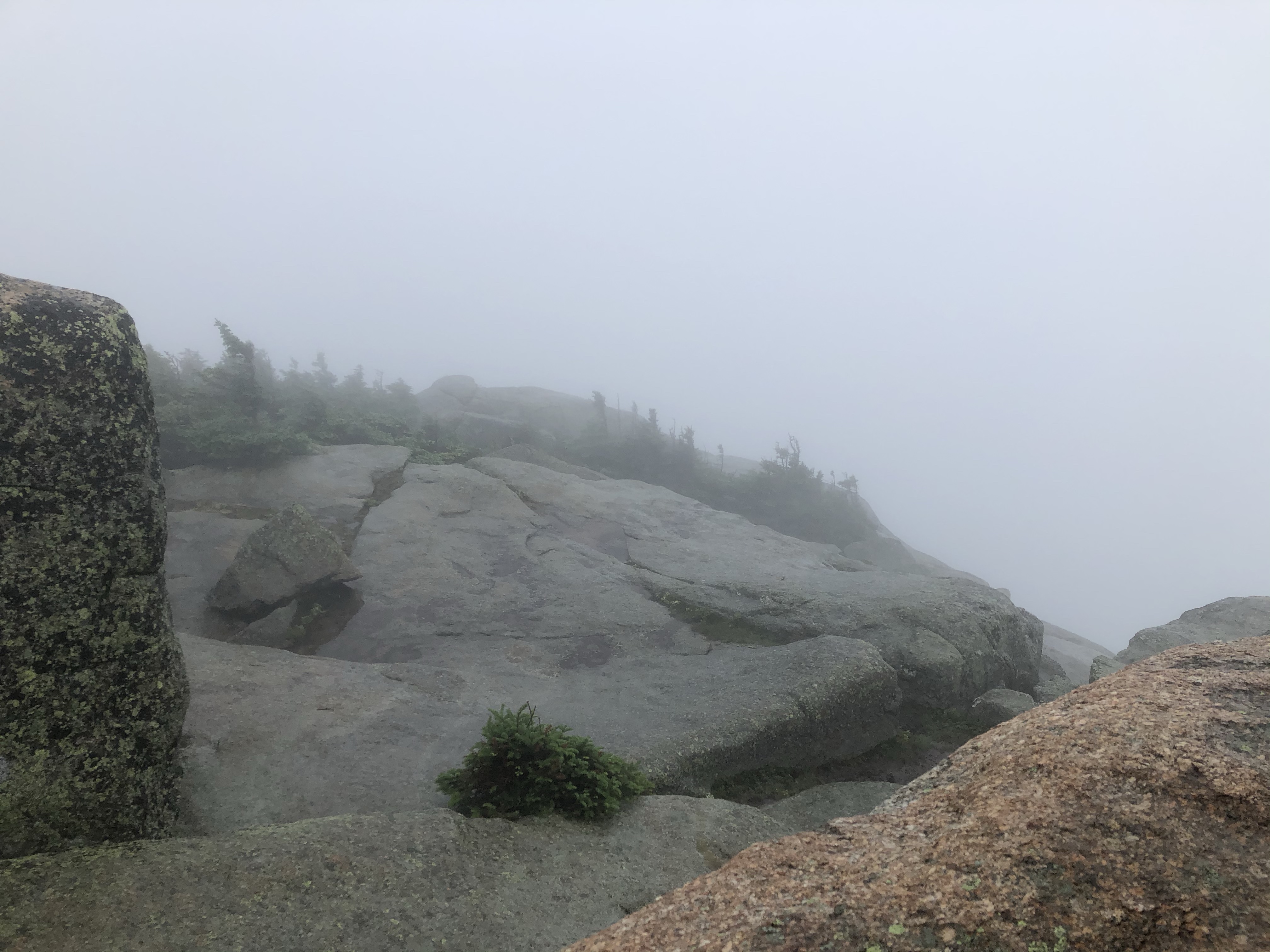
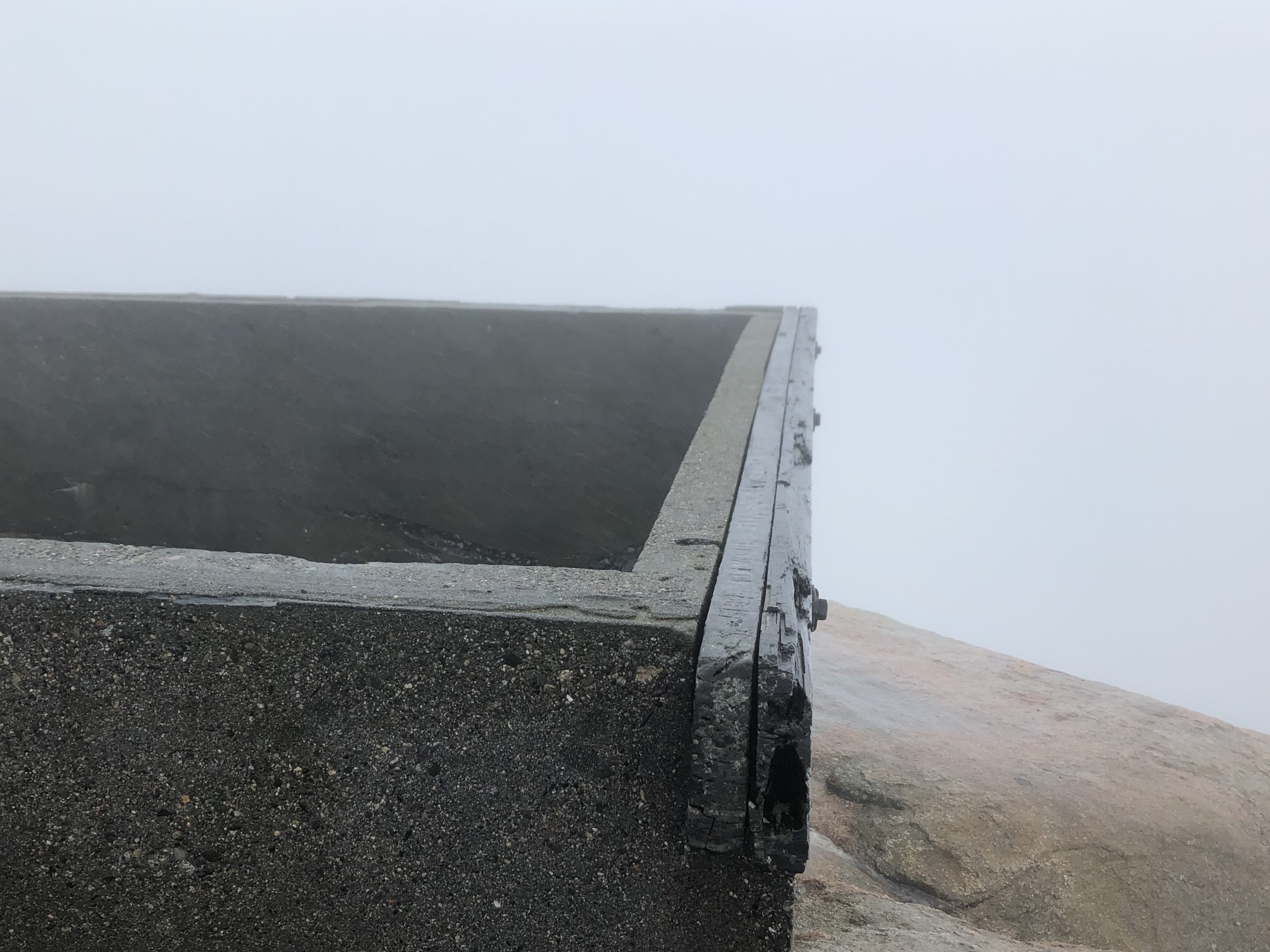
    The summit of Mount Garfield is a knob of granite with an old fire tower foundation set into it.  I arrived at the summit feeling a bit like a character in that Chia Tao poem.  Cloud hidden and whereabouts unknown.  There’s something about being alone in swirling clouds that is otherworldly.  I’ve felt this before, most notably when the fog rolled in as I stood alone on North Head at Signal Hill in St. John’s, Newfoundland.  My time on the summit lacked the drama of foghorns waking up to blare warnings to all that would hear, but made up for it with wind gusts that implied a threat of their own.  Normally the summit is a place to linger, but the mountain suggested I should move along.  When you’re on the mountain listen to the mountain.

    “The solitary is as necessary to our common sanity as wilderness, as the forest where no one goes, as the waterfall in a canyon, which no one has ever seen or heard. We do not see our hearts…” – Alan Watts, Cloud-Hidden, Whereabouts Unknown

    I’m not sure what I’d do if the rest of the world woke up early.  I suppose I’d go for long walks alone in the woods, or quietly slip a kayak into the bay or a river, or some such pursuit of solitude.  But the world tends to sleep in, or otherwise keep to itself, and so must I in the early hours.  Hiking offers a measure of solitude, even when you’re with others.  For who doesn’t listen to the mountain when they hike?  Sadly I’ve come across such people – loud talkers you hear from a mile away, or worse, people who play a soundtrack through their phone speakers as they tackle the trail like they’re on a treadmill at the gym.  There are people who never hear, because they never really listen.  I choose to listen.

    The morning after such a hike is filled with reminders: muscle kinks and soreness that grumble, memories of moments of lightness and wonder, gear to store away after a night of drying.  This is the afterglow of time on a trail, and some of that glow stays with you for a lifetime.  I still wonder at moments spent hiking from the Colorado River up Havasu Creek to the lower falls, or watching a meteor shower late in the night on Old Speck Mountain in Maine with college friends.  Hiking doesn’t always fill you with wonder, but it generally puts you in the neighborhood.  The rest is up to you.


  • Hiking Mount Garfield

    As U.S. Presidents go, James Garfield is barely remembered, but he seemed like a decent guy.  He fought for the Union primarily to eradicate slavery, and is the only President to be elected from a seat on the House of Representatives.  So he should be viewed favorably and as an American success story.  Unfortunately, his tenure as President lasted a mere six months, as he fell victim to an assassination attempt, dying a few months after being shot from complications.  That you and I don’t remember much about Garfield has as much to do with his short and tragic life more than any flaw in his character  His mother Eliza was born in New Hampshire, so it seems fitting that there’s a mountain named after him.  This morning I climbed that mountain.

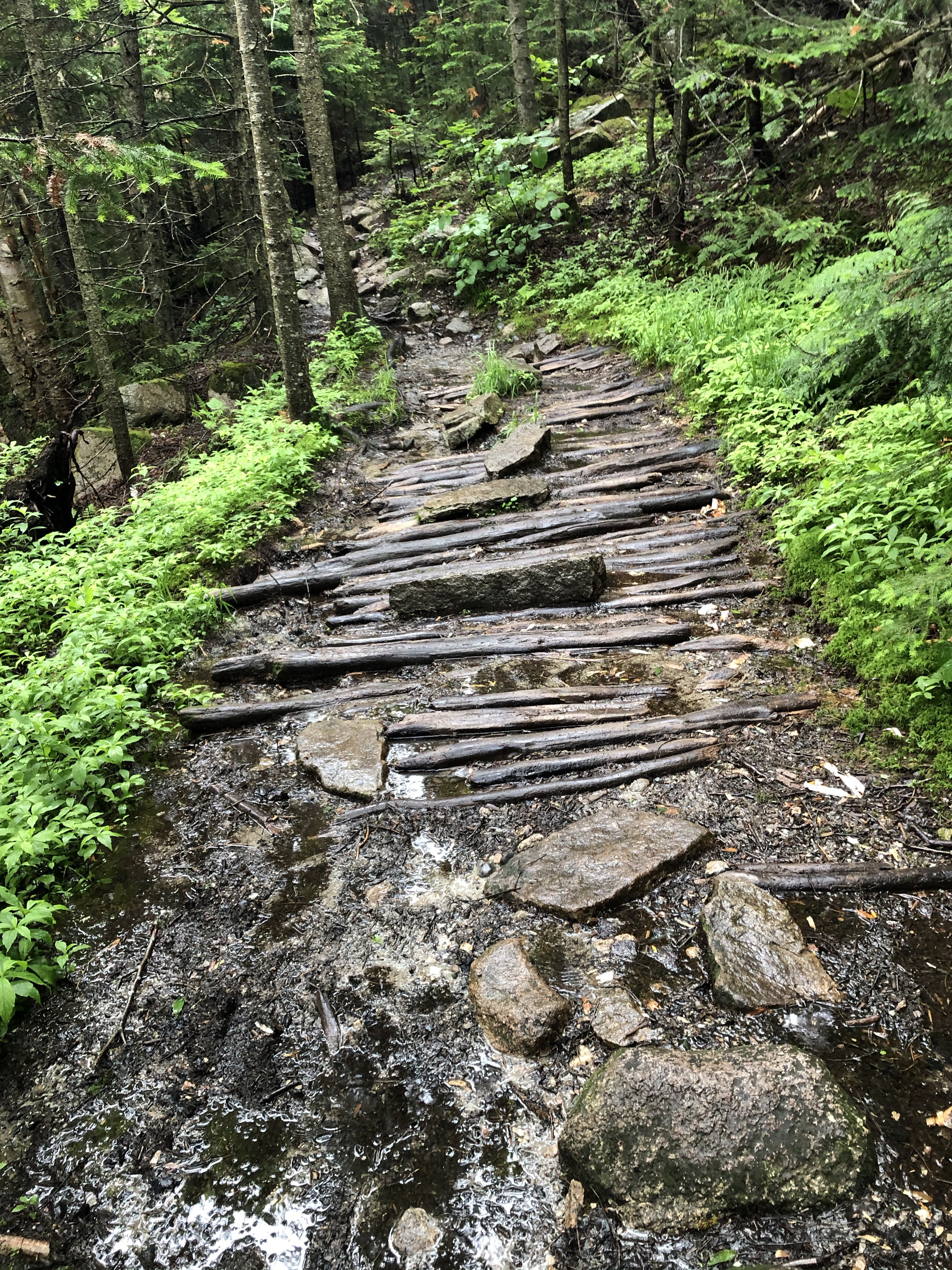
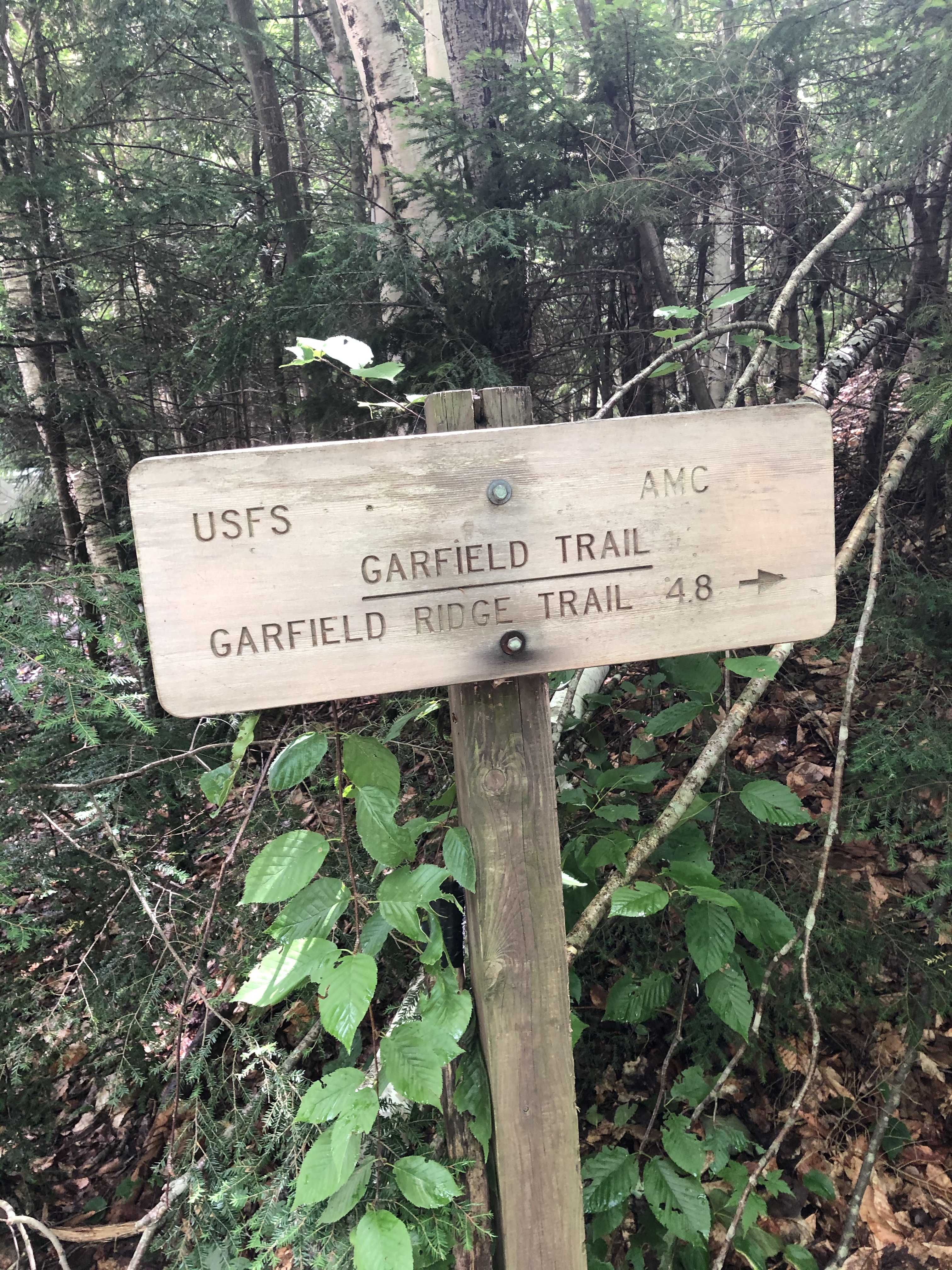
    Mount Garfield is known for the view from the summit.  There would be no view this morning, as rain and low cloud cover announced from the start that this wouldn’t be one of those days when you could see for miles.  I decided to hike it anyway, and to do it solo. The Garfield Trail is a relatively easy hike, and I was able to get to the summit in 2 1/2 hours.  As a wet hike, the Garfield Trail leaves a lot to be desired.  You feel like you’re hiking in a stream in stretches, and on the verge of getting bogged down in mud in some others.  But it’s a classic New Hampshire hike, with a cathedral of mature trees lining the ridge in the first third of the hike, and rocks for much of the rest of the way.  This is the type of hiking I’ve grown up with, and I quickly settled into my rhythm for the climb up.  For all its wetness, there were no bugs for the duration.

    Beginning at 7:30, I found little company on the trails.  I passed one father and daughter pair early on, and was in turn passed by a woman who flew past me after the first hour of hiking.  I’ve long checked my ego at the door when it comes to my pacing on hikes, and when I go solo I’m very deliberate with footing.  I’d see her again as she flew down the mountain at almost the same pace.  And that was it for company on the ascent.  It seemed most people were saving Garfield for a sunny day.  But the descent proved me wrong, with a steady parade of hikers streaming past me, most wondering about the view at the summit.  Not much of one, I’d tell them, but even as I spoke those words the day was beginning to change, with sunlight burning through the cloud cover and warming up the forest.  I was grateful for having done the ascent in the cool rain, even if the view didn’t cooperate.

    Mount Garfield is considered one of the easier climbs of the 48 4000 footers, but with that big payoff of a magnificent view waiting for you on a clear day.  If I wasn’t pursuing the 48, I might have saved this hike for better day, but I don’t view it as a waste at all.  20,000 steps later, I’d finished another 4000 footer and began my drive back home.  Garfield is a mountain I’ll do again a few times, certainly in autumn but also in winter when it becomes a longer hike as they close the gate on the access road.  Maybe my timing wasn’t good for a view, but it was an excellent 4 1/2 hour round trip anyway.  I’ve got my second notch on the 48 (I started over again from the beginning this year, since I rarely logged hikes previous to pursuing this goal) 4000 footers, and I got a decent workout in before lunchtime.  I’d call that a great success.

    A side benefit of hiking the 48 is learning more about the people the mountains are named for.  Other than knowing he was President and that he’d been assassinated, I didn’t know much about James Garfield until I chose this hike.  I’m glad I took the time to look back on his life a bit.  He only lived to aged 49, but managed to accomplish quite a bit in that time.  He was a classic rags to riches story with a life cut short too soon.  The White Mountains are dotted with more famous Presidents, but that doesn’t make Garfield a bit player.  Just a guy who ran out of time before he could do more.  I think he’s had a lot of company in that club.  A good reminder to get busy already, time waits for no one. And with that in mind I’m considering a peak bag for my next hike, which involves summiting multiple peaks in one day’s hike. I have another couple of former Presidents in mind for that one.


  • Beginning With Waumbek

    “Climb the mountains and get their good tidings.” – John Muir

    The workout today was pretty straightforward: hike a total of 7 miles round trip up one of New Hampshire’s forty-eight 4000 footers. I’ve hiked at least a dozen of them before , some multiple times, but I didn’t track it officially. So I’m simply starting over again. I’m not imposing a deadline on myself and I’m not in a race. I don’t go to the mountains to set distance records. I go to the mountains because I love the mountains. And I love who I become when I spend more time in the mountains. And so today was, officially, one. And some good tidings.

    I chose Mount Waumbek in Jefferson, considered a good beginner 4000 footer. I’m not a beginner, but I’m beginning again. Waumbek was as good a place to start as any. At 4006 feet, its one of the shorter 48, but it counts just the same as Mount Washington on the list. And so I announced to the family that I was going and got one taker; my daughter committed to getting up at 4:30 and joining me. You know someone is serious when they commit to 4:30 AM, and sure enough she was ready to go by 5 AM.

    Mount Waumbek is an interesting name. The White Mountains themselves were once called Waumbekket Methna, which either means “mountains with snowy foreheads” or “white rocks” in the dialect of the Abenaki. Or maybe some settler came up with that story after enough time passed. What I’m fairly certain of is that Mount Waumbek was once slated to be yet another ski area, but thankfully it fell through and was preserved. I imagine it would’ve still counted as a 4000 footer, as Cannon Mountain does, but it wouldn’t feel much like hiking then. I’ll take the New Hampshire rock and root tour, thank you.

    I like to start hikes early, especially in hot weather. It’s generally less crowded, making simple things like parking a car less of a process. And early makes a big difference on hot, muggy days. Get it done before the crowds, before the heat, and before the inevitable thunderstorms that roll through the mountains on such days. We began our first steps at 7:45, a bit later than desired, and with a bit more company, but thankfully no raindrops. Instead we ran into swarms of ravenous gnats, flies and a few odd mosquitos. None of them cared much for social distancing. None of them got the memo that we wore generous applications of bug juice, or that according to the small printed label, they’re supposed to hate this stuff. No, they actually seemed to view it the way I view olive oil.

    The only solution was to keep moving. Summit Starr King Mountain (now THAT is a name for a mountain), glance at the view, snap a picture, move. Summit Waumbek, sip some water and nibble on a snack (carefully brushing off the carnivores who made a reservation to dine on you), re-apply bug juice and get moving again. There was no getting around it, I chose the height of bug season to begin again. But a day of hiking, even with the swarm, is better than most workouts I can think of. 19,000 steps today, and I’ll surely feel it tomorrow.

    And so it was, we checked off the first of the 4000 footers, I’ll carefully note it on the tracking sheet, and I’ll move on to the next on the list. Maybe it’ll be a we? After all, I’m not the only one who checked a box today.

  • Beginning with !

    Yesterday I took the plunge into a brisk Buzzards Bay. Temperatures were well above “numbing” but not quite “refreshing“. It was more in the “you get used to it” range. I find that more than acceptable, if a bit lonely. It seems most still have it in the numbing category and there was a lot of elbow room in the water. I’m still a bit of an outlier it seems. And as memorable as the brisk swim was, it wasn’t the highlight. That came later when my son made us an amazing dinner from scratch. I’ll remember both, and isn’t that the point? Make life memorable through experiences.

    Today I find myself back in New Hampshire and got straight back to plunging into the deep end of the pool to start the day. Water temperature in the pool is firmly in the refreshing stage. So it was just me and those bubbles, once again rising to the surface. These are days you’ll remember in January, or someday when you aren’t able to do this, so take advantage of them now. That statement applies to so much more than jumping into water. Today’s plunge wasn’t as memorable as yesterday’s, but its early yet and I’ll look for that next magic moment as the day progresses. I’m planning a long row at lunchtime, and another plunge with a few laps would be a nice reset before the afternoon stretch of work.

    I’ve long believed that you need to add an exclamation point on every day. Have you done one of those one line per day journals? An exclamation point might be that one line you’d write about. It would certainly be the thing you’d most like remember about the day. Of course every moment can’t be an exclamation point moment. You’d be exhausted. Its the equivalent of shouting all the time, but taking the highlighter out and marking this particular moment, well, why not? What are we saving exclamation points for anyway? There’s only today. Get to it already.

  • Going to Do

    “What’s the me in ten years going to think about what I did today?” – Hugh Howie, TKP Interview

    I wrote a 500 word post Friday night about what I was going to do, read it and tucked it away in the drafts folder. I won’t write about what I’m going to do, I’m just going to do it and write about it after I’ve accomplished something. I have nothing against planning, but I’ve been caught in the trap of making bold claims and not getting there. No more “We will go to the moon” proclamations, just set the goal and get it done. And then I listened to a couple of The Knowledge Project (TKP) podcast interviews I’ve been meaning to get to, and it clarified my thoughts on the matter. I’ve noted my short-term goals, and I’ll pursue them earnestly, but quietly.

    “A lot of our calcification, the inability to break our stasis and launch our lives in a different direction is the feeling that we should have done it ten years ago and we’ve lost the opportunity and now we can’t do it.  But ten years from now we’re going to think the same thing about this very moment, today…  whatever you think you could have done five or ten years ago to change the direction of your life, you can do that right now, today, and make that deflection point, that decision…” – Hugh Howie, TKP Interview

    I can look back and see deflection points throughout my life. Places where I did something that led me to something else that led me here. We all can, really. And sometimes you’ll wish you’d done this or that other thing along the way, or done more of something that clearly would have brought you further down the path to where you wish you were at. But Howie turns that around and points to the future you looking back on you today. Today is your deflection point – what will you do with it?

    And that brings me to another TKP podcast that the interviewer Shane Parrish highlighted in his newsletter; Robert Greene’s concept of alive time. It’s been borrowed and amplified by Ryan Holiday as well. I keep coming back to this concept, and the words “alive time” chirp in my ear whenever I waste time playing one-too-many games of computer chess or watching television or scrolling through political opinions on Twitter. No, you were meant for more than this, get to it already.

    “You really don’t own anything in life. When you’re born, and you come out of your mother’s womb, and you’re kicking and screaming, and you go through your 60, 70, 80, 90 years of life, you think that you own stock and money, and this, that, and the other, but really, you don’t own anything, because it all disappears, it all goes away, and you die, and there’s nothing left. The only thing, the only thing that you own, the only thing that we can say is that you own time. You have so much time to live. … Let’s just say you have 85 years to live. That is yours … Alive time is time that’s your own. Nobody tells you what to do, nobody is commanding you how to spend it. … Taking ownership of your time means I only have this much time to live, I’d better make the most of it, I’d better make it alive time, I’d better be urgent, have a bit of an edge, be aware of each moment as it’s passing and not in a fog.” – Robert Greene, TKP Interview

    So when we talk about this pandemic in ten years, how did it serve as a deflection point in your life? How did you use your alive time to pivot into a new and exciting pursuit? How did you use the extra time with family? What did you learn? What workout did you do that proved foundational in your path to better fitness? What’s the me in ten years going to think about what I did today?

  • Avoiding Counterfeit Coins

    “Learn to recognize the counterfeit coins
    That may buy you just a moment of pleasure,
    But then drag you for days
    Like a broken man
    Behind a farting camel.”
    – Hafiz, Cast All Your Votes for Dancing

    Habits are great things when working for you, and your worst enemy when they’re conspiring against you.  In normal times I’d be chipping away at the usual mix of exercise, writing, reading, learning a language and having my day stacked up ahead of me in my bullet journal.  The upside down nature of this pandemic and the home renovations have challenged my habits, but I’m still chipping away at each of them.  Perhaps nothing has suffered more than my bullet journal, usually filled with meetings and travel.  I’ve decided I need to keep entering bullets to cross off, even if they’re smaller in scale than they were – what?  Two weeks ago?  Habits die when they aren’t fed.  And when good habits die bad habits fill the void.

    I deleted Facebook from my life in January, and honestly I don’t feel pangs of withdrawal.   It’s a massive distraction, designed to get you spun up in the random thoughts of family and friends.  Sharing pictures and life moments is great and all, but it was getting harder and harder to find any quality content without sifting through the swamp of political, religious and social commentary.  Freeing up the mindspace was refreshing.  But I’m finding Twitter conspiring to take over that space.  And Instagram, that perfect platform for sharing family photos, nature shots and travel pictures, and once a refuge from people’s opinions, is starting to get populated with people’s thoughts on the world (If I wanted your unsolicited thoughts on the world I’d get back on Facebook).  No, social media is a trap, designed to capture your attention and keep you from getting things done in this world.  I have things to do.

    We all are focused on the pandemic and the economic hit we’re all taking because of it.  Working from home changes you in ways that you don’t realize initially.  Over time you learn to be disciplined, both in doing the work that needs to be done and eventually turning the off switch and moving on to the other things in your life.  Where once I had to contend with a couple of cats interrupting a conference call, now I have two other people on their own webinars and calls in relatively close proximity to me.  It’s a new world and it requires more intense focus on positive habits, avoiding the temptation of checking Twitter or the latest headlines, and keeping a disciplined, focused calendar.

    This too shall pass.  It will change us in ways we don’t fully understand yet.  But ultimately events like this should be unifying and enabling.  Progress starts in the mirror, and feeding the habits that will carry us today and tomorrow and onward towards a better future. Bad habits lead to loss of control: frivolous spending leads to debt and maybe working at a job or two to makes end meet; frivolous spending of time leads to loss of productivity, and worse, wasting the one thing we can’t ever get back. Beware the validity of the coins you spend: Brief moments of pleasure can drag you for days, or a lifetime.

  • Touching Excellence?

    “In the absence of continual external reinforcement, we must be our own monitor, and quality of presence is often the best gauge. We cannot expect to touch excellence if “going through the motions” is the norm of our lives. On the other hand, if deep, fluid presence becomes second nature, then life, art, and learning take on a richness that will continually surprise and delight. Those who excel are those who maximize each moment’s creative potential—for these masters of living, presence to the day-to-day learning process is akin to that purity of focus others dream of achieving in rare climactic moments when everything is on the line… The secret is that everything is always on the line.” – Josh Waitzkin, The Art Of Learning

    I’m writing in the usual chair, with the cup of hot coffee well on its way down, with the cat over the shoulder in her usual way (excited tail swatting equals prey she’d burst through glass to catch) and I’ve run through the usual habit loop to get here. Routine is an essential part of productivity – no secret there – and the way you approach that routine matters as much as the routine itself – again, nothing revolutionary in that statement. So, knowing this, why don’t we all regularly touch excellence?

    I keep coming back to that Warren Buffett 5/25 strategy, and shake my head at the 25 things I’m currently doing. Working, writing, parenting and husband, home renovation projects (excellent timing on those), learning a language, trying to stay fit, and on and on. Josh Waitzkin wrote about touching excellence having focused completely on first chess and then Tai Chi. That’s a perfect strategy for touching excellence or achieving mastery at anything. Give up everything else in your life in pursuit of the one thing. And that’s why only a small percentage of people do it.

    It turns out sucking the marrow out of life requires a lot of work. Always “on” kind of work. You end up saying no to a lot of things you’d prefer to say yes to in that pursuit of excellence. So maybe pursuing pretty good will do? Personally, my priority list has shifted with the pandemic. I must complete the home renovations, I must keep my career objectives on track, and I must stay healthy. Everything else, including really important things (to me) like writing, learning a language and certainly travel have shifted into maintenance mode. Finish the home renovations and free up head space for one of those other 20 things. Simple, right?

    It really has to be that simple. I’m just not that good a juggler. Waitzkin’s perspective that “those who excel are those who maximize each moment’s creative potential” is certainly true, but it’s fair to also ask, what am I trying to excel in, and at what cost? The answer changes over time. Waitzkin wasn’t a National Chess Master while renovating a bathroom and balancing a career and family. I respect and am often awed at excellence, I just don’t find it a practical pursuit in my current situation. I’ll take excellence in balance, great at one or two other things and incremental improvement at the rest, thank you. Over time, maybe I’ll create an excellent body of work I can look back on (that’s surely a worthy goal), and celebrate the not-so-excellent-but-pretty-damned-good in my life too. Hopefully I’ll have that bathroom renovation project done first.

  • Working [Out] From Home

    If there’s any benefit to the current situation, it’s a spotlight shining on my home exercise equipment, most notably my Concept II Rowing Ergometer.  There are no excuses at the moment for not using it, or the weights or treadmill, or for simply going for a walk at least once a day.  I’m starting another streak today for consecutive days on the erg and consecutive days walking 10K or more steps.  I lost my previous streaks in both from heavy travel commitments for the first 11 weeks of 2020, but that seems like a distant memory now.

     Rowing 5000 meters per day doesn’t take much time, let’s call it 21-24 minutes for an average fitness level man (hey, that’s me!), but does a world of good for the body and mind. Walking 10,000 steps outdoors offers fitness, fresh air, some vitamin D and maybe a chance to see other humans from a safe distance. What a combination! Lifting weights a few times a week builds strength and fat-burning muscle. Combine all three and suddenly we’re in beach body shape by the time this curve is flattened.

    We all have the time to exercise. Use the commute time for exercise. Use some screen time for exercise. Use the excuse time for exercise. Just do it already. Maybe keep those lungs clear in the process. That alone seems a worthy goal. There’s no time like this crazy time to recommit to fitness. See you on the walk?

  • That Which Is Around Us

    “I am what is around me.” – Wallace Stevens, Theory

    We build the world around us, surrounding ourselves with things and people that reinforce for us that image in our minds. Believe you’re a hiker? Go to the mountains and be one. Sailor? Get a boat or crew in someone else’s. Runner? Get some good running shoes and hit the pavement again and again until it becomes your identity. Writer? Write every day: immerse yourself in the Great Conversation, pull in all that is around you like a warm blanket on a cold night and share it with the world.

    I heard about the death of a friendly acquaintance last night. He was larger than life in some ways, but fragile from years of abusing his body. He would drink too much, love too many, drive too fast and talk even faster, but he had a good heart and it showed in how he treated those around him. He lived the work hard, play hard mantra more than anyone I’ve ever met. I learned not to keep up with him drinking, to drive separately when going to meetings, and to keep pace when it came to work. I was just in his town last week but decided not to call him, thinking I didn’t have the time. It turns out I only had that time.

    We are what is around us. Jimmy surrounded himself with a lifestyle that killed him young, but was as fully alive as anyone I’ve met. We don’t get to choose everything that happens in our lives, but in our daily habits we slowly build up and reinforce our image of ourselves and what we might become. Ultimately it’s all just a story in our mind, and like any story you can choose to send it in another direction at any time. But you can’t turn a tragic-comedy into an action-adventure or a romance novel easily. Sometimes you’ve got to scrap the entire first draft and start writing a new book.

    As a nod to Jimmy, I’ll work to be more alive in the moment, but with a lot less vodka. I’ll work hard in my career and play hard at healthier activities than he chose. Like Jimmy I’ll beam in pride at my kids, but will try to lead by example that the things you surround yourself with in this one precious life matter much more than you might think. Those things either hold you up or press you down, so choose wisely. Thanks for the reminder Jimmy.