Category: Hiking

  • Hiking Mounts Liberty and Flume

    Let the record show that on the last day of January, 2021 this author fell in love with a pile of granite atop a ridge in New Hampshire. Mount Liberty rises 4,459 feet with a prominence of 379 feet, making it one of the state’s 4000 footers. I’ve flirted with Liberty for years, but when I wiped the slate clean and re-started my pursuit of the 48 4K’s last year in the middle of a pandemic I decided to leave this very popular hike for a quieter day. How about first light on the last day of January?

    Mount Liberty was named for George Washington, but since there was already a Mount Washington Liberty seemed appropriate. It seems when you look at the mountain from a certain angle it looks like George lying in state. And sure enough, from a certain angle you can see that.

    While Liberty was the goal all along, the proximity of Mount Flume, itself a 4000 footer with the rather intriguing measurements of 4,327’/407′ prominence made it a no-brainer for a peak bagging day. Since we were hiking an out-and-back, we ended up summiting Liberty twice, making for a three summit, eleven mile hike. There’s a loop option that includes the Flume Slide Trail, but we just weren’t that ambitious (and a friend talked me out of it). Talking to a hiker with crampons who’d done it, he described it as “gnarly”. And not in a good gnarly way. Better to stick with the safer route, thank you. Mount Flume is the source of Flume Brook, which carved the spectacular gorge named, you guessed it, The Flume. It’s worth a visit on a quiet day in late spring, but best done mid-week and early to beat the crowds.

    You know right away that most people turn around after some time on Mount Liberty by the condition of the trail. The Liberty Springs Trail was compacted snow the entire hike, and the summit was completely compacted. The trail between Liberty and Flume was defined but definitely not as well-travelled. Since we started early, we were contributing to the trail break, but it was just compacted enough to keep the snowshoes strapped to the pack (more on snowshoes in tomorrow’s post).

    For this hike, I’d texted a college friend I’ve hiked with before. The two of us met at the Liberty Springs trailhead at 6:45, making us some of the first hikers to climb that morning. We saw a few people on the summit of Liberty and were soon joined by a few more. The crowd was even thinner on the summit of Flume, with just a few diehards when we arrived there. But the day was spectacular and the traffic was picking up. Our return hike to Liberty required a lot of passing maneuvers, which generally meant whoever was coming downhill to posthole into virgin snow off trail to allow someone to pass. In summer you don’t think anything of it. In deep snow you think about it every time.

    Back on a now-crowded Liberty, we had a quick snack, drank some water and began our two-hour descent. Plenty of people passed us on this leg, suggesting the return hike can be much faster for those who like to jog or butt slide down the trail. We took our time, a concession of age or wisdom or experience. I’m just not going to jog down a mountain with a full pack with snowshoes strapped on the outside. With all the traffic and the sun warming the snow the trail was breaking down a bit. Our timing was just right.
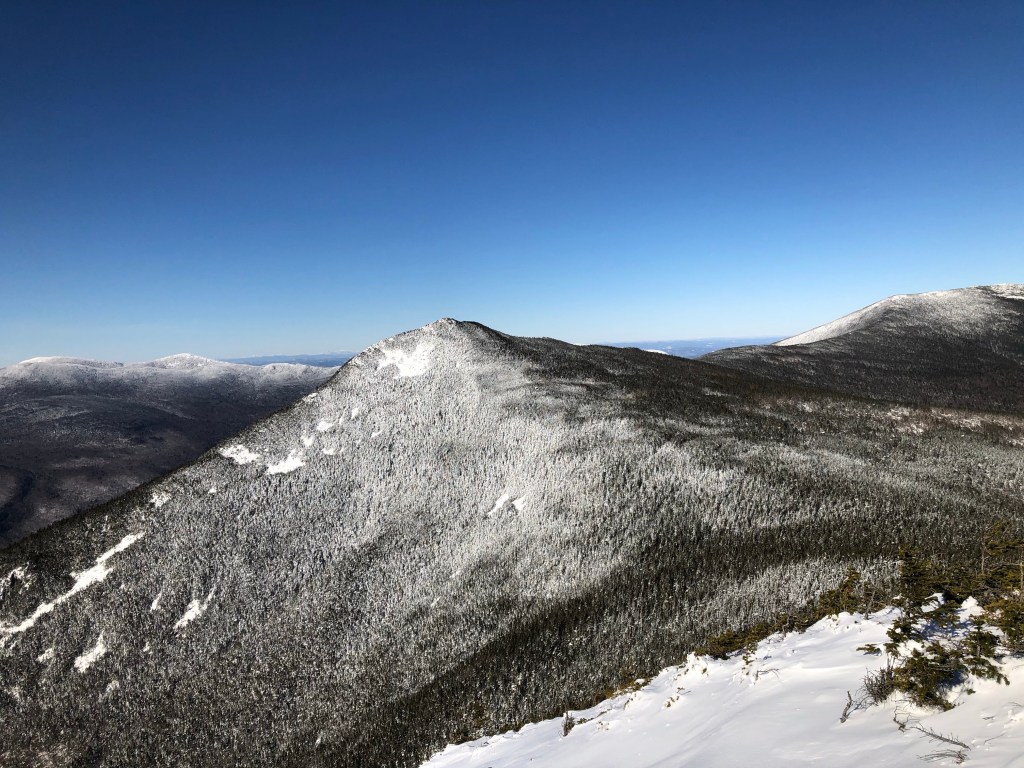
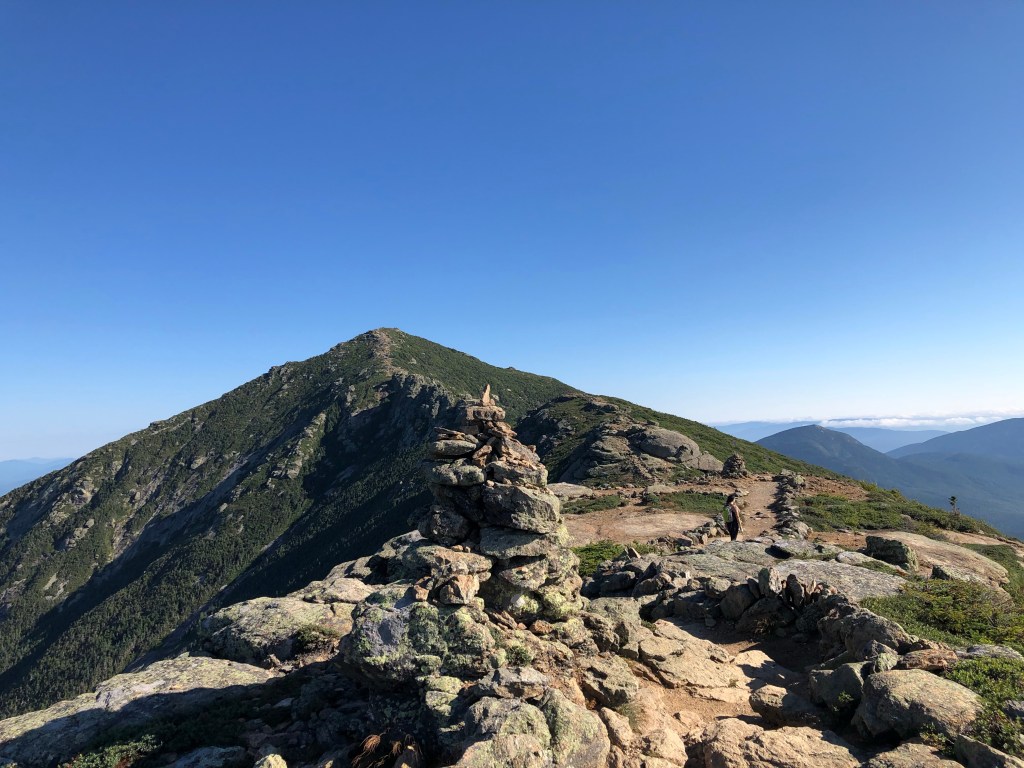
    Mount Liberty, seen from Mount Flume summit
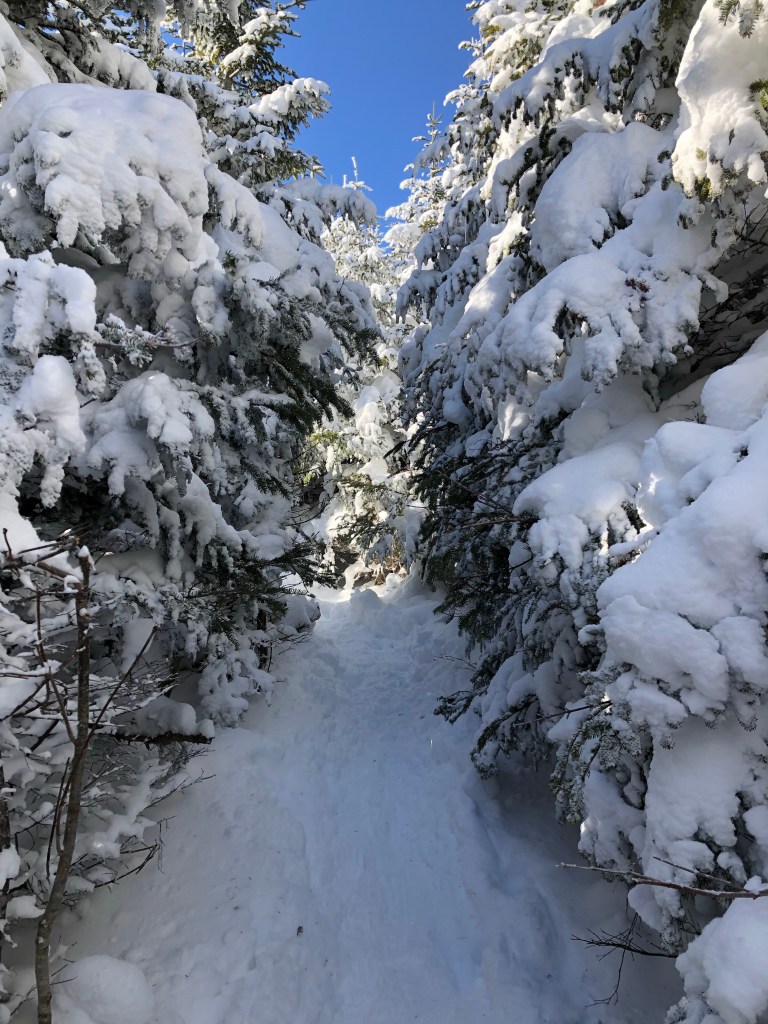
    Trail between the summits was a winter wonderland
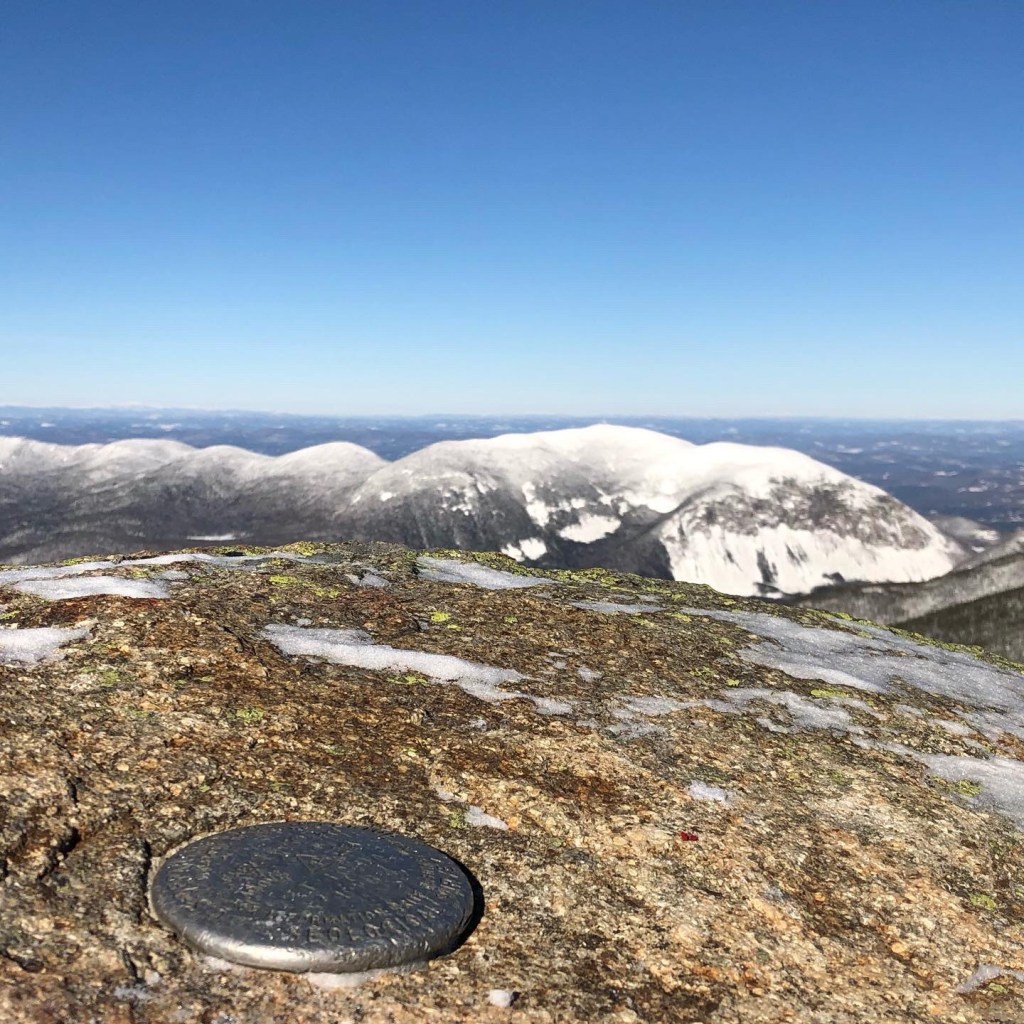
    USGS marker on Mount Liberty with Cannon Mountain in the background
  • The Art of Packing for a Winter Hike

    Contingencies. I pack for contingencies. Most of it stays in the bag, bulging against the sides, weighing the pack down directly onto the hip belt, as designed, and a bit on the shoulders, as is the way. First aid kit, extra warm clothing, extra food, and, it turns out, just enough water for this eleven mile trip. Snow demands micro spikes, but also snowshoes. Mine spent most of the day strapped to my backpack, but I gave them a try for about an hour of hiking before strapping them back on the pack. The compressed snow and narrow trail made wearing them more hassle than salvation. Sometimes you try out your contingencies and realize that you were better off with the original plan. But I do love those heal lifts on steep inclines.

    It was -4 degrees Fahrenheit at the start of my hike this morning. Most layers packed as contingencies went right on the body for the start of the hike. Snow has a way of being crispy and slippery when you dip below zero. And the trail we started hiking wasn’t the same trail we descended when the sun rose and warmed temperatures into the twenties. Having the right footwear and accessories is essential when you see swings in temperatures like that.

    Still, for all the contingencies planned for, most everything stayed in the pack. Sleeping pad, extra layers, way too much food, all of it mocking me on the steepest parts of the incline and for most of the descent. But as soon as you don’t pack it you know what’s going to happen. Yeah, contingencies, especially in winter, must be a part of your kit. You’ve got to have a winter pack that can handle all the extra stuff, provide tie downs for the snowshoes, and remain an afterthought for the duration of the hike. For day hikes I’ve settled on an ULA Photon pack, which offers everything I need and the space for those extras.

    Winter hiking in New Hampshire offers plenty of beautiful moments. Moments that serve as exclamation points on the trip and in your life. But winter can offer up stunning beauty and calamity quite rapidly in the White Mountains. Mother Nature doesn’t care about your feelings. You must be prepared for whatever she throws at you. And that’s what contingency packing is for. Sure it mocks you when it never gets used, but it also assures you that it will be there for you if you need it.

    The next blog post will cover the actual hike. Memorable, incredibly clear, and two more 4000 footers checked off. Stay tuned, there’s a lot to cover.

  • In the Grace of the World

    When despair for the world grows in me
    and I wake in the night at the least sound
    in fear of what my life and my children’s lives may be,
    I go and lie down where the wood drake
    rests in his beauty on the water, and the great heron feeds.
    I come into the peace of wild things
    who do not tax their lives with forethought
    of grief. I come into the presence of still water.
    And I feel above me the day-blind stars
    waiting with their light. For a time
    I rest in the grace of the world, and am free.”
    – Wendell Berry, The Peace of Wild Things

    The iPhone is a blessing and a curse, for all that it brings. Sometimes you want to be away from the made up frenzy of short traders and politicians and debates about which quarterback is best (long since answered).  Great for a picture and for safety in a pinch, but best left stowed away the rest of the time. I used to post pictures while I was still on the summit of a mountain, for that we’re here! moment. But the act of posting takes you out of the moment, and so I leave it be until later in the day locked in as a memory of what was. #saveitforlater

    Walks outside in quiet places serve the body, but mostly the mind. Free from the frenzy we create for ourselves. One notification at a time, relentlessly poking a hole in your soul. What have we done to ourselves with all of these pings and vibrations? Pavlov couldn’t have dreamed up a more diabolical experiment in self-torture.

    “To go out of your mind at least once a day is tremendously important. By going out of your mind, you come to your senses.” – Alan Watts

    The wind shakes the house and reminds me to bundle up. January days are short in New Hampshire, so you’ve got to get creative with your time in the grace of the world. The edges of the day work, and sometimes, dog-less as I am at the moment, late night star-gazing walks with a flashlight or headlamp to fill in the blanks and keep stray cars at bay.

    I’ve learned to pause longer. To fill the void with more silence. To quiet the mind and seek out small pockets of stillness. Time flies by anyway, but it feels like yours once again. Isn’t it, in the end? Step outside. Find the stillness. It’s out there waiting for you.

  • Packing a Winter Day in Maine

    Some days nothing much happens. That line a day summary looks very long when you sat in your house all day. Other days you jamb ridiculous amount of activities in a relatively short number of hours. Those days you flop down on the chair, exhale and assess. And that’s where I find myself today.

    The morning started with a snow squall and limited visibility that bordered on return home and wait it out intensity. But the radar showed it tracking away from where we were heading, so we pressed on. Sure enough, the snow soon disappeared and we settled into a normal early morning drive. Destination? Mount Agamenticus in York, Maine.

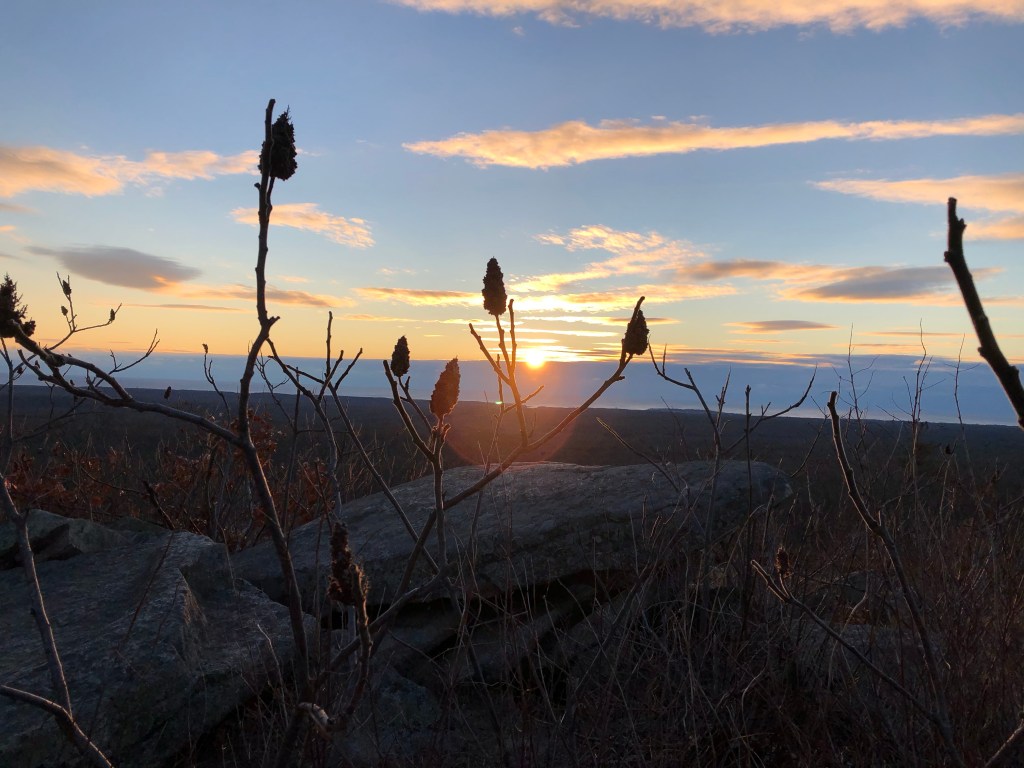
    Sunrise on this mountain top has been covered here before, I know. But we were heading to Maine anyway, so a quick hike up an old mountain for sunrise seemed like a good idea. And really, outside of the biting wind chill at the summit it wasn’t a bad way to subtract an hour of sleep from your morning.

    Next stop was breakfast at a family restaurant called Lucky Loggers in a Saco, Maine strip mall. This is the kind of place that Google searches are made for, and with 4 1/2 stars it was a no-brainer for a half dozen frozen early risers. Mission accomplished: they thawed out the group, filled our tanks full of goodness and bolstered the spirit for the next highlight in a packed morning: waterfalls.

    Hidden away amongst the touristy businesses lining the roads in Saco is a small parking lot in a stand of hemlock trees. This is the parking lot for Cascade Falls, a 20 foot wonder wedged in between granite and forest. There’s a sign that says this particular spot doubled as the Yukon in a 1930’s silent movie. It’s a lovely spot, even with large fallen trees partially obscuring the falls. On a cold January morning, ice lined the edges of the falls and the brook downstream. If you didn’t know you were in Saco you’d think you were deep in the White Mountains.

    After Cascade Falls, we drove up to Portland to see Jewell Falls in the Fore River Sanctuary. As advertised, it sits right in the middle of the city, and is a pretty little waterfall that must be really impressive when the water is running high. I’m grateful for resources like New England Waterfalls for pointing out this little gem I’d never have found on my own. For all the trips I’ve taken to Portland, I’d never known about Jewell Falls. Waterfall number two in the books, we turned westward for our third and final waterfall of the morning.

    Jewell Falls

    Waiting behind door number three this morning was Steep Falls in Standish, Maine. This was the toughest of the three to find, but featured the powerful waters of the Saco River dropping six feet into a churning pool on its way to the sea. This is where a resource like New England Waterfalls really becomes invaluable. Without it I’d never have seen this place in my lifetime. Even with the book it took a few minutes to figure out where the falls actually were. But upon arrival, we were all thrilled with the performance.

    Steep Falls, Saco River

    So there we are, three waterfalls in a small triangle in coastal Maine. We happened to do them in the order they were listed in the book, but that was coincidence. Having visited a number of waterfalls from the book before and since purchasing it, I can confirm the value of the book and recommend picking it up if you want to start your own New England waterfall adventure.

    So how do you cap a morning like that? With a beer with friends followed by a visit with a new puppy in the extended family. Driving back home we saw the sun setting over the Merrimack River and realized it was a very long day indeed. But so full of small adventures and memories. Another day in New England winter, but packed with more than the average.

  • Getting Lost With Waterfalls

    The day started with heavy, gusty rain. The kind of rain that would be a nor’easter had it been snow. The kind of rain that makes you glad you’re indoors looking out a window at it. And paradoxically, the kind of rain I wanted to be outside fully alive in. There’s an edge to any storm, and this one was abating just enough to prompt me to pursue a micro adventure or two. I packed up my rain gear and a water bottle and headed out to visit waterfalls.

    First stop was an hour from home, at Willard Brook State Park in Ashby, Massachusetts where the beautiful Trap Falls pour forever over granite ledge. This is a popular spot in the warmer months, but on a rainy Saturday in January I was the only one there. The falls were roaring from the rain, and easily heard from the small parking lot. A brief, shuffling walk on a few slippery spots and I was quickly at the falls, and thought it might be a trick. How could I have this all to myself on this day when the falls were screaming for attention? The answer lies in that moment when I looked out the window and decided I ought to go out in this weather, while the rest of the world thought that would be a crazy idea. Score one for the crazy folk.

    Trap Falls

    A few pictures and rock scrambles later, I headed back to the car and consulted the maps in Greg Parson’s excellent resource New England Waterfalls, which I’d picked up as a gift to myself while purchasing a gift for kindred spirits. Parson’s recommended a cluster of waterfalls just over the border in New Hampshire. I looked at two in particular as promising and plugged in their coordinates in my Waze app and headed off for more adventure.

    Driving towards Milford, New Hampshire, I decided to focus on Lower Purgatory Falls as my first choice, and sought out the trailhead on Wilton Road. The trailhead displayed some icy conditions and I brought my micro spikes with me for this hike. I would soon be grateful for having them.

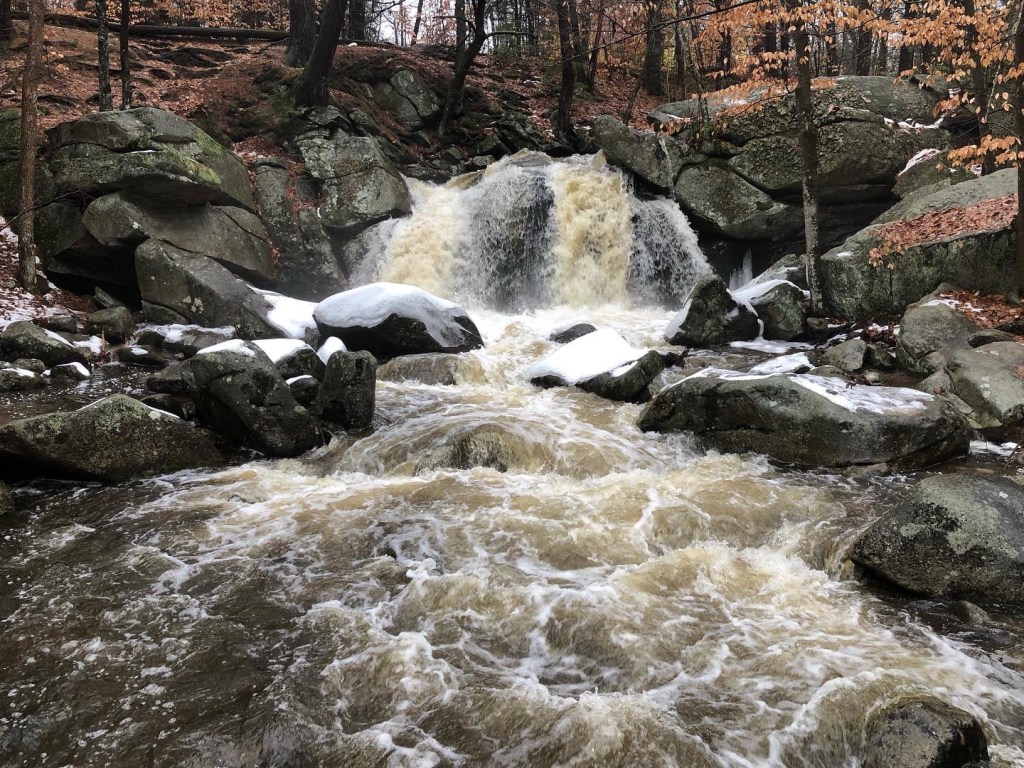
    The walk from the road to the falls is roughly half a mile. Nothing too crazy, really, just an old logging road that carries you to a yellow-blazed trail. And like Trap Falls, you could hear Lower Purgatory Falls well before you got to them. The falls are named for Purgatory Brook, a beautiful stretch of water that was white water after all the rain. Cresting a small rise, I saw the falls ahead and worked my way down to see them.

    And this is where the micro spikes were absolutely required. I was hiking solo in isolated conservation land on a day when nobody else thought it logical to be out there. A slip and fall would have been bad news. Micro spikes remain one of the best hiking investments I’ve ever made, and they offered a clear return on investment as I made my way down an ice covered hill with wet roots and rocks making up the better footing.

    Lower Purgatory Falls is a triangle-shaped wonder set deep in the woods of the aptly named Purgatory Falls Conservation Area. After the heavy rains and melt-off the falls had a lot to say, and I lingered by them for a bit to tap into their energy. Again I wondered why I was the only fool out there on this day, but I’m grateful I never came to my senses and stayed home.

    Lower Purgatory Falls

    As I was leaving the car I took a picture of the trail map supplied in Parson’s book. It indicated I could hike upstream to see Middle and Upper Purgatory Falls. The trail seemed clearly blazed in yellow and tightly followed the brook. And so I made my way upstream seeking more adventure. I found it.

    Hiking along the swollen brook, there were a couple of spots where it flooded over the trail, making for sketchy crossings. Not plummet into a frozen brook sketchy, for I’m not that crazy to attempt such things, more water deeper than your boot is tall sketchy. I made a few calculated crossings, trail blazed in a couple of spots, but always stayed safe and kept the yellow blazes in sight.

    Mossy Erratics
    Purgatory Brook, swollen with rainwater and melt-off

    Eventually the trail dead-ended at a development with a port-o-potty announcing “progress”. I silently cursed the abrupt ending to the trail, looked around to see if I’d missed it diverting elsewhere, and doubled back towards Lower Purgatory Falls, crossing anew the sketchy water crossings I’d already attempted.

    And here’s where it got interesting. I returned to the spot where I’d first seen the falls, looked left and right and saw yellow blazes going off in different directions. WTF.

    “Make sure to return on the trail you came in on as there are several official and unofficial paths in the area. Look for the yellow blazes and the junctions you passed through on the way to the falls originally.” – Greg Parsons and Kate Watson, New England Waterfalls

    Well, this is where I went wrong. I took the wrong yellow-blazed trail towards what I thought was a return to my car. After a few minutes of walking I was aware that I didn’t recognize any part of this trail. I doubled back and saw a logging road I’d ignored before and started following it until it dead-ended. Damn. And this is where you make choices deep in the woods. I could blaze my own trail through the woods with the compass on my cell phone, a picture from a book and Google maps as my guide, or I could double back once again and find the right trail. I’ve learned to trust my instincts in such situations, and not trust a phone battery. I doubled back.

    Finding a junction in the trail, I saw the yellow blazes once again splitting off in two directions. Who the hell blazed this land?? I stuck with the more worn trail and followed it to a place where (surprise!) I’d been before. It seems I’d followed the yellow blazed loop back around onto itself. And this is why bringing a compass and a reliable waterproof map is essential. Having neither, I relied on my experience in similar situations and kept my head about me. Since I was back on a trail I recognized, I simply followed it back to the Lower Purgatory Falls. Once there I saw immediately where I’d gone wrong and followed the correct yellow-blazed trail back to the logging road and eventually to the trailhead. Phew!

    This adventure started off as seeking a few waterfalls on a wet day. It became a small test in orienteering in unfamiliar woods on a wet, disorienting day without the proper equipment. And it ended with me deciding that two waterfalls were enough for one day. I thanked my wits and good fortune and headed home. The other waterfalls will have to wait… for now.

  • Doing More

    “The world as we have created it is a process of our thinking. It cannot be changed without changing our thinking.” – Albert Einstein

    Change happens slowly, one habit reinforced at a time. Some reach 10,000 views in one post, but most of us chip away for a few years of daily writing to get that first 10,000. Tolstoy filled War and Peace with 587,287 words. By that standard I’ve got a ways to go. I’ve only published 401K.

    Diet, for all intents and purposes, is one morsel shoved in your mouth to the next. You want to eat better? Don’t make an exception for that tasty treat you’re eying. Want to get fit? Move more, and more consistently. Simple, right?

    We all have reasons for the habits and beliefs we linger in. Life is a grind, after all. Sometimes the best you can do is walk to the refrigerator to see what inspires you that day. The world, as we’ve created it, can eat you up.

    Yesterday was a great day to be outside in New Hampshire, and I took full advantage of that with a hike up Mount Jackson. A hike like that, with friends and on a beautiful winter day, leaves a mark inside. It reinforces who you are in some ways, but alters your thinking as well. Standing on the summit of Jackson and looking up at Mount Washington, I thought it well within reach. I’ve climbed Washington before, but not lately. Looking up at Washington yesterday, cold breeze chilling my sweaty clothes, I thought it possible to do more.

  • Hiking Mount Jackson (New Hampshire)

    Too many weekends since I last hiked to a summit. Basically, I skipped December for the holidays, and was feeling the built-up restlessness that comes with knowing you’ve got things to do. I’d planned for Hale, but latched on to other’s plans for Mount Jackson for the views and banter of friends.

    Mount Jackson is a popular trail. We started early, meeting friends at the trailhead, but not early enough and parked along the side of Route 302. The out and back trail is roughly five miles of moderate hiking, with a short scramble towards the summit. Micro spikes were a requirement with a healthy dose of exposed ice and a couple of (frozen) stream crossings along the way.

    The straight path up Mount Jackson is via the Webster-Jackson Trail. That’s the trail we took, and judging from the compacted snow on the trail, so do most people. The day started overcast at the trailhead, but it was one of those hikes where you walk into sunshine, and like a jet bursting through the clouds, we emerged from the tree line to find bright sunshine and undercast in the valley below. Incredible views of Mount Washington and the Presidential Range greeted us, along with a few hungry Gray Jays looking for handouts.

    Mount Jackson is named for a geologist named Charles Thomas Jackson who completed a geological survey of New Hampshire in 1844. According to Wikipedia, Jackson seems to have been a somewhat controversial figure in his time, with a pattern of taking credit for discoveries others made. His brother-in-law was Ralph Waldo Emerson. For those who can’t get enough information on Charles Thomas Jackson there’s a wealth of information on Jackson in an article published by The State of Maine and while doing a bit of research I saw that the Bangor Daily News just published a small bit about Mount Jackson a few days ago. Apparently I’m not the only one wondering about why they’d name the mountain after this particular character, but based on his controversies he probably just named it after himself and nobody challenged it.

    After a lunch on the summit we started our descent, with plenty of butt sliding mixed into the walk back. A couple of side trails made for interesting views, we spent a few minutes at Bugle Cliff, but opted out of Elephant Head. After the stunning views on the summit maybe we were a bit spoiled.

    On the descent a couple of us hiked down to the Silver Cascade, which is very popular near Route 302 but involves some sweat equity further upstream. The small falls we saw were worth the side trip, with blue ice putting on a dazzling display for the two of us that sought it out. Waterfalls change by the day, and even though most of our party had seen them before I was still surprised more people don’t make the trek down. I’ll never turn down a side trip to a waterfall with kindred spirits.

    I’d circled this weekend in hopes of trying out my new Tubbs snowshoes. They’re a huge upgrade over the snowshoes I used to have, but we just haven’t had the snow accumulation to give them a workout. With the compacted trails today wasn’t the right day for them either. But that didn’t make the day disappointing. It turned out to be a spectacular way to spend a beautiful and cold Sunday; time with the closest of friends, relatively easy hiking and another summit checked off on the 48 New Hampshire 4000 footer list.

    View of Mount Washington
    Gray Jay looking for handouts
    Micro Spikes required
  • Mountains

    “the mountain before you
    is just a symbol

    what you climb
    step by step
    is yourself”
    – Kat Lehmann, Small Stones from the River

    I was going to save this poem and the one that follows for hiking days, for they obviously pair well with trail work. But then I thought to myself that life is a climb all its own.

    Thinking smaller, the year is also full of challenges and wonder, mingled together like four souls coexisting in a house next to the woods hoping the Internet service measures up today.

    “a mountain
    becomes smaller
    the longer it is climbed

    by the time
    the summit is reached
    all that remains
    is a valley”
    – Kat Lehmann, Small Stones from the River

    On some hikes, the return back to the car is far longer than the trip to the summit. How does that happen on an out and back hike? One way is discovery and anticipation. The other is reflection and seeing the same things from a different perspective. Shouldn’t we marvel at them both?

    The answer lies in summiting. And then turning back. We’re never the same, are we?

  • 20 Days Left in 2020

    Today there are twenty days left in 2020. What are you going to do with those twenty days? The other 346 tumultuous, maddening days of this year are behind us. All that’s left in this year are twenty days and it will be a memory stacked with all of our other memories. So what will we make of them?

    Time isn’t our friend, my friend. With so little time available in our productive lifetimes, deciding what you will finish, what will define your time here, is in itself life altering. Boiled down even further (since time isn’t guaranteed anyway), deciding what you will finish in a year, a month, a week and, you guessed it, a day lends urgency to the most mundane of tasks. Luckily for us, twenty days is a small enough sample that we can wrap our minds around it.

    What are you here for anyway? Decide what to be and go be it, as the Avett Brothers would suggest. And as the days shrink into the dark nuggets of December days and we round the corner into the New Year, what are you going to do with that precious time anyway? Finishing more seems a good answer.

    For me that means work goals, final chapters in several books, fitness goals and places to be. Everything else is time with loved ones. That’s more than enough to focus on as we hit the home stretch.

    Final Chapters
    I’ve got a stack of critical reading to finish. Seven books in all, that I’ve mentally noted as my finish in 2020 books. For all my complaining about my tendency to bounce around between books, I’ve made steady progress despite it all. If you’re the average of the five people you hang around with the most then raising that average with the authors of exceptional books is a worthy use of limited time. Notably, I’ve set aside some other books that I’ve chosen not to finish. Life is full of compromise. Just make compromises that will still move you forward.

    Fitness
    Stretching your mental boundaries through reading is one thing, but we can’t let our bodies waste away in the meantime. Worthwhile fitness goals force the issue of how you spend your days. I’ve accepted a rowing challenge from old college friends. And so I’ll be spending more of that precious time rowing a few hundred thousand miles in preparation for the moment of truth: 2000 meters for time. Nothing focuses the mind on the task of getting in peak shape like a 2000 meter row on a Concept 2 Rowing Ergometer.

    Places to Be
    Getting fit is great, but I’m an outdoor creature at heart and I can’t very well spend my entire winter indoors rowing. As luck would have it there are worthy places to go and things to see within reach in a year where travel is prohibited. Hiking trails, mountain peaks, waterfalls and long stretches of sandy beach with no footprints on them in winter are all waiting patiently for you. Lonely sites of historical significance with ghosts waiting to whisper to you. All outside the door and a short drive away. Forget binge-watching, try binge-doing.

    Only twenty days left in the year. A power twenty, as rowers would recognize: twenty at maximum effort to pull ahead. Not all that much for a year we’ll surely never forget in our lifetimes. Why not make something positive out of the last twenty? Twenty powerful days to finish this year, and to set ourselves up for a brighter future.

  • Hiking Mount Moosilauke

    I’ve heard about this mountain from several people. Popular because of the great payoff in views and experience for the amount of energy expended compared to other trails. I’d even heard about the Dartmouth Lodge at the head of the trail we were hiking. But you forget what you’ve heard before when you see such places. It served as another reminder that you must get out and see for yourself wonders in this world while you have time.

    There are several trails up to the summit. I’d highlighted the Beaver Brook Trail as one to do based on the cascades there, but with the gimpy ankle my hiking buddies chose an easier trail for this day. The warnings about the Beaver Brook Trail certainly discouraged trying it on an icy day like yesterday. Here’s a typical warning from the AMC: This trail may be extremely dangerous in icy conditions. Okay, got it. Instead we hiked the Gorge Brook Trail out and back. Easier, beautiful, and comparatively free of the ankle-busters you experience on most White Mountain trails.

    Ultimately, this hike made me feel better about the progress of my ankle as it wasn’t a factor. It also made me feel better about the progress of my fitness as the rowing has improved my stamina enough that I didn’t feel winded chasing jackrabbit hikers up the trails. Granted, this was an easy trail and they were likely taking it easy on me.

    Yesterday was several hikes in one. The lower section was wet and a bit muddy in places. The snow started accumulating on ice at higher elevations and prompted us to slip on micro spikes for crunchy hiking. The wind became a factor above tree line. Layers were added and thicker gloves went on. And then on the descent the micro spikes became leaf catchers and clumped up enough that we all opted to stick them back in the packs.

    Moosilauke means “bald place” I’m told, and the summit is fully exposed as advertised. What isn’t guaranteed when you hike is the view. This one would be socked in with fog and snow. No matter, for views are a notable bonus, but hiking the trail to the summit is the goal all along. I’ve got this one on my short list of summits to return to again on a clear day.

    Socked-in summit
    Foundation at summit
    In-between season where there’s snow but still exposed rock
    Snowshoe Hare (see yesterday’s post)
    Rime ice and snow frosting