Category: History

  • The Loyalty Building

    In Milwaukee, Wisconsin there are plenty of fascinating things to see, ranging from the strikingly gorgeous Milwaukee Art Museum to the time machine Bronze Fonz statue to the exceptional German food and beer scene. But beyond all of that, there’s a gem hidden in the most unusual of places that most tourists would never see. Unless, of course, they stayed there.

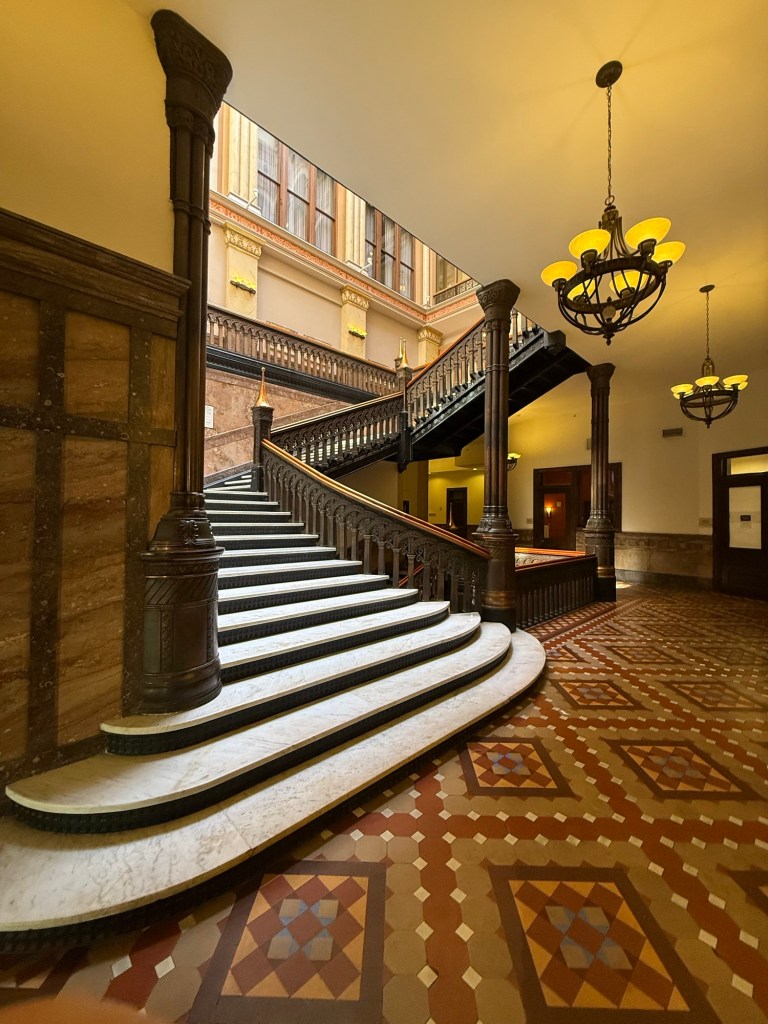
    In the late 19th century, the Northwestern Mutual Life Insurance Co. had commissioned the construction of a Richardsonian Romanesque building designed by S.S. Beman. That building, known as the Loyalty Building was completed in 1886 and is now both a National Historic Landmark and the most beautiful and unique Hilton Garden Inn I’ve ever been in.

    The building was built of Maine and Indiana granite, with arches and modern features like dual-lighting (gas and electric!), heating and an innovative cooling system. A massive glass ceiling lets in tons of natural light, and the floors feature terra cotta and terrazzo tiles in intricate patterns. Honestly, you don’t know where to look there’s just so much to see!

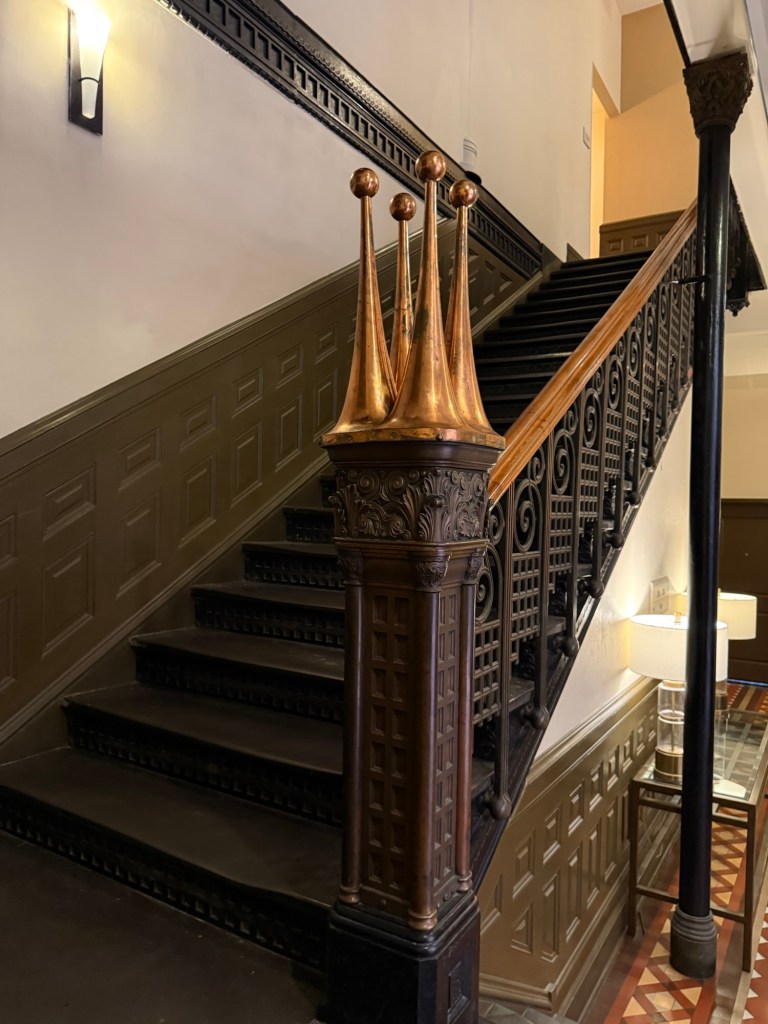
    But then you see and know. The star of the show is the staircase, with cast iron balusters and bronze newels topped with tall copper inverted cone-shaped finials. It’s those finials that catch your attention—that’s a lot of copper sitting their marking time. Those cones made it through the Great Depression and two world wars. And it’s the story of their survival that is most interesting of all.

    During World War II, copper was in short supply and being scooped up and thrown into the war effort all over the country. The building’s owner at the time, not having the heart to see the copper finials melted down, painted them black to escape notice. They stayed that way, forgotten it seems, until the 1960’s when they were uncovered for the world to see once again. And all you have to do is step into the Hilton Garden Inn in Milwaukee.

  • Following the Rhode Island to Bermuda Thread

    We stayed on St. David’s Island this week while we were in Bermuda. It wasn’t a conscious choice to stay there, but I’m pleased we did, for otherwise I don’t believe we would have gotten there on this particular trip. When I speak of conscious choices, I want to acknowledge that unconsciously I knew the connection between New England and Bermuda. In particular, between Rhode Island and St. David’s Island. Not simply the famous sailing race, but the historic slave trade. Bermuda was the destination for many of those “problematic” Native Americans who were being crowded out by waves of settlers changing the landscape of North America.

    One generation after the Pilgrims were saved in their first brutal winter in Plymouth, their saviors’ offspring were fighting for survival in what became known as King Philip’s War (1675-1676). King Philip was the English name for Metacomet, Chief of the Pokanoket, who’s seat was in Mount Hope, Rhode Island. The direct descendants of the Pokanoket are the Pocasset Wampanoag Tribe. When Metacomet was eventually tracked down and killed, ending the war, his wife Wootonekanuske and their son were sold into slavery in Bermuda, meeting the fate of many other Native Americans. Mother and son were separated on the island and lived out their lives as slaves. The son was said to have been on St. David’s Island.

    What seems completely separate is often connected in ways we don’t always understand. Our histories all blend together at some point, sometimes generations later. The story of humanity is tumultuous, tragic and beautiful all intertwined as a tapestry. One thread leads to the next, and we are one. We are forever learning, forgetting and relearning those connections. In a place called St. David’s Island, or in Bristol, Rhode Island, we find those threads and are reminded that our stories will forever be one and the same, even as our outcomes diverge.

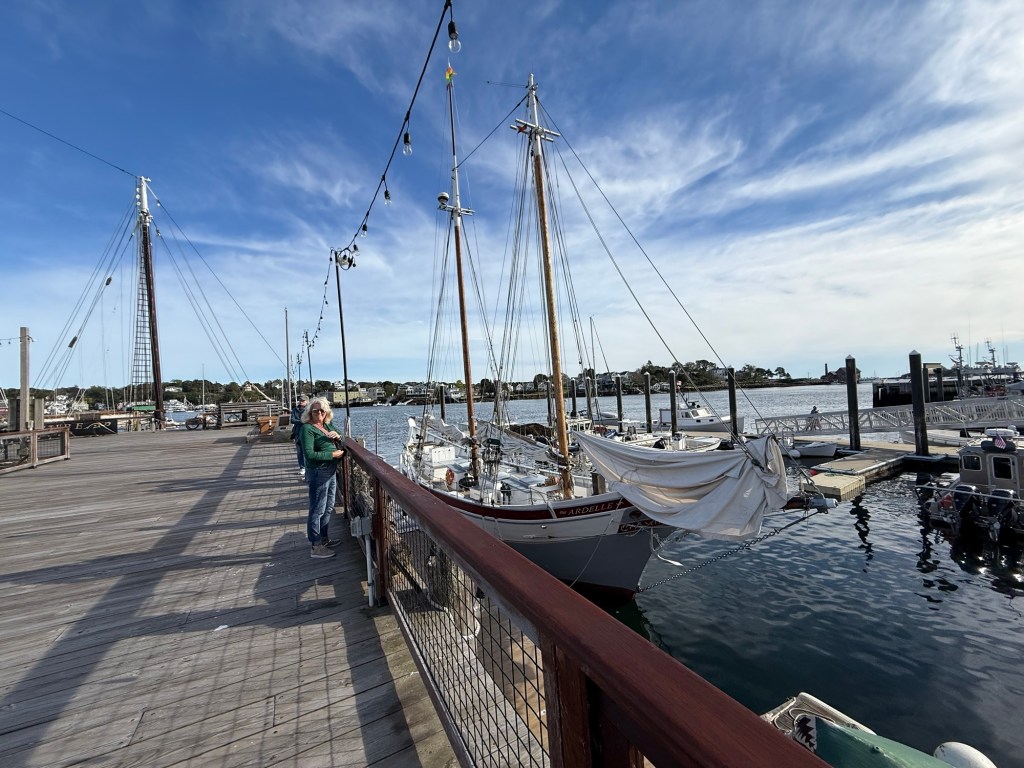
    Smith Island, as seen from St. David’s Island, looks a lot like Bermuda in its earliest days might have looked. An active archeological dig is uncovering English settlement in this part of the island.
    The rugged point of St. David’s Island near Fort Hill Bay, with Nonsuch Island seen to the left
  • Quo Fata Ferunt: How Fate Created Bermuda

    The normal way to cross the Atlantic east to west is to go south to the Canary Islands and catch the trade winds over to the Caribbean. But what should one do when the two end points are controlled by hostile forces? The answer for the British in 1609 was to sail the route north of the accepted route to avoid the Spanish altogether. And this led them to fate.

    The Sea Venture was the lead ship in a small flotilla resupplying Jamestown, Virginia. They ran into a major storm and the ships got separated. One ship sank with all souls lost, and the Sea Venture was foundering, taking on dangerous levels of seawater after the chalking between the ship’s timbers failed. And then by some miracle (that northern route), they spotted land. Admiral Sir George Saunders attempted to navigate the reefs to land and the ship wedged into it, saving all hands. They landed, built two ships and continued on to Jamestown. But having discovered it, the British would soon return to found Bermuda and establish another foothold in the New World.

    Quo fata ferunt (“Whither the fates carry us”) is thus an appropriate motto for Bermuda, and maybe for the rest of us too. We cannot control where fate might bring us, but we can accept it (amor fati) and make the most of the moment. Like Bermuda, we may be adapt and become resilient to whatever circumstances arise, and sometimes even thrive for having risen to the occasion.

    Coat of Arms of Bermuda (image: wikipedia)
  • The Unfinished Church

    In St. George’s, Bermuda there is an old church that whispers of its roots. Never finished, never consecrated, it stands as a testament to what might have been. But those whispers from the past are exactly why it’s so very appealing now. We hear the whispers, visit and feel our spirits lifted. Left to the elements, its roof ripped away by a hurricane, the structure became a beautiful revelation. Never finished? This church is exactly what it was meant to be.

  • A World No One Else Has Seen

    “Coming home from very lonely places, all of us go a little mad: whether from great personal success, or just an all-night drive, we are the sole survivors of a world no one else has ever seen.”
    ― John Le Carre, “The Chancellor Who Agreed To Play Spy”, The New York Times, May 8, 1974

    We’ve all heard that we are unique. That fact is hammered home by helpful people throughout our lives. And what is unique but the differences between us anyway? More to the point, we are each going through a life solely our own—experiencing things that no one else in the history of humanity has or will ever experience. That last sentence ought to have an exclamation point (!).

    We owe it to ourselves to document this unique path we’re on in some way, if only to remember who we once were. A journal or log book will do the trick, and so too will a blog. Pictures naturally capture the essence of a moment in time, or at least our perspective of that moment in time. And the collection of stuff we’ve collected along the way gathering dust on our shelves hints at who we once were and what created the current model on display.

    I celebrate the daffodils I planted twenty years ago as much for the time machine they represent to a younger version of me as for the bold announcement that they made it through another winter just as I did. Each project we do represents some measure of the person we were at the time, each brush stroke, each nail hammered home, each brick laid down on a path we’ve walked upon ever since. We are the sum of our days.

    But we know that the bulk of who we are will live and die with us, never revealed to the world. To the world we are anonymous at worst, and a passing fancy at best. That doesn’t make our lives meaningless—rather a blank slate from which we may begin to influence the lives of others in meaningful ways. We are matter, and we may choose to matter, when we apply ourselves to the task. We may thus make a ripple that echoes as identity, even as the puzzle of our life story will forever be ours alone to ever truly know.

  • The Visit

    Early last week, mentally tapped out and in need of consultation, I visited Author’s Hill at Sleepy Hollow Cemetery in Concord, Massachusetts. I’ve been there many times now, and the experience has grown from initial discovery and delight at finding the graves of Thoreau, Emerson, Alcott and Hawthorne in such close proximity to each other to visiting to simply say hello again. In a world full of useless noise, sometimes we find inspiration in the quietest places.

    Thinking it clever at the time, I once brought a water bottle filled with some water from Walden Pond to give Henry another sip. There are no such moments of gimmickry nowadays. Now a quiet nod is enough. They and all of their neighbors do whisper: memento mori.

    And isn’t that enough? They did their part in their time. We may choose to do ours now. One day soon enough we’ll join them in infinity. But now? Now is the time to live, friend.

    “Oh, for the years I have not lived, but only dreamed of living.”
    ― Nathaniel Hawthorne

    “If you have built castles in the air, your work need not be lost; that is where they should be. Now put the foundations under them.” ― Henry David Thoreau, Walden

    “I’ve got the key to my castle in the air, but whether I can unlock the door remains to be seen.” ― Louisa May Alcott, Little Women

    “The voyage of the best ship is a zigzag line of a hundred tacks. See the line from a sufficient distance, and it straightens itself to the average tendency. Your genuine action will explain itself, and will explain your other genuine actions. Your conformity explains nothing. Act singly, and what you have already done singly will justify you now.” ― Ralph Waldo Emerson, Self-Reliance

  • Where Am I?

    “Life is a series of natural and spontaneous changes. Don’t resist them; that only creates sorrow. Let reality be reality. Let things flow naturally forward in whatever way they like.” ― Lao Tzu

    I was prompted to look at an old blog post I’d written back in 2019 because it showed up in my statistics. That one post has garnered hundreds of views, which isn’t exactly Seth Godin numbers, but it was one of the ones that got more traction than most. Historical, introspective and curious. I’d like to think I’m still those things, even if my focus has changed a bit.

    Back then I was traveling a lot more, we hadn’t had a pandemic yet, and life hadn’t thrown a few more gut punches our way. We all accumulate experiences over time—the good, bad and ugly. In general, I liked the way I wrote back then, I just hadn’t experienced the changes that would wash over me yet.

    The thing is, back in those days exploring place, I was asking the same questions I’m asking now: Where am I? What happened here and what can it teach me?

    Everything changes, and so must we. Each experience accumulated changes us in some way minutely or profoundly. It’s like that river analogy, where both the river and we are not the same each time we visit. And flow we must, always having been somewhere, always on to the next, and yet right here in this moment. What have we learned this time?

  • Inhabited by Heroes

    “On whatever side I look off I am reminded of the mean and narrow-minded men whom I have lately met there. What can be uglier than a country occupied by grovelling, coarse, and low-lived men? No scenery will redeem it. What can be more beautiful than any scenery inhabited by heroes? Any landscape would be glorious to me, if I were assured that its sky was arched over a single hero.” — Henry David Thoreau, The Journal of Henry David Thoreau

    There’s always been two sides to America. Those who build on the foundation of freedom and liberty for all and those who would tear it all down and watch it burn. The thing is, we all believe we’re on the side of freedom and liberty—it’s all in how those words are interpreted. And so we all believe our cause is just and dig in for a fight. We aren’t fighting a Civil War in the traditional sense, but a manufactured war stirred up by profiteers and agents of destruction. The country has always had an abundance of grovelling, coarse, and low-lived men (and women!) on both sides who serve themselves first and foremost. Thoreau wrote this entry in 1851, and he would recognize the characters today as descendants in spirit of those he encountered.

    The real heroes strive for consensus and unification. Inclusiveness isn’t woke, it’s a shared vision that those “unalienable Rights” of Life, Liberty and the pursuit of Happiness apply to all of us. This is a dream that extends from sea to shining sea, and yes, across borders—autocrats and oligarchs, racists and “bro culture” be damned.

    These are dark days, and they will grow darker still. We all look around looking for heroes to unite us once again. Look in the mirror, friend. The strength of this country has always resided in our core, where reasonable people with common hopes and dreams reside. And here is where the heroes of the moral core must rise up and seize control of reason and dignity once again. We can’t simply wait it out hoping for better days.

  • Answers

    “Your mind will answer most questions if you learn to relax and wait for the answer.” — William S. Burroughs

    Yes, and how many years must a mountain exist
    Before it is washed to the sea?
    And how many years can some people exist
    Before they’re allowed to be free?
    Yes, and how many times can a man turn his head
    And pretend that he just doesn’t see?
    The answer, my friend, is blowin’ in the wind
    — Bob Dylan, Blowin’ in the Wind

    The world is a confusing mess that we may either work to make sense of or practice active avoidance of. Most of us are somewhere in the middle. I used to pride myself on reading the news every day, and doubled down by watching the news every morning to be informed before I stepped out the door. It was my way of having a perspective on things when asked for my opinion, but also because I thought it was my duty as a citizen to know what the hell was happening.

    Lately, I’ve had an ongoing dialogue with a good friend about which media source is most unbiased. We all should know that they’re all biased, because they’re all hoping for enough traction to be profitable, but which is the best for fair and mostly unbiased information? Those who follow one source for all information are a slave to that source. We must seek information from multiple sources and sort it out ourselves.

    Or not. The historian in me knows the truth is never found in the headlines, but in the stories that come out long after the dust settles. We know certain truths, but we certainly don’t know everything. The lens of time offers true perspective. And even though we see the world burning, even though we may feel outraged far more than we ever believed we’d be outraged at this point in human history, we must separate emotion from the moment and see what happens (while fighting for what’s right in this world).

    We know that those who say they have it all figured out are generally full of crap and trying to sell us something (well, unfortunately, slightly less than half of us know that). Knowing everything is not in the cards. Our answers will come to us in time, if we’re lucky enough to have time, and so we must rely on what we believe to be true for us and set ourselves in a direction that feels right.

    All that said, the historian in me also knows that history is written by the victors, and vast swaths of truth have been swept aside and blown away in the winds of time. We’ll never know the full story about anything, only what we are able to capture and discern. The trick for us in this moment is to ensure that we come out on the other side to bring the truth to the future.

    And that brings me back to the Burroughs quote that kicked us off today. We must learn to quiet our minds and find the answers within ourselves in the context of the times we live in. To be aware of the world is essential for navigating within it, but we cannot forget to turn inward and listen to what our own truth is. And if we find those answers, we may set our compass in a direction that carries us through the confusion and madness in the world to a place we know deep down is right for us.

  • In the Ripple

    “Men see God in the ripple but not in miles of still water. Of all the two-thousand miles that the St. Lawrence flows—pilgrims go only to Niagara.” — Henry David Thoreau, The Journal of Henry David Thoreau

    As a pilgrim to many a waterfall, including Niagara, I know the call of white water. Isn’t it thrilling to experience the power of water channeled into a plummet? Yet Niagara herself is only a fraction of what she was before most of her water was redirected to hydroelectric power. It turns out that I’m keen on productivity too, and appreciate the clean energy even as I wonder what those falls felt like before they were diminished.

    We focus so much on the ripple we’re making that we forget that a pond was beautiful before the splash is made at all. Deep down we know that those still waters may still be here for what feels like eternity, but humans don’t have that kind of timeline. We feel a compulsion to do something in our time. If it any wonder we’re attracted to the ripple?

    Action is thus our call. Sometimes it’s in service of the harvest; productive and purposeful. Often it’s merely busyness for its own sake, as if churning the waters enough will make up for direction. The thing is, it’s no secret that water that’s been churned up is often murky. To bring clarity we must also have stillness. All this busyness in our lives doesn’t lend itself to insight or revelation.

    I grew up in New England, where great mill cities were built with the power of channeled water. In the spring when the waters are flowing quickly it’s not difficult to maintain momentum in the mills. But after the waters recede, the mills have difficulty getting enough power. So the mill engineers built giant reservoirs to help regulate the flow of water for optimal performance.

    We run ourselves dry if we don’t pause now and then and gather ourselves. We must learn to settle into our stillness and see what it brings. We may find our creativity flows far better when we fill our own reservoir. Seeking out balance in this way brings us to sustained productivity and the ripple we wish to make, and also to revelation and purpose, that we may find the right channel for our power.