Category: Learning

  • Cracking the Egg

    I still remember the moment I watched the woman crack the eggs on the countertop and quickly move them into the hot pan to cook.  Swift, efficient and thoughtless.  This woman had cracked thousands of eggs for hundreds of guests, and I was just one more in the line.  She didn’t respond to my pleasantries, just cooked the eggs, slid them onto a plate and mumbled something about having a good morning before turning her attention to the next guest.  She was done with me, but ten years later I’m not done with her.  Or more specifically, the way that she cracked those eggs on the countertop.  Years of awkwardly tapping eggs on the rim of a bowl or frying pan hoping you wouldn’t make a mess of it had been eliminated in one encounter with a surly omelette chef in Niagara Falls, Ontario.

    We all have techniques, life hacks and learned skills that make our day-to-day more efficient, effective and safer.  Most of these we pick up as we march through life from a parent, friend or co-worker.  Some are aha! moments where someone shows you a keyboard shortcut or a way to crack an egg more efficiently, and some are less aha! and more ohhh, now I get it.  Walking on ice is best learned through example instead of trial and error.  When you see someone walk on ice you observe the technique and with practice become adept at navigating your way across a pond or down a driveway.  That doesn’t always keep you from slipping, but it greatly enhances your odds for success.  Learned skills are like spoken word history or fables; lessons passed from person-to-person for centuries.

    I learned how to drive a standard transmission car by learning how to drive a Ford tractor and soon after I took that skill to cars.  Once someone shows you the basics and you practice it a bit the skill stays with you forever, as I learned in Scotland driving a standard on the opposite side of the car with the stick on my left hand instead of my right.  Am I going to win the Grand Prix with this skill?  Nope, but I can comfortably get in a car and drive myself anywhere.  And I can tie a bowline knot, or spin a log to the right spot to split firewood, or know where to step when I’m descending a steep hiking trail, or to blunt the tip of a nail so I don’t split the wood when I drive it.  We all do a million small techniques and skills that we hardly ever think about.  Sometimes I catch myself and think about where I learned that life hack in the first place, and the person who taught me the lesson.  Ripples across time, connecting me to someone long ago when we were both different people.  These ripples I’ll continue to use, and pay forward for others in turn.  Another form of time travel for all of us, connecting the past to the future, disguised as a cracked egg.
  • Sun, Sand and Time Travel

    Friday morning, one last meeting in Buffalo, New York before I turn East and head home to New Hampshire. As I look at the calculated time necessary to get to my appointment I consider two quotes I’ve read this week on our perception of time. It’s a human creation, and as the saying goes, its relative. What is hard and fast is our small blip of “time” on the planet, so best to get to those priorities now. I love this reminder from De Mello of the trick time and the speed of light play on us when we look up at the sun:

    When you see the sun, you’re seeing it where it was eight and a half minutes ago, not where it is now. Because it takes a ray of the sun eight and a half minutes to get to us. So you’re not seeing it where it is; it’s now somewhere else.” – Anthony De Mello

    “As you get older, and the patterns become more obvious, time speeds up. Especially once you find your groove in the working world. The layout of your days becomes predictable, a routine, and once your brain reliably knows what’s next, it reclines and closes its eyes. Time pours through your hands like sand.” – Jedidian Jenkins, To Shake The Sleeping Self

    I’m thankful for travel, for it keeps me on my toes. And I’m thankful for reading so many new perspectives this year that force me to reconsider my perceptions. Time does indeed seem to accelerate as you get older, and this pair of quotes points out that it’s never really what we think it is anyway. So make the most of the moment, for time – whatever it is – is slipping by. All this inspires me to visit a tropical beach again as soon as possible. Where you spend your time counts too.

  • Getting There

    “What got you here won’t get you there.” – Marshall Goldsmith

    Indeed.  But knowing where there is is an essential part of making the shift in the what.  December is a great time to think about then and there stuff, but really every morning you should reflect a bit on where you’ve been and where you’re going.  What went well, what went badly, what can change, what must change…  and how do we begin right now, today?

    Personally, I function better with Bullet Journal type lists.  Check things off, move things forward that you didn’t do, etc.  Lists of tasks are easy.  Lists of life goals are a little harder.  The Warren Buffett/Mike Flint 25/5 exercise is harder still, but time marches on and if you don’t reflect on where you’re going you’re going to end up somewhere else with the things you wanted to do undone.  I did this 25/5 exercise a year ago, and I’m going to do it again this week.  Essentially, you write down 25 things you want to accomplish – start a business, write a book, run a marathon…. whatever.  You then circle the 5 most important goals and avoid the other 20 at all costs until you’ve accomplished the circled 5.  It forces you to focus on what your real priorities are, and what the real distractions are to getting there.  It’s challenging because we all want to be good at everything, but in being generalists we fail to achieve our biggest goals.  Hell yes or no.  Essentialism…  The 7 Habits of Highly Effective People story of putting the big rocks in the jar before filling the rest with pebbles, then sand and then water…  Whatever you want to call it it’s the act of saying no to many things to enable you to achieve the few big things.  And the few big things are the “there“.


  • The Great Repertoire

    I’ve reached a point in my life where I don’t depend on the people in my life for happiness, I’m quite happy whether I’m with my family, spouse, best friend or favorite pet or alone.  Don’t misunderstand:  All of the dancers on the floor with me certainly enhance my life and my happiness in profound ways.  But if experience and a whole lot of business traveling alone has taught me anything, it’s that I don’t require others to be happy.  Does that diminish the value of the people in my life? On the contrary, I believe it highlights that they’re in my life for all the right reasons.  So in reading this magnificent book Awareness, I was jolted by the following:

    “What I really enjoy is not you; it’s something that’s greater than both you and me. It is something that I discovered, a kind of symphony, a kind of orchestra that plays one melody in your presence, but when you depart, the orchestra doesn’t stop. When I meet someone else, it plays another melody, which is also very delightful. And when I’m alone, it continues to play. There’s a great repertoire and it never ceases to play.” – Anthony De Mello, Awareness

    I downloaded the Kindle version of this book after hearing it referenced by both Tim Ferriss and Ryan Holiday in a podcast interview and in a book, respectively.  I read a lot, and have a lot of books to get through sitting in limbo, but sometimes the neon sign points to one you should read first, and this was it.  De Mello passed away in 1987, and this book was published posthumously in 1990, building a passionate following ever since.  I’m taking my time reading it, not because it’s tough to read, but because there’s a lot to chew on.  It’s a lovely and profoundly compelling book, and well worth reading.

    This week I’ll see a lot of family I don’t see enough, while next week I’ll be traveling alone in New York and will only see business acquaintances.  Will I be more happy this week than next?  I don’t think so.  But will I enjoy this week more than next?  That’s highly likely.  This all sounds a bit narcissistic to me, but good God I’m really just not that into myself.  Instead I’m trying to be outside looking in objectively. De Mello shakes away any illusions of grandeur anyway:

    “Have you ever experienced your is-not-ness? In the East we have an image for this. It is the image of the dancer and the dance. God is viewed as the dancer and creation as God’s dance. It isn’t as if God is the big dancer and you are the little dancer. Oh no. You’re not a dancer at all. You are being danced!”

    So there’s a little humility for you as we dance (sorry) with the concept of non-dependent happiness. History and travel are actually easier to write about. They seem less… self-indulgent. Whatever: Make the most of the day at hand, wherever you are and whomever you’re with. Dance with life a bit, otherwise what’s a life for?

  • 2020 Vision

    “No man ever steps in the same river twice, for it’s not the same river and he’s not the same man.” – Heraclitus

    There are just 44 days left in 2019, and with that realization, I’m looking ahead at 2020.  What will the new year bring?  Major political change?  A swing away from nationalistic tendencies towards a global, we’re all in this together outlook?  An acceleration in the economy or a recession? Environment progress or rapid climate change after years of neglect?  A return of common sense and dignified communication or an increase in bitter, antagonistic rhetoric?  I don’t see the future, but I’ll hope for improvement in 2020.  Either way, I do know that change comes whether you want it or not, and it’s best to be as prepared as you can be for when it does.

    So with that in mind, and a look towards the New Year, what’s the mission?  Outside of a vote I can’t control larger political forces at play in the world that may lead to conflict, but I can control my general fitness and health through exercise and better nutrition.  I can’t control whether we go through a global recession in 2020, but I can control how much money I spend and to a certain extent how much I earn.  I can’t control the clickbait, extreme views that pull society apart, but I can choose what media to consume.   If stoicism teaches you anything, it’s to focus on improving yourself, and don’t try to control what the rest of the world is doing.  Step in when you can make a difference, offer support and encouragement, but don’t try to change people.  That’s on them.

    Reading, exercise, writing and travel have done more to improve my state of mind than anything else.  Doing more of each makes a lot of sense, and will help build a stronger foundation as I turn the calendar into 2020.  Looking at the future and assuming you’re in it is a fools game, but not preparing for the future is too.  So building habits that offer value today and long-term benefits tomorrow makes sense.  It’s a win-win when you pick the right habits. Change happens, and building resilience through positive habits helps us survive and maybe even thrive when it does.  So that’s my focus as we march towards 2020, tweaking the good habits and phasing out the bad whenever possible.  Acknowledging my small role in the universe, I’m hoping that occurs on both a micro and macro level.

    Today’s post was directly influenced by The Daily Stoic, providing both the Heraclitus quote and the reminder that we can only change ourselves.


  • Moments in the Light of Eternity

    “To perceive the world in the light of eternity, to accept your death as a gift, to accept suffering as a path toward joy. All of those are in Christ on the cross.” – Stephen Colbert

    I’m not particularly religious, but I do believe I’m a bit player in eternity.  Is eternity God?  Or is eternity timeless energy reshaping itself into various forms like planets and oceans and trees and sunsets and a cup of tea and people?  It’s way above my pay grade to state a definitive answer.  But like most humans I wonder about the universe and our place in it.  If religion helps you sort this all out in an acceptable way, perhaps you’ve got an advantage over me.

    Stoicism cuts to the root of my pragmatic approach to this eternity, but it isn’t a religion as much as a virtuous approach to life.  Common sense laid out by people long dead, who remind us that it’s right around the corner for us too (so you might as well savor every breath and live the best life you can with what you’ve been given).  Stoicism is thinking about eternity without fairy tales.

    But reading this Stephen Colbert quote twice this morning gave me pause.  Colbert lost his father and two brothers in a plane crash when he was ten years old.  He’s Catholic and his faith is the foundation of his life.  I’m Catholic and don’t give it much thought.  We’re both trying to live a virtuous and good life.  So who’s approach is better?  I don’t believe it matters so much as the end result.  Will all my deceased relatives be standing at the Pearly Gates telling me they told me so as I’m shuffled off to purgatory?  You’ll know that answer someday yourself, and you can point out my sin of doubt when you see me.  Religion uses stories to highlight virtue versus sin and the infallibility of God.  Eternity is infallible.  Put whatever name you want on it.

    Colbert talks about the loss of his father and brothers as a gift from God that he didn’t want.  That’s an extraordinary way of looking at a tragic event, but it makes sense to me. We’re all going to die and we’re all going to be challenged by the passing of those we love.  The reality of death won’t change whether we like it or not.  The question is what are you going to do with that reality?  And what will help you find an answer?  His mother’s answer was to look at that moment, as devastating as it was, in the light of eternity.  And whatever you call eternity, that makes sense to me.

  • Be Alive

    Quiet Sunday mornings are precious things.  This first Sunday morning back from vacation with no travel scheduled for the next week makes it even more so. A good time to contemplate picked-up pieces and solve the puzzle … like this Oscar Wilde quote:

    “Nowadays most people die of a sort of creeping common sense, and discover when it is too late that the only things one never regrets are one’s mistakes.”

    Which seems to pair well with this (recurring) observation from Seth Godin just this morning:

    “A few people somehow avoid these lessons [of following the rules school lays out] and become instigators, impresarios and disruptors instead. They’re not only dancing with infinity but completely unsure what’s going to work, and yet they are hooked on leaping forward.”

    There are some bold concepts to shake the complacency here. Most people try to avoid mistakes, but it turns out those mistakes are leaps forward not achieved if you don’t make them. Ironic, isn’t it? Go out on the floor and dance with infinity, or be a wall flower wishing you’d taken the risk. If I’ve learned anything in my time here, it’s that the risks can be mitigated, and the leaps are worthwhile.

    That “creeping common sense” Wilde talks about is something I’ve struggled with. But I smile at the mistakes I’ve made that have moved me forward, if only a little. Following the rules, waiting your turn, deferring to others and knowing your place each serve to bring order to society. There’s nothing wrong with making the bed, holding the door for someone else, driving safely and showing up on time for an appointment. These courtesies help us leap forward too. If you don’t weed the garden your harvest will suffer. But a little bend of the rules, an occasional left turn, a break from the norm and a few more mistakes along the way offer a bit of Miracle Grow in that dance with infinity.

    “… the only things one never regrets are one’s mistakes.”

    Ultimately Wilde isn’t indicting us for not taking risks (we do enough of that to ourselves), but rather, poking us to stop wringing our hands about whether it’s the right time or the right move and to just do it already. There are only so many days in store for all of us, and who cares if it turns out to be a mistake anyway? And I think of an image of a Polish man during the darkest days of World War II begging for his life, hands raised to his chest, seeking to be understood. Next to him are two other men, resigned to their fate, which is about to be the same as the bodies of other men sprawled on the ground. I felt empathy for that guy, who was caught up in a moment larger than himself, only wanting to be understood and to live another day. And he calls to me still, Memento mori! Go on, take the risks. Live your life today, as I myself cannot. Be alive.

  • Stumbling Upon Buried Treasure

    While waiting for a taxi to the airport I scanned the wonderful old books lining the shelves at the London hotel I’d been staying in. I do this often when I have moments like this, it’s where the buried treasure is after all. I saw two books on a shelf at eye level that drew my attention; Two Years Before the Mast, by Richard Henry Dana Jr. and an old collection of English poems. I’d read Two Years Before The Mast several years ago at the recommendation of a friend who’s doing exactly that at the moment. I flipped through it quickly, saw the old stamps indicating it was a library book and smiled. Libraries were where I found most of my buried treasure before the Google and Amazon changed everything.

    To this day my favorite discovery was an old copy of Typee by Hermin Melville pulled at random from a university library shelf in the fall of 1984. I was a freshman then, figuring out this college thing, and fascinated with the vast rows of books I could walk through. I picked up Typee and brought it to a reading nook and read the first couple of chapters, quickly falling in love with this other world. I’d return the book and come back again and again to it in the same fashion until I finished it, never checking it out (sadly not including my name on the stamp), but finishing it nonetheless. That friend who loaned me Two Years Before The Mast in turn took my recommendation to read Typee and now has a boat named Fayaway, a compelling character in the story.

    That other book, the one on poetry? I opened to a completely random page in a completely random book in an old library book stuck on a hotel shelf in London….. so you know; random. And I read this:

    Care-Charming Sleep, thou easer of all woes,

    Brother to Death, sweetly thyself dispose

    On this afflicted prince; fall, like a cloud,

    In gentle showers; give nothing that is loud

    Or painful to his slumbers; easy, light,

    And as a purling stream, thou son of Night,

    Pass by his troubled senses; sing his pain,

    Like hollow murmuring wind or silver rain;

    Into this prince gently, oh, gently slide,

    And kiss him into slumbers like a bride!John Fletcher

    Fletcher died in 1625. Analogies between sleep and dying are common, and Fletcher dabbling with the concept in this poem/song from 400 years ago illustrates that. We all want to gently fall asleep, and given the choice we’d likely all wish the same for our final sleep. Poetry either grabs you or it doesn’t. I haven’t made up my mind on this one, which means it’s the latter. Not everything you pick up in a book is going to be buried treasure. If it were what would be the value anyway? But there’s something to chew on here anyway.

    Two Years Before The Mast was written by a man named Richard Henry Dana Jr. after he left Harvard to regain his health after contracting measles. It’s a fascinating book that illustrates life onboard a merchant ship on a two year journey as they rounded Cape Horn to pick up cattle hides in California to haul back to Massachusetts. Seeing the book again prompted me to read a bit more about Dana, and I was struck by one part of his legacy. Dana Point, California is named after him. I’ve spent a fair amount of time in Dana Point, but never made the connection to the book until today. It seems I found some buried treasure after all.

  • The Great Conversation

    I’m bouncing again, book-to-book, pulling this book off the shelf, scanning over that sentence on the Kindle app, and stacking the pile higher. It’s funny how one thing sparks another thing, it’s what Robert Maynard Hutchins called The Great Conversation, written work building on written work, theory built on theory, across time, but shrunken down to just the books in my personal library. Each offering a little something to keep the imagination abuzz. This morning’s great conversation started with a little stoicism:

    “What’s the meaning of life? Why was I born? Most of us struggle with these questions—sometimes when we’re young, sometimes not until we’re older. Rarely do we find much in the way of direction. But that’s simply because we miss the point. As Viktor Frankl points out in Man’s Search for Meaning , it is not our question to ask. Instead, it is we who are being asked the question. It’s our lives that are the answer.” – Ryan Holiday, The Daily Stoic

    That led me right to the source, and I pulled Frankl’s classic off the shelf for additional perspective:

    “It did not really matter what we expected from life, but rather what life expected from us. We needed to stop asking about the meaning of life, and instead to think of ourselves as those who were being questioned by life – daily and hourly. Our answer must consist, not in talk and meditation, but in right action and in right conduct. Life ultimately means taking the responsibility to find the right answer to its problems and fulfill the tasks which it constantly sets for each individual.” – Viktor Frankl, Man’s Search For Meaning

    Outside I hear the telltale roar of hot air balloon burners. It breaks my focus and I walk outside barefoot to look for the familiar visitors, but all I hear is them announcing “we’re close”. Bare feet quickly turn cold on the pool deck and I move back inside. Shoes are one of our best inventions as a species, but we miss so much information about our environment that is telegraphed through our bare feet (today’s telegraph: put some shoes on you fool, that’s what they were invented for). I glance outside and spot the yellow top of smiley face balloon over the trees and, seeing its landing elsewhere, give a nod of welcome and get back inside to the great conversation. Life is calling, but I have a few things to mull over first.

    “Well, what are you? What is it about you that you have always known as yourself? What are you conscious of in yourself: your kidneys, your liver, your blood vessels? No. However far back you go in your memory it is always some external manifestation of yourself where you came across your identity: in the work of your hands, in your family, in other people. And now, listen carefully. You in others – this is what you are, this is what your consciousness has breathed, and lived on, and enjoyed throughout your life, your soul, your immortality – your life in others.” – Boris Pasternak, Doctor Zhivago

    I read that passage for the first time in 1989, the year I graduated from college, not in Doctor Zhivago, but as a quote from a book by Warren Bennis called On Becoming a Leader. This book, along with Frankl and more recently Holiday’s books, can be thought of as stepping stones in the stream of life, there for me when I needed a solid footing on my way across. And they’re also voices at the table, part of the great conversation happening still. There are hundreds of voices at that table: authors, poets, songwriters, coaches, family and friends. All voices in that great conversation, ripples across time, influencing me in ways subtle and profound. And you’re at the table too. Welcome.

  • Solving the Wren Riddle

    I was clearly wrong. My educated guess was off the mark. My attempts at online research failed. Apps I trusted to point me in the right direction flopped. So it goes.

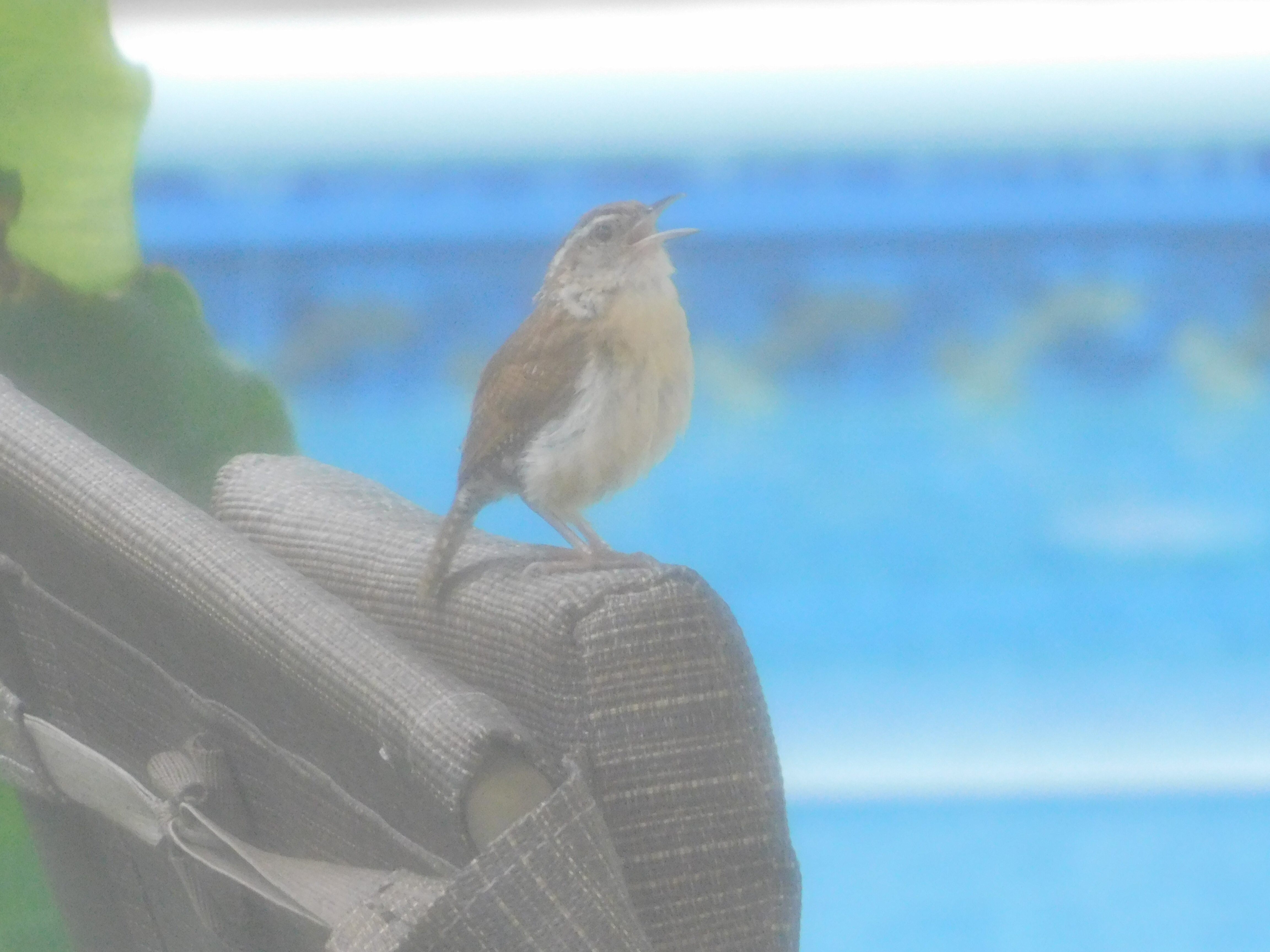
    I’ve written about my attempts to identify a bird I wasn’t familiar with that has moved into the neighborhood. And not just this neighborhood but I’ve heard a similar song on Cape Cod, as if it was following me across the Bourne Bridge, taunting me all along.  After many fruitless searches I’d finally settled on the Brown Thrasher as the most likely candidate, and have referred to the Brown Thrasher ever since.  But it wasn’t a Brown Thrasher at all.  It was a Carolina Wren.

    The Carolina Wren, as the name indicates, is typically seen (and heard) further south of here.  I’ve seen another “southern bird”‘, the Baltimore Oriole, in Massachusetts and New Hamphire, but this was a new song; a song I couldn’t get out of my head until I solved the riddle.  An app that records birds singing and analyzes it like Shazam continually got the wrong answers.  So I tried a different app, and still continually got the wrong answers.  Frustrated, I emailed the .m4a voice file to Chirp, the second app I tried, and they responded within 24 hours with the elusive answer; Carolina Wren.  A quick search online confirmed this was indeed the singer I’d been searching for all season.  It seems the bird song apps use a strong location filter to eliminate matches that wouldn’t normally be found in your area.  And Carolina Wren’s weren’t thought to settle in New Hampshire so Chirp was eliminating it as a choice.  Well, welcome to the Granite State, my southern friend.

    The New York Times recently published an article detailing the decline of North American birds, and followed that with an article detailing birds moving away from natural territory as the climate changes.  New Hampshire’s Purple Finch is apparently considering a move to other climates.  Thankfully the one’s who visit my backyard haven’t felt so inclined as of yet.  But then again, I have this new visitor to my backyard whom I’ve never had before who might be singing that there’s something to this story after all.

    Carolina Wren teasing me with her song, July 2019