Category: Lifestyle

  • Torn Between Two Places

    God it’s so painful when something that’s so close
    Is still so far out of reach
    — Tom Petty & the Heartbreakers, American Girl

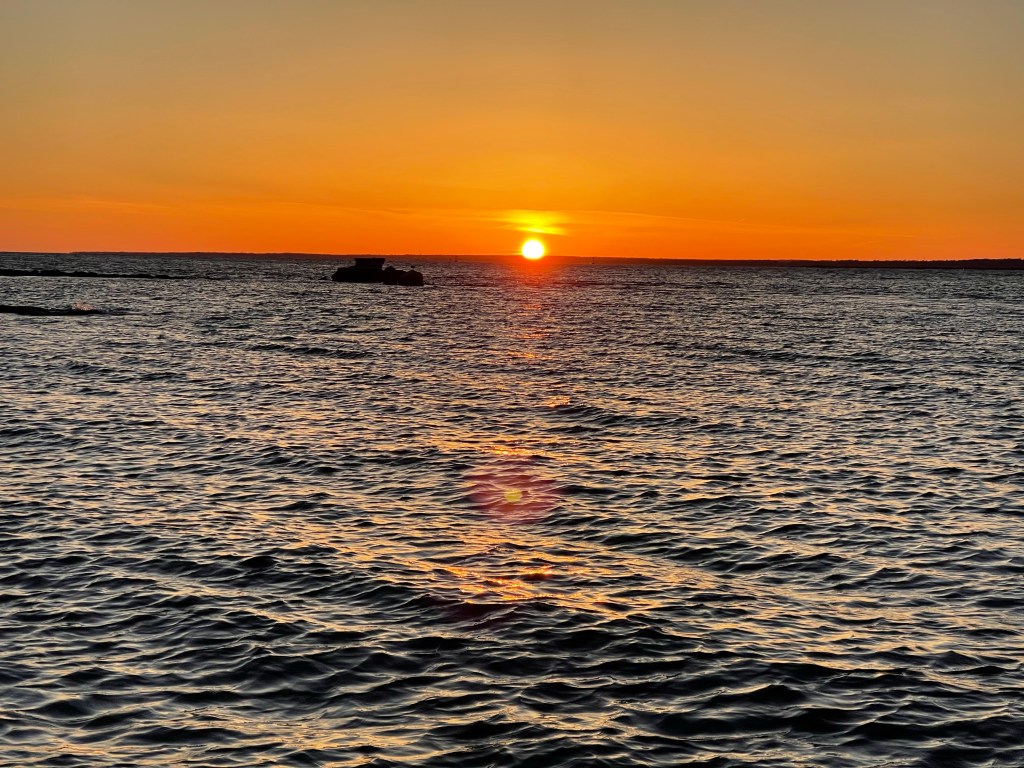
    September conjures up images of red and gold leaves in crisp air. I thought of their possibility while sneaking another swim in water that believes it’s still summer. But what we linger on isn’t always where we are, is it? I reminded myself to savor the water while I was still in it.

    We’re often torn between where we are and where we want to be. Between things we’re comfortable doing and things we’d like to try. It’s a fiendish place; nurtured dissatisfaction with one, with a lingering frustration that the other is just out of reach. We reason with the mind to accept one place, while the other place sings its siren song. No matter, were we to reverse our position, we’d likely yearn for the place we just came from. Such is human nature.

    The space between seems to be the real issue. We can’t have it all, but we dwell on images of places we’d love to be, or parts of our lives we’d love to return to, or maybe run away from. Surely, it’s there in that between where the devil resides. It’s our no man’s land where dreams go to die if we dare wander into it. And don’t we all stumble into discontent at times in our lives?

    All season I’ve been dealing with a garden neglected at the start of the growing season while I bounced around in Europe in June. It never really established itself, then came the drought, and here we are at the end of the season with a sad little garden that’s a shadow of its former self. The garden and I gave it a go, despite it all, and now it will go dormant for the winter before we try again next year. But I wonder, will I be inclined to try again, or leave it for the beauty of another place once again?

    Such are the considerations of an itinerate wanderer with a strong sense of place. Making a go of it here, while thinking about there. With American Girl playing in my head as a soundtrack of this life between two places.

  • Irreplaceable Instants

    “Every instant of our lives is essentially irreplaceable: you must know this in order to concentrate on life.” — André Gide

    Here we go again: another week beginning. Much like last week and the week before, yet we’ve changed. We’ve layered on our moments of insight and irreplaceable instants that root us in identity and purpose, or perhaps left us anchor-less and drifting. Let’s hope for the former.

    The thing is, this week is different from those weeks gone by. It’s surely more tangible and immediate, but more, this one is in our hands. We can’t get too caught up in our previous successes and failures, we can only double down on what works for us. And maybe, try something bold and new.

    I like the idea of micro-bursts: sprints of intensity where you focus on key activities that move you towards your goals. In rowing it was a Power 10, where everyone put aside personal discomfort and focused on making the next ten strokes their very best. It started with a call from the coxswain when they felt the boat needed a boost in momentum. And it nearly always worked.

    Focus on living a bold, meaningful life can start in an instant. Often it begins with a feeling that you need a bit of a boost in productivity or purpose. With the right concentration and effort, like a boat gaining a burst of speed and swing, it nearly always works to reset rhythm and concentration.

    Now seems as good a time as any.

  • Solitude as a Path Forward

    “Society is the cave. The way out is solitude.” — Simone Weil

    We know, deep down, that our way is found in the quiet moments. It’s so easy to be caught up in the expectations and scandals of society, so easy to trap ourselves in the words so tightly shaped around the stories of our lives, that we might never really fly. Yet we must fly, whatever our flight path may be, if we are to get out of that cave. How many countless souls never fly?

    We grow up hearing we might be odd if we aren’t part of the group. As adults we hear that we’re either in the collective party of the righteous or there’s something suspicious and odd about us. To be a part of the tribe we must participate in the rituals of the tribe. And so we all fall in line, find our career path, work to strengthen our relationships, build our bridges, marry up and in, and then have kids and place them carefully into the right environments to maximize their own potential in society.

    There’s nothing inherently wrong with being a part of things. We learn and grow in society. We play our part and find meaning through our connection with others. We meet people who help transform us from what we were to what we might become. We rightfully celebrate our place in society and the people who are woven into the fabric of our lives.

    One might point to the social structure as the clearest way to find our place in this world. We get in the mix, bounce ideas off each other, collaborate, feed off the energy in the room, get a leg up with the help of others, and so on. And indeed, so it is that we thrive in a world built on maximizing the contribution of the individual for the benefit of our collective future together.

    But if there’s a shared secret we all know, it is the critical nature of solitude in finding our own path forward. It’s the voice inside your head saying, “And what of me?” We can’t really make out what that voice is saying until we step away from the din. What we find, if we are so audacious as to listen, is that that voice has a lot to say.

    Is it narcissistic to ask such questions? Parts of society would shout down such selfish ideas. The very idea of contemplation and individuality are reckless and dangerous in many corners of this world. But is it selfish to seek solitude, or selfless to find places to reflect? We don’t run away from society, we stride boldly towards ourselves. The boldest ideas are conceived in solitude.

  • Enjoying the Interval

    “There is no cure for birth and death save to enjoy the interval.“ — George Santayana

    Santayana was a Harvard professor who personally influenced a long list of people who in turn became influential themselves. People like Robert Frost, T.S. Eliot, Walter Lippmann, Gertrude Stein, G. E. Moore, Wallace Stevens and others. So the way he spent his interval seemed pretty substantive and consequential. He demonstrated that we can enjoy our time while also making the most of it.

    So sure, they say that life is what we make of it. But on the surface this feels somewhat simplistic, given the general indifference of the universe towards our feelings on the matter of our fragile egos. Through the fair and unfair, the rituals and routines, the obligations and distractions, the magical and the mundane, we all choose and have choices imposed on us. In the end, or rather, in the interval, it’s all in the way we play the game, despite everything thrown at us along the way.

    Knowing we’ve hit this lottery of birth in our time and place, we ought to be fully aware of this moment and the opportunity it represents for us. I might have written a version of that phrase a hundred times now in this blog. Be assured it’s a reminder to myself more than a call to action for others. A reminder that, in the end, this interval is all we’ve got to work with.

  • What We Will

    “If the world were merely seductive, that would be easy. If it were merely challenging, that would be no problem. But I arise in the morning torn between a desire to improve the world and a desire to enjoy the world. This makes it hard to plan the day.” — E. B. White

    I grow cilantro, not so much to eat it, but to watch bees roll around in the wispy white flowers that wave ever so lightly in the breeze. Surely someone must grow cilantro for all the tasty dishes (or soapy dishes) one might imagine it worthy of, but give me the bees, please. Summer officially ends for me the moment the cilantro peters out—like life itself—entirely too soon.

    The dance between the earnestness of rolling up your sleeves and fixing things versus opening up your heart and savoring all the world offers is a constant struggle. As with everything, we must skate the line between the world of order and the world of chaos, Yin and yang. Nobody said this living business would be easy, but it’s such a short ride we ought to make the most of it.

    Still, there’s work to be done, and no time to waste in solving the world’s problems. As anyone out there trying to get things done knows, there’s just not enough people willing to make a go of it and do the work. Every school, every hospital, every landscaper and construction firm and restaurant is struggling to find a warm body with an eager mind to simply do the work. Who are we to ignore the call? Yet so many do.

    Every day should be filled with a bit of challenge, and a bit of seduction. Every life lived well ends with a measure of satisfaction for the things we did well and a measure of consternation for that which wasn’t accomplished. That’s life, and we must learn to skate that line. In the end, we do with it what we will.

  • Building Upon the Dream

    “Qué lindo es soñar despierto, he says. How lovely it is to dream while you are awake. Dream while you’re awake Andre. Anybody can dream while they’re asleep, but you need to dream all the time, and say your dreams out loud, and believe in them.” — Andre Agassi, quoting Gil Reyes, Open: An Autobiography

    I detected movement in the pool, a light ripple that telegraphed swimming. Walking over to see what was generating the ripple, I saw a mouse treading water while desperately trying to find a way out of the pool. Isn’t it funny that the very thing I might attempt to kill if it were in my home is something I immediately set about rescuing when I found it floundering in deep water? We can’t possibly kill something that so desperately wants to be alive, and go to great lengths to save it.

    But what of our dreams?

    Qué lindo es soñar despierto… How nice it is to daydream. For in dreams we find ourselves. And begin to believe you might just reach them. Which is exactly what Thoreau pointed out to us:

    “If you have built castles in the air, your work need not be lost; that is where they should be. Now put the foundations under them.” ― Henry David Thoreau, Walden

    Dreaming is the necessary first step, but too many forget to build upon the dream. The foundation is the required next step in the process of getting there. We’ve all neglected this next step a few times in our own lives—for the dreaming is easy, while the building is hard. But build we must to get where we dream of going.

    Have you seen The Secret Life of Walter Mitty? It’s a frustrating, tedious movie when Walter is daydreaming all the time. It becomes compelling when he finally acts. The message is clear: We must wake up from our daydream and act upon it to reach excellence.

    We can’t let our dreams flounder and drown. Act! While there’s still time! For we can’t tread forever.

  • Making Room

    Things!
    Burn them, burn them! Make a beautiful
    fire! More room in your heart for love,
    for the trees! For the birds who own
    nothing—the reason they can fly.

    Mary Oliver, Storage

    We talk of downsizing. Simplifying. Getting rid of stuff that doesn’t matter in favor of that which matters very much: Elbow room for the body and soul.

    Leaving the anchor behind and setting course for adventure! Clearing the runway and lightening the load! Surely there’s liberation in releasing the weight of years of accumulation: stuff, beliefs and biases, people trying to hold you to what you once were.

    What do we cling to that is holding us back from soaring?

  • Clearing the Hurdles

    “Life will throw everything but the kitchen sink in your path, and then it will throw the kitchen sink. It’s your job to avoid the obstacles. If you let them stop you or distract you, you’re not doing your job, and failing to do your job will cause regrets that paralyze you more than a bad back.” — Andre Agassi, Open

    When you witness excellence in action, it’s hard to comprehend the work that went into the performance. Seeing Sydney McLaughlin destroy her own 400 meter hurdles record is awe-inspiring because she does the incomprehensible. But the work that brought about the moment isn’t ours to see, or feel. The hurdles aren’t the only obstacle she had to clear on her way to a record-breaking performance—she had to clear every other distraction along the way to get to it. People like McLaughlin or Agassi or Tom Brady are anomalies to the rest of us. They’re obsessively focused and a bit quirky in their habits. Most of us balk at the price of greatness, for them it’s simply the act of doing your job.

    Disciplined routine is the answer. Doing your job is the moment-to-moment bias towards productive action and good decisions. Anyone in New England will hear Bill Belichick’s own words ring in that Agassi quote. Do your job… and do it well. It’s a simple thing to grasp, must harder to execute with an undisciplined mind. We must get up daily and do the work that calls to us. No excuses needed, you either do or do not, there is no try (thanks Yoda). This is a tough mindset to acquire, but it’s required for reaching excellence.

    “Excellence is the next five minutes”, as Tom Peters put it, “or nothing at all”. We get too caught up in excuses that lie beyond the immediate. Surely we must know where we’re going, but we must then get beyond long term thinking, for it’s a form of procrastination. We often kick things down the curb that we ought to be doing right now. Planning isn’t doing, so we mustn’t tell ourselves what we’re going to do, we mustn’t tell ourselves anything at all, really. We must friggin’ do it.

    There are so many obstacles to navigate in life that it can be overwhelming. But most of it is BS playing on a loop between our ears. The only way to break that loop is with a viable habit loop that forces us to execute in the now. Excellence is the next five minutes, or maybe the next 50.68 seconds, or maybe just this very instant. What we do with this moment determines so much of who we’ll be at the finish line. Don’t regret the moment.

  • Be Merciless With Time

    “Don’t bend; don’t water it down; don’t try to make it logical; don’t edit your own soul according to the fashion. Rather, follow your most intense obsessions mercilessly.” — Franz Kafka

    We are the authors of our own souls, yet most of us squander our agency and slide into compliance with expectations and deferment of dreams. What a shame. We ring in our celebration of adulthood with jobs, mortgages and parenthood. These are surely worthy pursuits (otherwise why would we do them?), but isn’t it fair to ask, what are we punting down the path in our quest to measure up?

    To be fair, we weren’t born ready to leap across the chasm. We’re never ready, really, but it didn’t feel right to risk everything, such that it was at the time, for the unknown. But every one of us is in the process of becoming whatever we’ll be next, not sitting still, and what we weren’t ready for yesterday might be just the ticket today or tomorrow. We aren’t what we were in all of our previous days, we’re the sum of it.

    So given that, shouldn’t we write a script that inspires, makes us well up a bit with emotion and make the hairs on the back of our neck stand up in nervous excitement just for the shear possibility of realizing what we’ve schemed up? I should think so. We’re all actors in our own play, why do we spend so much of it reading lines written by another?

    We mustn’t bend or dilute our future. We must be merciless — for it’s ours alone, and soon it will fall away like all of our days before. Isn’t it better to realize our greatest obsessions than to squander them in the swirl of trivial pursuits?

  • Forgetting the Old Myths

    “We have no reason to mistrust our world, for it is not against us. If it has terrors, they are our own terrors. If it has precipices, they belong to us. If dangers are present, we must try to love them: And if we fashion our life according to that principle, which advices us to embrace that which is difficult, then that which appears to us to be the very strangest will become the most worthy of our trust, and the truest.

    How could we be capable of forgetting the old myths that stand at the threshold of all mankind, myths of dragons transforming themselves at the last moment into princesses? Perhaps all dragons in our lives are really princesses just waiting to see us just once be beautiful and courageous. Perhaps everything fearful is basically helplessness that seeks our help.”
    — Rainer Maria Rilke, Letters to a Young Poet

    The latter part of this quote is making its second appearance in this blog, following a post in September 2019 when all of us were different people than we are now. I wonder, if I were to use it again in 2025, who might we all be then? Will we be more beautiful and courageous in our work? Will we embrace our personal terrors and ride them to greater heights? Or will dragons roam our minds, tricking us into timidity?

    The Latin word vocō means to “call, summon or beckon in our own voice”. From it we’ve derived the English word vocation. We often get trapped in that classic question of identity: “What do you do for work?” Isn’t the bolder question, the question that creates a stir, “What is your calling?” Words, used just so, invoke myths or magic.

    The old myths survive because we nurture them. We must be bold with our today, and slay our dragons. We must celebrate the path that brought us here but not be imprisoned by what will never be again. We must decide what we’ll be tomorrow and set the table for it today. We must create new myths.