Category: Nature

  • The Heart of the Bay

    Nobody owns the sky or the trees.
    Nobody owns the hearts of birds.
    Still, being human and partial therefore to my own
    successes—
    though not resentful of others fashioning theirs—

    I’ll come tomorrow, I believe, quite early.
    – Mary Oliver, Winter and the Nuthatch

    Oliver writes of building trust with a nuthatch that eventually learns to eat out of her hand. One morning she arrives later than other mornings only to find her nuthatch friend eating from another person’s hand. And thus she resolves to arrive earlier the next morning. I’ve felt this myself, not with birds in the hand so much as places of solitude.

    Early Spring is still a time of hard frosts and temperature swings. Maple syrup weather – when the sap flows and gathers in buckets around Maple trees throughout the region. But not here. Cape Cod is more temperate, not subject to the extremes that draw the sap out. And then there’s the trees themselves, which seem to prefer the other side of the bridges. No, here we have a different sap drawn out in the early mornings. And I’m drawn to the light and the chorus.

    Buzzards Bay, well before the dawn, is awash in deep blues and burnt orange and the calls of thousands of Eider Ducks off in the distance. They have a lot to say to each other. It must be breeding season for these migratory birds. They didn’t pay much attention to the stranger on land, and I let them alone in their banter and flirting. The chorus felt altogether different from the bay in warmer months, when outboard engines of fishermen roaring off to favorite holes pierce the silence. Eiders quickly become white noise as I refocus on the task at hand.

    I crunched across a deep frost, leaving footprints in the grass on my walk to the shoreline. Low tide drew me out further into the bay, right to the waters edge quietly lapping in quiet surges like a heart beat. The bay is alive in this way. Alive in its vibrant, nutrient-rich, welcoming way. It pulls at me as it pulls at the Eider ducks, down from northern regions for their version of Spring Break. I suppose I am as well, looking for a change of scenery from New Hampshire to Buzzards Bay. For a return to salt water reflections and big skies.

    The chorus of Eiders ends with the sun breaking the horizon. Mating time gives way to feeding time. I leave the shoreline myself, for I’m not adorned in the down of a duck and the morning chills me in lingering too long. Hot coffee and inadequate words await me, with the glow of the morning alive in my mind.

    Buzzards Bay
  • Determining the Age of a Tree

    I’ve been wondering about the age of a large white oak tree guarding the edge of the forest for years. Not enough to actually do something about it, mind you, but wondering nonetheless. Then a hike with old growth trees last Sunday triggered a burning curiosity in me about the age of the trees we hiked amongst, and by extension, the age of the trees in my own backyard. I found myself having to know.

    There’s an easy way to gauge the age of a tree: you count the rings. The problem with that method is you’re really measuring the age of death of the tree. I prefer to keep them around, especially when they’re my elders. But rest assured, there’s another method for estimating the age of a tree, and that’s doing some basic math and adding a bit of educated guessing. All of this is searchable online, of course, but I found the instructions from Purdue University to be particularly helpful.

    Step one is to measure the DBH of the tree. What’s this? Another acronym in a world of acronyms? Sorry! But this one is easy to remember. DBH stands for Diameter at Breast Height. Take a flexible tape out to your tree of interest, measure 4 1/2 feet up from the base of the tree and there’s your DBH. Now anchor the end of the tape measure (or have someone hold it) and walk around the tree back to your starting point. This is the circumference of the tree. Convert this to total inches. In the case of my stately white oak, it measures 92 inches in circumference.

    The next step is to determine the diameter of the tree, which simply means dividing the circumference by 3.14. For the white oak, this was 29.29. So far, so good. And now we rely on something called the growth factor to figure out the rest. This is where science meets estimation. For a tree on the edge of the forest in optimal growing conditions, the growth factor is pretty straightforward. For a tree on a sidewalk in downtown Boston or near the summit of Mount Jackson in New Hampshire, well, that tree’s growth factor is going to be pretty compromised by the stress of everyday living. You’ll need to factor that in to the equation at some point.

    Back in my backyard, our white oak is happy as a tree can possibly be in this crazy world. The growth factor for a white oak in this happy situation is 5. You multiply the diameter by the growth factor and my favorite white oak tree turns out to be around 146 years old! And those old growth trees I saw hiking? They’re roughly 300 years old, which is about how long a healthy white oak typically lives. I hope they beat the odds with that good clean living.

    So around 1875 when the fields were no longer being farmed or grazed in this patch of Southern New Hampshire land an acorn sprouted and grew in the sun. It witnessed the forest grow around it, protecting it from the worst of the winds and the whims of humans looking for firewood and lumber. And then I became its neighbor and guardian at age 124. And we became fast friends.

  • Finding the Magic Behind the Ice

    There’s something uniquely foreign about the experience, akin to visiting an ice palace in a fantasy movie. Humans aren’t supposed to be in such places. At least that’s what we tell ourselves when we look at a waterfall from the front. And when it’s frozen in winter? Well, there’s something chillingly locked away in… there.

    Now, in case you’re wondering, this isn’t the first time I’ve been behind a waterfall. Like countless thousands, I’ve walked behind Niagara Falls and for the price of admission seen the roaring waters dropping away from the safety of a dim, well-engineered if soulless tunnel. Interesting, to be sure. But not magical.

    It’s clearly the ice. It forms a wall over the falls that announces, “sorry, closed for the season”. There’s beauty in the frozen stillness of a waterfall in winter, of course, but there’s a small part of you that feels betrayed by the ice. You hear the muted sound of water falling deep inside, and want for more.

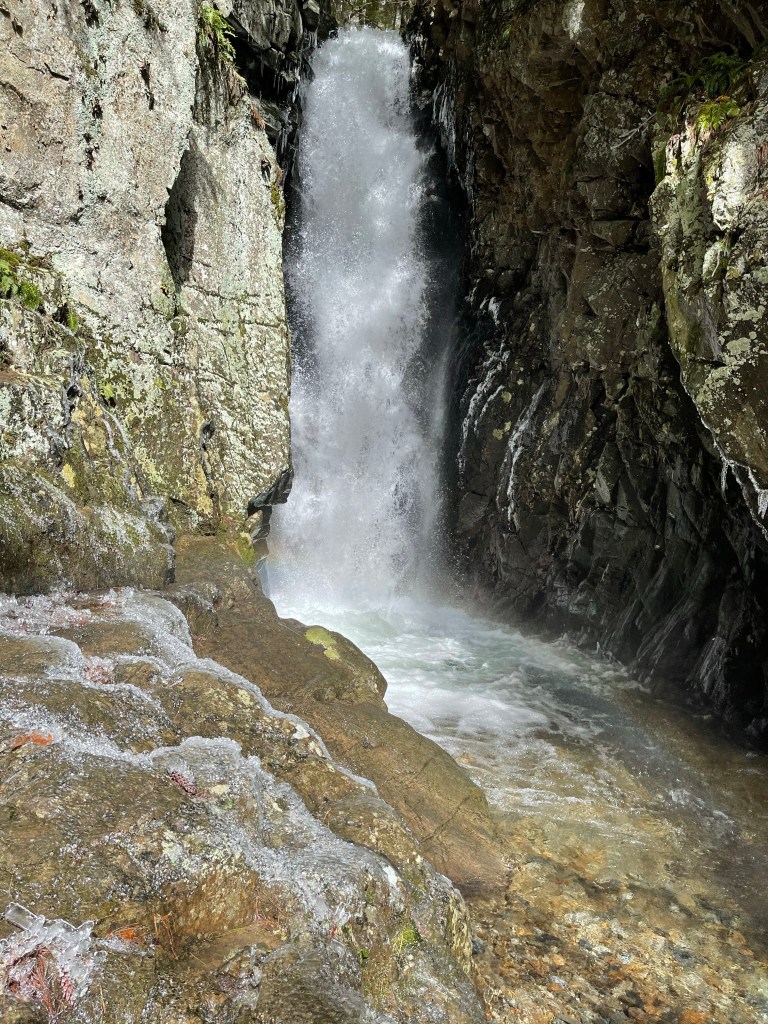
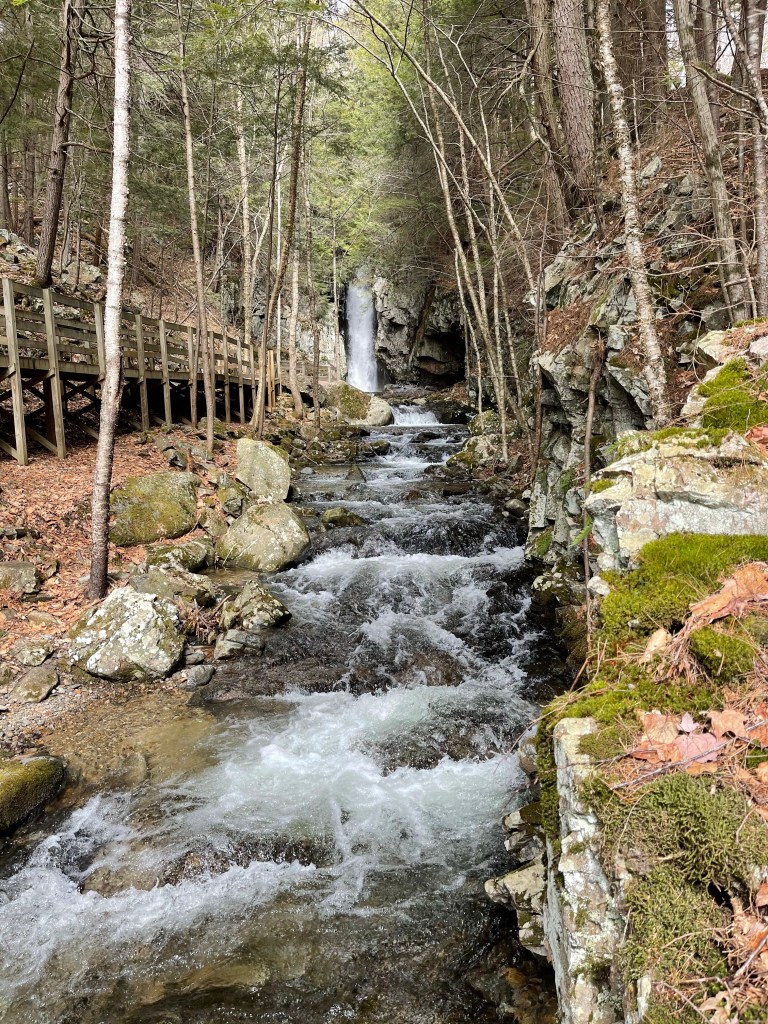
    Enter Beede Falls in Sandwich, New Hampshire. In warmer months it’s a 35 foot horsetail of falling water with a popular swimming hole. In winter it’s an ice bulge, beautiful but seemingly as inaccessible as other frozen waterfalls. But this one offers a secret for those who dare. You can duck and crawl in behind the falls on the left or right side, and even crawl all the way through if you wanted to. For some less tall than me standing up is even possible.

    I wondered at the characters over the years who have crawled behind the falls in all seasons. I wasn’t the first on this day, and other hikers waited patiently for me to finish to have their own turn in the tight tunnel between granite, water and ice. How many humans have made this crawl over the thousands of years that this cave and waterfall have danced together? A lot, I suppose. But for a few minutes, there was only me and the ice and water.

    That’s where I finally saw the magic locked away behind that frozen blue skin. Deep behind the water is indeed falling, forming icicles and frozen bubbles successively grown upon each other to form otherworldly sculptures. And through it all that shower of water penetrates the center, surrounded by its icy shield and backlit by the daylight beyond. An incredible wonderland so foreign to me, so delightful, that I felt I’d gone to another world. And indeed I had.

    Beede Falls, behind her icy shield
  • On New Paths

    What good is livin’ a life you’ve been given
    If all you do is stand in one place – Lord Huron, Ends of the Earth

    If snow transforms the landscape, then a walk in that snowy terrain transforms the winter walker. Add a new path and suddenly you’re seeing the world entirely differently than you had before. Add snowshoes and you’re suddenly set free to break off trail to see new places, explore animal tracks that run off into the woods, and to see what’s on top of a rise you might have walked by at another time of year.

    There’s a popular pursuit in hiking called red-lining, in which hikers hike every bit of every trail on a map or guide. A popular red-lining pursuit in New England is hiking the AMC White Mountain Guide. The whole point of red-lining is to explore new paths – to get off the crowded hiking trails and try something new. To do it, and to belong to a small group of hardcore hikers who have also done it. And add a measure of accomplishment and camaraderie in the world of hiking. I don’t see myself hiking every trail in the AMC White Mountain Guide, but I’m fully onboard with hiking new trails and seeing the previously (for me) unseen.

    On Valentine’s Day I explored trails previously unseen in a forest I’ve spent a lot of time in. Snowshoeing with friends, we walked a trail largely by ourselves to new places. When you’re on a new trail like that, every step is a discovery, every bend in the trail is a curiosity, and every trail junction is confirmation and validation of what the map was trying to tell you all along. There’s magic in taking that image on a map for a walk and making it real.

    The day after a long walk on new trails you start thinking about the trails at those junctions that you didn’t take. You wonder at what you might have missed down that way and begin to realize the allure of red-lining. For how do you want to spend your time in this world? Sticking with the familiar or exploring new places and challenging yourself in new ways? There are other paths that warrant exploration. I’ve seen them out there, if only on a map.

  • Hiking Cannon Mountain

    A flurry of texts over the work week from two directions with questions about hiking led to a decision to join forces for a hike of Cannon Mountain. On the one hand were the Perry’s, increasingly famous in the White Mountains for years of summiting mountains and red-lining trails. I don’t recall a hike in the last couple of years where they didn’t know at least one person on the trails. And a text from my niece Kellyn offered a nice treat, with her deciding to hike with us as well.

    Cannon Mountain is an old granite mound that’s famous for a sheer rock face that once held the Old Man of the Mountain until it collapsed in 2003, and for the tram built to promote tourism and skiing on the mountain in 1938, making it the first passenger tramway in the United States. The Old Man of the Mountain gave this granite mound its first name, Profile Mountain, but eventually its resemblance to a cannon from some vantage points let to what we’re familiar with now.

    So the stage was set for four hikers to set out on a cold February 13th morning for a hike from Lafayette Campground. We chose the Lonesome Lake Trail, with three of us starting in micro spikes on the snow-packed trail. Our fourth hiker stuck with snowshoes the entire time. The conditions on the popular trail made either option fine. As with other hikes, you quickly know when it’s time to put on the snowshoes. For us that was when we took the largely unbroken Dodge Cutoff Trail over to Hi-Cannon for the hike up to the summit.

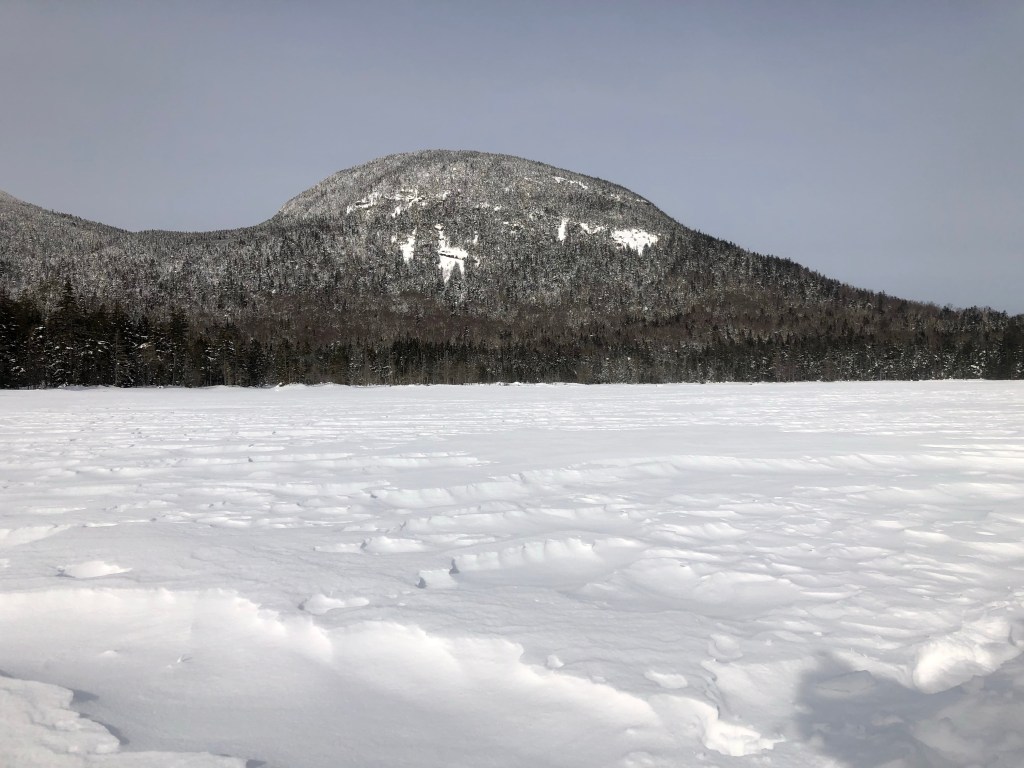
    Lonesome Lake is a beautiful lake sitting in the bowl of Cannon and the neighboring mountains of the Kinsman Range. It’s a destination of its own, and plenty of people hike up to see it, walk on the frozen lake for the beautiful views it offers, and then hike back down. But you don’t summit mountains when you turn around halfway. We powered on, snowshoeing through a wonder of marshmallow trees up the steep trail. There’s one ice-caked ladder on Hi-Cannon that I’ll always remember for the limited footing options presented to us, but we all got past it with a little help and a dose of courage.

    The thing about summits is they tend to be much colder when you’re exposed to the wind and you stop moving. Sweaty gloves quickly freeze up, making a change a requirement to keep your fingers working. We considered the observation tower for a few minutes and opted to just hike down to the ski resort’s Mountain Station, where I’m told you can buy a beer at 4080 feet. I opted for hot chili and hot chocolate, with extra hot, thank you. It’s a rare day when you can summit a mountain and have hot chili waiting for you. We quickly warmed up and reached a point where if we didn’t get going we might choose to close out the place. Onward.

    Crossing a ski trail is akin to crossing a highway. You judge the oncoming traffic, decide whether your speed can overcome the approaching traffic’s speed and go. We quickly crossed over to the trail back to the summit observation deck, crowned the summit and began our descent using the Kinsman Ridge Snow Chute, er, Trail. On the map, 4/10’s of a mile of hiking, but a lot of squiggly elevation lines stacked up in a small space. We butt-slid down large sections, my snowshoes were more telemarking skis on other sections, and we all collected snowy memories that will make great tall tales someday.

    On one of the butt-sliding sections I lost a water bottle. It wasn’t until we’d snowshoed across Lonesome Lake and I changed to micro spikes that I realized it. My disappointment at losing it turned to delight when we got to the trailhead and someone who’d found it and beaten us down the trail while we lingered at the lake had left it sitting on a post waiting for me. Good hiking karma right there. It was hard to come away with anything but positive vibes after hiking Cannon Mountain on a pristine winter day. A solar halo signaled goodwill to all. A very good day indeed.

    Cannon Mountain from Lonesome Lake
    Solar halo through the frosty trees
    Lonesome Lake with Franconia Ridge beyond
  • Joyful Walks

    Now shall I walk
    Or shall I ride?
    “Ride”, Pleasure said;
    “Walk”, Joy replied.

    Now what shall I —
    Stay home or roam?
    “Roam”, Pleasure said;
    And Joy — “stay home.”

    Now shall I dance,
    Or sit for dreams?
    “Sit,” answers Joy;
    “Dance,” Pleasure screams.

    Which of ye two
    Will kindest be?
    Pleasure laughed sweet,
    But Joy kissed me.
    – William Henry Davies, The Best Friend

    Joy and pleasure sound similar, but joy is something you can build off of, while pleasure seems more, well, short term. In the forever competition between Pleasure and Joy it’s interesting to note that walking is solidly in the corner of Joy. I’m at my best walking, and fill with joy in those moments on a trail or in the quiet places in the world. I know I’m not alone in this respect.

    What makes walking so positive for the mind and soul? Something in the rhythm of walking long distances clears the fog. Reboots the brain. I don’t have a lot of eureka moments walking, but I’m always better for having done it.

    Today was filled with miles of joyful walking. A poem like the Davies poem above hits you differently when you’re blissfully tired and sore from miles on the trail. Don’t get me wrong, pleasure is nice too, but today belonged to joy. And it started with a long walk.

  • A Measure of Health

    “Nature says thou shalt keep the air, skate, swim, walk, ride, run. When you have worn out your shoes, the strength of the sole leather has passed into the fibre of your body. I measure your health by the number of shoes and hats and clothes you have worn out. He is the richest man who pays the largest debt to his shoemaker.” – Ralph Waldo Emerson

    Those Concord folks were walkers, weren’t they? Ralph and Henry wandered about, wearing out shoes and building big thoughts. There are a couple of versions of that Emerson quote above, but some online research makes me believe these were his words. I like the alternate quotes just fine, but when I start quoting people I’d like to have it right. I love the idea of transferring the strength of the shoes into the fiber of your body. It applies just as well with shoes as it does time and sweat equity invested in other worthwhile things.

    I’m wearing out shoes more quickly lately. My feet took a beating last year, ankles and knees too, but they merely paid it forward to my heart and soul. Over time the body adjusts and stops complaining about taking another step and just goes. It’s a bit like writing and washing dishes and making the calls, you just teach yourself that there’s joyful bits in every moment of doing.

    I’m a collector of joyful bits. On my deathbed I won’t regret not finishing Breaking Bad, but I’ll surely regret not seeing the Northern Lights or the Southern Cross should I not see each. The last year is a reminder to not take mobility for granted. Wearing out more shoes seems a great goal for our next normal. The correlation seems apparent. Wearing out your gear is an easy measure of your physical and mental health. So lace up; we have places to go.

  • Making Tracks

    I promised myself a snowshoe walk in the woods for lunch, and dammit if I wasn’t going to honor that promise. There was more snow drifting down, quietly adding to the base layer in fluffy contentment. Day-old snow welcoming the new to the accumulation. We’re in the weather pattern now, folks. Snow-upon-snow: February in New Hampshire.

    I’d walked these woods on Sunday, but felt a return was in order. Conservation land, with trails popular with dog walkers and tree whisperers. At lunchtime on a random Tuesday in winter you don’t expect a crowd but you expect somebody. In this case one car running, its driver staring down at a phone screen, oblivious to me strapping on snowshoes and beginning my walk.

    The trail is compacted again, a day after six inches of snow and with more in the air, speaking to the popularity of the trail. I help compact it for twenty steps and then move off trail into deeper snow. This is what I came for after all: the highly addictive, calorie-burning bliss of clumping about in deep snow. I followed an old stone wall that spends its lifetime keeping the woods and fields apart, and wonder at the farmers who built it a few hundred years ago, and the generations that mended it until the woods finally wrested back control of the land. Now it’s my turn on the land, and I quietly honor those who came before me; their hard life on display.

    I rejoin the trail and the pace picks up, crossing a bridge over a stream I see a stand of old pines and step off trail to walk amongst them. Just me and the snowshoes, walking an endless blanket of white that covers the features of the land. Fallen trees, dormant vines and brambles, rocks and frozen wetland all lay together under Mother’s white blanket. And one soul clumping about above like a kid at recess. For that is how I feel, being out like this on a snowy workday.

    I think about the time. How long have I been out here? 45 minutes? An hour? Hard to say, really, and I don’t want to look at the watch or phone to find out. But I know it’s time to head back towards the car. Clumping along, I join a familiar path, newly blazed but strangely not compacted as much as other trails. I help with that task while walking under hemlock trees – old friends who I speak with now and then across the years. They’d like me to linger awhile, I smile and hint I’ll be back another day. And cross a stone wall and step out on another field of white.

    The car isn’t all that far away now. I could be in it and back in my home office in minutes. But the snowshoes want to fly some more, and so do I. Not just yet, world. I step off the path and walk back into the deep snow, a wandering soul in a quiet, timeless field. I spot a tall stone wall on a rise across an unbroken plane, set my course, and fly.

    A quick look back and then back on my way
  • Walking to Interesting

    If you watch a commercial on television, or a reporter out on a city street, or even the cast intro on Saturday Night Live in February 2021, everyone is wearing masks. A year ago you’d have wondered at it, even as the pandemic rapidly descended on the world. Today it’s commonplace, and I’m more often surprised at the outliers walking into a store without one. I stood in a line for snowblower parts and a mechanic walked briskly through the store unmasked. In a crowded grocery store I saw an elderly woman(!) without a mask on. In both cases I had the same reaction I might have had two years ago to someone wearing a mask. Isn’t it funny how the world has changed our perceptions in such a brief turn of the calendar?

    I chafe at restrictions, favoring wandering, crossing borders, friendly conversations with strangers and simply getting out there. But we all sense a light at the end of the tunnel, and we’ll reach a tipping point with vaccinations as we did with mask wearing. With more and more people I know joining the ranks of the vaccinated, a sense of optimism grows. Travel will soon be a reality again, even if a bit different from the travel of a few years ago. There’s plenty of travel available today, without worrying about the complexity of borders, just outside.

    “My vicinity affords many good walks; and though for so many years I have walked almost every day, and sometimes for several days together, I have not yet exhausted them. An absolutely new prospect is a great happiness, and I can still get this any afternoon. Two or three hours’ walking will carry me to as strange a country as I expect ever to see. A single farmhouse which I had not seen before is sometimes as good as the dominions of the King of Dahomey. There is in fact a sort of harmony discoverable between the capabilities of the landscape within a circle of ten miles’ radius, or the limits of an afternoon walk, and the threescore years and ten of human life. It will never become quite familiar to you.” – Henry David Thoreau, Walking

    Many times during the past year I’ve thought of Thoreau walking the landscape I know today. There’s plenty that’s changed since his time, but there’s also plenty that remains just as it was then. Much of it remains undisturbed, as if in a time warp, awaiting a visitor. I doubt he ever got up to the corner of New Hampshire where I walk, but I’ve walked in his woods near Walden and note the similarities.

    “Walk until your day becomes interesting — even if this means wandering out of town and strolling the countryside. Eventually you’ll see a scene or meet a person that makes your walk worthwhile.” – Rolf Potts, Vagabonding

    With a hint of the coming snow in the air, I took my snowshoes out to find new prospects. I quickly moved off the packed trail into virgin snow, crunching along on the snowdrifts through woods and fields. Cold hands soon warmed as I worked up a good pace past old stone walls and silent trees. Snowshoeing offers a slow burn, steady state workout similar to cross-country skiing. There’s a small thrill in hovering over the frozen land while blazing a new trail on snowshoes, and I felt a bit like I was flying as I crunched along.

    Reconnecting with the blazed trail at a frozen stream crossing, I noted the collection of prints of those who had come before me. Snowshoes and fat tire mountain bikes, micro spikes and dog prints spiraling in circles from the trail in patterns of joyful exuberance and the freedom of the winter woods. It occurred to me that my own tracks were more similar to the dog prints than those of the trail walkers. Wandering spirits are rarely contains for very long on defined paths.

    A simple walk in the woods, off trail, can change a person. In winter what was familiar ground becomes a voyage of discovery. Perception is how we frame the world around us, and I find it best to turn my perceptions upside down now and then. Every walk suggests something profoundly new, and winter transforms both the landscape and the visitor alike. Pausing a moment, I listened to the sound of silence. My snowshoes and I had walked our way to interesting, embracing the cold indifference of the woods to pandemics and masks and turns of the calendar.

    Walking along on familiar trails transformed into strange country, I stopped worrying about the neglected collection of stamps in my passport. Feeling a million miles from anywhere I’d every been before, I came across a border marker deep in the woods indicating I’d crossed over from the town forest of my neighboring town into the undeveloped forest of my own town. I smiled and noted that not all borders are closed. And the unfamiliar isn’t very far at all from home.

    Into the snowy woods
    Snow blanket on an old stone fence
  • Encountering Darshan

    “‘There’s a Sanskrit word, darshan,’ Jon said as we gazed up at Konka. ‘It suggests a face-to-face encounter with the sacred on earth; with a physical manifestation of the holy.’ I hadn’t known the word, but I was glad to have learnt it. Darshan seemed a good alternative to the wow! that I usually emitted on seeing a striking mountain.”Robert Macfarlane, The Old Ways

    Waterfalls and sunrises and mountains and ancient trees are a physical manifestation of the holy. And so is the ripple across a calmly rolling ocean betraying a puff of wind. And the Milky Way on an especially dark and clear night. The catch in my throat when I see these things is spiritual, more than any church I’ve ever walked into, and I go out of my way to seek them out. Admittedly, I haven’t been to the Sistine Chapel yet, but I’m not convinced you can’t find the same thing walking deep into the woods.

    I stumbled on the quote above from Macfarlane and immediately identified with darshan in this context. I read this book almost eight years ago and keep returning, skimming over magical phrases and bucket list places. But in the end the book is about standing up and walking out to find yourself in the world. To come face-to-face with the divine requires inspired effort. Sweat equity in your spiritual education. Getting out there and in it.

    And yet… One of the most beautiful waterfalls I’ve ever seen is She-Qua-Ga Falls in Montour Falls, NY. It felt like cheating when I arrived, because you essentially drive right up to them. The falls are framed by houses and a concrete lined basin below and an arched bridge above. Like Niagara Falls humanity encroaches on the beautiful, threatening to edge it out in the process. But truthfully I don’t see those things at all; I look at the timeless waterfall captured there, like a rose under glass. And I see darshan.

    There’s a tendency for people to see something beautiful and immediately try to put a stake in the ground there. The Eagles wrote about this in The Last Resort. Houses lined up on the edge of the beach grabbing a share of sunset and water views. Homes mounted atop mountains to maximize the view while killing it for those looking up at the mountain they’ve scarred with a box. I visit a house with a great sunset view as often as I can, and would be a hypocrite if I were to condemn those who build for the view. For all the beauty we see from that house by the bay, I know that the view from the water or from the other side of the street is a row of houses. So I take no issue with the people who built Montour Falls for edging up to the falls and wanting to linger there, but wish the land around the falls had been preserved in its original state. Then again, the falls are beautifully accessible for those who can’t hike deep into the woods. Darshan on display for everyone. And maybe that’s enough.

    The network of trails and rhumb lines that weave across the Earth like a tartan reveal the whispers of those who came before us. There’s very little that hasn’t been seen by someone before us except in the most remote corners of the planet. But who said encounters with darshan must be exclusive anyway? Each human making their way in this world looks for something greater than themselves. Encounters with darshan are uniquely ours alone, even when shared with others we internalize it differently. But what is darshan if not seen through the lens of our mortal human perspective? We seek it out, discover something in ourselves, and try to capture the divine with a few inadequate words and pictures. And honor it as best we can before leaving it for others to discover in their own time.