Category: seasons

  • Time Buckets

    “Draw a timeline of your life from now to the grave, then divide it into intervals of five or ten years. Each of those intervals—say, from age 30 to 40, or from 70 to 75—is a time bucket, which is just a random grouping of years. Then think about what key experiences—activities or events—you definitely want to have during your lifetime. We all have dreams in life, but I have found that it’s extremely helpful to actually write them all down in a list… Your list will be your own unique expression of who you are, because your life experiences are what make you who you are…
    Then, once you have your list of items, start to drop each of your hoped-for pursuits into the specific buckets, based on when you’d ideally have each experience…
    by dividing goals into time buckets, you are taking a much more proactive approach to your life. In effect, you’re looking ahead over several coming decades of your life and trying to plan out all the various activities, events, and experiences you’d like to have. Time buckets are proactive and let you plan your life; a bucket list, on the other hand, is a much more reactive effort in a sudden race against time.” — Bill Perkins, Die With Zero

    When I was helping to raise two very active children, I could barely keep up, let alone plan a sabbatical for three months to explore the fiords of Norway. If you learn anything as a parent, it’s that to be a good parent your own desires should take a back seat to the needs of your family’s. But that phase of life is a different time bucket that you’ll have before and after it. Everything has its season. The trick is to identify when those seasons are and feel the urgency to fill it with experiences that fit it best. I wouldn’t trade the time with my children when they were growing up for anything. Now that they’ve grown up, I might just look towards those fiords again.

    “If not now, when?” ought to be the our mantra, for there’s truth in it when we face it. Time buckets put it all in black and white. We see immediately what is possible and what will be a forever dream. If we don’t book the experiences we want in life, we’re likely to miss them altogether. History is full of people with regrets in those final moments.

    Many people go through life believing that they’ll do those big life experiences when they retire, but forget that our bodies may have other plans. We’re more fragile than we want to believe we are. And there’s no currency more valuable than health and fitness. Some things simply can’t be done when we lose this currency. If you want to hike the Appalachian Trail or follow the Tour de France course on your own bike, it’s unlikely you’ll be able or inclined to do these things when you’re 70 or 80. Even if you are, you’re body is better equipped for the experience when you’re 25 or 35. Time buckets force us to look at such things and determine where in our lives certain experiences best fit in, while reconciling what we’ll never do if we defer any longer.

    Putting life experiences into buckets has merit, but there has to be room for serendipity in our lives too, for life should never be fully lived based on a Day-Timer or spreadsheet. The point isn’t to schedule every aspect of our lives, but to identify the buckets of time when we’re most likely to have the time and resources to do the things we most want to do in this lifetime: Build it and they will come. Life is what what we plan for and make of our time. We’ll have misses along the way, but we ought to put ourselves in the best position to play the hits too.

  • On Sirens and Place

    “Where you are is who you are. The further inside you the place moves, the more your identity is intertwined with it. Never casual, the choice of place is the choice of something you crave.”
    ― Frances Mayes, Under the Tuscan Sun

    I talk of travel but deliberately spend money on plumbing fixtures that cost as much as a plane ticket to faraway places. You can feel the quality in a good plumbing fixture, you can feel the permanence of it if fate allows it a good home. A good faucet will outlive all of us. Surely it will last longer than a trip to Paris or Tuscany. Does a faucet sing a siren song the way that travel does? Surely not, but never forget that Odysseus was simply trying to get home to Ithaca. Sirens pull us away from home, never to return. Still, we hear the call.

    Surely, this place that we call home will outlast our desire to stay in it. Yet the garden remains, with bee balm rising to meet the sun year after year. The hummingbirds return to meet it, and the butterflies and bees. Bee balm (Monarda) is a bit like me, with a wandering soul. Its roots spread out, testing the limits of the garden, and each year the flowers bloom in a different place than the year before. Kindred spirit, I let them roam, content to see where they rise each year. In a walled garden there’s only so much room to run. Still, the hummingbirds always return, knowing they’ll be there somewhere nearby. And so will I.

    Returning seems the thing. When you have a sense of place you’ll move heaven and earth to get back to it again. But to return means to leave now and then. Knowing deep down that place remains.

  • Searching for the Marvelous

    “Ordinary life does not interest me. I seek only the high moments. I am in accord with the surrealists, searching for the marvelous. I want to be a writer who reminds others that these moments exist; I want to prove that there is infinite space, infinite meaning, infinite dimension.
    But I am not always in what I call a state of grace. I have days of illuminations and fevers. I have days when the music in my head stops. Then I mend socks, prune trees, can fruits, polish furniture. But while I am doing this I feel I am not living.” — Anais Nin

    “The secret of a full life is to live and and be open to others as if tomorrow they might not be there as if you might not be there. This eliminates the vice of procrastination, the sin of putting things off, the missed communions.” — Anais Nin

    I’m often accused of talking to everyone—this is often true—for in each of us there’s a story worth discovering. Every now and then you discover magic, sparked by interest. These are the high moments I believe Anais Nin was seeking as well. She seemed a woman I’d have loved to have met. Forget for a moment her fame for writing erotica, she just seemed so damned interesting. We must each find the fascinating things about living and bring it to the world. When you meet someone equally compelled to discover, the space between us erupts in wonder. You don’t have to take your clothes off for that to happen.

    There are moments when I feel the infinite meaning, when I feel the marvelous. You sense these things all around you when you’re attuned to discovery. It might be something as exhilarating as travel or as commonplace as gardening: I’ve found it in waterfalls deep in the forest and in the crashing surf seen from high on a cliffside trail in western Portugal. These are to be expected, and the compelling reason why we seek out such places. But I’ve also found it hiding in plain sight in my backyard garden, in the scent of tomato vines on a hot summer day. It’s all around you when you look for it.

    The trick is to be open to experiences. Find possibility in the circumstance we’ve stumbled into. These occasions are fleeting at best, and gone in an instant. To be fully alive is to tune in to everything around us and savor its sweetness in its season. For this is also our season, and we may never pass this way again. Carpe diem. Let’s not waste another moment.

  • History and Identity

    July was originally called Quintilis, which is latin for fifth (The Roman calendar once consisted of ten months: Martius, Aprilis, Maius, Junius, Quintilis, Sextilis, September, October, November, and December). When Julius Caesar was assassinated, his birth month was named in his honor (July: Julius), thus forever changing what we call the month (August was similarly named after a Roman, but let’s not get ahead of ourselves). Such is the reach of the Romans: they’re very much a part of everything around us, we just don’t always see them. The months make a lot more sense when you know they threw on January and February after the fact.

    History isn’t just all around us, it’s a part of our identity. As such, we rarely stop to think about it. Why was a street named this way? How about the town itself? What of the waterways and mountains? Everything originated in history and carries with us today. Whether a Roman Emperor or a slave cast to the lions, each was woven into the fabric of our identity.

    Do you wonder what history we’re making now? Where will all of this take us? They say in songwriting that everything’s been done already, yet people keep coming up with creatively new songs. Likewise, everything has been written already, and AI is taking over everything anyway, so why bother writing anything at all? Because nobody has every experienced what we are experiencing. Nobody could possibly have our unique perspective on the world, because it wasn’t their world then and it surely isn’t anyone else’s. Perspective matters a great deal in art.

    We may not have a month named after us, or even a local street, but we can each leave our dent in the universe with each act. The dominos will fall where they may (or is that Maius?). Everything matters or none of it does: time will determine everything. History will live on without us one day. But it may yet feel our ripple. Perhaps it already has. The only thing certain is this story isn’t over quite yet.

  • Full Moon & Fireworks

    I once was a boat owner. Nowadays I’m a passenger on other people’s boats, and occasionally crew. I’d like to say I like it this way, not having the expense of maintaining a boat and such talk, but once it’s in your blood you never get over not having one, no matter how often you hop on someone else’s. That doesn’t make the experience any less delightful when you’re blessed with the opportunity. It’s more a call from the life that got away.

    Big Island Pond, located in Southern New Hampshire, is bordered by three towns. The namesake big island, called Governor’s Island, is mostly conservation land, making the lake feel like a time warp back to another era. There is a lot of history on this small lake, beginning with the famous Native American warrior Escumbuit, one of the leaders of the Abenaki. For the French, he was considered a hero, and knighted by Louis XIV of France in 1706. For the English settlers, he was a holy terror, responsible for several local raids during King William’s War and Queen Anne’s War. He lived on a small island now named after him; Escumbuit Island. Another famous character, Alan Shepard, the first American in space, also once lived on Escumbuit Island. Surely, there are whispers from history on quiet nights on this lake.

    Today, there’s little doubt who won the long game. The perimeter of the lake is lined with homes, and every one of those homeowners tries to be on the lake for the 4th of July fireworks. The threat of rain postponed the fireworks this night, making the lake quieter than it otherwise would have been. It turned out to be the wrong decision for the fireworks organizers, as the rains drifted away and the skies cleared enough to offer a full moon spectacle for those who ventured onto the lake anyway. That full moon rose over the dark shoreline, illuminating the calm lake with wonder.

    Cruising a populated American lake on the weekend of our national holiday is usually a recipe for boisterous fun and a bouncy ride. Boaters jockey for position to watch the fireworks, various patriotic-themed soundtracks and “homeowner special” fireworks blend together into a chaos of sound. Individual boats are also lit up in various colorful displays. I suspect most of the people on those boats are also lit up. Such is Independence Day in America. Americans don’t take nearly enough time off, but when we try to make up for lost time.

    With the fireworks postponed, it fell to some adventurous souls to make their own display. Three characters, one in nothing but a red, white and blue bathing suit, floated a swimming platform out into the middle of the lake stacked with professional-grade fireworks. They spent the next half an hour lighting off ridiculously large fireworks precariously close to their future well-being. As with boats, other people’s fireworks cost a lot less but offer the same benefit. We had a front row seat for our own fireworks display, making for a magical evening with friends. Sometimes things just seem to come together at just the right time. A timeless lake, full of history and magic, set the stage once again.

  • Rounding the Mark on 2023

    The forest is dead quiet in the early morning hours when you walk out into it. At least until the creatures assess you and, seeing no imminent threat, go back about their business. It’s akin to going to a cocktail party and either working the room as the life of the party or receding back a bit and seeing what’s actually happening in the room. You might believe you’re the life of the party in the one case, but you won’t know what’s actually going on around you. It pays to shut up and read the room now and then.

    Sitting quietly in my trusty Adirondack chair, the woods soon erupted into chatter, as various couples expressed distain or encouraged more urgent attention to the nest. A young squirrel chewed through maple branches and hauled them back to the nest, where another squirrel seemed to be dissatisfied with the progress. Nearby, a house wren destroyed the silence with loud chattering birdsong. It’s always the smallest birds that make the most noise. Some might say the same about people. Two ears, one mouth is the ratio I taught my children. Sometimes I even take my own advice.

    There have been precious few mornings like this, just sitting outside listening to the world wake up around me. We’ve arrived at the month of July, and in New Hampshire it doesn’t really feel that’s possible. Blame it on the rain, relentlessly taking control of the month of June in the region. We’d all like to gift the precipitation to places that desperately need it now. Canada, on your big day, please have as much as you’d like. Feast or famine: that’s the climate now. The lawns thrive, the tomatoes and basil are horrified.

    I use that Adirondack chair for more than just listening to wildlife. It’s the place to listen to what’s happening between the ears as well. Assessing where we are, what we’ve done, what was left undone. Sometimes you have to sit still long enough to recognize it wasn’t ever about listening to the squirrels and house wrens or the weather. Assessing moments with people, places seen for the first time or the thousandth time, projects completed, projects put aside for another day. Where did it all get me? How about you?

    We’ve rounded the mark on the year: six months down, six to go. When we look back on the first half of the year, now ended, how do we feel about it? Do we like the view? A good life is represented by stacking our days with memories and small wins, all measured as progress. Sometimes we aren’t progressing at all, but receding and trying to hold it all together as best we can. Sometimes everything slips away and we feel we’re left with nothing. That’s life too. We all know how this ends, but it doesn’t mean we have to let today slip away without a small win. Maybe tomorrow too. String enough wins together and half a year later maybe we actually have something to celebrate. I hope so. But either way, there’s this other half of the year to reckon with, beginning today.

  • The Way of Rain

    You have been forced to enter empty time.
    The desire that drove you has relinquished.
    There is nothing else to do now but rest
    And patiently learn to receive the self
    You have forsaken for the race of days.

    At first your thinking will darken
    And sadness take over like listless weather.
    The flow of unwept tears will frighten you.


    You have traveled too fast over false ground;
    Now your soul has come to take you back.


    Take refuge in your senses, open up
    To all the small miracles you rushed through.

    Become inclined to watch the way of rain
    When it falls slow and free.
    — John O’Donohue, For One Who is Exhausted, A Blessing

    I might go weeks without reading poetry. I may feel victorious in my efficiency and productive use of time. I can sometimes grind through my days in hopeful work, forgetting to walk outside to greet the day. These are days of emptying the bucket while filling the ledger with checked tasks. Empty buckets make a hollow sound. They demand to be filled.

    It’s not lost on me that I’m posting about taking time to rest at the beginning of another work week. When we go, go go! for weeks at a time, sometimes things like weekends disappear in a flash. We forget to see the small miracles we rush through in our mad pursuit of getting things done.

    Slow down. Step away. Find that which is calling you from outside yourself. The work will always be there, awaiting your return. Or maybe it was never your work at all. How can you know if you never take the time to listen?

    The days and the seasons roll on by, like waves to the beach. We only have so many days. Only so many seasons. We must learn to slow down and celebrate the one we’re in.

  • The Magic of Applied Attention

    “We’re all going to die, all of us, what a circus! That alone should make us love each other but it doesn’t. We are terrorized and flattened by trivialities, we are eaten up by nothing.” — Charles Bukowski

    There is a Persian lime tree growing in a large pot on the sunny deck behind my house. This spring there were more than a hundred blossoms on this tree, each developing into tiny fruit that promised a bumper crop of limes. But after a particularly angry thunder storm and torrential downpour dozens of those tiny fruits scattered the deck, their tart potential over before they really began. While mourning the loss of so may limes, I took solace in the dozens of fruit still developing on the tree. It seems the tree had culled itself that it might focus on the ripe potential of the fruit that remained.

    We each bear so much in our lifetime, holding on to things we ought to shed to focus on the essential few. It’s okay to let go of the trivial, that we might nurture the truly important things in our lives. Letting go is painful, but not as painful as diminishing our best work by carrying more than we should.

    Little by little,
    as you left their voice behind,
    the stars began to burn
    through the sheets of clouds,
    and there was a new voice
    which you slowly
    recognized as your own,
    that kept you company
    as you strode deeper and deeper
    into the world,
    determined to do
    the only thing you could do —
    determined to save
    the only life that you could save.

    — Mary Oliver, The Journey

    The night after the thunderstorm, I spent an evening with friends, throwing axes at a target drawn on a wooden wall and building fragile wooden castles in the air (Jenga). There is a unique strategy for each, naturally, being so very different from each other in practice. But there are also similarities. Besides each pursuit using wood, it was the act of applied attention that is common to both. To be good at either you must simply get out of your own head and focus on successfully completing the task at hand. One might utilize this in every pursuit, from writing to navigating any of the essential tasks that fill one’s day.

    We ought to cherish our time together, forgetting the trivial affronts that life throws at us. We ought to find our own voice in a world full of people waiting for us to shut up that they may say something clever. We ought to direct our attention inward, to the ripe potential of our own ideas, calling us to truth and clarity. We know, deep down, that we won’t survive this, but if we give ourselves the time to focus, we may just yet produce something substantial anyway.

  • Observations From a 20K Day

    Sunday is supposed to be a day of rest, and I’d planned to do just that. There shall be no hiking or waterfall chasing for you, I told myself. But when you believe that we aren’t built to be sedentary beings, eventually those rigid thoughts of who we ought to be evolve into action. I wrapped my mind around 20,000 steps as a goal for the day, no matter what. What is the first rule with any goal? Putting ourselves in the best position to achieve that goal.

    The path to a 20K day really began a few years back, when I decided I was going to buy a push mower and walk the lawn instead of driving around on it. Would it be nice to sit on a cushy seat with a cup holder? Of course! But my work has me sitting entirely too much already. Mowing, trimming and leaf blowing the yard easily knocks off 4000 steps in roughly an hour. Is that the equivalent of hiking a 4000 foot mountain? Of course not, but it’s a starting point for an active lifestyle, and a head-start towards my activity goal for the day.

    I’ve hit 20K just doing yard work, but a change of scenery was in order. On a beautiful Sunday afternoon there were many choices available, but I opted for the local rail trail. As with beaches, I favor the rail trail when few people venture onto it, during snow or light rain, in the early morning or dead of winter. The rail trail in the middle of the day during peak season is an entirely different experience.

    A rail trail is popular because you’re safely removed from automobile traffic, but there are other hazards to consider. As on a highway, one must skate one’s lane and be predictable to avoid collisions. Hoards of cyclists, joggers and walkers descend on the trail, making it near impossible to be on a spot where there isn’t someone in your line of sight. e-bike Andretti’s zip past at breakneck speed, and clumps of independent teenagers on bicycles ride towards you shoulder-to-shoulder leaving you the choice of standing your ground or stepping aside (there’s magic in the moment they realize that you’ve—responsibly—put the choice back on them).

    In the off-season on this rail trail, I would immerse myself in the nature around me. There’s surely a lot more to witness when sharing the path with hundreds of people on a long walk. Inevitably, you begin to people watch. Humans are quirky. Fashion on the path runs from traditional breathable fabrics to bold statements of individuality. Of all the travelers, the e-bikers seemed to be the most outlandish, fully kitted with fishing poles or picnic baskets, small dogs poking out of backpacks, and fat tires announcing they’re about to pass you from 100 meters away. It was an impressive display, and reminded me of the parade of custom golf carts seen at 55 plus developments and campgrounds around the country. But I was here for walking, not powered transportation. There’s relative simplicity on a rail trail: you walk one direction for as long as you want, then you turn around and walk back.

    The thing about goal-setting is that we know the obstacles before we begin, but we don’t always account for them in our bold declaration that we’re going to do this thing. The only things that get in the way of completing a good goal are available time, resources (like health) and willpower. Hitting fitness goals usually comes down to simply beginning and not stopping until we’ve met our objective. On a day of rest I decided to hit 20K, not exactly a bold number but high enough that it required my time and attention. It also served as a reminder that I’m not ready to retire to an e-bike and backpack dog just yet. There’s still so much to do.

  • Stillness Instead

    Have I lived enough?
    Have I loved enough?
    Have I considered Right Action enough, have I come to any conclusion?
    Have I experienced happiness with sufficient gratitude?
    Have I endured loneliness with grace?

    I say this, or perhaps I’m just thinking it.
    Actually, I probably think too much.

    Then I step out into the garden,
    where the gardener, who is said to be a simple man,
    is tending his children, the roses.
    — Mary Oliver, The Gardener

    Just this morning, I opted for the garden instead of a hike. I’ve done that a lot recently, choosing just about anything instead of a hike. Last week it was finishing a book I’d wanted to dive into, and I celebrated my time not doing something else I love. For it isn’t that I don’t love hiking, I surely do, it’s more a case of wanting something else instead. When you have free will you get to choose, within reason, such things as where to be and what to do.

    When it comes to such things as checklists of books read and summits climbed, we sometimes opt for none of the above. Life is a series of days where anything is possible if we just persist, or nothing gets done if we resist. What leads to resistance in a world that rewards action? Are we the lesser for having opted out? Or do we find something else in stillness?

    Lately I’ve wanted nothing more than time in the garden. It’s June, after all, and even a raw and wet June is still a month of growth and possibility. Slowing down enough to find the beauty in my own backyard seems the best use of this time.

    “It is the beauty within us that makes it possible for us to recognize the beauty around us. The question is not what you look at but what you see.” ― Henry David Thoreau

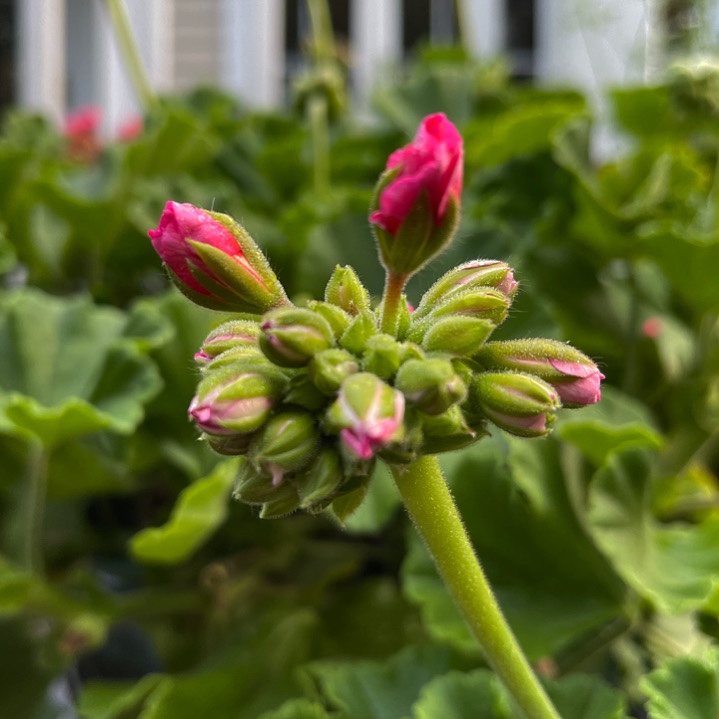
    That old expression, “when the student is ready, the teacher will appear”, applies equally well with the geraniums as with the mountains. When this student is ready I’ll attend to that checklist of summits once again, or perhaps I won’t. For today there are other lessons to learn.

    Geranium