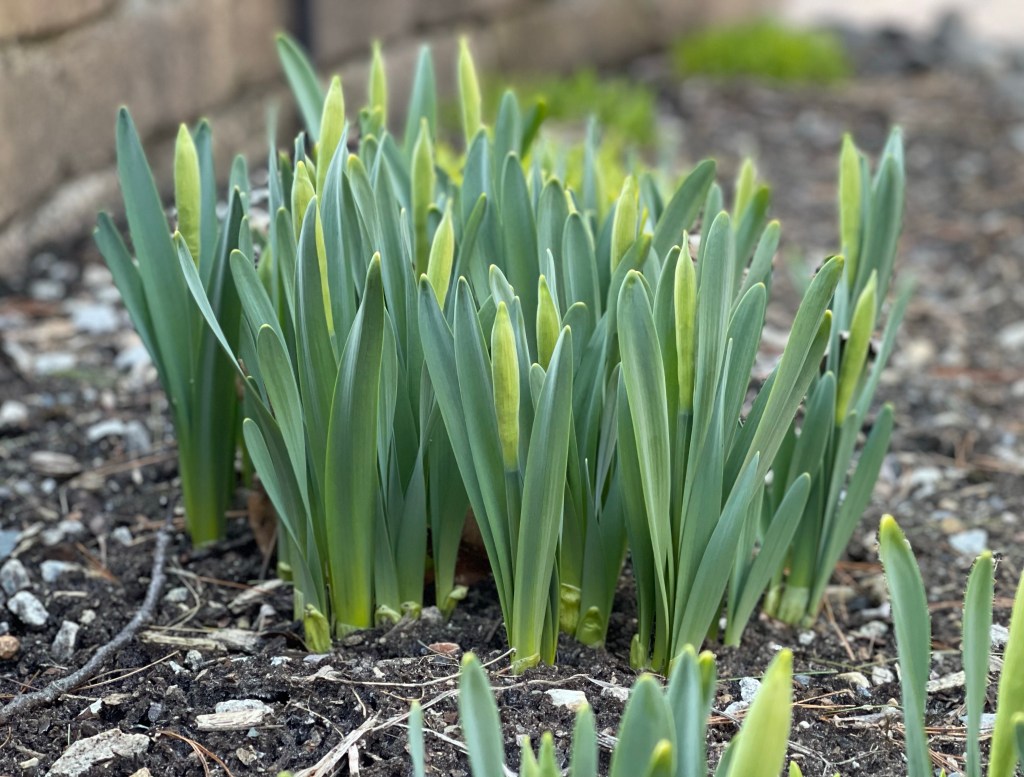
Category: seasons

  • Back to the Garden

    And maybe it’s the time of year
    Yes, and maybe it’s the time of man
    And I don’t know who I am
    But life is for learning
    We are stardust, we are golden
    We are billion-year-old carbon
    And we got to get ourselves
    Back to the garden
    — Joni Mitchell, Woodstock

    At first I thought it was simply the snow melting while I was away. The place looks different, I thought. Some of the usual winter cleanup to do, fallen leaves and an abundance of fallen branches litter the lawn and garden. Some wood rot on the pergola that must finally be addressed this season. Some fallen trees that ought to be cut up for firewood before mud season arrives in earnest. Yes, this must be what’s different about the place, I thought again. Spring cleanup and such.

    We know when we’ve been away too long from the garden. There are things to be done. Things that bring us back to the earth. Things that ground us. Seasons work on us in profound ways. It’s not just the place that’s changed, but me. I’m not the person I was when winter began—are you? We’ve all change in ways big and small. What are we to do when we understand this about ourselves but to lean in to our best possible outcome in this next season?

    It occurred to me that I didn’t even know what stage the moon was in late last night. There was a time when I knew where every planet was in relation to where I was standing. The universe marches on whether we pay attention to it or not. Sometimes, in our frenzied and productive lives, we forget to be a part of things. Sometimes we forget who we are. What our place in the universe is. But life is for learning, and a new season is upon us.

    Gardens and sweat equity, pets and poetry, walks in the woods and wonder at the stars: each offer an opportunity to find our stride once again. As Whitman would prod, this powerful play goes on, and we may just yet contribute a verse. Has everything changed? Always. But while we go on, we might play a part.

  • Insist on Color

    “I don’t trust the answers or the people who give me the answers. I believe in dirt and bone and flowers and fresh pasta and salsa cruda and red wine. I don’t believe in white wine; I insist on color.” ― Charles Bowden (Via Outlawspoetic)

    There are surely shades of gray that warrant discussion, for there’s a place for nuance in this complicated world. But give me color. Give me personality and vibrancy. Give me that jolt that knocks me off my complacency when I encounter something out of the ordinary.

    There’s a reason humans seek out sunsets and the aurora borealis, knock down doors to see Van Gogh or sing about pink houses. We humans crave brightness and a rich color palate. Life is full of enough muted living; give us bold.

    This blog was started as a lens on a particular corner of the world I happen to love. It’s grown as my attention shifted, as I’ve changed. What comes next is anyone’s guess, but expect colorful wherever we go.

    Early Morning Orange
  • A Snowball Walk in the Woods

    There are winters when it seem to snow, relentlessly, mercilessly, every day. The types of winters that wiped out half of the pilgrims on the Mayflower. “Hungry? Eat more snow!” kind of winters. This was not that kind of winter in New England. And now that we’re well into March, when the sun is higher and the snow melts quickly, it seems clear that opportunities to celebrate winter are drawing to a close.

    Blame it on seasonal variability or jet streams run askew or climate change, whatever the reason, the opportunities to fly across snow on skis or snowshoes wasn’t quite available locally. None of that quick lunch hour snowshoe hiking presented itself this year in southern New Hampshire. And truthfully, I missed it. When friends invited me to hike up north after a heavy snowfall on Saturday, I leaned in towards it but pivoted back to home. I wanted to savor the local trails instead. It turned out to be a sound decision.

    Driving over to a local town forest, I expected the parking lot to be jammed full of fellow snow lovers. Instead, I found it relatively quiet. Tracks indicated others had set off on snowshoes, while a few chose to post-hole their way through the snow, wrecking the pristine trail. This would prove a problem on the wooded trails, but in the fields I simply flew off on my snowshoes to break my own trail. After all, this was what I missed most this winter—flying atop unbroken snow.

    It proved to be as delightful as I’d hoped it would be, but already the sun was up and working on the snow pack. The trees began dropping snowballs, often with small branches, which dampened my enthusiasm for the wooded trails. The fields were better, and I thumped my way around in earnest, seeking that flying feeling until I was breathless. Stopping for a rest, I looked around and listened. Nothing but snowballs falling in the woods. Not a single human voice, or dog barking, or even a car far off in the distance. Just a clydesdale in snow, appreciating the briefness of the moment. We never know if we might have another opportunity to do something. A winter like this one teaches you to make the most of the moment before it melts away.

    A rare opportunity to fly over snow
  • Stories in Time

    Now through the white orchard my little dog
    romps, breaking the new snow
    with wild feet.
    Running here running there, excited,
    hardly able to, stop, he leaps, he spins
    until the white snow is written upon
    in large, exuberant letters,
    a long sentence, expressing
    the pleasures of the body in this world.
    Oh, I could not have said it better
    myself.

    — Mary Oliver, The Storm

    A rafter of wild turkey hens took up residence in the woods prior to the last snowfall. Likely anticipating the snow better than this human could, they opted for the scattered certainty of fallen birdseed from the feeders over the starkness of scratching out a next meal from the deep blanket of fresh snow. Who can blame them? Without a dog for longer than I care to think about, a turkey might find the backyard a relative paradise. This turkey nurtured the land to be just so, for children who have long since migrated. The tracks across the snow break up the blanket as children and Bodhi once did, and I quietly celebrate the contribution to my own tracks.

    Perhaps it’s time to welcome another dog to write its own story in time. Life goes one. We bring to it what we choose.

  • What Falls Away is Always

    Great Nature has another thing to do
    To you and me; so take the lively air,
    And, lovely, learn by going where to go.

    This shaking keeps me steady. I should know.
    What falls away is always. And is near.
    I wake to sleep, and take my waking slow.
    I learn by going where I have to go.

    — Theodore Roethke, The Waking Poem

    We might agree that our lives are a brief accumulation of ideas and ritual, happenstance and things, that are ours today and a part of our history tomorrow. We’re all winging it, it seems, following instinct and a compass that is drawn to comfortable and habitual. Learning this about each other and ourselves, most of us hit our stride in time. Still, some chafe at life and constantly turn it upside down in the hope that there’s more on the other side. What is the right path? Doesn’t that change too? We’re a work in progress, each of us, wherever we are along the path. The view and how we feel about it changes as we ourselves change.

    Looking back is most striking. Old photographs and videos from another time in our lives betray who we were once, and that wave of change breaks over us, soaking us in memories. We recognize that we are not any one moment in our lives, we’re the sum of it, a character study transforming. We each see where we’ve been, but we learn by going. Who we were always falls away. The only way is onward to the next.

  • Geysers and Ice

    Iceland is known as the land of fire and ice, for all the volcanic activity you can find nudged up against the Arctic Circle. Visiting in February, there’s ample opportunity to experience ice, but less so fire. You just don’t get eruptions that frequently, even here. But you do get plenty of geothermal activity. They might be experienced as hot springs, as with the Blue Lagoon, or they can be experienced as geysers dancing with in sky. Both are amazing to be a part of,

    Geysers are what you might expect: groundwater boiling underground looking for a release. Once it finds a weak spot it erupts with whatever force it’s accumulated. The result, especially on a cold winter day, is a spectacular column of boiling water and steam. Not something to linger too close to, but fun to watch from just far enough away.

    The word geyser originated in Iceland, with a geyser called—surprise—Geysir. Geysir is largely dormant now, but the boiling water has a release point nearby in a geyser called Strokkur, which spouts every 7-10 minutes. It’s predictability and frequency make it a great place to experience a geyser with efficient use of your limited winter daylight.

    Strokkur
    Strokkur
  • Finding Aurora

    “The Aurora Borealis is a fickle phenomenon. A week can pass without a flicker … then bang! The Northern Lights come on like a celestial lava lamp.” — Nigel Tisdall

    I went to Iceland expecting to be disappointed by the weather. I’m not a pessimist by nature, but the forecast simply didn’t look good. There are a lot of reasons to go to Iceland in winter, but the primary reason is to see the Aurora Borealis. Yes, there are waterfalls and volcanoes, geysers and glaciers. These are spectacular, but also things that you can see any old month. But the Northern Lights are more evasive than that. Dark, clear skies are merely a starting point. You must also have some luck. Winter brings ample darkness but also some challenging weather conditions. We put ourselves in the way of beauty, but a bit of luck goes a long way too.

    Sure enough, we arrived to heavy snow. That might have frustrated me, but I’d already seen the Northern Lights on this trip. We’d had an ace up our sleeve, a window seat facing north for the flight, which carried us over the snow-laden clouds, up where auroras dance. It’s there that I finally glimpsed it, checking a box I wondered when I’d ever get to. There’s still hope for more dances with Aurora, should the weather cooperate, beginning tonight. Bucket lists deserve more than a brief encounter to savor, don’t you think?

  • A Wisp of a Moment, Captured

    On a recent walk I noticed the recently painted median strip dividing the road featured artwork now and then. It seems they painted the road in autumn, as the oak leaves returned to the earth to close their cycle and begin again. A few rebels, wishing for immortality perhaps, found the opportunity to capture the moment. It struck me this was what all artists do; reach out from the anonymous mass of their moment and leave something of ourselves for others to find.

    There’s something lovely in the temporary nature of this street art, akin to chalk drawings on sidewalks or sandcastles at low tide. Some art is meant to someday be a memory, recalled in quiet moments when you again walk down that street or on that particular stretch of beach. Do you remember the leaves of autumn, swirling in the wind? How quickly they fade from memory. We surf on a wisp of a moment, sometimes captured, mostly lost forever. We ought to embrace the freedom in that, elusive as it feels, for this is our fragile dance.

    “If you would create something, you must be something.” ― Johann Wolfgang von Goethe

    At times we hear the call from the naked page of a notebook, and at times from the middle of the road. Leaves locked in the amber of their moment are a whisper from seasons past to do something with this one. To feel the urgency of the season and make the most of it before the moment fades. This is the unique call of our work, leaping to our attention in the strangest of places. In each case, the question lingers in the moment: Where will you take us now?

  • Deliberate Reflection

    “Productive activity has nothing to do with being swept away by the inertia of busyness. It is not about quantity, either. Rather, it is a deliberate choice of where and how to direct one’s attention.” — Brad Stulberg, The Practice of Groundedness

    We seek solitude, when possible, in the quiet places. Places of stoic beauty with elbow room necessary to reflect. Places of quiet walks and the indifference of cold. For me these places are off-season beaches and lonely trails that lead me deep into the woods, or most days simply the magic hour before the rest of the world awakens.

    Some believe solitude is the very opposite of a productive place, thinking collaborative effort and the energy of the pack fuels production. But we humans aren’t cogs in a factory, at least we aren’t meant to be. We can be so much more than that if we choose to find it within ourselves. There is no reflection in a turbulent sea.

    Sometimes, even in quiet places, perhaps especially so, we come across characters who are starved for attention. They’ll steal sand from our hourglass if we let them, and take us away from ourselves. These sand gobblers disguise themselves brilliantly in the faces we trust the most. There’s nothing wrong with sharing our sand with others, but we must guard against the gluttonous lest they take it all.

    We must be deliberate in where we use our time, and mindful of just who is the director of our attention. The world will always ask for everything. What we give to it is up to us. We earn our director position in every moment. Deliberate reflection is not an act of selfishness, it’s preservation of the self.

  • An Unusual Winter

    Winter is different this year. The ground, frozen for weeks leading up to the New Year, thawed in a warming trend that hit New England in the first few weeks of the year. We sometimes say we’re grateful when it rains instead of snows here, knowing the general equation of one inch of rain equalling one foot of snow, but some of us actually prefer the snow. And when it finally came after the thaw and heavy rains, it made for muddy cleanup when you dared stray off the pavement. Yes, winter is finally here, sort of, and fashionably late, so enjoy it while you can. Just don’t go straying out on pond ice or try to steer a snowblower across the lawn to the shed. Each of these reckless acts will end in regret.

    Plenty of friends and acquaintances celebrate a mild winter. Perennially overextended, they’d rather deal with snow on their terms, with a quick ride up I-93 to the ski resorts. “Let them have the snow;” they say, “we’d rather not deal with it here”. As if we aren’t meant to have it here. Here isn’t all that far from there, I think, and winter has retreated enough already.

    I’m more sympathetic with the aged and the frail amongst us. Shoveling and navigating the world is a lot more complicated for them when you add heavy snow. This is where a sense of community is essential, to help those who might not be physically able to help themselves. Like snow, we accumulate awareness and empathy over time, and learn to check in on people more than we might have when we were younger and more carefree.

    We witness the changes in those we know moving from vibrant wrestlers of winter conditions to a more fragile condition. On days of particularly heavy and wet snow, we learn to face our own move to a more fragile condition. They call it “heart attack snow” for a reason, and something as mundane as shoveling snow can be a reckless act if our heart isn’t up for the task. We ought to celebrate the things we can do now, like walking in snow through the woods to visit a pond or simply shoveling the deck, for one day it will be beyond our reach.

    After cleaning up the remnants of the latest storm, I took a walk through the woods to see how winter was treating a local pond. During the drought of summer it had dropped to sad levels. With the rains of autumn and winter the water levels were back to normal and now coated with a slushy ice coating that wasn’t to be trusted. Still, it made for a pretty winter scene on a quiet winter morning. Moments like this are what we remember about winter, even as we forget that winter isn’t what it once was.

    Facing the changes this winter, it’s easy to see that everything is connected. Everything has its time, maybe even normal winters. With things like climate and physical fitness, we ought to do what we can while we can. Regret is no way to cap a window of time when it closes.