“Life starts all over again when it gets crisp in the fall.” — F. Scott Fitzgerald
Who says beginnings should be saved for New Year’s or spring? Every day offers the same opportunity for transformation. Aside from seasonal planting and certain outdoor sports, a crisp autumn day seems just as appropriate a time to change things up as the first day of spring.
Crispy days conjure memories of the first day of school, or heading off to college or beginning a new season of your favorite fall sport. The connection to beginnings isn’t all that much of a reach after all.
So as the air gets good and crispy, and as the earth tilts just so in the Northern Hemisphere, what are we to do with it?
“One doesn’t discover new lands without consenting to lose sight, for a very long time, of the shore.” — André Gide
The truth is, we each concede more than we consent. The truth is, discovery is a shore too far for many of us. And yet we each set sail in our own way from the past every day. What seems the same alters ever so slightly each day, imperceptibly, inalterably, and we wrestle with the truth of it whether we set our course for distant shores or futilely try to hold on with all our might to what once was.
This is the time of year when parents post pictures of children heading off to school, on their way to discovering their own new lands. The discovery isn’t just for the children, but the parents too, as they return to a home different than it was before. At such moments the daily leap is profound in its breadth.
So often we dwell on the gap between where we are and where we hope to be and our confidence waivers. Discovery requires a leap into the unknown, and the courageous consent to make that leap. Indeed, the thrill of losing sight of who we once were and gliding into an unknown future might be frightening, but ultimately, doesn’t it bring us to places we never thought possible?
Sometimes we get so caught up in what we might lose that we forget about what we might find.
A monk sips morning tea, it’s quiet, the chrysanthemum’s flowering. — Matsuo Bashō
The mornings are chilly again, and unlike Bashō’s poem, full of the sounds of squirrels gathering food and bickering about who gets what. The water is warmer than the air, for the sun is reluctant to stick around so long nowadays. The seasons are flipping, just as surely as the hickory nuts are falling.
I think about the fall cleanup and shudder. Is it the chill in the air or the thought of forced labor to come? We dream of autumn for all its beauty, for the crisp air and the scent of fallen leaves. We forget about the work. We pay penance for the pleasure.
I promised myself I’d drink more tea this summer. I planned to use more of the mint spilling out of its terra cotta pot in an attempt to displace the basil in the neighboring pot. Yet the drink of choice is most often coffee. Does coffee nullify my monk inclinations, or does the ritual matter more? Ask the flowers—for they’ve quietly observed all summer.
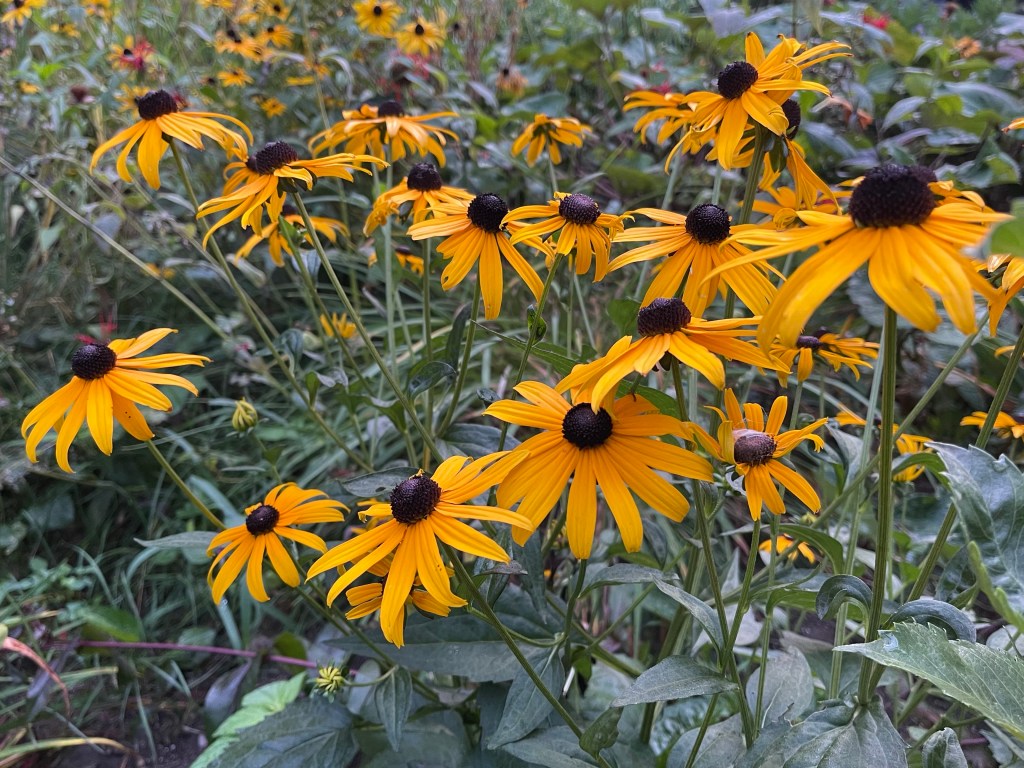
Black-eyed Susan’s once again dominate, staking a claim on more of the garden every year if you let them. I mostly let them. They remind me of conversations with a favorite gardener who’s moved on, which means they’ll forever receive favorable treatment in my garden.
Crickets receive no such favorable treatment, but we peacefully coexist nonetheless. They play the soundtrack of August. Most of the year we hardly give crickets a thought, until they begin playing their persistent song from mid-summer to mid-autumn. Thousands of musicians announcing “We’re here, if only so very briefly.” Is there anything more stoic than a cricket?
The gardener senses the seasons. No calendar is required. The days grow shorter even as the heat continues. For these are the dog days of August, marked by black-eyed Susan’s dancing to the persistent tune of an orchestra of crickets.
For all the new experiences I seek in this world, for all the exotic foods I’ll willingly try at restaurants around the globe, I tend to stick with the greatest hits when cooking at home. Call it frugal, or boring, or maybe simply safe, but I mostly cook foods the way I know they’ll be tasty without straying too far into the abyss.
And so it was that corn on the cob was always shucked and steamed or boiled, and the grill was used for meats and other vegetables. Similar to my previous hesitation with pizza, there was a distinct separation of church and state when it came to taking perfectly good corn and sticking it on a grill. But like that pizza, I eventually recognized that the risk versus reward equation leaned heavily in my favor.
There are three ways to grill corn, and two of them involve completely shucking the corn husks off. You can oil and season the corn and throw it right on the grill for a nice char and flavor, which is great if you remain at the grill and fully attentive to avoid burning it. Alternatively, you can wrap it in aluminum foil, which steams it while lightly charring it. Both of these methods seemed appropriate for the first attempt at grilling, but I wanted to go all in with the third method: grilling corn with the husk still on.
Ironically, grilling with the husk on is the most labor-intensive grilling experience. You’ve got to roll back the husks, remove the silk and roll the husk back on, then soak the corn for 30 minutes so it doesn’t just burn away when you grill it. Not nearly as simple as throwing the shucked corn into a pot of steaming water, but what worthwhile endeavors in life are easy?
I chose to use a charcoal grill with some hickory chips tossed in to maximize the flavor, waited for the grill to cool down to 400 degrees and placed it directly on the grill. Every five minutes I rotated the corn a quarter turn for about 25 minutes, then removed it, cleaned the grill and let it rest while I grilled the meat.
And the result? Perfectly cooked corn with a mild grilled flavor. Nothing revolutionary here, but a departure from the norm. It was a good reminder to push the comfort zone with my own cooking. Next up? Direct charring on the grill. Can’t let this adventurous momentum stall just yet. After all, summer and fresh corn won’t last forever.
Ah, yet, ere I descend to the grave May I a small house and large garden have; And a few friends, and many books, both true, Both wise, and both delightful too! And since love ne’er will from me flee, A Mistress moderately fair, And good as guardian angels are, Only beloved and loving me. — Abraham Cowley, The Wish
The air is filled with squeaky chirps and the buzzing sound of wings beating the warm morning air, announcing that the bluebirds of June were replaced by the hummingbirds of July. They remind me that the garden, despite early neglect, still dazzles, inspires and informs. The frenetic urgency of the hummingbirds to feed brings life to the midsummer garden, just when it most needs a lift.
It’s sometimes easy to forget the things we build around us that attract nuance and substance. We build our lives on the four cornerstones of relationships, legacy, learning and action. Each in turn determines who we might become as we build our life atop this foundation. Like the birds flirting briefly with the garden, people come and go from our lives. Jobs and money and fashion come and go. We each note the changes, but how we react is determined by who we’ve grown to be.
What is a garden but a foundation? We stake our place in this world to cultivate our hopes and dreams as life changes around us like the seasons. Each season brings enchantment, frustration, context and acceptance. We become what we cultivate, influenced by the seasons but not always determined by them. Everything has its time, and the blessings in our lives must be realized in their own season.
There’s been some unusual activity in the garden lately. A squirrel walked up to me as I sat still sipping coffee, looked me squarely in the eye and didn’t run away until I called his bluff. A pair of bluebirds, normally quite shy, are aggressively guarding the birdhouse they made into a home. They let that squirrel know it was time to move along, while given me a sideways glance to remind me there will be no eggs for breakfast for me today.
Speaking of blue, it’s almost blueberry season in New Hampshire and that means the return of catbirds, the little devils who gobble up ripening blueberries by the pint, usually just before harvest. In previous years I’d rig netting and chicken wire to hold them at bay, but they always seem to find a way to the fruit. This year no netting and only a half-hearted attempt to chase them away. After traveling for much of June I’m conceding the early harvest to nature. Maybe I’ll have better luck with the tomatoes later in the season. We all choose what we fight for in this world. Isn’t it funny how that changes season-to-season in our lives?
Earlier this morning I walked around the garden, seeing first-hand all the work I’ll need to do to set things straight. Nearing the fence, I spooked a large doe, who betrayed her position in her panic. I told her as her white tail bounced away that I’d never have seen her if she’d just waited a beat longer. Movement betrays, it’s only in stillness that we become one with the natural world. The doe had no use for my unsolicited advice.
The garden is neglected and mocks me my late return to tend it: “Too little, too late pal.” Such is the way, for stillness need not apply in the garden. But I’ve come to think of the garden differently this season. Or maybe just my position as head gardener. I’ve taken something of a sabbatical this year with more emphasis on the hardscape and less on the seasonal magic. Looking around, it feels foreign to me, this garden I’ve labored over for years. Thinking about the behavior of that squirrel and the doe, I wonder if they simply aren’t used to having someone linger in the garden anymore?
Gardens, like our lives, ebb and flow. In June 2022, when things are usually flowing, I feel an ebb. So much feels different this season, but the bluebirds remind me that change is inevitable. We either roll up our sleeves and get back to work or we wallow in the blue. Gardens frown upon the wallowing gardener, for the season—our season—isn’t over just yet. And so it must be that we get back to it once again.
“I am summer, come to lure you away from your computer… come dance on my fresh grass, dig your toes into my beaches.” — Oriana Green
Maybe it was appropriate that today, June 21, the Summer Solstice, I awoke at 4 AM—just in time to mark the exact minute (4:13 AM CST) of the tip of the planet back towards shorter days. But let’s worry about that tomorrow, for today is the longest day of the year in the northern hemisphere. After bouncing from Vienna to Boston to Nashville, my body isn’t quite sure which time zone it currently resides in. Yet the mind is fully rested and ready to hit the day.
By the time of the solstice it usually feels like summer has been with us awhile. This year feels different, like I’m running away from the season. Travel will do that. I spent a day at home assessing the neglected garden before flying off once again. Is that a tragedy or simply a new way of experiencing the season? The weeds seem to enjoy my absence, while the cats seem surprisingly annoyed when I packed a suitcase as soon as the laundry was done from the previous trip. Sorry felines, the world calls.
Do you wonder why we heed the call at all? Isn’t summer a chance to slow down and relax for awhile? Tell that to a farmer. Europeans know how to take a proper holiday, Americans jump right into the next thing. Which is right? It depends on what you want your life to be.
Ultimately summers, like life, are made by what we do with the time. Whether our longest day or our shortest matters little if we don’t make something of the moment. Experience begins with presence, the rest is just finding a place to land and the tilt of the earth.
If you can’t decide what you want to do If you can’t stand what people say to you If you can’t see when your eyes are open wide If you ask yourself what your doing and there’s no reply Get outside — Robert Palmer, Get Outside
Sometimes you reach the end of the day and you don’t know what you’ve done with it. You check the boxes, have the conversations, do the work… and everything seems off anyway. These are days to get outside and feel the world.
Yesterday, after entirely too much madness in my life, I walked outside to seek answers in the blooming lilacs. Like so many flowering woody plants their blooms are here today, gone tomorrow. Yet their fragrance is one of the most familiar of all. They make their mark on the world and recede from the scene as summer heat approaches.
I want to tell them not to go. Stick around a bit longer. But of course this isn’t the way the world works. The lilacs remind us not to blink. It’s now or never, friend. Get outside and linger with them before your opportunity is gone. How many more lilac seasons do we have left in us anyway? We throw out our days as if our account is unlimited.
Why do we spend so much of our time indoors when the world whispers to us in this way? We ought to be more present with the larger world. We ought to embrace the changes that wash over us whether we want to pay attention or not.
The lilacs will surely return again next year—but will we be here to enjoy them? To every thing there is a season. The future is a fool’s game. Our moment is now. Get outside and find it.
“Deep in the forest there is something sacred that exists without a perceptible function. This is the central core, the navel of the world, and I want to return to that place.” — Hayao Miyazaki
Last month I walked through a forest with several coworkers on a group hike. One of them commented that the naked trees were spooky and reminded him of The Blair Witch Project. I looked around and saw something completely different. And two days later I doubled down on that place and hiked alone in the dark before dawn with a failing headlamp. The things we do for love.
So much of the world is what we perceive it to be. I may find tranquility in a stand of trees, someone else sees a buildable lot and the trees themselves as a commodity to haul off to the mill. America was built on such vision. Thankfully there are people who saw the land as something timeless and preserved it. Were we to level every forest where would we ever find ourselves?
The trees are beginning to leaf out in the Northern Hemisphere, transforming the naked landscape. Soon the forest will hide things that are apparent in colder months. Leaves bring deep shade and mystery to the forest. Often what we see appears distinctly different from one person to another. What the forest is really showing us is not itself, but our own nature. My hiking friend that day saw horror in the naked forest. I saw tranquility.