Star and coronal and bell April underfoot renews, And the hope of man as well Flowers among the morning dews. — A. E. Housman, Spring Morning
Spring in the air, with a twist of biting cold thrust like a knife into the gut to keep you on your toes. That’s April in New England—best to appreciate the brief moments of wonder before the weather changes yet again. Daffodils are one of my favorite flowers precisely because they take it on the chin over and over again and still rise to the occasion. Who are we to complain?
I’m not in a hurry to awaken the garden this year, feeling busy and distracted, but it doesn’t much matter whether I feel like awakening the garden or not, for the garden awakens. You either snap out of it and get ahead of things or you suffer through the ramifications of a rough start. There are beds to rake out, fallen branches to clear, fences to stand up, and soon sowing with more hope than a casual gardener has a right to. You’re either all in as a gardener or you concede it to the wild.
I suppose I’m not quite ready for that. Like the daffodils we must rise and do what must be done. Our season is so brief and well underway. And there’s still hope for the harvest.
“If there seems to be no communication between you and the people around you, try to draw close to those things that will not ever leave you. The nights are still there and the winds that roam through the trees and over many lands.” — Rainer Maria Rilke, Letters to a Young Poet
We’re often alone in this world, but alone doesn’t require loneliness. These days gifted to us are full of routine and ritual, from how we wake up in the morning to where we sit and what we eat. Who we interact with is often our choice, but alas, not always. How we react to everything and everyone we interact with—or don’t interact with—is always our choice.
Stepping outside on a spring day in New Hampshire, the world is alive in chatter. Birds and squirrels debate nest design or which yard has the best feeders today. A light wind might stir the tree tops like a hand brushing over tall grass, while a heavier wind might offer a gusty, heartfelt shake. No, there is no loneliness outside—the world is always present.
The garden begins to awaken. Rabbits have nibbled the tops off of some early bulbs, inspiring a silent curse and a fence resurrected to stake a claim for beauty. Days are longer now and there’s more to see, but for the stars as they concede more and more to the sun. Every day brings a new voice to the yard as the migration continues northward. Flashes of blue are a regular part of the days now as the Bluebirds, present all winter at the feeder, decided to make the birdhouse their own once again.
Every day is a poem. Every day offers an embrace when you step out to greet it. Even on the quietest of days, the wind always speaks.
We are the first double-leaf sprout, two inches out of the ground. We need rain, or we may not grow more than this. — Rumi
The rain rolled in right on schedule, really, timed to mask the Aurora Borealis thoroughly and keep my mind from wandering north. Quietly scheming to drop everything and drive as far north as necessary to be under the northern lights, it became a blessing when I saw there was no point in trying this time. Even as the geomagnetic activity caused a stir of excitement in the aurora community, Mother Nature mocked the audacity of those of us waiting for our turn in New Hampshire.
April is the second month of the Roman calendar. Depending on the sources you believe, the name is derived from the Roman word Aprillis, for second, or aperio, which means to open up as a flower does. I’ll stick with the former, even as I recognize the world opening up around me. April showers help this process, even as it masks the magic in the universe.
So be it. We need the rain. More importantly, I need to be present here and now, focused on things beyond my control. Let it rain. April showers wash away the last of winter and coax the earth to awaken in the gun-shy way annuals always approach April in New England. Stick your head up too quickly and you’ll end up freezing it off. Yet one day at a time the world begins to green once again.
We asked the universe for clear skies, we received days of steady rain. These are the gifts we don’t always welcome in the moment, but come to appreciate some time down the path. For now we must be rooted, and using the stormy days for growth.
“We do not know how life is going to turn out. Therefore the story has no beginning, and the end can only be vaguely hinted at. The life of man is a dubious experiment. It is a tremendous phenomenon only in numerical terms. Individually, it is so fleeting, so insufficient, that it is literally a miracle that anything can exist and develop at all. I was impressed by that fact long ago, as a young medical student, and it seemed to me miraculous that I should not have been prematurely annihilated. Life has always seemed to me like a plant that lives on its rhizome. Its true life is invisible, hidden in the rhizome. The part that appears above ground lasts only a single summer. Then it withers away — an ephemeral apparition. When we think of the unending growth and decay of life and civilizations, we cannot escape the impression of absolute nullity. Yet I have never lost a sense of something that lives and endures beneath the eternal flux. What we see is blossom, which passes. The rhizome remains. In the end the only events in my life worth telling are those when the imperishable world erupted into this transitory one. That is why I speak chiefly of inner experiences, amongst which I include my dreams and visions. These form the prima materia of my scientific work.” — Carl Jung, Memories, Dreams, Reflections
Our lifespan is but the bloom that eventually withers away, yet the rhizome remains in our spirit and the work we leave behind for others. Think of the traits we see carry from generation to generation. Think of the art and music that resonates long after the composer has withered away. We have people that stay with us for the rest of our days; we can see the twinkle in their eye, we can hear their laughter. Life is Jung’s ephemeral apparition, but as we feel of those who have transcended this world, the physical manifestation of our being isn’t all there is of us.
Our season is very short, but rooted below the surface we’re anchored to eternity. And this, when you think about it, offers a bit of hope in this ridiculous game of living. For we come and go in our season, but our rhizome remains. There’s a sense of permanence in that, as we make the most of our impermanent time in bloom. We shine in our time and offer what we might to those who carry on.
Cape Cod is a summer playground, we all know that. But what of winter and early spring? These “off” seasons are often described by well-meaning seasonal snobs as desolate and depressing. I’d argue for the stark beauty of isolation, and seek it out whenever possible. The Cape isn’t desolate off-season; it’s dormant. If you listen you’ll hear the pulse of preparation for the busy months. You’ll see the changes as houses transform from small cottages to McMansions all around you. People want to be here, more than ever, and will pay insane sums of money to have their place in the sand.
I spoke with a neighbor, who lives alone on a plot of land he bought against the strong wishes of his future in-laws for $10,000 back when the Beatles were still cranking out albums. That view is worth well over 100 times what he paid for it back in the day. But money doesn’t matter for him now, what matters is this spot and his place in it. He keeps watch on the bay, talks of old storms and the last time he saw a seal on the beach. Time flies by, and he’s one of the last holdouts from the original young hopefuls buying property in this small piece of paradise. Five and a half decades watching the tides ebb and flow teaches you a few things, and he’s happy to share lessons if you invest your time. I’m in investor in such time.
I check in on him whenever I visit the Cape, especially off-season. I might be the last person who stepped into his house over a month ago. I’m surely not his first choice for visitors but he hasn’t locked the door on me yet. I did a couple of chores for him while he settled in for story time. He spoke of old cocktail parties as I brought up a few bottles of scotch and bourbon coated in a decade of dust from his basement. His sister was coming over in a week or two (what’s time?) and they were going to light it up once again, having a cocktail with a view of the bay.
Walking alone in the thick Buzzards Bay fog the next morning, I thought of him alone in his house with the million dollar view. He’s like a lighthouse keeper forever on watch as the world changes around him. He’s both an anchor to what once was and a witness to what is becoming of the upper Cape. Walking around, I was drawn to the bits of hardscape that rose up out of the fog, to reflections in water and the sense of timeless change. We’re all lighthouse keepers in the fog, both anchors and witnesses. We hold relationships and communities together, remember the lessons of the past and share them when we have an audience willing to listen.
Fog is disorienting because our eyes have nothing to lock on to. The swirling white mist hides both the objects we seek out and the ones we hope to avoid. A lighthouse keeper cuts through the confusion and helps us realize our place. Moving around the bay, seeing objects rise up to greet me, I understood why I’d come down here alone. I was simply keeping watch, it was and always has been about the lighthouse.
Monument Beach, in the Upper Cape town of BourneCape Cod Railroad Bridge swallowed in Buzzards Bay fog
“On every side, the eye ranged over successive circles of towns, rising one above another, like the terraces of a vineyard, till they were lost in the horizon. Wachusett is, in fact, the observatory of the State. There lay Massachusetts, spread out before us in its length and breadth, like a map. There was the level horizon, which told of the sea on the east and south, the well-known hills of New Hampshire on the north, and the misty summits of the Hoosac and Green Mountains, first made visible to us the evening before, blue and unsubstantial, like some bank of clouds which the morning wind would dissipate, on the northwest and west. These last distant ranges, on which the eye rests unwearied, commence with an abrupt boulder in the north, beyond the Connecticut, and travel southward, with three or four peaks dimly seen. But Monadnock, rearing its masculine front in the northwest, is the grandest feature.
As we beheld it, we knew that it was the height of land between the two rivers, on this side the valley of the Merrimack, or that of the Connecticut, fluctuating with their blue seas of air,—these rival vales, already teeming with Yankee men along their respective streams, born to what destiny who shall tell? Watatic, and the neighboring hills in this State and in New Hampshire, are a continuation of the same elevated range on which we were standing. But that New Hampshire bluff,–that promontory of a State,—lowering day and night on this our State of Massachusetts, will longest haunt our dreams.” — Henry David Thoreau, A Walk to Wachusett
Mount Wachusett is a glaciated monadnock, standing 2006 feet tall. Like her neighbor to the northwest, Mount Monadnock in New Hampshire, Mount Wachusett stands watch over the landscape that bows before her. You can’t talk about one mountain without mentioning the other, for they are forever kindred spirits in the landscape. Both mountains are uniquely positioned so that their waters flow to the Merrimack River from one side and to the Connecticut River from the other. The waters from each river run in my blood, which made a hike to the summit a sort of homecoming for me. And yet, for all the hikes I’ve done on Monadnock, I’d never hiked Wachusett.
This was a month where the weather continued to disappoint those who dream of deep snow drifts, while thrilling those who pine for a mild winter. Count me in the camp of the former: I wanted nothing more than to fly across snow plains this winter. A heavy snowfall the day before offered one last chance for the month. But it was quickly apparent that this was a micro spike hike, and the snow shoes were left behind yet again.
From the Visitor’s Center, you can easily summit Mount Wachusett in under 30 minutes. But that wasn’t our goal. Instead we took the Bicentennial Trail around the eastern slope to High Meadow Trail, up through a stand of Hemlocks to the Pine Hill Trail. Fluffy snow over ice creates uncertain footing, and we slowed our pace to mitigate the risk of injury. For a time, the only break in the trail ahead was from a porcupine, who’s distinct tail marked the trail in footprints and swirly plows. It seems most people cut to the chase and scramble up the mountain. We were more inclined to linger with it, to get to know it better. To feel what Thoreau felt when he and Richard Fuller hiked here from Concord, set up their tent atop the lonely summit, and had the place to themselves for a night.
Wachusett’s summit has changed since Thoreau’s time. There’s a ski slope on one side, there’s a mountain road you can drive up in the warmer months to see the view without earning it, and there’s ample parking for those cars. A few towers, including an observation tower, complete the scene. I wonder, reading Thoreau’s account, where did they pitch their tent and read Virgil by the light of a summer full moon?
Winter snow obscures much of the impact of man, but you’re still clearly in a manmade world when you’re on the summit of Mount Wachusett. To return to nature you must seek the trails that criss-cross around the reservation. But the views are largely the same as they were for Thoreau’s 180 years ago. Just as it was for him, Monadnock stands prominently as the grandest feature of the 360 degree view.
Inevitably we left with more to see, trails and old growth forest to explore another day. For this day I found what I was looking for. Time with an old friend hiking trails I’d always meant to get to one day. And a glimpse into a world Thoreau would find both foreign yet comfortably familiar. Wachusett is timelessly accessible, but somehow always felt apart from the mountains I sought out. We finally got acquainted with one another.
Summit tower, Mount Wachusett Distinctive porcupine tracks mark the trailPlenty of exposed granite despite the snowWhich way do we go? Plenty of choices.
Do you ever wonder about this Roman character, San Valentino, who was martyred when he died around 268 AD? He was the patron saint of courtly love, beekeeping and epilepsy, according to his Wikipedia page. That’s a trifecta right there. I’m not sure if the beekeepers celebrate him the way the lovers do, but you’ve got to hand it to the Christians, they’ve kept him busy in his afterlife.
Then again, I’m not sure how much work sainthood really entails anyway. Cupid seems to do all the early work. He was the son of Venus and Mars, which fittingly represented love and war, respectively. Most relationships have a healthy mix of each, for while we unite as one we remain independent as well. The key is the balance between unity and independence, as any long termer might point out.
The real winners on Valentine’s Day are the companies that cater to the audience: Hallmark, jewelry stores and florists, and the chocolate makers. For what says “I love you” like a gift from Kay? Humph. The hardest part of the lead-up to Valentine’s Day is navigating the card aisle at the local stores. Here you’ll find some of the lamest expressions of gushy love ever created. Which is why I head right for the humorous cards, looking for some magic in a clever punchline just inside. Inevitably most of these fail horribly as well, leaving you to find the best available under the circumstances. For me, a card that gives me enough room to write something more meaningful than the punchline is my first choice.
When you stack up enough Valentine’s Days with someone, the marketing doesn’t resonate quite the same. For you show your feelings with action and consistency and the occasional bouquet of flowers on a random Wednesday. Valentine’s Day is an acknowledgement that another year has gone by and I’ve still got your back. The rest is just clever punchlines and cheap chocolate.
Friday offered heavy rain that turned to sleet and finally snow. With temperatures plummeting, this quickly turned into a frozen mess on the roads. And temperatures stayed well below freezing, guaranteeing that anything frozen was likely to stay that way for a few days. The snow was transformed to rock-hard ice, with a light frosting of granular snow atop it. It was perfect for slipping on boots and micro spikes and heading for the trails.
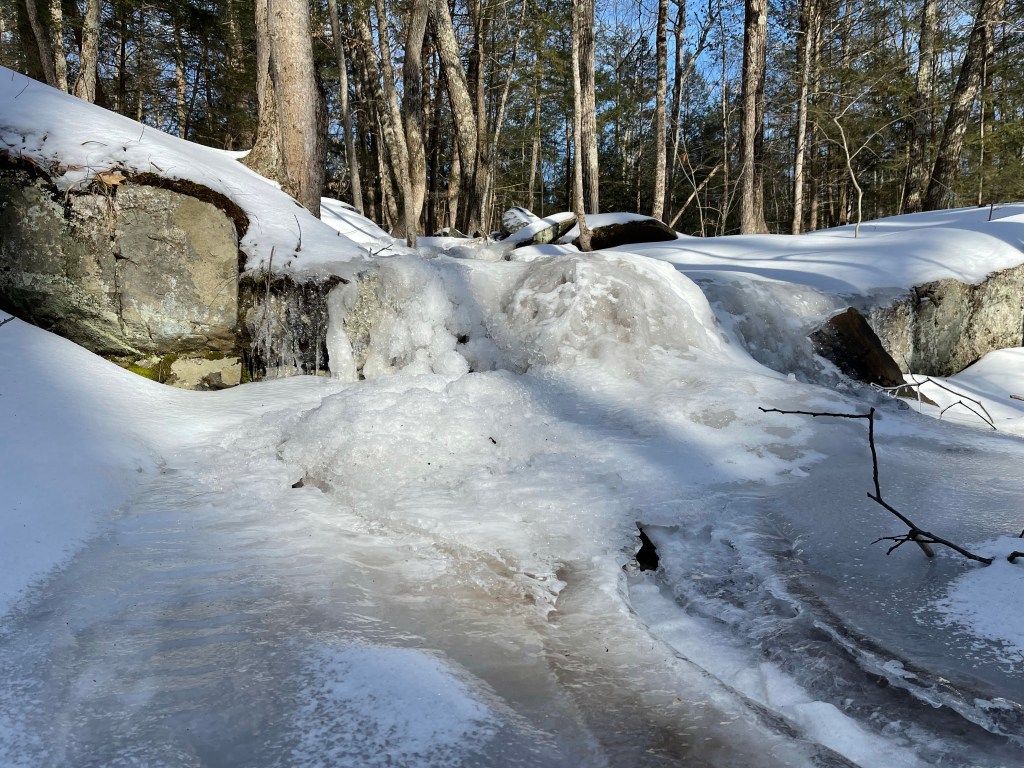
The same conditions that make roads miserable transform trails into magic carpet rides. Most of the sins of the trail are locked below the frozen hard pack, and with the right gear the trail is a joyful peregrinate through the wonders of the forest. Streams and waterfalls become sculpture. Granite recedes from primary feature to delightful accent locked in the ice blanket. The trail itself offers an entirely different experience than it did just days before when snowshoes were the kit of choice. In winter every day brings something new, should you go out to find it.
Much like the landscape around you, walking alone through the woods on a frozen but brilliant sunny day you become intensely embedded in the moment. You don’t walk with purpose to a destination, the walk is your destination. Every step becomes the point of your being here. With micro spikes announcing their grip on the ice, every step becomes a cry of Now! Here! Now!
I visit a frozen waterfall. I only seem to visit it in winter, when it’s locked away in ice, and each visit I tell myself I ought to stop by in spring when the water is running angry. We all feel locked away ourselves in winter, I suppose the waterfall and I are kindred spirits in this way. My visit becomes a vote of solidarity with the falls behind the ice. I promise once again that I’ll be back, and believe I mean it this time. The frozen waterfall is indifferent to my promises. All that matters is the present for a waterfall. The future lies upstream, waiting for its moment. Whether I’m here for it doesn’t matter to the waterfall.
I come across a few people along the way, couples and dog walkers and snowshoers gamely giving it a go on the ice. Read the room, folks. The trail betrays all who have come before me: fat tire tracks, boots, paw prints and snowshoe tracks. We believe we’re the only people on earth when we’re alone in the frozen woods, yet here was proof of all who came before, with all that you chance upon. You aren’t really alone in the woods, you’re alone in the moment. And there’s a measure of delight that washes over you as you make your way towards your own future.
The forecast called for a blizzard, and officially it met the requirements to be called one in some places. Not so much where I call home. But a significant storm nonetheless. A storm you take seriously. A storm you hunker down in. A storm in which an adventurous spirit might look out at the hot tub and think to oneself, “I’m going in, now”. And fancying myself so, I changed into a bathing suit, slipped on my adidas slides, a cap and the warmest shirt I own and headed out into the swirl.
Taking a broom with me, I swept a path through the 4 inches of light accumulation to the tub, swept off the cover, opened the tub and took a deep breath. Off came the warm shirt and the tickle of snow landing on my back greeted me immediately. Stepping out of the slides into the 39 degree Celsius/103 degree Fahrenheit water, I felt the sting of fast-frozen toes meeting heat. I quickly brought my other foot in for the party and dropped down to chin level to warm myself.
Immersing yourself in hot tubs (or hot springs) is supposed to improve your health in several ways. First, it puts you in a state of weightlessness, easing stress on your joints and relaxing muscles. But it also improves cardiovascular health and helps lower your blood pressure. The jets in a hot tub offer some massage for those sore muscles. But mostly a hot tub draws the stress out of you and plunges you into a relaxed state.
That state change is most obvious when you’re sitting in hot swirling water in a snowstorm, with the steam rising up to meet the snow as it swirled down to reunite with the water. That’s some extreme swirling, to be sure, and with your head places squarely on the line between chaos and order, Yin and Yang, you have a front row seat for the dance. Too much in either direction and you’ll freeze or drown. Choices. It was life, amplified, in the splurgy decadence of a hot tub in a blizzard.
The fine snow accumulated all around me, coating all cool surfaces. I felt it landing on my exposed skin, sliding down to greet the hot water or melting in surrender to the warmth of my body. But the snowy assault kept on relentlessly. My knit cap, my eyelashes and nose collected snow. The line between chaos and order is very thin in such conditions, and I delighted in the opportunity to be right there. Nothing else mattered in that moment.
But all good things must end, and at some point you’ve got to brace yourself for the retreat from the hot tub through the swirling snow to the warm house. This is best done with purpose, and I reached up and shook off a towel, quickly stood and wrapped my shoulders and reached for my wool shirt, shook that off too and replaced the towel with the cold shirt as I got up. I offered the adidas a dip in hot water to clean off the snow and slipped them on.
It was all a choreographed dance on the edge of chaos, and I loved it without lingering. Buttoning up the hot tub and walking through the accumulation was my penance paid for the indulgence. Still radiating heat, I shuffled back to reality while scheming a return.
“I wonder how long it would take you to notice the regular recurrence of the seasons if you were the first man on earth. What would it be like to live in open-ended time broken only by days and nights? You could say, “it’s cold again; it was cold before,” but you couldn’t make the key connection and say, “it was cold this time last year,” because the notion of “year” is precisely the one you lack. Assuming that you hadn’t yet noticed any orderly progression of heavenly bodies, how long would you have to live on earth before you could feel with any assurance that any one particular long period of cold would, in fact, end?” — Annie Dillard, Pilgrim at Tinker Creek
Lately I’ve been watching some Lonewolf 902 YouTube videos of winter camping with a hot tent. I’ve done a bit of winter camping in my time, with an old sleeping bag sprinkled with ember burns to prove it, but not recently. I don’t see myself hauling a titanium stove through the woods of New Hampshire and cutting up dead standing timber for firewood anytime soon. But his adventures northeast of me in Nova Scotia and Cape Breton Island are stirring the imagination once again. It’s time to get back out there.
You might feel the cold, and might even experience the snow when you stay put in your nest. But you just don’t become a part of the season without being immersed in it. January, by all rites, offers cold, short days. I’ve noticed that I don’t notice as much when I don’t get out in it. Without a dog to walk in the cold night, I don’t watch the celestial dance across the sky. Without gathering my hiking gear and heading north, I don’t feel the sting of winter or the snow blindness of brilliant sun on frigid snow. What fun is January if you aren’t out in it?
“Sunshine is delicious, rain is refreshing, wind braces us up, snow is exhilarating; there is really no such thing as bad weather, only different kinds of good weather. ” — John Ruskin
January is the month when you begin to go stir crazy if you aren’t active enough. The best remedy is right in front of us—bundle up and get your ass out there. The magic of snow and ice and crisp air won’t last for long. You must go to it, prepared, if you want to experience the exhilaration of winter. Melancholy is for those who would shelter indefinitely. Nothing breaks the hold of the winter blues faster than embracing winter. So get out and experience all winter offers! How many more do you expect to have? Appreciate the gift that this season represents.