Category: seasons

  • The Magical Hours

    Water patterns reflect on the tree trunks, illuminating the bark and lichen in a dance of morning light. The wave patterns slowly fade as my bathing suit air dries in the early warmth. Birds and chipmunks fill the air with a soundtrack of their greatest hits. It’s going to be a scorcher today, they seemed to agree.

    The house wren that moved into the bluebird house dominates the conversation, but the chipmunks have a lot to say too. Until I stand up and abruptly reset the agenda from banter to assessing the new guy. In the sudden hush I catch the sound of a woodpecker, unseen, seeking a meal in a tree somewhere in the woods. The bass tone indicates deep work.

    It’s such a short time, these magical hours spent in outdoor spaces when everything in the world just seems perfect. No bugs, no pollen, no shoes, no problems. That these days exist at all is a blessing. I imagine this is why people live in Southern California, where every day is this kind of perfect. Here we take what we can get while it’s here, and boy do we love it when it’s here.

    Early mornings are reserved for the knowing few. I catch a glimpse of a neighbor out watering potted plants as I do the same with my own. We nod a greeting to each other and return to the work at hand.

    The garden isn’t the same as Mother Nature. Magic doesn’t just happen in a garden, you’ve got to put the work in. These are the days when you’re rewarded (or punished) for the work invested in a yard and garden. Harvest is still weeks or months away for the vegetables, but we’re entering peak season for the flowers.

    How do you know when you’ve reached a peak? When the world aligns in moments of wonder? When everything just seems to click for you? Or do you have to wait until you’ve declined from your peak, when things aren’t going as well and you see, maybe for the first time, just how good that moment was?

    I’m past peak when it comes to athletic performance, but haven’t yet peaked in my learning. If fitness is the flowers in your garden, learning and mental development is the fruits and vegetables, often taking until the very end of the season to fully develop. Like flowers your fitness level doesn’t have to stop midway through your season, and like vegetables you can find enlightenment well before the end of your season.

    There are no hard and fast rules in life or gardening, but there are seasons to honor and work to do in each. In each day there are moments available to appreciate the blessings that have come your way. Those magical hours that seem to fly by so quickly when life seems just about perfect in every way.
  • Let It Rain

    “The sound of the rain needs no translation.” – Alan Watts

    A rainy weekend dashes the dreams of many. For me it provides an opportunity to refill the pool, water the garden and catch up on reading and favorite old songs from years ago. Songs that pair well with raindrops tapping on hard surfaces. Rainy days are a necessary chapter in the story, and I welcome the cool, soggy embrace. The world is changing, and collectively so are we.

    The timing of this rainy weekend is unfair for businesses deeply impacted by the pandemic. Imagine riding out the storm and circling this weekend to open up to full capacity and having it rain buckets. Imagine seeing things begin to brighten and suddenly the dark clouds open up again, washing away dreams of outdoor sports and al fresco dining. Have we learned empathy in the darkest of days? I hope so.

    We’re all living through the storm together, and some of us are, apparently, on the other side of it. But storms don’t hit us all the same. Some are going to be hit harder than others. Some will have it linger for years. And some will never see the other side of it. Let it rain if it must, but remember those who are weathering the worst of the storm.

    No, I have no business complaining about a rainy weekend. We’ve seen far worse than this. And we will again. Rain washes away old memories and feeds new growth. The world greens up in celebration. Shouldn’t we? Welcome the raindrops for what they offer. This too shall pass, and what will remain of us on the other side? What new possibilities are germinating even now in the soggy soil?

  • Caretakers of the Present

    “Even when we get what we wish, it is not ours.” – Publius Syrus

    We’re all in a relationship with time. Some relationships are abusive, some are blissful. Time teases us. We think we have so much of it, but that’s a fabric of our imagination, like the belief that we might just live forever. The days fly by in rapid succession, and we do with them what we can.

    Over the last week I’ve wrestled with a yard relentlessly assaulted by the surrounding trees, raining pollen and catkins and samaras into and on to everything I’d worked to clean up until the rains came and turned the tide in my favor. The chores of home ownership are relentless and a fool’s game. Yet it offers the meditative work required for me to sort out the rest of this crazy world. For all my complaints, I recognize this plot of land I’ve squatted on is borrowed from the universe, and I appreciate what it’s brought to me.

    And some day I’ll return it to that universe to do with it whatever it must. Will this land return to the oaks, pines and maples that regularly reach back for what was stolen from them, or will the house will be torn down and the pool filled in to make way for a McMansion as the region continues to face the pressure of urban sprawl. Who knows? I’m the caretaker of the present, such that it is, and recognize the folly in it all.

    What we receive is not really ours. What we have is on loan in the present, be it stuff or relationships or a plot of land with a modest garden. It’s ours to work with as best we can today. If we think of ourselves as caretakers instead of consumers, we might just leave something for those who come after us. That’s not exactly a new way of thinking, but maybe forgotten in the assault of consumerism and consumption and pursuit of “ownership”.

    We might wish for more time, but like stuff we accumulate, it’s not really ours. Once you accept that time is on loan to us, it liberates you. Simply dance with these days and forget the math. We have what we have, and the rest is not our concern. Take care of the present. While there’s still time.

  • The Air is Thick

    I’ve surrounded myself with friends who treat me kindly for forty-eight weeks of the year and then abuse me for four. They were here first, they tell me amidst their relentless attack. Who are you but our guest? I nod in reluctant acceptance of my fate.

    There are two times of year that are especially difficult to be a home owner surrounded by the forest. The first wave comes in the spring with pollen, catacombs and maple seed helicopters assaulting you from all sides. It’s pollinating season for the trees. This lasts for about two weeks. The second wave is the autumn return to earth of millions of leaves and acorns, seemingly all contained in my yard. Let’s call that another two weeks (I’m overly generous in my time estimates).

    The trees deserve their spring fun, and then earn their winter slumber. Who am I to complain? Shut your mouth and clean out the pool seven times a day like a good homeowner. Why am I whining about the puke yellow pollen coating everything when I knew what I was moving in to? I’m the keeper of the trees, the one who protects them for another generation. Despite the mess.

    The funny thing about being a New Englander is waiting all winter for the beautiful weather to arrive and then, just as it does, stay inside because of the pollen and black flies. It’s a waiting game, really, and each will subside over the next week. The trees will soon be settling into their most productive days, and we shall coexist peacefully for the rest of summer.

    You can place the timing of this blog by the moment I write about the trees again. Sure enough, it’s springtime again in New England. A time of celebration and massive, ongoing cleanup effort. Oh Joy! Oh Rapture!

    The air is thick with tree pollen and it’s raining debris. This is no time to relax poolside with a cool drink, for there’s work to be done. But this too shall pass. And it’s still way better than having no trees.

  • The Ones That Got Away

    Letters swallow themselves in seconds.
    Notes friends tied to the doorknob,
    transparent scarlet paper,
    sizzle like moth wings,
    marry the air.

    We’re into the long days now in New England. Days of early light and lingering twilight well into the evening. I wake to the sound of fishermen racing to seize their moment, wondering at the urgency of a favorite fishing spot when the entire bay is full of fish. They fish with purpose. Purpose brings intensity and competition. I know these things, even if I don’t share their commitment to fishing before the sun rises. I use that time for other things.

    So much of any year is flammable,
    lists of vegetables, partial poems.
    Orange swirling flame of days,
    so little is a stone.

    I don’t understand the lure of fishing but I understand the pull of the open water. I know the call of the early morning air. I imagine the Striper are running just below the surface as I watch the water. The lilacs are out and so they must be too. Lilacs come and go so quickly, don’t they? So, it seems, do the Striper.

    Where there was something and suddenly isn’t,
    an absence shouts, celebrates, leaves a space.
    I begin again with the smallest numbers.

    Every year we go through this, these fishermen and women out on the water and me watching from shore. The boats change and so do the characters in them, but still the fish run with the tides. This year feels more optimistic than last year. We’ve all come through something together, even if we aren’t quite there yet. But the Striper don’t care a lick what we’ve been through.

    Quick dance, shuffle of losses and leaves,
    only the things I didn’t do
    crackle after the blazing dies.
    -Naomi Shihab Nye, Burning the Old Year

    So many of these moments disappear like sparks into the night sky. We burn through days like firewood, and make the most of so few of them. So much of our time burns away, and we’re left holding on to scraps of memorable. While contemplating the ones that got away.

  • A Walk on Cahoon Hollow Beach

    “The sea-shore is a sort of neutral ground, a most advantageous point from which to contemplate this world. It is even a trivial place. The waves forever rolling to the land are too far-travelled and untamable to be familiar. Creeping along the endless beach amid the sun-squall and the foam, it occurs to us that we, too, are the product of sea-slime.” – Henry David Thoreau, Cape Cod

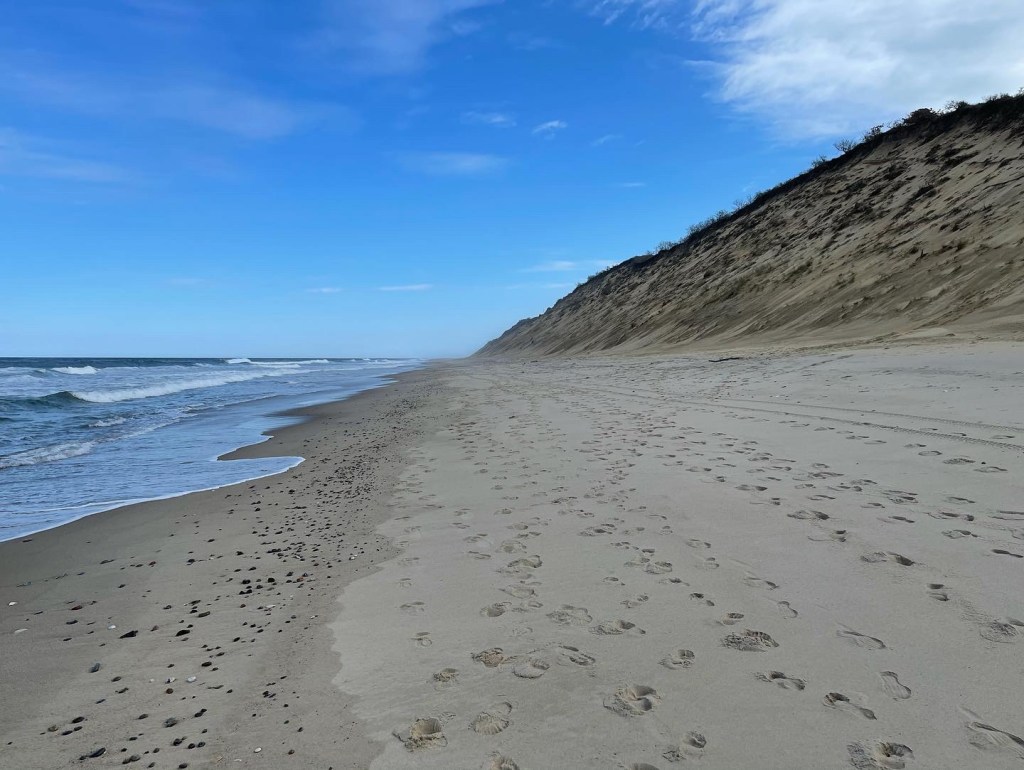
    Between the massive dunes and the crashing Atlantic Ocean in Wellfleet is a strip of sandy beach bearing the brunt of the relentless assault from wind and sea. The surf in warmer months is a feeding ground for Great White Sharks, who have modified their hunting style to chase grey seals right into the churning shallows that swimming humans like to frolic in during the warmer months. Great Whites don’t hunt humans, but sometimes they mistake humans for seals.

    In April you don’t see many seals bobbing in the surf on Cape Cod. So the sharks move on to other hunting grounds and leave this stretch of wild ocean to the occasional surfer and the beach walkers. A walk on the Cape Cod National Seashore can happen just about anywhere with an access path down the 100-foot dunes. Sand is dangerous stuff that can bury a reckless trespasser in no time at all. Sticking to the access paths preserves the dunes and just might preserve you too. The access paths themselves inform in their soft give. This is not a place for the meek. If you can’t handle the access path don’t walk this beach.

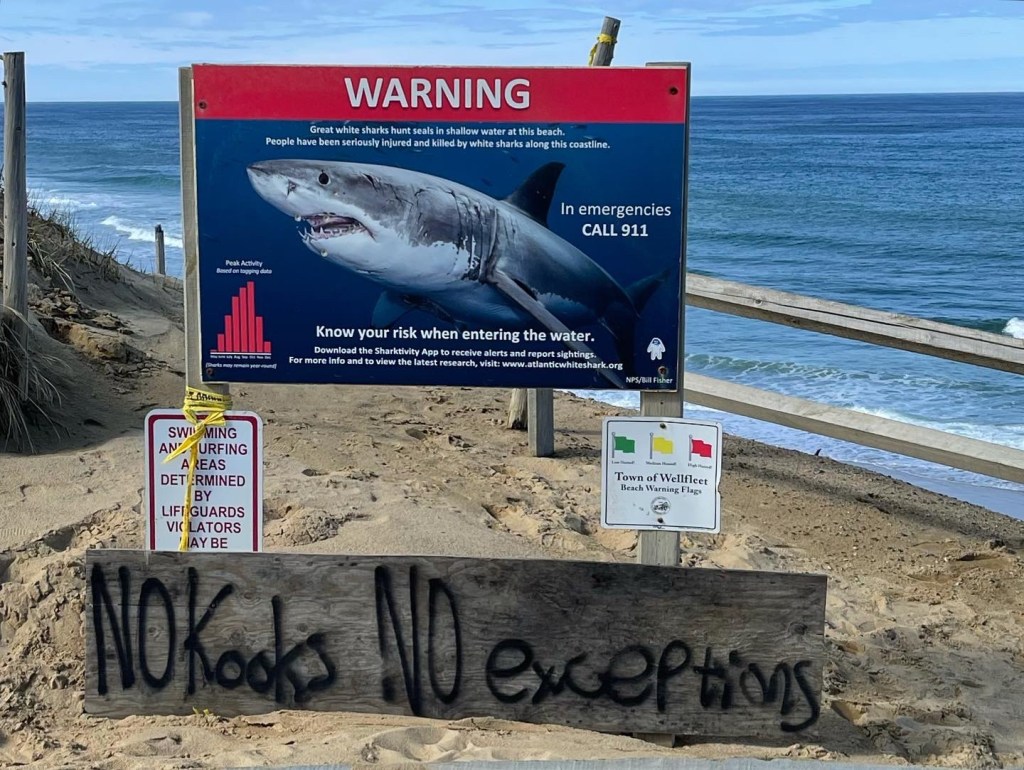
    For an off-season walk, we chose to park at the Beachcomber in Wellfleet and walk a stretch of soft sand known as Cahoon Hollow Beach. The Beachcomber is a trendy cool place at the height of summer. In mid-April it’s a convenient parking spot for easy access to the beach. A sign of the times is a shark warning with a handmade sign added to the bottom sharply suggesting “No kooks, no exceptions”. Wellfleet has had just about enough of the worst representatives of shark tourism.

    The National Seashore has a 40 mile stretch of beach that would test the strongest of walkers. When you say you’ll walk just to the bend you soon realize that bend keeps disappearing ahead of you. We walked about a mile, following the curve of the dunes around the forearm of Cape Cod. Walkers tend to gravitate towards the surf line where shells and smooth rocks offer themselves up for consideration. Soon your pockets are full and you recognize the folly of treasure hunting when every receding wave reveals another treasure.

    Thoreau walked the entire length from Chatham to Provincetown in the mid-1850’s and wrote about it for lectures that would end too soon in his abbreviated life. It would be published after his death in 1865 – the same year the Civil War ended. I think often about Thoreau, dying at 45 with so much left to do and see and write about. And here I was following him again, walking the beach between dune and sea, thinking it might just go on forever. Knowing it won’t.

  • A Walk in Dense Fog

    The dense fog presses up against the glass, tapping on the window lightly, wanting to come inside. Or calling me outside. I listen and layer up for a walk to the bay. I know it’s out there, if only from memory. And walk slowly to the water.

    The fog comes
    on little cat feet.
    It sits looking
    over harbor and city
    on silent haunches
    and then moves on.
    Carl Sandburg, Fog

    The birds carry on their morning song, but not so many today. Early still. What does 98% humidity sound like? It sounds like it looks; muted and disorienting. I close my eyes and let my bearings reset. I’m the only human outside this morning. Or possibly one of thousands – who can tell in the gray billowing dance?

    Down by the water, surprising wave action on a still morning. The bay is restless, like a sleeping child with a fever. Fog blurs hard lines. Instead I focus on what it amplifies. The lapping sounds of the waves slapping on the beach. A loon hidden from view out there somewhere calling its kind. Reaching me.

    Walking up from the shore, the sweet smell of dune grass requests a moment of my time. I gladly linger and thank the grass for the invitation. The air feels different as you walk away from the beach. The waves recede, birdsong grows and the world brightens. Dawn is approaching even as the fog asserts its hold on the world.

    Much later, fog lifting, you see the details fill in. I admit I liked the ambiguity of the fog just a bit more. If only for a momentary change in perspective. And, ironically, the clarity it brought. Swirling in the darkness by the bay.

  • Living That Last Word

    See with every turning day,
    how each season wants to make a child
    of you again, wants you to become
    a seeker after rainfall and birdsong,
    watch now, how it weathers you to a

    testing
    in the tried and true, tells you
    with each falling leaf, to leave and slip

    away,
    even from that branch that held you,
    to go when you need to, to be courageous,
    to be like that last word you’d want to say
    before you leave the world.

    – David Whyte, Coleman’s Bed

    We all move through the world at our pace, seeing things as our mind opens our eyes to them. I could never have read this poem ten years ago and seen it the way I do today. I wonder at who I might be in another ten years, should I be so bold as to expect the time.

    We all transform over time and place, in each conversation and with every realization. We get consumed with thoughts of whether we do enough or become enough, we reach a point where we gently push such self-talk away or let it eat us alive. But the question isn’t whether we’ve done enough at all. It’s simply, have we lived enough?

    When you’re lying on your death bed someday 50 years from now or maybe tonight, what will your last word in this earth be? What are the last thoughts racing through your fading mind? Will you smile in your last breath or will a tear form in your eye? That person in that last moment wants you to be courageous today.

  • Friends with the Sky

    “One of the many ways we have made ourselves lonely without gaining the deeper nourishment and intimacies of true aloneness, is the way we have lost the greater supporting circle of friendship available to us in the created, natural world: to be friends with the sky, the rain, the changing light of a given day and the horizon always leading us beyond the circle we have drawn too readily for ourselves.” – David Whyte, from the forward of Essentials

    I’ve often wondered at loneliness. I’m rarely lonely, but I’m often alone. I think the root of it lies in Whyte’s observation about the greater supporting circle – a connection to the world around you and with your own inner voice. Nothing awakens your relationship with the world like lingering with it on its terms.

    One of the things I miss about having a dog is that forced connection with the outside, no matter the weather. It’s easy to just stay inside when it’s raining sideways or bitter cold. But having a dog forces your hand – they’ve gotta go, and you must connect them with the place they go. Letting them out is a cop-out. You must walk as a true offering to the pet gods.

    This connection to the outdoors doesn’t require a dog, I’ve had similar connection with hiking, rowing and sailing where you’re forced to deal with nature as it comes to you. When you’re a small part of the natural world you tend to see it differently than you might looking at a screen from the comfort of a favorite chair. Nature demands that we meet it with respect and reverence, and in return we awaken something deeper in us.

    I suppose a circle drawn around us feels like a hug or the blankets you pull over yourself on the coldest nights. The problem with a tight circle is that it’s inherently limiting. Getting out under the open sky and feeling the elements, you recognize that you’re alone, yet a part of something bigger than yourself. When you see the world outside that old circle, you’re never quite the same.

    Loneliness is a state of isolation derived from looking inward. Connection is looking outward, and beyond yourself. Stepping outside the circle is a courageous act if you haven’t spent much time there, but it leads to a world that is alive with wonder. A sensory world of conversations in many dimensions. A world where we can become more than whatever it was you were when contained in that circle. That’s where you’ll find larger possibility. You’ll never be lonely outside your comfort zone.

  • Freeze and Thaw

    In the dark time of the year.
    Between melting and freezing
    The soul’s sap quivers.
    – T.S. Eliot, Little Gidding

    There are more famous lines from this poem, but this is the time of sap buckets and lines run between maple trees in New England, so forgive me for straying from the popular. For these are the days of freezing and thawing – a confused mix of awakening and nature turning a cold shoulder on us. A reminder that warmer days are coming but we aren’t there just yet.

    And so it is with the vaccine and a pandemic that hasn’t quite finished its business with us, despite casual disregard and letting up of guards. We aren’t quite there, but surely we’re closer. So persevere; for we’ll get through the darkness, together in our isolation.

    Eliot wrote Little Gidding during the darkest days of the Blitz, set it aside in dissatisfaction and returned to it again to publish it during slightly brighter days in 1942. Who would ever think of 1942 as brighter days? Someone who lived through the Blitz of 1940-41 I suppose.

    So who are we to complain about a turn to colder days just as the sun began to warm us once again? Who are we to complain about wearing a mask for just a bit longer? Are we that precious and self-absorbed? Focus on the brighter days ahead, but stay the course in the meantime.

    As the snow and ice retreats for another season, the mud rises to meet our favorite footwear in a cold, gooey grip. The warmest days bring swirls of bugs celebrating their brief dance with life. And we, the comfortable masses, find reasons to complain about the mud and bugs and even the miraculously fast release of vaccines to the world that just seem a bit too slow. For all the joy of thaw, we seem to prefer the angst of freeze.

    Spring is upon us, despite it all. The sap flows with each freeze and thaw, and drips slowly into buckets. Drop by drop, the buckets fill. It’s the only way, really. You can’t very well cut the tree in half to pour out the sap. Not if you hope to have another season anyway. No, progress is slow that way. And offers lessons in patience and perseverance. Of going with the flow and staying the course.