Category: seasons

  • The Ones That Got Away

    Letters swallow themselves in seconds.
    Notes friends tied to the doorknob,
    transparent scarlet paper,
    sizzle like moth wings,
    marry the air.

    We’re into the long days now in New England. Days of early light and lingering twilight well into the evening. I wake to the sound of fishermen racing to seize their moment, wondering at the urgency of a favorite fishing spot when the entire bay is full of fish. They fish with purpose. Purpose brings intensity and competition. I know these things, even if I don’t share their commitment to fishing before the sun rises. I use that time for other things.

    So much of any year is flammable,
    lists of vegetables, partial poems.
    Orange swirling flame of days,
    so little is a stone.

    I don’t understand the lure of fishing but I understand the pull of the open water. I know the call of the early morning air. I imagine the Striper are running just below the surface as I watch the water. The lilacs are out and so they must be too. Lilacs come and go so quickly, don’t they? So, it seems, do the Striper.

    Where there was something and suddenly isn’t,
    an absence shouts, celebrates, leaves a space.
    I begin again with the smallest numbers.

    Every year we go through this, these fishermen and women out on the water and me watching from shore. The boats change and so do the characters in them, but still the fish run with the tides. This year feels more optimistic than last year. We’ve all come through something together, even if we aren’t quite there yet. But the Striper don’t care a lick what we’ve been through.

    Quick dance, shuffle of losses and leaves,
    only the things I didn’t do
    crackle after the blazing dies.
    -Naomi Shihab Nye, Burning the Old Year

    So many of these moments disappear like sparks into the night sky. We burn through days like firewood, and make the most of so few of them. So much of our time burns away, and we’re left holding on to scraps of memorable. While contemplating the ones that got away.

  • A Walk on Cahoon Hollow Beach

    “The sea-shore is a sort of neutral ground, a most advantageous point from which to contemplate this world. It is even a trivial place. The waves forever rolling to the land are too far-travelled and untamable to be familiar. Creeping along the endless beach amid the sun-squall and the foam, it occurs to us that we, too, are the product of sea-slime.” – Henry David Thoreau, Cape Cod

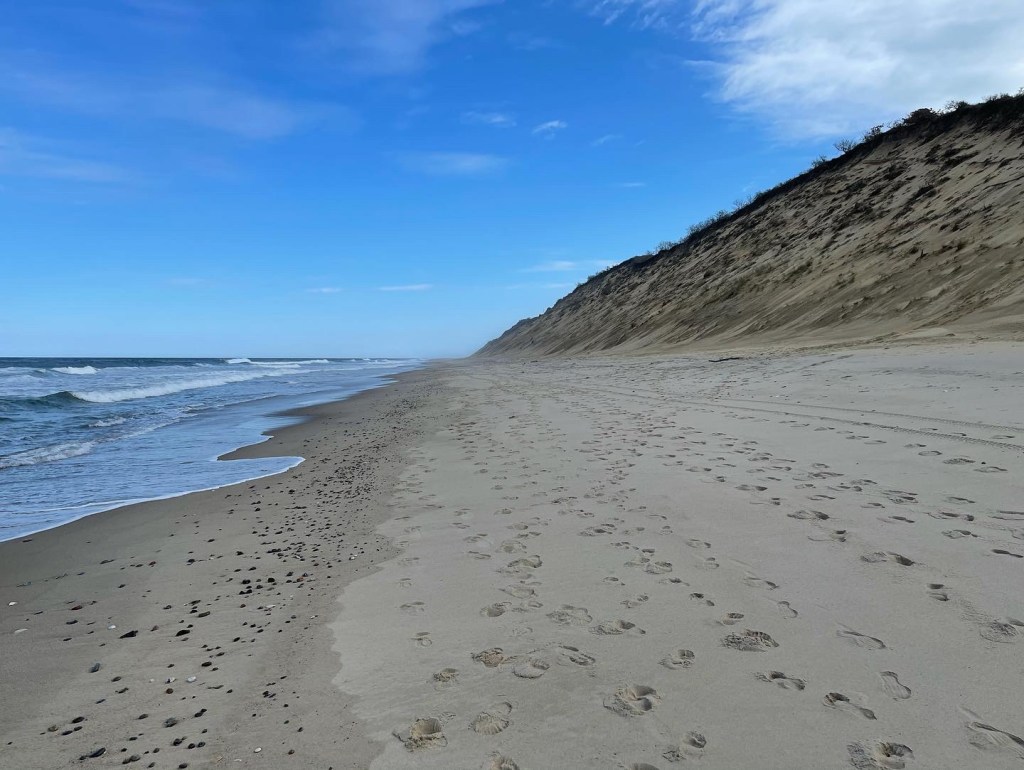
    Between the massive dunes and the crashing Atlantic Ocean in Wellfleet is a strip of sandy beach bearing the brunt of the relentless assault from wind and sea. The surf in warmer months is a feeding ground for Great White Sharks, who have modified their hunting style to chase grey seals right into the churning shallows that swimming humans like to frolic in during the warmer months. Great Whites don’t hunt humans, but sometimes they mistake humans for seals.

    In April you don’t see many seals bobbing in the surf on Cape Cod. So the sharks move on to other hunting grounds and leave this stretch of wild ocean to the occasional surfer and the beach walkers. A walk on the Cape Cod National Seashore can happen just about anywhere with an access path down the 100-foot dunes. Sand is dangerous stuff that can bury a reckless trespasser in no time at all. Sticking to the access paths preserves the dunes and just might preserve you too. The access paths themselves inform in their soft give. This is not a place for the meek. If you can’t handle the access path don’t walk this beach.

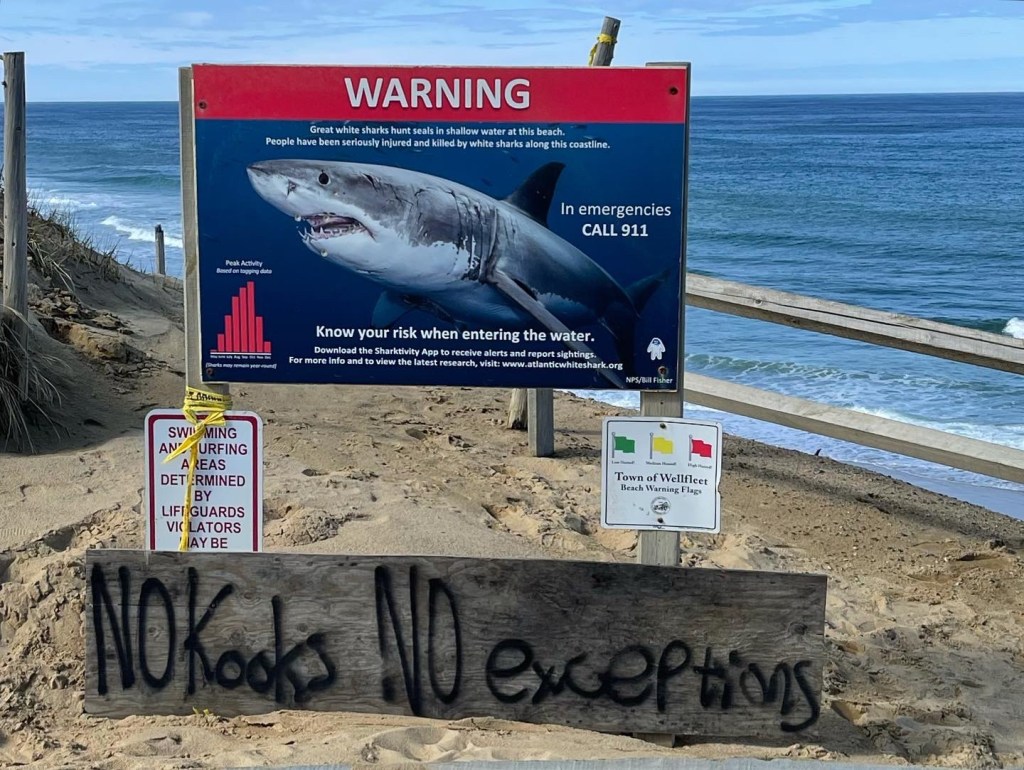
    For an off-season walk, we chose to park at the Beachcomber in Wellfleet and walk a stretch of soft sand known as Cahoon Hollow Beach. The Beachcomber is a trendy cool place at the height of summer. In mid-April it’s a convenient parking spot for easy access to the beach. A sign of the times is a shark warning with a handmade sign added to the bottom sharply suggesting “No kooks, no exceptions”. Wellfleet has had just about enough of the worst representatives of shark tourism.

    The National Seashore has a 40 mile stretch of beach that would test the strongest of walkers. When you say you’ll walk just to the bend you soon realize that bend keeps disappearing ahead of you. We walked about a mile, following the curve of the dunes around the forearm of Cape Cod. Walkers tend to gravitate towards the surf line where shells and smooth rocks offer themselves up for consideration. Soon your pockets are full and you recognize the folly of treasure hunting when every receding wave reveals another treasure.

    Thoreau walked the entire length from Chatham to Provincetown in the mid-1850’s and wrote about it for lectures that would end too soon in his abbreviated life. It would be published after his death in 1865 – the same year the Civil War ended. I think often about Thoreau, dying at 45 with so much left to do and see and write about. And here I was following him again, walking the beach between dune and sea, thinking it might just go on forever. Knowing it won’t.

  • A Walk in Dense Fog

    The dense fog presses up against the glass, tapping on the window lightly, wanting to come inside. Or calling me outside. I listen and layer up for a walk to the bay. I know it’s out there, if only from memory. And walk slowly to the water.

    The fog comes
    on little cat feet.
    It sits looking
    over harbor and city
    on silent haunches
    and then moves on.
    Carl Sandburg, Fog

    The birds carry on their morning song, but not so many today. Early still. What does 98% humidity sound like? It sounds like it looks; muted and disorienting. I close my eyes and let my bearings reset. I’m the only human outside this morning. Or possibly one of thousands – who can tell in the gray billowing dance?

    Down by the water, surprising wave action on a still morning. The bay is restless, like a sleeping child with a fever. Fog blurs hard lines. Instead I focus on what it amplifies. The lapping sounds of the waves slapping on the beach. A loon hidden from view out there somewhere calling its kind. Reaching me.

    Walking up from the shore, the sweet smell of dune grass requests a moment of my time. I gladly linger and thank the grass for the invitation. The air feels different as you walk away from the beach. The waves recede, birdsong grows and the world brightens. Dawn is approaching even as the fog asserts its hold on the world.

    Much later, fog lifting, you see the details fill in. I admit I liked the ambiguity of the fog just a bit more. If only for a momentary change in perspective. And, ironically, the clarity it brought. Swirling in the darkness by the bay.

  • Living That Last Word

    See with every turning day,
    how each season wants to make a child
    of you again, wants you to become
    a seeker after rainfall and birdsong,
    watch now, how it weathers you to a

    testing
    in the tried and true, tells you
    with each falling leaf, to leave and slip

    away,
    even from that branch that held you,
    to go when you need to, to be courageous,
    to be like that last word you’d want to say
    before you leave the world.

    – David Whyte, Coleman’s Bed

    We all move through the world at our pace, seeing things as our mind opens our eyes to them. I could never have read this poem ten years ago and seen it the way I do today. I wonder at who I might be in another ten years, should I be so bold as to expect the time.

    We all transform over time and place, in each conversation and with every realization. We get consumed with thoughts of whether we do enough or become enough, we reach a point where we gently push such self-talk away or let it eat us alive. But the question isn’t whether we’ve done enough at all. It’s simply, have we lived enough?

    When you’re lying on your death bed someday 50 years from now or maybe tonight, what will your last word in this earth be? What are the last thoughts racing through your fading mind? Will you smile in your last breath or will a tear form in your eye? That person in that last moment wants you to be courageous today.

  • Friends with the Sky

    “One of the many ways we have made ourselves lonely without gaining the deeper nourishment and intimacies of true aloneness, is the way we have lost the greater supporting circle of friendship available to us in the created, natural world: to be friends with the sky, the rain, the changing light of a given day and the horizon always leading us beyond the circle we have drawn too readily for ourselves.” – David Whyte, from the forward of Essentials

    I’ve often wondered at loneliness. I’m rarely lonely, but I’m often alone. I think the root of it lies in Whyte’s observation about the greater supporting circle – a connection to the world around you and with your own inner voice. Nothing awakens your relationship with the world like lingering with it on its terms.

    One of the things I miss about having a dog is that forced connection with the outside, no matter the weather. It’s easy to just stay inside when it’s raining sideways or bitter cold. But having a dog forces your hand – they’ve gotta go, and you must connect them with the place they go. Letting them out is a cop-out. You must walk as a true offering to the pet gods.

    This connection to the outdoors doesn’t require a dog, I’ve had similar connection with hiking, rowing and sailing where you’re forced to deal with nature as it comes to you. When you’re a small part of the natural world you tend to see it differently than you might looking at a screen from the comfort of a favorite chair. Nature demands that we meet it with respect and reverence, and in return we awaken something deeper in us.

    I suppose a circle drawn around us feels like a hug or the blankets you pull over yourself on the coldest nights. The problem with a tight circle is that it’s inherently limiting. Getting out under the open sky and feeling the elements, you recognize that you’re alone, yet a part of something bigger than yourself. When you see the world outside that old circle, you’re never quite the same.

    Loneliness is a state of isolation derived from looking inward. Connection is looking outward, and beyond yourself. Stepping outside the circle is a courageous act if you haven’t spent much time there, but it leads to a world that is alive with wonder. A sensory world of conversations in many dimensions. A world where we can become more than whatever it was you were when contained in that circle. That’s where you’ll find larger possibility. You’ll never be lonely outside your comfort zone.

  • Freeze and Thaw

    In the dark time of the year.
    Between melting and freezing
    The soul’s sap quivers.
    – T.S. Eliot, Little Gidding

    There are more famous lines from this poem, but this is the time of sap buckets and lines run between maple trees in New England, so forgive me for straying from the popular. For these are the days of freezing and thawing – a confused mix of awakening and nature turning a cold shoulder on us. A reminder that warmer days are coming but we aren’t there just yet.

    And so it is with the vaccine and a pandemic that hasn’t quite finished its business with us, despite casual disregard and letting up of guards. We aren’t quite there, but surely we’re closer. So persevere; for we’ll get through the darkness, together in our isolation.

    Eliot wrote Little Gidding during the darkest days of the Blitz, set it aside in dissatisfaction and returned to it again to publish it during slightly brighter days in 1942. Who would ever think of 1942 as brighter days? Someone who lived through the Blitz of 1940-41 I suppose.

    So who are we to complain about a turn to colder days just as the sun began to warm us once again? Who are we to complain about wearing a mask for just a bit longer? Are we that precious and self-absorbed? Focus on the brighter days ahead, but stay the course in the meantime.

    As the snow and ice retreats for another season, the mud rises to meet our favorite footwear in a cold, gooey grip. The warmest days bring swirls of bugs celebrating their brief dance with life. And we, the comfortable masses, find reasons to complain about the mud and bugs and even the miraculously fast release of vaccines to the world that just seem a bit too slow. For all the joy of thaw, we seem to prefer the angst of freeze.

    Spring is upon us, despite it all. The sap flows with each freeze and thaw, and drips slowly into buckets. Drop by drop, the buckets fill. It’s the only way, really. You can’t very well cut the tree in half to pour out the sap. Not if you hope to have another season anyway. No, progress is slow that way. And offers lessons in patience and perseverance. Of going with the flow and staying the course.

  • The Heart of the Bay

    Nobody owns the sky or the trees.
    Nobody owns the hearts of birds.
    Still, being human and partial therefore to my own
    successes—
    though not resentful of others fashioning theirs—

    I’ll come tomorrow, I believe, quite early.
    – Mary Oliver, Winter and the Nuthatch

    Oliver writes of building trust with a nuthatch that eventually learns to eat out of her hand. One morning she arrives later than other mornings only to find her nuthatch friend eating from another person’s hand. And thus she resolves to arrive earlier the next morning. I’ve felt this myself, not with birds in the hand so much as places of solitude.

    Early Spring is still a time of hard frosts and temperature swings. Maple syrup weather – when the sap flows and gathers in buckets around Maple trees throughout the region. But not here. Cape Cod is more temperate, not subject to the extremes that draw the sap out. And then there’s the trees themselves, which seem to prefer the other side of the bridges. No, here we have a different sap drawn out in the early mornings. And I’m drawn to the light and the chorus.

    Buzzards Bay, well before the dawn, is awash in deep blues and burnt orange and the calls of thousands of Eider Ducks off in the distance. They have a lot to say to each other. It must be breeding season for these migratory birds. They didn’t pay much attention to the stranger on land, and I let them alone in their banter and flirting. The chorus felt altogether different from the bay in warmer months, when outboard engines of fishermen roaring off to favorite holes pierce the silence. Eiders quickly become white noise as I refocus on the task at hand.

    I crunched across a deep frost, leaving footprints in the grass on my walk to the shoreline. Low tide drew me out further into the bay, right to the waters edge quietly lapping in quiet surges like a heart beat. The bay is alive in this way. Alive in its vibrant, nutrient-rich, welcoming way. It pulls at me as it pulls at the Eider ducks, down from northern regions for their version of Spring Break. I suppose I am as well, looking for a change of scenery from New Hampshire to Buzzards Bay. For a return to salt water reflections and big skies.

    The chorus of Eiders ends with the sun breaking the horizon. Mating time gives way to feeding time. I leave the shoreline myself, for I’m not adorned in the down of a duck and the morning chills me in lingering too long. Hot coffee and inadequate words await me, with the glow of the morning alive in my mind.

    Buzzards Bay
  • Charming Gardeners

    “Let us be grateful to people who make us happy; they are the charming gardeners who make our souls blossom.” – Marcel Proust

    Spring in New England is a tricky thing. We pivot from beautiful warm days to snow squalls and bitter wind, often within a few minutes of each other. But the days grow longer and we quietly grow more confident about putting the lawn furniture back out and maybe planting some seeds in starter soil. Basil, cilantro and parsley are each growing in sunny windowsills as I write this, and I’m considering getting the dahlia bulbs going soon. Such is the mind of a gardener.

    Proust writes of a different kind of gardener, of course, but they’re generally one and the same. The people who light us up in social interaction are quiet observers of humanity, readers of eyes and solicitors of smiles. In this particular time when social interaction has been elusive, we haven’t had as much interaction like this, and we’ve never needed it more.

    Spring brings hope to the gardener, and vaccines bring hope for time with those people who make us happy. I’m as ready for a gathering of celebration with friends and family as I am for the smell of fresh cut grass and tomato vines. Confident hugs and hand squeezes and shoulder leans are just around the corner.

    Imagine the days ahead, as a gardener imagines them – life blossoming anew, hope in the air, warm sun on our backs. Breathe in the fresh warm air, turn towards friends old and new, and smile. They could use it – and so could you.

  • Finding the Magic Behind the Ice

    There’s something uniquely foreign about the experience, akin to visiting an ice palace in a fantasy movie. Humans aren’t supposed to be in such places. At least that’s what we tell ourselves when we look at a waterfall from the front. And when it’s frozen in winter? Well, there’s something chillingly locked away in… there.

    Now, in case you’re wondering, this isn’t the first time I’ve been behind a waterfall. Like countless thousands, I’ve walked behind Niagara Falls and for the price of admission seen the roaring waters dropping away from the safety of a dim, well-engineered if soulless tunnel. Interesting, to be sure. But not magical.

    It’s clearly the ice. It forms a wall over the falls that announces, “sorry, closed for the season”. There’s beauty in the frozen stillness of a waterfall in winter, of course, but there’s a small part of you that feels betrayed by the ice. You hear the muted sound of water falling deep inside, and want for more.

    Enter Beede Falls in Sandwich, New Hampshire. In warmer months it’s a 35 foot horsetail of falling water with a popular swimming hole. In winter it’s an ice bulge, beautiful but seemingly as inaccessible as other frozen waterfalls. But this one offers a secret for those who dare. You can duck and crawl in behind the falls on the left or right side, and even crawl all the way through if you wanted to. For some less tall than me standing up is even possible.

    I wondered at the characters over the years who have crawled behind the falls in all seasons. I wasn’t the first on this day, and other hikers waited patiently for me to finish to have their own turn in the tight tunnel between granite, water and ice. How many humans have made this crawl over the thousands of years that this cave and waterfall have danced together? A lot, I suppose. But for a few minutes, there was only me and the ice and water.

    That’s where I finally saw the magic locked away behind that frozen blue skin. Deep behind the water is indeed falling, forming icicles and frozen bubbles successively grown upon each other to form otherworldly sculptures. And through it all that shower of water penetrates the center, surrounded by its icy shield and backlit by the daylight beyond. An incredible wonderland so foreign to me, so delightful, that I felt I’d gone to another world. And indeed I had.

    Beede Falls, behind her icy shield
  • On New Paths

    What good is livin’ a life you’ve been given
    If all you do is stand in one place – Lord Huron, Ends of the Earth

    If snow transforms the landscape, then a walk in that snowy terrain transforms the winter walker. Add a new path and suddenly you’re seeing the world entirely differently than you had before. Add snowshoes and you’re suddenly set free to break off trail to see new places, explore animal tracks that run off into the woods, and to see what’s on top of a rise you might have walked by at another time of year.

    There’s a popular pursuit in hiking called red-lining, in which hikers hike every bit of every trail on a map or guide. A popular red-lining pursuit in New England is hiking the AMC White Mountain Guide. The whole point of red-lining is to explore new paths – to get off the crowded hiking trails and try something new. To do it, and to belong to a small group of hardcore hikers who have also done it. And add a measure of accomplishment and camaraderie in the world of hiking. I don’t see myself hiking every trail in the AMC White Mountain Guide, but I’m fully onboard with hiking new trails and seeing the previously (for me) unseen.

    On Valentine’s Day I explored trails previously unseen in a forest I’ve spent a lot of time in. Snowshoeing with friends, we walked a trail largely by ourselves to new places. When you’re on a new trail like that, every step is a discovery, every bend in the trail is a curiosity, and every trail junction is confirmation and validation of what the map was trying to tell you all along. There’s magic in taking that image on a map for a walk and making it real.

    The day after a long walk on new trails you start thinking about the trails at those junctions that you didn’t take. You wonder at what you might have missed down that way and begin to realize the allure of red-lining. For how do you want to spend your time in this world? Sticking with the familiar or exploring new places and challenging yourself in new ways? There are other paths that warrant exploration. I’ve seen them out there, if only on a map.