Category: Stoicism

  • Today, as Forever

    “We are like butterflies who flutter for a day and think it is forever.” – Carl Sagan

    I met an old friend at the airport, both of us heading for the same plane, and we caught up on each other’s lives until we boarded the plane and went our separate ways on the other end of the flight. We spoke of family members fighting cancer who faced different expectations for the duration of their time on this planet. And saw in that brief conversation the folly of waiting for another day that might not be ours for the taking.

    Each of us reminded that life is but a brief flutter that all too soon must end. Memento mori.

    Each of us reminded to seize the day. Carpe diem.

    What will we make of this day? This, our brief dance with the world? We ought to have one eye on the moment while we aim at tomorrow. To build for that tomorrow but to not ever rely on it being there for you. Celebrate today, as forever.

    “Do not act as if you had ten thousand years to throw away. Death stands at your elbow. Be good for something while you live and it is in your power.” – Marcus Aurelius, Meditations

    Enough of talk and grand plans. There’s no time for that! Get to it already. Today.

  • Until We Are Not

    The singular and cheerful life
    of any flower
    in anyone’s garden

    or any still unowned field—
    if there are any—
    catches me
    by the heart,
    by its color, by its obedience
    to the holiest of laws:
    be alive
    until you are not.
    – Mary Oliver, The Singular and Cheerful Life

    We all have gut punches along the way. Moments of bliss interrupted by the fiercest of reality checks. Moments when you question the unfairness of it all. Look around at the world and you’ll find plenty of examples of it today.

    What do we do when we catch our breath from this gut punch?

    We generally find a way to carry on. To make the most of our brief time together. To spin up just a little more magic in the world, if only to reflect in the glow it creates between us. To be alive until we are not.

    There is only this.

  • Breaking Garden (and Life) Rules

    I regularly break the accepted rules of gardening. Rules like putting the tall plants in the back of the garden. But when something like a balloon flower (Platycodon grandiflorus) or bee balm (Monarda) are shoved way to the back you lose something intimate that you gain when they’re right in your face. So my apologies to the garden rule enforcers. Surely you see my dilemma?

    I was offering advice to a former coworker who wants to quite her job and travel the world with her husband, but she feels stuck in the job, stuck in the life she’s wrapped herself in, and is only looking at the reasons why she can’t just do it instead of finding the reasons to just go for it. I dropped my favorite pair of Latin phrases on her to reflect on: Memento Mori and Carpe Diem (Remember we all must die, and seize the day!).

    Some rules are there for logical reasons; if the tall plants are up front you can’t see the shorter ones behind them. Makes sense. Some rules are there because we’ve all grown up believing stories: you have to get a job and work 50 weeks a year, then skip one of the two weeks of vacation and work on weekends to stay ahead. Who made that rule? Someone who wants to profit on your short productive years before they turn you to dust and plan you out for someone else.

    Make your own rules. Rules like walking out in the middle of a work day and seeing how the flowers are doing, just because you feel like it. Putting yourself out there in the world, to meet it on your terms. And maybe find something of yourself that was hidden when it was shoved to the back by someone else’s rules.

    Balloon Flower
  • Illusions of the Moment

    “When you go through life with preferences but don’t let your happiness depend on any one of them, then you’re awake. You’re moving toward wakefulness. Wakefulness, happiness—call it what you wish—is the state of nondelusion, where you see things not as you are but as they are, insofar as this is possible for a human being. To drop illusions, to see things, to see reality. Every time you are unhappy, you have added something to reality. It is that addition that makes you unhappy. I repeat: You have added something … a negative reaction in you. Reality provides the stimulus, you provide the reaction. You have added something by your reaction. And if you examine what you have added, there is always an illusion there, there’s a demand, an expectation, a craving.” – Anthony De Mello, Awareness

    Monday mornings are a good time to revisit De Mello. To confront the reality of the work week ahead without dread requires a measure of acceptance of the moment you’re living in. If you don’t enjoy what you’re doing do something else as soon as you possibly can. If you enjoy it, understand what it draws out of you and double down on that. Most people in the world today have the freedom to choose how they react.

    The entire quote above might immediately makes you think of Viktor Frankl’s thoughts on stimulus and response. Even in the worst of moments, we can choose how to react to stimulus in our lives. Accept the truth of the matter for what it is and see things for how they are. That might not make you happy, but it makes you fully aware. And don’t we need to be in that state to make effective, meaningful decisions in our lives?

    The question is, what exactly are you adding in the moment? What are your illusions about the way things ought to be, about how someone should speak with you, about wearing a mask or getting vaccinated or how we see a person a bit different from ourself? How do you view that job you’re going to or the title you have or the car you drive? How about how you view the person driving in front of you or the one trying to pass you? What are you adding in that moment?

    We often confront illusions in how others treat us. I had a conversation with an old friend who was poking at me about a tendency I used to have when we were younger. I smiled and let the moment slide away, knowing I’m not that person anymore. You learn to accept who you once were as you get older. But doing so in the moment is a bit trickier, isn’t it? It requires us to be constantly aware of the illusions we’re throwing up. What story am I telling myself right now? And what might happen if I simply subtracted that story?

    This idea of observing yourself in the moment between stimulus and response is a way of getting outside of your own head and seeing the choices in front of you. To shatter the illusion that you don’t have a choice in how you react. To shift to a state of non-delusion and maybe, to choose the path towards happiness. In the thirty years since I first read Man’s Search for Meaning and accelerating in the two years since I read Awareness I’ve chipped away at this within myself. I’m under no illusion that I’ve mastered it, but I work with the tools available to step outside myself towards wakefulness.

    This is a skill that is especially handy on some Monday mornings.

  • Since It Must Be So

    “For Sayonara, literally translated, ‘Since it must be so,’ of all the good-bys I have heard is the most beautiful. Unlike the Auf Wiedershens and Au revoirs, it does not try to cheat itself by any bravado ‘Till we meet again,’ any sedative to postpone the pain of separation. It does not evade the issue like the sturdy blinking Farewell. Farewell is a father’s good-by. It is – ‘Go out in the world and do well, my son.’ It is encouragement and admonition. It is hope and faith. But it passes over the significance of the moment; of parting it says nothing. It hides its emotion. It says too little. While Good-by (‘God be with you’) and Adios say too much. They try to bridge the distance, almost to deny it. Good-by is a prayer, a ringing cry. ‘You must not go – I cannot bear to have you go! But you shall not go alone, unwatched. God will be with you. God’s hand will over you’ and even – underneath, hidden, but it is there, incorrigible – ‘I will be with you; I will watch you – always.’ It is a mother’s good-by. But Sayonara says neither too much nor too little. It is a simple acceptance of fact. All understanding of life lies in its limits. All emotion, smoldering, is banked up behind it. But it says nothing. It is really the unspoken good-by, the pressure of a hand, ‘Sayonara.” – Anne Morrow Lindbergh, North to the Orient

    The very best part of coming out the other side of this pandemic, fully vaccinated and more than ready to get on with things, is getting reacquainted face-to-face with the people who you’ve built lifetime relationships with. It was seeing my father in person for the first time in two years a few weeks ago. And seeing a group of people I hadn’t seen since Christmas 2019 yesterday. The reunions are always special, and now always involve some version of How was it for you?

    And what then? We part ways and go back to knowing each other from apart. Fresh memories instead of stretching the mind for highlights. Will we see each other again soon or was this a quick stepping stone to another few years, or really, will we ever see each other again? The presumption is yes, because we live in a time where there’s generally a good probability that we will. But what if we don’t?

    Lindbergh clarifies this moment of goodbye and the things we say to each other in the moment. The moment for me is a celebration of what we’ve just shared in our short time together, less a reflection that we might not cross paths again. Call me an optimist if you will.

    The stoic in me recognizes the fragility of the moment. I was at a birthday party yesterday, looked around at all the people celebrating their newfound freedom to be together and saw that nobody was taking pictures. For the record, I do this at every event, and generally I’m the one pulling out the camera phone and taking photos to lock the moment in photographs. For photos are more reliable than memory. Photos travel through time, awakening old memories and even past our lifetimes to introduce us to people we will never meet. Long after our goodbyes and Sayonaras, that picture may still exist.

    Since our separation must be so, I wish you good health and a moment when we might be together again to celebrate this short time with you once again. Reunions seem more tenuous than before, but surely more special than they ever were. So here is my acceptance of fact: this moment will not last, so since it must be so I’m making the very best of it while it does.

    Happy Father’s Day.

  • Leaving Long Shadows

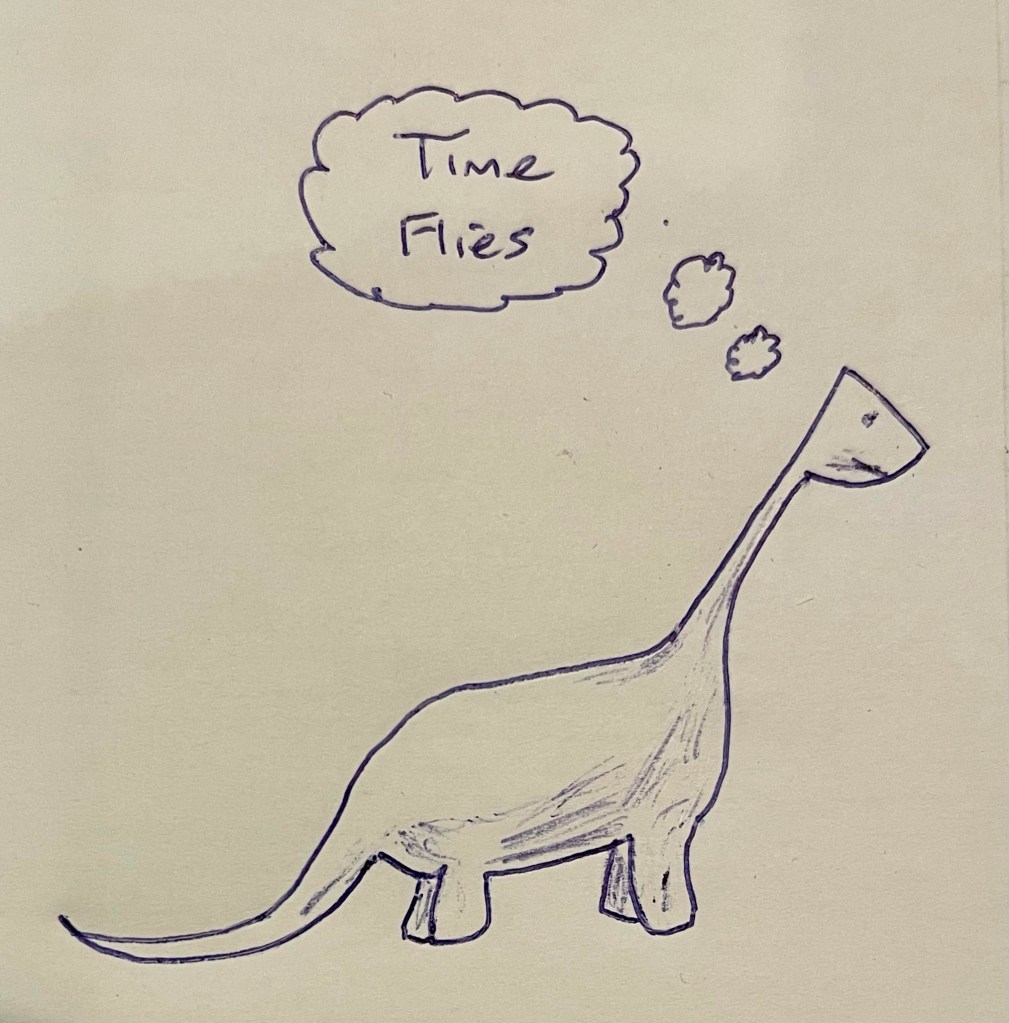
    “Time flies over us, but leaves its shadow behind.” – Nathaniel Hawthorne

    The march through time continues. What will the shadow that we cast behind our lives look like? I’m reading through a couple of weighty tomes that run through evolution. Don’t know why the stars aligned in such a way that I’m diving deep into evolution at this particular moment, but here we are.

    Maybe it was the subject matter but I absently sketched a dinosaur on a notepad and thought about these giants who came and went millions of years ago. Millions. So what is a hundred years or so for us? Not a whole lot.

    Or maybe it’s enough, if you use it well.

    The point is, we’re all leaving shadows behind us. What will our shadows be? Long and notable or brief and forgettable? In some ways it doesn’t matter when you look at life through the lens of millions of years. But then again, doesn’t it all matter in the end?

    This planet has been spinning around in the universe for billions of years. Dinosaurs roamed millions of years ago. These are big numbers. But this? This is our time. Shouldn’t we make the most of it, and leave the longest shadow we can? I should think so.

    Time Flies
  • Caretakers of the Present

    “Even when we get what we wish, it is not ours.” – Publius Syrus

    We’re all in a relationship with time. Some relationships are abusive, some are blissful. Time teases us. We think we have so much of it, but that’s a fabric of our imagination, like the belief that we might just live forever. The days fly by in rapid succession, and we do with them what we can.

    Over the last week I’ve wrestled with a yard relentlessly assaulted by the surrounding trees, raining pollen and catkins and samaras into and on to everything I’d worked to clean up until the rains came and turned the tide in my favor. The chores of home ownership are relentless and a fool’s game. Yet it offers the meditative work required for me to sort out the rest of this crazy world. For all my complaints, I recognize this plot of land I’ve squatted on is borrowed from the universe, and I appreciate what it’s brought to me.

    And some day I’ll return it to that universe to do with it whatever it must. Will this land return to the oaks, pines and maples that regularly reach back for what was stolen from them, or will the house will be torn down and the pool filled in to make way for a McMansion as the region continues to face the pressure of urban sprawl. Who knows? I’m the caretaker of the present, such that it is, and recognize the folly in it all.

    What we receive is not really ours. What we have is on loan in the present, be it stuff or relationships or a plot of land with a modest garden. It’s ours to work with as best we can today. If we think of ourselves as caretakers instead of consumers, we might just leave something for those who come after us. That’s not exactly a new way of thinking, but maybe forgotten in the assault of consumerism and consumption and pursuit of “ownership”.

    We might wish for more time, but like stuff we accumulate, it’s not really ours. Once you accept that time is on loan to us, it liberates you. Simply dance with these days and forget the math. We have what we have, and the rest is not our concern. Take care of the present. While there’s still time.

  • The Battle of Timidity and Boldness

    “Focus your attention on the link between you and your death, without remorse or sadness or worrying. Focus your attention on the fact you don’t have time and let your acts flow accordingly. Let each of your acts be your last battle on earth. Only under those conditions will your acts have their rightful power. Otherwise they will be, for as long as you live, the acts of a timid man…. Being timid prevents us from examining and exploiting our lot as men.” – Carlos Castaneda, Journey to Ixtlan

    I did the math, mentally adding 25 years to my current age and toyed with the idea of being that later age. There are no guarantees that I’ll ever reach that point in my life, of course. No guarantees for any of us marching through time on our annual trip around the sun. But I toyed with the idea of being an old man and wondered at the state of my mind and body. I wondered at the experiences I’d had in the interim, these years between now and then.

    This long sleep we have in store for ourselves is our future, whether a quarter century away or this afternoon, and we ought to live boldly instead of merely timidly existing. I won’t say I’ve mastered this, but I live a better life knowing that the whole dance could end on the next drum beat. But we can do so much more. Simply by living with urgency.

    This theme, the constant reminder of our imminent death, runs through Stoic philosophy. And it runs through this blog. I try, not always successfully, to use it as a cattle prod to my backside. A jolt of awareness that this could all end at any moment, so break free of that routine, break away from the timid existence and live a life of adventure and boldness. It’s the underlying theme of this blog, beginning on the home page with Thoreau’s call to action:

    “Rise free from care before the dawn and seek adventures.” – Henry David Thoreau

    If we accept that we must die, and as improbable as it might seem, at any moment, what might we do to live now? If this is our final act, what will it be? And, if blessed with another, what of the act to follow?

    The answer clearly must be to live the moment with urgency. Say what must be said. Do what must be done. Get out there and live boldly! Pursue the magic in the moment with vigor and a profound lust for life.

  • Making the Sun Run

    But at my back I always hear
    Time’s wingèd chariot hurrying near;
    And yonder all before us lie
    Deserts of vast eternity…

    Let us roll all our strength and all
    Our sweetness up into one ball,
    And tear our pleasures with rough strife
    Through the iron gates of life:
    Thus, though we cannot make our sun
    Stand still, yet we will make him run.
    – Andrew Marvell, To His Coy Mistress

    Spending time ought to come with a warning label. I’m revisiting this poem from Marvell. I’d first written about it before the pandemic, when the world seemed quite normal, if maddeningly out of sorts. Since then, well, we all know how things have gone.

    So what do we do with this hard-won knowledge? We have our own time’s winged chariot hurrying near. Maybe we have a few years more or less than the average, but what’s it worth to you anyway? Another trip around the sun and vast eternity ahead for every last one of us. Make the most of life now, while there’s still some of that time for you.

    Today is the day before the promise of another year more. I’m getting a second dose of the Pfizer vaccine with a hopeful eye towards the future. A future where we might run with the sun, chasing every day to its extraordinary end. Sporting while we may. The sun doesn’t stand still. And neither should we.

  • Something More

    “The world always seems brighter when you’ve just made something that wasn’t there before.” Neil Gaiman

    This rather cheery quote by Gaiman prompts a challenge of sorts from me. For making something isn’t what makes the world brighter, making something you care about making is what brightens the world. For in the making of something in such a way you honor the world with your contribution.

    As Gaiman rightly points out, we’re lovingly placing something that wasn’t there before out in the world for it to embrace. Will it fly or get lost in the noise? It’s not up to us to decide. It’s up to us to create it and set it free. And then to get back to the business of building another beacon.

    The best of our work becomes accretive rather than reductive. Look around, there’s plenty of people creating hateful, mean-spirited work that divides and diminishes the world. But not us, no: we offer something more. Something that resonates across the table and across time. For the very best work becomes timeless.

    So what makes something timeless? I believe it’s the deep connection between two people that your work represents. Paint placed just so on canvas. Architecture that stirs the heart generations after the last stones were laid. Words that transcend the author or poet and connect one soul to another. This is what brightens the world. This is the shining soul beacon of the artist that keeps hope alive, like a Fresnel lens lights the distance in a turbulent dark sea:

    “If you have built castles in the air, your work need not be lost; that is where they should be. Now put the foundations under them.” – Henry David Thoreau, Walden

    “Dwell on the beauty of life. Watch the stars, and see yourself running with them.”
    – Marcus Aurelius, Meditations

    “Tell me, what is it you plan to do
    with your one wild and precious life?”
    – Mary Oliver, The Summer Day

    “If you dare nothing, then when the day is over, nothing is all you will have gained.”
    – Neil Gaiman, The Graveyard Book

    “This above all: to thine own self be true,
    And it must follow, as the night the day,
    Thou canst not then be false to any man.”
    – William Shakespeare, Hamlet

    All words across time, offering a path through the darkness in the world. Offering hope and direction and illumination. This is something more. And this is our opportunity too. Great artists are ambassadors to the world, bridge builders to the future, and infinite soul connectors. That’s something to aspire to.