Category: Stoicism

  • Rooted

    “You lack a foot to travel?
    Then journey into yourself!”
    – Rumi, If A Tree Could Wander

    For all my talk of moving and travel, I found myself digging deeply into the rocky soil at home, rooting myself to the land with labor and that most valuable commodity of all; time. For this weekend was the allocated time to put a privacy fence up on the side of the yard that offered a view into the backyard for our neighbors, and a view of their garage for us. The fence answered a question in my mind: Is it time to move on from this place? Answer: Not just yet.

    So maybe it was while in this frame of mind that I should linger on this Rumi poem. A tree is deeply rooted to the place it sprouts from, living and dying in the same place. Its only option is to reach higher and wider to the sun. And to do so it must root probe deeper and wider into the earth for strength and sustenance. Those roots can grow as thick as the branches in the canopy above.

    The first post hole is the most important. It sets the tone for where the fence will be positioned, and like a tree, once its set it isn’t going anywhere easily. I chose the most logical position of all for a privacy fence to begin, adjacent to the fence that lines the rest of the property. Replacing a section of fencing with the new privacy fence and continuing it further along for the desired effect. That post hole, in theory, should have been the easy one once the previous fence post was removed. But the first probe of the shovel revealed a long-hidden truth that only the original fence installer knew: there was a massive root from a tree growing right through the spot I would need to dig. The original fence post had been cut just below ground level and screwed into the post that was staying. Thus began a three hour conversation with myself about the wisdom of staying in one place for too long, sacrificing a chain saw blade and three reciprocating saw blades to the fence gods.

    But the funny thing about manual labor is the time it gives you inside your own head. That journey three feet into a post hole was a long conversation with myself. The view might not have been the Presidential Range or a waterfall, but if it had been I would have been too far outside of myself to still my mind. Manual labor offers stillness of the mind even as it wears the body down. I’ve built a complete hardscape and renovated much of my home, and find the process rewarding even as I curse myself for not just paying someone else to do it. And the finished product stands as a reminder that you’ve done something of significance. There’s a love of fate that must be applied in the moment that the stoics would be very familiar with. It wasn’t the hole in the ground but the fence that grew from it. And the laborer who found a bit of clarity in the soil and rocks and roots. The time wasn’t lost after all.

  • Merely Time

    “Life will follow the path it started upon, and will neither reverse nor check its course; it will make no noise, it will not remind you of its swiftness.“ – Seneca, On The Shortness Of Life

    I re-read Seneca’s On The Shortness Of Life again over the last few days. Its a quick read but jammed full of timeless quotes we’ve all heard and yet don’t hear. They say repetition penetrates the dullest of minds, and perhaps thats a reason to re-read essays like this often. By dull I don’t mean I’m an idiot (though you may insist I reconsider), but rather distracted by the madness of life. We’re all so distracted by the whirl of everyday that we don’t value the breathless moment we’ll never see again. Seneca pokes at us from a distance- he’s been dead far longer than he was alive. And so will we be someday too soon. And so it is that he reminds us; why are you not fully alive today? Stop postponing time you don’t have!

    “Postponement is the greatest waste of life; it deprives them of each day as it comes, it snatches from them the present by promising something hereafter. The greatest hindrance to living is expectancy, which depends upon the morrow and wastes to-day.”

    It isn’t easy to honor the urgency of life. Even as I write this I’m distracted by other pressing things and need to force myself to turn off the work monitor until normal working hours. To turn off the Twitter feed, and all the rest of the noise. And to reflect on what matters now. For now will surely slip away as quickly as then did. The stack of thens grows taller by the day, casting a shadow on the brightness of tomorrow. There is only now.

    Life is divided into three periods – that which has been, that which is, that which will be. Of these the present time is short, the future is doubtful, the past is certain.”

    So what do we do in a pandemic when we can’t travel freely? In a career that demands fair share of your time? And in other commitments that demand of you? I believe we choose wisely, and make the most of the moments at hand. To live in this moment, drawing from the past for wisdom, and with an eye towards the future we’re navigating towards (even if we might never reach it). Making the most of our lives in the time we have.

    “The part of life we really live is small. For all the rest of existence is not life, but merely time”

  • How Shall I Live?

    “When a person tries to apply his intellect to the question “Why do I exist in this world?” he becomes dizzy. The human intellect cannot find the answers to such questions. What does this mean? This means that our intellect is not given to us to find a solution for this question. Our intellect can only answer the question: “How shall I live?” And the answer is simple: “We should live so as to bring good to all people.” – Leo Tolstoy

    There was a moment in college many years ago when I thought I’d like to major in Philosophy, but couldn’t possible justify it to my peers and parents.  But no matter: I’ve majored in Philosophy off and on ever since.  And it seems from my reading lately that I’m back on.  Perhaps there is something in the air.  Or perhaps there’s something in the changing light as the earth pivots and the days persistently grow shorter.  But I find myself drawn back into the great minds of history lately.  Seneca, Marcus Aurelius, Tolstoy, Campbell, Jung, Nietzsche, Frankl, Thoreau…  and on.

    The root of philosophy are these two questions posed by Tolstoy: Why are we here? and so, How shall I live?   As Leo points out, the first question is one most people don’t dwell on.  Existential questions about why we’re here make you pause a beat too long.  It’s easier to just get right to the second question.

    “I don’t believe people are looking for the meaning of life as much as they are looking for the experience of being alive.” – Joseph Campbell

    Most people just go about living whatever identity they choose for themselves.  For the most part you can march along most of your life just living your chosen identity, until something like 2020 comes along to disrupt that illusion.  The easy path becomes harder, doors that were always open are closed, and the people we’ve come to rely on to reinforce our identity have their own problems.  But there’s nothing unique in history about the challenges we’re dealing with in 2020 – the only thing unique about it is that its happening to us this time.  And in a year as disruptive to identities as this one, what better question to ask of ourselves than how shall I live?

    “As far as we can discern, the sole purpose of human existence is to kindle a light in the darkness of mere being.” – Carl Jung

    Kindling light is lovely, but sometimes your battery is running low and you’re a long way from the dawn.  So where do we go from here?  I hear people despair at lost semesters, lost seasons in sports, lost jobs, lost mobility to cross borders, lost time with loved ones…  and what I hear most is despair of lost identity.  We all had plans for these days, and those plans were turned upside down.  But here in the darkness of 2020 philosophy gently taps you on the shoulder and offers direction from those who came before us, and in many ways suffered in ways that we can’t imagine in our current life of relative comfort:

    “It did not really matter what we expected from life, but rather what life expected from us. We needed to stop asking about the meaning of life, and instead to think of ourselves as those who were being questioned by life – daily and hourly. Our answer must consist, not in talk and meditation, but in right action and in right conduct. Life ultimately means taking the responsibility to find the right answer to its problems and to fulfill the tasks which it constantly sets for each individual.”  – Viktor Frankl, Man’s Search for Meaning

    So how shall I live?  Responsibly; in this moment and the next one too, bringing good to all people and bringing light to the darkest corners.  Offering a shoulder to cry on and an ear for those who need it.  To keep climbing the hill and giving a hand to those who need it.  To be patient with those who lose their way but firm with those who would pull you towards the darkness.  To be a steady presence in an unsteady world.  And when the bucket empties, draw from the wisdom of those who came before for strength and sustenance to keep going.

  • Five Things

    “Strategically, its better to do five big things with your life than 500 half-assed things.” – Derek Sivers, The Knowledge Project podcast

    This statement got me thinking.  I’ve done plenty of half-assed things in my life, but what are the big things, both accomplished and yet to complete?  That’s the real question of a lifetime.  I’m likely past the halfway mark on my own life (you never know), so what have you done with the time?

    “Doesn’t everything die at last, and too soon?
    Tell me, what is it you plan to do
    with your one wild and precious life?”
    — Mary Oliver, The Summer Day

    Raising two children to be good humans is one notable accomplishment.  An accomplishment that was decades in the making.  And if they’re a work in progress, they’re far ahead of where I was at their age.  Surely parenthood is one of the five big things.  When I look at my two I’m amazed at who they’ve become.  I played a part in that (perhaps only as an example of what not to do?).  If you have kids be a responsible kid with them, delighting in the world.  Most of parenthood is figuring things out as you go, but being a steady, reassuring presence in your children’s lives as they stick their own necks out into this crazy world.

    And if parenthood is one big thing, so too must a long, happy marriage?  Having gotten this one very wrong once, I celebrate the one I’ve gotten right.  And by right I mean I haven’t screwed it up just yet, despite my stumbling through the minefield of time.  I’m no expert on the topic, but I’ve learned a few things over the years.  Ultimately you get what you put into something, and if you invest the time and passion into a marriage you’ll have a healthy return on investment with the right partner.  Marriage is never 50/50 – sometimes you give 80, sometimes you give 20, but with the right partner it evens out over time.  So that’s two, for those keeping score, and where do we go from here?

    Career?  One’s career is a complicated journey full of half-assed things, but if you play it well there’s potential for that big thing over time.  If I’ve learned anything at this stage of my career its that relationships and trust built day-after-day matter more than skills accumulated or degrees earned.  It all counts, but nothing matters more than how you interact with others.  I celebrate being in a good place in a complicated time with the potential for great things should I do the work well.  Isn’t that what we all want in a career?  One of the key decisions you’ll make in your career is how much you want to sacrifice time with that family and in your marriage  for career growth.  Choose wisely, for balance is possible.  Life is too short to work for assholes.

    So riddle me this: Beyond family, marriage and career, what are the next couple of big things that you want to accomplish in life?  Starting a business?  Meaningful charitable work?  Environmental activism?  Writing that great American novel?  Athletic accomplishments?  And what of world traveler?  I like to think of myself as an unpaid American diplomat, going out into the world and demonstrating that what you see in the movies and reality television and (God forbid) politics isn’t the real America, but just a part of our story.  There’s a lot to be said for climbing the ladder and reaching a hand down to help others on their own climb.  The more you’re a student of the world, the more you learn and the more you can apply that knowledge towards meaningful interactions.

    “Life is like arriving late for a movie, having to figure out what was going on without bothering everybody with a lot of questions, and then being unexpectedly called away before you find out how it ends.” – Joseph Campbell

    Focus on the big things, and less on the half-assed things.  You’ll know the big things when you find them.  At least I’m counting on that as a guiding principle on my own path.  And if you don’t eventually get five big things accomplished, maybe one or two is enough.  But make them really big things.
  • Dazzling Infinity

    “The buying of more books than one can read is nothing less than the soul reaching toward infinity.” –  A. Edward Newton

    I have an ongoing fascination with the infinite.  Maybe it’s because I’m rather finite myself, with only so many days left at the dance with life.  Or maybe its the humility that comes with thinking about things bigger than yourself that attracts me.  Whatever, the attraction is real.  The French have an expression for it: l’éblouissement de l’infinit or “dazzling infinity”.  I think that’s a fitting adjective to tack on to the infinite. For who among us who bothers to look up from their phone isn’t dazzled by the vastness of the universe?

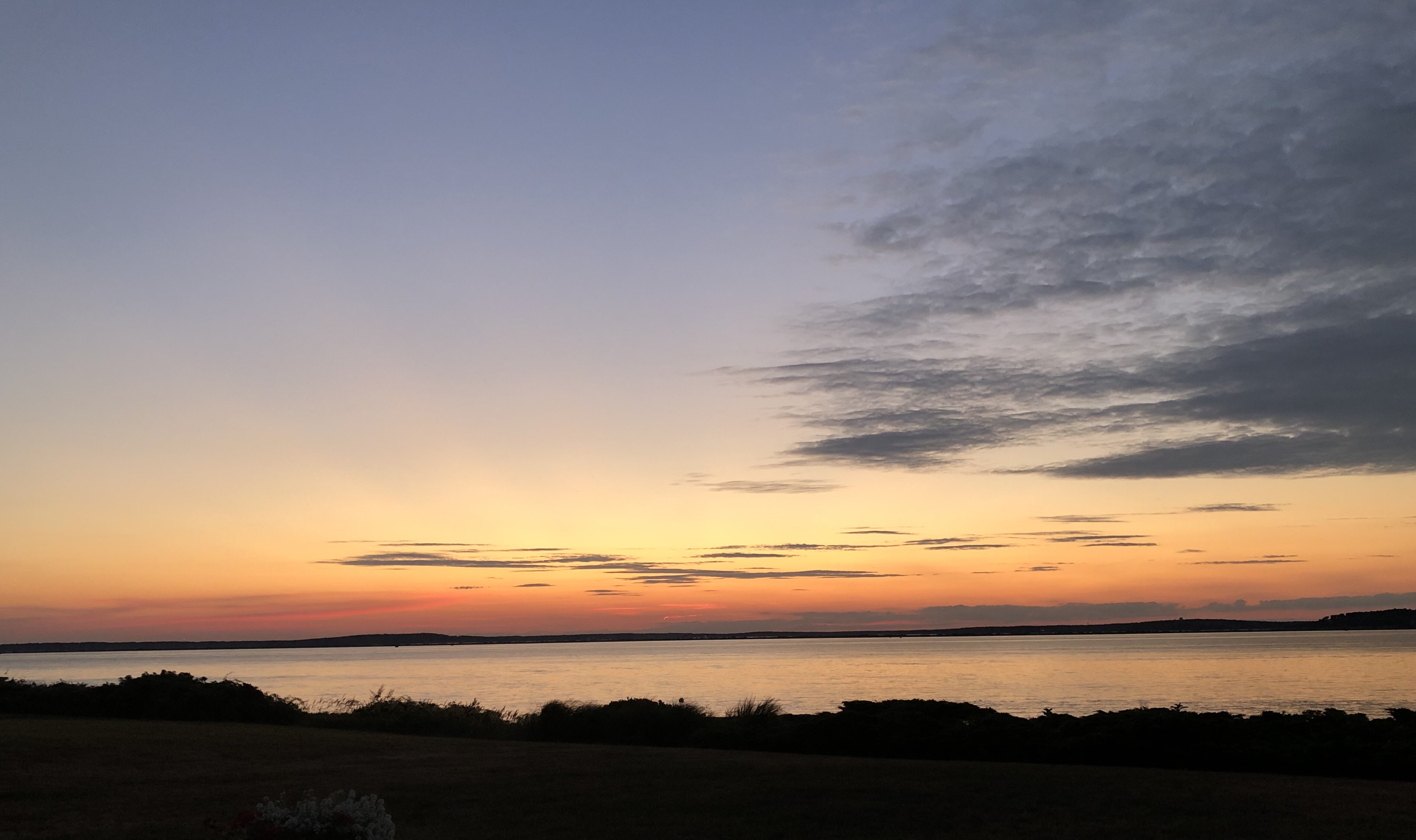
    I try to create infinity bookends in a day by getting up early for sunrises and going out late to look at the stars as one way of putting myself at the edge of forever.  And it might explain the draw of rivers and the ocean and the mountains.  Each dazzles in their own way because they’re both silent witnesses to forever while simultaneously the embodiment of it.

    The Newton quote above hits close to home.  I do collect impossibly large stacks of books that I fear I’ll never get around to.  But rather than reign in my collection I add to it.  Someday maybe I’ll finish the stack, but I know its almost certainly blind optimism talking.  I may never get to all of the books or all of the places I want to go to, but that doesn’t mean I won’t vainly believe deep down that its possible I could.

    Watching the post-sunset show along the shore of Buzzards Bay a couple of nights ago I thought about the long list of experiences I’d like to have before I go gently into the night.  It seemed a rather long and impossible list given the state of the world at the present moment, but I think its rather like the stack of books.  I may not get to everything on the list, but hopefully I’ll get to enough.

    Watch the stars in their courses and imagine yourself running alongside them. Think constantly on the changes of the elements into each other, for such thoughts wash away the dust of earthly life.” – Marcus Aurelius, Meditations

  • Life In Four Native American Quotes

    “When it comes time to die, be not like those whose hearts are filled with the fear of death, so when their time comes they weep and pray for a little more time to live their lives over again in a different way. Sing your death song, and die like a hero going home.” – Chief Aupumut in 1725, Mohican.

    The Chief Aupumut I’ve read about was born in Stockbridge, Massachusetts and fought in the Revolutionary War as an important ally against the British.  He wrote an extraordinary letter to Thomas Jefferson asking for lands for a reservation in Wisconsin, so that his people wouldn’t have to keep moving further and further until they ran out of land.  He was also known as Hendrick Aupaumut, the Chief of the Muhheconneck Nation.  Given the date, the quote above may have derived from his father.  I’m not really sure, I’m relying on a web site dedicated to quotes from Native Americans.  But it took my breath away whomever the source was.  There’s a fair amount of stoicism in Aupumut’s words, not unexpected, and he challenges all of us to live more boldly in pursuit of our own dreams.  That’s a lot to live up to, living that we might die like a hero going home, but what else is this wild and precious life for if not to reach our potential?

    “What is life? It is the flash of a firefly in the night. It is the breath of a buffalo in the wintertime. It is the little shadow which runs across the grass and loses itself in the sunset.” – Crowfoot, Chief of the Siksika First Nation, Blackfoot warrior, peacemaker

    Crowfoot died relatively young at 60 from tuberculosis, so there’s wisdom in this quote reminding us of the briefness of life.  We’re all here for a short time, whether 60 years or 100, it’s all just the flash of a firefly in the night.  So why do we waste time on the trivial when time is so precious?  Because we don’t believe the truth before us.  There’s always another tomorrow, always next year, always an I’ll get to it…  until there isn’t.  Do it now.  If ever there was a consistent call from those who came before us its to make the most of this moment, not some future moment.

    “All who have died are equal.” – Comanche or Navajo quote (source uncertain)

    Google this quote and you’ll find multiple sources for it.  But generally it comes down to either the Comanche or the Navajo.  I wouldn’t be shocked if they both had a version of the same quote.  All who have died are equal.  And all who live are equal as well, even if treated differently.  I was raised to treat everyone the same, no matter what their skin color or nationality or sexual identity or preference.  But I’ve taken my own identity for granted, not seeing the struggles of those who fight unseen battles with those who weren’t raised the same way.  The world is full of struggles for equality and the respect and dignity of all.  But collectively we can make significant improvements in our lifetimes.

    “When a man moves away from nature his heart becomes hard.” – Navajo Expression

    There are a lot of hardened hearts in the world, removed from nature and seeing the world as asphalt and concrete and electricity.  It’s easy to dismiss climate change and consumer waste as hoaxes when you’re not immersed in nature.  How can you possibly see what you aren’t looking at?  I have seen the plastic washed up on remote beaches, and the oil slicks from spills far away.  I have noticed the shift in seasons and the haze over cities on busy commuter days.  As with equality, we can make significant improvements in our lifetimes, but we can’t wait much longer.  Perhaps a new President and Congress will prove to be the catalyst for change long overdue in the United States.  Perhaps the pandemic has given the world enough of a breather to give us the time to make meaningful change in our collective behavior.  But it always starts with us.

    I linger on the edge of nature often.  Gardening and observing the birds and bees and mammals attracted to the garden.  Hiking and getting out on the water whenever possible.  But I need to plunge deeper into the heart of it, to soften the hardness in my own heart.  We’re all that firefly in the night, with so little time.  How will we use our light?  What are you waiting for?


  • Resetting the Mind

    Monday morning wasn’t offering me any free rides today.  The well of creativity felt tapped out.  I looked through the 27 drafts I had going and wasn’t inspired to pursue any of them.  I tried sitting in my favorite reading chair and read Seneca’s On the Happy Life for inspiration, highlighting many passages yet finding no inspiration for today’s blog.  I put on headphones and listened to my favorite create something of substance song (Wild Theme) on repeat.  Nothing yet…  but getting closer.  Coffee cup drained.  Walked outside and sat on my favorite outdoor muse capturing device and waited.  And finally it came to me.

    “One of the most effective ways to reduce the friction associated with your habits is to practice environment design….  “resetting the room”.
    The purpose of resetting each room is not simply to clean up after the last action, but to prepare for the next action…
    How can we design a world where it’s easy to do what’s right?” Redesign your life so the actions that matter most are also the actions that are easiest to do.”
    – James Clear, Atomic Habits

    It occurred to me that I’ve set a few spaces to optimize productivity.  Sit/stand desk, noise-cancelling headphones, proper lighting, indoor and outdoor spaces at the ready.  All of this is setting the room, as Clear writes about.  And it’s setting the mind as well.  When I hear Wild Theme I get creative.  When I sit in a specific chair my mind focuses on writing.  And eventually it clears the fog and I get to it.  These are all methods of flipping the switch.  Want to work out first thing in the morning?  Put your workout clothes out so they’re front and center when you get up.  Writing is the same way – take the necessary steps of setting the “room” to prepare for the next action.

    Ultimately resetting the room means resetting the mind for the actions you wish to prioritize.  Having a dedicated workspace is important so personal time and work time don’t bleed over into one another.  I think that particular point has been hammered home by just about every business or lifestyle writer out there.  I won’t regurgitate the key points here.  For me it’s not about the space you place yourself in but the mindset you achieve.  Monday mornings are generally difficult because you’re transitioning from weekend activities to the work week.  I don’t recall having a similar challenge with Friday nights or the first morning of a vacation.  It’s all in the mind, this calendar mentality, but the uncertainty of which hat am I wearing at the moment? is valid.  So in times of transition, to reduce the friction, the question how do we make it easy to do what’s right? is paramount to actually getting things done effectively.

    And that brings me back to Seneca, which didn’t seem at all connected to this topic when I started writing this morning.  In speaking about virtue, Seneca’s pointed out that he hadn’t quite gotten to a virtuous life just yet.  To which his critics pounced, saying why should we listen to a man who hasn’t mastered the very thing he lectures us on?  But Seneca turns this around on his critics, pointing out that:

    “I make this speech, not on my own behalf, for I am steeped in vices of every kind, but on behalf of one who has made some progress in virtue.”

    We all tend to think that everyone else has it all figured out, don’t we?  And it can be unnerving when someone who is “showing us the way” admits that they’re a work in progress themselves.  But I’ve come to a point where I view anyone that tells me they have it all figured out is a con artist – be it a fundamentalist, politician, overly aggressive business person: you know the type.  Like you I’ve learned to be skeptical of people who say they have it all figured out.  Instead, I write to show myself the way.  On behalf of one who has made progress in the things that I myself strive for.  Finding a way to flip the switch on a misty Monday morning, and sharing in the process for arriving at the desired state.  The well feels a bit less empty even as I tap from it.  Funny how that happens.

  • On Setbacks and Moving Ahead

    “Show me that the good life doesn’t consist in its length, but in its use, and that it is possible—no, entirely too common—for a person who has had a long life to have lived too little.” Seneca, Moral Letters

    Preparing to sauté a holy trinity of onions, celery and peppers last night, I found the counter loaded with dishes and grocery items that hadn’t been put away.  So I set about putting them away and in the process of pushing a bag of coffee into a cabinet a glass mason jar was pushed out and plummeted to the floor, where it transformed into hundreds of shards of glass.    Which transformed my evening of cooking into an evening of cleaning every bit of glass off the floor before I could get back to the original mission.  Life is full of setbacks.

    I have big plans – I always have.  Sometimes they play out but many times they peter out. So it goes.  Lately I’ve been planning big again, as documented yesterday in this blog, and planning big requires a healthy dose of optimism about tomorrow and the tomorrows after that.  But like the mason jar I know they’ll be setbacks along the way.  Ultimately plans are just a direction we decide to go in, and action is what we do to move in that direction today.  For there’s only today, as Seneca reminds us from his dusty grave.

    “I don’t complain about the lack of time . . . what little I have will go far enough. Today—this day—will achieve what no tomorrow will fail to speak about. I will lay siege to the gods and shake up the world.” – Seneca, Medea

    Bold statement to be sure, but there’s boldness in action, and boldness in the immediate. So why not be bold today?  Do something outside the ordinary.  And this is where we might book a trip to someplace new or dart off the some other adventure.  Since “darting off” options are limited for most of us, what can we do that strikes of bold?  What shall today’s one line entry in the journal be?  Rolled the trash bin back up from the street?  Or maybe something more?  We’ve got roughly 16 hours of useful time in a day.  What little time we have will go far enough if we would only get moving now.

    “The whole future lies in uncertainty: live immediately.” – Seneca

    Every morning I wake up and get moving right away.  There’s always urgency in my mornings.  Urgency to write and read and think a bit about things before the rest of the world wakes up and imposes itself on my grand plans.  I value the mornings most of all for this reason.  We don’t know what mason jars are lurking about to mess up the plans we have, but worrying about lurking setbacks isn’t going to build momentum in this moment.  Focus on the actions you can take now to build resilience and momentum to handle the setbacks then.  When the setback happens, give it the attention it needs for the time it requires, and then find some small step forward.  And another step after that.  That’s life, one moment and one setback at a time.  Whether a shattered mason jar or a pandemic, it’s only a setback (and not a finale) if we work through it and put it behind us.  Stop signs are really only pauses before we get moving again.  Having looked both ways, I believe it’s time to get moving again.  Seneca is right there with us, prodding us along through our inertia: “Now”.

  • Masters of the Art of Life

    Dive deep with me on this quote, there’s a lot to it:

    “In der Beschränkung zeigt sich erst der Meister [“Only the master shows himself in the limitation,”] says Goethe. Mâle résignation, this also is the motto of those who are masters of the art of life; “manly,” that is to say, courageous, active, resolute, persevering, “resignation,” that is to say, self-sacrifice, renunciation, limitation. Energy in resignation, there lies the wisdom of the sons of earth, the only serenity possible in this life of struggle and of combat. In it is the peace of martyrdom, in it too the promise of triumph. – Henri Frédéric Amiel, Amiel’s Journal

    “Manly resignation” seems counterintuitive, contradictory and weak to some. But dig deeper here into the words used to describe resignation: self-sacrifice, renunciation and limitation. These are anything but weakness, they’re honorable traits. It takes courage to stand up and voice a counter argument, to say this isn’t right, this will not stand. It takes courage to face ridicule and violence. The weak are the blind followers.  What shall you be?

    Only the master shows himself in the limitation… visually I leap to Obi Wan Kenobi raising his light saber in concession to Darth Vader in Star Wars. But who really won in the end? In real life, it means finding common ground, conceding a point, compromise for the greater good. The art of diplomacy.  The REAL art of the deal, not the con man version.  All very adult traits that Congress might wish to return to. Traits any good leader has. Any good parent. Any good spouse. The United States is not currently being led by someone who shows himself in the limitation. But the country recoils and will spit out this poison pill eventually. I hope in a few months.

    “Masters in the art of life” suggests the easy path on its face. But life isn’t easy, and the art of life is making it look easy while you press ahead doing the work that matters.  Any fool can set aside responsibilities and chase after pots of gold on the other side of the rainbow. Decide what to be and go be it, but remember the truly great people, the masters in the art of life, are the people who sacrifice of themselves for the greater good.  Not frivolously, but for the things that matter.  Who are the masters in the art of life?  I think of Robert Kennedy, Martin Luther King, Jr., Mother Theresa, Gandhi, Winston Churchill, John Muir, George Washington, Clara Barton, and dozens more.  All of them very human, with flaws some were/are eager to point out as if to elevate their own standing.  But all rose above the common man or woman, showing themselves in resignation, not of the fight, but of the easier path.

    Maybe we all can’t be the answer on some future Jeopardy trivia question, but we can be an anchor in our family, in our community, in our careers.  We can be linchpins, as Seth Godin would put it, that hold things together even in the most trying of times.  And maybe that’s enough. To throw another couple of movie characters at you, it’s so much harder to be George Bailey in It’s A Wonderful Life or Atticus Finch in To Kill a Mockingbird, but don’t we have to try?  Looking around at the moment, it seems plenty want to try.  That’s the recoil in action.  The pendulum swinging back to center.  This is not who we ought to be.  This will not be who we will be from now on.  We can be better than this.  Decide what to be and go be it.

    In a bit of trivia perhaps interesting only to me and the parents who conceived me, Amiel wrote that entry in his journal 114 years to the day before I was born. He was 31 at the time. He was wise beyond his years. If there’s a joy in reading, its in mining gold from the ages. Tapping into the Great Conversation is available to all of us, so why don’t more people seize the opportunity?  To master the art of life, it helps to learn from those who have been here before.  I’m a work in progress myself, but try to learn a bit more every day, and apply some of that wisdom in my own life.  I may not be Obi Wan Kenobi, but I can try to be George Bailey.

  • The Waves of Change

    “The first thing to do—don’t get worked up. For everything happens according to the nature of all things, and in a short time you’ll be nobody and nowhere, even as the great emperors Hadrian and Augustus are now. The next thing to do—consider carefully the task at hand for what it is, while remembering that your purpose is to be a good human being. Get straight to doing what nature requires of you, and speak as you see most just and fitting—with kindness, modesty, and sincerity.” – Marcus Aurelius, Meditations

    The world is in a state of change, and countless people are raising their voice to say that this reality, the way we are right now, it will not stand.  Will we be the better for having endured the tumultuous waves washing over us?  Or will we drown in the chaos?  That often depends on how we react in the moment.  When the world get’s a bit overwhelming, and let’s face it, the world is a little overwhelming at this moment, I turn back to stoicism, take long walks, and write more.  In short, I sort out how I want to react to the world around me.  Instead of getting angry at injustice, despair at suffering, or frustrated at apathy, I must absorb the reality and choose how to react.  Like waves crashing over you in heavy surf, you’ve got to get your feet underneath you to absorb the blows, but also know when to duck under the big waves so you aren’t knocked down for the count.  2020 is bringing some pretty heavy surf.

    “If, at some point in your life, you should come across anything better than justice, honesty, self-control, courage – than a mind satisfied that it has succeeded in enabling you to act rationally, and satisfied to accept what’s beyond it’s control – if you find anything better than that, embrace it without reservations – it must be an extraordinary thing indeed – and enjoy it to the full. – Marcus Aurelius, Meditations

    Justice, honesty, self-control and courage, acting rationally and accepting what isn’t in your control…  That’s stoicism.  And a good place to set your feet as the waves crash over.  At some point this storm will abate.  Will the storm shift the landscape enough for meaningful change, or will there be more storms in the future? Will we be the better for having endured?  I can’t change the landscape, and I can’t change the storm, but I can choose how I react to it, and to act in small, meaningful ways that cast a vote for what I want to see in the world today and tomorrow.  To be a good human being and a steadying influence to help others find their footing.  To set my feet and rise to the occasion.  That seems to me a good starting point.