Category: Exploration

  • Hiking Through the Boulders of Pawtuckaway

    On a cool, raw and occasionally wet Sunday an avid hiker friend and I explored the trails and summits of Pawtuckaway State Park. Situated within the towns of Nottingham and Deerfield, New Hampshire, Pawtuckaway is easy to reach compared with some other mountains in New England. And of course it’s hard to call them mountains at all, if you want to get righteous about the height thing. Doing North and South Mountains together offers a gain of only 1409 feet, I’m told, but the story isn’t the elevation gain, it’s the geological interest that draws you here.

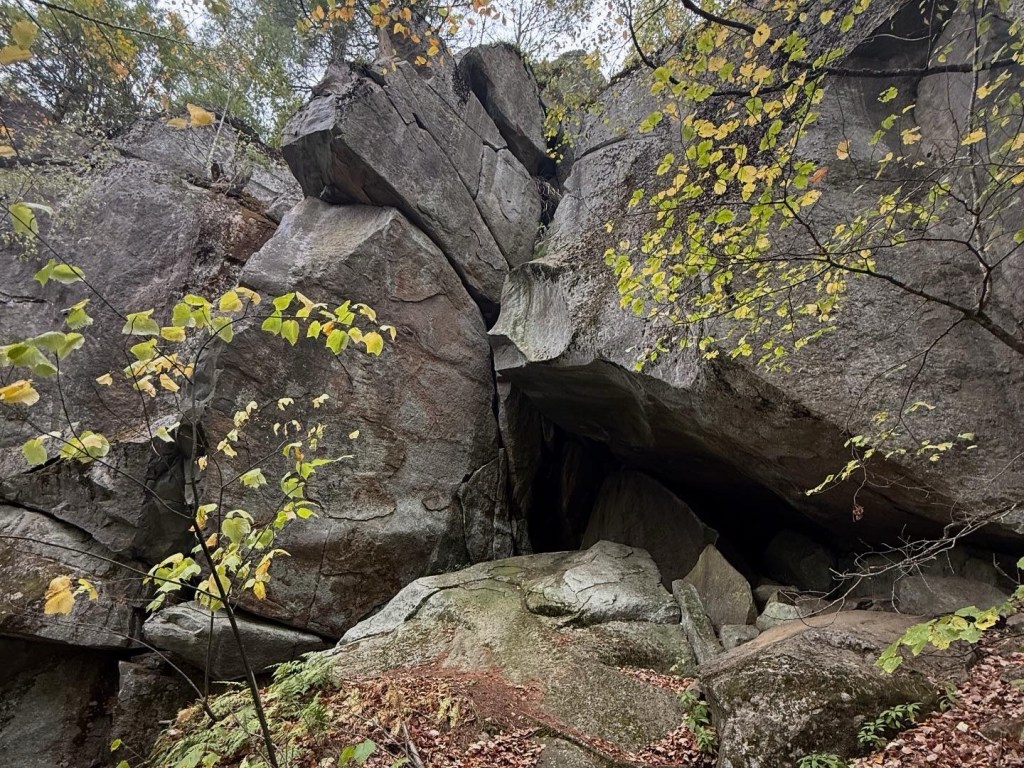
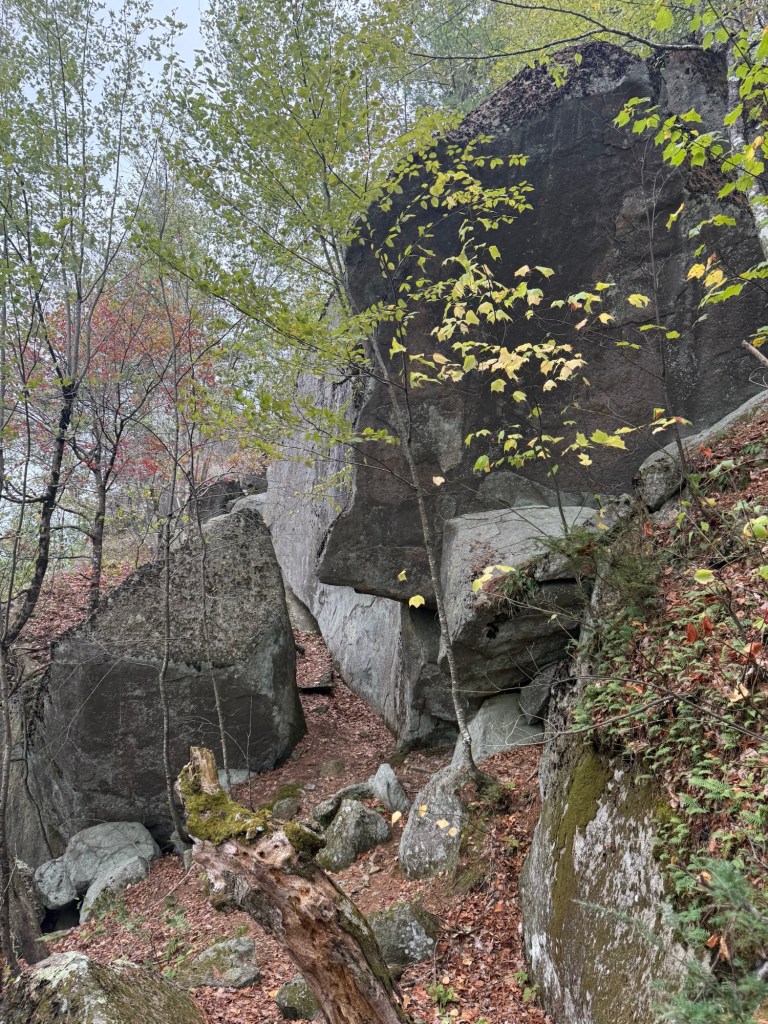
    “High up on South Mountain a dike of black trap rock cuts the granite-like rock of the mountain, and breaking out rectangular blocks provides the treads and risers of Devil’s Staircase. The top of South Mountain and the firetower rising above it command a view overlooking the sea to the east and the mountains to the north. The Devil’s Den Trail to North Mountain first passes the huge Pawtuckaway Boulders. These tremendous blocks of rock ranging up to 60 feet in some dimensions and probably comprising the largest group of boulders anywhere, are strewn for about a quarter mile along the trail. Once a part of North Mountain, they were plucked by the glacier during the Great Ice Age and dumped in their present position when the ice melted. Devil’s Den was hollowed out by this same plucking action.”
    — Jacob Freedman, The Geology of the Mt. Pawtuckaway Quadrangle

    “Forces in the earth developed a circular fracture around the solid rock, and into this fracture more magma of a different composition rose. It consolidated to form a gray coarse-grained granite-like rock called monzonite, which now makes up the circle of the Pawtuckaway Mountains in what is called a ring-dike.” — Jacob Freedman, The Geology of the Mt. Pawtuckaway Quadrangle

    Winding through these fields of plucked glacial erratics, you’ll find plenty of rock climbers bouldering the monzonite, mountain bikers and the usual assortment of casual and serious hikers navigating the trails, and a surprising amount of horse manure indicating that some of the trails are very popular for horseback riding. There are gravel roads throughout the park as well, and we found these to be useful connectors between trails on our 12 mile hike.

    Reading about the history of the area, it seems there was a character known as the “Barefoot Farmer of Pawtuckaway” named George Goodrich who played a large role in making it a state park. The Goodrich family farmed this rocky land, and you can find the family graveyard within the state park. I can’t imagine hiking the terrain barefoot the way he farmed it, but I suppose a few decades of barefoot farming would go a long way to toughen up the toes.

    New Hampshire is in a serious drought, and you could see the impact it’s having in the streams, ponds and wetlands. Stream beds are largely dried up and the ponds are showing plenty of their muddy bottoms. The foliage is muted this year too after the stress of a dry season. But our hike coincided with the beginning of a few days of rain, and we hiked out to a misty, raw sendoff.

    I’d hiked this place before, almost twenty years ago, focused mainly on South Mountain and the fire tower you can climb up. That’s surely the most popular trail because it’s relatively easy with a nice payoff in views when you reach the summit. But for my money, North Mountain and the ledges and boulders below it are the most dramatic and fascinating place in Pawtuckaway. If you go, you can’t miss them. Shoes are optional, of course, but highly recommended.

  • Release the Dancers

    “He was weary of himself, of cold thoughts and intellectual dreams. Life a poem! Not when you perpetually went around inventing your life instead of living it. How meaningless it was, empty, empty, empty. This hunting for yourself, slyly observing your own tracks—in a circle, of course; this pretending to throw yourself into the stream of life and then at the same time sitting and angling for yourself and fishing yourself up in some peculiar disguise! If only it would seize him: life, love, passion—so that he wouldn’t be able to invent it, but so that it would invent him.”
    — Jens Peter Jacobsen, Niels Lyhne

    There’s a fine line between imagination and invention. We dream big dreams, or perhaps simply a wee wish or two, and they each dance about happily in our imagination until we do the work to realize them or eventually get sick of being teased by the dancers and find something else with which to fancy for awhile. Life isn’t meant to be a dream, it’s meant to be a gradual realization of our potential. It’s a matter of turning imagination into reality through deliberate and purposeful work. That line is crossed through action.

    “Decide what to be and go be it.”… The Avett Brothers lyric that lives rent free in my head.

    Incremental experience—the experience that Jacobsen’s character Niels is pining for—in turn forever reinvents us. The person we’ve become is far more capable of doing this next thing than the person we were then. We imagine possibilities we couldn’t imagine from our previous vantage point, and we move along a timeline of steady progression.

    It’s natural to chafe at the limitations of our current level of experience. This discomfort is a catalyst for change—if we allow it to be anyway. Unless we’re forever paralyzed by inaction and low agency. We must develop our voice over time and learn to use it to realize possibility:

    Alas for those that never sing,
    But die with all their music in them!
    — Oliver Wendell Holmes, The Voiceless

    We are forever inventing ourselves or settling into the stasis of an under-developed character. We must raise our voice and sing! This life is flying along with or without our active participation. By all means, step away from the mirage of dreams and do something with this day. Release the dancers!

  • Seeing It

    “The world is full of wonderful things you haven’t seen yet. Don’t ever give up on the chance of seeing them.” ― J.K. Rowling

    Here on the home front, the acorns and crickets signal the last days of summer are closing in on us. And once again, we seem to have an abundance of each. Whether we like it or not, the clock is ticking on summer days, and that old back to school feeling is all around us (along with Halloween candy displays—why?!). The Final Countdown is playing in my head, and to be honest, I’ve never liked that song. Someone make it stop!

    When I take stock of what I’ve done this year thus far, I have no right to complain about not traveling more. But end of summer always makes me think about the places I haven’t reached just yet. Once a vagabond, always a vagabond. At least in spirit. We may be grateful for the places we’ve reached in our life while still aspiring for more. A mindset of kaizen (constant, never-ending improvement) includes never being truly satisfied. But there’s still time for a little more exploration and discovery.

    This blog began as a vehicle to write about what I saw in an active regional travel routine. Through deliberate lifestyle design, I’ve gone from 80% travel to 0% in my work. Work travel may satisfy the mind’s desire to see something new each day, but let’s face it, most Hilton hotel rooms are about the same. Travel is not the accumulation of points or the “free” bottles of water, it’s the revelatory experience of stumbling upon wonderful and taking the time to learn something about it.

    The thing is, we can discover wonder anywhere, in any season. We just have to be open and curious and willing to experience what is right in front of us. I can wonder at the explosive production of cucumbers growing in pots on the patio just as easily as I can about some roadside historical sign. Why did it take me so many years to give that a try? Just as the garden is where you grow it, gratitude is where you nurture it.

    This was a season when being home was more essential than ever. The end of life journey of my father, a brief summer reunion with old friends, and the time with our children as they each making significant pivots in their own lives, is time I would never have had if I’d been off checking bucket list destinations off the list. There is a season for everything in life. When we are forever looking for the next, we miss so much of the now. Being here, now, and seeing what is right in front of us all along is the true journey of discovery. Do we see it?

  • The Chain of Understanding

    “A man receives only what he is ready to receive, whether physically or intellectually or morally, as animals conceive at certain seasons their kind only. We hear and apprehend only what we already half know. If there is something which does not concern me, which is out of my line, which by experience or by genius my attention is not drawn to, however novel and remarkable it may be, if it is spoken, we hear it not, if it is written, we read it not, or if we read it, it does not detain us. Every man thus tracks himself through life, in all his hearing and reading and observation and travelling. His observations make a chain. The phenomenon or fact that cannot in any wise be linked with the rest which he has observed, he does not observe. By and by we may be ready to receive what we cannot receive now.” — Henry David Thoreau, The Journal of Henry David Thoreau

    We are conditioned to see by what we’ve seen. When I think about half of the country believing the current direction of our leadership is great, while the other half are horrified and angry, I can only understand it by conditioning. Those who are conditioned by fear and a scarcity mentality believe one thing. Those who are conditioned to be empathetic and develop a growth mindset in their education, spiritual, career, health and financial life believe another thing.

    Knowing this, I see that the answer lies in education and diversity. Unfortunately, the other side knows this too, and so books are banned, late night talk show hosts are cancelled, and even satellites that give us information about climate change are targeted for destruction. Ignorance is bliss. And humanity takes two steps back.

    So what do we do in a world that is so infuriating? We continue listening, reading, observing and traveling. We keep finding the truth and share it with others. We counter the momentum of ignorance with insight and mutual understanding. We are the ambassadors of truth and compassion, and we aren’t going away any time soon.

    There is no them
    There’s only us
    — U2, Invisible

    So stay the course—learn and grow and share. There is no them, there’s only us. When we stop thinking of them as different from us and simply less aware, something opens up within our own minds. We are ready to build bridges—to help them see, not simply them, but all of us. The solution has always been right in front of us, waiting for enough of us to finally receive it. We are all links in the human chain. That chain connects to an anchor of truth or shackles of mistrust. What we connect to is up to us.

  • Perfectly Reasonable Reasons

    “Listen, are you breathing just a little, and calling it a life?” — Mary Oliver

    It’s always the poets and the artists who draw our attention away from the straight and narrow path. And if we ever need a poem to call us out and force us to reassess what we’re focused on, reading Mary Oliver’s Have You Ever Tried to Enter the Long Black Branches in the quiet time before the world awakens to demand we fall in line will do the trick. We listen at our peril, for to do so is to shatter the illusion that this life we’ve wrapped around ourselves in this protective shell is enough.

    How long will you continue to listen to those dark shouters, caution and prudence?
    Fall in! Fall in!

    What are we doing with our time? Have we noticed, even as we’ve entered the height of summer, that the days are growing shorter? We must venture to the tingly work now. What is bold and a little scary? What are we truly working on but clever excuses and perfectly reasonable reasons for not leaping? Do we really believe the audacious life will sit in the corner awaiting our approval?

    What do we see? What do we seek? Go to it. For our time grows ever shorter. May this day leave us breathless with wonder at what we’ve done with the time.

  • Being Mad in a Prudent World

    “Run from what’s comfortable. Forget safety. Live where you fear to live. Destroy your reputation. Be notorious. I have tried prudent planning long enough. From now on I’ll be mad.” — Rumi

    We are too often prudent. We like to think ourselves mad, but we gradually move back to doing what is expected of us, what is logical, what will pay the bills and such. When all along our wild side cries for release. Do you still hear the cry, or has it been smothered to death?

    I’m not suggesting we each take the sum of our 401(k)’s and put it all in at the craps table, merely that we stray off the straight and narrow more often. Do what nobody ever expected of us now and then, just to keep them from believing they have us figured out. We are more than the expectations others that have of us—at least we ought to be.

    We stack our experiences neatly in a line, one day to the next. Towards the middle, we start to see a trend as our collection of experiences become our identity. This is who I am is as powerful an anchor as any. To slip that anchor in favor of this is who I will be is a scary proposition. And this is why most people never sail beyond that safe harbor. They reach the end of their days wondering where they might have gone but for a little courage to weigh that anchor and set the sails for adventure.

    I see my light come shining
    From the west unto the east.
    Any day now, any day now,
    I shall be released.
    — Bob Dylan, I Shall Be Released

    A blog is a form of expression. Perhaps it’s a way to let the cries have their say, or to document the gradual release of this writer from the anchors that once held him firmly in place. There’s far more to say and do, and following the heading of who we will be is easier said than done. But Rome wasn’t built in a day, and neither are we, friend. The voyage begins with each step away from prudent, towards what once seemed quite mad. We find that what was prudent at anchor is mad when we’ve sailed beyond who we once were.

  • The Waterfalls of Letchworth State Park

    If you love waterfalls (and who doesn’t love waterfalls?), Upstate New York is the place for you. Get beyond Niagara Falls and you find hundreds of waterfalls worth exploring (officially over 2000). I’ve written about many of the waterfalls of New York over the years as I’ve explored them, but circumstances had never gotten me to Letchworth State Park to see their beloved three on the Genesee. During a drive from Cleveland to Boston, we finally stopped to see what all the fuss was about.

    Once you get off I-90, the rule is single lane roads rolling up and over hills through the never-ending farmland and woodland of New York. This rule demands two things: a full fuel tank and an empty bladder. Obeying these rules will get you to your destination eventually. Letchworth State Park is a destination worthy of that drive.

    Rolling in on a hot summer day, we pulled up to pay the $10 day entry fee. The park official looked up at the bug-spattered roof bag and asked if we planned on camping. “Nope, just here for the afternoon”, we assured her, and followed her instructions that led us to the restrooms. We all must prioritize our time based on the urgency call of the moment.

    After getting our affairs in order, we drove back towards the southern entrance to the park to the impressive railroad bridge spanning the Genesee River (Portage Bridge). There was ample parking for a Sunday hike, and we quickly made our way to the trailhead at Portage Bridge. Being a New York State Park, you come to expect elaborate public works like staircases, walls and railings, and there they were to greet us as we made our descent.

    The three waterfalls in the southern section of the park are the Upper Falls, Middle Falls and Lower Falls. The Upper Falls, with the railroad bridge spanning the river above them, offer a beautiful view. The Middle Falls are the most impressive and are the falls you can get closest to. The Lower Falls are further away as you’re hiking, but on easy terrain for the average hiker. Once you’ve arrived at the Lower Falls you can either continue hiking through the canyon or turn to head back to where you started. We opted for the out and back, making a solid 5 mile round trip.

    Letchworth is a park full of campers and day-trippers. There are plenty of amenities situated along the route, from restrooms to a restaurant with gift store for those wanting perfume-fragranced candles and such. Closer to Upper Falls there’s even an ice cream stand. That proved a fortuitous opportunity for us to purchase some cold drinks to reinvigorate for the final climb back up to the trailhead.

    As we were rehydrating four girls with their grandmother were walking away from the ice cream stand with soft serve cones quickly melting in the sun. As they licked to keep up, one of the girls said, “Best day ever.” as they made their way to a picnic table. I thought to myself, you just might be right.

    Upper Falls
    Middle Falls
    Lower Falls
    Genesee River below Lower Falls
    Classic New York State Park stairs and railings
  • Returning to the Cascadilla Gorge Trail

    For a few years I found myself spending a lot of time in Ithaca, New York. If you love waterfalls and a relaxed college town vibe, it’s the place to be. I forgot how much I missed it until I returned.

    My connection to Ithaca runs deep. My favorite Navy pilot went to the big red school on the hill. My daughter went to the big blue school on the other hill. I have a long affinity with the Moosewood restaurant through the cookbooks and [not nearly enough] visits to eat there. There are other connections but you get the point.

    It’s those waterfalls that root deeply into your soul and never release you. My favorite Navy pilot used to tell me that Cascadilla Gorge was his favorite, and I feel the same way. It doesn’t have the jaw-dropping impact of Ithaca Falls or the height of Taughannock Falls, but it’s a more intimate experience—especially early in the morning when you have the place mostly to yourself.

    I was with my favorite Navy pilot last the last time he visited Ithaca, to see his granddaughter and see the campus again. We saw some waterfalls then too, but not Cascadilla Gorge. It was beyond his ability at that point in his life. I thought about him as I descended back down along the rushing waters. We are only here and healthy for such a brief time. Will I ever visit this gorge again myself? Who knows what the future brings? But I am here, now, when it matters most.

  • To Live

    “To live is the rarest thing in the world. Most people exist, that is all.” — Oscar Wilde

    Do interesting things. Cross borders—real and imagined. Test the validity of advice from timid people. Discover the bridges that fill the gaps between who we are and who we aspire to become. For the clock is ticking and time grows short, even as we foolishly believe it may run on forever.

    There’s work to be done (surely there’s always work to be done), but make it work that explores limitations and offers a steep ascent in learning. Always remember that we may never pass this way again, so do what calls for attention while we are here—younger and more vibrant than we would be if we ever were to return.

    To live, and not to merely exist. This is our quest. Get to it already!

  • Quo Fata Ferunt: How Fate Created Bermuda

    The normal way to cross the Atlantic east to west is to go south to the Canary Islands and catch the trade winds over to the Caribbean. But what should one do when the two end points are controlled by hostile forces? The answer for the British in 1609 was to sail the route north of the accepted route to avoid the Spanish altogether. And this led them to fate.

    The Sea Venture was the lead ship in a small flotilla resupplying Jamestown, Virginia. They ran into a major storm and the ships got separated. One ship sank with all souls lost, and the Sea Venture was foundering, taking on dangerous levels of seawater after the chalking between the ship’s timbers failed. And then by some miracle (that northern route), they spotted land. Admiral Sir George Saunders attempted to navigate the reefs to land and the ship wedged into it, saving all hands. They landed, built two ships and continued on to Jamestown. But having discovered it, the British would soon return to found Bermuda and establish another foothold in the New World.

    Quo fata ferunt (“Whither the fates carry us”) is thus an appropriate motto for Bermuda, and maybe for the rest of us too. We cannot control where fate might bring us, but we can accept it (amor fati) and make the most of the moment. Like Bermuda, we may be adapt and become resilient to whatever circumstances arise, and sometimes even thrive for having risen to the occasion.

    Coat of Arms of Bermuda (image: wikipedia)