Category: Exploration

  • The Glories of the Journey

    “We must go beyond textbooks, go out into the bypaths and untrodden depths of the wilderness and travel and explore and tell the world the glories of our journey.” – John Hope Franklin

    “On a personal level, [the pandemic is] reminding me that, “Boy, life is short.” Life is precious. And, if you’re dreaming about doing something, there’s no better time than right now, if you can pull it off.” – Rick Steves

    The world is slowly opening up, even as COVID is declaring it’s not quite done with us yet. So where do we go when the world and we are ready? In the United States, the National Parks are already almost fully booked. Everyone is thinking the same way; we must get out there! The next few years are going to be the flood of the masses making up for lost time. Knowing that, where do you find your quiet little corner of Paradise?

    Personally, my vote is the most remote and obscure of destinations. Places where the RV’s can’t reach. Places where exercise and inconvenience are a toll many refuse to pay. The glories of the journey aren’t found elbow to elbow at the railing of the South Rim. They’re found when you hike deep down into the canyon to the silent reverence. When you wake up early and watch the sunlight dance on the canyon walls.

    Don’t get me wrong, I’m happy that there are folks jamming into National Parks in record numbers. The more people who see and experience the wonders of the world, the more people will care enough to protect it for future generations. Pack ’em in. Buy the magnets and stickers and t-shirts. When I visit those places I do it too. Just try to peel back the onion a layer or two deeper while you’re there. Find the secret places hiding just around the corner.

    The world has stories to tell us. It’s waiting for the change it will bring to you in that moment of connection between the ancient truth and your current state. Those moments that you’ll bring back to the rest of the world in stories of your own. For we travel out to reach within.
  • Catching the Wind

    Waking up early I dress straight away and head outside for the Spring performance. Birdsong in spring is like no other time of year, and you must be out there early to catch the peak. Soon the tall pines caught the wind and danced together with it in a song of their own. And the harmonies of birds and breeze and trees sang to me their morning song. April mornings in New Hampshire; playing for a limited time only.

    I thought I might read a favorite Mary Oliver poem, and read ten times the one. Some days every word grabs you and shakes you to the core. Other days the words aren’t for you. I apologized to Ms. Oliver for not having my mind on the lesson and gently put poetry aside for another time.

    And turn to music. Wild Theme, Symphony No. 5, and finally Suite bergamasque: Clare de lune. Like poetry you know when it’s the right moment for a song. And so this morning Debussey and I walked about the quiet house while the world slept. But soon the restlessness returned.

    The child is in me still… and sometimes not so still.” – Fred Rogers

    Mondays hand us the friction of the weekend meeting the work week. The question of what must be done taps on the shoulder demanding answers. Each passing minute you linger with birds and poets and symphonies amplifies the urgency of the questions. What must be done?

    Listen to the world around you. Accept the day as it comes, but plot your course with clarity of purpose. Find stillness, if you can. If only for just a moment. If you listen, you’ll hear what it’s been telling you all along. Minimize that friction and dance with the world on your own terms. Catch the wind, and fly.

    Of course! the path to heaven
    doesn’t lie down in flat miles.
    It’s in the imagination
    with which you perceive
    this world,
    and the gestures
    with which you honor it.
    – Mary Oliver, The Swan

  • Making the Sun Run

    But at my back I always hear
    Time’s wingèd chariot hurrying near;
    And yonder all before us lie
    Deserts of vast eternity…

    Let us roll all our strength and all
    Our sweetness up into one ball,
    And tear our pleasures with rough strife
    Through the iron gates of life:
    Thus, though we cannot make our sun
    Stand still, yet we will make him run.
    – Andrew Marvell, To His Coy Mistress

    Spending time ought to come with a warning label. I’m revisiting this poem from Marvell. I’d first written about it before the pandemic, when the world seemed quite normal, if maddeningly out of sorts. Since then, well, we all know how things have gone.

    So what do we do with this hard-won knowledge? We have our own time’s winged chariot hurrying near. Maybe we have a few years more or less than the average, but what’s it worth to you anyway? Another trip around the sun and vast eternity ahead for every last one of us. Make the most of life now, while there’s still some of that time for you.

    Today is the day before the promise of another year more. I’m getting a second dose of the Pfizer vaccine with a hopeful eye towards the future. A future where we might run with the sun, chasing every day to its extraordinary end. Sporting while we may. The sun doesn’t stand still. And neither should we.

  • Quicksand and Tasks of Consequence

    “Bad writing is almost always a love poem addressed by the self to the self.” Toby Litt

    “The more books we read, the clearer it becomes that the true function of a writer is to produce a masterpiece and that no other task is of any consequence.” – Cyril Connolly

    The time we spend, these moments slipping through the hourglass, are either consequential or quicksand. And so the tasks filling those moments are loaded with questions – is this the right use of this brief moment in time or might there be a better place to spend the grains of sand? Is this a task of consequence, or is it a love poem to the self, mere folly?

    You know when you’ve stepped in quicksand. Maybe not immediately, but soon enough you recognize the stickiness of a habit and the sinking feeling that you’re not making any forward progress. Quicksand is tricky stuff. The one thing you don’t want to do when you’re in it is flail in place.

    Writing a blog every day might not be a masterpiece, but is it folly? The act of writing is pouring your grains of sand into a jumble of words and placing them just so. With a picture in your mind of what they might be if you could just get it right.

    The ultimate measure of tasks is whether you’re flailing in place or going somewhere consequential. What might you otherwise be doing with those grains of sand? The answer isn’t what are you doing now. Not really. It’s what are you becoming? That is what really matters. For what will your masterpiece be, in the end?

    Work towards that.

  • Whispers from a Dead Poet

    There is no dusk to be,
    There is no dawn that was,
    Only there’s now, and now,
    And the wind in the grass.

    Days I remember of
    Now in my heart, are now;
    Days that I dream will bloom
    White the peach bough.

    Dying shall never be
    Now in the windy grass;
    Now under shooken leaves
    Death never was.

    – Archibald MacLeish, An Eternity

    I confess to not really knowing much about Archibald MacLeish, who died in Boston exactly 39 years ago yesterday, the day I started thinking about Archibald MacLeish at all. It started the night before, watching Ken Burns’ Hemingway and latching on to his name as someone Hemingway hung out with in Spain, as someone I ought to look into. Much of his poetry is available online, and I waded through a strong dose of it. And then I read his biography:

    “His mother was a Hillard, a family that, as Dialogues of Archibald MacLeish and Mark Van Doren reveals, MacLeish was fond of tracing back through its New England generations to Elder Brewster, the minister aboard the Mayflower.” – Poetry Foundation Biography of Archibald MacLeish

    It seems I’m a distant relative of Mr. MacLeish, both of us pointing to Elder Brewster as a connection to the Mayflower. I don’t dwell on the Mayflower connection – who cares if you were the first European to settle here or the millionth? What matters is how you behaved when you got here. I think on the whole Brewster settled his accounts well. And MacLeish lived a life of consequence himself. So how does one keep up with the relatives?

    What do you make of meeting a long dead relative through his work on the very day he passed 39 years before? Serendipity? Whispers? Or just history and happenstance capturing my imagination and carrying it away once again, as it’s done so many times before?

    It doesn’t matter so much, does it? We have the advantage of now, and now. Until we lose it. Until we are whispers ourselves, hardly heard in the swirling wind in the grass. Days we remember and dreams of the future matter little compared to the urgent matter of now. And what we might do with it.

  • A Visit to First Encounter Beach

    If Provincetown claims the first landing of the Pilgrims in North America, and Plymouth claims the place they settled, Eastham is the place where they first encountered the Native American population. And like the thousands of encounters between settlers and natives to follow, it wasn’t hugs and kisses.

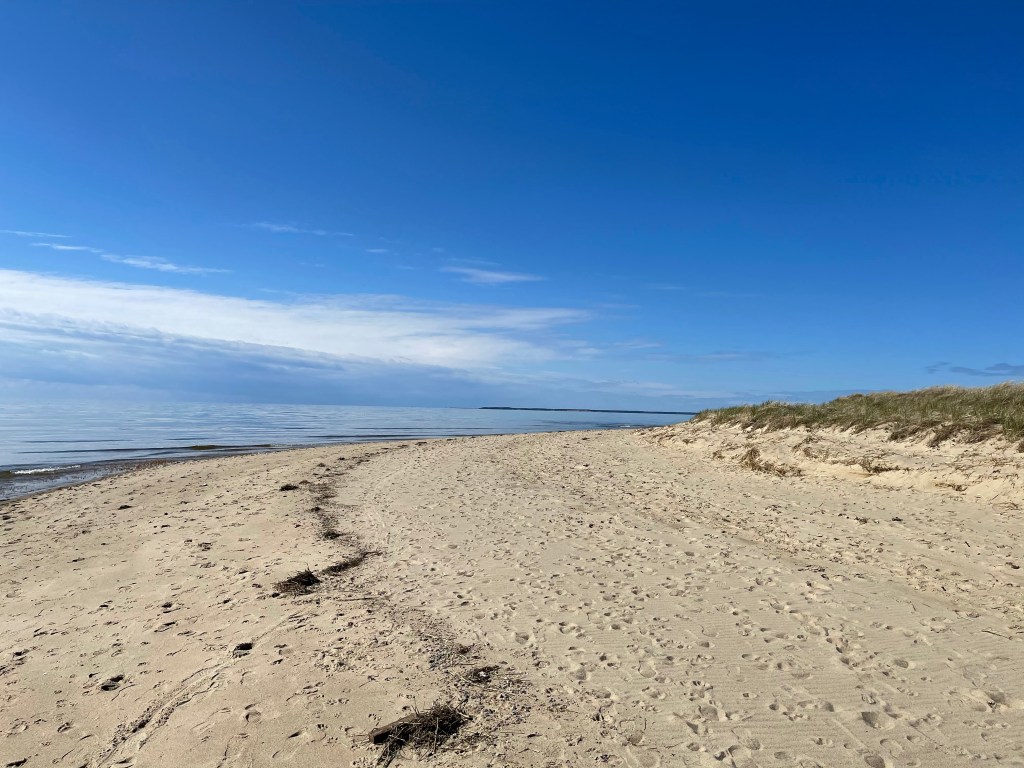
    Today there’s a popular beach with a paved parking lot on the calm waters of Massachusetts Bay. The real estate runs in the millions now, with great sunsets and a chance to swim while the sharks stake a claim on their ancestral hunting grounds on the opposite coast of Cape Cod. Really, it’s all funny money out here, but especially when you can claim a water view.

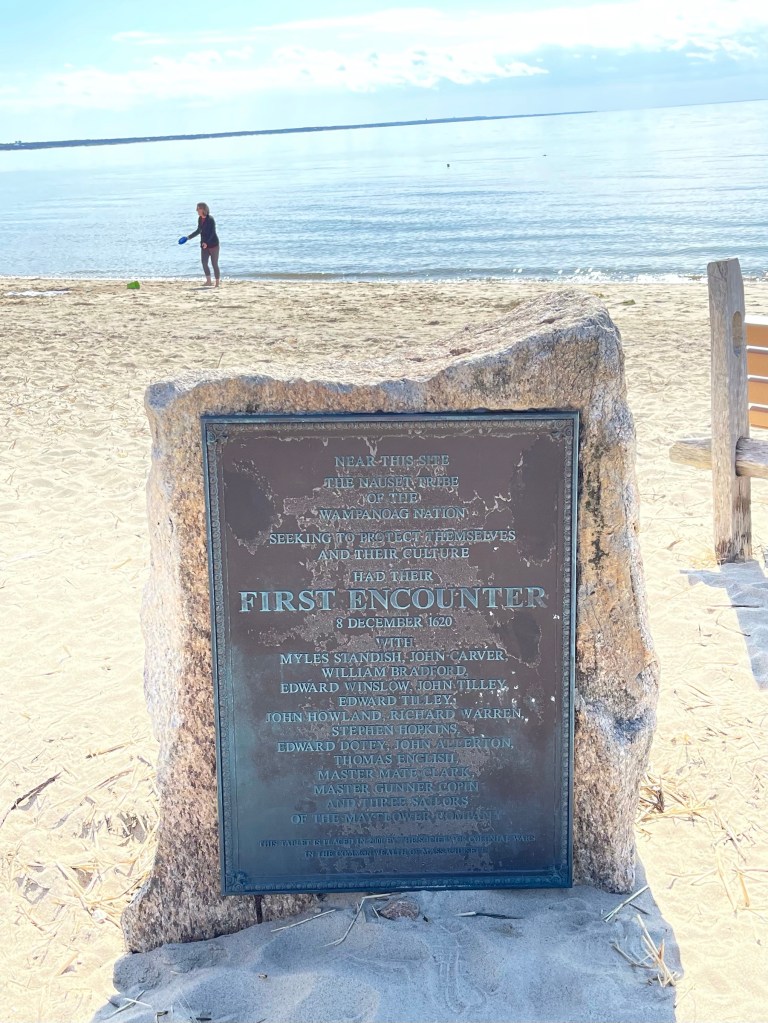
    There are two memorial plaques at the beach. One is hidden from view up the hill a bit from the beach, placed there to commemorate the tercentenary anniversary of that first encounter. The second, and more obvious one, is right as you walk from the parking lot onto the beach. Each offer a history lesson in worldview of the time.

    1920: “On this spot hostile indians had their first encounter December 8, 1620”

    2001: “Near this site the Nauset Tribe of the Wampanoag Nation seeking to protect themselves and their culture had their first encounter 8 December 1620”

    Both are true, aren’t they? But the devil is in the details, and none of us really know how that first encounter went down. We have historical record from one side but not the other. And that’s history for you; recorded by those who ultimately survive to write about it. Ultimately both inform, and the site itself pulls at history buffs like me. How do you visit Cape Cod for decades without a pilgrimage to the site of the first encounter between those who had it all and those who would ultimately take it from them?

    Now all you need is a parking spot at $15 per day for non-residents. For all the historical import of the site, today it’s mostly just a pretty, family-friendly beach. And a nice place for a quiet Spring walk with your significant other. And maybe a few hugs and kisses.

  • A Walk on Cahoon Hollow Beach

    “The sea-shore is a sort of neutral ground, a most advantageous point from which to contemplate this world. It is even a trivial place. The waves forever rolling to the land are too far-travelled and untamable to be familiar. Creeping along the endless beach amid the sun-squall and the foam, it occurs to us that we, too, are the product of sea-slime.” – Henry David Thoreau, Cape Cod

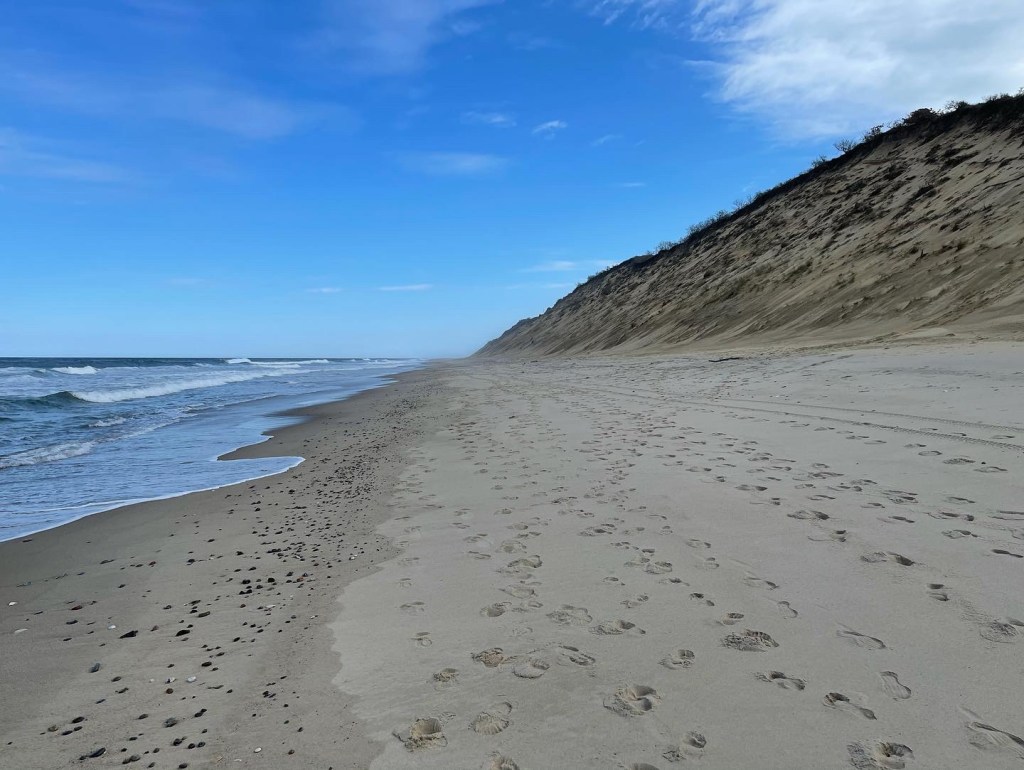
    Between the massive dunes and the crashing Atlantic Ocean in Wellfleet is a strip of sandy beach bearing the brunt of the relentless assault from wind and sea. The surf in warmer months is a feeding ground for Great White Sharks, who have modified their hunting style to chase grey seals right into the churning shallows that swimming humans like to frolic in during the warmer months. Great Whites don’t hunt humans, but sometimes they mistake humans for seals.

    In April you don’t see many seals bobbing in the surf on Cape Cod. So the sharks move on to other hunting grounds and leave this stretch of wild ocean to the occasional surfer and the beach walkers. A walk on the Cape Cod National Seashore can happen just about anywhere with an access path down the 100-foot dunes. Sand is dangerous stuff that can bury a reckless trespasser in no time at all. Sticking to the access paths preserves the dunes and just might preserve you too. The access paths themselves inform in their soft give. This is not a place for the meek. If you can’t handle the access path don’t walk this beach.

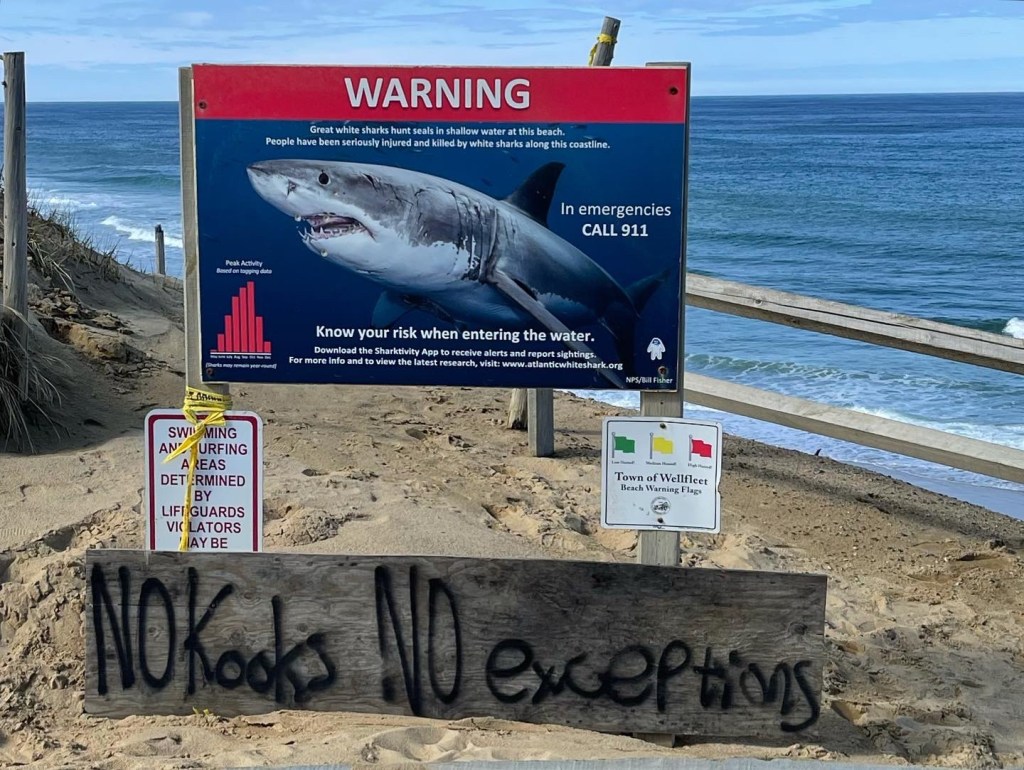
    For an off-season walk, we chose to park at the Beachcomber in Wellfleet and walk a stretch of soft sand known as Cahoon Hollow Beach. The Beachcomber is a trendy cool place at the height of summer. In mid-April it’s a convenient parking spot for easy access to the beach. A sign of the times is a shark warning with a handmade sign added to the bottom sharply suggesting “No kooks, no exceptions”. Wellfleet has had just about enough of the worst representatives of shark tourism.

    The National Seashore has a 40 mile stretch of beach that would test the strongest of walkers. When you say you’ll walk just to the bend you soon realize that bend keeps disappearing ahead of you. We walked about a mile, following the curve of the dunes around the forearm of Cape Cod. Walkers tend to gravitate towards the surf line where shells and smooth rocks offer themselves up for consideration. Soon your pockets are full and you recognize the folly of treasure hunting when every receding wave reveals another treasure.

    Thoreau walked the entire length from Chatham to Provincetown in the mid-1850’s and wrote about it for lectures that would end too soon in his abbreviated life. It would be published after his death in 1865 – the same year the Civil War ended. I think often about Thoreau, dying at 45 with so much left to do and see and write about. And here I was following him again, walking the beach between dune and sea, thinking it might just go on forever. Knowing it won’t.

  • Where a Road Will Go

    What if this road, that has held no surprises
    these many years, decided not to go
    home after all; what if it could turn
    left or right with no more ado
    than a kite-tail? What if its tarry skin
    were like a long, supple bolt of cloth,
    that is shaken and rolled out, and takes
    a new shape from the contours beneath?
    And if it chose to lay itself down
    in a new way; around a blind corner,
    across hills you must climb without knowing
    what’s on the other side; who would not hanker
    to be going, at all risks? Who wants to know
    a story’s end, or where a road will go?
    – Sheenagh Pugh, What If This Road

    That anticipation of what’s around the bend or over the next rise is the fuel of exploration. Getting out there, seeing what there is to see, chancing upon magic and the mysterious, that’s the stuff of life. And it’s what we anticipate in the faraway places we might visit after the world opens up again.

    But the alternate path, the shake of routine to try a new way, that holds plenty of potential too, doesn’t it? I should think so. The last year has proven the point: when you can’t cross borders, the world down that path you’ve ignored for years looks pretty inviting. That dusty little corner with a story to tell is more informative in its proximity than those extraordinary places that remain tantalizingly out of reach.

    The last year has a silver lining, and it’s learning our own backyard better than we ever thought possible. Those castles and islands and mountains that call to us are just around the corner too. But for now let’s embrace the road we can travel on today, and see just where it will go. And where we might go.

  • What is Precious

    What is precious
    inside us does not
    care to be known
    by the mind
    in ways that diminish
    its presence.
    -David Whyte, The Winter of Listening

    A storm pivots around New England, sideways rain one minute, bright sunshine the next. Cold wind pushing the swirling mix about, demanding attention. I step outside and look for the rainbow that must be out there somewhere. Nothing but icy rain greets me. I quickly abort the mission and hustle back inside.

    Some days rainbows appear out of seemingly nowhere. Some days conditions diminish the very possibility. Likewise, bold ideas come to us when we’re quietly resolved and ready to hear them. Our most precious and colorful thoughts are sometimes evasive. Maybe it just isn’t their time. Or maybe it isn’t ours.

    When the student is ready the master will appear. If we are open to hearing the call. If we open our minds to possibility. The funny thing about rainbows is that they always appear directly opposite of the sun.

  • Leaning Into Revelatory Writing

    “I feel it’s important for me to be completely honest in what I write about. To me artists fall into two categories, they are revelatory or obfuscatory. There are artists that want to create an image of themselves, that isn’t really them, but it’s part of the product, the brand and stuff like that. So whenever they are in the context of performance… they adopt this persona. And the words that they write are from this persona not from themselves… I have always been a revelatory artist. I am most interested in writing about the things that I actually think about rather than trying to think about what someone wants to hear and write about that.” – Todd Rundgren, from The Moment podcast interview

    There are days when I’d rather have published anonymously. There’s something liberating about the free pass granted to the anonymous – you see it in Tweet and troll comments I suppose, where people feel they can say anything that comes to mind. But, deep down, can you really respect the anonymous? I don’t believe so. We respect those who put themselves out on a limb.

    We all balance the character we want to present to the world with who we actually are. As you get a bit wiser you stop worrying about becoming a character and you just become yourself (and some of us are real characters). Artists either play for the hits or mine deep for the gold. Now and then you get both in the same work.

    If you’re lucky and a bit brave, you reach a point where you just write for the love of discovery and revelation. Joyful bits of magic stumbled upon and written about, one post at a time. Some frivolous, some tedious, but now and then you scrub the words together just so and something sparkles. Sometimes you’re the only one that sees the glimmer, other times it bounces around the room like laser light on a disco ball.

    You know when you’ve put it all out there, just as you know when you’ve held back a bit of yourself. I’ve written a few posts where I clearly obfuscated and see it immediately when I look back on it. I think most people see it too. Deep down we all know when someone is holding back or playing to the audience. Fluff writing designed for clicks and likes and whatnot.

    Rundgren reminds me that there’s more to do. You want your work to crackle and spark imagination and wonder? Go deeper. Leaning into revelatory writing is a leap into the the chasm. But where else would you rather be?