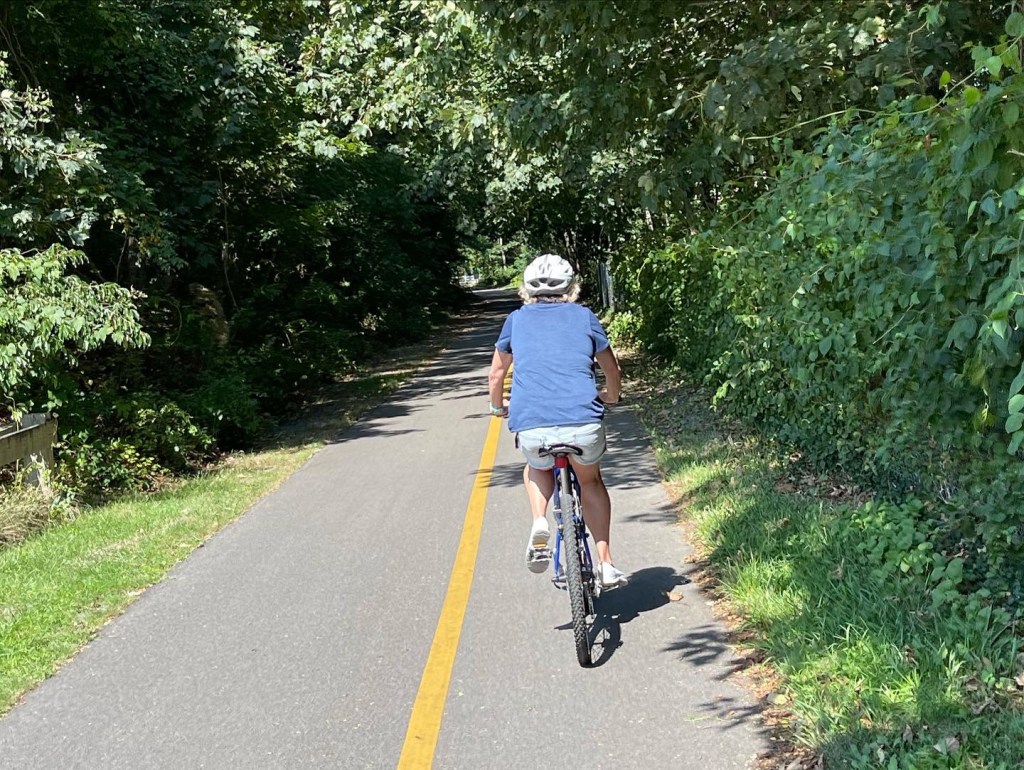
“Life is like riding a bicycle. To keep your balance, you must keep moving.” – Albert Einstein
Walking into a hotel room, exhausted after a long day on my feet and driving three hours for the privilege of sleeping in a town previously unknown to me, I looked at my Apple Watch to find out what the score was. I’m a streaky player in this game of life, and currently I’m hitting 10,000 steps per day and closing all my “circles” every day for 22 days. My watch informed me that I still had work to do, still (despite how tired you feel buckaroo). Reluctantly I slipped on running shoes and walk down the stairs for a reckoning with the pavement.
Streaks keep us honest, forcing our hand when we’re on the fence and could easily slip towards the comforts of life. My inclination last night was to grab a drink at the bar before it closed and read a book I’ve been putting off. But comfort zones are for people that don’t want to go anywhere in life. That’s not us, friend.
We must keep moving, and push ourselves to move a bit more than we’d like now and then. This bicycle ride won’t last forever, will it? And there’s just so much left to see.
“You do not need to leave your room. Remain sitting at your table and listen. Do not even listen, simply wait. Do not even wait, be quite still and solitary. The world will freely offer itself to you to be unmasked, it has no choice, it will roll in ecstasy at your feet.” — Franz Kafka
We stumble over the universe most days. Distracted, harried, willfully blinded by the frenzy of staking a claim on our lives. The world unmasks itself when you look up and meet its gaze, and otherwise marches on to infinity without us.
There’s no way we can possibly see everything, attempting to is a fool’s game. Still, an embarrassment of riches roll to us in waves when we offer our attention. We ought to rise to the occasion and meet the world halfway.
There’s something about a coastal island, surrounded by water yet firmly locked to the earth, that is deeply compelling. It offers tangible isolation from the madness of the mainland, yet is close enough to feel its gravitational pull. Some combination of luck and inclination brings me to islands occasionally, where my gut tells me it’s not nearly enough.
Maine has over 4600 coastal islands, big and small. Some are barren rock knobs, others are quite large, and covered in forest and diverse landscape. Visiting each is nearly impossible, property rights being what they are, but if you visit enough of them you might just realize you aren’t really seeing them at all. The right island soothes a restless soul, and like a soulmate, you’ll know it when you find it. Isn’t it far better to linger with a favorite or two than to endlessly collect names on a list? Islands, as with all such things, ought to be savored.
Would an island offer enough of the world to satisfy a vagabonding soul? Perhaps. Perhaps not. But I hear their whispers, and wonder if I ought to pay more attention.
“How terribly sad it was that people are made in such a way that they get used to something as extraordinary as living.” ― Jostein Gaarder, The Solitaire Mystery
When we think back on our days, how many are frosted with magic and delight? The very definition of ordinary points to the relative sameness in each day. Sprinkling a bit of magic on each moment seems frivolous, unorthodox, and perhaps a little… irresponsible. Shouldn’t magic be saved for weddings, holidays and other such highlight reel moments? We can’t very well sprinkle magic into everything, could we? For wouldn’t that make the magical mundane?
Don’t listen to the nihilists and the fearful, for they have no taste for spice. We must look up at our remaining time and decide to meet it. We can enhance the flavor profile of our life one dash at a time. And make our lives something to savor.
Raising our standard doesn’t inherently level the field of play. On the contrary—we just play at a higher level. Our lives won’t run out of magic until we stop making it. So go on, stir a bit more audacity and adventure into your day. Punctuate each moment with purpose. You may just develop a taste for it.
Autumn, delightful as it is in so many ways, is the source of one bit of frustration: the quickly receding number of daylight hours. Traveling west, the morning becomes more and more difficult to work with if you’re trying to be active outdoors. Sure, you can strap on all manner of lighting to make you more visible and to offer a tunnel of light to walk through. But you lose something in all that battery-powered brightness–a feeling of connectedness with the land around you. And isn’t that the point of going outside to walk in the first place?
Just yesterday I was walking on a warm and humid day on Cape Cod. This morning, I found myself next to an old favorite, the Erie Canal at Bushnell’s Basin. The canal trail here is mostly stone dust, with a few paved places along the way. Familiarity is helpful when you’re walking in the dark, and so is choosing to walk in the early morning. Morning offers hope for improving conditions, something an evening walk would be short of. In a safe area like Pittsford there aren’t a lot of concerns about getting mugged, but in a sketchier area most of the thugs eventually go to sleep, leaving the morning generally safer for wannabee fitness models.
Still, there’s something about seeing that offers comfort. Even on a walk I’ve done a dozen times or so, when you run out of ambient light you’ve got to make choices in life. Press ahead into the dark or return to the ambient light? What are the risks? Walking into a branch? A skunk? The Erie Canal? Getting run over by a random cyclist not using a headlamp? None of those sound particularly appealing to start a work day. So I turned back to the light.
Here’s the trick, you don’t walk all the way back to the brightest parts of your walk. You walk just far enough that your eyes can still see in the dim early morning light, then turn around and see how far you can go the next time. Does walking back and forth on a 1000 meter section of cinder path sound fun? You know what? It actually was. Just me and the ducks and some vehicle traffic on the other side of the canal. Back and forth, a bit further each time, until the scales tipped at 6 AM and suddenly you could see everything clear as… well, almost clear as day.
It might seem ridiculous, this walking in the dark business, but I managed four miles before coffee, and sort of saw the Erie Canal from a different perspective than I’m used to. There’s a lot to be said for checking a few boxes before breakfast–exercise, reading, and writing this blog. The only thing that might have made it better would have been an epic sunrise. Perhaps tomorrow, when I plan to be out there again.
Rail trails offer a great opportunity to walk, skate or ride without dealing with the resentful glare of automobile drivers who believe they own the road while controlling your life in their distracted hands. The Shining Sea Bikeway ups the ante with beautiful views and a diverse landscape. The trick on this trail is to avoid being too distracted yourself as the views stack up one upon the other.
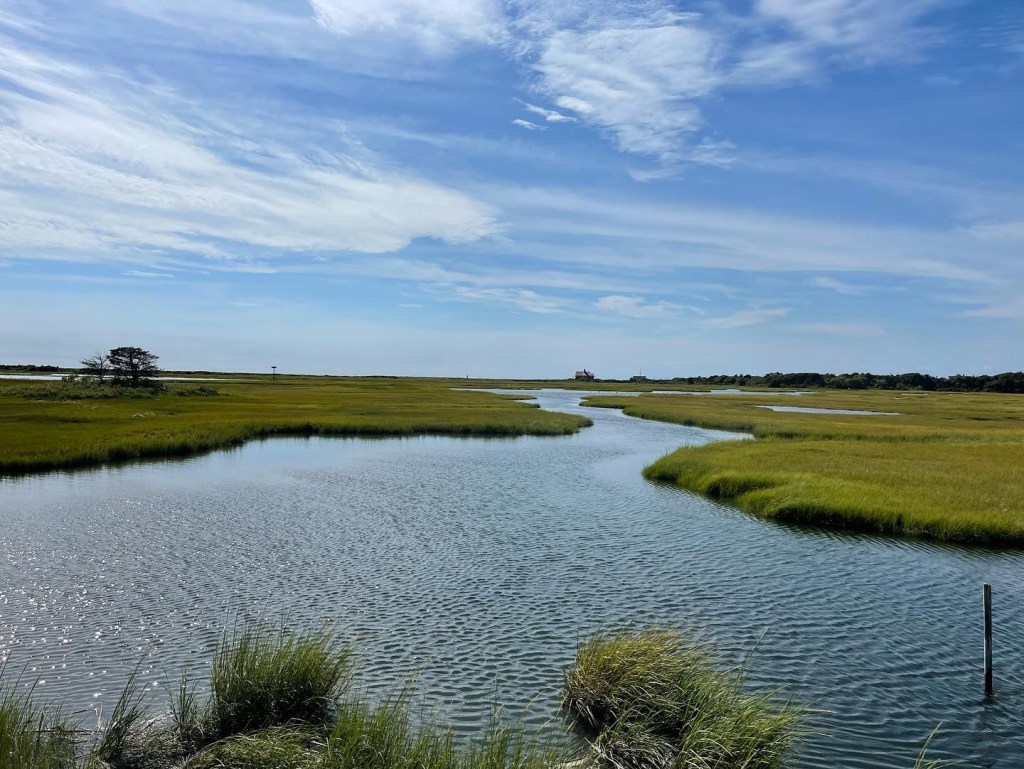
The trail lives up to its name, with views of Buzzard Bay across both of the Sippewissett Marshes (Little and Great—but aren’t they both great?) and of Vineyard Sound and Martha’s Vineyard as it hugs the beach. Shining Sea runs from North Falmouth to Woods Hole, offering plenty of options to linger for time on the beach, stroll through woodland trails, or a visit to the many shops and restaurants of Main Street in Falmouth and Woods Hole.
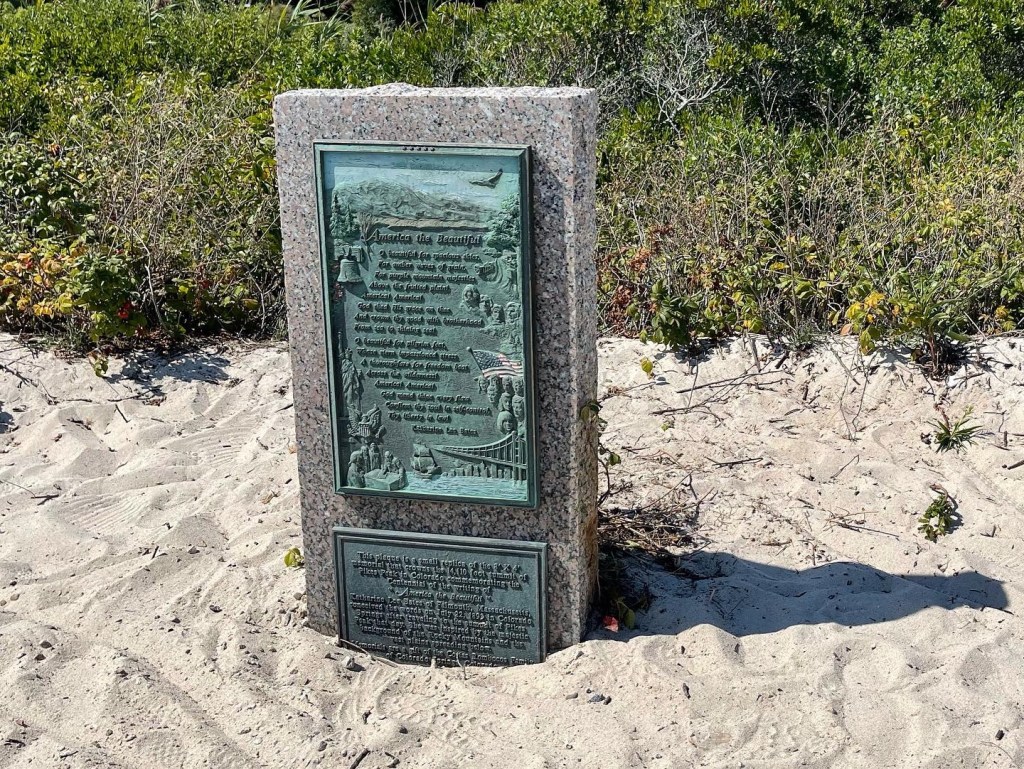
As a sucker for salt water, it was easy to fall in love with the beachside section of the trail. Here you’re treated to those expansive views, the latest trends in beach fashion, and a monument to the trail’s namesake, Katharine Lee Bates, author of “America the Beautiful”, which ends with the famous line, “from sea to shining sea”. Very few Americans can recite every verse of America, the Beautiful, but everyone knows that last line.
The magic on this trail is in riding through a tunnel of woodland canopy, salt march grass, past that beach sand and finally to the trail’s terminus at the Woods Hole Ferry. For a cyclist with dreams of never getting in a car for a vacation on the Cape and islands, the Shining Sea Rail Trail makes a strong statement of what’s possible. For this cyclist, it was an opportunity to give the feet a break while getting some exercise with a view.
From the North Falmouth terminus, it’s a 21 mile (33 km) round trip. That’s very manageable on a good bicycle. The human body connects with a bicycle in five places, each essential to a great experience. Perhaps none more than the seat. My bicycle seat was apparently designed to maximize suffering, but no matter, a sore saddle wasn’t going to ruin one of the prettiest rail trails in the northeast United States. The seat is replaceable, the memories will last far longer.
There may be no better time to experience the Shining Sea Bikeway than autumn. September is a great time to get the warmth with the crowds, and October should be spectacular for fall colors in that canopy. It’s a trail worth considering if you’re interested in experiencing Cape Cod without the hassle of driving in traffic.
God it’s so painful when something that’s so close Is still so far out of reach — Tom Petty & the Heartbreakers, American Girl
September conjures up images of red and gold leaves in crisp air. I thought of their possibility while sneaking another swim in water that believes it’s still summer. But what we linger on isn’t always where we are, is it? I reminded myself to savor the water while I was still in it.
We’re often torn between where we are and where we want to be. Between things we’re comfortable doing and things we’d like to try. It’s a fiendish place; nurtured dissatisfaction with one, with a lingering frustration that the other is just out of reach. We reason with the mind to accept one place, while the other place sings its siren song. No matter, were we to reverse our position, we’d likely yearn for the place we just came from. Such is human nature.
The space between seems to be the real issue. We can’t have it all, but we dwell on images of places we’d love to be, or parts of our lives we’d love to return to, or maybe run away from. Surely, it’s there in that between where the devil resides. It’s our no man’s land where dreams go to die if we dare wander into it. And don’t we all stumble into discontent at times in our lives?
All season I’ve been dealing with a garden neglected at the start of the growing season while I bounced around in Europe in June. It never really established itself, then came the drought, and here we are at the end of the season with a sad little garden that’s a shadow of its former self. The garden and I gave it a go, despite it all, and now it will go dormant for the winter before we try again next year. But I wonder, will I be inclined to try again, or leave it for the beauty of another place once again?
Such are the considerations of an itinerate wanderer with a strong sense of place. Making a go of it here, while thinking about there. With American Girl playing in my head as a soundtrack of this life between two places.
“One doesn’t discover new lands without consenting to lose sight, for a very long time, of the shore.” — André Gide
The truth is, we each concede more than we consent. The truth is, discovery is a shore too far for many of us. And yet we each set sail in our own way from the past every day. What seems the same alters ever so slightly each day, imperceptibly, inalterably, and we wrestle with the truth of it whether we set our course for distant shores or futilely try to hold on with all our might to what once was.
This is the time of year when parents post pictures of children heading off to school, on their way to discovering their own new lands. The discovery isn’t just for the children, but the parents too, as they return to a home different than it was before. At such moments the daily leap is profound in its breadth.
So often we dwell on the gap between where we are and where we hope to be and our confidence waivers. Discovery requires a leap into the unknown, and the courageous consent to make that leap. Indeed, the thrill of losing sight of who we once were and gliding into an unknown future might be frightening, but ultimately, doesn’t it bring us to places we never thought possible?
Sometimes we get so caught up in what we might lose that we forget about what we might find.
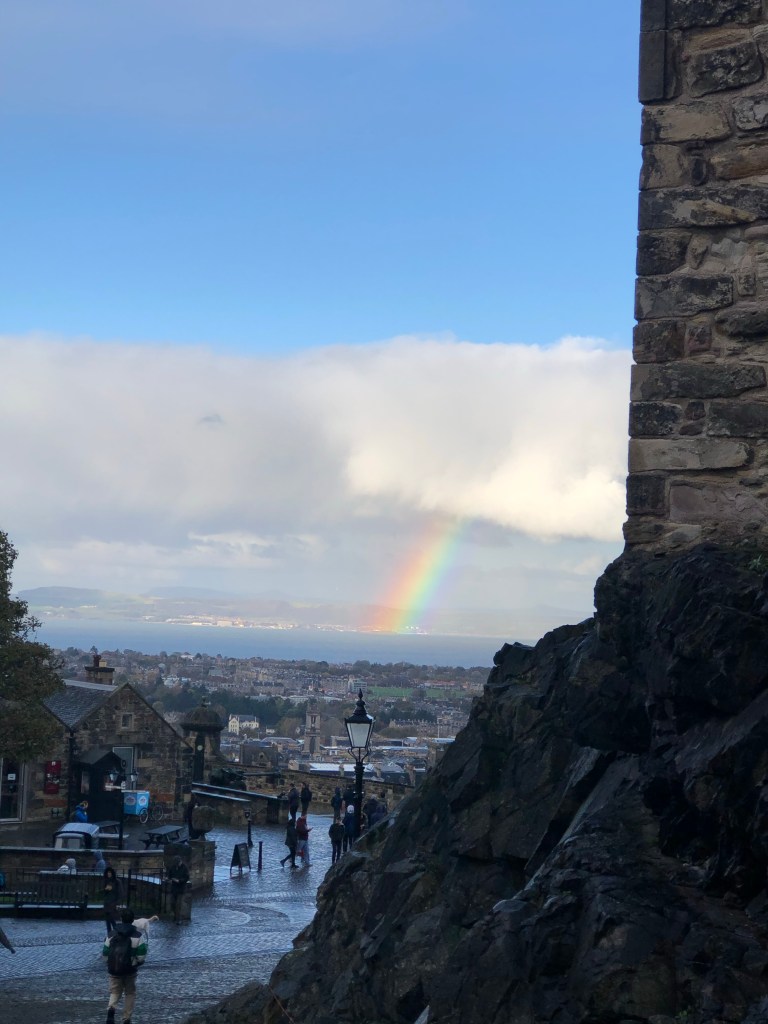
Well, I see the end of the rainbow But what more is a rainbow Than colors out of reach? — The Avett Brothers, Swept Away
There’s a fine line between being satisfied with what you’ve got and yearning for what you haven’t got. I follow, and thus am constantly teased by, Aurora Borealis updates. I happen to live in a place with a very slight chance of seeing the Northern Lights, but sure, I’m saying there’s a chance. The hardy souls who stay up all night on mountain tops for the ten minutes with the Aurora post their photos immediately, making me grumble when I rise early the next morning and see what I’ve missed. But I know that that show wasn’t meant for me.
We are in our moment, in our place, with or without the things we yearn for. There’s nothing to do about that which we’ve missed out on. For the things we seek, we must either go to them or let them fly away unencumbered by our attempt to grasp them.
When you go to a place you’ve dreamed of going to, be it a tropical paradise or Paris or (just maybe) Iceland for volcanos and waterfalls and the dance of the Northern Lights, you close the book on dreaming and capture its memory, like a flower folded into a book. The thing is, memories are rainbows out of reach too. But with memories, bits of the color embed themselves in us that live on through us. You can see it in your eyes when you look at yourself in the mirror, and others see it in you too. Each encounter brings more color to our lives.
Ultimately we can’t have it all, and we ought to focus on the things that are most important to us. Yet there’s something to be said for a recurring dream of light and color dancing in the sky. It will always remain just out of reach, yet so very close to our heart.
So what do we chase, and what do we let fly away? Don’t we already know? For our answer appears when we stop chasing every rainbow and really think about what’s important now.
“If the world were merely seductive, that would be easy. If it were merely challenging, that would be no problem. But I arise in the morning torn between a desire to improve the world and a desire to enjoy the world. This makes it hard to plan the day.” — E. B. White
I grow cilantro, not so much to eat it, but to watch bees roll around in the wispy white flowers that wave ever so lightly in the breeze. Surely someone must grow cilantro for all the tasty dishes (or soapy dishes) one might imagine it worthy of, but give me the bees, please. Summer officially ends for me the moment the cilantro peters out—like life itself—entirely too soon.
The dance between the earnestness of rolling up your sleeves and fixing things versus opening up your heart and savoring all the world offers is a constant struggle. As with everything, we must skate the line between the world of order and the world of chaos, Yin and yang. Nobody said this living business would be easy, but it’s such a short ride we ought to make the most of it.
Still, there’s work to be done, and no time to waste in solving the world’s problems. As anyone out there trying to get things done knows, there’s just not enough people willing to make a go of it and do the work. Every school, every hospital, every landscaper and construction firm and restaurant is struggling to find a warm body with an eager mind to simply do the work. Who are we to ignore the call? Yet so many do.
Every day should be filled with a bit of challenge, and a bit of seduction. Every life lived well ends with a measure of satisfaction for the things we did well and a measure of consternation for that which wasn’t accomplished. That’s life, and we must learn to skate that line. In the end, we do with it what we will.