“The universe is full of magical things patiently waiting for our wits to grow sharper.” – Eden Phillpotts
Rumors of Aurora Borealis potential had me looking up at the skies last night and tracking its progress across the globe with my trusty Aurora app. Overcast skies last night combined with being too far south made it all but impossible to see it where I am, but there’s hope tonight when I’m further north. Expectations rise with the solar flares.
Do you wonder at the skies the way that I do? I should hope so. Without magic and wonder life would be a quiet bore. A bitter slate of scarcity and distraction and isolationism. There are plenty of people in this mad world who consume and sling bile. That’s no way to live.
The Northern Lights are big and evasive when you live far away, but there’s magic right in our midst, should we look for it. It’s in the eyes of a toddler looking at you with a soggy smile. In the vibrating purr of a cat sneaking in for body heat and affection. In the wispy steam drifting from your coffee on a cold morning. Lurking in a dusty book on the shelf that you’ve skipped over for years. It’s right under your nose waiting for your wits to grow sharper.
“It is remarkable that men do not sail the sea with more expectation. Nothing remarkable was ever accomplished in a prosaic mood. The heroes and discoverers have found true more than was previously believed, only when they were expecting and dreaming of something more than their contemporaries dreamed of, or even themselves discovered, that is, when they were in a frame of mind fitted to behold the truth. Referred to the world’s standard, they are always insane.” – Henry David Thoreau, Cape Cod
This is a year of the commonplace and unromantic if you let it be. Lockdowns and border closings and mandatory quarantines tend to temper the passions of the high agency traveler. But then again, if you keep your expectations and dreams focused on regional adventuring until things open up again you might just find the world under your nose.
Yesterday I watched a bobcat, set against the snow, on the hunt. It was slinking along the edge of the forest where the fence announces wilderness begins. I expect it was attracted to the bird feeder activity, for there were squirrels and juicy birds for the taking for the ambitious hunter. Unlike my snowshoe hare encounter I wasn’t prepared for a picture, and I settled for locking her image in my brain.
Leaving Cape Cod the other day I stopped to fill up the tank and, glancing up, noticed 9-10 osprey hovering in the wind, all clustered together. I’ve never seen so many osprey flying together, and there they were right above me gliding gracefully about. By the time I finished fueling the car the osprey had drifted away to awe others elsewhere, but damn if they didn’t capture my imagination first.
For all his fame as a transcendentalist and beholder of truths, Thoreau didn’t travel very much in his lifetime. He spent most of his lifetime in Concord, Massachusetts, with notable trips to Cape Cod, up the Concord and Merrimack Rivers to the White Mountains, to the Maine woods, and one solitary trip across an international border when he visited Quebec. And yet he saw more than most people who travel far beyond the northeast corner of North America.
There’s light at the end of the pandemic, though we remain in a dark and treacherous tunnel. This isn’t the time to cross borders, but the world outside our Twitter feed remains vibrant and alive, awaiting discovery. The bobcat, osprey and Thoreau have each inspired me to shake off the creeping prosaic mood that shorter, darker days cloak you in and dive back into adventuring.
Et toi? Are you ready to re-join the hunt? Nothing remarkable was ever accomplished in a prosaic mood.
“I am in love with Ocean lifting her thousands of white hats in the chop of the storm, or lying smooth and blue, the loveliest bed in the world.” – Mary Oliver, Ocean
I anticipate a white cap day on Buzzards Bay as a Nor’easter rolls through. For now the bay is restless but content to let the rain fall in abundance to its surface instead of rising up to meet it. For the march of thousands of white hats the current and wind must be more contentious than this. It will come in time, as it always does on Buzzards Bay.
Nor’easter days are meant for hunkering down, catching up on reading and sipping hot beverages. On Cape Cod the storm will bring heavy rain and high winds. The salty water will surely rise to greet her fresh visitors. I’m a visitor myself; like a river forever moving between the mountains and the sea. I want to leave the comfort of the warm house to walk on the beach. You don’t come this far to look at it from afar. For I’m mostly water, shouldn’t I rise up to meet it too?
Up in New Hampshire all this water will mean white hats of a different kind, with heavy snow in the mountains and clever swirls of white donning posts and mailboxes in the lower elevations. I’ll welcome the grace of snow-packed trails covering the ankle-breakers when I return to the mountains. Whenever that might be – I really don’t know. But they’ve heard my silent promise to return. We have unfinished business, those mountains and me.
I laugh when I read polls asking where you would want to live forever. How do you choose between the mountains and the sea? Its a Sophie’s Choice question; asking one to pick between a mountain waterfall and the crashing surf. Instead I look to the Abenaki who moved for generations between the White Mountains and ocean fishing villages. They didn’t choose one over the other, they chose a life in between. And that’s where you’ll find me too.
So today as the white caps rise, I’m reminded of the Mary Oliver poem above. I’m on the very edge of that in between for this Nor’easter, and the chop of the storm has begun. Who’s up for a walk?
“You should be a lantern for yourself. Draw close to the light within you and seek no other shelter.”– Buddhist Wisdom (according to Leo Tolstoy)
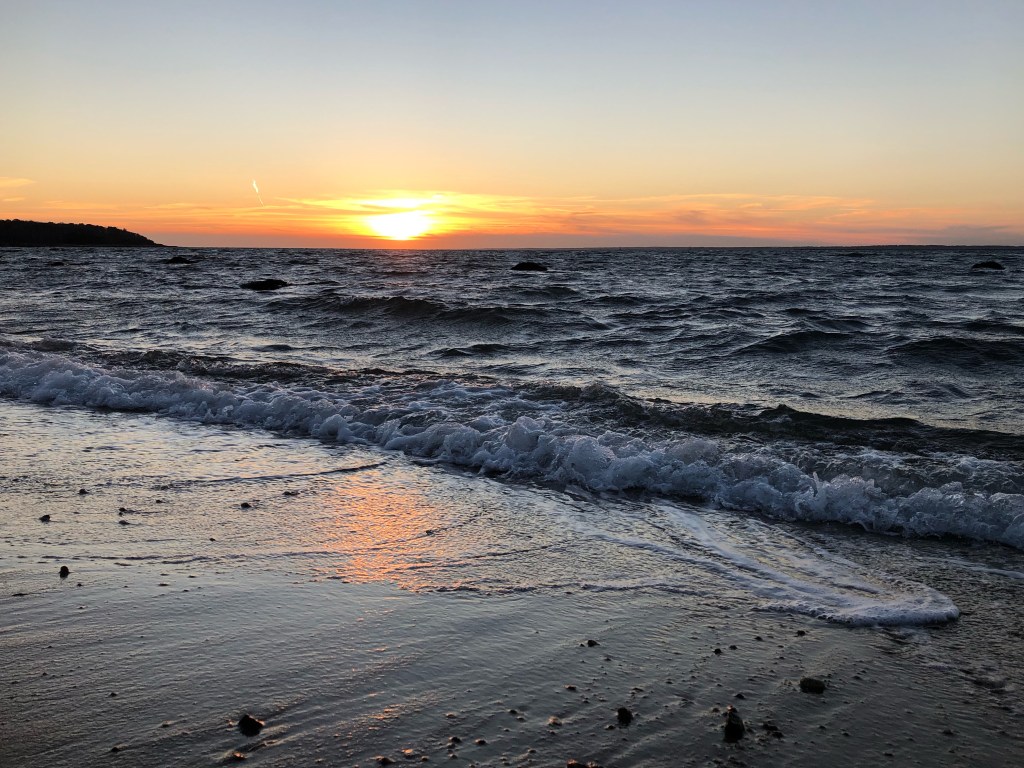
I waited in the darkness for the sunrise. When you wake early that can be a long wait. The sunset last night was way down the bay and just after 4 PM, making this a long wait indeed. Such is winter in New England.
But I walked outside and find it really isn’t all that dark at all. The moon is bright, a few stars shine through, and we’re well into nautical twilight start. Were I to let my eyes adjust I could get about quite well outdoors, even if it looks dark from inside the comfortable house. Perspective, on such things as light and time and relationships with others, offers insight.
For all the darkness in this year of years, there’s still plenty of light even now. It starts from within, and shines outward on the world, reflecting and amplified by others back towards us. But sometimes it feels like the bowl is empty. If your own light is dimmed in the darkest moments, add fuel and oxygen. Seek reflection. And venture out. It’s brighter than you might believe it to be.
If you live in Boston or Halifax you likely know Boston’s Christmas tree is an annual gift from Halifax. Since 1971 Halifax has sent a tree to Boston. Fifty years of tree giving. This isn’t inconsequential. The cost of transporting a tree 700 miles to Boston surely add up. So why make the commitment at all? The story behind that tradition is lesser known.
In 1917, at the height of World War One, a French ship named the SS Mont Blanc was loaded with munitions and set out from Halifax Harbor for Europe. The ship would never leave Halifax. She collided with another ship in the narrows and caught on fire. When the fire reached the munitions there was a massive explosion that wiped out part of Halifax, killing over 2000 people and injuring another 9000. At the time it was the largest manmade explosion in history. And it occurred in a heavily populated area.
When Boston’s Mayor Curley heard about the tragedy, he immediately sent a group of doctors and nurses to aid Halifax with medical supplies. Boston’s response was actually significantly faster that Ottawa’s. The team of doctors and nurses spent Christmas 1917 in Halifax, decorating Christmas trees in the hospitals. The bond between Halifax and Boston was forever fused.
The connection between the two cities goes beyond Christmas trees: Halifax broadcasts Boston’s WCVB and also has a large following of Red Sox and Patriots fans as the games are broadcast there. And then there’s family connections. Since the Port of Halifax was the Ellis Island of Canada, many New Englanders are descendants of immigrants who came through Nova Scotia. The bond is indeed deep.
In 1971, within the lifetimes of many of the people who lived through that tragedy, Halifax began donating a tree every year. I bet there were several survivors of the explosion who shed a few tears the day that first tree was shipped to Boston. Boston remembered as well, and the tree serves as a reminder of the common bond between the two cities. Today is the lighting of the Christmas tree in Boston, and we turn our eyes north to our friends in Halifax.
The pandemic has closed borders, blocking access to people and places we took for granted. With the border closed even the Christmas tree took a unique route to Boston in 2020: It was shipped from Halifax to Portland, Maine and then driven down the rest of the way. Many of us look forward to having the borders open again so that we may once again see our friends and kin up north.
“At first the fruit is small and green and hard. Everything has dreams, hope, ambition – Mary Oliver, Someday
I was thinking about a post I made on social media three years ago next month. Newfoundland. I’d gotten up early, as I usually do, and drove to the eastern edge of the continental North America for sunrise. A month after that photo I was on the western edge of continental Europe taking in the the crashing ocean and looking back towards where I was from.
I looked like quite a world traveler on social media, but a week after that trip to Portugal I was unemployed. I didn’t post that on social media. I just scrambled to reach out to my contacts and find meaningful work as quickly as possible. We tend to amplify the positive: trips, events, big meals, relationships… the highlight reel stuff.
That month of unemployment transformed my writing from a once in a while thing to an every day thing. I switched from Blogger to WordPress, found my voice through repetition and trips to local places, read a lot, and mostly just wrote. The fruit of my labor is still small and green and hard, but I see it ripening. At least I believe it to be so.
We’re all works in progress, they say. Mastery is elusive. Ten thousand hours elusive. Lifetime elusive. But the art is in the doing, day in and day out. When the fruit is small and green and hard and you’re hungry it seems like it will never ripen. But being a bit hungry is where the art comes from. There’s nothing burning inside when you’re well-fed and satiated. The mind says maybe this is enough.
In the spring my apple trees were a wonder of showy blooms. I was thrilled and dreamed of a rich harvest. But the dry summer transformed that bounty of blooms into a few deformed, tiny apples. By contrast the grapes were bountiful this year and fed the birds and yellow jackets when I couldn’t keep up. Funny the way two plants of the same age react to the same conditions, isn’t it?
Everything has dreams, hope, ambition. We never know what will ripen and bear fruit. How the seasons will shape us. But fruit withers without focused energy. So we must keep at it.
“It is a serious thing just to be alive on this fresh morning in this broken world.” – Mary Oliver, Invitation
I woke up twenty minutes before the 4:30 wake-up call and contemplated skipping the planned sunrise hike. But I wouldn’t skip an early morning business flight, so why skip on this? With no good answer I got up and dressed in the dark.
Driving an hour, it stuck me how many people were already up. Cars lined up at a traffic light heading to some job or other, while I drove the opposite way. I had work to do today as well. But first this. Arriving at the access road, I read the sign informing me the gate wouldn’t be open until 7 AM. I was the only car in the lot next to the gate to start this sunrise trek. Others would follow soon enough.
I geared up and started hiking the half mile up the road. Hard to even call it a hike… a brisk walk up the hill? Semantics don’t matter, the destination did. It was already brightening enough that I could slip my headlamp into my coat pocket. This walk would be just enough to warm my core for the cold breeze at the summit.
Mount Agamenticus is an old mountain, worn down by time. It’s more of a hill now at 692 feet, but does have a prominence of 522 feet. But 220 million years ago it was part of a 20,000 foot tall volcano. They say it was once part of Africa. Now you look out and see the Atlantic Ocean and a long way to the continents that were once joined. A lot can happen in 220 million years; continents shift, mountains erode, people come and go. That’s what? Eight billion sunrises? For the sun and for this mountain it was one more in a long string of greeting each other.
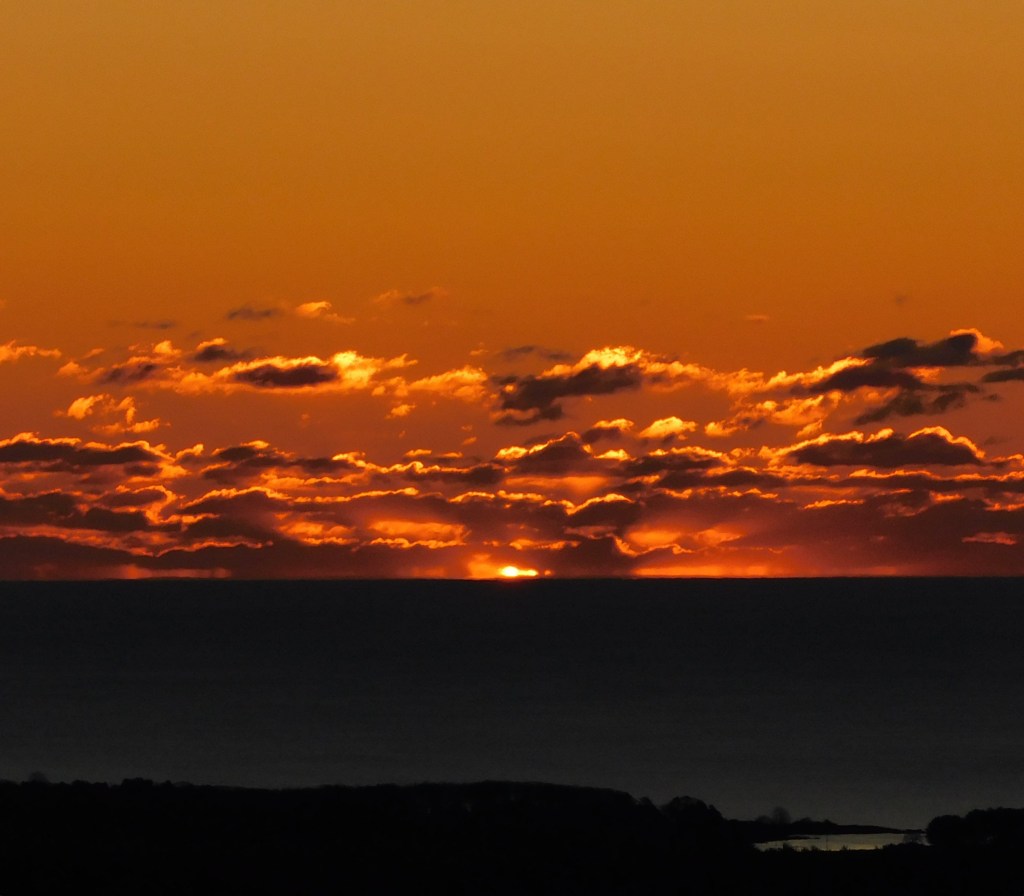
This morning it was my turn in a long succession of people standing atop this old volcano gazing out at the sun rising to begin another day. Billions of sunrises and this morning I got to share the reunion between the mountain, the ocean and the sun. And it was indeed a serious thing just to be alive to see it.
The young buck appears on the screen for a total of five sequenced pictures. He’s making his way through the woods. I count the points and it appears that’s he’s legal for hunters. I think about him when I hear the guns fire in the distance in the next few days. November is no time to be straying into open woods with a rack. I hope this guy makes it through to see another season, for I’d like to see what he looks like in a year.
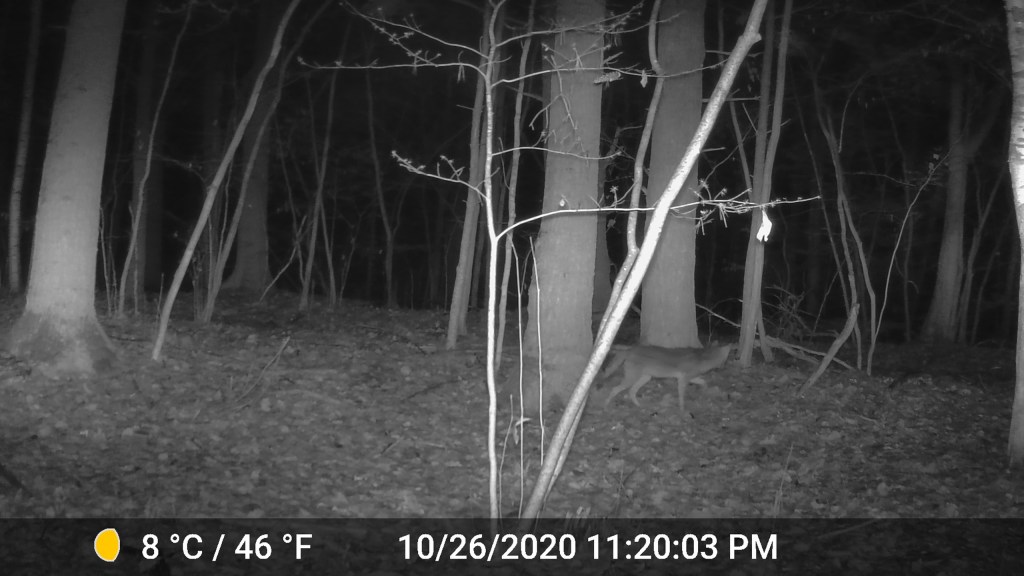
Nearly in the same spot a coyote nested a week before. I wondered if the buck smells the coyote when he walks by. But this time of year scent changes quickly as leaves stack up and the rain washes everything down. Strangely, there’s only the one coyote on the camera. I thought they were social animals, yet here he was alone in the woods. He took a quick nap under this tree on at least two occasions.
Of course, not everything happens in the night. The wild turkey roam through the scene in large numbers during the day. This is so commonplace now that it hardly warrants a mention, but even now there’s something interesting about watching these large birds. There’s clearly a pecking order in this rafter, coordinating movement through the woods and spooking would-be predators like that coyote.
I put up the wildlife camera after years of wondering what walked unseen through the woods behind us. I’ve seen plenty over the years from the yard or from an upstairs window, but hearing that bear crunch through the woods last month finally inspired me to get the camera up and running. To find what defies the eyes peering into the darkness. And it hasn’t disappointed. It’s a bit like Christmas morning walking out to see what it picked up every week or two. Isn’t it always interesting to see what the neighbors are up to?
We had a fire again on Friday night. I could hear something crunching in the woods. Not as loud as the bear, not as stealthy as the deer. I wondered what it might be? This morning I may take a walk out to the camera to see who our visitor was. I’ve come to enjoy solving a good mystery.
The cow outweighed me by more than 1200 pounds and had long horns protruding menacingly to her right and left, but I edged closer anyway. Bob, the Activities Director at The Trapp Family Lodge, insisted that it was safe to walk out amongst the Highland Cows. He gave us instructions on what to do if they approached us looking for apples (fold your hands into your body and turn slowly away to show you don’t have food). And he told us when one of the cows was annoyed with us. Otherwise, we were turned out to explore the field. Turning around, I realized I was one of the few who took him up on the offer. But risk has its rewards, and being close to the cattle was thrilling.
Highland Cow
I’ve been to Stowe, Vermont many times over the years. Mostly I’d drive up for Heady Topper beer, look around a bit and dream of lingering awhile. I’d even stopped to visit the Trapp Family Lodge, walking into the lobby to see what all the fuss was about. Like most Americans I’ve seen The Sound of Music a few dozen times. This wasn’t the Austrian Alps, but you can definitely see why they sank their roots here. The hills are alive in Stowe too.
The Trapp Family Lodge is a lovely place, with fires roaring and pilsner flowing freely from taps and a quiet elegance without pretense. Pictures of the family decorate the walls throughout the lodge along with art derived from the story of the family’s escape from Nazi Austria. The mountains surround the property in all directions, and the von Trapp family owns much of the land and has donated many more acres to a land trust, ensuring this view would remain largely as it’s always been.
We’d explored some of that land on our first day at the Lodge, walking the trails to find the Chapel at the top of the hill, and circling back to check out the Kaffeehouse for a snack. There are hiking and snowshoe trails criss-crossing the woods at the resort, and we had plenty of options for getting to know the lay of the land. Mountain bikers had their own single track trails that offered challenging terrain to explore. And wide cross-country skiing trails waited patiently for the snow to arrive. This was an outdoor enthusiast’s paradise. The outdoor hot tub and spa is a great reward for having done the work.
After meeting the Highland Cows we walked back up the hill to the Lodge, with massive ravens flying about us speaking a sophisticated language of their own. I wondered at the banter, and wished we had more time to get to know them better. But we had other places to explore, and a long hill to walk back up. It seemed the cows were on the furthest pasture from the Lodge, and we had to earn our visit. It worked out to be about a mile each way, and a good way to work off breakfast with a different vantage point.
We made a quick trip to downtown Stowe to explore the shops and made a stop at The Alchemist to pick up our Heady Topper beer order curbside before returning to the Bierhouse for lunch and a pint. We made a point of saving room in the cooler for some von Trapp beer as well. The Alchemist helped make Stowe the heart of New England IPA country, but the von Trapp’s make a great case for pilsners with their brews. This wasn’t some mass-produced American lager, this was beer with substance.
Brewing at von Trapp is serious business
As luck would have it, the woman who seated us was Kristina von Trapp, the granddaughter of Maria and a Director of the resort. She was a gracious host, with a striking presence about her borne of her family celebrity but honed on an active life outdoors and running a successful business. She wasn’t quietly sitting in the corner office looking at spreadsheets, she was hands-on and engaged with the public. And that made the von Trapp experience all the more impressive.
We resolved to come back here again in the other seasons. Stowe is beautiful year-round, even on a cold November morning when the trees are bare and the snow is just hinting that it might return again. Staying here in all four seasons seems a worthy goal. And it will help keep the refrigerator well-stocked too.
A weekend in Vermont stirs the imagination, and Stowe is famously rich in beauty, romance and adventure. As with so many other places, the magic crackles and sparks here on the edges of the day. Days are filled with adventure, nights a starry dome. The edges in between are when the light dancers march across the mountains and leap and twirl in the sky. In the morning the mountains are jagged black walls that holds the rising dawn back from our eager eyes. At dusk the mountains turn ember-red as they reach for the last rays of light. My iPhone screen mocks my attempts to capture it, but try I must.
We stayed at the Trapp Family Lodge to get the full Stowe experience. The lodge is lovely and full of the amenities you’d expect at such a place. For me the abundance of hiking trails just outside the door were a nice incentive to stay here. The spa, Bierhall and Kaffeehaus all spoil the senses. But if you’re in Stowe get your ass outside.
Hiking options are everywhere here, but we wanted waterfalls on this trip. Stowe has a couple of waterfalls nearby that are well worth the quick hike to see. Moss Glen Falls are a tumbling cascade framed by hemlocks. It’s an easy ten minute hike from the car to the best viewing point, and I smiled at how over-prepared we were for a much longer trek. The falls are postcard perfect, and worth a visit on quiet days when the tourists are elsewhere.
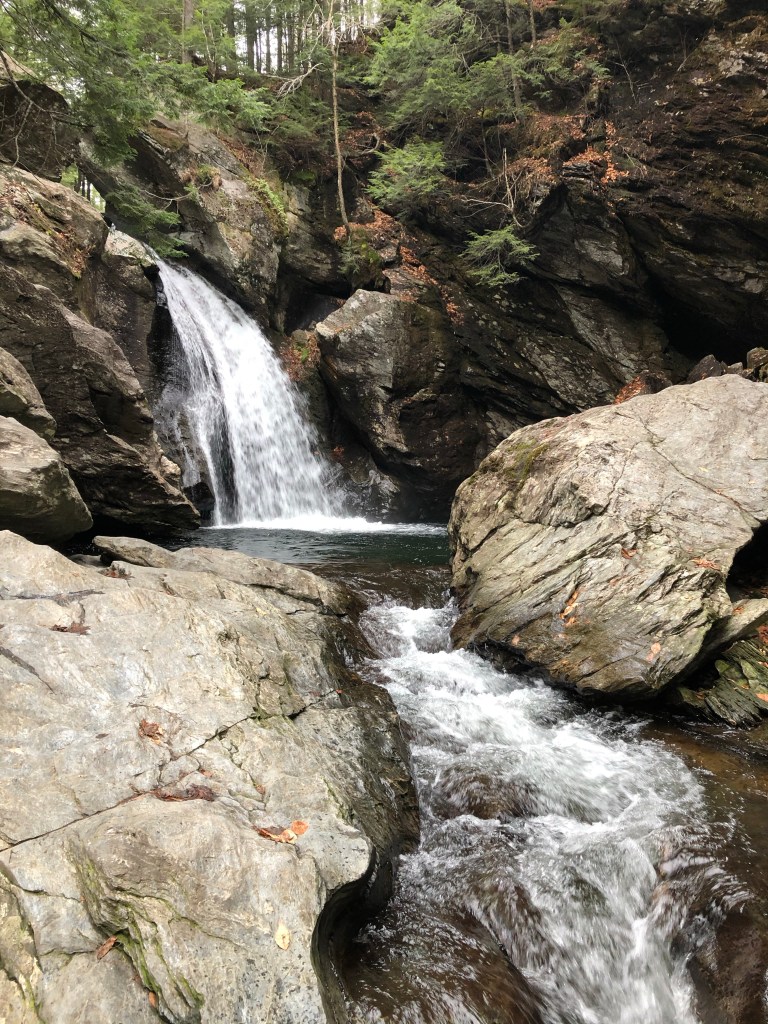
Bingham Falls are near Smugglers Notch with a beautiful waterfall falling into a pristine pool worth the descent. What goes down must go up, and the walk up isn’t as bad as you think it will be after descending a couple of steep, muddy stretches. A few people have died falling into the gorge here, and it’s easy to see how. Nothing separates you from a plunge into the gorge but your own awareness. Not a place for little kids to run unattended.
Mountains and waterfalls pair well together, and I greedily seek out each. I often wonder why there aren’t more visitors when I come across beautiful places, but usually it’s because I go when the crush of visitors ebbs. Like the mountains at sunrise, waterfalls whisper to you when there’s nobody else around. But only if you’re there to listen.