Category: Travel

  • Questions

    “Said the monk, “All these mountains and
    rivers and the earth and stars—where do
    they come from?”
    Said the master, “Where does your
    question come from?”
    – Anthony De Mello, The Question

    One part of the writing process I value is that it fuels better questions. What’s the story behind that monument? How did this mountain I’m hiking get its name? Where do we go from here? What is the author really trying to say here? And of course, spiritual questions about creation and science and the place in the middle where they meet. And this morning, awake much sooner than I ought to be, I dove into another Anthony De Mello book, The Song Of The Bird, in search of better answers… or at least better questions.

    Today I seek a bit of adventure, even as I press on with my business trip in the middle of a pandemic. I found myself silently angrily at a couple of unmasked men getting off an elevator I was waiting for this morning. They’re supposed to be wearing masks as mandated by the Governor, with reminders on signs all over the hotel, but they opted out. My anger wasn’t with them – that was frustration at their disregard for others – but instead at myself for putting myself in a position to be concerned with their unmasked presence in the first place.

    And so I decided I need to get myself outdoors. It’s raining out there. It’s raw. There’s a short window of time I have between where I am and where I have to be later. And yet I’m getting outdoors anyway. I have a few questions that need answering. There’s truth out there in the cold, wet outdoors.

  • Observations While Flying in a Pandemic

    It’s been eight months since I’ve flown anywhere or even been in an airport. A lot has happened in eight months, and the pandemic is relentlessly marching along with no regard for whether we want to flip the switch back to normal again. I’m not sure it ever will be normal again, but whether we get there or not I had obligations that put me on a flight to Cleveland. What was commonplace less than a year ago was now unique, outlier stuff. And I felt compelled to note the changes.

    TSA outnumbers passengers 20:1
    That flight eight months ago coincidently departed from the same gate I was departing from on my flight to Cleveland. But instead of walking into a cue of people trying to bypass the regular TSA line and finding a line of our own, I walked straight to a lonely TSA agent who scanned my passport and asked me to take the mask down to verify my face matched the photo. By my count there were at least twenty TSA agents for every person going through screening.

    Every row, not every seat
    I boarded a plane that was being seated from back to front and found my way to my seat. This plane was small – two seats on either side of the row. Everyone had a window seat except for the couples flying together. From a social distancing perspective I was at least six feet from the person on the opposite window seat. But they were also seating every row, so the person in front of me and the person behind me were only three feet away. But masks were required, right?

    Mask etiquette
    The rule was pretty straightforward: wear your damned mask while you were on the plane. You couldn’t walk into the airport without the mask, let alone get on the plane. Simple right? Yet I was braced for the one flake who would take off their mask and scream about their rights. But thankfully this plane was full of functioning adults without delusions of grandeur. Everyone wore their mask the entire time. Until they didn’t.

    Food and Beverages
    The smell of food on the plane shortly after sitting made me question someone’s mask etiquette. I’m no expert on such things, but eating a chicken sandwich seems challenging while keeping a mask on the entire time. But it demonstrated the challenges of enforcement. Then the crew announced they would be coming through with snacks and beverages. No booze and no hot coffee or tea options, but water and soft drinks. Airline-sanctioned bending of the mask rule. And again I thought to myself, how exactly are we going to be responsible mask-wearing passengers while eating and drinking? I accepted the snack and water and stuffed them into my bag for after the flight. Mask stayed put.

    First in line to take off?!!
    As with the TSA line, there was literally no line of planes awaiting take-off. We taxied to the end of the runway and simply took off. Granted it was an afternoon flight, but for me that was a first at Logan International Airport. As we soared over the islands I spied a lonely sailboat cruising Boston Harbor, and wondered where they were going. They might have been looking up at the plane wondering who in the world is flying in a pandemic. Me, folks. The answer was me.

    Exiting the plane
    The routine in Cleveland was similar to boarding in Boston. Stay seated until the people in front of you stand up and exit. A few rebels stood up to grab bags from the overhead bins, but most of us just played along. Perspective is a beautiful thing. None of us wanted to dance with COVID-19. Walking out into the terminal, it felt different from Logan Airport. More people for sure. Cleveland was much more crowded than terminal C in Boston. Here too masks were required and social distancing applied. And more stores and restaurants open in Cleveland than in Boston. I suppose every place is different, and just as each country handles things differently, so too does every state. But overall people were showing respect for the pandemic here as well.

    Real PPE Hurts
    This flight was about two hours. Wearing a KN-95 mask instead of my cloth mask gave me even more respect for healthcare workers geared up for the pandemic for hours at a time. The elastic bands began to irritate the backs of my ears over time and I found myself pulling the elastics back off my skin for relief. If I were to do a cross-country trip I’d have to rig up a hat with buttons or pull the bands back with string to avoid this. But I wasn’t going to complain, I was wearing a mask to stay healthy and to keep other people healthy should I be infected but asymptomatic. It seemed a fair tradeoff.

    Like Riding a Bicycle
    Despite all the strangeness, travel came right back to me. Walking through airports, renting cars, and checking into hotels are all part of the deal when you travel for work. It took no time at all to feel I was back in the flow of things. Masks, heavy doses of hand sanitizer and soap and water, avoiding touching the face and maintaining social distance made it all clear that the routine was different even as it was the same. Some of these habits will remain with us long after we figure out this virus, and honestly some of these measures are welcome changes to the petri dish traditional travel placed you in. I wondered about the future of travel even as I welcomed a brief return to it.

  • The Flying Tree Dance

    Removing a tree from the yard is always a painful decision. I’ve cut down a few trees over the years, and a part of me is cut out with every one of them. But sometimes they have to go. And I had a clump of them that were ready to go wedged in a tight cluster with trees I wanted to keep. Well above my skill set to cut these down, I delayed for years until now. But it was finally time.

    A giant crane, a bucket truck and a third truck towing a wood chipper arrived and their drivers started positioning them for the tasks they each performed. First in was the bucket truck, limbing up a large oak that would be in the way of the crane. This was opportunistic work, as the neighbor wanted that tree limbed up anyway, and so they negotiated a separate deal to get it done. Capitalism on the fly.

    Next came the big event. The crane was extended, chain saws were readied, men positioned in familiar roles. The most notable was the man who would fly. Clearly the most fun job of all, and the most dangerous. He harnessed up, attached himself to the crane cable, and slowly flew into the air with his chain saw and rappelling gear. He would wrap a strap around the tree trunk of choice, secure his rappel rope and lower himself down to the ground. He then cut the base of the tree as the crane held it up, clear out of the way, and it was time for the tree to sky dance. If I were a tree and it was my last day on earth, I might choose one final pirouette across the sky as this tree took.

    But then the performance was over, the tree laid across the driveway, and the second act began. a second cable was secured halfway up the trunk and the tree was now hanging from two cables. A few branches were trimmed away, and then the machinery took over. I realized what was about to happen and put my fingers into my ears. The cables and men fed the entire tree, trunk first, into the wood chipper. The chipper roared its horrific roar, and the tree flew in chips into the truck bed to live its second life as mulch. A second flight for the tree, not quite as grand as the first.

    This performance continued for the morning and early afternoon and then the machines and men and mulch drove away, leaving empty sky and stories. Some of the felled trees remained, to serve as firewood in a season or two. Then they too will fly as well, as smoke and a pagan tribute to their final day.

  • Hawks and Squirrels, Bears and Goats

    As the leaves fall the big reveal begins. What exactly have the neighbors across the way been doing all summer with all that building and landscaping? We’ll know soon enough. The golden leaves of fall are quickly conceding to fate and weather, dropping in abundance to coat the ground in a blanket of yellows and reds. And suddenly we see what was screened for months.

    I watched a red-tailed hawk flying rapid spirals up and down a white pine tree, wondering for a moment if it was injured, then recognizing the reality of what was happening. The hawk chased a gray squirrel that was scrambling up, down and around the trunk trying to reach the relative safety of the branches above, but found itself stuck in the long exposed trunk. Its only chance was this spiraling scramble. And this is where the hawk proved to be an expert flyer, keeping pace with the squirrel for what seemed like forever. But suddenly it was over, the hawk flying to a nearby branch, exhausted perhaps, but having the food that would keep it alive to fight another day. I picked my jaw up off the ground and left the hawk to its meal.

    The big reveal brought another surprise. I knew the neighbor’s didn’t have a dog, but caught a glimpse of an animal walking back and forth on their patio. A look over the fence confirmed it was a goat pacing back and forth near the patio door. A text to the neighbor to inform them of the visitor and a visit from Animal Control and the goat’s owner revealed the truth of the matter: this goat was a survivor, having run away from a black bear that’s been breaking into animal pens for a week now killing chickens and goats. Dangerous, unusual behavior for the bear. And the State of New Hampshire has taken notice, setting traps to try to move this dangerous character out of the area.

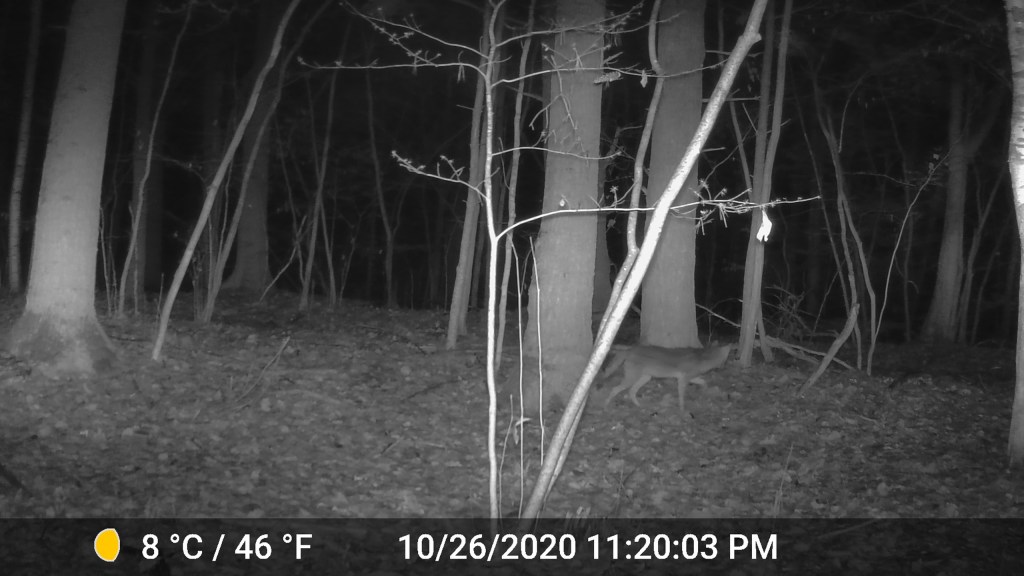
    And so it is that I finally put a wildlife camera out in the woods, beyond the old stone fence that separates land that I pay taxes on from land that is preserved and funded by all taxpayers. After close encounters with deer, coyotes, fox, opossum, skunks, raccoons, groundhogs, bobcats, fisher cats, snapping turtles, assorted rodents, bear and now a domesticated animal I’ve finally taken the hint. That preservation land is an animal highway between the brook on one side and the larger forest on the other. The land that I pay taxes on was once part of that highway, until I put up a fence to keep the dog from meeting this parade of characters marching by. Having shifted the corridor over to the other side of the wall the least I could do is capture images of the travelers. And I wonder what will we find stored on the memory card? There’s still some time left in 2020, what haven’t we seen yet? Unicorn? Centaurs? Griffons? In this year of years nothing surprises me anymore.

  • The Work of Exploration

    “Filling the mind with illusions is not the way to carry out with honor the work of exploration.”
    – Samuel Champlain

    Champlain was a stickler for careful preparation and research. He wasn’t one to half-ass anything he did, especially when it came to sailing across an ocean to uncharted places. He learned from the failures of others, noting failures in leadership, failures in preparation, failures in aligning political alliances to have your back when you were away, and failures in the treatment of the Native American population. And he was disciplined in his resolve to be successful in his own exploration.

    When I think about Samuel Champlain, I think about the guy who famously explored the North American coast and more than anyone helped stake a flag of settlement for France. In New England we live in a culture that rightfully celebrates the arrival of the Pilgrims in America 400 years ago, surely a major turning point for the English settlement of North America, but let’s not forget those who came well before the Pilgrims. If the settlement of Plymouth was a comedy of errors and bad preparation, Champlain’s plan for exploration and settlement was meticulous.

    Champlain found a way to be an invited guest of the Spanish on a trip to their own empire, surveying and documenting the atrocities of the Spanish conquerers with the native population and with African slaves for gold, silver and pearls. He resolved to never duplicate the things he saw, and treated men with respect and honor in his own exploration. And he learned from the brutal religious wars of France between Catholics and Protestants as well, resolving to bring religious tolerance to his own settlement. Champlain wasn’t just ahead of his time, he was helping to pave the way to our time.

    I’ll return to Champlain again in future blogs, but for now I’m lingering on the quote that opens this post. A warning to not half-ass our own exploration. To be prepared and do the work necessary to put yourself in a position to not just survive, but thrive. This is true whether you’re starting a business, changing your career, working to finish a project before a deadline or planning that long hike. Filling the mind with illusions is not the way to carry out with honor the work of exploration. Be prepared, as the Marines would tell you. But don’t just prepare and dream of exploration either. Do the work of exploration too.

  • A Bear in the Night

    Sunday night, while sitting around the fire in conversation, a large wild creature moved through the woods, announcing its presence with the crunch of dried leaves and crack of fallen twigs. Not a deer. Not a raccoon or a skunk. Definitely not a squirrel. I quietly walked into the house for the big flashlight and walked out to the edge of the fence and switched it on. Nothing but leaves glowed back at me, but the crunching and cracking continued on and away from us. The speculation on what had visited stayed with us. But we knew.

    The next day someone up the hill posted that three goats had been killed in her yard, and there was talk of a bear up to 800 pounds being the culprit. Was this our visitor? We wondered at the possibility. I walked deep into the woods in daylight looking for tracks, but quickly realized the folly of my search. I’d guess we had a solid layer of leaves blanketing any possible evidence of bear tracks. I contemplated purchasing a wildlife camera set in the woods to track future visitors. It would be good to know the neighbors a bit better. We’ve seen just about everything in our time at the edge of the woods, but haven’t yet seen a bear. But others in town have. This would be our closest encounter.

    Bear encounters have increased in New Hampshire over the years, and there have been three bear attacks over the last decade, including one this year when a man was attacked from behind while getting an air conditioner out of his car. There are reasons for this. First, the bear population has grown significantly over the years as they outpace efforts to cull them through hunting. Second, some people actively feed bears, making them less fearful of humans. And then we have the drought that New Hampshire is currently in, which forces the bears to wander further into populated areas for food. There’s a fascinating article about the increase in bear encounters in the September issue of NH Magazine.

    Bear populations, like squirrels, apparently increased with the bumper crop of acorns a couple of years ago. Well-fed bears want to stay well-fed. And so they come. I can’t help but compare the increase in bear encounters to the increase in Great White Shark encounters on the beaches of New England. Limit hunting seals and sharks and the population explodes in places we’d gotten used to having the beaches to ourselves. Something similar is happening with bear populations (and every other wild animal for that matter). Fewer hunters, more comfort with humans and drought-fueled hunger means more bears in the suburbs.

    Standing in the woods, looking back towards the house, you get the perspective of the wild things. As much as you could I suppose, given my free access to the comforts of a home just on the other side of the border. I considered my desire to get out in the wild so often, and here I was, standing in bear country, 200 feet from my back door. I looked around one last time for tracks and walked back to the other side, closing the gate behind me. But I’ll be back. I suspect the bear(s) will be too.

  • Walking the Frost Farm

    Sunday restlessness prompted a short road trip up to an apple orchard for some apples and pumpkins. This proved to be too brief, so it seemed a good day to revisit the Robert Frost Farm. Maybe it was his poem October that inspired me, or maybe the beautiful fall day, but either way he whispered to come over and stay awhile.

    The last visit to the Robert Frost Farmhouse was during a different time when you could actually walk about with a group of strangers and not think about the risk associated with doing so. This time we skipped the farmhouse and just walked the property and the adjacent Grinnell Farm conservation land. Walking slowly, reading the poems and biographical information that lined the path on the Robert Frost Farmhouse property, it was still a quick walk even with the extended walk through the conservation land. But still altogether necessary to be outside in the world, and especially in Frost’s former world.

    A lot changes over time. The farm was used after Frost sold it as an auto graveyard for a time, with the top soil scraped away and car parts scattered all through the property. Thankfully all that is gone now, and though the farmland itself isn’t what it once was, it’s grown back into a field that feels largely feel like you’re walking the land that Frost would have known. The land that inspired his writing. The auto parts are gone, but the wildlife, the farmhouse, and especially the stone walls remain largely as they were for Frost during his formative years as a poet. Having visited the farm on several occasions, I manage to draw something new out of the experience each time. I’ve toured the farmhouse and recommend it for a first-time visitor, but for me walking the path is what makes you feel like you’re a part of Robert Frost’s world, if only for a short time.

    Frost lived at the farmhouse from 1900 to 1911, honoring his grandfather’s wish to maintain the farm for at least a decade. It proved formative for him as a writer: “the core of all my writing was probably the free years that I had there.” He would leave this farm and rise to fame and relative fortune (for a poet) in the years that followed. He would read a poem he wrote at John F. Kennedy’s inauguration. And his words would ring in the minds of millions, including mine. And really, it all started here at a little farm in Derry, New Hampshire.

  • October

    “O hushed October morning mild,
    Thy leaves have ripened to the fall;
    Tomorrow’s wind, if it be wild,
    Should waste them all.
    The crows above the forest call;
    Tomorrow they may form and go.
    O hushed October morning mild,
    Begin the hours of this day slow.
    Make the day seem to us less brief.
    Hearts not averse to being beguiled,
    Beguile us in the way you know.
    Release one leaf at break of day;
    At noon release another leaf;
    One from our trees, one far away.
    Retard the sun with gentle mist;
    Enchant the land with amethyst.
    Slow, slow!
    For the grapes’ sake, if they were all,
    Whose leaves already are burnt with frost,
    Whose clustered fruit must else be lost—
    For the grapes’ sake along the wall.”
    – Robert Frost, October

    Robert lived just up the road. And I find his words to be my own as I survey the land this morning. The garden has changed with the longer, frosty nights as the Northern Hemisphere turns a cold shoulder to the sun. A Saturday surprise was the abundance of Dahlia blooms sprinkled through the garden. I waited patiently for the entire summer for some of these blooms and they chose October to make their debut. Still, I’m grateful for their tardy appearance, for like the late roses they persist against the hard reality of Autumn.

    I thought about a long hike on Saturday, but looking around the yard and garden it was clear I needed time here to do the work that must be done between seasons. A survey of the garden revealed my own grape vines were burnt and the last of the fruit was well past. Grapes are funny that way; bursting onto the scene all at once, and you can’t possibly eat them all. Friends politely ignore your offer to take some, and instead the yellow jackets and birds eagerly take the lead in finishing off the ripe fruit. I don’t have the ambition to make preserves and concede the grapes to the wild.

    Autumn is a magical time, and generally I’m deeply immersed in the transition. 2020 feels different in so many ways from previous years, and Autumn is no different. The persistent drought has the foliage sweeping through earlier and dropping faster. The news cycle makes me dizzy as every day something bigger seems to be breaking. Best to be in the garden, I think, than to wrap yourself in a blanket of endless narrative. And the garden reveals the truth of the matter. The world goes on without the news. Its October, that’s no surprise, and the leaves are falling more quickly than you’d like them to. Why not get out amongst them and thank them for their service?

  • Mount Desert Island

    “Le sommet de la plus part d’icelles est desgarny d’arbres parceque ce ne sont que roches. Je l’ay nommee l’isle des Monts-deserts.” – Samuel de Champlain
    (Translated into English: “The top of most of them is bare with trees because they are only rocks. I named it the island of Monts-deserts.”)

    French Explorer Samuel de Champlain sailed up the Gulf of Maine in 1604 and observed the granite mountain summits on the island before him. He named it “Ile de Monts Deserts,” or “island of the bare mountains”. Through all the turf wars between the French and the English the place names haven’t always been consistent, but this one has. The map below was from the British atlas The Atlantic Neptune in 1800 that shows the name clearly, along with other place names commonly accepted. And thus the island became known by a name we’ve called it forever since; Mount Desert Island. The pronunciation of “desert” itself leans towards the French… as it should.

    While exploring this island topped with pink granite peaks, Champlain hit a ledge off of Otter Cliff and had to take the time necessary to repair the hull. With the aid of a couple of Abenaki guides he explored some of the island, most likely around the Otter Creek area, but I wonder how far he explored while he was there. He and his guides would surely recognize large parts of the island today, but would be stunned by the crowds. A large part of the island and surrounding islands and land became part of Acadia National Park (from 1919 to 1929 it was known as Lafayette National Park, but changed to reflect the original French colony) and forever preserved for generations to see what Champlain saw in 1604. It would be the only time he set foot on Mount Desert Island, but his mark on history remains to this day.

  • Hiking The Beehive

    As hikes go, The Beehive is everything you’d want and wouldn’t want rolled into a quick hike. Looking for diverse terrain, stunning views and challenging but non-technical climbing? Beehive. Long lines cued up waiting for people to overcome personal fears of heights? Also Beehive. You either embrace them both and treat it like a Disney ride or you go elsewhere. But it’s a hike worth doing either way.

    Expecting large crowds is part of every Acadia National Park experience. As with Cadillac Mountain, Thunder Hole, Bass Harbor Head Light and Jordan Pond you know what to expect. And sure enough, there they are. But the place is worth the trade-off in breathing space, and there’s always a little corner of the park you can call your own, if only for a few minutes. On Beehive we paused on the pink granite summit for a snack and water in relative solitude. Like a picnic in Central Park on a warm Saturday solitude.

    As for logistics, one thing I never thought I’d say on a hike: bring hand sanitizer to use after summiting Beehive. Those iron rails get used all day and we are in a pandemic. Parking is tight at the trailhead, so get there early. And since you’re sharing the same parking lot with Sand Beach you might as well get out on the beach while you’re there. Beehive, even with the waiting in line, is a short hike. If you want to extend your hiking experience after summiting take the Gorham Mountain Trail, or do as we did and hike the Good Head Trail. Both are less crowded than Beehive, but you’ll still have company. Sand Beach is worth the stop, whether you swim or not is up to you but that ultra-soft sand is worth experiencing.

    Beehive stays with you well after you finish. The iron rungs, the scrambles up granite, the stunning views of foliage, Sand Beach and salt water all through a kaleidoscope of swirling fog. And yes, the shared experience of hiking with hundreds of people, like the millions before you, all winding your way on this Pilgrimage with the ancient mountain.

    Wait your turn
    Just do it
    Dad and daughter mid-climb