Category: Travel

  • Getting Lost With Waterfalls

    The day started with heavy, gusty rain. The kind of rain that would be a nor’easter had it been snow. The kind of rain that makes you glad you’re indoors looking out a window at it. And paradoxically, the kind of rain I wanted to be outside fully alive in. There’s an edge to any storm, and this one was abating just enough to prompt me to pursue a micro adventure or two. I packed up my rain gear and a water bottle and headed out to visit waterfalls.

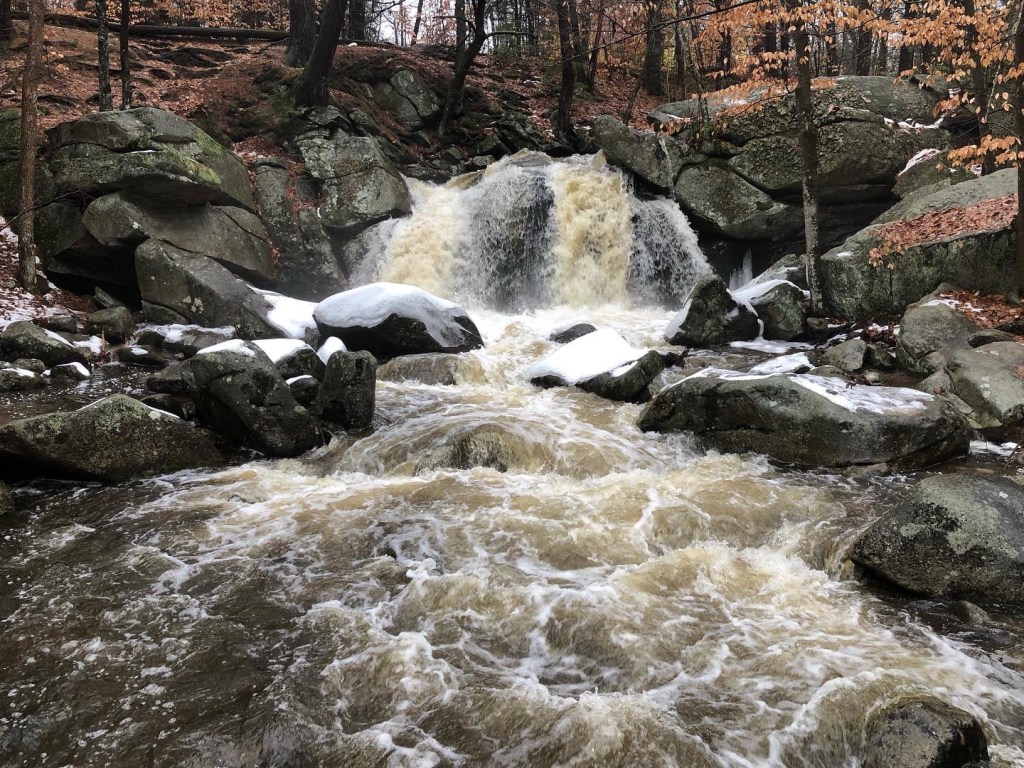
    First stop was an hour from home, at Willard Brook State Park in Ashby, Massachusetts where the beautiful Trap Falls pour forever over granite ledge. This is a popular spot in the warmer months, but on a rainy Saturday in January I was the only one there. The falls were roaring from the rain, and easily heard from the small parking lot. A brief, shuffling walk on a few slippery spots and I was quickly at the falls, and thought it might be a trick. How could I have this all to myself on this day when the falls were screaming for attention? The answer lies in that moment when I looked out the window and decided I ought to go out in this weather, while the rest of the world thought that would be a crazy idea. Score one for the crazy folk.

    Trap Falls

    A few pictures and rock scrambles later, I headed back to the car and consulted the maps in Greg Parson’s excellent resource New England Waterfalls, which I’d picked up as a gift to myself while purchasing a gift for kindred spirits. Parson’s recommended a cluster of waterfalls just over the border in New Hampshire. I looked at two in particular as promising and plugged in their coordinates in my Waze app and headed off for more adventure.

    Driving towards Milford, New Hampshire, I decided to focus on Lower Purgatory Falls as my first choice, and sought out the trailhead on Wilton Road. The trailhead displayed some icy conditions and I brought my micro spikes with me for this hike. I would soon be grateful for having them.

    The walk from the road to the falls is roughly half a mile. Nothing too crazy, really, just an old logging road that carries you to a yellow-blazed trail. And like Trap Falls, you could hear Lower Purgatory Falls well before you got to them. The falls are named for Purgatory Brook, a beautiful stretch of water that was white water after all the rain. Cresting a small rise, I saw the falls ahead and worked my way down to see them.

    And this is where the micro spikes were absolutely required. I was hiking solo in isolated conservation land on a day when nobody else thought it logical to be out there. A slip and fall would have been bad news. Micro spikes remain one of the best hiking investments I’ve ever made, and they offered a clear return on investment as I made my way down an ice covered hill with wet roots and rocks making up the better footing.

    Lower Purgatory Falls is a triangle-shaped wonder set deep in the woods of the aptly named Purgatory Falls Conservation Area. After the heavy rains and melt-off the falls had a lot to say, and I lingered by them for a bit to tap into their energy. Again I wondered why I was the only fool out there on this day, but I’m grateful I never came to my senses and stayed home.

    Lower Purgatory Falls

    As I was leaving the car I took a picture of the trail map supplied in Parson’s book. It indicated I could hike upstream to see Middle and Upper Purgatory Falls. The trail seemed clearly blazed in yellow and tightly followed the brook. And so I made my way upstream seeking more adventure. I found it.

    Hiking along the swollen brook, there were a couple of spots where it flooded over the trail, making for sketchy crossings. Not plummet into a frozen brook sketchy, for I’m not that crazy to attempt such things, more water deeper than your boot is tall sketchy. I made a few calculated crossings, trail blazed in a couple of spots, but always stayed safe and kept the yellow blazes in sight.

    Mossy Erratics
    Purgatory Brook, swollen with rainwater and melt-off

    Eventually the trail dead-ended at a development with a port-o-potty announcing “progress”. I silently cursed the abrupt ending to the trail, looked around to see if I’d missed it diverting elsewhere, and doubled back towards Lower Purgatory Falls, crossing anew the sketchy water crossings I’d already attempted.

    And here’s where it got interesting. I returned to the spot where I’d first seen the falls, looked left and right and saw yellow blazes going off in different directions. WTF.

    “Make sure to return on the trail you came in on as there are several official and unofficial paths in the area. Look for the yellow blazes and the junctions you passed through on the way to the falls originally.” – Greg Parsons and Kate Watson, New England Waterfalls

    Well, this is where I went wrong. I took the wrong yellow-blazed trail towards what I thought was a return to my car. After a few minutes of walking I was aware that I didn’t recognize any part of this trail. I doubled back and saw a logging road I’d ignored before and started following it until it dead-ended. Damn. And this is where you make choices deep in the woods. I could blaze my own trail through the woods with the compass on my cell phone, a picture from a book and Google maps as my guide, or I could double back once again and find the right trail. I’ve learned to trust my instincts in such situations, and not trust a phone battery. I doubled back.

    Finding a junction in the trail, I saw the yellow blazes once again splitting off in two directions. Who the hell blazed this land?? I stuck with the more worn trail and followed it to a place where (surprise!) I’d been before. It seems I’d followed the yellow blazed loop back around onto itself. And this is why bringing a compass and a reliable waterproof map is essential. Having neither, I relied on my experience in similar situations and kept my head about me. Since I was back on a trail I recognized, I simply followed it back to the Lower Purgatory Falls. Once there I saw immediately where I’d gone wrong and followed the correct yellow-blazed trail back to the logging road and eventually to the trailhead. Phew!

    This adventure started off as seeking a few waterfalls on a wet day. It became a small test in orienteering in unfamiliar woods on a wet, disorienting day without the proper equipment. And it ended with me deciding that two waterfalls were enough for one day. I thanked my wits and good fortune and headed home. The other waterfalls will have to wait… for now.

  • Hummingbirds in Winter

    “For unless one is able to live fully in the present, the future is a hoax. There is no point whatever in making plans for a future which you will never be able to enjoy. When your plans mature, you will still be living for some other future beyond. You will never, never be able to sit back with full contentment and say, “Now, I’ve arrived!” Your entire education has deprived you of this capacity because it was preparing you for the future, instead of showing you how to be alive now.” – Alan Watts

    I was thinking about flowers. Specifically, Bee Balm (Monarda). The blooms of next summer are currently scheming in the frozen turf of the garden, awaiting the heat of late June and July to burst onto the scene. In that respect, I share more in common with the flower than the hummingbird, which ignores border restrictions altogether and zips down to Mexico and Central America for the winter. You think that snowbird expression invented itself? The hummingbird is one of many birds that bolts the limited prospects of survival in the north for the tropics.

    Still, I don’t mind winter, when we have it. This year is a confusion of rain and frigid temperatures, but no significant snow to speak of just yet. But that’s the world we live in now, with seasons shifted slightly askew, and some uninformed loud people thinking climate change is a hoax, like COVID and election results and any science that doesn’t jibe with their worldview.

    I imagine the hummingbirds I got to know last summer are doing the Macarina with friends from around North America in some tropical paradise right about now. And why shouldn’t they? They flew 3000 miles and straight across the Gulf of Mexico to arrive in the tropics. So go on: guzzle that nectar and dance to your heart’s content!

    Back here in the frozen north, we wonder when the snow might return again, and then the flowers, and finally the hummingbirds. But, as Watts points out, we can’t live in the future, we can only embrace what we have now. We keep things going here, the dormant flowers and their gardener, making the most of what we’ve got until warmer days and open borders.

    As a gardener, I know there’s merit in planning for the future that Watts doesn’t account for in the quote above. Amending the soil, sowing, weeding and generally seeing your crop through to harvest are inherently forward-looking activities that happen in the present. There’s nothing wrong with knowing where you’re going while living fully in the present. Watts knew this too of course, but you can’t wedge everything into one clever quote.

    Here in New Hampshire, I’m packing as much alive time as possible into each day as it presents itself. In six months time, should we be fortunate to arrive there together, I’ll get reacquainted with the hummingbirds, who like to hover at eye level and check out the character who tends the garden for them. They’ll have squeaky tales of perilous travel over open water and jungle reunions with cousins. What shall my own tales be for them? Don’t we owe it to them to make it interesting?

  • Hit the Road, Jack

    “You boys going to get somewhere, or just going?” We didn’t understand his question, and it was a damned good question. – Jack Kerouac, On the Road

    I first visited Jack Kerouac’s grave in Lowell, Massachusetts when I was 20 years old. Once I knew where it was I’d stop in now and then to visit in my younger days. Usually there would be some scattered bottles of whiskey or some other tribute piled about. I’ve seen similar tributes with Thoreau and Twain’s graves, but Kerouac’s was first. It was there that I learned the sticky bond between a great writer and his readers.

    It was always mañana. For the next week that was all I heard—mañana,a lovely word and one that probably means heaven.

    Funny thing, I was wrapped up in the history of Kerouac, but I kept putting off reading his classic On the Road for years. Maybe I didn’t want to be disappointed if I didn’t like it. Maybe I had an image of what it was but wasn’t willing to see for myself what it was all about. But it was always mañana with this book. Until a friend posted a picture of his grave on social media that triggered me and I immediately downloaded it and started reading.

    “What is he aching to do? What are we all aching to do? What do we want?” She didn’t know. She yawned. She was sleepy. It was too much. Nobody could tell. Nobody would ever tell. It was all over. She was eighteen and most lovely, and lost.

    I think if I’d read On the Road at 20 I might have hopped in my Ford F-150 and crossed the country right then. Because at 20 you understand how Sal and Dean feel. The lost souls bouncing coast-to-coast searching for answers. When you live a bit you realize you’re searching in the wrong place most of the time. Most of the answers you need are right where you started. What are you aching to do? What do you want?

    “The days of wrath are yet to come. The balloon won’t sustain you much longer. And not only that, but it’s an abstract balloon. You’ll all go flying to the West Coast and come staggering back in search of your stone.”

    Wandering about in life sounds romantic, but Kerouac paints the grim reality of the quest. The abject poverty, the desperation and rootlessness. The descent into drugs and sex and casual regard for anything meaningful. The pursuit of what’s next. If Sal and Dean had iPhones they might never have left New York. They may have scrolled blankly through their Twitter feed. The search continues one generation to the next, the characters just use a different mode of transportation.

    He made one last signal. I waved back. Suddenly he bent to his life and walked quickly out of sight. I gaped into the bleakness of my own days. I had an awful long way to go too.

    It took a few decades but I finally finished On the Road. And really, I don’t have an urge to immediately drive across the country chasing dreams. Well, maybe a little bit. But mostly I understand. I see how it influenced the Baby Boomer generation when it was published in 1957. I hear it echo in Bob Dylon and Simon & Garfunkel songs (Listen to America and you’re On the Road with Jack Kerouac). I understand now how it influenced me even without reading it. What took me so long? I don’t know. But I’m happy I’ve finally crossed that bridge.

  • The Cold Water Initiation

    “Though it be the hottest day in July on land, and the voyage is to last but four hours, take your thickest clothes with you, for you are about to float over melted icebergs.” – Henry David Thoreau, Cape Cod

    The stretch of water between Cape Sable Island in Nova Scotia and Cape Cod in Massachusetts is known as the Gulf of Maine. A lot of history has floated between these two points, from Native Americans and later the Basque fishing and whaling these rich and vibrant waters to explorers like Giovanni da Verrazzano and Samuel de Champlain mapping the coast and looking for places for settlements. The Gulf of Maine remains the one constant that each would recognize, though they might wonder where all the fish went until they glance back at the developed shoreline.

    In 1604 Champlain ventured south from Port Royal to explore the coast of Maine. It was on this trip that he discovered Acadia, and further south, the “baye longue” between two capes and a long stretch of sand beaches on the present coast of New Hampshire.” (David Hackett Fischer, Champlain’s Dream. It’s on these beaches that generations of New Englanders and vacationing Canadians have discovered the truth in Thoreau’s words: this water is as cold as melted icebergs!

    Cold water gets in your blood, and you don’t celebrate it so much as accept it for what it is: a shocking reminder of how insignificant we really are. The Atlantic Ocean is divided into the Northern Atlantic and the Southern Atlantic, but really, there are divisions within divisions. A swim in Miami is not the same as a swim in Virginia, and a swim in the Hamptons on Long Island is definitely not the same as a swim at Hampton Beach in New Hampshire.

    You aren’t really a New Englander until you’ve taken the plunge into the Gulf of Maine on a hot day. It’s an initiation of sorts into the extremes. There isn’t a person who swam in early July at Hampton Beach who couldn’t relate to the bobbing passengers at the end of Titanic. The cold water hardens you, tests your mettle, and reminds you of your mortality. And that’s why I’ve grown to love a bracingly cold swim now and then. That stinging skin is a shocking reminder that you’re still very much alive… if a bit numb.

  • Stepping Out of Tiny Boxes

    Most people live their entire lives in tiny little boxes of their own making. I recognize the tendency because I too live in my own tiny box. But, for most people, the box we live in isn’t as tiny as it once was. It grows when we step out of it, over and over again. Until it isn’t such a tiny box after all.

    Experience is the great teacher, be it ours or the work of others before us. Reading and understanding are also forms of stepping out. Building things of significance, be they careers or causes or art or relationships, expand our tiny boxes. And journeys of consequence are also expansive in nature. I’ve never quite fit in my old box when I return from a faraway place or a mountain top, nor would I want to.

    Some choose to remain in their tiny boxes. Perhaps they find it comfortable in there. It isn’t our place to expand other people’s boxes, but we can gently coax them outside for a stretch. The sneaky part about helping other people expand their boxes is that ours expand in kind.

    Now and then I’ve realized that inside the box was far more comfortable than the place I found myself on the outside, but I couldn’t get back in again as hard as I tried. Soon any discomfort faded and I realized that it was just my hardened edges expanding to new places. I’ve learned to enjoy that feeling of discomfort more each time.

    We reach a point where we want to spend more time outside stretching, and less time pressed inside our borders. I hope that feeling never goes away, but I see it fades in some people. If you aren’t paying attention you get pretty comfortable in that box you’ve built and even stretching a little bit seems like a step too far.

    If we’re being honest with ourselves, sometimes it feels better to just stay where you’re comfortable. After all, there’s nothing cozy about leaping. Crossing chasms is scary and dangerous work. So why risk it?

    Because we weren’t born to live in tiny boxes.

  • A Small Change

    “a small change
    in rudder
    affects both the journey
    and the destination”
    – Kat Lehmann, Small Stones From The River

    There is no doubt that the year brought unprecedented storms that have collectively altered our course. But what of the set of our sail? What of the rudder? The world in all its maddeningly unpredictable ways will be what it is, but our course is largely set by us.

    Ultimately we control very little in the world but how we react to it. We change course in countless ways all the time. This year offered many lessons. And choices: Alive time or dead time? Some may say it was a lost year, but I would argue it informed us greatly about our resilience, our priorities, and our adaptability. And with that hard-won knowledge, where do we steer to now?

    A small change, consistently acted upon, determines where we go. Small, constant changes lead to a zig-zagging, undetermined course. Which is better? It depends on where you want to be and how quickly you want to get there. Both bring you places. But we don’t want to be rudderless.

    I prefer to have the tiller and a compass heading I’m confident in. React as we must to the conditions we find ourselves in, but generally keep steering towards our destination. And discover what we may. For the journey is underway.

  • 20 Days Left in 2020

    Today there are twenty days left in 2020. What are you going to do with those twenty days? The other 346 tumultuous, maddening days of this year are behind us. All that’s left in this year are twenty days and it will be a memory stacked with all of our other memories. So what will we make of them?

    Time isn’t our friend, my friend. With so little time available in our productive lifetimes, deciding what you will finish, what will define your time here, is in itself life altering. Boiled down even further (since time isn’t guaranteed anyway), deciding what you will finish in a year, a month, a week and, you guessed it, a day lends urgency to the most mundane of tasks. Luckily for us, twenty days is a small enough sample that we can wrap our minds around it.

    What are you here for anyway? Decide what to be and go be it, as the Avett Brothers would suggest. And as the days shrink into the dark nuggets of December days and we round the corner into the New Year, what are you going to do with that precious time anyway? Finishing more seems a good answer.

    For me that means work goals, final chapters in several books, fitness goals and places to be. Everything else is time with loved ones. That’s more than enough to focus on as we hit the home stretch.

    Final Chapters
    I’ve got a stack of critical reading to finish. Seven books in all, that I’ve mentally noted as my finish in 2020 books. For all my complaining about my tendency to bounce around between books, I’ve made steady progress despite it all. If you’re the average of the five people you hang around with the most then raising that average with the authors of exceptional books is a worthy use of limited time. Notably, I’ve set aside some other books that I’ve chosen not to finish. Life is full of compromise. Just make compromises that will still move you forward.

    Fitness
    Stretching your mental boundaries through reading is one thing, but we can’t let our bodies waste away in the meantime. Worthwhile fitness goals force the issue of how you spend your days. I’ve accepted a rowing challenge from old college friends. And so I’ll be spending more of that precious time rowing a few hundred thousand miles in preparation for the moment of truth: 2000 meters for time. Nothing focuses the mind on the task of getting in peak shape like a 2000 meter row on a Concept 2 Rowing Ergometer.

    Places to Be
    Getting fit is great, but I’m an outdoor creature at heart and I can’t very well spend my entire winter indoors rowing. As luck would have it there are worthy places to go and things to see within reach in a year where travel is prohibited. Hiking trails, mountain peaks, waterfalls and long stretches of sandy beach with no footprints on them in winter are all waiting patiently for you. Lonely sites of historical significance with ghosts waiting to whisper to you. All outside the door and a short drive away. Forget binge-watching, try binge-doing.

    Only twenty days left in the year. A power twenty, as rowers would recognize: twenty at maximum effort to pull ahead. Not all that much for a year we’ll surely never forget in our lifetimes. Why not make something positive out of the last twenty? Twenty powerful days to finish this year, and to set ourselves up for a brighter future.

  • Have a Look

    “The universe is full of magical things patiently waiting for our wits to grow sharper.” – Eden Phillpotts

    Rumors of Aurora Borealis potential had me looking up at the skies last night and tracking its progress across the globe with my trusty Aurora app. Overcast skies last night combined with being too far south made it all but impossible to see it where I am, but there’s hope tonight when I’m further north. Expectations rise with the solar flares.

    Do you wonder at the skies the way that I do? I should hope so. Without magic and wonder life would be a quiet bore. A bitter slate of scarcity and distraction and isolationism. There are plenty of people in this mad world who consume and sling bile. That’s no way to live.

    The Northern Lights are big and evasive when you live far away, but there’s magic right in our midst, should we look for it. It’s in the eyes of a toddler looking at you with a soggy smile. In the vibrating purr of a cat sneaking in for body heat and affection. In the wispy steam drifting from your coffee on a cold morning. Lurking in a dusty book on the shelf that you’ve skipped over for years. It’s right under your nose waiting for your wits to grow sharper.

    Have a look.

  • Awaiting Discovery

    “It is remarkable that men do not sail the sea with more expectation. Nothing remarkable was ever accomplished in a prosaic mood. The heroes and discoverers have found true more than was previously believed, only when they were expecting and dreaming of something more than their contemporaries dreamed of, or even themselves discovered, that is, when they were in a frame of mind fitted to behold the truth. Referred to the world’s standard, they are always insane.” – Henry David Thoreau, Cape Cod

    This is a year of the commonplace and unromantic if you let it be.  Lockdowns and border closings and mandatory quarantines tend to temper the passions of the high agency traveler.  But then again, if you keep your expectations and dreams focused on regional adventuring until things open up again you might just find the world under your nose.

    Yesterday I watched a bobcat, set against the snow, on the hunt.  It was slinking along the edge of the forest where the fence announces wilderness begins.  I expect it was attracted to the bird feeder activity, for there were squirrels and juicy birds for the taking for the ambitious hunter.  Unlike my snowshoe hare encounter I wasn’t prepared for a picture, and I settled for locking her image in my brain.

    Leaving Cape Cod the other day I stopped to fill up the tank and, glancing up, noticed 9-10 osprey hovering in the wind, all clustered together.  I’ve never seen so many osprey flying together, and there they were right above me gliding gracefully about.  By the time I finished fueling the car the osprey had drifted away to awe others elsewhere, but damn if they didn’t capture my imagination first.

    For all his fame as a transcendentalist and beholder of truths, Thoreau didn’t travel very much in his lifetime.  He spent most of his lifetime in Concord, Massachusetts, with notable trips to Cape Cod, up the Concord and Merrimack Rivers to the White Mountains, to the Maine woods, and one solitary trip across an international border when he visited Quebec.  And yet he saw more than most people who travel far beyond the northeast corner of North America.

    There’s light at the end of the pandemic, though we remain in a dark and treacherous tunnel.  This isn’t the time to cross borders, but the world outside our Twitter feed remains vibrant and alive, awaiting discovery.  The bobcat,  osprey and Thoreau have each inspired me to shake off the creeping prosaic mood that shorter, darker days cloak you in and dive back into adventuring.

    Et toi?  Are you ready to re-join the hunt?  Nothing remarkable was ever accomplished in a prosaic mood.

  • White Cap

    “I am in love with Ocean
    lifting her thousands of white hats
    in the chop of the storm,
    or lying smooth and blue, the
    loveliest bed in the world.”

    – Mary Oliver, Ocean

    I anticipate a white cap day on Buzzards Bay as a Nor’easter rolls through. For now the bay is restless but content to let the rain fall in abundance to its surface instead of rising up to meet it. For the march of thousands of white hats the current and wind must be more contentious than this. It will come in time, as it always does on Buzzards Bay.

    Nor’easter days are meant for hunkering down, catching up on reading and sipping hot beverages. On Cape Cod the storm will bring heavy rain and high winds. The salty water will surely rise to greet her fresh visitors. I’m a visitor myself; like a river forever moving between the mountains and the sea. I want to leave the comfort of the warm house to walk on the beach. You don’t come this far to look at it from afar. For I’m mostly water, shouldn’t I rise up to meet it too?

    Up in New Hampshire all this water will mean white hats of a different kind, with heavy snow in the mountains and clever swirls of white donning posts and mailboxes in the lower elevations. I’ll welcome the grace of snow-packed trails covering the ankle-breakers when I return to the mountains. Whenever that might be – I really don’t know. But they’ve heard my silent promise to return. We have unfinished business, those mountains and me.

    I laugh when I read polls asking where you would want to live forever. How do you choose between the mountains and the sea? Its a Sophie’s Choice question; asking one to pick between a mountain waterfall and the crashing surf. Instead I look to the Abenaki who moved for generations between the White Mountains and ocean fishing villages. They didn’t choose one over the other, they chose a life in between. And that’s where you’ll find me too.

    So today as the white caps rise, I’m reminded of the Mary Oliver poem above. I’m on the very edge of that in between for this Nor’easter, and the chop of the storm has begun. Who’s up for a walk?