Category: Travel

  • Hiking Mount Garfield

    As U.S. Presidents go, James Garfield is barely remembered, but he seemed like a decent guy.  He fought for the Union primarily to eradicate slavery, and is the only President to be elected from a seat on the House of Representatives.  So he should be viewed favorably and as an American success story.  Unfortunately, his tenure as President lasted a mere six months, as he fell victim to an assassination attempt, dying a few months after being shot from complications.  That you and I don’t remember much about Garfield has as much to do with his short and tragic life more than any flaw in his character  His mother Eliza was born in New Hampshire, so it seems fitting that there’s a mountain named after him.  This morning I climbed that mountain.

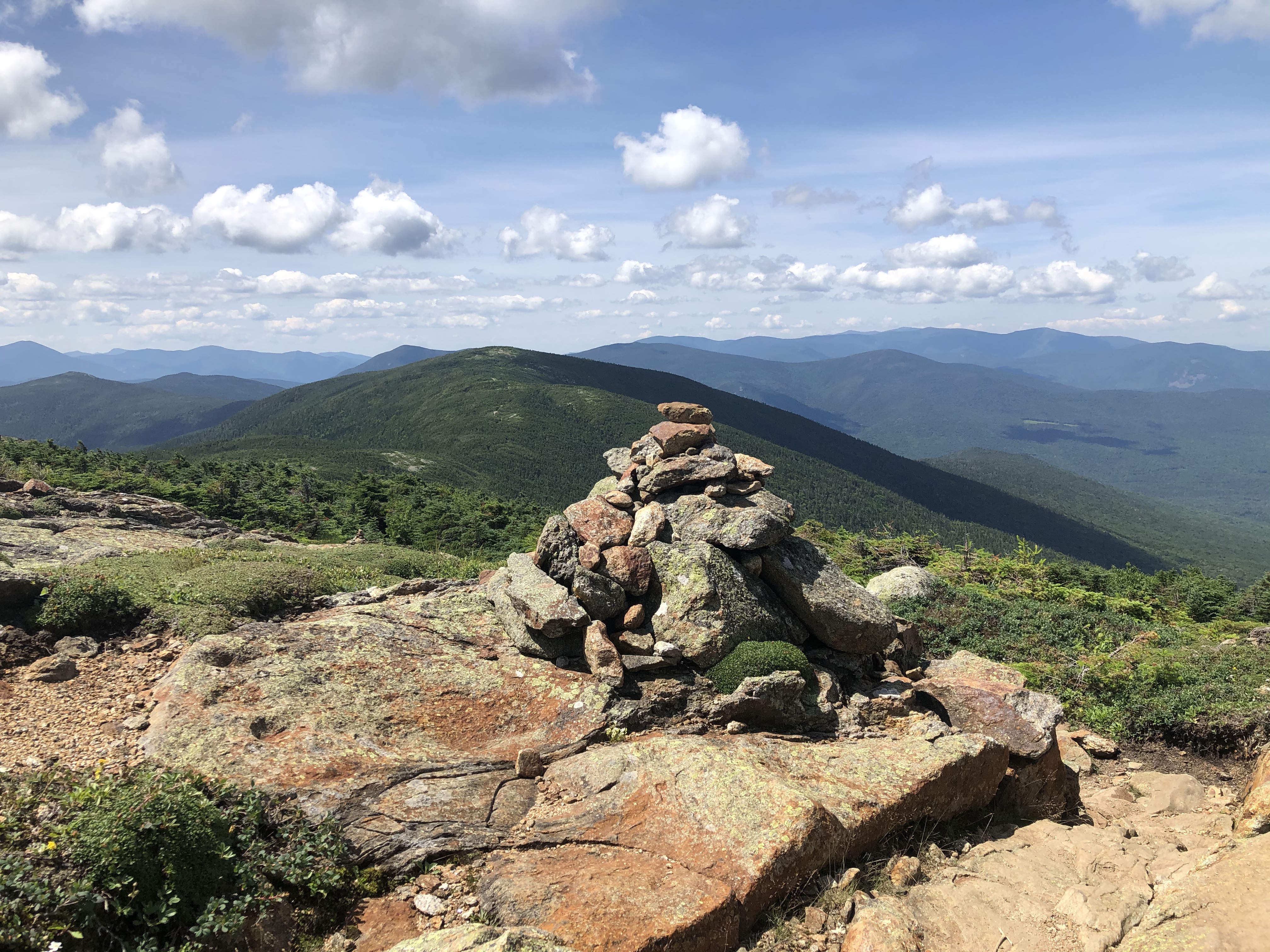
    Mount Garfield is known for the view from the summit.  There would be no view this morning, as rain and low cloud cover announced from the start that this wouldn’t be one of those days when you could see for miles.  I decided to hike it anyway, and to do it solo. The Garfield Trail is a relatively easy hike, and I was able to get to the summit in 2 1/2 hours.  As a wet hike, the Garfield Trail leaves a lot to be desired.  You feel like you’re hiking in a stream in stretches, and on the verge of getting bogged down in mud in some others.  But it’s a classic New Hampshire hike, with a cathedral of mature trees lining the ridge in the first third of the hike, and rocks for much of the rest of the way.  This is the type of hiking I’ve grown up with, and I quickly settled into my rhythm for the climb up.  For all its wetness, there were no bugs for the duration.

    Beginning at 7:30, I found little company on the trails.  I passed one father and daughter pair early on, and was in turn passed by a woman who flew past me after the first hour of hiking.  I’ve long checked my ego at the door when it comes to my pacing on hikes, and when I go solo I’m very deliberate with footing.  I’d see her again as she flew down the mountain at almost the same pace.  And that was it for company on the ascent.  It seemed most people were saving Garfield for a sunny day.  But the descent proved me wrong, with a steady parade of hikers streaming past me, most wondering about the view at the summit.  Not much of one, I’d tell them, but even as I spoke those words the day was beginning to change, with sunlight burning through the cloud cover and warming up the forest.  I was grateful for having done the ascent in the cool rain, even if the view didn’t cooperate.

    Mount Garfield is considered one of the easier climbs of the 48 4000 footers, but with that big payoff of a magnificent view waiting for you on a clear day.  If I wasn’t pursuing the 48, I might have saved this hike for better day, but I don’t view it as a waste at all.  20,000 steps later, I’d finished another 4000 footer and began my drive back home.  Garfield is a mountain I’ll do again a few times, certainly in autumn but also in winter when it becomes a longer hike as they close the gate on the access road.  Maybe my timing wasn’t good for a view, but it was an excellent 4 1/2 hour round trip anyway.  I’ve got my second notch on the 48 (I started over again from the beginning this year, since I rarely logged hikes previous to pursuing this goal) 4000 footers, and I got a decent workout in before lunchtime.  I’d call that a great success.

    A side benefit of hiking the 48 is learning more about the people the mountains are named for.  Other than knowing he was President and that he’d been assassinated, I didn’t know much about James Garfield until I chose this hike.  I’m glad I took the time to look back on his life a bit.  He only lived to aged 49, but managed to accomplish quite a bit in that time.  He was a classic rags to riches story with a life cut short too soon.  The White Mountains are dotted with more famous Presidents, but that doesn’t make Garfield a bit player.  Just a guy who ran out of time before he could do more.  I think he’s had a lot of company in that club.  A good reminder to get busy already, time waits for no one. And with that in mind I’m considering a peak bag for my next hike, which involves summiting multiple peaks in one day’s hike. I have another couple of former Presidents in mind for that one.


  • What’s a More Soulful Way to Live?

    “What’s a more soulful way to live?  What’s a way that I can benefit from the dynamism and prosperity of American society without having to play by these rules that keep us in a holding pattern?” – Rolf Potts, from his Deviate podcast

    Leave it to Rolf Potts to ask the question.  The question that drives much of what I write about, and seek in travel and reading and gardening and hiking and in lingering solitude in the early light of dawn and the spaces in between notes and in the eyes of kindred spirits.  What’s a more soulful way to live?  And this is the path I live my life on.  Travel might not be as readily available in this moment, but it will return in time.  In the meantime there’s this living thing to do, and why not make it a dance instead of a holding pattern?

     The world is alive around us. I see it in the trees as the wind swirls the leaves and branches bounce in delightful prances. In the leaves and flower buds earnestly unfolding and reaching for the light. I hear it in the birdsong and buzz of pollinators and I feel it in the dampness of the earth after a night of rain. And we are alive as well, at least for now. Shouldn’t we dance while the music’s still playing?

    I’m very good at creating to-do lists. Projects to complete, places to go, bucket lists of experiences and other such compilations. The question, what’s a more soulful way to live? is a useful lens for planning the future, but I find it as valuable as an earnest sounding board for the moment. How do I highlight this moment in time soulfully? How do I fill my remaining days with a more soulful life? Both questions have value. Life is best lived in the moment, but with a realistic eye on where you’ll be tomorrow, should it arrive.

    Collectively it feels like we’re all in a holding pattern, but that doesn’t mean we can’t live more deeply. Thoreau showed you don’t have to travel far to explore soulfully. And so it is that the trees dance, the dappled light sparkles on lingering droplets and the world wakes up around me. I find myself a witness in the moment but also a willing participant, alive and grateful for the opportunity at hand.

  • Life In Four Native American Quotes

    “When it comes time to die, be not like those whose hearts are filled with the fear of death, so when their time comes they weep and pray for a little more time to live their lives over again in a different way. Sing your death song, and die like a hero going home.” – Chief Aupumut in 1725, Mohican.

    The Chief Aupumut I’ve read about was born in Stockbridge, Massachusetts and fought in the Revolutionary War as an important ally against the British.  He wrote an extraordinary letter to Thomas Jefferson asking for lands for a reservation in Wisconsin, so that his people wouldn’t have to keep moving further and further until they ran out of land.  He was also known as Hendrick Aupaumut, the Chief of the Muhheconneck Nation.  Given the date, the quote above may have derived from his father.  I’m not really sure, I’m relying on a web site dedicated to quotes from Native Americans.  But it took my breath away whomever the source was.  There’s a fair amount of stoicism in Aupumut’s words, not unexpected, and he challenges all of us to live more boldly in pursuit of our own dreams.  That’s a lot to live up to, living that we might die like a hero going home, but what else is this wild and precious life for if not to reach our potential?

    “What is life? It is the flash of a firefly in the night. It is the breath of a buffalo in the wintertime. It is the little shadow which runs across the grass and loses itself in the sunset.” – Crowfoot, Chief of the Siksika First Nation, Blackfoot warrior, peacemaker

    Crowfoot died relatively young at 60 from tuberculosis, so there’s wisdom in this quote reminding us of the briefness of life.  We’re all here for a short time, whether 60 years or 100, it’s all just the flash of a firefly in the night.  So why do we waste time on the trivial when time is so precious?  Because we don’t believe the truth before us.  There’s always another tomorrow, always next year, always an I’ll get to it…  until there isn’t.  Do it now.  If ever there was a consistent call from those who came before us its to make the most of this moment, not some future moment.

    “All who have died are equal.” – Comanche or Navajo quote (source uncertain)

    Google this quote and you’ll find multiple sources for it.  But generally it comes down to either the Comanche or the Navajo.  I wouldn’t be shocked if they both had a version of the same quote.  All who have died are equal.  And all who live are equal as well, even if treated differently.  I was raised to treat everyone the same, no matter what their skin color or nationality or sexual identity or preference.  But I’ve taken my own identity for granted, not seeing the struggles of those who fight unseen battles with those who weren’t raised the same way.  The world is full of struggles for equality and the respect and dignity of all.  But collectively we can make significant improvements in our lifetimes.

    “When a man moves away from nature his heart becomes hard.” – Navajo Expression

    There are a lot of hardened hearts in the world, removed from nature and seeing the world as asphalt and concrete and electricity.  It’s easy to dismiss climate change and consumer waste as hoaxes when you’re not immersed in nature.  How can you possibly see what you aren’t looking at?  I have seen the plastic washed up on remote beaches, and the oil slicks from spills far away.  I have noticed the shift in seasons and the haze over cities on busy commuter days.  As with equality, we can make significant improvements in our lifetimes, but we can’t wait much longer.  Perhaps a new President and Congress will prove to be the catalyst for change long overdue in the United States.  Perhaps the pandemic has given the world enough of a breather to give us the time to make meaningful change in our collective behavior.  But it always starts with us.

    I linger on the edge of nature often.  Gardening and observing the birds and bees and mammals attracted to the garden.  Hiking and getting out on the water whenever possible.  But I need to plunge deeper into the heart of it, to soften the hardness in my own heart.  We’re all that firefly in the night, with so little time.  How will we use our light?  What are you waiting for?


  • The Compass and the Torch

    “Not like the brazen giant of Greek fame,
    With conquering limbs astride from land to land;
    Here at our sea-washed, sunset gates shall stand
    A mighty woman with a torch, whose flame
    Is the imprisoned lightning, and her name
    Mother of Exiles. From her beacon-hand
    Glows world-wide welcome; her mild eyes command
    The air-bridged harbor that twin cities frame.

    “Keep, ancient lands, your storied pomp!” cries she
    With silent lips. “Give me your tired, your poor,
    Your huddled masses yearning to breathe free,
    The wretched refuse of your teeming shore.
    Send these, the homeless, tempest-tost to me,
    I lift my lamp beside the golden door!”
    – Emma Lazarus, The New Colossus 

    There’s an interesting connection between Emma Lazarus and Henry David Thoreau.  It seems that Emma visited Ralph Waldo Emerson at his home in Concord, Massachusetts in 1876, and met the poet William Ellery Channing while visiting.  Channing was a close friend of Thoreau, and apparently never really got over the death of Thoreau 14 years prior to Lazarus’ visit to Concord.  He proved to be a tough nut to crack, but succumbed to Lazarus as he learned she was an admirer of Thoreau’s.  Channing gave her a personal tour of Thoreau’s Concord, from Walden Pond to the place he was born, and when she was leaving Concord he gave her an incredible gift; Thoreau’s compass.  I admit, that’s a breathtaking gift to me, the compass of Henry David Thoreau, the surveyor of lands and spiritual guide to generations.

    Lazarus, like Thoreau, would live a short life, succumbing to what is believed to be lymphoma at the age of 38.  But like Thoreau she lives on in words of significance created during her short tenure on earth.  Her most famous poem is The New Colossus, which was written to raise funds for the base of the Statue of Liberty, and is forever associated with Lady Liberty.  I’ve read it many times, but find new meaning in it with each reading.

    A mighty woman with a torch, whose flame
    Is the imprisoned lightning, and her name
    Mother of Exiles.

    When you absorb The New Colossus, you recognize the folly of Trump, the Tea Party and the undercurrent of white privilege that’s always been there but is recoiling under an uncomfortable spotlight.  The Founding Fathers might have been complicated in how they lived their own lives, but the ideas behind the Declaration of Independence and the Constitution were bigger than their lives.  The century after would see a nation boiling inside, putting the words to the ultimate test again and again culminating in the Civil War and Reconstruction, the settlement of the continent and the sweeping aside of Native Americans, much of the wildlife and the very land itself.  Set against this was the rise of Transcendentalism, conservation and preservation.  And all the while the immigrants kept flooding in, fleeing desperation and seeking a new hope in America.  Lazarus represents the open arms of Lady Liberty and America, with no restriction in who might be welcomed when they arrive:

    Give me your tired, your poor,
    Your huddled masses yearning to breathe free

    I know people who despair at Trump and the rise of hatred in America.  I take no pleasure in the vile and ugly amongst us.  But I also take the long view, and recognize that American is shifting once again, and the undercurrent of hatred, racism and greed is unwelcome by the vast majority in this country.  I have faith in the process and believe we’ll come out of this year like no other better for having endured.  America is a land of hope, transcendentalism is founded on the belief in the inherent goodness of people.  Emma Lazarus corresponding with Ralph Waldo Emerson and eventually visiting him shows her own interest in his thoughts and opinions.  When I read The New Colossus I think of Thoreau’s compass that was handed to Lazarus by Channing and the direct link that created between them.  I wonder if she glanced at the compass while writing The New Colossus and found the right words to say.  Words that still show us the way forward, towards our true north as a country.

  • Movies Under the Stars

    When I was a kid we’d go to the drive-in movie places that dotted the landscape to catch whatever summer movie was playing that week. You’d roll up to a parking spot, and we’d roll out of the back of the station wagon and establish our turf with blankets and folding chairs. Half the fun of drive-in’s was the social aspect of seeing a movie with friends, cars parked nearby and bouncing around to see who else was there and to visit the snack shack for popcorn and candy. If you wanted to preview a different movie you’d go to a multi-screen drive-in and simply turn around and see what was happening behind you.
    Drive-in’s don’t make a lot of sense as a business. You need cheap land to pull it off, but enough people to fill it to make any money. And then you factor in the weather and the sharp reduction in opportunities to pack the place for maximum profit and you see why the drive-in’s failed over time. I still see a few in out-of-the-way places in the northeast, but mostly they’re a thing of the past. Sometimes you’ll see a lonely screen standing in a neglected lot or on the side of the highway and recall what used to be. But mostly the land is swallowed up for more profitable tenants, with box stores and condos taking the place of the drive-in’s. The last movie I saw at a drive-in was Top Gun at a place that’s now a Home Depot. I tried to listen for the echoes of movies past one time while buying fasteners, but all I heard was the hum and beep of forklifts.
    Last night we tried something different during a party. We erected a pop-up screen and placed a projector on a table connected to a laptop and had a movie night in the back yard. We streamed Hamilton and sat around the table with a fire and the stars and rising moon lighting up the ceiling. And just as with those old drive-in’s we had to wait out the mosquitos before settling into the movie. Hamilton competed with the sound of exploding fireworks as the rest of New Hampshire celebrated the 4th of July in a different way. But it died down as the evening progressed, and it became easier to lose yourself in a broadway musical as other stars danced above us. It brought back those memories of drive-in movies and simpler times when maximizing the profit of the land wasn’t always the primary consideration. I went to sleep with Hamilton tunes stuck in my head and a smile on my face.

    Originally posted 5 July 2020

  • Life, Liberty and the Pursuit of Happiness

    “We hold these truths to be self-evident, that all men are created equal, that they are endowed by their Creator with certain unalienable Rights, that among these are Life, Liberty and the pursuit of Happiness. – That to secure these rights, Governments are instituted among Men, deriving their just powers from the consent of the governed.”

    I’m late in posting today, but wanted to take a moment to reflect on America’s Independence Day. I’m listening to vast amounts of consumer-grade fireworks being blown up around me. Its quite mad, this roar of explosions near and far. But my morning started in quiet contemplation, reading the Declaration of Independence well before the fuse was lit on the first bottle rocket. In these times, more than any time in my lifetime, I appreciate the boldness and courage captured in the Declaration of Independence. And I’m grateful for the gift of freedom and the reminder of sacrifices made to achieve it.

    Life, Liberty and the pursuit of Happiness. A worthy pursuit, surely worth the price of declaring independence. And tonight, as the citizens of this great country blow up crazy amounts of ordinance in celebration of the anniversary of the signing of the document that shook the world, I celebrate too. Albeit more quietly.

    Originally posted 4 July 2020

  • Following the Bread Crumbs: Coffee with Kant

    “We live in an epoch of discipline, culture, and civilization, but not in an epoch of morality. In the present state, we can say that the happiness of the people grows, and yet the unhappiness of the people increases as well. How can we make people happy when they are not educated to have high morals? They do not become wise.” – Immanuel Kant

    Kant wrote that more than two centuries ago but it rings as true today as it did then. He might not recognize the world we live in today but he’d recognize people’s behavior and tendencies. We might live in a world unimaginable then, but human nature remains roughly the same. People want happiness but not the journey to get there. To know their place in this world but not know themselves. To be informed by distraction while they shun wisdom. But what is the wisdom Kant points us to, and how does it lead us to happiness?  He left a trail of breadcrumbs to follow:

    “Look closely. The beautiful may be small.”

    “Dare to know! Have the courage to use your own.”

    “Genius is the ability to independently arrive at and understand concepts that would normally have to be taught by another person.”

    “Two things fill the mind with ever new and increasing admiration and awe, the more often and steadily we reflect upon them: the starry heavens above me and the moral law within me. I do not seek or conjecture either of them as if they were veiled obscurities or extravagances beyond the horizon of my vision; I see them before me and connect them immediately with the consciousness of my existence.”

    “For peace to reign on Earth, humans must evolve into new beings who have learned to see the whole first.”

    So there’s the path:  Live in awe of the world around us and seek to understand it.  Above all have the courage to think for yourself.  Focus inwardly on your own learning, don’t rely on others to tell you what to see and think.  He’d be thrilled with the vast wealth of knowledge available to humanity today, and chagrined that more people don’t tap into it, instead deferring to others to tell them what to think.  For all our progress, we still have a long way to go.

    I’m leaving my own trail of breadcrumbs as I live my life, as much to find my own way back to these places as it is suggestions for others.  My way of saying “Don’t forget this” in addition to “Hey, check this out!”  But that’s the nature of blogging, isn’t it?  Don’t pretend to have it all figured out, just mention what you see along the way.  Have the courage to put it out there for others to weigh in on.  Adapt and grow.  Develop your own philosophy derived from a lifetime of thoughtful observation, living and learning.

    I tapped into Immanuel Kant while sipping coffee early this morning.  I like to dive into the deep end when my mind is fresh and willing to dance with the great thinkers.  Kant would get along well with Thoreau, Emerson, Muir, Mary Oliver and other brilliant minds.  I’m working to earn a place at that table, for I’d hang with that crowd anytime.  But then again, I guess I already am.  The great thinkers were generous that way.  Thanks for leaving the bread crumbs.

    Originally posted 3 July 2020

  • Work in Progress

    I’ve decided to clean up Alexandersmap a bit. Improve navigation, add meaningful content, optimize for SEO, and make it generally more user-friendly. After writing more than 300,000 words over the last few years, I’m feeling the need to change things up a bit. Step one was to watch a few videos of how others have built their sites. Then I signed up for a WordPress “Happiness Engineer” to Zoom with me for 30 minutes to show me a few tips. All that’s fine and well, but ultimately I’ve just got to mess about with the site and learn it from trial and error. And so what you see now is different from what you saw yesterday, and will likely be very different from what you see a week from now. I could just save this all as templates behind the scenes, but I think it’s more interesting to have it change with me as I modify the site. For those who are interested it might be fascinating or frustrating as a relative novice takes on web site creation. For those who are less interested, thanks for your patience: I’ll continue to write and post every day. Hopefully the writing will hold your interest even as the structure around it changes.
    One thing I’ve learned about my learning process is that watching others do something generally works better for me than reading about it. When I want to know how to install a new bathtub there’s a video for it. When I want to figure out the best way to fix my pool deck, there’s a video for it. And so it is with web site design. YouTube videos of subject matter experts navigating around in Elementor or Gutenberg or Yoast SEO are more instructive for me than other such learning paths. I’m not proficient enough to just figure it all out myself, and don’t want to spend hours of my short lifetime reinventing the wheel. So trial and error with video guidance from SME’s seems to be the right mix for me.
    It seems simplicity is key in whatever it is that makes a great web site. Look at the blogs of Seth Godin, Pico Iyer, Tim Ferriss or Rolf Potts – all of them simple, intuitive and elegant. The best form of flattery is imitation, so these four will be quite flattered should they stumble upon alexandersmap.com sometime in the near future. For now the future remains cloudy, but I know it’ll clear up eventually. You’ve gotta have faith in such things. So as we enter a long weekend in America, I’m dipping into the deep end of web site editing, and we’ll see what comes out the other side.

    Originally posted 2 July 2020

  • The Lure of Falling Water

    “As long as I live, I’ll hear waterfalls and birds and winds sing. I’ll interpret the rocks, learn the language of flood, storm, and the avalanche. I’ll acquaint myself with the glaciers and wild gardens, and get as near the heart of the world as I can.” – John Muir

    What is it about waterfalls?  Is it the sound of falling water hitting hard surfaces and drowning out the rest of the world?  The stunning visual dance of water and light that often creates rainbows in the mist?  Or is it the lure of something bigger than ourselves?  Something timeless and enchanting all at once?  I’m not really sure I can answer my own question.  But I’m drawn to waterfalls just the same.

    We made a point of visiting two waterfalls during a brief visit to Ithaca, New York.  We’ve been to both before, and wanted to see how they looked in a different season.  It turns out that the first attempt was thwarted by the closure of the Cascadilla Gorge Trail because of some damage sustained to the trail that prompted officials to deem it dangerous for the public.  I suspect we would have done just fine on it, but we honored the signs and temporary fencing the City of Ithaca had barring access to the trail.

    Thankfully, the second option was open and available, and we were able to spend a bit of time contemplating Ithaca Falls.  Strangely, there were very few people about.  I always wonder about that when visiting places like Ithaca Falls.  Why aren’t there more people there?  But we were grateful for the relative solitude afforded to us, and the opportunity to see a place like this one more time.  I’m not sure how many times I’ll get back to the many waterfalls of Ithaca; I hope many more.   Why would you visit a place and knowing what lingers nearby, not take a moment for awe and reflection?  It really doesn’t matter why we love it, only that we’re able to spend moments of wonder with falling waters.

  • Dining Out in a Pandemic

    Going out for dinner in the midst of a pandemic, at least in places where people are responsible and informed, requires a shift into the “new normal”.  I’ve dined at restaurants in Massachusetts, New York and New Hampshire since restaurants began opening up again in this new normal, and I’ve taken time to observe a few things.  Before I dive in, count me among the true believers in responsible social behavior at all times, but especially now.  If you’re too casual with your behavior around social distancing, mask wearing and cleaning your hands, I make a mental note of it.  You have a right to your opinion, but mine counts too, and if you aren’t taking measures to prevent people from catching something you might have I simply won’t do business in your establishment.

    Restaurants offer much more outdoor seating than before, which somewhat makes up for the fewer and more distanced tables inside.  Everyone who walks around inside the restaurant is supposed to be wearing a mask, and it seems most everyone follows that rule, whether staff or patrons.  The gray area is the outdoor seating, where some people aren’t sure whether to wear a mask or not.  I think the rule is pretty clear: keep your mask while you’re on the property of the restaurant until you’re backside is planted in the seat they offer you.  Simple, right?  In Massachusetts and New York, the rules are clear: wear the mask or don’t go into the restaurant.  In New Hampshire, the more Libertarian “Live Free or Die” state, it’s more like a strong suggestion.  And behavior reflects this.  I saw several people walk in for a table without a mask on, many in high risk categories.  The staff wore masks at an Italian restaurant I got take-out at, but a few of the servers had the mask tucked below their nose.  Noted.

    The only place that I’ve had my temperature taken before entering was at the dentist.  Getting a haircut everyone wore masks, but there was no screening of patrons.  I checked in to my first hotel since the pandemic began and noticed the rooms are cleaned and sterilized better and the free coffee is no longer in the lobby, but there’s no screening of guests for fever.  That’s been my experience with restaurants as well.  That’s a lot to ask of a small business.  People expect you to self-screen yourself if you’re sick, and aren’t turning people away based on having a fever (if you aren’t screening how would you know anyway?).  Taking a temperature isn’t perfect anyway, and I don’t believe it should be required in most places.  I’d hope that someone who was obviously sick would be politely refused entry should they be bold enough to try.

    The northeast United States was hit by a wave of COVID-19 early, which locked down many businesses.  We tend to believe science over rhetoric around here, and most people have flipped to wearing masks as the price of entry into that new normal.  Restaurants have pivoted too, and most are doing what they can to be open and profitable in this pandemic.  No more buffets, no more candy dishes at the cash register, no more packed restaurant bar full of patrons waiting for their table (wait outside until your table is ready).  But the ones that survived are largely open for business again.  That’s dining in the northeast – follow the rules or go home.  Americans generally don’t like rules and people telling us what to do.  But we’ve all seen what happens when you just open up with no regard for the virus.  Spikes in Florida, Texas, Arizona and other states, even in the heat of summer (sorry, another incorrect Trump statement) are indicative of the danger of COVID-19.  By now we know the drill, this isn’t February people.  So act accordingly.  Eat out and support local businesses, but do it responsibly.