“Listen, are you breathing just a little, and calling it a life?” — Mary Oliver
It’s always the poets and the artists who draw our attention away from the straight and narrow path. And if we ever need a poem to call us out and force us to reassess what we’re focused on, reading Mary Oliver’s Have You Ever Tried to Enter the Long Black Branches in the quiet time before the world awakens to demand we fall in line will do the trick. We listen at our peril, for to do so is to shatter the illusion that this life we’ve wrapped around ourselves in this protective shell is enough.
How long will you continue to listen to those dark shouters, caution and prudence? Fall in! Fall in!
What are we doing with our time? Have we noticed, even as we’ve entered the height of summer, that the days are growing shorter? We must venture to the tingly work now. What is bold and a little scary? What are we truly working on but clever excuses and perfectly reasonable reasons for not leaping? Do we really believe the audacious life will sit in the corner awaiting our approval?
What do we see? What do we seek? Go to it. For our time grows ever shorter. May this day leave us breathless with wonder at what we’ve done with the time.
“Run from what’s comfortable. Forget safety. Live where you fear to live. Destroy your reputation. Be notorious. I have tried prudent planning long enough. From now on I’ll be mad.” — Rumi
We are too often prudent. We like to think ourselves mad, but we gradually move back to doing what is expected of us, what is logical, what will pay the bills and such. When all along our wild side cries for release. Do you still hear the cry, or has it been smothered to death?
I’m not suggesting we each take the sum of our 401(k)’s and put it all in at the craps table, merely that we stray off the straight and narrow more often. Do what nobody ever expected of us now and then, just to keep them from believing they have us figured out. We are more than the expectations others that have of us—at least we ought to be.
We stack our experiences neatly in a line, one day to the next. Towards the middle, we start to see a trend as our collection of experiences become our identity. This is who I am is as powerful an anchor as any. To slip that anchor in favor of this is who I will be is a scary proposition. And this is why most people never sail beyond that safe harbor. They reach the end of their days wondering where they might have gone but for a little courage to weigh that anchor and set the sails for adventure.
I see my light come shining From the west unto the east. Any day now, any day now, I shall be released. — Bob Dylan, I Shall Be Released
A blog is a form of expression. Perhaps it’s a way to let the cries have their say, or to document the gradual release of this writer from the anchors that once held him firmly in place. There’s far more to say and do, and following the heading of who we will be is easier said than done. But Rome wasn’t built in a day, and neither are we, friend. The voyage begins with each step away from prudent, towards what once seemed quite mad. We find that what was prudent at anchor is mad when we’ve sailed beyond who we once were.
If you love waterfalls (and who doesn’t love waterfalls?), Upstate New York is the place for you. Get beyond Niagara Falls and you find hundreds of waterfalls worth exploring (officially over 2000). I’ve written about many of the waterfalls of New York over the years as I’ve explored them, but circumstances had never gotten me to Letchworth State Park to see their beloved three on the Genesee. During a drive from Cleveland to Boston, we finally stopped to see what all the fuss was about.
Once you get off I-90, the rule is single lane roads rolling up and over hills through the never-ending farmland and woodland of New York. This rule demands two things: a full fuel tank and an empty bladder. Obeying these rules will get you to your destination eventually. Letchworth State Park is a destination worthy of that drive.
Rolling in on a hot summer day, we pulled up to pay the $10 day entry fee. The park official looked up at the bug-spattered roof bag and asked if we planned on camping. “Nope, just here for the afternoon”, we assured her, and followed her instructions that led us to the restrooms. We all must prioritize our time based on the urgency call of the moment.
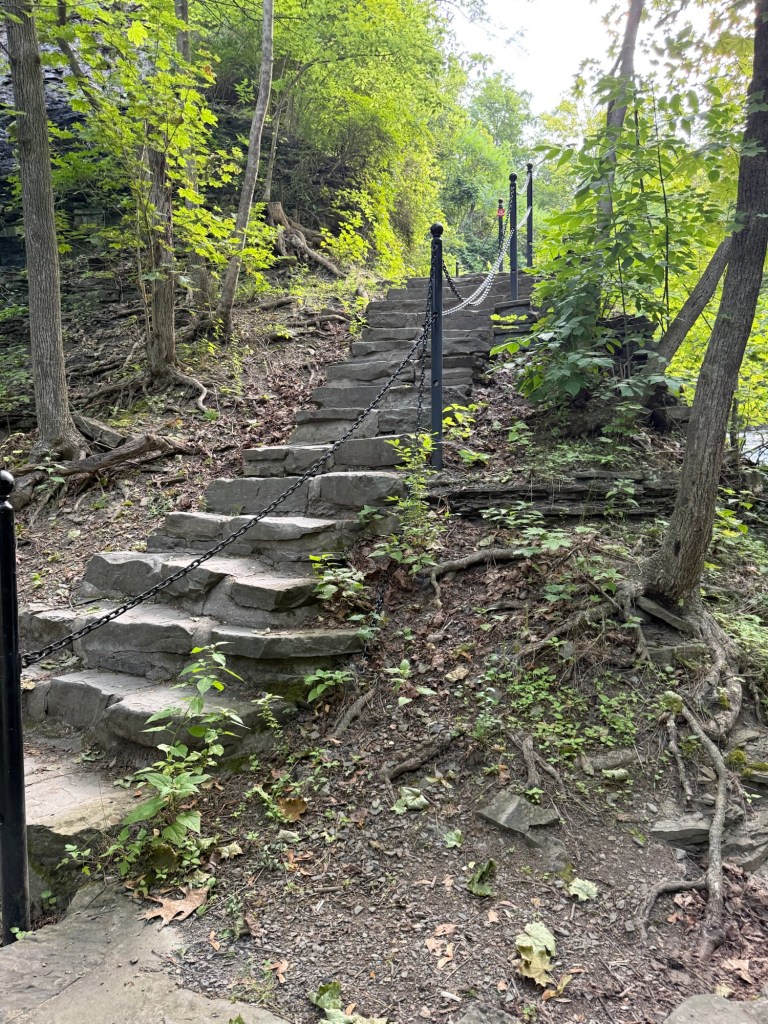
After getting our affairs in order, we drove back towards the southern entrance to the park to the impressive railroad bridge spanning the Genesee River (Portage Bridge). There was ample parking for a Sunday hike, and we quickly made our way to the trailhead at Portage Bridge. Being a New York State Park, you come to expect elaborate public works like staircases, walls and railings, and there they were to greet us as we made our descent.
The three waterfalls in the southern section of the park are the Upper Falls, Middle Falls and Lower Falls. The Upper Falls, with the railroad bridge spanning the river above them, offer a beautiful view. The Middle Falls are the most impressive and are the falls you can get closest to. The Lower Falls are further away as you’re hiking, but on easy terrain for the average hiker. Once you’ve arrived at the Lower Falls you can either continue hiking through the canyon or turn to head back to where you started. We opted for the out and back, making a solid 5 mile round trip.
Letchworth is a park full of campers and day-trippers. There are plenty of amenities situated along the route, from restrooms to a restaurant with gift store for those wanting perfume-fragranced candles and such. Closer to Upper Falls there’s even an ice cream stand. That proved a fortuitous opportunity for us to purchase some cold drinks to reinvigorate for the final climb back up to the trailhead.
As we were rehydrating four girls with their grandmother were walking away from the ice cream stand with soft serve cones quickly melting in the sun. As they licked to keep up, one of the girls said, “Best day ever.” as they made their way to a picnic table. I thought to myself, you just might be right.
Upper FallsMiddle FallsLower FallsGenesee River below Lower FallsClassic New York State Park stairs and railings
For a few years I found myself spending a lot of time in Ithaca, New York. If you love waterfalls and a relaxed college town vibe, it’s the place to be. I forgot how much I missed it until I returned.
My connection to Ithaca runs deep. My favorite Navy pilot went to the big red school on the hill. My daughter went to the big blue school on the other hill. I have a long affinity with the Moosewood restaurant through the cookbooks and [not nearly enough] visits to eat there. There are other connections but you get the point.
It’s those waterfalls that root deeply into your soul and never release you. My favorite Navy pilot used to tell me that Cascadilla Gorge was his favorite, and I feel the same way. It doesn’t have the jaw-dropping impact of Ithaca Falls or the height of Taughannock Falls, but it’s a more intimate experience—especially early in the morning when you have the place mostly to yourself.
I was with my favorite Navy pilot last the last time he visited Ithaca, to see his granddaughter and see the campus again. We saw some waterfalls then too, but not Cascadilla Gorge. It was beyond his ability at that point in his life. I thought about him as I descended back down along the rushing waters. We are only here and healthy for such a brief time. Will I ever visit this gorge again myself? Who knows what the future brings? But I am here, now, when it matters most.
“To live is the rarest thing in the world. Most people exist, that is all.” — Oscar Wilde
Do interesting things. Cross borders—real and imagined. Test the validity of advice from timid people. Discover the bridges that fill the gaps between who we are and who we aspire to become. For the clock is ticking and time grows short, even as we foolishly believe it may run on forever.
There’s work to be done (surely there’s always work to be done), but make it work that explores limitations and offers a steep ascent in learning. Always remember that we may never pass this way again, so do what calls for attention while we are here—younger and more vibrant than we would be if we ever were to return.
To live, and not to merely exist. This is our quest. Get to it already!
In Milwaukee, Wisconsin there are plenty of fascinating things to see, ranging from the strikingly gorgeous Milwaukee Art Museum to the time machine Bronze Fonz statue to the exceptional German food and beer scene. But beyond all of that, there’s a gem hidden in the most unusual of places that most tourists would never see. Unless, of course, they stayed there.
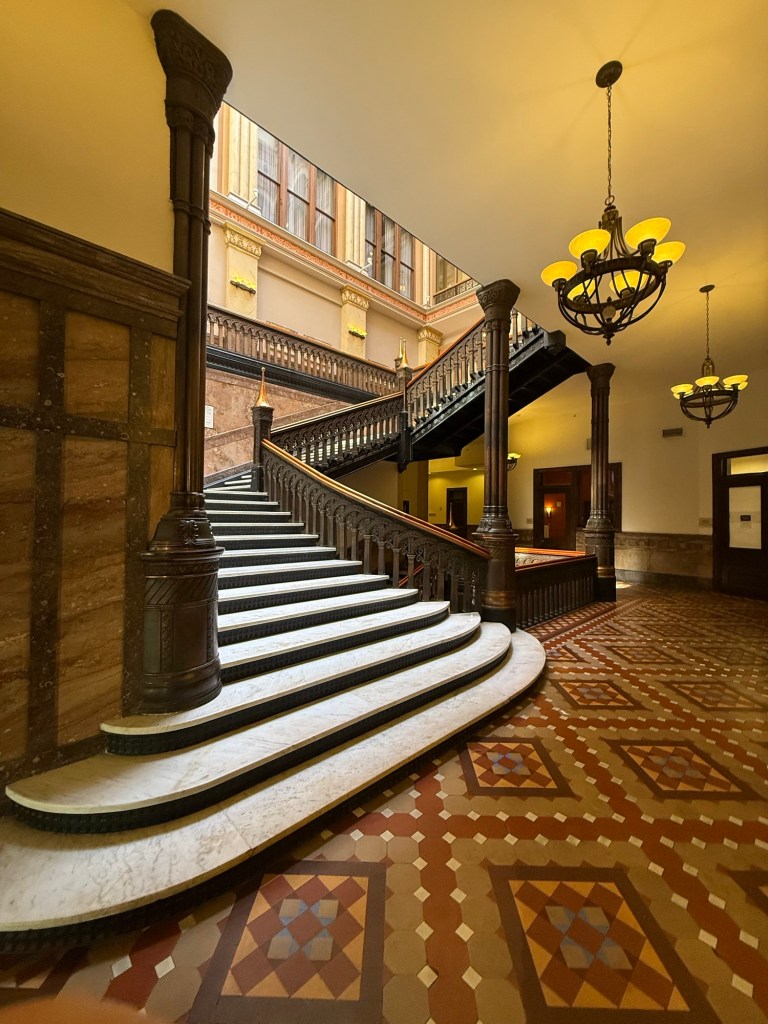
In the late 19th century, the Northwestern Mutual Life Insurance Co. had commissioned the construction of a Richardsonian Romanesque building designed by S.S. Beman. That building, known as the Loyalty Building was completed in 1886 and is now both a National Historic Landmark and the most beautiful and unique Hilton Garden Inn I’ve ever been in.
The building was built of Maine and Indiana granite, with arches and modern features like dual-lighting (gas and electric!), heating and an innovative cooling system. A massive glass ceiling lets in tons of natural light, and the floors feature terra cotta and terrazzo tiles in intricate patterns. Honestly, you don’t know where to look there’s just so much to see!
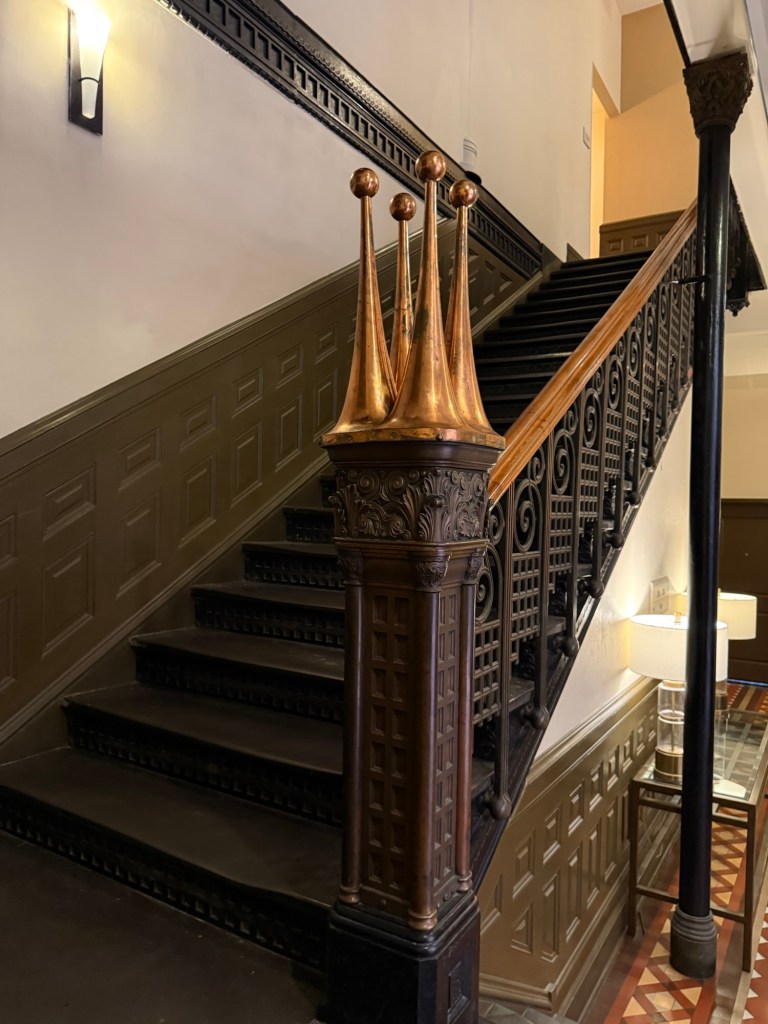
But then you see and know. The star of the show is the staircase, with cast iron balusters and bronze newels topped with tall copper inverted cone-shaped finials. It’s those finials that catch your attention—that’s a lot of copper sitting their marking time. Those cones made it through the Great Depression and two world wars. And it’s the story of their survival that is most interesting of all.
During World War II, copper was in short supply and being scooped up and thrown into the war effort all over the country. The building’s owner at the time, not having the heart to see the copper finials melted down, painted them black to escape notice. They stayed that way, forgotten it seems, until the 1960’s when they were uncovered for the world to see once again. And all you have to do is step into the Hilton Garden Inn in Milwaukee.
We stayed on St. David’s Island this week while we were in Bermuda. It wasn’t a conscious choice to stay there, but I’m pleased we did, for otherwise I don’t believe we would have gotten there on this particular trip. When I speak of conscious choices, I want to acknowledge that unconsciously I knew the connection between New England and Bermuda. In particular, between Rhode Island and St. David’s Island. Not simply the famous sailing race, but the historic slave trade. Bermuda was the destination for many of those “problematic” Native Americans who were being crowded out by waves of settlers changing the landscape of North America.
One generation after the Pilgrims were saved in their first brutal winter in Plymouth, their saviors’ offspring were fighting for survival in what became known as King Philip’s War (1675-1676). King Philip was the English name for Metacomet, Chief of the Pokanoket, who’s seat was in Mount Hope, Rhode Island. The direct descendants of the Pokanoket are the Pocasset Wampanoag Tribe. When Metacomet was eventually tracked down and killed, ending the war, his wife Wootonekanuske and their son were sold into slavery in Bermuda, meeting the fate of many other Native Americans. Mother and son were separated on the island and lived out their lives as slaves. The son was said to have been on St. David’s Island.
What seems completely separate is often connected in ways we don’t always understand. Our histories all blend together at some point, sometimes generations later. The story of humanity is tumultuous, tragic and beautiful all intertwined as a tapestry. One thread leads to the next, and we are one. We are forever learning, forgetting and relearning those connections. In a place called St. David’s Island, or in Bristol, Rhode Island, we find those threads and are reminded that our stories will forever be one and the same, even as our outcomes diverge.
Smith Island, as seen from St. David’s Island, looks a lot like Bermuda in its earliest days might have looked. An active archeological dig is uncovering English settlement in this part of the island.The rugged point of St. David’s Island near Fort Hill Bay, with Nonsuch Island seen to the left
The normal way to cross the Atlantic east to west is to go south to the Canary Islands and catch the trade winds over to the Caribbean. But what should one do when the two end points are controlled by hostile forces? The answer for the British in 1609 was to sail the route north of the accepted route to avoid the Spanish altogether. And this led them to fate.
The Sea Venture was the lead ship in a small flotilla resupplying Jamestown, Virginia. They ran into a major storm and the ships got separated. One ship sank with all souls lost, and the Sea Venture was foundering, taking on dangerous levels of seawater after the chalking between the ship’s timbers failed. And then by some miracle (that northern route), they spotted land. Admiral Sir George Saunders attempted to navigate the reefs to land and the ship wedged into it, saving all hands. They landed, built two ships and continued on to Jamestown. But having discovered it, the British would soon return to found Bermuda and establish another foothold in the New World.
Quo fata ferunt (“Whither the fates carry us”) is thus an appropriate motto for Bermuda, and maybe for the rest of us too. We cannot control where fate might bring us, but we can accept it (amor fati) and make the most of the moment. Like Bermuda, we may be adapt and become resilient to whatever circumstances arise, and sometimes even thrive for having risen to the occasion.
Bermuda is a great place to visit but an expensive place to live. Everyone wants a piece of paradise, and an island only has so much paradise to divide up. Still, not every place can simply be an escape for the uber rich. Who keeps things going if everyone is wealthy and secluded? Teachers and firefighters and nurses need to call the place home too, if you’re going to have anything but gated mansions anyway. Bermuda seems to have that under control, but the locals say it’s getting harder by the day. Time will tell.
Even nomads want to root themselves in a place now and then. That place ought to be in close proximity to ample supplies of the essential things: food and water, shelter, healthcare and a community one can immerse themselves into now and then. Some might add in a few other essentials like the opportunity to make a viable income and a thriving cultural scene. Maybe throw in a decent book store with a great cafe. Simple, right?
The thing about Bermuda that jumps out at me isn’t the history or beautiful vistas or fish sandwiches, it’s the warmth and generous spirit of the people who live there. They’re all just so friendly. Coming from a place where that isn’t always the case, it feels pretty welcoming. And who wouldn’t want to linger in a place like that?
In St. George’s, Bermuda there is an old church that whispers of its roots. Never finished, never consecrated, it stands as a testament to what might have been. But those whispers from the past are exactly why it’s so very appealing now. We hear the whispers, visit and feel our spirits lifted. Left to the elements, its roof ripped away by a hurricane, the structure became a beautiful revelation. Never finished? This church is exactly what it was meant to be.