Category: Travel

  • Cod Tongue

    Cod Tongue

    Newfoundland doesn’t waste time flirting with you – its beauty drops your jaw to your chest at first sight.  The flight into St John’s reveals the rugged coastline and the rolling ocean swells that define it.  Cape Spear is easy to find with its old lighthouse and its newer replacement reaching up to the sky to greet us.  Newfoundland is a rocky coast, much like Maine, Ireland, Portugal and other North Atlantic coasts that feel the wrath of the ocean.  I feel at home here immediately.  This is a place I could live in…  or at least return to again soon.

    Newfoundland is strongly associated with the Atlantic Cod, a lovely freckled fish that fed generations and once thrived in the ocean from here to Cape Cod, Massachusetts.  So thick you could walk on them its said.  At least until massive overfishing fueled by highly efficient bottom trawlers scooped up cod by the millions.  Scientists were slow to sound the alarm, but eventually the entire fishing grounds were closed in 1992.  With the closing of the fishing grounds the lives of tens of thousands of fishermen and their families were changed.

    Almost 30 years later the cod are slowly rebounding.  The fishing industry, which shifted to crab and shrimp but never fully recovered, isn’t there just yet.  Cod offers a great lesson in sustainability, responsible self-governing, corporate greed, weak political leadership and tradition that dies hard, even in the face of overwhelming evidence.  The climate change, coal and fracking debaters today would do well to look closely at the Grand Banks to see what happens when you aren’t open to facts that differ from your current point of view.

    Cod tongue is a uniquely Newfoundland treat.  I ordered it at a bar in St John’s Harbor just to try it.  Frankly it was a bit fatty and chewy for my tastes, but I finished the appetizer anyway.  I like to try new things, just as I like to visit new places.  And I don’t like to waste food.  Especially endangered food.  Cod borders on mystical in the land of Alexander’s Map, and by God I was going to give it a go.  It’s not really the tongue, more like the cheek of the fish.  Kids would cut out this throwaway part of the fish to bring home to the family to cook.  Over time it came to identify this place almost as much as the unique Irish-Canadian brogue identifies the people here.
  • Sap Moon

    Sap Moon

    Tonight I watched the moon rising through the trees and illuminate the night.  Sometimes the universe gives you just enough.
  • Clusters

    I read a great book called Geography of Genius that focuses on the tendency of communities of like-minded people to form and thrive, often changing the course of history.  Essentially people feed off each other, and are inspired by the geniuses around them to do more in their own lives.  Rome, Athens, Vienna, Edinburgh and other places are covered in the book.

    It got me thinking about the clusters of geniuses in the northeast.  Maybe we didn’t have Beethoven, Mozart and Freud running around Boston as Vienna had, but we sure had Ralph Waldo Emerson, Henry David Thoreau, Louisa May Alcott and Nathanial Hawthorne roaming around Concord, Massachusetts at roughly the same time, and all are buried at Sleepy Hollow Cemetery in Concord.

    Down in New York in another Sleepy Hollow Cemetery, you have the titans of industry Carnegie, Rockefeller, Chrysler all clustered in their final resting place after building empires just down the river from Tarrytown.  The New York Sleepy Hollow Cemetery is where Washington Irving, writer of The Legend of Sleepy Hollow, is buried.

    In Boston, you can visit the graves of Sam Adams, John Hancock, Paul Revere and other notable figures from the Revolutionary War at the Granary Burying Grounds.  They fed off each other in life, building on each other’s ideas, one-upping each other.  In death, they’re still neighbors.

    Down in Hartford, Connecticut you had Mark Twain living right next door to Harriet Beecher Stowe.  Talk about a literary one-two punch.  While the neighborhood has changed significantly, becoming grittier, the homes of these two literary giants remain much as they were when they lived there.  I’ve toured the Twain house, and will carve out time for Stowe another time.

    As the weather gets warmer, I’m going to spend a little more time visiting the homes of notable people.  Walking around the homes of Robert Frost and Mark Twain reinforce that they were just regular people with extraordinary talent and the grit necessary to produce.  Visiting their graves reminds you that their time was brief, and so too is ours.

  • Kills or Creeks

    New York, and particularly the Hudson River Valley, was once part of the Dutch Colony of New Netherland.  Manhattan was once New Amsterdam, and the region is sprinkled with names that hint at the Dutch influence.  As a New England, I’m always intrigued by the unique names in the Hudson Valley.  Towns like Rensselaer, Guilderland and  Watervliet have distinctly Dutch names.

    Perhaps no place name turns the head more than Kill.  It means body of water, and you’ll see it used often in the region.  Peekskill, Fishkill, and from my rowing days the Schuylkill River.  Normans Kill, Fall Kill, Owl Kill, Batten Kill, Saw Kill, Fall Kill….  and so on.  I drive by these places and wondered for years what this kill thing was all about.  Google and Wiki solved that mystery for me.

    Doing business in the Hudson River Valley, I run into people with Van in their name, which is uniquely Dutch.  Rip Van Winkle is a character right out of this valley.  I’d imagine that if old Rip were to wake up now he’d hardly recognize the towns, but he’d know from the river and the hills exactly where he was.

    The Hudson River Valley remains a strikingly beautiful corridor despite the encroaching development of the region.  For Henry Hudson and other explorers to this region, it must have been an extraordinary trip up the river.  The Dutch were a relatively small footnote in the settling of North America compared to the English, French and Spanish, but they picked a region that strongly influences the rest of the country.  New York and Pennsylvania hold on stubbornly to the Dutch cultural influences.  One could say you can’t kill it off.

  • Cellar Holes

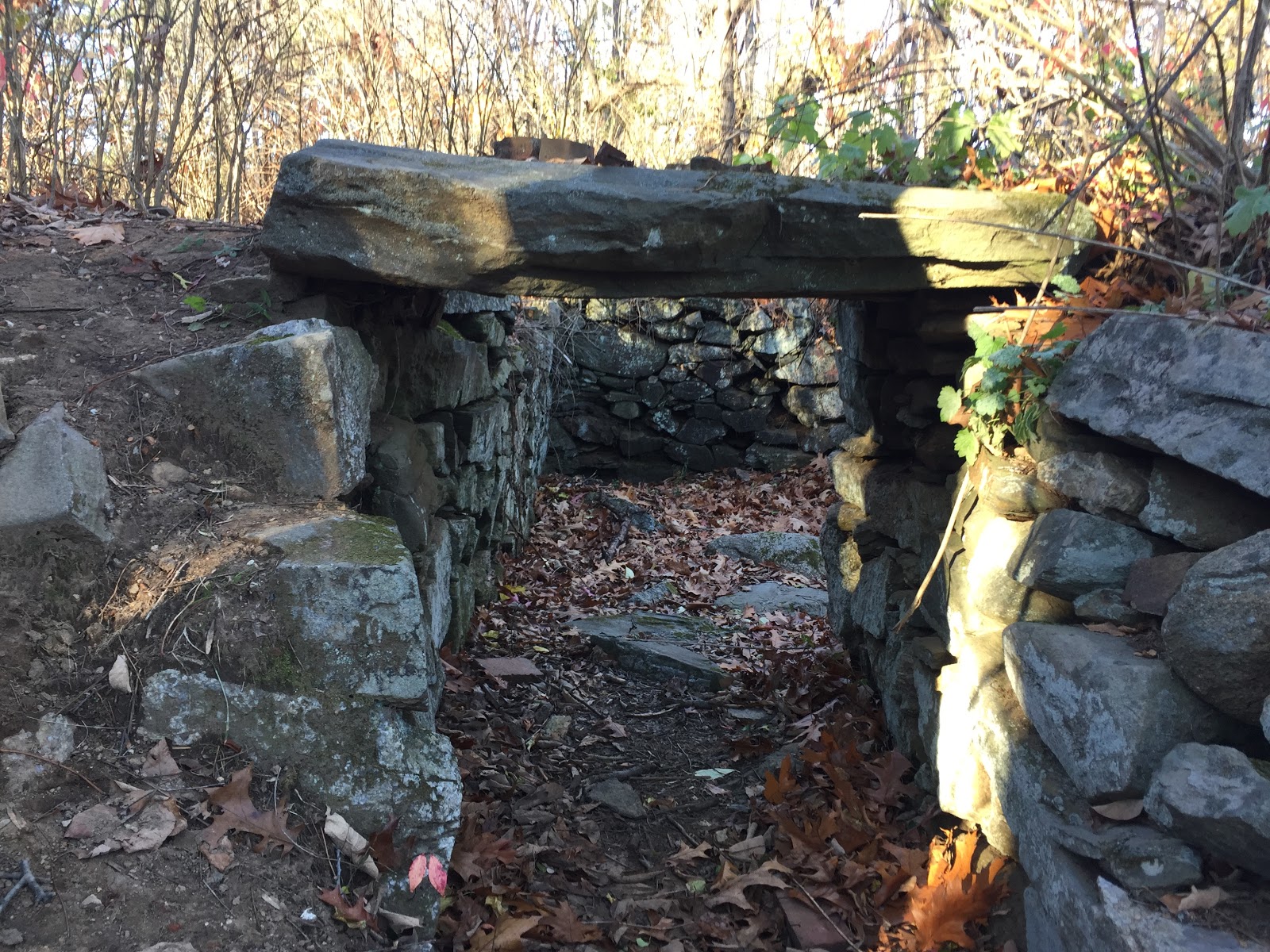
    New England is full of ghosts.  A walk in the woods will bring you across old stone walls by the mile.  In places that you feel like you’re the first person to ever walk in a place, you’ll come across hard evidence to the contrary.  Settlers and the farmers who came after them cleared this land, raised crops and the next season did it all over again.  New England’s gift to these farmers were the stones that would come up with the frost, which the farmer would toss drag to the edge of the field to build stone fences to mark the property line, or the line between crops and grazing fields for livestock.  It was a hard life, compounded by hard winters, disease, wars with the native population, and a whole host of other things.

    These early residents lived in modest houses built over stone cellars.  The houses are mostly long gone now, and many of the cellar holes are too.  But many remain to tell their story.  Coming across an old cellar hole in the woods is like a telegram from the people who once lived in the house it sat on.  Cellar holes and the stone walls are often the only thing left to mark the existence of these people.

    This cellar hole in Hampstead, NH was once the foundation of the house that Job Kent lived in.  Job was born in 1743, bought land from his father to farm, and built a house on this site around 1770.  Job fought in the Revolutionary War as a Sergeant in the Northern Army, and he died in 1837.  He’s buried in the Town Cemetery in Hampstead, making his stay in town permanent.  Today his farmland is conservation land, hopefully making the land a permanent monument to what once was; forest and, for a time, farmland.  The stone walls criss-cross the land marking the fields that sustained Job and his family at a significant time in our nations history.  The walls and his cellar hole marks where he lived his life.  Quiet now, this cellar hole was once the foundation of a busy family enduring the struggle of living off the cold, unforgiving New Hampshire land.  Job Kent didn’t make a large dent in the universe, but he lived a life of significance, fought for our nation’s independence, and returned to his farm afterwards to work it season after season.

    I spent a little time inside this cellar hole and walking around the woods in November 2016.  I didn’t hear ghosts calling out to me at the time, but this hole and the man who built it still stay with me 17 months later.  Almost 52 and I’m still building my stone walls.  I’ve got a good foundation beneath me, and hope to make my own dent in the universe, however modest that dent might be.

  • Starting Again

    I started a new job two weeks ago, which coincides with my last post on this blog.  It’s not that I didn’t have the time, it’s that I didn’t have the focus.  I was starting again, and there’s a lot to think about when you start again.  New processes, new names and faces, new technology to learn, new relationships to build and old relationships to re-kindle.  When you sell technology some people want to dance, and many others don’t.  My last company had a lot of the latter.  I saw it early but wanted to see it through.  My reward was some interesting travel but not a lot of money.

    Money.  I went to my previous company because I was running away from a dead end and chasing the big money.  Bold claims of big commission dollars and what looked like a strong and differentiated product.  But the timing was bad, the market said no thanks and so here we are.

    In a better place, with a culture of longevity and great leadership.  Drinking from the fire hose, but mostly around product differentiation and such.  The rest I know.  I’m starting again, but its not such a climb this time.

  • Wentworth-Coolidge Mansion

    The first Governor of New Hampshire was a real character.  Benning Wentworth Colonial Governor from 1741 to 1766, granted the governorship by Great Britain to settle a business deal with Spain that went south when the two countries got into one of their many disputes.

    As Governor, Wentworth had a damn the torpedoes approach that fits well with the Live Free or Die state motto that was adopted later.  One of the most controversial things Wentworth did was grant land in what is now Vermont to settlers, even though New York claimed the land as theirs.  Naturally this eventually led to hostilities between the two, most famously with Ethan Allen.  That’s a story for another day.

    Wentworth requested that a capital building be built in Portsmouth, but the New Hampshire General Council denied his request.  So Wentworth built a council chamber at his 100 acre farm instead.  It was here that he did most of the governing of the state.  It’s also where he sprung another controversy on his guest one night when, as a widowed 64 year-old, he married his 23 year-old servant.  It seems Wentworth was a player.

    The farmhouse is actually four or five buildings tacked together.  According to the Wentworth-Coolidge mansion web site, “The property became the center of political and social life in the colony. The Mansion is historically significant as the only original surviving residence of a Royal Governor in the United States”.  Interestingly, the first lilacs planted in the United States were planted here and the oldest in the country.  So New Hampshire has potatoes in Londonderry and lilacs in Portsmouth as two firsts.

    The house was eventually sold off a couple of times, remaining a farm for some time but gradually falling into disrepair until it became the summer house of John Templeman Coolidge III in 1886.  The Coolidge family, wealthy Bostonians, restored the property and likely saved it from oblivion.  The family hosted wealthy friends and artists from Boston each summer, and the area thrived.  His widow donated the mansion to the state in 1954.

    Today the property is a state park, surrounded by some pricy real estate.  I did a first day hike here to mark the New Year, 2018.  It’s a property I’d love to explore sometime, and dig into the history a bit more.

  • March

    March

    The full moon tonight brings with it a different kind of sky watching.  The wind and dropping temperatures signal a front moving through.  The clouds at 10 PM are wispy, but there’s a haze developing in the sky and it won’t be long before it’s overcast.  We have weather moving in.

    Going out for a walk when you’ve settled in after dinner is a mental hurdle akin to getting up and doing a workout.  You’re always happier for having done it, but every day is a test of willpower.  Bodhi is a creature of habit though, and that’s usually enough to push me out the door.  Thank you for that Bodhi.

    The breeze sounds different in winter than it does in the summer.  The oaks, maples and poplars are still bare and largely silent save for the clickity-clack of high branches fighting for space.  In winter the white pines sing alone with the breeze.  Pine needles shush like a parent coaxing a baby to sleep.  Ponderosa Pine needles in the southwest are bigger and make an assertive shushing sound in the wind.  Eastern White Pines, with their smaller needles and taller reach for the sky, offer a hushed shush.  Some of the trees in my neighborhood are mature, likely in the 120-130 foot range.  And at these heights the needles tango in the breeze, producing the nights music.

    The full moon backlights the clouds as they sprint across the sky east to west, offering a muted kaleidescope of white, grays and navy blues.  As the haze develops so too does a halo around the moon.  There’s an old expression; “ring around the moon means rain soon”.  Rain is certainly in the forecast.  It seems our ancesters know what they were talking about with those expressions.  In this developing haze, most stars concede the night to the moon, but Sirius, Procyon and Capella hold their own.  Such is the sky on this March 1st evening in New Hampshire.

  • Finding a New Routine

    Finding a New Routine

    When Bodhi was younger we would easily cover three or four miles in an hour walking every night.  We were both power walkers, and we had a rythym and pace that we both understood and enjoyed.  Bodhi was clearly burning more calories than I was because in addition to keeping pace with his walking his tail was wagging like crazy the entire time.

    Fast-forward to today, and Bodhi’s pace has changed dramatically.  He’s more inclined to stop and sniff, mark his territory, or really anything that stopped the walk so he could catch his breath.  He’s getting older and walking becomes much more of a process than before.  I’ve learned to accept this, and appreciate our time together more than I did when we were younger and I didn’t fully understand what we had.

    Since Bodhi isn’t walking as much, I’ve found that I’m not walking as much either.  Worse, since I’m not outside pounding the pavement at 9 or 10 PM, I’m replacing that exercise time with television or reading with a drink and snack.  Or sometimes just a drink.  Or two.  Not a good routine for a weeknight, so I’m finding a new routine.  I’m getting back outside to walk, even if alone.  I’m getting up earlier to row when I’m home, and walk when I’m traveling.

    Of course, routines don’t just happen.  They start with the first step on the first day and go from there. The trick is overcoming inertia.  When I rowed and we started the spring sprint races from a dead stop we’d do three rapid, short half strokes to get the boat moving, then progress to a full length and a high stroke rate for twenty or thirty strokes.  This has the desired effect of getting the boat to full speed.  Once you get moving you then settle into more manageable stroke rate for the body of the race.

    Routines are like that too.  Quick, relatively easy burst of activity to get yourself going followed by an increase in intensity and then settle into a sustainable level of activity.  That’s the kind of routine I need to be engaged in now.  Now would be a great time to start.

  • Common Periwinkle

    Common Periwinkle

    Consider the common periwinkle.  It lives a life relatively invisible to humans, unless you happen to be on the coast in New England anyway.  Even then most people wouldn’t think anything of these creatures.  And why not?  The Common Periwinkle lives a modest life fixed to rocks or marsh grass, scarping and eating algae and hoping not to be eaten by predators.

    The Periwinkle (let’s drop the common, shall we?) is a survivor.  Its foot clings to rocks as waves crash and swirl around and on top of it.  At low tide they’re exposed to extreme temperatures.  At high tide they’re underwater for hours at a time, all while whelks, fish and even humans hunt you down to eat you.  At low tide I’ve accidentally stepped on periwinkles, and honestly a feel a little sad about it.  Life is a strange thing, and it’s easy to feel small in this world that we live in, looking out at the universe.  And yet the periwinkle offers a little perspective.  We’re small, but there are many creatures smaller than us.  Life can be challenging at times, but hey, I’m not clinging to a rock getting battered by waves while I scrape off my algae meal.