Category: Walking

  • Autumn Leaves

    It always happens this way. The leaves start to turn, and suddenly accelerate into a burst of color. Meanwhile, you’re busy with life, knowing the wave is washing over you but not getting out there enough to see it. The rains come, often with wind gusts, and it ends before you really noticed.

    The alternative is to notice. To walk away from the computer screen and see the foliage, feel the crisp air, smell the freshly fallen leaves mingle with the harvest. To experience the world on more than just the weekends. It seems to me a better way, noticing, and we ought to do more of it.

    Still, I have this stack of responsibilities that keep me at bay. Three big projects due for work, and home projects to finish, and other such to-do commitments. Those seem like compelling reasons to skip a walk amongst the trees today, don’t they? No?

    We remain reckless with our time, we humans, and it flies by regardless of our attention to the urgency of the matter. The autumn leaves come and go whether you linger amongst them or not. But the journey is more pleasant when you linger awhile.

    The image that stays with me most after a weekend in Acadia is not the rocky shore or the stunning sunrise on Cadillac or the lighthouse, but a single brilliant red tree along the Carriage Road. I imagine that the leaves have fallen off that tree in the stormy few days since I was there, but in my mind they remain, fluttering like Cardinals at a social event. And there’s the fleeting magic of fall foliage. The Autumn leaves are here today, gone tomorrow. Go have a look then.

  • A Cape Cod Time Warp

    We slipped back into old Cape Cod for a quiet walk on the trails of Little Bay and Monks Park in Bourne, Massachusetts yesterday.  From a perspective of scale this park is of modest size, and the loop is quick, but from the perspective of getting you out of modern Cape Cod and back into a time before the place was built up it served us well.  A time capsule of sorts, onto shady paths of sand and scrub pine needles with surprising variations in elevation from sea level to 70 feet.  Not exactly the White Mountains, but a pleasant departure from the usual flat walks.

    The variation in flora matched the elevation changes, with sassafras, scrub pine, oak, highbush blueberries and a fair amount of poison ivy dominated the landscape, with salt marsh and views of the bay sprinkled in.  In some ways this feels like its always been this way.  But there are hints to other uses in the flora as well.  A pair of large beech trees guard the entrance to the park on Valley Bars Road, planted at some point maybe a hundred years ago.  A holly on the Loop Trail looks to be out of place in the landscape as well, perhaps planted by someone before this became conservation land in 1980, perhaps by someone taking a walk in the woods who wanted a home for a shrub.  The holly keeps her secret from me.

    All of this land is preserved because of the work of the Bourne Conservation Trust, which saw the explosion of development on the Cape in 1980 and decided to do something about it.  This land was once part of the estate of George Augustus Gardner, brother of Isabella Stuart Gardner, giving it a hint of Boston Brahmin.  This area was pretty exclusive back in the day, with President Grover Cleveland summering just up the road.  He bequeathed it to his daughter Olga Eliza, who married a man named George Howard Monks, which is where the name Monks Park comes from.  The family sold the land when Olga passed away, and thankfully it was purchased by the Bourne Conservation Trust.

    The Loop Trail is roughly 1.5 miles, with a few trails that cut straight across the land providing a shortcut of sorts.  If you were to walk this trail in late fall or winter the water views would be spectacular.  In summer the oak leaves obscure much of the view, making you earn it with a walk down steep grade to the beach from the trail, or simply walk under the railroad bridge from the parking lots.  Not the longest trail, but you could walk the loop a few times and try the side trails for variation if you wanted a longer walk.  This place is a gem hidden in plain site on busy Shore Road, and worth a visit.  A quiet connection to old Cape Cod, to the wealthy who acquired the land, and to those progressive people who saved it from ever being developed. Consider a donation to their future efforts, as Little Bay and Monks Park demonstrates just how much good a few people can do.

  • Breathe

    I admit I didn’t think much about breathing until recently when my son strongly recommended a book for the family.  After some due diligence in listening to the author interviewed on a Joe Rogan podcast I was convinced I needed to read the book myself and quietly slid the stack of real and virtual books aside to read Breath: The New Science of a Lost Art before anything else. I’m well into it now, and can tell its one of those transformative books that influences the way you think about many things. And so it was that I hiked two 4000 footers yesterday with these thoughts in my head:

    In a single breath, more molecules of air will pass through your nose than all the grains of sand on all the world’s beaches—trillions and trillions of them.”

    “Nasal breathing alone can boost nitric oxide sixfold, which is one of the reasons we can absorb about 18 percent more oxygen than by just breathing through the mouth.”

    “The greatest indicator of life span wasn’t genetics, diet, or the amount of daily exercise, as many had suspected. It was lung capacity.”

    “Moderate exercise like walking or cycling has been shown to boost lung size by up to 15 percent.”

    “The most important aspect of breathing wasn’t just to take in air through the nose. Inhaling was the easy part. The key to breathing, lung expansion, and the long life that came with it was on the other end of respiration. It was in the transformative power of a full exhalation.”

    With apologies to author James Nestor, I wasn’t going to fully commit to nasal breathing hiking up Crawford Path yesterday. I gave it a try a few times but didn’t feel like I was getting enough air. Something to work on for sure, but I opted for the more familiar mouth breathing for the steepest stretches of the path and reserved the nasal breathing for the descent from Mount Eisenhower. I can tell I’ve got my work cut out for me, but anything worthwhile deserves putting the work in. What’s more worthwhile than breathing?

  • To Visit All the Celebrated Places

    “Now is the time to visit all the celebrated places in the country, and fill our heads with what we have seen, so that when we become old and bald we will have something to talk about over the teacups.” – Jippensha Ikku

    Credit to Smithsonian Magazine for the Ikku quote, for it made me smile when I read it.  Ikku lived in Japan during a fairly important period in American history (1766-1831) so its easy to overlook what might have been happening in other places in the world.  The quote reminds me that our feelings about travel and aging are timeless.  We all hope to see the world while we’re young and full of vigor, that we might have epic stories to tell over a favorite beverage when we’re older and less mobile.

    The travel list of celebrated places is ready, and all earnest travelers wait for the starting gun to set us free to explore once again.  We’re all rooting for a vaccine and some level of herd immunity, some measure of personal responsibility from society at large and perhaps stronger political leadership to set policy that makes sense.  May we see it sooner than later.  But in the meantime, I’m traveling as Thoreau traveled: exploring the place where I am in ways that I hadn’t before.  Walking fully aware in the woods, or the mountains and shores of New Hampshire, stopping at local landmarks previously unknown to me, and exploring space  while looking up at the stars to pick out planets and constellations.  For the adventurous spirit, there’s no shortage of opportunities to explore, even in a pandemic.

    “Travel spins us round in two ways at once: It shows us the sights and values and issues that we might ordinarily ignore; but it also, and more deeply, shows us all the parts of ourselves that might otherwise grow rusty. For in traveling to a truly foreign place, we inevitably travel to moods and states of mind and hidden inward passages that we’d otherwise seldom have cause to visit.

    All [great travel writers]… believed in “being moved” as one of the points of taking trips, and “being transported” by private as well as public means; all saw that “ecstasy” (“ex-stasis”) tells us that our highest moments come when we’re not stationary, and that epiphany can follow movement as much as it precipitates it.

    Travel, then, is a voyage into that famously subjective zone, the imagination, and what the traveler brings back is — and has to be — an ineffable compound of himself and the place, what’s really there and what’s only in him.” – Pico Iyer, Why We Travel

    While nice on the surface, I chafe when spending too much time at resorts because I’m not looking for pampering or losing myself in a cartoon world.  Travel at its best isn’t distraction, but exploration.  It isn’t running away from ourselves, but finding ourselves.  And that can happen anywhere if we let it.  Our highest moments come when we’re not stationary…  and so we hear the call to explore.  I’m conspiring to travel locally over the next couple of weeks to places near, while foregoing far.  At least for now.  For there’s so much to see right in our own backyards that we rarely celebrate.  Over the next few weeks I’ll explore some of those places in New Hampshire and Massachusetts.  And as you might expect having read any of this blog, explore hidden inward passages too.

  • Hiking Mount Tecumseh on a Foggy Night

    It seemed like a good idea at the time is a beginning statement that might indicate more adventure than bargained for.  And so it was that I hiked solo up Mount Tecumseh at 6:30 PM on a random Thursday, with noble intent to meet the Comet Neowise halfway by climbing a relatively easy mountain and looking at the stars.  Except that the stars were hidden in overcast, and the stakes of a solo hike ratchet up when it gets dark on a steep and wet trail.  But I had a plan B for the descent all the while, which turned out to be an epic adventure of its own.

    Mount Tecumseh is a relatively small mountain that was recently demoted from an official 4000 footer to a just short of greatness 3997 foot.  The mountain is named for the Shawnee Chief who unified tribes against settlement in the Great Lakes region and fought against America in the War of 1812.  There’s no logical connection between Tecumseh and New Hampshire that I’ve seen, but I can respect his name more than some others I’ve come across hiking.  I’ve hiked it before and remembered it as a relatively easy hike save for a steep mile of the trail known as the staircase.  This made hiking the trail as it was getting dark less concerning for me.  But the last time was in winter when Tecumseh’s famous staircase is softened by a heavy snow blanket.

    The ascent was easier than I thought it would be, which bodes well for the trend in my overall fitness level I suppose.  I arrived at the summit at 8 PM with plenty of light to see the view, if the clouds hadn’t dropped down to start blanketing the mountain anyway.  I changed into a long sleeve shirt and began my descent quickly after arriving.  I knew I had a challenging descent to deal with if I chose to hike down the Tecumseh Trail, though I had the gear necessary for a hike in the dark.  But there was that fog to consider, which makes a headlamp beam about as effective as your high beams in your car in fog.  I decided to hike as long as it was safe to do so without using the headlamp.  And after considering the Tecumseh Trail made the decision to hike the Sosman Trail on the descent.  I’ve hiked this one before and knew it was relatively easy for a descent, partially following the ski trail for Waterville Valley.

    But here’s where the story takes a twist.  The fog and darkness made it very difficult to mark the trail, and I lost it in the swirling mist at the summit of the ski lift.  And so I said my first WTF of the night, looked at the ski trail sloping down and decided to just walk down that instead.  I kept to the green trails, which are a combination of gravel road and grassy meadow in the summer.  Skiing down a slope and hiking down are very different things, and I found it slow going.  At one point I spooked a couple of large birds roosting in a tree – likely those turkey I’d been wondering about earlier in the week, and it startled me enough that I thought I might just expire right then and there.  But that would’ve been too easy.  I uttered another WTF and kept descending.

    After walking for what seemed like hours I reached the middle chair lifts at the ski area and looked down to see the lights of the ski lodge depressingly far away.  I said another WTF and made the fateful decision to follow the chair lifts down instead of the gravel access road that would add a lot of time to the hike.  And I discovered just how tall the meadow becomes on the walk down.  By now it was completely dark and I used the beam to illuminate every step and the hiking poles to probe for gopher holes and other hazards.  Eventually I made it down to the base and glanced around at just how lonely a ski area looks at 9:30 on a foggy summer night.  I arrived at my car, used the beam to check for ticks and headed home.  Not your average Thursday night.

    Lessons learned on this one.  Hiking solo in the dark wasn’t the best idea I ever had.  Even though I knew the trails I was hiking, they always look different in the dark, and especially when there’s fog.  I would’ve been better off descending the Tecumseh Trail.  Even if it was slow going its clearly defined and I would have arrived at roughly the same time as taking the Sosman Trail.  The point of this hike was to see the night sky, and I might have been better off just bagging the hike when I saw the overcast at the summit.  But I don’t panic when I hit WTF moments, I assess.  There were things that could have gone wrong but I took it slow and easy and got back safely.  I’m glad I hiked it, and all the extra drama of darkness and fog and overgrown ski trails made it memorable, if slightly reckless (but calculated reckless). Another 4000 footer completed, and a story to tell.

  • Collecting Daily Microadventures

    I heard a Rolf Potts podcast interview with Alastair Humphreys during a long walk around town.  I listen to podcasts when walking on loud roads because I can never fully immerse myself in nature when heavy objects traveling at terminal velocity are close enough to know the deodorant of choice of the driver.  Of course, I always keep an eye on the driver and the relative distance between their passenger mirror and my rib cage.  But a podcast gives me something else to think about during this regular dance on the narrow shoulders of New Hampshire roads.

    Potts and Humphreys captured my imagination during my dance with the drivers with a discussion of microadventures.  Microadventures is Humphreys’ term, but the pursuit of adventures isn’t a new concept.  I’ve been doing many of the things he lists on his site already, and think of them as exclamation points on a day of living on this planet.  But impressively he does take it to another level.  This well-made video explains the concept, or do a deeper dive on his web site (I felt a bit of web site envy visiting his site, and it once again prompted me to up my alexandersmap.com game.  You can see my ongoing progress on the site).  There are many microadventures available for the able and willing, I could get in my car and drive to the White Mountains for a hike, or drive to a waterfall for a shower under bracingly cold water, or camp out on a sleepy beach for sunrise.  But I wanted something close to home and on a somewhat smaller scale as a nod to the spirit of microadventuring.

    And so it was that I found myself getting in my car with a camera and tripod and driving a couple of miles away from home to an entirely different world: the soccer fields my kids once competed on, which last night transformed into a dark and mysterious upside down world with vaguely familiar fences and sheds providing anchors of bearing.  I was challenged by three separate people to go out and see the Comet Neowise, dancing just below the Big Dipper just after sunset.  It seems people have noticed my affinity for the stars over the years.  I’ve silently been plotting a viewing all along, but the weather proved frustratingly unreliable for comet gazing.  Last night was a micro adventure of comet hunting, confirming that my Nikon Coolpix B500 camera wasn’t up to the task (or more likely its owner), and learning from the experience.  Perhaps I’ll get that evasive picture tonight or in the next few days before Neowise travels on for another thousand generations, or maybe I’ll just bring the binoculars out and just view it.  Plenty of better photographers are taking stunning photos of Neowise already.   My micro adventure wasn’t for a picture anyway, but for the experience of trying something new right in my own town.  It was me alone in a dark field, strange noises in the forest beyond, constellations and planets spinning above and satellites zipping past.  Memorable even without a digital image to post on social media.

    Here’s the thing: we get caught up in the big bucket list stuff.  Hiking the Appalachian Trail, sailing across the ocean, hiking to Machu Picchu, visits to Amsterdam, Paris, London and a hundred other great cities.  Heck, even hiking the 48 NH 4000 footers in my home state requires time investment and planning on a larger scale than a simple microadventure.  Life should be full of the great exclamation points that a bucket list offers, but lifetimes are made up of a collection of days.  Why not downsize the scale of the adventure and do something interesting today?  So when someone asks you tomorrow what you did last night, you aren’t replaying the same old soundtrack of streaming Netflix series or watching YouTube videos of other people’s adventures.  Yesterday, in between the traditional fare of a random Wednesday, I began my day with a plunge in the pool at 6 AM and ended it with a hunt for Comet Neowise until past my bedtime.  So a memorable yesterday, if only for the endcaps.  So what shall today bring?


  • Cloud-Hidden, Somewhere on the Mount

    “I asked the boy beneath the pines.
    He said, “The Master’s gone alone
    Herb-picking somewhere on the mount,
    Cloud-hidden, whereabouts unknown.”
    – Chia Tao

    Inevitably I had to arrive at Alan Watts.  I’ve circled around his work for some time, and finally landed on Cloud-Hidden, Whereabouts Unknown, which is as much personal journal as philosophical work.  And so it was that I lingered on these lines from Chia Tao that open Watts’ book.  I thought about my hike yesterday, cloud-hidden myself, with my whereabouts largely unknown on a solo hike.  It seemed appropriate to borrow this translation for my own observations.  For yesterday’s post was all nuts and bolts detail on hiking Mount Garfield, but it didn’t convey much about hiking solo largely in solitude.

    There’s a part of me that wants to knock off the 48 New Hampshire 4000 footers as a solo hiker.  Not because I’m anti-social, but because I feel the mountains differently when I’m alone with them.  Perhaps I’m more attuned to the ripple of water and the breeze in the trees, but mostly I’m more attuned with myself.  Slipping or tripping on a solo hike feels more consequential than it does when you’re with hiking buddies.  Sure there are other hikers on the trails, especially on a 4000 footer, but if you’re injured you’re relying on the goodwill of strangers and blowing up their own moment with the mountain.  Who wants that memory of your last hike?  I’d just as soon take the extra millisecond to be especially sure of footing.  To that end, I find hiking poles to be especially valued on a solo hike for the reassurance they provide on the descent.  It took me years to conclude that there was any value at all in hiking poles.  Now I find them invaluable.  I was reminded of their worth when I slipped on a hidden muddy root on my descent yesterday and my right pole bore the weight of my slide, keeping me from a hard fall and now shows evidence of bearing the brunt of the force in the form of a slightly bent shaft.  Thanks for your sacrifice, friend.

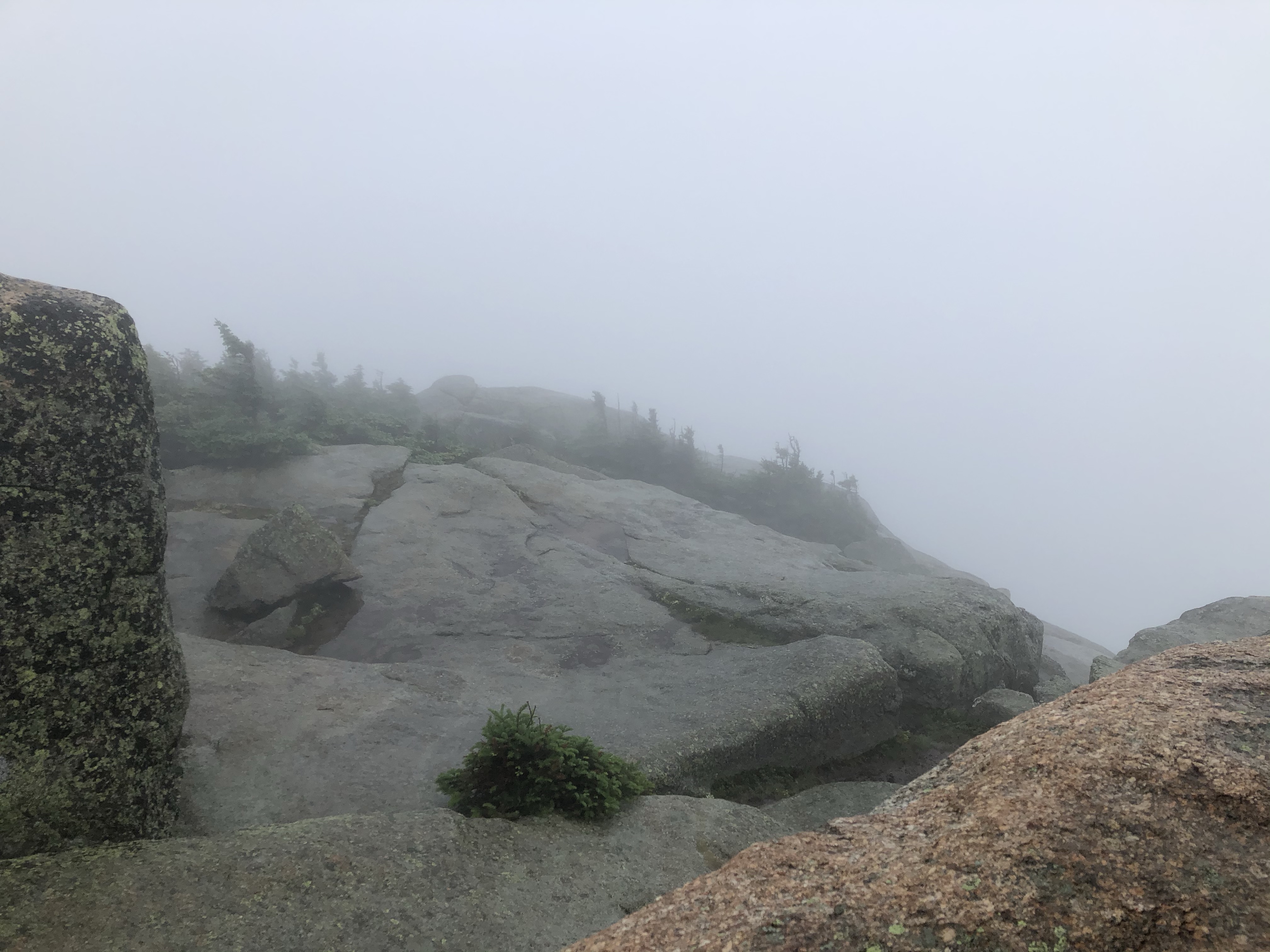
    The summit of Mount Garfield is a knob of granite with an old fire tower foundation set into it.  I arrived at the summit feeling a bit like a character in that Chia Tao poem.  Cloud hidden and whereabouts unknown.  There’s something about being alone in swirling clouds that is otherworldly.  I’ve felt this before, most notably when the fog rolled in as I stood alone on North Head at Signal Hill in St. John’s, Newfoundland.  My time on the summit lacked the drama of foghorns waking up to blare warnings to all that would hear, but made up for it with wind gusts that implied a threat of their own.  Normally the summit is a place to linger, but the mountain suggested I should move along.  When you’re on the mountain listen to the mountain.

    “The solitary is as necessary to our common sanity as wilderness, as the forest where no one goes, as the waterfall in a canyon, which no one has ever seen or heard. We do not see our hearts…” – Alan Watts, Cloud-Hidden, Whereabouts Unknown

    I’m not sure what I’d do if the rest of the world woke up early.  I suppose I’d go for long walks alone in the woods, or quietly slip a kayak into the bay or a river, or some such pursuit of solitude.  But the world tends to sleep in, or otherwise keep to itself, and so must I in the early hours.  Hiking offers a measure of solitude, even when you’re with others.  For who doesn’t listen to the mountain when they hike?  Sadly I’ve come across such people – loud talkers you hear from a mile away, or worse, people who play a soundtrack through their phone speakers as they tackle the trail like they’re on a treadmill at the gym.  There are people who never hear, because they never really listen.  I choose to listen.

    The morning after such a hike is filled with reminders: muscle kinks and soreness that grumble, memories of moments of lightness and wonder, gear to store away after a night of drying.  This is the afterglow of time on a trail, and some of that glow stays with you for a lifetime.  I still wonder at moments spent hiking from the Colorado River up Havasu Creek to the lower falls, or watching a meteor shower late in the night on Old Speck Mountain in Maine with college friends.  Hiking doesn’t always fill you with wonder, but it generally puts you in the neighborhood.  The rest is up to you.


  • Hiking Mount Garfield

    As U.S. Presidents go, James Garfield is barely remembered, but he seemed like a decent guy.  He fought for the Union primarily to eradicate slavery, and is the only President to be elected from a seat on the House of Representatives.  So he should be viewed favorably and as an American success story.  Unfortunately, his tenure as President lasted a mere six months, as he fell victim to an assassination attempt, dying a few months after being shot from complications.  That you and I don’t remember much about Garfield has as much to do with his short and tragic life more than any flaw in his character  His mother Eliza was born in New Hampshire, so it seems fitting that there’s a mountain named after him.  This morning I climbed that mountain.

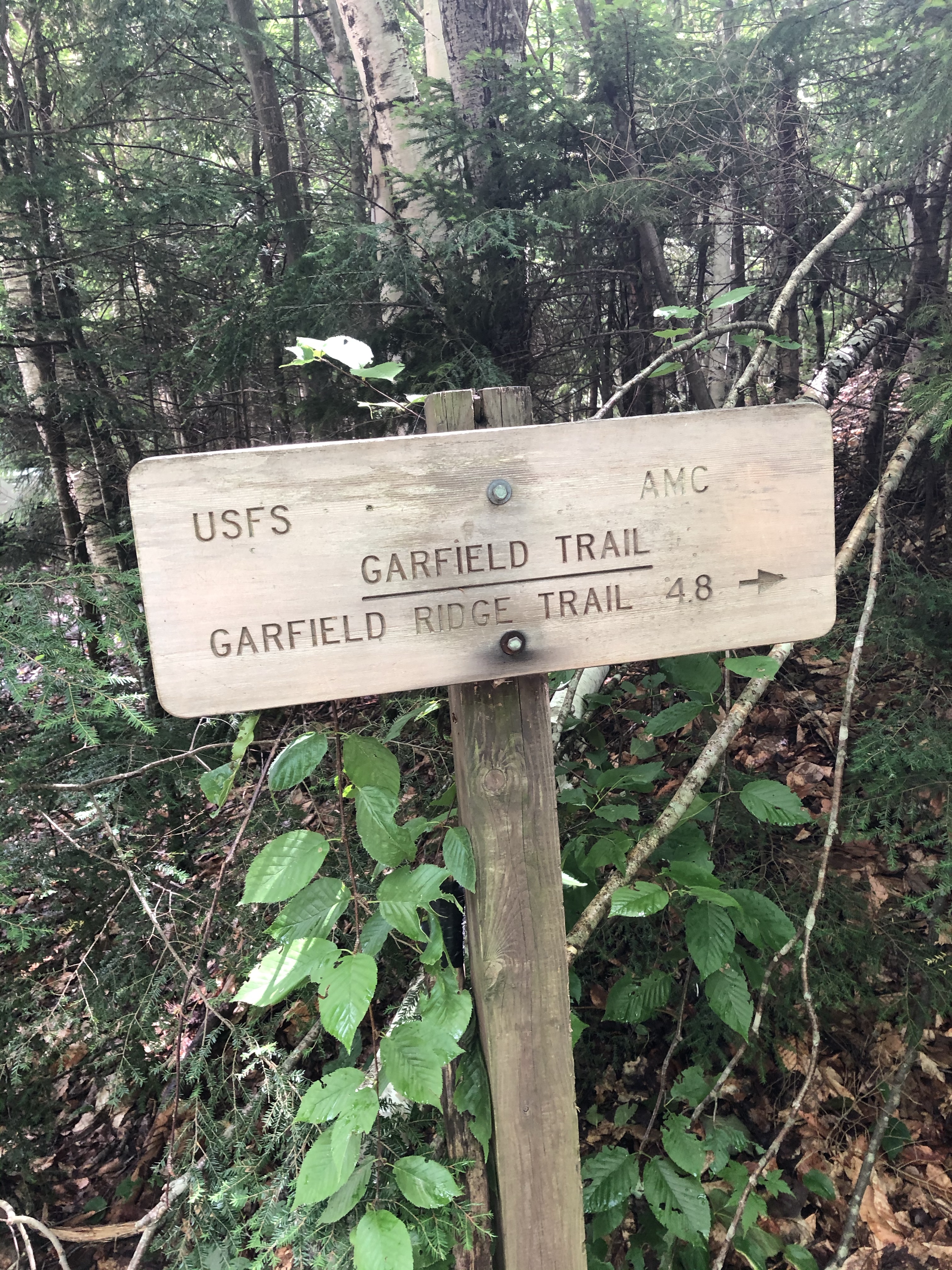
    Mount Garfield is known for the view from the summit.  There would be no view this morning, as rain and low cloud cover announced from the start that this wouldn’t be one of those days when you could see for miles.  I decided to hike it anyway, and to do it solo. The Garfield Trail is a relatively easy hike, and I was able to get to the summit in 2 1/2 hours.  As a wet hike, the Garfield Trail leaves a lot to be desired.  You feel like you’re hiking in a stream in stretches, and on the verge of getting bogged down in mud in some others.  But it’s a classic New Hampshire hike, with a cathedral of mature trees lining the ridge in the first third of the hike, and rocks for much of the rest of the way.  This is the type of hiking I’ve grown up with, and I quickly settled into my rhythm for the climb up.  For all its wetness, there were no bugs for the duration.

    Beginning at 7:30, I found little company on the trails.  I passed one father and daughter pair early on, and was in turn passed by a woman who flew past me after the first hour of hiking.  I’ve long checked my ego at the door when it comes to my pacing on hikes, and when I go solo I’m very deliberate with footing.  I’d see her again as she flew down the mountain at almost the same pace.  And that was it for company on the ascent.  It seemed most people were saving Garfield for a sunny day.  But the descent proved me wrong, with a steady parade of hikers streaming past me, most wondering about the view at the summit.  Not much of one, I’d tell them, but even as I spoke those words the day was beginning to change, with sunlight burning through the cloud cover and warming up the forest.  I was grateful for having done the ascent in the cool rain, even if the view didn’t cooperate.

    Mount Garfield is considered one of the easier climbs of the 48 4000 footers, but with that big payoff of a magnificent view waiting for you on a clear day.  If I wasn’t pursuing the 48, I might have saved this hike for better day, but I don’t view it as a waste at all.  20,000 steps later, I’d finished another 4000 footer and began my drive back home.  Garfield is a mountain I’ll do again a few times, certainly in autumn but also in winter when it becomes a longer hike as they close the gate on the access road.  Maybe my timing wasn’t good for a view, but it was an excellent 4 1/2 hour round trip anyway.  I’ve got my second notch on the 48 (I started over again from the beginning this year, since I rarely logged hikes previous to pursuing this goal) 4000 footers, and I got a decent workout in before lunchtime.  I’d call that a great success.

    A side benefit of hiking the 48 is learning more about the people the mountains are named for.  Other than knowing he was President and that he’d been assassinated, I didn’t know much about James Garfield until I chose this hike.  I’m glad I took the time to look back on his life a bit.  He only lived to aged 49, but managed to accomplish quite a bit in that time.  He was a classic rags to riches story with a life cut short too soon.  The White Mountains are dotted with more famous Presidents, but that doesn’t make Garfield a bit player.  Just a guy who ran out of time before he could do more.  I think he’s had a lot of company in that club.  A good reminder to get busy already, time waits for no one. And with that in mind I’m considering a peak bag for my next hike, which involves summiting multiple peaks in one day’s hike. I have another couple of former Presidents in mind for that one.


  • Beginning With Waumbek

    Climb the mountains and get their good tidings.” – John Muir

    The workout today was pretty straightforward: hike a total of 7 miles round trip up one of New Hampshire’s forty-eight 4000 footers. I’ve hiked at least a dozen of them before , some multiple times, but I didn’t track it officially. So I’m simply starting over again. I’m not imposing a deadline on myself and I’m not in a race. I don’t go to the mountains to set distance records. I go to the mountains because I love the mountains. And I love who I become when I spend more time in the mountains. And so today was, officially, one. And some good tidings.

    I chose Mount Waumbek in Jefferson, considered a good beginner 4000 footer. I’m not a beginner, but I’m beginning again. Waumbek was as good a place to start as any. At 4006 feet, its one of the shorter 48, but it counts just the same as Mount Washington on the list. And so I announced to the family that I was going and got one taker; my daughter committed to getting up at 4:30 and joining me. You know someone is serious when they commit to 4:30 AM, and sure enough she was ready to go by 5 AM.

    Mount Waumbek is an interesting name. The White Mountains themselves were once called Waumbekket Methna, which either means “mountains with snowy foreheads” or “white rocks” in the dialect of the Abenaki. Or maybe some settler came up with that story after enough time passed. What I’m fairly certain of is that Mount Waumbek was once slated to be yet another ski area, but thankfully it fell through and was preserved. I imagine it would’ve still counted as a 4000 footer, as Cannon Mountain does, but it wouldn’t feel much like hiking then. I’ll take the New Hampshire rock and root tour, thank you.

    I like to start hikes early, especially in hot weather. It’s generally less crowded, making simple things like parking a car less of a process. And early makes a big difference on hot, muggy days. Get it done before the crowds, before the heat, and before the inevitable thunderstorms that roll through the mountains on such days. We began our first steps at 7:45, a bit later than desired, and with a bit more company, but thankfully no raindrops. Instead we ran into swarms of ravenous gnats, flies and a few odd mosquitos. None of them cared much for social distancing. None of them got the memo that we wore generous applications of bug juice, or that according to the small printed label, they’re supposed to hate this stuff. No, they actually seemed to view it the way I view olive oil.

    The only solution was to keep moving. Summit Starr King Mountain (now THAT is a name for a mountain), glance at the view, snap a picture, move. Summit Waumbek, sip some water and nibble on a snack (carefully brushing off the carnivores who made a reservation to dine on you), re-apply bug juice and get moving again. There was no getting around it, I chose the height of bug season to begin again. But a day of hiking, even with the swarm, is better than most workouts I can think of. 19,000 steps today, and I’ll surely feel it tomorrow.

    And so it was, we checked off the first of the 4000 footers, I’ll carefully note it on the tracking sheet, and I’ll move on to the next on the list. Maybe it’ll be a we? After all, I’m not the only one who checked a box today.

  • A Walk Amongst the Stars

    Walking out, the night was pleasantly still and clear, and I instinctively glanced up to see what the walk had in store for me in the darkening sky.  Venus shining brightly in the west offered promise, with a faint El Nath riding just above her.  El Nath is the star that marks the tip of the left horn of Taurus.  I’m a Taurus myself, and so I’m pleased to see a bit of the constellation as it drops down for the night.  Taurus, like his eternal hunter nemesis Orion, roams the winter sky. Everything has its season, even the stars.

    A quick survey around reveals Gemini to the southwest and further up Leo prowls above.  Like bird songs and French and cooking Indian food, I know the basics but I’m in no way a master at the night sky. But like those other pursuits I chip away at it when I can.  Tonight was no exception and I work at it a bit longer but the evening is already getting too bright.  Reaching the top of the hill I turn around and gasp at the stunning full yellow moon rising above the tree tops.  I linger in the middle of the road for a minute when I’m startled by a noise behind me.  A woman out for a walk is powering past, loud music vibrating out of her earbuds and reaching across to jolt me.  I mention the moon but she’s in no mood to talk to a stranger in the dark.  Neither was I, honestly.  I let her walk ahead to give her the space we all need on such a night.

    The walker shook the magic out of the moment and I reluctantly walk back home.  I’m teased by a shooting star off in my peripheral vision.  They have a way of doing that, the rascals.  As I walk down the hill the moon disappears into the trees, but still illuminates the sky.  The stars, just emerging, grow faint again and I know it’s time to call it a night.  One last look around; Leo nods down at me and I say my farewells.  Another evening walk in the books, different from others in so many ways, as they always are. I didn’t focus on how far I walked, but my watch tells me I spent most of my time in the stars. That’s just like me.