If you’re counting walking as a workout, at what point does it really count? When you reach 10,000 steps? By how many flights of stairs it equates to? Or is simply getting out and walking enough to count? It depends, doesn’t it? It depends on fitness level, on injuries or disabilities you’re working with, and on state of mind. Every walk counts for something. Every walk can be meaningful.
Any walk of substance, whether hiking a mountain or a long walk on a bike path, could be called a workout. And a walk with the stars or a dog curious about the world can be especially meaningful. A walk filled with an abundance of steps and curiosity can be both. I think the point is to get out there and do something. To experience the world on her terms.
This month I’m in a challenge to do 25 workouts in the month of April. Given my fitness level, which is decent but not Olympian, I count a walk as a workout when I hit 10,000 steps (5 miles), and the walk itself is brisk. Sometimes I don’t have the time to do 5 miles in one walk and I’ll walk again at night to finish the steps. It’s my workout, these are the rules I put in place.
Walking as a workout isn’t the most efficient use of your time. I can row 5000 meters in half the time that I can walk 10,000 steps. If I broke that 10K into meters I could have a killer workout of 5x2K or 10x1K. And I can quickly raise my heart rate swinging a kettle bell, and mix in those workouts too for the pure intensity they offer. But sometimes you don’t care about efficiency. Sometimes you just want to walk.
I’m doing the math on those 25 workouts in the month challenge and figure I need to do a few double sessions this coming week to make the total. I’m having my second vaccine on the 27th and would like to be done by then just in case I have side effects. I haven’t done double sessions in some time, but I’m drawn to the idea. A mix of rowing, kettle bell swinging but especially those brisk walks. A micro burst of meaningful workouts to get across the finish line. And a burst into spring.
“One of the many ways we have made ourselves lonely without gaining the deeper nourishment and intimacies of true aloneness, is the way we have lost the greater supporting circle of friendship available to us in the created, natural world: to be friends with the sky, the rain, the changing light of a given day and the horizon always leading us beyond the circle we have drawn too readily for ourselves.” – David Whyte, from the forward of Essentials
I’ve often wondered at loneliness. I’m rarely lonely, but I’m often alone. I think the root of it lies in Whyte’s observation about the greater supporting circle – a connection to the world around you and with your own inner voice. Nothing awakens your relationship with the world like lingering with it on its terms.
One of the things I miss about having a dog is that forced connection with the outside, no matter the weather. It’s easy to just stay inside when it’s raining sideways or bitter cold. But having a dog forces your hand – they’ve gotta go, and you must connect them with the place they go. Letting them out is a cop-out. You must walk as a true offering to the pet gods.
This connection to the outdoors doesn’t require a dog, I’ve had similar connection with hiking, rowing and sailing where you’re forced to deal with nature as it comes to you. When you’re a small part of the natural world you tend to see it differently than you might looking at a screen from the comfort of a favorite chair. Nature demands that we meet it with respect and reverence, and in return we awaken something deeper in us.
I suppose a circle drawn around us feels like a hug or the blankets you pull over yourself on the coldest nights. The problem with a tight circle is that it’s inherently limiting. Getting out under the open sky and feeling the elements, you recognize that you’re alone, yet a part of something bigger than yourself. When you see the world outside that old circle, you’re never quite the same.
Loneliness is a state of isolation derived from looking inward. Connection is looking outward, and beyond yourself. Stepping outside the circle is a courageous act if you haven’t spent much time there, but it leads to a world that is alive with wonder. A sensory world of conversations in many dimensions. A world where we can become more than whatever it was you were when contained in that circle. That’s where you’ll find larger possibility. You’ll never be lonely outside your comfort zone.
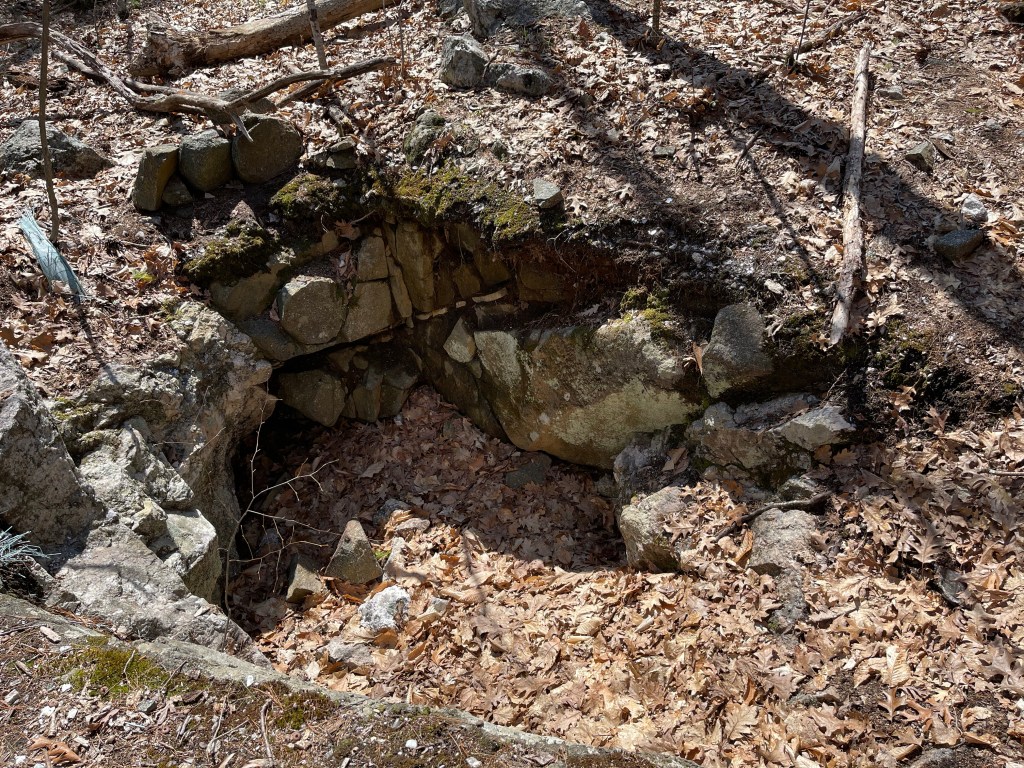
Walking through the woods of Hampstead, New Hampshire we found an old mine quietly marking time. A modest hole in the ground, really, with scattered bits of Mica all around. To call it a mine seems a bit of a stretch when compared to the big mining operations elsewhere in the world. But it called to me, knowing I’d been looking for it, and seemed to sparkle in the sun for the attention.
Mica is also known as Isinglass. From a resource perspective, Mica is sheet silicates used in everything from glass making to fashion to a key ingredient in gypsum. It has some heat-resistant qualities and is non-conductive, which makes it useful. But it’s very expensive to mine and labor intensive, so most of the mining now is done in India. For anyone complaining about their work, I’d point to Mica mining as one of many professions that might be a bit tougher.
In New Hampshire you see flakes of Mica everywhere but the meaningful sheets (or “books”) were harder to find. When they did find it, they’d root it out by blasting and drilling carefully around the sheets. Keeping the sheets intact was the labor-intensive trick.
There’s a semi-famous mine in Grafton called the Ruggle’s Mine, now closed, that used to be a tourist attraction. Visitors could carry out whatever rock that met their fancy. The mountain where it was mined was called Isinglass Mountain. You can find it on a topographical map but good luck finding that on the list of New Hampshire’s 1,786 mountains. Does a mountain lose prominence when people dig holes in it?
Back in the woods, I wondered about this old hole in the ground, once a Mica mine, now a landing place for leaves and pine cones. There’s little history around it, probably because it really isn’t any bigger than a cellar hole. But it’s in my nature to wonder about such things. Not so much for the hole but the people who labored in it. I imagine they’re buried somewhere in town, filling their own holes in the ground. What was their story?
Holes in the ground aren’t nearly as flashy as waterfalls and mountaintops. I can’t blame anyone who skimmed the first paragraph of this post and thought, “not for me”. But there’s a story there in the ground, marking time like the rest of us. And I wonder, what would it take to dig it out? For without a story it’s just another hole in the ground.
This morning I stepped to the floor awash in good soreness after re-introducing kettle bell swings into my workouts. The workout started with a 5000 meter row, three sets of alternating two and one arm kettle bell swings, dead lifts and some dynamic stretching. Then a long, brisk walk on soft beach sand to really emphasize the legs workout.
You know when your body needs a break, or at least you should know if you’re listening to it. Living with pain is a good indicator, signaling a need for adjustment to either your body or your routine. Pain is generally bad. But what do we make of sore? Exercise-induced soreness is the good kind of sore. It signals your body is adapting to change, flushing out lactic acid and repairing muscle fibers. And it signals dues paid towards a more vibrant tomorrow.
Changing up exercise is a great way to keep the body guessing. Adding good stress to your body flushes out the bad stress, keeping that stack of organs and muscle you walk around with healthy. We intuitively know this, but most of us sit around too much anyway. If we know that sitting around too much is bad for the brain and the body, then we ought to get up and get moving more often, right? I tell this to myself all the time, but don’t always listen enough. I’ll present a convincing (if misguided) argument that I’ll get to it later. But later is just deferring our well-being. The body doesn’t care about your next meeting, it needs to move more often.
“The more you move yourself by your own muscle power, no matter what form that movement takes, the surer you will be of the result.” – John Jerome, The Elements of Effort
Jerome points towards the confidence that builds up inside of us when we do the work to build our better selves. Sports and nutrition guru Chris Carmichael calls people who are fit and vibrant as they age the defiant minority. We all know where we’re heading, but why not be fully alive when we get there? Adding a rigorous program of weight lifting or kettle bell swings to surprise the body offers day-after soreness but for-a-lifetime benefits. So embrace the soreness.
“People who lead a physically active life have a lower risk of cognitive decline, and research is now emerging to show that greater fitness is correlated with maintaining better processing skills in aging brains.” – Sanjay Gupta, MD, Keep Sharp
As I was finishing my workout yesterday I thought about the similarity between the kettle bell swing and a rock scramble in the White Mountains. The strength, endurance and mental toughness built through a workout like kettle bell swings translates well to other activities like hiking, offering yet another reason to add them to your routine. That soreness you feel the morning after a workout will translate well towards doing more, with less soreness, in those other activities you’ll do later. Pay me now or pay me later.
And that pay me now or pay me later rule is really the point, isn’t it? If we continually defer our health and fitness through undisciplined exercise and nutrition choices now, we’ll pay for it with a shorter window of cognitive and physical well-being later. We’ll accomplish less in the time we have than we would if we’d simply invested in ourselves with exercise and disciplined consumption today.
That soreness is yesterday’s glow of accomplishment. But today is a new day, requiring its own payment of dues. Keep the streak alive, pay today’s dues. Tomorrow will thank you.
What good is livin’ a life you’ve been given If all you do is stand in one place – Lord Huron, Ends of the Earth
If snow transforms the landscape, then a walk in that snowy terrain transforms the winter walker. Add a new path and suddenly you’re seeing the world entirely differently than you had before. Add snowshoes and you’re suddenly set free to break off trail to see new places, explore animal tracks that run off into the woods, and to see what’s on top of a rise you might have walked by at another time of year.
There’s a popular pursuit in hiking called red-lining, in which hikers hike every bit of every trail on a map or guide. A popular red-lining pursuit in New England is hiking the AMC White Mountain Guide. The whole point of red-lining is to explore new paths – to get off the crowded hiking trails and try something new. To do it, and to belong to a small group of hardcore hikers who have also done it. And add a measure of accomplishment and camaraderie in the world of hiking. I don’t see myself hiking every trail in the AMC White Mountain Guide, but I’m fully onboard with hiking new trails and seeing the previously (for me) unseen.
On Valentine’s Day I explored trails previously unseen in a forest I’ve spent a lot of time in. Snowshoeing with friends, we walked a trail largely by ourselves to new places. When you’re on a new trail like that, every step is a discovery, every bend in the trail is a curiosity, and every trail junction is confirmation and validation of what the map was trying to tell you all along. There’s magic in taking that image on a map for a walk and making it real.
The day after a long walk on new trails you start thinking about the trails at those junctions that you didn’t take. You wonder at what you might have missed down that way and begin to realize the allure of red-lining. For how do you want to spend your time in this world? Sticking with the familiar or exploring new places and challenging yourself in new ways? There are other paths that warrant exploration. I’ve seen them out there, if only on a map.
Now shall I walk Or shall I ride? “Ride”, Pleasure said; “Walk”, Joy replied.
Now what shall I — Stay home or roam? “Roam”, Pleasure said; And Joy — “stay home.”
Now shall I dance, Or sit for dreams? “Sit,” answers Joy; “Dance,” Pleasure screams.
Which of ye two Will kindest be? Pleasure laughed sweet, But Joy kissed me. – William Henry Davies, The Best Friend
Joy and pleasure sound similar, but joy is something you can build off of, while pleasure seems more, well, short term. In the forever competition between Pleasure and Joy it’s interesting to note that walking is solidly in the corner of Joy. I’m at my best walking, and fill with joy in those moments on a trail or in the quiet places in the world. I know I’m not alone in this respect.
What makes walking so positive for the mind and soul? Something in the rhythm of walking long distances clears the fog. Reboots the brain. I don’t have a lot of eureka moments walking, but I’m always better for having done it.
Today was filled with miles of joyful walking. A poem like the Davies poem above hits you differently when you’re blissfully tired and sore from miles on the trail. Don’t get me wrong, pleasure is nice too, but today belonged to joy. And it started with a long walk.
“Nature says thou shalt keep the air, skate, swim, walk, ride, run. When you have worn out your shoes, the strength of the sole leather has passed into the fibre of your body. I measure your health by the number of shoes and hats and clothes you have worn out. He is the richest man who pays the largest debt to his shoemaker.” – Ralph Waldo Emerson
Those Concord folks were walkers, weren’t they? Ralph and Henry wandered about, wearing out shoes and building big thoughts. There are a couple of versions of that Emerson quote above, but some online research makes me believe these were his words. I like the alternate quotes just fine, but when I start quoting people I’d like to have it right. I love the idea of transferring the strength of the shoes into the fiber of your body. It applies just as well with shoes as it does time and sweat equity invested in other worthwhile things.
I’m wearing out shoes more quickly lately. My feet took a beating last year, ankles and knees too, but they merely paid it forward to my heart and soul. Over time the body adjusts and stops complaining about taking another step and just goes. It’s a bit like writing and washing dishes and making the calls, you just teach yourself that there’s joyful bits in every moment of doing.
I’m a collector of joyful bits. On my deathbed I won’t regret not finishing Breaking Bad, but I’ll surely regret not seeing the Northern Lights or the Southern Cross should I not see each. The last year is a reminder to not take mobility for granted. Wearing out more shoes seems a great goal for our next normal. The correlation seems apparent. Wearing out your gear is an easy measure of your physical and mental health. So lace up; we have places to go.
I promised myself a snowshoe walk in the woods for lunch, and dammit if I wasn’t going to honor that promise. There was more snow drifting down, quietly adding to the base layer in fluffy contentment. Day-old snow welcoming the new to the accumulation. We’re in the weather pattern now, folks. Snow-upon-snow: February in New Hampshire.
I’d walked these woods on Sunday, but felt a return was in order. Conservation land, with trails popular with dog walkers and tree whisperers. At lunchtime on a random Tuesday in winter you don’t expect a crowd but you expect somebody. In this case one car running, its driver staring down at a phone screen, oblivious to me strapping on snowshoes and beginning my walk.
The trail is compacted again, a day after six inches of snow and with more in the air, speaking to the popularity of the trail. I help compact it for twenty steps and then move off trail into deeper snow. This is what I came for after all: the highly addictive, calorie-burning bliss of clumping about in deep snow. I followed an old stone wall that spends its lifetime keeping the woods and fields apart, and wonder at the farmers who built it a few hundred years ago, and the generations that mended it until the woods finally wrested back control of the land. Now it’s my turn on the land, and I quietly honor those who came before me; their hard life on display.
I rejoin the trail and the pace picks up, crossing a bridge over a stream I see a stand of old pines and step off trail to walk amongst them. Just me and the snowshoes, walking an endless blanket of white that covers the features of the land. Fallen trees, dormant vines and brambles, rocks and frozen wetland all lay together under Mother’s white blanket. And one soul clumping about above like a kid at recess. For that is how I feel, being out like this on a snowy workday.
I think about the time. How long have I been out here? 45 minutes? An hour? Hard to say, really, and I don’t want to look at the watch or phone to find out. But I know it’s time to head back towards the car. Clumping along, I join a familiar path, newly blazed but strangely not compacted as much as other trails. I help with that task while walking under hemlock trees – old friends who I speak with now and then across the years. They’d like me to linger awhile, I smile and hint I’ll be back another day. And cross a stone wall and step out on another field of white.
The car isn’t all that far away now. I could be in it and back in my home office in minutes. But the snowshoes want to fly some more, and so do I. Not just yet, world. I step off the path and walk back into the deep snow, a wandering soul in a quiet, timeless field. I spot a tall stone wall on a rise across an unbroken plane, set my course, and fly.
If you watch a commercial on television, or a reporter out on a city street, or even the cast intro on Saturday Night Live in February 2021, everyone is wearing masks. A year ago you’d have wondered at it, even as the pandemic rapidly descended on the world. Today it’s commonplace, and I’m more often surprised at the outliers walking into a store without one. I stood in a line for snowblower parts and a mechanic walked briskly through the store unmasked. In a crowded grocery store I saw an elderly woman(!) without a mask on. In both cases I had the same reaction I might have had two years ago to someone wearing a mask. Isn’t it funny how the world has changed our perceptions in such a brief turn of the calendar?
I chafe at restrictions, favoring wandering, crossing borders, friendly conversations with strangers and simply getting out there. But we all sense a light at the end of the tunnel, and we’ll reach a tipping point with vaccinations as we did with mask wearing. With more and more people I know joining the ranks of the vaccinated, a sense of optimism grows. Travel will soon be a reality again, even if a bit different from the travel of a few years ago. There’s plenty of travel available today, without worrying about the complexity of borders, just outside.
“My vicinity affords many good walks; and though for so many years I have walked almost every day, and sometimes for several days together, I have not yet exhausted them. An absolutely new prospect is a great happiness, and I can still get this any afternoon. Two or three hours’ walking will carry me to as strange a country as I expect ever to see. A single farmhouse which I had not seen before is sometimes as good as the dominions of the King of Dahomey. There is in fact a sort of harmony discoverable between the capabilities of the landscape within a circle of ten miles’ radius, or the limits of an afternoon walk, and the threescore years and ten of human life. It will never become quite familiar to you.” – Henry David Thoreau, Walking
Many times during the past year I’ve thought of Thoreau walking the landscape I know today. There’s plenty that’s changed since his time, but there’s also plenty that remains just as it was then. Much of it remains undisturbed, as if in a time warp, awaiting a visitor. I doubt he ever got up to the corner of New Hampshire where I walk, but I’ve walked in his woods near Walden and note the similarities.
“Walk until your day becomes interesting — even if this means wandering out of town and strolling the countryside. Eventually you’ll see a scene or meet a person that makes your walk worthwhile.” – Rolf Potts, Vagabonding
With a hint of the coming snow in the air, I took my snowshoes out to find new prospects. I quickly moved off the packed trail into virgin snow, crunching along on the snowdrifts through woods and fields. Cold hands soon warmed as I worked up a good pace past old stone walls and silent trees. Snowshoeing offers a slow burn, steady state workout similar to cross-country skiing. There’s a small thrill in hovering over the frozen land while blazing a new trail on snowshoes, and I felt a bit like I was flying as I crunched along.
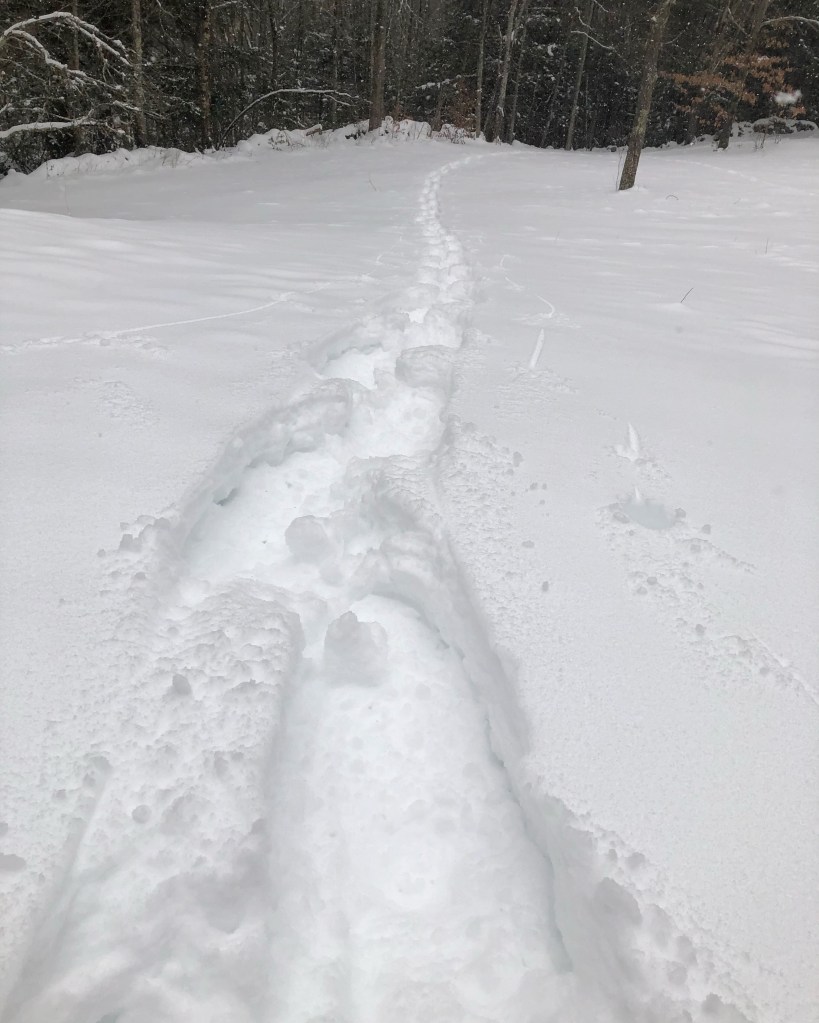
Reconnecting with the blazed trail at a frozen stream crossing, I noted the collection of prints of those who had come before me. Snowshoes and fat tire mountain bikes, micro spikes and dog prints spiraling in circles from the trail in patterns of joyful exuberance and the freedom of the winter woods. It occurred to me that my own tracks were more similar to the dog prints than those of the trail walkers. Wandering spirits are rarely contains for very long on defined paths.
A simple walk in the woods, off trail, can change a person. In winter what was familiar ground becomes a voyage of discovery. Perception is how we frame the world around us, and I find it best to turn my perceptions upside down now and then. Every walk suggests something profoundly new, and winter transforms both the landscape and the visitor alike. Pausing a moment, I listened to the sound of silence. My snowshoes and I had walked our way to interesting, embracing the cold indifference of the woods to pandemics and masks and turns of the calendar.
Walking along on familiar trails transformed into strange country, I stopped worrying about the neglected collection of stamps in my passport. Feeling a million miles from anywhere I’d every been before, I came across a border marker deep in the woods indicating I’d crossed over from the town forest of my neighboring town into the undeveloped forest of my own town. I smiled and noted that not all borders are closed. And the unfamiliar isn’t very far at all from home.
Into the snowy woodsSnow blanket on an old stone fence
“‘There’s a Sanskrit word, darshan,’ Jon said as we gazed up at Konka. ‘It suggests a face-to-face encounter with the sacred on earth; with a physical manifestation of the holy.’ I hadn’t known the word, but I was glad to have learnt it. Darshan seemed a good alternative to the wow! that I usually emitted on seeing a striking mountain.” – Robert Macfarlane, The Old Ways
Waterfalls and sunrises and mountains and ancient trees are a physical manifestation of the holy. And so is the ripple across a calmly rolling ocean betraying a puff of wind. And the Milky Way on an especially dark and clear night. The catch in my throat when I see these things is spiritual, more than any church I’ve ever walked into, and I go out of my way to seek them out. Admittedly, I haven’t been to the Sistine Chapel yet, but I’m not convinced you can’t find the same thing walking deep into the woods.
I stumbled on the quote above from Macfarlane and immediately identified with darshan in this context. I read this book almost eight years ago and keep returning, skimming over magical phrases and bucket list places. But in the end the book is about standing up and walking out to find yourself in the world. To come face-to-face with the divine requires inspired effort. Sweat equity in your spiritual education. Getting out there and in it.
And yet… One of the most beautiful waterfalls I’ve ever seen is She-Qua-Ga Falls in Montour Falls, NY. It felt like cheating when I arrived, because you essentially drive right up to them. The falls are framed by houses and a concrete lined basin below and an arched bridge above. Like Niagara Falls humanity encroaches on the beautiful, threatening to edge it out in the process. But truthfully I don’t see those things at all; I look at the timeless waterfall captured there, like a rose under glass. And I see darshan.
There’s a tendency for people to see something beautiful and immediately try to put a stake in the ground there. The Eagles wrote about this in The Last Resort. Houses lined up on the edge of the beach grabbing a share of sunset and water views. Homes mounted atop mountains to maximize the view while killing it for those looking up at the mountain they’ve scarred with a box. I visit a house with a great sunset view as often as I can, and would be a hypocrite if I were to condemn those who build for the view. For all the beauty we see from that house by the bay, I know that the view from the water or from the other side of the street is a row of houses. So I take no issue with the people who built Montour Falls for edging up to the falls and wanting to linger there, but wish the land around the falls had been preserved in its original state. Then again, the falls are beautifully accessible for those who can’t hike deep into the woods. Darshan on display for everyone. And maybe that’s enough.
The network of trails and rhumb lines that weave across the Earth like a tartan reveal the whispers of those who came before us. There’s very little that hasn’t been seen by someone before us except in the most remote corners of the planet. But who said encounters with darshan must be exclusive anyway? Each human making their way in this world looks for something greater than themselves. Encounters with darshan are uniquely ours alone, even when shared with others we internalize it differently. But what is darshan if not seen through the lens of our mortal human perspective? We seek it out, discover something in ourselves, and try to capture the divine with a few inadequate words and pictures. And honor it as best we can before leaving it for others to discover in their own time.