Category: Writing

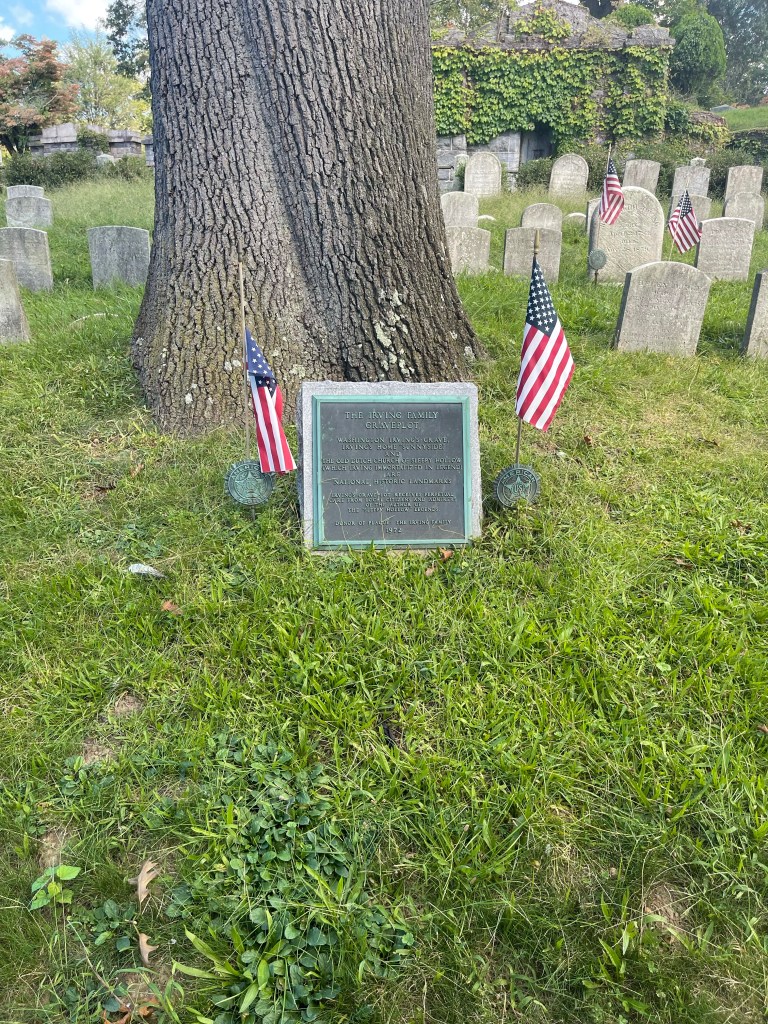
  • Visiting a Legend in Sleepy Hollow

    “To look upon its grass grown yard, where the sunbeams seem to sleep so quietly, one would think that there at least the dead might rest in peace.” – Washington Irving, The Legend of Sleepy Hollow

    There are two Sleepy Hollow Cemeteries of note. There’s the one up in Concord, Massachusetts with it’s Author’s Ridge populated with the bones of Thoreau, Emerson, Alcott and others. And then there’s the one here on the shores of the Hudson River, where the wealthy vacated the city for one last time and tried to one-up each other in death with grand mausoleums as their final statement about how rich and powerful they were.

    Those rich folks can wait in their eternity. For there’s really only one name that matters when you talk about Sleepy Hollow, the guy who put it on the map: Washington Irving. Irving wrote two of the most familiar short stories in our cultural memory: The Legend of Sleepy Hollow and Rip Van Winkle.

    It’s that tale of the headless horseman that inspires people to visit his grave at the Sleepy Hollow Cemetery. Irving is buried in the oldest section of the graveyard, with unpaved roads crisscrossing un-mowed plots with headstones protruding up in neat columns. That walk up the hill to visit his grave seemed perfect. Like walking back in time to visit those who came before us.

    I didn’t visit out of some ghoulish fascination with his short story, but for the whispers you hear at their resting place. Cemeteries generally hold the lay of the land as it was on the day they buried someone, and Irving’s resting place nestled amongst his family on a hill overlooking the Hudson River Valley seems a lovely place to spend eternity.

    Of course, Irving doesn’t need to whisper, for he wrote plenty for us to draw on. His stories will likely outlast every gravestone in Sleepy Hollow. Does that make him a legend?

  • The Widest Helpful Influence

    “There is no wealth but life. Life, including all its powers of love, of joy, and of admiration. That country is the richest which nourishes the greatest numbers of noble and happy human beings; that man is richest, who, having perfected the functions of his own life to the utmost, has also the widest helpful influence, both personal, and by means of his possessions, over the lives of others.” – John Ruskin, Unto This Last

    It’s no surprise to learn that Gandhi was strongly influenced by John Ruskin when you read something like this. The ripples of Ruskin continue to reverberate in Liberal thought. By Liberal I’m not speaking of foolish political labels, but in the concept that life and liberty for everyone matter. Matter, in fact, more than the political ambitions of some autocrat or profiteer.

    Think about this: who has the loudest voice in the room? Does that person hold the most influence? It seems so, doesn’t it? But it’s generally the person that influences them who has the most power. It’s the person behind the spotlight who has the power, not the person who the light is being cast upon.

    So how do we develop the widest helpful influence over the lives of others? The obvious answers are to build wealth, a powerful network, and a base of followers. And there’s no doubt that these will reverberate the loudest. But nothing is more powerful than developing the right story and the commitment to having it heard. And that starts with us.

    Gandhi, Ruskin, Thoreau, Nietzsche, King, Emerson, Seneca, Aurelius, Carson, Oliver, Goethe, Montaigne… all are just people who developed a story and a voice. All found an audience over time. So why not us? What story will we tell?

  • Let Us Go Forth

    “What is literature but the expression of moods by the vehicle of symbol and incident? And are there not moods which need heaven, hell, purgatory, and faeryland for their expression, no less than this dilapidated earth? Nay, are there not moods which shall find no expression unless there be men who dare to mix heaven, hell, purgatory, and faeryland together, or even to set the heads of beasts to the bodies of men, or to thrust the souls of men into the heart of rocks? Let us go forth, the tellers of tales, and seize whatever prey the heart long for, and have no fear. Everything exists, everything is true, and the earth is only a little dust under our feet.” – W.B. Yeats, The Celtic Twilight: Faerie and Folklore

    There is still a schemer in you and me, plotting escapes to faraway places and magical hidden nooks closer to home. There are still stories percolating in our heads, looking to escape into the world in mischievous stacks of words. For everything exists, and we do too for such a short time as this. We must explore it with the urgency that this brief life demands.

    We’ve all learned a hard lesson the last few years. The world isn’t fair, doesn’t care about your hopes and dreams, and far too many people believe whatever Machiavellian story someone else is spinning for them. Is there not worthier magic in this world that needs expression? We must explore the physical world, and swim the sparkling waters of the ethereal within our imagination while there’s still time.

    Have the mettle to rise above the dismal din. Fly, while we may, for the world is only a little dust under our feet. Go forth and bring its wonder back for all to see.

  • Aspired Greatness

    “I believe that the first test of a great man is his humility. I don’t mean by humility, doubt of his power. But really great men have a curious feeling that the greatness is not of them, but through them. And they see something divine in every other man and are endlessly, foolishly, incredibly merciful.” – John Ruskin

    If we agree, and I hope we do, that there’s a divine spark in each person, then each of us has something to offer. I know there some particularly hideous exceptions to that rule, but in general most people in this world are trying to do the right thing. The outrage we feel when some dark soul erupts in the world demonstrates our shared faith in humanity. Outrage originates out of a feeling of betrayal of shared beliefs.

    To reach greatness in the world doesn’t require the most followers or likes on YouTube or a particular net worth. Really great people have an aura of positive energy exuding from them. Really great people lift those around them up. Really great people strap themselves to the helm to steer the ship through the worst of storms. There are plenty of really great people in the world, and you’re probably thinking of a few examples right now.

    “I believe God made me for a purpose, but he also made me fast. And when I run I feel His pleasure.” – Eric Liddell in Chariots of Fire

    Divinity isn’t within us, it runs through us in our chosen pursuits, our relationships, our empathy and our sacrifice. It’s a calling, a purpose, that demands us to give of ourselves so that others may feel the Divine Spirit as well. That spirit may mean something religious to you (capital D, capital S), or simply something far greater than ourselves.

    I humbly write in pursuit of the divine – not to capture it, but to channel it through my writing. I’m a long way from greatness, but I see the path grow incrementally shorter with every hour devoted to the craft. Writing hasn’t been my life’s work to this point, but it’s woven in everything I’ve ever done. A modest, often futile attempt to share the divine that I’ve encountered in this world with you. Does that make it a purpose or a pursuit? I think the latter, but I hear the call of the former.

    And shouldn’t we aspire for greatness and a way to share it?

  • Every Setting Sun

    “Let every dawn of morning be to you as the beginning of life, and every setting sun be to you as its close.” – John Ruskin, The Two Paths

    You see the difference in the days now. September brings that perceptible tilt of the earth, shrinking daylight hours and with it a persistent tightening up of that time between sunrise and sunset. Soon the trees will react and the world will turn a kaleidoscope of colors. In the northern hemisphere we’ve turned the corner from the laziness of summer and you can feel the quiet insistence of the harvest season upon us.

    There’s work to do, meaningful work, and it must begin in earnest while there’s time. It’s funny how September does that. Deeply engrained in our souls, this feeling of bringing all your work to a satisfactory conclusion. A harvest. Like the setting sun you can feel when one chapter is ending, with a bold suggestion that something new might begin. But we’re fools to focus on that which isn’t promised to us.

    Sunsets are lovely, but you earn the sunrise. And when you greet the day your thoughts turn naturally to what you might do with it. Life is best lived in the urgency between sunrise and sunset. When the sun sets this evening, what will we have harvested in these brief hours? For the days grow shorter with every setting sun.

  • Work and Love

    “The wind speaks not more sweetly to the giant oaks than to the least of all the blades of grass; And he alone is great who turns the voice of the wind into a song made sweeter by his own loving. Work is love made visible.” – Kahlil Gibran, The Prophet

    Today is Labor Day in the United States, a day of rest for many (not all), and an opportunity to reflect on this thing called work. If you’re doing work you love, then Gibran’s words will resonate. If you’re doing work that grinds your soul to dust, you might think his words are ridiculous. But to live a fulfilling life, shouldn’t that which we labor in be loved?

    Piecing words together isn’t hard labor, but any writer knows that it’s work. Paradoxically, if writing every day is work, it must reverberate with love to be enjoyable for the reader. The jury is still out on this writer.

    In my working life I’ve done everything from sweeping up broken glass to managing salespeople in a Fortune 500 company. I took as much care removing every sliver of glass from the ground as I did managing the emotional response to a quarterly review. Work is love made visible, otherwise it’s self-immolation.

    So on this rare day of rest in our hustling culture, what do we celebrate? A break from the grind or a moment to recharge before leaping back into the joy of a meaningful career? Especially now, somewhere between a pandemic and normal, work should be celebrated for where it brings us in our lives, and for what we may give back to others.

    What can we be great at? Shouldn’t we put our heart and soul into that which transcends work? To rise above the daily grind to joyful, purposeful labor seems the only path to a full life.

  • What We Create, What We Leave Unfinished

    We create ourselves by our choices. – Søren Kierkegaard

    In my house there are a hundred half-done poems.
    Each of us leaves an unfinished life.

    – Mary Oliver, Thinking of Swirler

    It’s an oddity in my character, admittedly, that I linger with poetry and well up with emotion over words. After a particularly stunning pink swirling sky at sunrise I could think of nothing better to do with my morning coffee than pair it with Mary Oliver. Life is a series of choices, one quietly laid upon the other, carrying us to eternity. I’ll regret many, but not this one.

    What will we create in our time here? What will we leave unfinished? These are the questions of a lifetime, and the questions of each day.

    I’ve mentally cast aside this blog dozens of times, but each morning I wake up and write anyway. It isn’t the writing that challenges and mocks me, it’s measuring up to the words. Knowing what’s unfinished, knowing the choices that make up a lifetime. Waking up with a chance to measure up once again.

  • The Thing We Ought to Be

    “The ideal life, the life of completion, haunts us all; we feel the thing we ought to be beating beneath the thing we are. We are haunted by an ideal life, and it is because we have within us the beginning and the possibility of it” – Phillips Brooks

    It sneaks up on you now and then, this feeling. It’s a nagging call for action, Thoreau described it as quiet desperation, a feeling that you’re living below your dreams and see no path to reach them. But he would also remind us that it’s okay to build these castles in the air, just build the foundations underneath them.

    What do we make of ourselves when we know what we ought to be?

    How we reconcile this in our own lives is how we determine for ourselves whether we lived a successful life on our deathbed. But let’s not get ahead of ourselves. When you pause in a quiet moment in the day and reflect on where you are and where you’re going, do you like the answer?

    The haunting is a call to action.

  • Follow the Trail and Scatter Light

    Man dreams one day to fly
    A man takes a rocket ship into the sky
    He lives on a star that’s dying in the night
    And follows in the trail, the scatter of light
    – U2, In A Little While

    There are moments in an album or a book or an evening when you recognize the magic. Emotion wells up in you, stirring and amplifying feelings, sending you to another place. A higher place, maybe, or a darker place should the moment direct you that way. I keep climbing to higher places, hoping the view is better. Hoping I’ll become better in the process. And some of it ends up here in this blog.

    U2 hit me a few times over with All That You Can’t Leave Behind. Opening with the hit, dropping in a mournful homage to Michael Hutchence and then the heart pounding Elevation. This was the U2 I’d missed in their experimental days of the late 90’s. These were songs that stuck with you. Ear worms if you will. And then they hit you with Walk On, which grabbed me by the throat waiting for a flight from LA to Boston. When Bono starts singing “Home, hard to know where it is if you’ve never had one” while sleepily waiting for a red eye flight home… well, I’ll never hear the song the same again.

    For all that, the second half of the album is admittedly weaker. And for me, In A Little While became the unconscious end. For it was this song that got that emotion welling, that stirred and amplified those feelings. When Bono sings “Slow down my bleeding heart” I’m right with him, and I know it hit others the same way. That’s the power of a moment.

    Bono stated at one of the concerts U2 recorded that Joey Ramone’s family told him In A Little While was the song that he listened to in hospice, which changed the song for Bono, the guy who wrote it, from a hung over dolt going home at the end of the night to something bigger. Something more meaningful. I never heard the song as anything but soul-stirring, which just goes to show, art might begin with the artist, but it becomes whatever the audience wants it to be.

    I think about that as I write. About reaching moments of emotional connection in my writing. About crafting something of depth and substance, something that amplifies that nugget of desire or fear or love in your soul. Surely I’m a work in progress, but still climbing. Following the trail and scattering light. Still dreaming of flying.

  • Telling Stories

    “The true beauty of a story is not in its apparent conclusion but in the alteration in the mind of the reader that has occurred along the way.” – George Saunders, A Swim in a Pond in the Rain

    The more I live, the more I see the connection between success in any pursuit and the connection you make with your audience. And this connection is directly related to the gravitational pull of our stories. When I was a shy kid I’d avoid telling stories because it put me squarely in the center of attention. I no longer worry about being the storyteller, because I’ve realized over time that the attention isn’t really on me at all, but on the story I’m telling.

    Think about the last time you were listening to a powerful story. You were pulled in, compelled, maybe even fascinated. Each of us wants this kind of connection. Each of us wants a story to resonate. Each of us wants to be part of something. And when you have this level of audience engagement you’re halfway there. Just don’t let them down.

    It goes without saying that this applies to writing as much as it does to a speech or conversation with someone. When you start stacking that pile of words together, who are you doing it for? Yourself? Nobody likes to listen to someone talking to themselves. No, craft your story for someone in your mind. Decide who the audience is and craft something that creates connection and transforms and shapes ideas.

    Humans are either connected or driven apart through the stories we tell ourselves. Stories of religious and political views, ethnicity, sports and a hundred others. The best story tellers sprinkle a magic spell over the audience, drawing them in and making them a part of it. And that’s where the beauty is in a story. And a beautiful reason to master the art of telling it and then use it for good.