Category: Writing

  • Incremental Pulses

    “A story is a series of incremental pulses, each of which does something to us. Each puts us in a new place, relative to where we just were.” — George Saunders, A Swim in a Pond in the Rain: In Which Four Russians Give a Master Class on Writing, Reading, and Life

    Swap “Life” for “A story” in the quote above. It does something different to you, doesn’t it? All storytelling is just sharing experiences and lessons with each other. Some are completely made up, some are relatively on point, but all are told through the perspective of the writer.

    This month a family friend is painting a couple of rooms in my home. Normally I’d do this work myself, but for several reasons it’s better that he’s doing it. In the process, the house is turned upside down, and we’re all feeling the accumulated fatigue of these relatively new places and experiences, stacked one atop the other. The one taking it the hardest is the younger cat, who’s had three years to establish her world order, her safe places, only to have it all turned upside down in a few days. And so she’s a basket case of concerned meows and fearful hiding. New places can be hard to adjust to.

    The world is changing rapidly around us, and the stories we tell each other about the future are all so very different than they were not that long ago. We’re collectively in a new place, and finding it hard to adjust to it. What do we do next? Stop using plastic straws? Buy (or sell!) crypto currency? Stockpile canned goods and bottled water? It feels like we all just worked through our pandemic stock!

    So now what? It begins with the stories we tell ourselves. What we share with the world. Storytelling is a way to share lessons, to offer a path for others to follow. We listen to each other for shared perspective. Change happens, how we react to it usually determines what happens next.

    The last few nights, I’ve coaxed the cat out of deep hiding places. She walks out timidly, fearful of this new place she finds herself in. I’ll give her a moment to adjust, then pick her up and give her a reassuring hug. This too shall pass. Soon we’ll be in a new place yet again. And maybe it will all be okay. We ought to stick together, just in case.

  • The Proof Will Be In Your Living

    “I don’t know what that means. To truly live.’…
    ‘To find work that you love and work harder than other men. To learn languages of the earth, and love the sounds of the words and the things they describe. To love food and music and drink. Fully love them. To love weather, and storms, and the smell of rain. To love heat. To love cold. To love sleep and dreams. To love the newness of each day.’
    He stared at his hands.
    ‘To love women. To pleasure them. To make them laugh. To be foolish for them. To respect them. To listen to them’ He paused. ‘They are the lifegivers. To live is to love them’
    ‘You will see,’ he said. ‘The proof will be in your living”
    ― Pete Hamill, Forever

    Forever is one of those books that I’ve come back to a few times, and I celebrate the magic Pete Hamill weaves into the novel. We must weave magic into our own lives, mustn’t we? Books do that for us, even when the world itself doesn’t always measure up.

    I’ve returned to reading the stack of fiction that’s been mocking my time with business and history books. I give a nod here to Forever, but my attention is on novels new to me that spin their own magic. Perhaps I’ll quote them in the blog, but certainly I’ll learn something from each writer’s style. What is your writing style? And is there enough magic weaved in to transform the reader?

    The central character in Forever is a man named Cormac O’Connor who comes to New York City and lives forever as long as he doesn’t leave the island of Manhattan. When you live forever you get a chance to accumulate experiences and languages, master a musical instrument or two, navigate a few relationships from beginning to end, and reinvent yourself every new day. There’s joy and pain inherent in watching people come and go in your life, there’s accumulated wisdom of bringing each day’s lesson home with you.

    You and I won’t live forever. But we too can accumulate our share of experiences and celebrate the newness of each day. We too can weave magic into our lives. Ultimately, the proof will be in our living.

  • Upon Reflection

    “Long had he believed that a gentleman should turn to a mirror with a sense of distrust. For rather than being tools for self-discovery, mirrors tended to be tools of self-deceit. How many times had he watched as a young beauty turned thirty degrees before her mirror to ensure that she saw herself to the best advantage? … When the celestial chime sounds, perhaps a mirror will suddenly serve its truer purpose—not revealing to a man who he imagines himself to be, but who he has become.” — Amor Towles, A Gentleman in Moscow

    I was looking for a quote online, recalling a bit of it but not enough to find it easily. In my search I stumbled on a few sites lingering near the very top of Google’s results with titles along the lines of “inspirational quote for your Instagram post” or some such nonsense. And I thought about how fragile the collective ego of this online world really is.

    Want to improve your reflection? Put yourself out in the world more. Read more. Join the conversation. Stumble a bit more. Write badly and steadily find your voice. Live a bigger life. But do it on your terms or you’ll never be satisfied with yourself.

    Life is about becoming the person we want to be, and learning to live with our shortcomings. Whether your reality check is a mirror or a bank account, number of followers or the stamps in your passport, we all have our reckoning with self-deceit. If we’re honest with ourselves that reckoning might just lead to self-discovery and a new path on our journey. Venture out to meet your future self one step at a time. We never quite reach that perfect image of ourselves, but we reach a point where we’re satisfied with the person looking back at us.

  • Enough

    You try to accomplish things, to win, to reach goals.
    This is not the true situation.
    Put the whole world in ambition’s stomach,
    it will never be enough.
    — Rumi, I Met One Traveling

    I’ve been mentally stacking mountaintops, places to summit in my short time here. You tend to feel you’re falling behind when you’re always chasing something more. Maybe each blog post, such that it is, is my summit for the day. But I wonder, sometimes, is this the right mountain to climb at all?

    Maybe for one more day.

  • A Wednesday Walk in the Woods

    “Listen! Let the high branches go on with their opera, it’s the song of the fields I wait for, when the sky turns orange and the wind arrives, waving his thousand arms.” — Mary Oliver, Wind

    The woods were quiet save for the steady clump, swish, click of this clydesdale making his way through the fields and woods on snowshoes. The snow had transformed from powdery bliss Sunday to snowball clingy in the warm sun. In New England you work with whatever Mother Nature gives you, and a lunch walk on a warmish day brought isolation from humanity and companionship from thousands of naked old friends biding their time to bud in Spring.

    Steadily I make my way through the forest to revisit favorite spots. I have memories of who I once was in certain places, for the trail whispers. Why do we settle on the familiar so often, when the world offers so much to discover? The trick when walking in familiar woods is to look for the different. The most obvious tell was the snow itself, tracks and consistency completely transformed in a few days, and it will be again on every visit.

    Autumn leaves lay scattered near a dug-up clump of snow. Deer tracks? No… Canine. The tracks and leaves tell the rest of the story. I realize I’m telling my own story with every step. I wonder who might read it? The trees stand stoic and unmoved.

    I climb up a small rise on virgin snow. Something catches my eye and I walk closer for a look. Someone built a lean-to between two oak trees, with netting and fallen tree branches making up the roof. This wasn’t new, just unnoticed on prior walks. They’d wanted it that way, of course, building it up away from the trail. I wondered at the builder for a moment, and left the mystery unsolved. The world is full of questions, I don’t feel compelled to answer every one of them.

    Turning back, I recalled this line of poetry from Mary Oliver about tree branches waving in the breeze. We know this song, the woods and I. Looking around one last time I look for an excuse to linger. They stand in cold indifference and show me the way home.

    Biding their time
  • Unbroken Snow & Writing

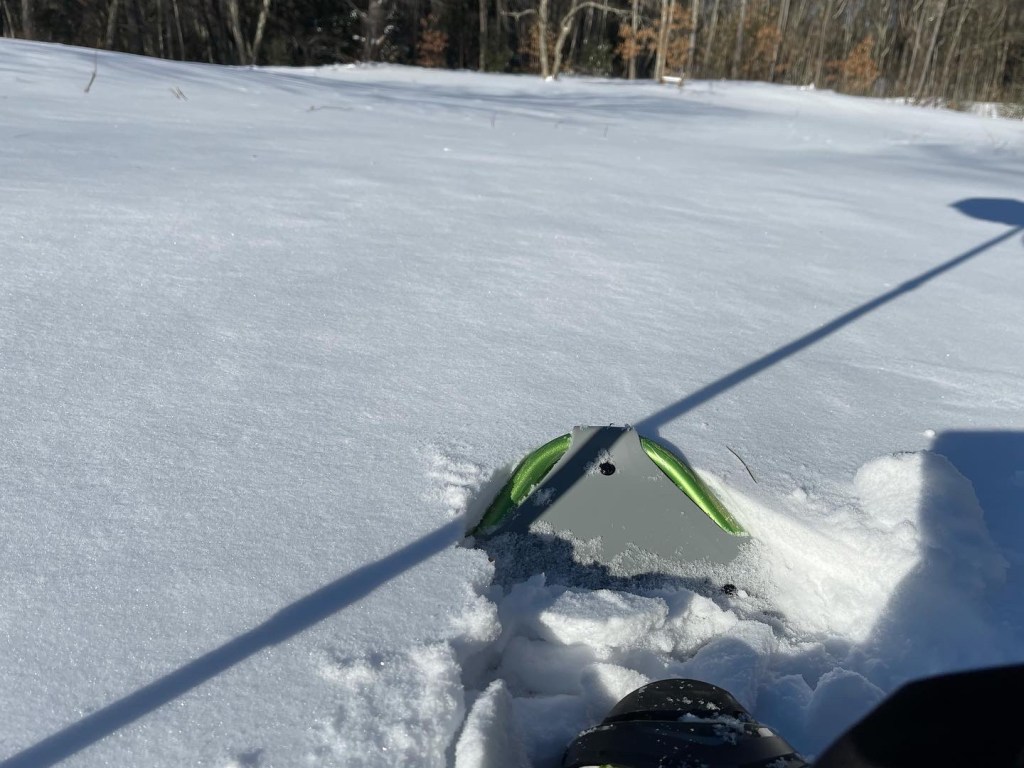
    There are different kinds of snow, and different kinds of snowshoeing. Snowshoe hiking up a mountain is very different than snowshoeing across a snow-covered field. Like walking on these terrains when there’s no snow, there’s a certain tactical change that develops with each. Hiking up a mountain, there’s a unique relief in flipping up the heel lifts on snowshoes to level your foot to the incline that you naturally wouldn’t feel on flat terrain. There’s also a wholly different intensity in grinding up an unbroken mountain trail. Steep terrain and unbroken snow are a workout. For me it’s a bit like technical writing, you know the payoff will be big but in your lowest moments the effort feels like it isn’t worth it (it’s almost always worth it).

    Flat terrain snowshoeing is a different story altogether. Easier, in a lot of ways, but that ease releases you to explore more than you might on something more technical and demanding. But that very freedom can force people to stick with the formula of the familiar. Why be uncomfortable in breaking new ground? Because that’s where things get most interesting!

    There are times when you’ve got to stay on the path. Inevitably, you’ll begin on broken ground: trails that lead from a parking lot to open fields, or woodland trails that must be honored before you reach open space. There’s an obligation, unsaid, to help groom the trail by tamping it down with your snowshoes. We do our part, but it feels like paying penance, and you look ahead to where you might break free. The very unevenness of the broken trail is what makes it a chore. Compacting broken snow means staying in your lane, taking what others have left for you and finding a path through it. Broken snow, especially when regular walkers use the same trail, exposes boulders and roots and ruts that lead to post holing on the trail. There’s a certain satisfaction in tamping down the brokenness, akin, in a way, to editing a sloppy bit of writing.

    But the real fun begins when you find an opening to fly. A small break in an old stone fence that leads you to a virgin field of unbroken snow, or a wide open field with a single broken path going across it each whispers, “It’s time: FLY!” and gives you the opportunity to break from all expectations and obligations and just go for it. Like a plane freeing itself from the obligation of the runway, launching yourself into unbroken snow is freedom. It’s just you and the snow, and you can go in any direction you want.

    Writing can feel very much the same. You chafe at the obligatory structure, you get caught up in the rules of punctuation and order, you try to clean up run-on sentences and spelling errors and the like as you go. But to really fly with writing you’ve just got to just launch yourself into it, technique and order be damned, and just see where it takes you. Inevitably to places you never imagined when you started. If you truly let yourself go you don’t worry about editing the broken trail you leave behind you. There’ll be time for that another day. No, this is your time to take wing.

    If you’ll forgive me another analogy about snowshoeing and writing, it’s the conditioning. When you haven’t been out on snowshoes in a while you forget the pace and rhythm and become a bit breathless. When you do it every day you quickly find your pace and rhythm and just get right to it. It becomes natural–a part of you. And when you reach that point you can cover so much more ground than you would otherwise. The lesson, of course, is to get to it every day.

    The obligation of the broken trail
    The freedom of unbroken ground
  • For All That Is Life

    “You must understand the whole of life, not just one little part of it. That is why you must read, that is why you must look at the skies, that is why you must sing, and dance, and write poems, and suffer, and understand, for all that is life.” ― Jiddu Krishnamurti

    Having a nightcap with friends at a clever book and bar establishment in Portsmouth, New Hampshire, my attention drifted to stacks of books all around me, chess boards and kitschy furniture from another era. This was my kind of place, and one I made note to wander around in again in daylight, when I wasn’t compelled to be polite and focused on our conversation, instead of just drifting off into this newly discovered world of wonder so tantalizingly close. Such is the nature of books—they pull you in when you least expect it.

    It’s not just books. How could it be, really? All that is life is around us, nudging us to pay attention, to immerse ourselves in the moment, to listen and understand, to act and to be a part of, to share and empty ourselves to others that we might fill ourselves up again with new and wonderful bits. Like a tide flowing in and out of a bay, our accumulation and sharing of knowledge keeps our mind fresh and alive.

    We spend a lifetime trying to understand what’s all around us, and yearning for all that ever could be. We are the audience in our own life, but also an active participant in the play. None of this is all that it could ever be, but isn’t it wonderful just the same?

  • Living Like Sidney Poitier

    I had no way of knowing that there was madness in what I was trying to do.” — Sidney Poitier

    That quote was from an interview that Sidney Poitier did with Lesley Stahl in 2013 that was broadcast a day or so after his passing last week. He reveals the bold, you might say reckless, leap into acting for a man with a strong Bahamian accent who couldn’t read at the time. It would telegraph the boldness and courage with which he would live his life and manage his career.

    I didn’t want to let too much time pass between the passing of Sidney Poitier and my writing about him. He was a favorite actor, not because I’ve seen every movie that he’s done (I’ve only seen three) or because I was star struck by his screen presence, but because of the elegant, dignified way that he lived his life. There’s a lesson there for all of us.

    “I did not go into the film business to be symbolized as someone else’s vision of me. If the screen does not make room for me in the structure of their screenplay, I’d step back. I couldn’t do it. I just couldn’t do it… I live by a certain code. I have to have a certain amount of decency in my behavior or pattern. I have to have that.”

    At the end of the interview, Lesley Stahl was asking Poitier about a book he’d just written. His words were equally revealing about how he identified himself. As someone who chips away at this writing thing, I found his words compelling and relatable:

    Poitier: “I was not intending to make an impression. I was finding release for myself within myself. I was looking for who I am at this point in my life.”
    Stahl: “Did you find out?”
    Poitier: “Somewhat, yeah.”
    Stahl: “Who are you?“
    Poitier: “I’m a good person”

    During this interview he reminded me, in his quietly elegant way, of my favorite Navy pilot, my step-father who passed away last year. Maybe that’s why I found him such a compelling guy. I think it was more a passing similarity based on the interview. More to the point, it came down to his decision to live his life by a code of honor, similar to what a Navy pilot might have, and the way that he exemplified it to the end.

    Shouldn’t we all aspire to live our lives in this way?

  • Beacons

    “The books I read are like the stone men built by the Eskimos of the great desolate tundras west of Hudson’s Bay. They still build them today, according to Farley Mowat. An Eskimo traveling alone in flat barrens will heap round stones to the height of a man, travel till he can no longer see the beacon, and build another. So I travel mute among these books, these eyeless men and women that people the empty plain. I wake up thinking: What am I reading? What will I read next? I’m terrified that I’ll run out, that I will read through all I want to, and be forced to learn wildflowers at last, to keep awake.” — Annie Dillard, Pilgrim at Tinker Creek

    These stone beacons, called Inuksuk by the Inuit, are like cairns for hikers above tree line. Dillard’s description, borrowed from Mowat, stirred my imagination. I’ve used a similar analogy of stepping stones across a stream in this blog before but I love this concept of books guiding you across a barren landscape. Each of us moves through our days, finding beacons that show us the way, or, if we need it, how to get back to where we started.

    It made me wonder, reading Dillard’s words, what are my own beacons? They come readily to mind. And I smile at the recollection. For they’ve been guiding me all along through the starkest and stormiest of days. Reliable and ringing truth in my most uncertain moments. Beacons save us when all hope seems lost.

    And then, I wondered, what beacons am I building?

  • To Be a Philosopher

    “You must be one man, either good or bad. You must cultivate either your own ruling faculty or externals, and apply yourself either to things within or without you; that is, be either a philosopher, or one of the vulgar.” — Epictetus, The Enchiridion

    Do you ever wonder why the Stoics are more popular than ever? Why would Epictetus, who died in 135 A.D. be relevant today? Why would Marcus Aurelius, who died in 180 A.D. be so revered? Or Seneca, who died in 65 A.D.? I believe it comes down to a few key reasons: First and foremost, they wrote from a very human perspective that is still relatable no matter what millennium you’re passing your time in. Second; if it weren’t relevant it would have long ago been vanquished to the trash heap like the lesser work of millions before and after them. And finally, you might also say they gain a lot of momentum as the great men and women who followed them referred to them for wisdom and inspiration. And if it worked for them, why not us?

    On our journey from the vulgar, callow juvenile inside each of us to the refined, philosophical sage we may wish to become, we learn to cultivate discipline. Discipline draws us deeper into our true selves, structures our lives in such a way that we might accomplish a few things and bring us closer to becoming who we want to be. To stop looking from one shiny object to the next and focus on what means the most, now, and when we reach that stepping stone find the next.

    Will our own work become timeless, or vanquished with the lesser work of millions? We’re dealt an unfair hand trying to measure up with the greatest thinkers of the past. That’s not stoicism, that’s upward comparison. Comparing yourself to others leads to unfocused misery. It’s better to compare yourself with the person you used to be instead. Stoicism is a quest to become the best person you can be in your short time on earth. Ultimately everything we do shows the way for those who follow us. Just as those great Stoics did. If it’s transcendently great it might become timeless. But it’s not for us to decide such things.

    Our only purpose is to maximize our potential in the time we’re given. To cultivate our own ruling faculty and apply ourselves to becoming what we might. While we may.