Tag: Amor Fati

  • Consenting to Change

    “One does not discover new lands without consenting to lose sight of the shore for a very long time.” — Andre Gide

    It’s easier to stay with the tried and true. Live in the same house, commute to work the same way every morning, eat the same breakfast day after blessed day, and work in the same job for years. Routines fit like a glove, even if it sometimes feels like a pretty boring glove. Routines are the building blocks of identity. Most of us find our routine and stick with it until we’re forced to change by events out of our control. We forget sometimes that we can simply force the change upon ourselves.

    Change is the opposite of tried and true. It’s all new and sometimes we question what the hell we’re doing it for. But the funny thing about losing sight of the shore is we begin to see things we couldn’t see when we were back in that routine. Things about ourselves and our resiliency. Things about others we simply believed would always be there, just as they’ve always been. It all changes, and so must we.

    To grow, we must learn to accept and even love the changes that wash over us every day. Amor fati. And more than accepting our fate, we must develop the inclination to push ourselves to change. Consenting to change is a mindset put into action with every decision. To provoke and prod ourselves ever farther away from those familiar comfort zones and come to relish the unknown rapidly advancing upon us. Here it comes. Be ready for all that it represents.
  • Working With It

    “Accept – then act. Whatever the present moment contains, accept it as if you had chosen it. Always work with it, not against it.” — Eckhart Tolle

    I’m working through a blip in the old WordPress blog, dealing with changes I inflicted upon myself, not happy about that but accepting of the moment. life is change, and not all changes are welcome. Amor fati.

    We must work with what we’ve been given. Today I was given some never-ending tasks and a blog site that turned upside down. So it is. All that is to be done is to make the most of it, and here we are. Our only real choice in life is to carry on.

  • Here We Are

    “A fire broke out backstage in a theatre. The clown came out to warn the public; they thought it was a joke and applauded. He repeated it; the acclaim was even greater. I think that’s just how the world will come to an end: to general applause from wits who believe it’s a joke.”
    ― Soren Kierkegaard, Either/Or, Part I

    Those who pay attention know the score. Those who don’t are happy with the distractions the world flashes in front of them one after the other. They don’t want to know the score, they want to be entertained in the moment. Let the world crash down later as long as we all have a good laugh now. And here we are.

    To pay attention is to watch a story where you know the ending but you just hope maybe there will be one of those Hollywood twists that make everything all right. Whoops, the scientists forgot to carry over the extra value! Climate change is magically fixed! Only a clown would believe that, and here we are.

    The only answer is to build a resilient life for ourselves. Live in places that put us in the best position possible for the best or worst case scenario. Invest well financially, but also in our knowledge, our network and in our physical and mental health. Resilience is a way of life, not a lock on the door. It’s seeing how high the flood waters might rise and building ever higher than that. Yes, here we are, but maybe we need to move up and over there.

    The stoics went through their version of all this themselves. That they wrote about it offers us a light in the darkness with which to navigate. We too may be writers and thinkers and live boldly individual lives apart from the whims of a distracted society. We’ll be fine or we won’t, all we can control in the universe is how we react. Amor fati (love of fate). And here we are.

  • Stories to Tell

    He who does not travel, who does not read,
    who can not hear music,
    who does not find grace in himself,
    she who does not find grace in herself,
    dies slowly.
    He who slowly destroys his own self-esteem,
    who does not allow himself to be helped,
    who spends days on end complaining about his own bad luck, about the rain that never stops,
    dies slowly.
    — Martha Medeiros, Die Slowly

    Sure, this blog is one big reminder to live in the moment and to savor it all. Amor fati already! The aim is a counter narrative to the relentless soundtrack of outrage, nihilism and distraction found in most media platforms nowadays. Be the change you wish to see in the world and all that. In this way the blog is a lifeline to anyone who needs to hear it, beginning with the author.

    What became clear a thousand posts or so ago is that writing a blog is a solitary act of self reflection shared with the world, or at least the few that seek it out or stumble upon it. Travel, reading, music, gardening, hiking—whatever it is we’re exploring in the season and discovering within ourselves ought to be fair game. Every day is a statement of here we are.

    We are alive today, and maybe not tomorrow. We must heighten our appreciation for that gift and find within ourselves the grace to accept and carry the weight of our brief shelf life. Not to dwell on it, just to acknowledge it as a compelling reason to jump back into the dance with life.

    So bravo to the adventurous spirits who seize their precious lives and get after it. We all should be so bold. You do you, I’ll do me, and perhaps we’ll meet on the dance floor one day soon. If we are blessed to meet again, may we each have our share of intriguing stories to tell.

  • What Our Situations Hand Us

    They say that these are not the best of times
    But they’re the only times I’ve ever known
    And I believe there is a time for meditation
    In cathedrals of our own
    Now I have seen that sad surrender in my lover’s eyes
    And I can only stand apart and sympathize
    For we are always what our situations hand us
    It’s either sadness or euphoria
    — Billy Joel, Summer, Highland Falls

    We would be naive to believe that every day would be sunshine and roses. We must build ourselves up to become resilient, accept our fate whatever it happens to be, and manage our situations as best we can. Amor fati indeed.

    If there’s a problem with the world today, it’s this feeling of entitlement and privilege that develops through comfort and distraction. Collectively we lose our capacity to manage the waves of challenges that life throws at us. We build resilience through stressors in our lives, just as we build perspective and empathy by getting out of our own heads and seeing what the rest of the world is dealing with. It turns out quite a lot, actually, and we aren’t the center of the universe after all.

    Philosophy isn’t an escape, it’s a set of tools that help us manage whatever situation we happen to be in now. It tempers us when things are going well, and keeps us afloat when we feel like we’re drowning in it all. It turns out there is a time for meditation, and there is that ultimate power to choose our response between stimulus and response, as Viktor Frankl pointed out to us.

    Somewhere between sadness and euphoria is our normal state. We go through life learning lessons, adding tools to our kit that we may use when we plummet into challenges or soar into bliss. We learn what we can control or influence and what simply happens no matter what we do. Amor fati is simply accepting it all for what it is. We are human after all.

  • Time to Step Out

    House on fire
    Leave it all behind you
    Dark as night
    Let the lightning guide you
    Step outside, time to step outside
    Time to step out
    — José González, Step Out

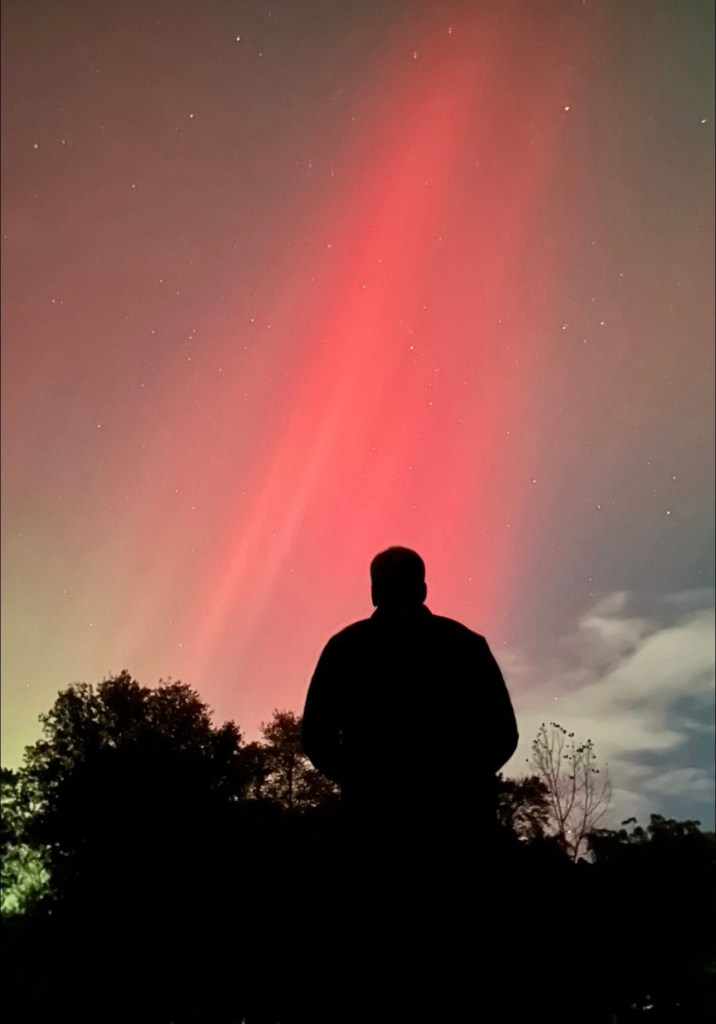
    Yesterday was one of those epic days we’ll remember for the rest of our days. I picked up my daughter from a red eye flight, which meant I was up quite early myself, and capped the evening with the northern lights dancing brilliantly overhead late into the evening. Why does anyone stay inside when the universe wants to play with us just out the door? Just what call are we listening for instead?

    Every other time I’ve chased the aurora borealis I’ve gone somewhere other than home. Most of the time I’ve come up empty. Scotland, Iceland, Maine, and northern New Hampshire have largely mocked me with overcast or a fickle aurora. But there’s something to that Cheryl Strayed quote about putting ourselves in the way of beauty that continues to whisper to me. Step out! Be patient…

    What we seek often comes to us if we simply get out of our own way and put ourselves in the way of it. Last night I opted to stay put and see if Norðurljós wanted to dance. It turned out she did, and what a performance!

    The thing is, we get wrapped up in what we miss, instead of simply stepping out of ourselves to find what is often right in front of us. Something like the northern lights is out of our control most of the time, but what is in our control is a willingness to dance with whatever comes our way. Amor fati: Love of fate. Fate brought my daughter home and a visit from Norðurljós in one memorable day.

    Photo credit to my daughter for this one
    Visible to the naked eye, but incredibly bright in night mode
  • Have a Look

    “Mountains should be climbed with as little effort as possible and without desire. The reality of your own nature should determine the speed. If you become restless, speed up. If you become winded, slow down. You climb the mountain in an equilibrium between restlessness and exhaustion. Then, when you’re no longer thinking ahead, each footstep isn’t just a means to an end but a unique event in itself. This leaf has jagged edges. This rock looks loose. From this place the snow is less visible, even though closer. These are things you should notice anyway. To live only for some future goal is shallow. It’s the sides of the mountain which sustain life, not the top. Here’s where things grow.
    But of course, without the top you can’t have any sides. It’s the top that defines the sides. So on we go—we have a long way—no hurry—just one step after the next.” — Robert Pirsig, Zen and the Art of Motorcycle Maintenance

    I see it in the pup when we get home. She bolts into the house, looks for our friends who’d been staying with us, and realizes the emptiness in a sad look back at me. Life is change, I want to tell her, but the beauty of being a dog is there’s always a chipmunk to chase down outside, and she’s soon forgotten her sadness and is out hunting instead.

    The thing is, it’s humans that really pay the price of change every day. It’s part of growing into who we may be next. Holding on to the past wastes today. And so the only answer is to savor more. Carpe diem is more than just seizing the day, it’s embracing all that it offers. In this way it pairs well with that other reminder from our stoic friends: Amor fati: Love of fate.

    We grow in the climb itself, even as we aspire for the summit. And so on we go. We ought to be careful what we wish for, for as Pirsig points out, we’ll miss all the good stuff charging ahead through life in hopes of reaching some imagined better place. Our place is simply where we’re standing now, friends, even as we’re poised for the next step. So have a look.

  • The Choices We Make

    “In the long run, we shape our lives, and we shape ourselves. The process never ends until we die. And the choices we make are ultimately our own responsibility.” ― Eleanor Roosevelt

    We who live in free societies have agency. Sometimes it doesn’t feel that way as the world works to impose its will on us, but we can make choices and take action that will take us towards our desired outcome. No matter how crazy life gets at times, we must remind ourselves that we choose how to react to circumstances. The choices others make may impact our own, but the choices we make are still, and always, the choices we make.

    Some never stop blaming others and fate for the hand they’ve been dealt, without seeing the choices all around them. Without accepting and even embracing fate (amor fati). We must learn to own our choices. It’s part of growing into adulthood. The process of becoming never ends until we do. Knowing this, we ought to always be asking of ourselves, what next? For the process, for now, continues.

  • The Occasional Success

    “It is six A.M., and I am working. I am absent-minded, reckless, heedless of social obligations, etc. It is as it must be. The tire goes flat, the tooth falls out, there will be a hundred meals without mustard. The poem gets written. I have wrestled with the angel and I am stained with light and I have no shame. Neither do I have guilt. My responsibility is not to the ordinary, or the timely. It does not include mustard, or teeth. It does not extend to the lost button, or the beans in the pot. My loyalty is to the inner vision, whenever and howsoever it may arrive. If I have a meeting with you at three o’clock, rejoice if I am late. Rejoice even more if I do not arrive at all.

    There is no other way work of artistic worth can be done. And the occasional success, to the striver, is worth everything. The most regretful people on earth are those who felt the call to creative work, who felt their own creative power restive and uprising, and gave to it neither power nor time.” — Mary Oliver, Of Power and Time

    It feels like success is more elusive nowadays. We could all use more wins in this stage in our collective history. A few less setbacks would be great. Just what is happening in the world anyway? Nothing all that good it seems. We must remember to focus on what we can control and acknowledge the rest is up to fate. Amor fati.

    The thing we can control is our reaction to this world boiling away uncontrollably in rage and gases. We don’t have to like it but we have to remain focused on the things within our grasp, like how we greet each other and the example we set for our children. We can choose to be cool and steady, and produce something beautiful in this world.

    Distraction is pulling us down from the heights we might reach. What does success look like today? Small wins have a way of stacking up into something bigger. When the sun sets on this day, on this lifetime, what will we have done with it? The muse will not be ignored, it will simply find someone else who will give it the focused time it demands. Let that be us.

  • Emergency Room Poetry

    “I don’t know if I will ever write another poem. I don’t know if I am going to live for a long time yet, or even for a while.
    But I am going to spend my life wisely. I’m going to be happy, and frivolous, and useful….
    To rise like a slow and beautiful poem. To live a long time.”

    — Mary Oliver, Fletcher Oak

    Hours waiting quietly in an emergency room, alongside the patient dozing on a bed nearby, her husband dozing in a chair next to me, and a constant stream of activity feet away as the frailty of humans is displayed in one example after another. But not just frailty—resiliency is also on display. So many people fighting for better health and another day. We have only to see the staff in an emergency room in action to know that the best of humanity lingers among us.

    It’s unspoken, but acknowledged. You assess the people around you and the suffering they’re dealing with in this particular moment in our collective history. They do the same with you. What brought us all here? Most often not how we expected this day to go. Yet here we are. Amor fati.

    The waiting rooms in hospitals usually have televisions broadcasting something uncontroversial, like cooking shows. There’s already enough tension in such places without pouring gas on the fire. But inside the locked door where treatment happens (or where you await it) there are no such distractions as cooking shows. It’s here that people learn to listen to themselves again, or glance at others, or most often, text and scroll with the outside world, far from this place.

    I chose Mary Oliver. Poetry in the quiet moments awaiting answers, awaiting treatment for those I support, those who have supported me on my own down days. Here I sat in awe of doctors and nurses doing what is routine for them. Asking questions and texting updates when there were any, feeding crackers to the patient and joking about sneaking gin and tonics in. Whatever it took to make the moment better. To be useful in a challenging moment is all we can ask of ourselves.