Tag: Benedict Arnold

  • A Visit to the Major John André Monument

    “I had taken my station close on the left of Major Andre’s left hand officer; and continued in that station the whole march. The guard marched a short distance when it wheeled to the left, turning a corner of the road, and marched a short distance, when they again wheeled to the left, in order to pass through a fence. Having entered a field, they marched forward a short distance, wheeled to the right, and halted. The ground here was level; a little distance in front was a moderate ascending hill, on the top of which the gallows was erected. In the position where they halted, Major Andre was, for the first time, in view of the gallows. Major Andre here said, ‘Gentlemen, I am disappointed. I expected my request’ (which was to be shot) ‘would have been granted.’ No answer was given, and he continued with his arms locked with those of the two officers.Dawson, Papers Concerning André

    Early one morning, as commuters made their way to work and parents waited for the school bus on street corners throughout town, I made a quick stop to visit the Major John André Monument. André was swept up in the treason of Benedict Arnold and paid the ultimate price when Arnold wouldn’t turn himself in, hung and buried at this spot on 2 October 1780. George Washington himself would lament the death of André, stating that “he was more unfortunate than criminal”.

    The Hudson River Valley was once the headquarters for George Washington. The river was a critical transportation hub, and if the British were to control it they would have cut off New England from the rest of the colonies. Benedict Arnold was once a highly-respected leader in the Continental army and the fight to protect the Hudson River and Lake Champlain from British control. But he was increasingly frustrated with his status, feeling like he wasn’t properly honored and rewarded for his leadership. His wife was also a Tory and desired a better position in society. This made him a prime candidate for recruitment by the British turn against the American Colonies.

    Major John André, a rising star in the British Army, was chosen to meet with Benedict Arnold to formalize the details of engagement and Arnold’s rewards, both financial and status, for turning against the Americans. Arnold and André met on a warship in the Hudson River and again on shore not very far north from where André’s American journey would end. Unfortunately for André, his warship was chased off by cannon and during his overland journey back to British-controlled territory he was captured in enemy territory while disguised as an American. This made him a spy and subject to execution. That execution would happen on a small hill in what is now Tappan, New York.

    “Every attention and respect was paid to Major Andre that it was possible to pay to a man in his situation … every officer and soldier in the army would have lifted both hands for the exchange of Andre for General Arnold. This exchange was offered by General Washington, but refused by General Clinton, the British Commander-in-chief. So the life of a traitor was saved; and Major Andre fell a sacrifice” Dawson, Papers Concerning André

    Major John André was later exhumed from the site and is now buried as a hero at Westminster Abbey. The site of his execution remained unmarked and, like so many historical places, eventually doomed to obscurity. In 1879, a wealthy American named Cyrus W. Field, who laid the first telegraph cable across the Atlantic Ocean, decided to put a monument up honoring Major John André. It makes sense that a man who made his fortune connecting the Old World with the New would seek to honor a dignified officer seen as more unfortunate than criminal. But it would take time for the community to see it the same way. As you might imagine, erecting a monument honoring an enemy soldier associated with the most notorious traitor in American history was unpopular at the time, and there were three attempts to destroy the monument before someone decided to add a plaque honoring George Washington and his army.

    You’d never know the monument was there, in the middle of a small traffic circle on a quiet residential street, if you didn’t seek it out. Such is the nature of the Hudson River Valley today, rooted in history but built for the future. The former encampment and small hill where Major John André met his fate are today simply suburbia in Metro New York. Yet history still whispers here, and reminds us that nation-defining heroism and treachery once played out right here.

  • Favorites From a Year of Reading

    This might go down as my favorite year of reading.  I made it a goal to read more the last two years, and the momentum from 2018 definitely carried over into 2019.  Reading inspired my travel to new places and offered side trips of meaning in places I’ve been many times before.  It kicked me in the backside with work, writing, exercise and diet, and it inspired me to be a better version of myself than I previously had been.  I’m still a work in progress, but aren’t we all?  In all I read 23 books cover-to-cover in 2019, and dabbled in chapters of a few more.  Here are my ten favorite books this year:

    Atomic Habits by James Clear was by far the most impactful book on self-improvement that I’ve read in many years.  Strongly recommend this if you’re looking to make meaningful changes in your life.  I’m going to re-read it again in January to get a jump-start on 2020.  Habits that are now part of my identity include reading, writing, walking and drinking water.  Habits that went by the wayside include daily burpees and drinking less.  2020 (every day really) offers a chance to reset on habits, with new possibilities with learning language(s) and a few notable work goals.

    The Gift by Hafiz is a stunningly beautiful collection of poems.  Why it took me until 2019 to find Hafiz I don’t know…  but I’m glad I got here.

    Dream Work by Mary Oliver is another collection of brilliant poetry that it took me way too long in life to discover.  Maybe Oliver’s passing this year put a spotlight on her work, or maybe the student was finally ready.  Either way I’m glad I’ve immersed myself in the world of Mary Oliver.

    To Shake the Sleeping Self: A Journey from Oregon to Patagonia by Jedidiah Jenkins is a travel book on the one hand, and a journey of self-discovery one the other as Jenkins wrestles with his religious upbringing and his sexual identity during an epic biking trip across North and South America.  The book reinforces my belief that most people are good while acknowledging some good fortune along the way.  As a bonus, Jenkins pointed me towards one Hafiz poem, Tim Ferriss pointed me towards another, and soon I was reading The Gift (above).

    Awareness by Anthony De Mello is not the kind of book I ever would have picked up, as it feels self-helpy and overly religious at first glance.  And it does have a healthy dose of both things, but this books is an incredible call to action for the self, and backed up with tremendous insight into human nature.  Another book I wish I’d read years ago that I’m glad I got to in 2019.

    How the Scots Invented the Modern World by Arthur Herman is a book I’ve had on the shelf for years that I finally got to in 2019.  Perhaps inspired by my then upcoming trip to Scotland, I burned through the book quickly, learning a lot about the Scottish people who made a massive impact on the world we live in today.  It also prompted me to add a few places to my trip that I might not otherwise have gone to.

    The Map Thief by Michael Blanding poured gasoline on my burning fascination with old maps, and fired me up in another way; as someone who is passionate about historical artifacts like maps and old books, and also in a career based on securing people and assets from criminals like Forbes Smiley, this book was highly relevant for me.

    The French and Indian War: Deciding the Fate of North America by Walter R. Borneman offered me more insight into the place I live than any history book in a long time.  The Northeast corner of North America is where most of this fighting took place, and I took the opportunity to visit many historically important sites in my travels that were inspired by this book.

    Benedict Arnold’s Navy: The Ragtag Fleet That Lost the Battle of Lake Champlain But Won the American Revolution by James L. Nelson is a look at the complex individual that is Benedict Arnold.  And it goes well beyond the Battle of Lake Champlain, with a detailed account of Arnold’s epic raid of Quebec through the wilderness of Maine.  The retreat from Quebec opened up the St Lawrence River to the British, which put Lake Champlain and Lake George in their sites as the critical water route to the Hudson River. Arnold’s fleet delayed the British just long enough to set up the victory at Saratoga (where Arnold played a critical role as well).  I followed this book by reading Valiant Ambition by Nathanial Philbrick, another excellent book with even more detail on complicated life of Benedict Arnold.  Benedict Arnold’s Navy inspired that read, so it gets the nod here in the top ten.

    The Daily Stoic: 366 Meditations on Wisdom, Perseverance, and the Art of Living by Ryan Holiday is, as the title indicates, meant to be read daily, one quick dose of stoic medicine at a time.  After immersing myself in Marcus Aurelius’ Meditations in 2018, I felt that The Daily Stoic would be a great way to add a little daily stoicism to my life.  And it became part of my morning routine, where I’d read this before other books.  I’ll continue this habit by re-reading The Daily Stoic one day at a time in 2020 and on into the future.

    So there you go, my top ten favorite reads in 2019.  I’m a better person for having read them all, and look forward to revisiting several of them again and again in the years to come.  I’m a better writer for having read them all (still a work in progress).  And there’s a big stack of exciting books to tackle waiting patiently beside them.  So here’s to some great reading in the year ahead!

  • Samuel Mott; General and Justice of the Peace

    I love random events that introduce me to people from the past.  It’s a dance with a ghost, a handshake with history.  This is one of those stories…

    I’d driven by this monument several times over the last few years whenever I went to Foxwoods Casino for meetings.  Shaped like a pawn on a chessboard, it was big and different and meaningful when placed on this spot, but seemed largely neglected and ignored by the thousands of cars that drive by going to and from the casino.  I’d glance over and contemplate stopping to read the engraved tributes on the monument, but the driveway was tight and not particularly welcoming for someone zipping by in a line of cars.  From the road I could read the dates on the top of the front face of the monument – 1861 1865 – the American Civil War.  Just about every town that was a town during the Civil War has a monument to those who served, and in many cases died there.  I resolved to pull into the tight driveway on my return from my meeting for a quick visit.

    By all accounts, this monument isn’t a big draw.  I may be the first person to pull into the driveway to walk around it in months.  It’s lovely and all, but let’s face it, most people aren’t thinking about the Civil War and World War One veterans of Preston, Connecticut.  The monument is right up on the road, but there are no flags commemorating those who fought, and on this rainy day no flag on the flagpole behind the monument either.  The monument was sited on the grounds of the former mansion of General Samuel Mott, who lived here and apparently, like seemingly every soldier in the Revolutionary War, hosted General George Washington.  His home is long gone, but the library that replaced the building stands watch.  The library in turn has been replaced by a newer building somewhere else in town and the old one, like the monument, doesn’t appear to have a lot of visitors.

    Of the four faces on the monument, two are dedicated to the Civil War veterans from Preston who served, one to the guy who paid for the monument in 1898 (That guy gets a nod if only for preserving his name for the life of that monument for a modest cash donation.  Hey, you can’t take it with you…), and one face was dedicated to General Samuel Mott.  That face was facing the old library, meaning it was facing away from the road…  meaning that very few people ever read his name anymore.

    This monument marks the dwelling place of General Samuel Mott

    Eminent citizen

    Upright Magistrate

    Soldier of the Revolution

    Friend of Washington

    To honor the Civil War veterans, the town offered these two tributes:

    “From this town obedient to the call of patriotism and humanity went forth one hundred and fifty men as soldiers in the Civil War.”

    “In grateful memory of those citizens of the town of Preston who served their country in arms in the war for the preservation of the Union.”

    Interestingly, the town decided to bolt on a bronze tablet honoring the men from Preston who served in World War One below the “grateful memory” engraving.  I imagine there are other memorials in town to the veterans of each war, but I found it curious that they turned the Civil War memorial into a general “War Memorial” after WWI.  There’s likely a story about the bolting on of the tablet buried somewhere in the town’s history, but it speaks to Yankee frugality.  At least they faced it towards the road so people could see it.

    “Colonel (afterwards General) Samuel Mott, at whose house General Washington is said to have called, lived in Preston City; his house occupied the spot where now (1922) stands the Public Library of that town  …  Samuel Mott was appointed an Engineer in 1776.  He was Lieutenant-Colonel when he served in the Northern campaign at Ticonderoga, Crown Point and Quebec…” The Descendents of Governor Thomas Wells

    Samuel Mott wasn’t a big name in the Revolutionary War, but he served his country in some of the most critical battles in the early part of the war.  Being promoted to general was a highly political business during the war, but it does speak to some level of respect for his accomplishments to that point.  I’m sure he knew Benedict Arnold well, being a fellow Connecticut guy, and likely served under him on those early campaigns when Arnold was still a complicated hero.  Arnold led troops to Quebec through Maine and was met there by General Richard Montgomery, who came up from Lake Champlain.    The soldiers who laid siege on Quebec faced starvation, smallpox, and a determined enemy.  They barely escaped with their lives when the British sailed up the St Lawrence River in the spring to reinforce Quebec and drive out the Northern Army.  Mott is a guy who saw a lot in his time in the army.

    Mott moved to Preston in 1747, and came back after the war, where he served as the Justice of the Peace.  There’s a record online of the many marriages that he blessed from 1769 to 1811.  He died in 1813 at the ripe old age (for the time) of 78, and likely had quite a few people remembering him fondly as the gentleman who married them.  I think of that Jewish saying when I meet someone long gone randomly:  We all die twice; the day we stop breathing and the day people stop saying your name.   If that’s the case, Samuel Mott has a little more time with us.  I appreciated the call to go visit his old stomping grounds on a rainy June afternoon.  My dress shirt quickly darkened as the rain pelted down on me as I walked around the monument reading and taking pictures.  Drivers buzzing by surely thought I was crazy and they may be right.  But I’m glad I stopped, and I’ll be sure to give a nod to the General whenever I drive by that monument.


  • Oriskany

    I wasn’t planning on another detour on this trip, but saw the sign, calculated the total time the detour would take and made the decision to stop by the battlefield.  I was deeply impressed with the quiet dignity of the site, and reflected on the violence that took place in the ravine I walked down into.  The battlefield is nothing but tranquil today, save for the landscaper mowing the fields.  But at 10 AM on August 6, 1777 this valley erupted in thunderous clouds of gunfire and screams the hidden Loyalists and Iroquois aligned with the British ambushed a column of American patriots and Oneida Indians allied with them.  That this battle pitted neighbor against neighbor, Iroquois tribe against Iroquois tribe makes the results all the more devastating.

    We met the enemy at the place near a small creek. They had 3 cannons and we none. We had tomahawks and a few guns, but agreed to fight with tomahawks and scalping knives. During the fight, we waited for them to fire their guns and then we attacked them. It felt like no more than killing a Beast. We killed most of the men in the American’s army. Only a few escaped from us. We fought so close against one another that we could kill or another with a musket bayonet…. It was here that I saw the most dead bodies than I have ever seen. The blood shed made a stream running down on the sloping ground.” – Blacksnake, Seneca War Chief

    When I decided to divert from I-90 to check out the battlefield, I had no idea what to expect.  I’d seen pictures of the monument, but there’s an emotional weight in walking in the footsteps of those who perished here down into that ravine, across the creek and up the other side.  The land looks remarkably similar to what it looked like then.  Perhaps more fields have replaced the deep forest of the day, but this area remains largely undeveloped, and will remain so as the Oriskany Battlefield State Historic Site.

    So I pulled into the driveway leading to the monument and drove down to the parking area.  The 85 foot tall oblisk built in 1883 dominates the landscape in front of you.  But I’d noticed another monument and some signs marking historically relevant locations on the battlefield off to the right as I drove in, and decided to walk over to check those out first.  This is the best approximation of where the ambush took place, and looking around it seemed as appropriate a spot as any.  I walked up to the monument honoring General Nicholas Herkimer, wounded in the initial ambush, who famously directed patriot forces into defensive positions from behind an ash tree at or near this location. The Iroquois warriors would wait for a soldier to fire their one shot then rush at them with tomahawks and knives. This was up close, brutal fighting that decimated the American forces. Herkimer directed his men to pair up, with one firing while the other reloaded, to counter this rush.  Herkimer was shot in the leg, and died when the amputation to save him didn’t go as planned.  I wonder sometimes if Benedict Arnold, shot in the leg later in the same year, refused to have his leg amputated after seeing what happened to Herkimer?

    Of the almost 800 American and Oneida ambushes, almost half were killed, and overall casualties were over 500. For the patriotic farmers who rallied to save their brothers-in-arms under siege at Fort Stanwix, the ambush quickly ended their dreams and destroyed the lives of their families back home.  By all accounts these were tough losses for any army, but for Tryon County, it was a devastating loss of fathers, brothers and sons that brought the county to its knees.

    Ultimately the relief column suffered far more casualties than the defenders at Fort Stanwix, who were saved when Benedict Arnold orchestrated a con to make the British and Iroquois think he was much closer to engaging with them, and with many more troops than he actually had.  But that’s a story for another day.  The Loyalists who survived would eventually flee to Canada or other British territories as reprisals reached their homes as momentum swung away from the British.  While the battle at Oriskany was a huge setback in momentum, it was another domino in the string of events that led to the defeat of General Burgoyne’s army at Saratoga.

    On this rainy June afternoon, I had the place largely to myself.  There were about a dozen New York State Troopers visiting, a couple huddled under an umbrella, a man walking two Labrador retrievers, and… me.  The experience reminded me of my trip to Hubbardton a couple of months ago, the quiet solitude and signs describing the lay of the land on the day of the battle were similar.  But Oriskany felt different, because what happened here was different. Hubbardton was a retreating rear guard being caught by a faster moving British force. Oriskany was neighbors ambushing neighbors. Iroquois tribe against Iroquois tribe. A mass casualty event that shook a region. The Revolutionary War was far more complicated than Americans overthrowing a tyrannical oppressor. It was a messy divorce that forced each individual to decide which parent they were going to remain with, and which one they would betray in the most violent ways.

    Visiting the Oriskany battle site is easy. Roughly ten minutes off I-90, it offers a quick respite from travel, and perspective on the sacrifices others made to give us the freedom to do so. On the day I visited, as with other battlefields related to the Saratoga campaign, a quiet stillness prevailed. There’s a small building set down behind the monument where you can learn more about the site and events that day, and (please) leave a donation to help support the maintenance of this sacred ground.  The obelisk is showing signs of wear and needs renovation, but remains a striking tribute to those who fell here.

  • Two Epic Marches in 1775

    During the early days of the Revolutionary War, there were two epic marches of heroic proportion.  Henry Knox’s Noble train of artillery in November and December 1775 was one.  Benedict Arnold’s march through the wilderness of Maine for the invasion of Quebec in September to November 1775 was the other, and the one that seems to have been lost to history because of Arnold’s turncoat future in the war and the immediate result from each effort.

    Benedict Arnold was the person credited with the idea of hauling the artillery from Fort Ticonderoga to Boston, which was occupied by British troops but under siege from the colonists.  The Generals recognized that a long, drawn-out siege was going to help the British more than the colonists, as reinforcements from England would be arriving at some point in the spring to try to eradicate the uprising.  Ships in Boston harbor weren’t going to leave just because militiamen were surrounding Boston.  Artillery was needed to encourage them to move on.

    Since Arnold was a little busy marching through the wilderness of Maine, it fell on Henry Knox to bring the cannon from Ticonderoga to Boston.  As with any travel in those days, using existing waterways was much easier than horse paths through the woods.  So bringing almost 120,000 pounds of cannon down the Hudson River to Albany made a lot of sense, but from there they needed to haul the cannon on sleds across ice and rough terrain all the way to the Dorchester Heights.  The hardest part of this overland trip must surely have been bringing them over the Berkshires roughly where Blandford, Massachusetts is today (where the Massachusetts Turnpike cuts through the Berkshires).

    Arnold by contrast sailed to the Kennebec River and up to Augusta, Maine, where he began his march through the wilderness to Quebec.  He started with 1100 men, and reached the St. Lawrence with about 600 starving men.  Some starved to death on the trip, and the rest abandoned the march and retreated towards home.  Arnold’s expedition was even more bold than Knox’s.  Yet the immediate results were very different.  Knox’s artillery chased the British out of Boston on what is forever celebrated as Evacuation Day in the city.  Arnold’s army reached Quebec and were met there by Montgomery’s troops who had come from Lake Champlain.  Ultimately they didn’t have the numbers or the artillery to lay a proper siege on Quebec, and they were eventually chased away as the ice broke on the St Lawrence and British reinforcements arrived to chase them down.

    Two men remembered differently in history.  Benedict Arnold’s name is forever associated with treason, but in the early years of the war he was a hero many times over.  Henry Knox would continue to grow his career in the Continental Army, becoming the Secretary of War for the United States.  His name lives on at Fort Knox.  Benedict Arnold doesn’t have any forts named after him, but the United States may not have won the war without him.

  • Benedict Arnold

    Growing up in the United States of America, you heard a version of history that made our Founding Fathers and the generals who fought the American Revolution out to be heroes.  And in many ways they were.  The winners write the history, no doubt, but they did create a democracy that was the envy of the world while fighting off the greatest military power of the day.

    I’ve read that if Benedict Arnold had been killed at Saratoga instead of badly wounded he would be remembered as one of our greatest heroes.  There’s no doubt that he was a complicated man; aggressively ambitious to a point where he drove those he commanded, was loathed by many of his peers, but loved as a true leader by anyone who saw him in action.  
    Had Benedict Arnold not turned against the colonies, he would have been celebrated as one of our greatest military leaders for his raid on Quebec, the raid on Ticonderoga, the Battle of Valcour Island on Lake Champlain against overwhelming odds, the Battles of Ridgefield, Connecticut and Saratoga. In all of these, Arnold exhibited courage, persistence, strategic vision and competitive spirit critical in war.  He sacrificed an enormous amount of his personal wealth and political power for the Revolution, and was a key reason the British were ultimately defeated.  And yet he’s best known for his betrayal.
    You can’t take omit that betrayal when considering the man.  There’s no doubt that he deserved the condemnation and infamy he received and receives to this day for not just betraying the colonies, but also betraying George Washington and the troops he served with.  But it’s… complicated.  If Arnold weren’t such a hero in 1775-1778, his betrayal in 1780.  He remains the most famous traitor in history, and the most forgotten hero.
    I’ll try to visit a few of the places that Benedict Arnold made history in.  Not because I admire the man, but because without him I’m not sure that the Continental Army would have won in the end.  And what would our history have been then?  Unlike Washington, there aren’t a lot of “Benedict Arnold slept here” placards on the sides of colonial era homes.  But there are monuments to what he accomplished, and I’d like to explore a few of those in 2019.
  • Pass the Flowing Bowl

    When Ethan Allen and the Green Mountain Boys helped Benedict Arnold seize Fort Ticonderoga, they apparently wanted to celebrate the occasion.  In 1775 these two men, who couldn’t be more different, led the attack on the lightly defended fort, winning it without a fight.  British soldiers stations there hadn’t heard about Lexington and Concord yet, and had no idea that they might be attacked by people who were supposed to be loyal to the crown.  For the Green Mountain Boys, the best way to celebrate was to pass the flowing bowl around.  The bowl was usually filled with punch.

    The recipe for punch varied from place to place across the globe, but in the American Colonies it called for rum.  Punch rivaled ale and flip in popularity, and in some colonies exceeded it.  Punch had an added benefit over Flip or ale in that it helped introduce fruits and juices into the diet of colonists, which certainly improved their overall health (rum aside) and fending off scurvy.Wayne Curtis in And a Bottle of Rum referenced a recipe for Planters Punch that was published in The New York Times in 1908 in the form of a ditty:

    “This recipe I give to thee,
    Dear brother in the heat.
    Take two of sour (lime let it be)
    To one and a half sweet.
    Of Old Jamaica pour thee three strong,
    And add four parts of weak.
    Then mix and drink “I do no wrong – 
    I know whereof I speak.”

    Back in my college days, I thought I’d be clever and mix up a batch of punch for a party.  Not being an expert in the art of mixology, I was pretty aggressive in my pours, adding several spirits into a bowl and adding Hawaiian Punch or something like it.  After celebrating a bit too much with this concoction, the night took a turn for the worse.  It was the first and last time I’ve ever made punch.

  • The Great Carrying Place

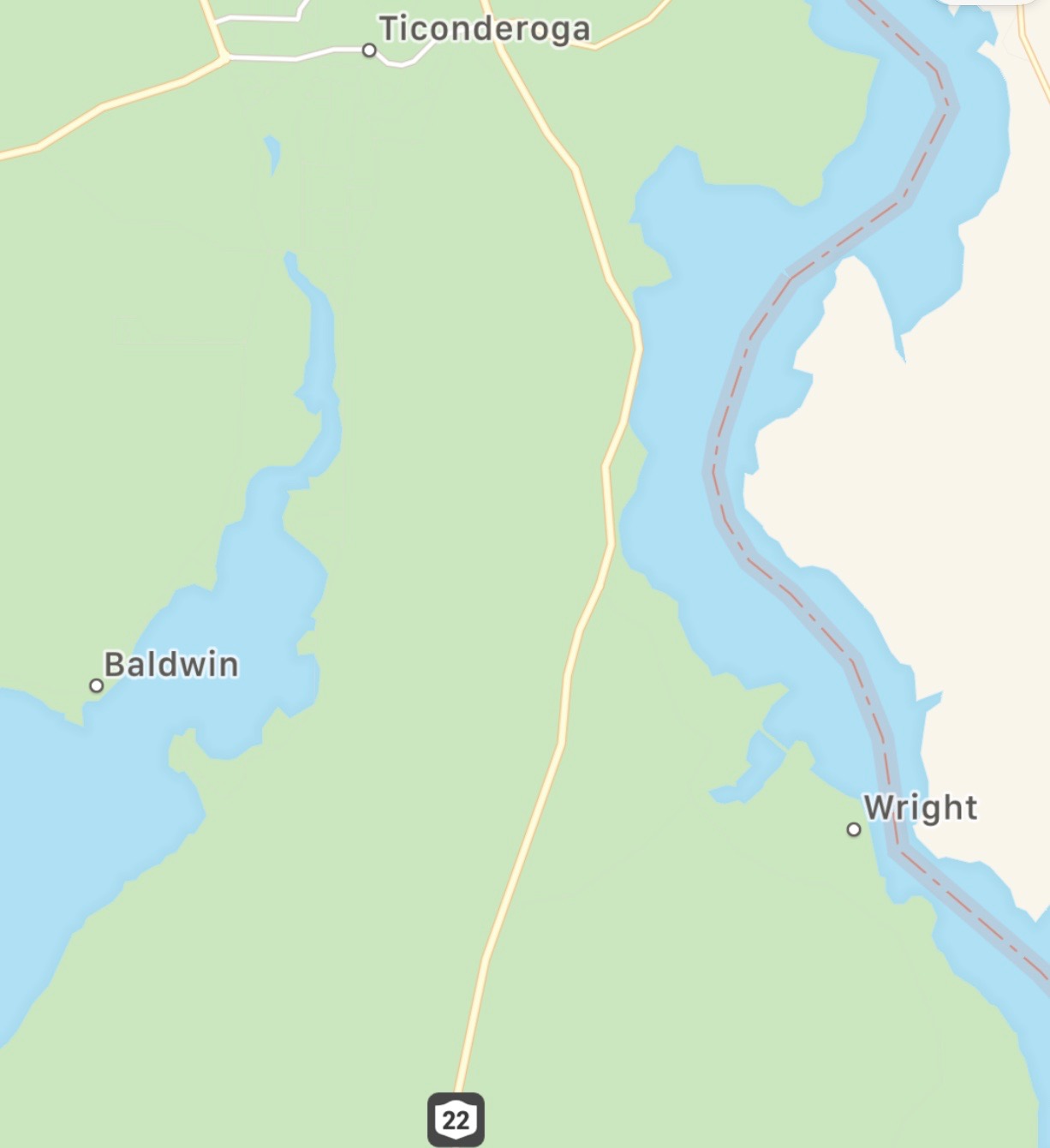
    There’s an almost unbroken stretch of navigable water from New York City up the Hudson to Lake George to Lake Champlain to the St. Lawrence Seaway, which in turn leads back to the Atlantic Ocean or deep into the interior of North America to the Great Lakes.  The “almost” part is a couple of stretches of land that must be portaged where the La Chute River is unnavigable.  This two mile stretch of land between Lake George and Lake Champlain is the place the Native Americans called “the great carrying place”.  There are other portages with the same name, notably a stretch of trail in Maine that Benedict Arnold used to invade Quebec, but this stretch in New York is arguably much more strategic.

    In the years before and during the French and Indian War this was one of the most strategically important and thus heavily contested patch of wilderness in North America.  Navigable water was the most efficient and fastest way to travel at the time, and aside from this stretch of land navigable water was close to unbroken.  During the Revolutionary War this place was the site of significant naval and land battles led by Benedict Arnold.

    I’ve been to Glens Falls and Saratoga many times.  I’ve been to Lake George once or twice.  And I’ve been on and most of the way around Lake Champlain.  But I’ve never viewed the region with the educated eyes of a historian.  It’s not that I didn’t know the rough history of the region, it’s that I was apathetic towards it.  I’m not longer apathetic.  The next time I make my way through the region I’m going to spend a little time immersing myself in the history of the region.  Fort Ticonderoga, Mt. Defiance, Saratoga and so much epic history happened right in this area.  I can’t very well ignore it now can I?