Tag: Cape Cod

  • The Naming of Cape Cod

    “On the 26th of March, 1602, old style. Captain Bartholomew Gosnold set sail from Falmouth, England, for the North part of Virginia, in a small bark called the Concord… The 15th day,’ writes Gabriel Archer, ‘we had again sight of the land, which made ahead, being as we thought an island, by reason of a large sound that appeared westward between it and the main, for coming to the west end thereof, we did perceive a large opening, we called it Shoal Hope. Near this cape we came to anchor in fifteen fathoms, where we took great store of cod-fish, for which we altered the name and called it Cape Cod.’” – Henry David Thoreau, Cape Cod

    A bit of trivia lost in history is where Cape Cod originally got its name. A lot of people, including Thoreau, point to Gabriel Archer. Archer wrote the entry Thoreau quotes above in 1602. He’d then go on to supposedly name Martha’s Vineyard after his daughter when an abundance of grapes were found there.

    Of course, without the Cod, it might have been named something else. Four hundred years of fishing decimated the Cod population, leading to sharp restrictions on fishing. Pressure from commercial fishing lobbies to raise limits on Cod run counter to the goal of full restoration of the biomass. And then you’ve got those seal population increases. The slow restoration of the Cod population is ongoing, but like so many endangered species it hangs by a thread.

    Archer traded with the local Wampanoag Tribe at what is now Cuttyhunk. He returned to England that same year but would return again in 1607. Archer would butt heads with John Smith in Jamestown and would ultimately die there within a few years. His journal was published after his death and the names Cape Cod and Martha’s Vineyard were sticky enough to live on well after him. More than his own name, it seems. Life is funny that way.
  • A Visit to First Encounter Beach

    If Provincetown claims the first landing of the Pilgrims in North America, and Plymouth claims the place they settled, Eastham is the place where they first encountered the Native American population. And like the thousands of encounters between settlers and natives to follow, it wasn’t hugs and kisses.

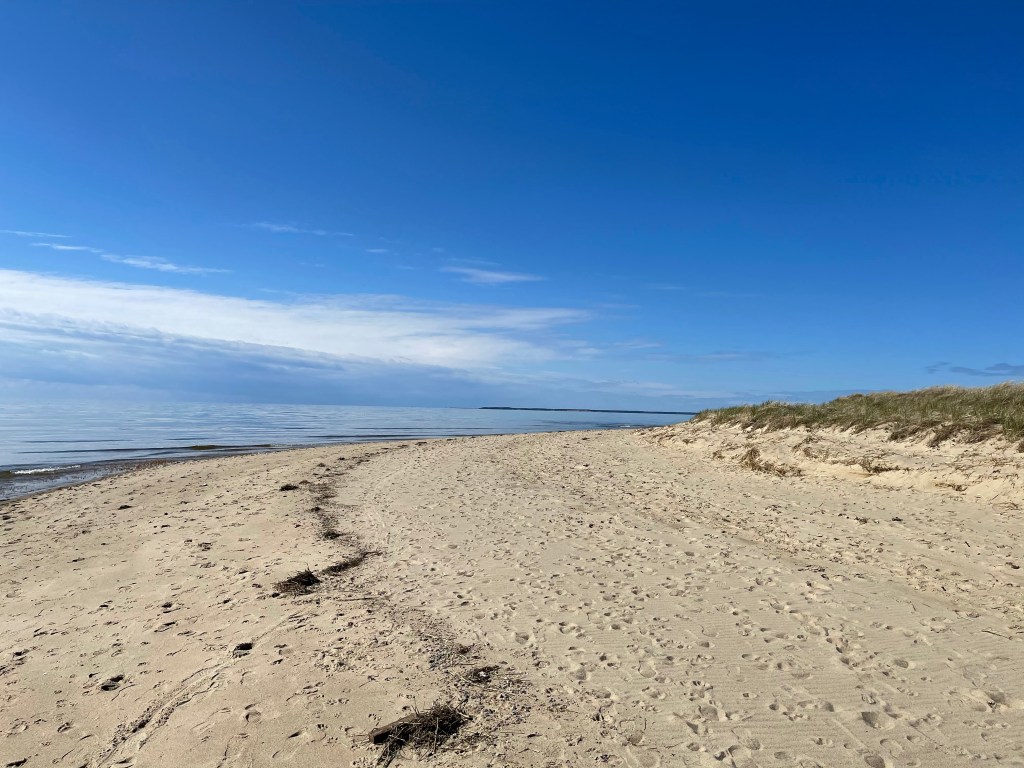
    Today there’s a popular beach with a paved parking lot on the calm waters of Massachusetts Bay. The real estate runs in the millions now, with great sunsets and a chance to swim while the sharks stake a claim on their ancestral hunting grounds on the opposite coast of Cape Cod. Really, it’s all funny money out here, but especially when you can claim a water view.

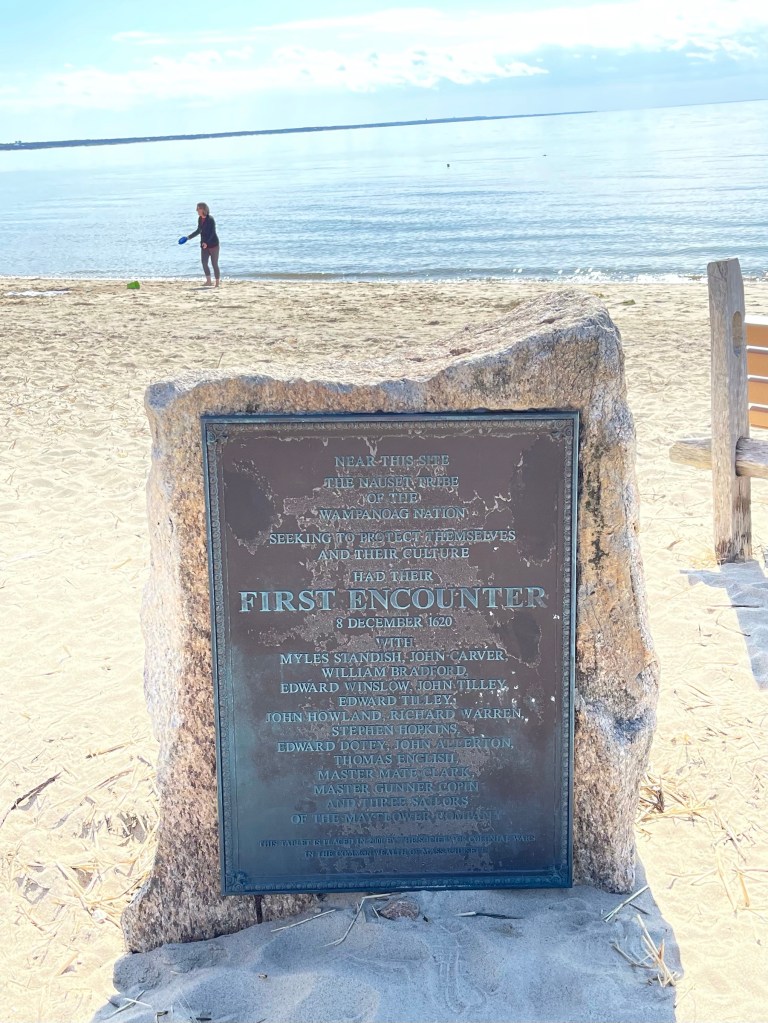
    There are two memorial plaques at the beach. One is hidden from view up the hill a bit from the beach, placed there to commemorate the tercentenary anniversary of that first encounter. The second, and more obvious one, is right as you walk from the parking lot onto the beach. Each offer a history lesson in worldview of the time.

    1920: “On this spot hostile indians had their first encounter December 8, 1620”

    2001: “Near this site the Nauset Tribe of the Wampanoag Nation seeking to protect themselves and their culture had their first encounter 8 December 1620”

    Both are true, aren’t they? But the devil is in the details, and none of us really know how that first encounter went down. We have historical record from one side but not the other. And that’s history for you; recorded by those who ultimately survive to write about it. Ultimately both inform, and the site itself pulls at history buffs like me. How do you visit Cape Cod for decades without a pilgrimage to the site of the first encounter between those who had it all and those who would ultimately take it from them?

    Now all you need is a parking spot at $15 per day for non-residents. For all the historical import of the site, today it’s mostly just a pretty, family-friendly beach. And a nice place for a quiet Spring walk with your significant other. And maybe a few hugs and kisses.

  • A Walk on Cahoon Hollow Beach

    “The sea-shore is a sort of neutral ground, a most advantageous point from which to contemplate this world. It is even a trivial place. The waves forever rolling to the land are too far-travelled and untamable to be familiar. Creeping along the endless beach amid the sun-squall and the foam, it occurs to us that we, too, are the product of sea-slime.” – Henry David Thoreau, Cape Cod

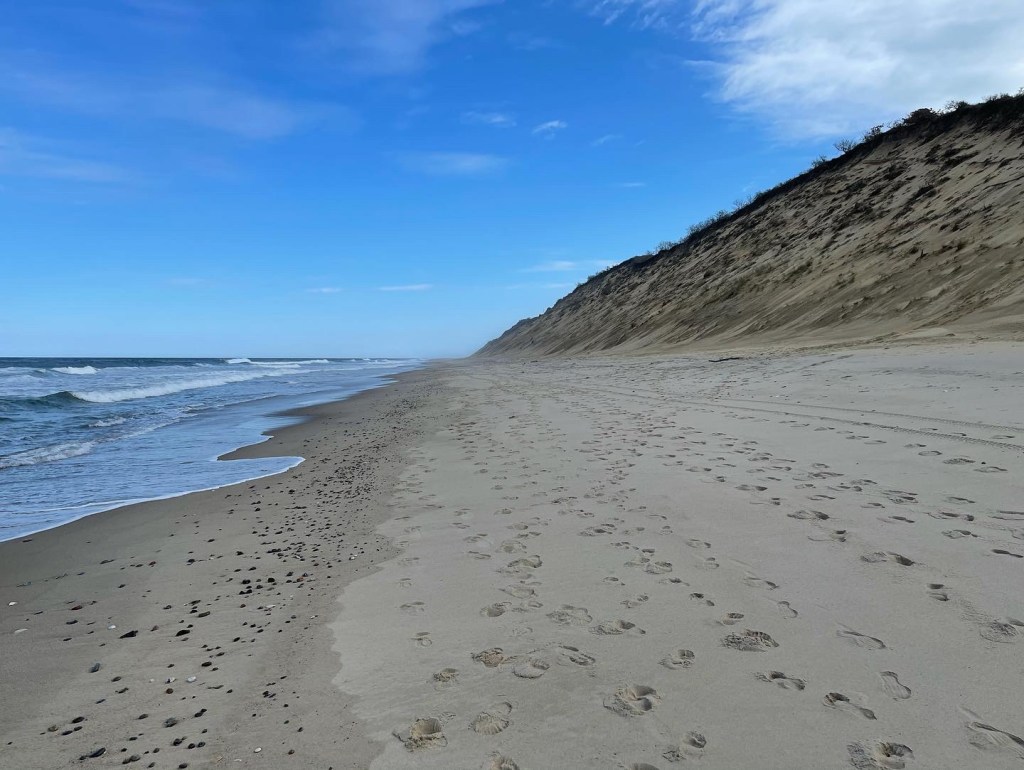
    Between the massive dunes and the crashing Atlantic Ocean in Wellfleet is a strip of sandy beach bearing the brunt of the relentless assault from wind and sea. The surf in warmer months is a feeding ground for Great White Sharks, who have modified their hunting style to chase grey seals right into the churning shallows that swimming humans like to frolic in during the warmer months. Great Whites don’t hunt humans, but sometimes they mistake humans for seals.

    In April you don’t see many seals bobbing in the surf on Cape Cod. So the sharks move on to other hunting grounds and leave this stretch of wild ocean to the occasional surfer and the beach walkers. A walk on the Cape Cod National Seashore can happen just about anywhere with an access path down the 100-foot dunes. Sand is dangerous stuff that can bury a reckless trespasser in no time at all. Sticking to the access paths preserves the dunes and just might preserve you too. The access paths themselves inform in their soft give. This is not a place for the meek. If you can’t handle the access path don’t walk this beach.

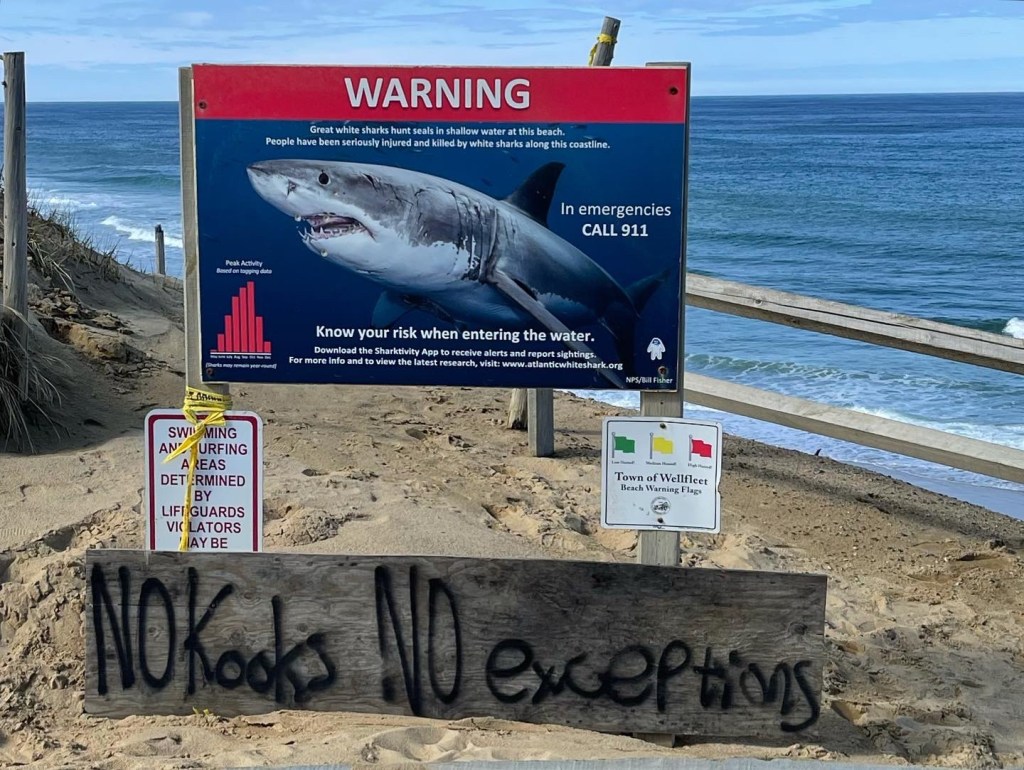
    For an off-season walk, we chose to park at the Beachcomber in Wellfleet and walk a stretch of soft sand known as Cahoon Hollow Beach. The Beachcomber is a trendy cool place at the height of summer. In mid-April it’s a convenient parking spot for easy access to the beach. A sign of the times is a shark warning with a handmade sign added to the bottom sharply suggesting “No kooks, no exceptions”. Wellfleet has had just about enough of the worst representatives of shark tourism.

    The National Seashore has a 40 mile stretch of beach that would test the strongest of walkers. When you say you’ll walk just to the bend you soon realize that bend keeps disappearing ahead of you. We walked about a mile, following the curve of the dunes around the forearm of Cape Cod. Walkers tend to gravitate towards the surf line where shells and smooth rocks offer themselves up for consideration. Soon your pockets are full and you recognize the folly of treasure hunting when every receding wave reveals another treasure.

    Thoreau walked the entire length from Chatham to Provincetown in the mid-1850’s and wrote about it for lectures that would end too soon in his abbreviated life. It would be published after his death in 1865 – the same year the Civil War ended. I think often about Thoreau, dying at 45 with so much left to do and see and write about. And here I was following him again, walking the beach between dune and sea, thinking it might just go on forever. Knowing it won’t.

  • The Heart of the Bay

    Nobody owns the sky or the trees.
    Nobody owns the hearts of birds.
    Still, being human and partial therefore to my own
    successes—
    though not resentful of others fashioning theirs—

    I’ll come tomorrow, I believe, quite early.
    – Mary Oliver, Winter and the Nuthatch

    Oliver writes of building trust with a nuthatch that eventually learns to eat out of her hand. One morning she arrives later than other mornings only to find her nuthatch friend eating from another person’s hand. And thus she resolves to arrive earlier the next morning. I’ve felt this myself, not with birds in the hand so much as places of solitude.

    Early Spring is still a time of hard frosts and temperature swings. Maple syrup weather – when the sap flows and gathers in buckets around Maple trees throughout the region. But not here. Cape Cod is more temperate, not subject to the extremes that draw the sap out. And then there’s the trees themselves, which seem to prefer the other side of the bridges. No, here we have a different sap drawn out in the early mornings. And I’m drawn to the light and the chorus.

    Buzzards Bay, well before the dawn, is awash in deep blues and burnt orange and the calls of thousands of Eider Ducks off in the distance. They have a lot to say to each other. It must be breeding season for these migratory birds. They didn’t pay much attention to the stranger on land, and I let them alone in their banter and flirting. The chorus felt altogether different from the bay in warmer months, when outboard engines of fishermen roaring off to favorite holes pierce the silence. Eiders quickly become white noise as I refocus on the task at hand.

    I crunched across a deep frost, leaving footprints in the grass on my walk to the shoreline. Low tide drew me out further into the bay, right to the waters edge quietly lapping in quiet surges like a heart beat. The bay is alive in this way. Alive in its vibrant, nutrient-rich, welcoming way. It pulls at me as it pulls at the Eider ducks, down from northern regions for their version of Spring Break. I suppose I am as well, looking for a change of scenery from New Hampshire to Buzzards Bay. For a return to salt water reflections and big skies.

    The chorus of Eiders ends with the sun breaking the horizon. Mating time gives way to feeding time. I leave the shoreline myself, for I’m not adorned in the down of a duck and the morning chills me in lingering too long. Hot coffee and inadequate words await me, with the glow of the morning alive in my mind.

    Buzzards Bay
  • The Cold Water Initiation

    “Though it be the hottest day in July on land, and the voyage is to last but four hours, take your thickest clothes with you, for you are about to float over melted icebergs.” – Henry David Thoreau, Cape Cod

    The stretch of water between Cape Sable Island in Nova Scotia and Cape Cod in Massachusetts is known as the Gulf of Maine. A lot of history has floated between these two points, from Native Americans and later the Basque fishing and whaling these rich and vibrant waters to explorers like Giovanni da Verrazzano and Samuel de Champlain mapping the coast and looking for places for settlements. The Gulf of Maine remains the one constant that each would recognize, though they might wonder where all the fish went until they glance back at the developed shoreline.

    In 1604 Champlain ventured south from Port Royal to explore the coast of Maine. It was on this trip that he discovered Acadia, and further south, the “baye longue” between two capes and a long stretch of sand beaches on the present coast of New Hampshire.” (David Hackett Fischer, Champlain’s Dream. It’s on these beaches that generations of New Englanders and vacationing Canadians have discovered the truth in Thoreau’s words: this water is as cold as melted icebergs!

    Cold water gets in your blood, and you don’t celebrate it so much as accept it for what it is: a shocking reminder of how insignificant we really are. The Atlantic Ocean is divided into the Northern Atlantic and the Southern Atlantic, but really, there are divisions within divisions. A swim in Miami is not the same as a swim in Virginia, and a swim in the Hamptons on Long Island is definitely not the same as a swim at Hampton Beach in New Hampshire.

    You aren’t really a New Englander until you’ve taken the plunge into the Gulf of Maine on a hot day. It’s an initiation of sorts into the extremes. There isn’t a person who swam in early July at Hampton Beach who couldn’t relate to the bobbing passengers at the end of Titanic. The cold water hardens you, tests your mettle, and reminds you of your mortality. And that’s why I’ve grown to love a bracingly cold swim now and then. That stinging skin is a shocking reminder that you’re still very much alive… if a bit numb.

  • Awaiting Discovery

    “It is remarkable that men do not sail the sea with more expectation. Nothing remarkable was ever accomplished in a prosaic mood. The heroes and discoverers have found true more than was previously believed, only when they were expecting and dreaming of something more than their contemporaries dreamed of, or even themselves discovered, that is, when they were in a frame of mind fitted to behold the truth. Referred to the world’s standard, they are always insane.” – Henry David Thoreau, Cape Cod

    This is a year of the commonplace and unromantic if you let it be.  Lockdowns and border closings and mandatory quarantines tend to temper the passions of the high agency traveler.  But then again, if you keep your expectations and dreams focused on regional adventuring until things open up again you might just find the world under your nose.

    Yesterday I watched a bobcat, set against the snow, on the hunt.  It was slinking along the edge of the forest where the fence announces wilderness begins.  I expect it was attracted to the bird feeder activity, for there were squirrels and juicy birds for the taking for the ambitious hunter.  Unlike my snowshoe hare encounter I wasn’t prepared for a picture, and I settled for locking her image in my brain.

    Leaving Cape Cod the other day I stopped to fill up the tank and, glancing up, noticed 9-10 osprey hovering in the wind, all clustered together.  I’ve never seen so many osprey flying together, and there they were right above me gliding gracefully about.  By the time I finished fueling the car the osprey had drifted away to awe others elsewhere, but damn if they didn’t capture my imagination first.

    For all his fame as a transcendentalist and beholder of truths, Thoreau didn’t travel very much in his lifetime.  He spent most of his lifetime in Concord, Massachusetts, with notable trips to Cape Cod, up the Concord and Merrimack Rivers to the White Mountains, to the Maine woods, and one solitary trip across an international border when he visited Quebec.  And yet he saw more than most people who travel far beyond the northeast corner of North America.

    There’s light at the end of the pandemic, though we remain in a dark and treacherous tunnel.  This isn’t the time to cross borders, but the world outside our Twitter feed remains vibrant and alive, awaiting discovery.  The bobcat,  osprey and Thoreau have each inspired me to shake off the creeping prosaic mood that shorter, darker days cloak you in and dive back into adventuring.

    Et toi?  Are you ready to re-join the hunt?  Nothing remarkable was ever accomplished in a prosaic mood.

  • White Cap

    “I am in love with Ocean
    lifting her thousands of white hats
    in the chop of the storm,
    or lying smooth and blue, the
    loveliest bed in the world.”

    – Mary Oliver, Ocean

    I anticipate a white cap day on Buzzards Bay as a Nor’easter rolls through. For now the bay is restless but content to let the rain fall in abundance to its surface instead of rising up to meet it. For the march of thousands of white hats the current and wind must be more contentious than this. It will come in time, as it always does on Buzzards Bay.

    Nor’easter days are meant for hunkering down, catching up on reading and sipping hot beverages. On Cape Cod the storm will bring heavy rain and high winds. The salty water will surely rise to greet her fresh visitors. I’m a visitor myself; like a river forever moving between the mountains and the sea. I want to leave the comfort of the warm house to walk on the beach. You don’t come this far to look at it from afar. For I’m mostly water, shouldn’t I rise up to meet it too?

    Up in New Hampshire all this water will mean white hats of a different kind, with heavy snow in the mountains and clever swirls of white donning posts and mailboxes in the lower elevations. I’ll welcome the grace of snow-packed trails covering the ankle-breakers when I return to the mountains. Whenever that might be – I really don’t know. But they’ve heard my silent promise to return. We have unfinished business, those mountains and me.

    I laugh when I read polls asking where you would want to live forever. How do you choose between the mountains and the sea? Its a Sophie’s Choice question; asking one to pick between a mountain waterfall and the crashing surf. Instead I look to the Abenaki who moved for generations between the White Mountains and ocean fishing villages. They didn’t choose one over the other, they chose a life in between. And that’s where you’ll find me too.

    So today as the white caps rise, I’m reminded of the Mary Oliver poem above. I’m on the very edge of that in between for this Nor’easter, and the chop of the storm has begun. Who’s up for a walk?

  • The Grinch Seeks the Seashore

    “The sea-shore is a sort of neutral ground, a most advantageous point from which to contemplate this world.” – Henry David Thoreau, Cape Cod

    I’m a bit of a contrarian in this family. While others are planning to transform the house into a Christmas wonderland, I’m thinking about cold and isolated beaches. Don’t get me wrong, I like warm beaches too, but they’re in short supply this time of year in New England. And when they’re warm they definitely aren’t isolated.

    I saw some of the extended commercial they call the Macy’s Thanksgiving Parade on NBC yesterday while prepping for Thanksgiving dinner. The best way to watch the parade is standing on a street corner in New York. But maybe not in a pandemic. The second best way to watch it is on mute so you don’t have to hear all the breathless commercials for each sponsor as some designated singer lip syncs their cover of a holiday song that will be featured on some rom com special on… NBC. But really, I love the holidays.

    Christmas decorations are lovely, the problem is me. I don’t turn on a dime like that. I don’t rush out to grab whatever is on sale, I don’t flip a switch to start Christmas the moment the Thanksgiving dishes are cleaned, and I don’t have all my gifts purchased yet either. I like to ease into the holidays one at a time, thank you.

    So while the holidays are ramping up in this New Hampshire household, I’m thinking about staring at the ocean. Perhaps too many SV Delos videos? Too much time away from the sea? Really, it could be any number of things, but mostly I think I’m not ready for the crush of Christmas. And yet here we are anyway.

    I’ve plotted an escape. A quick weekend on Cape Cod next weekend to stare at Buzzards Bay, feel the brisk wind on my face, and mentally shift gears from Autumn to winter. Cape Cod in early December is wondrously quiet, which is just what the Grinch needs before he switches to Have Yourself A Merry Little Christmas.

    But that’s next weekend. Today the Grinch strings Christmas lights on dormant trees. After all, it isn’t all about you. Right? Happy Holidays.

  • The Old Indian Meeting House

    The Nauset of Cape Cod are part of the Mashpee Wampanoag and were known as the “Praying Indians” because they became converts to Christianity.  They were an important ally for the colonists against tribes that rose up against the encroachment of the English settlements.  Most famously they worked with Benjamin Church as guides in his hunt for Metacom, or “King Philip”.  It was one of the Praying Indians who killed Metacom, effectively ending King Philip’s War in 1678.

    The Nauset were clearly converts to Christianity in the 1670’s, and they met somewhere in Mashpee to pray, but the original building is long gone.  A second building was purportedly built in 1684 at the original site near Santuit Pond.  That building is generally agreed upon as the current Old Indian Meeting House, relocated in 1717 to its current location on Meetinghouse Road (naturally) just across from the Mashpee River. This would make it the oldest church on Cape Cod and the oldest Indian church in the United States.  I’ve read at least one article that disputes the original date of construction for the meeting house, with a local historian claiming the building was actually built in 1757 or 1758 by Deacon John Hinckley.  I believe that Deacon Hinckley is agreed upon as the builder of the church, so determining the actual date should be relatively easy from there.  But I’m not diving deep into this controversy.  There’s no doubt that the Meeting House is historically highly relevant and important.  It was used by the Nauset as a church, and also no doubt that it was here that the Nauset staged a nonviolent protest known as the Mashpee Revolt against the Commonwealth of Massachusetts in 1833 over control of the tribe’s land.  Of course, that was exactly what Metacom was doing from 1675 to 1678, but he chose violence (spurred on by violence against the Pokanoket).

    I visited the Old Indian Meeting House on a quiet, hot August day.  Not a lot of Cape tourists hanging out at an old build next to a cemetery on a perfect beach day. I find that I’m often the only visitor to such places in the moment I’m there. But I prefer quiet time with places of relevance. It’s set on a small hill on the edge of the cemetery, roughly three miles from Santuit Pond, which would make moving it on logs on old colonial roads quite an undertaking.  The Mashpee Wampanoag hold this place as sacred, and I respectfully walked around the site for a few minutes, read a few of the nearby gravestones and generally tried to get a feel for the place before moving on.  A visit to their web site prompts a popup requesting that you sign a petition to help the tribe protect their lands from changes at the Bureau of Indian Affairs.  It seems that the contributions of the Praying Indians are once again being forgotten by some in the endless land grab of the native lands.  That would be par for the course.

  • A Sand and Scrub Pine Kid Visits the Past

    It might say a lot about me that on a hot Monday morning on Cape Cod when I found myself with time alone I didn’t opt for the beaches, but instead made a pilgrimage to an old graveyard in the woods of Forestdale.  This was a trip back for me, for I would walk in this graveyard as a kid reading the names and the stories behind the people who once lived and died in this place.  The graveyard was a short walk from the shores of Peters Pond, a place that I’d spend many summers in my formative years.  For I was a sand and scrub pine kid.

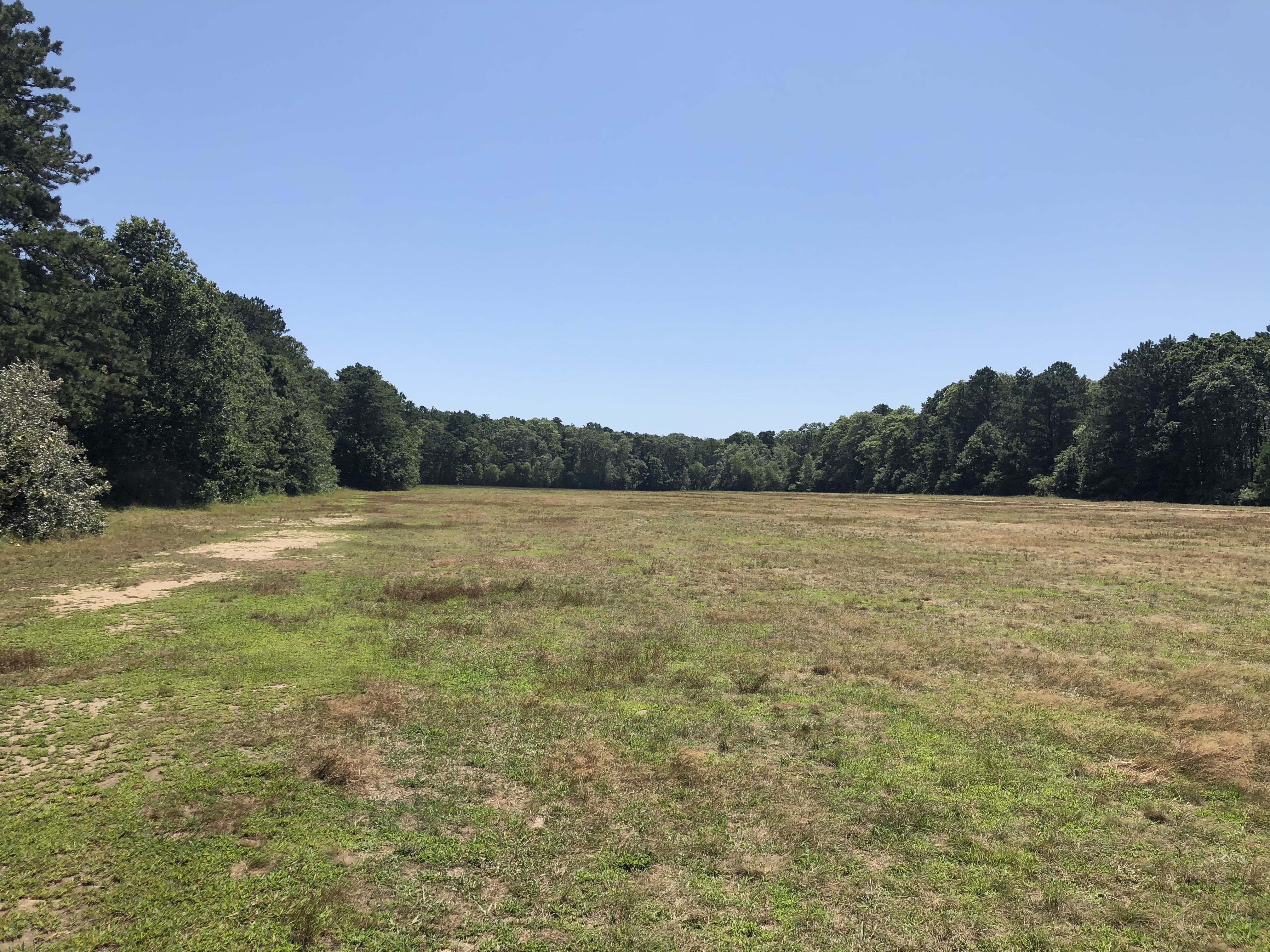
    30 years ago you could read the names clearly on most of the gravestones, and the cemetery was well-maintained by the caretaker for the Hewlett Packard Sandwich Resort (back when HP was a different kind of place).  That place on Peters Pond was a great perk for employees – a place to bring your kids for a week or two every summer at no charge.  When you went on the same week every year, you’d build friendships with other HP families, and that would build momentum year-after-year until it became a defining part of growing up for many of us.  The summer would end and they would have one last company party with employees grilling steaks and burgers and having games with prizes on a large field up the hill from the grounds of the resort.  That field is now home to The Sandwich Bazaar Flea Market, which effectively preserved the field in just as it was three decades ago.  I was grateful it hadn’t become a landing spot for condos.

    Sandwich Bazaar Field, once a part of HP’s Peters Pond Resort

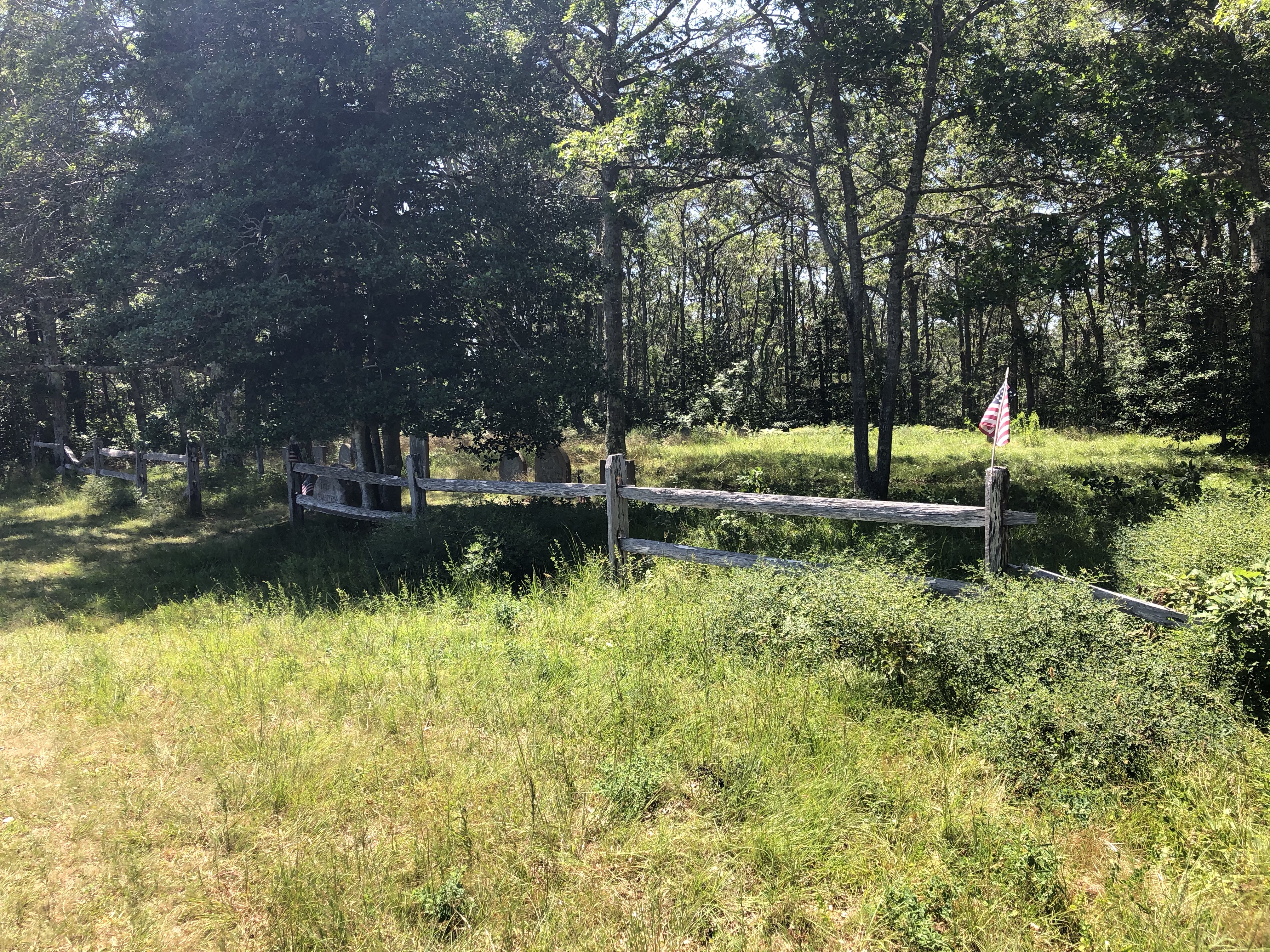
    The entrance to the field is chained off to prohibit cars, but I parked across the street and walked over.  Warning signs about deer ticks and Lyme Disease greeted me.  We didn’t think about such things when I was a kid, we’d just pull ticks off of our skin before they became engorged.  Now I guess you need to remind people.  And so I walked down to where I remembered the small graveyard being, walking in a time warp back to the late 1970’s and early 1980’s when this was my escape and the rest of the family didn’t think anything of you disappearing for the entire day as long as you showed up for dinner (I never missed dinner).  I saw the fence for the graveyard well past where the tire tracks for the flea market stopped.  Just where I remembered it being.  But sadly the old graveyard isn’t maintained anymore.  Where once the grass was neatly mowed, now it was as tall as the gravestones.  More troubling was the poison ivy that spread all over the grounds.  Apparently the Town of Sandwich has decided to let this cemetery return to nature.  At least the gravestones that were still standing.  Many were crumbled piles of broken stone.  Perhaps vandalized?  But even the gravestones still standing showed they haven’t aged well.  Most were illegible as the sandstone faces curled and peeled downward.  The last three decades haven’t treated the old graveyard well.

    The Sandwich Historical Commission does a great job of posting old maps of the area.  I compared two maps from around the time that the people taking up permanent residence here would have been alive.  The first was a map from 1794 that offers a larger view of Sandwich, with delightful details on the map.  Peters Pond is clearly named, making it an easy point of reference.  The land is marked as “wast land” on one side of the pond and “good land” on the other.  But the graveyard isn’t noted.  It does show up on a map from 1857, which also notes family names on houses in the community.  Interestingly, none of the names correspond with the people who are buried in the graveyard.  Its as if all references to them disappeared.  And so now is the graveyard, quietly being swallowed up by forest and poison ivy.  I thought of that 1794 map, describing this land as “wast land”.  Its impossibly hard to make a living farming on sand, but the land isn’t a waste.  It raised countless generations.  And for a dozen or so summers, it raised me.

    Segment of 1857 map of Sandwich

    I walked the serpentine path through the graveyard where the tall grass had been trampled down.  The path followed a route to the gravestones that were still intact.  I’m not the only one to visit Tobey Cemetery this year.  Which made me wonder, was it other sand and scrub pine kids returning to their childhoods as I was?  Or curious flea market people wondering what this remote graveyard was all about?  I’d like to think the former.  There were so many of us once.


    Tobey Cemetery

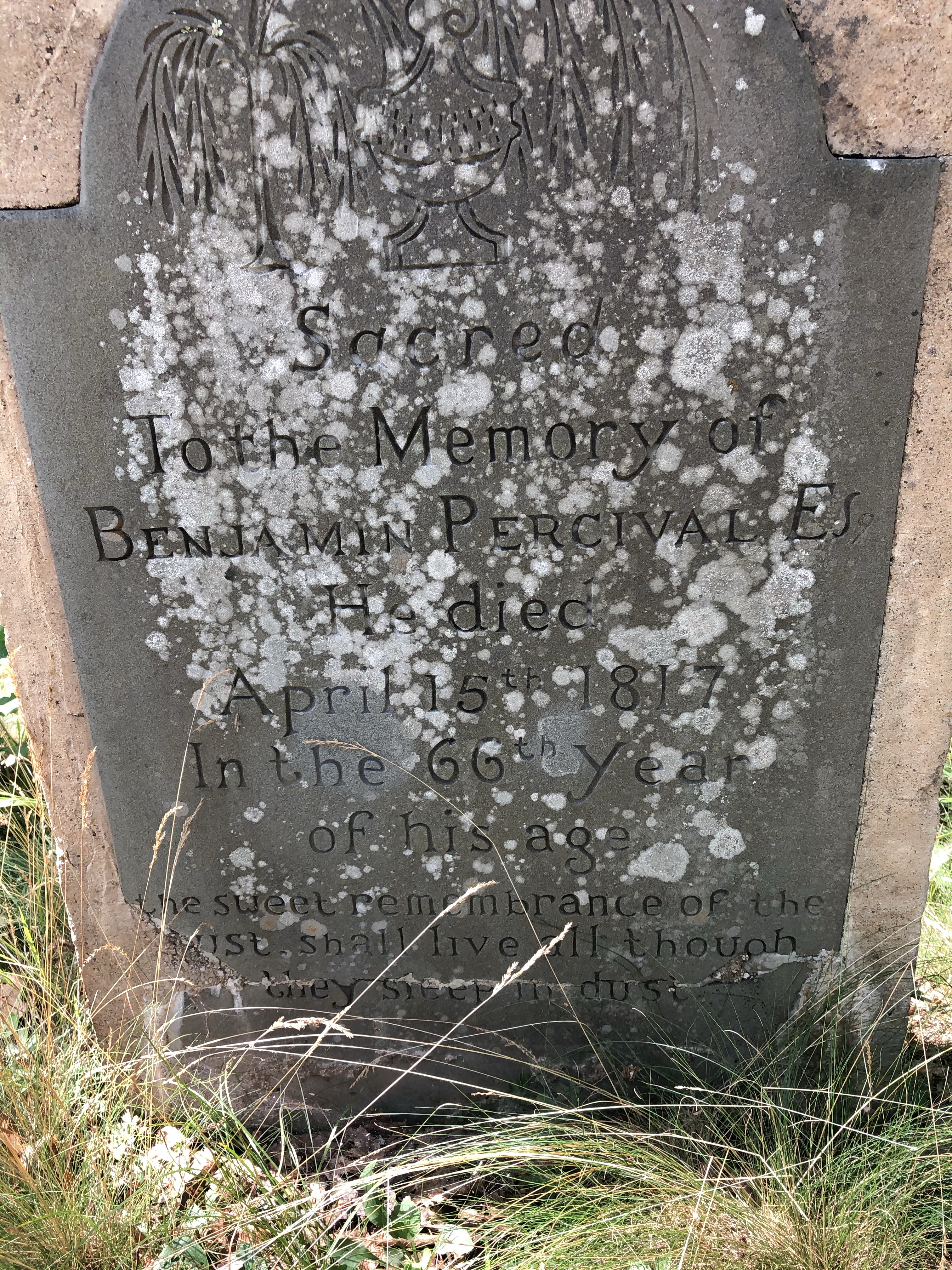
    One of the few intact and legible gravestones left